City, University of London Institutional Repository
Citation:
Frankort, H. T. W. (2008). Structural holes, technological resources, and innovation: A study of an interfirm R&D network. Academy of Management Proceedings, 2008(1), pp. 1-7. doi: 10.5465/AMBPP.2008.33664585This is the accepted version of the paper.
This version of the publication may differ from the final published
version.
Permanent repository link:
http://openaccess.city.ac.uk/17041/Link to published version:
http://dx.doi.org/10.5465/AMBPP.2008.33664585Copyright and reuse: City Research Online aims to make research
outputs of City, University of London available to a wider audience.
Copyright and Moral Rights remain with the author(s) and/or copyright
holders. URLs from City Research Online may be freely distributed and
linked to.
STRUCTURAL HOLES, TECHNOLOGICAL RESOURCES, AND INNOVATION: A STUDY OF AN INTERFIRM R&D NETWORK
HANS T. W. FRANKORT Maastricht University
The Netherlands [email protected]
ABSTRACT
I examine how two partner attributes alter a firm’s innovative performance stemming from access to structural holes in its network of R&D alliances. My results suggest that effects of access to structural holes are modified individually and jointly by (i) partners’ technological resources and (ii) partners’ access to structural holes.
INTRODUCTION
In the past few decades, the proliferation of interfirm R&D alliances has caused the emergence of R&D networks. The alliances a firm occupies in the structure of such networks, determining its ‘network position’, influence its opportunities and performance in a number of ways (e.g., Baum, Calabrese, & Silverman, 2000; Rowley, Behrens, & Krackhardt, 2000). Work building on Burt (1992) argues that a firm achieves higher innovative performance by
maintaining alliances to others that are not directly connected. The lack of direct connections among a firm’s partners, signifying the presence of ‘structural holes’, indicates that these partners operate in distinct parts of the network, increasing the likelihood that they carry heterogeneous information. The focal firm’s position at the intersection of such heterogeneous sources of information provides it with an advantage as it is more likely than others to develop novel, innovative ideas. Empirical evidence abound, see Burt (2004) for a review of the literature.
Building on accumulated evidence on the main effect of structural holes in shaping firm-level advantages, recent work has started to investigate its scope conditions. Thus far, scholars found that advantages are not universal, but rather contingent on attributes of the focal firm (e.g., Baum et al., 2000) and relational and industry attributes (e.g., Rowley et al., 2000). In this paper I propose that the main effect of access to structural holes masks yet another set of contingencies. My focus is on the partner attributes that shape the advantages of access to structural holes, which have remained largely unexplored (cf. Gulati, 2007: 265). The scant attention to partner contingencies in studies of interfirm cooperative networks is remarkable, as theories of interfirm learning suggest that, net of industry attributes and trends, the transfer of knowledge between firms is a function of the focal and partner firms and their relationships (Greve, 2005).
In the context of an interfirm R&D network, I focus on two partner contingencies
imposed on the performance association of a firm’s access to structural holes with its innovative performance: (i) partners’ amount of technological resources and (ii) partners’ access to structural holes. The former is nodal: partners that possess many technological resources could upgrade the advantages associated with a firm’s access to structural holes. The latter is structural: the value of access to structural holes could diminish if partners have access to structural holes as well.
THEORY DEVELOPMENT
A network position rich in structural holes confers two related benefits upon a firm: (i) access to unique, heterogeneous sources of information and (ii) control over the information’s dispersion (Burt, 1992). The baseline prediction is that a firm that has access to more structural holes is, on average, more likely to develop innovative knowledge. Two partner attributes may alter the innovative value of accessing structural holes: (i) partners differ in the amount of technological endowments, and (ii) partners differ in their access to structural holes.
The Moderating Role of Partners’ Technological Resources
In R&D alliances, partners’ technological resources are an important source of learning (Stuart, 2000). Larger amounts of technological resources in a firm’s R&D network enrich the opportunity set a firm faces (Baum et al., 2000; Silverman & Baum, 2002). This opportunity set is twofold. First, the more external technological resources, the higher the amount of unique combinations a firm potentially perceives when monitoring its partners’ technologies. This increases its vision advantage of access to structural holes. Second, the firm’s capacity to develop and implement such novel combinations increases because the technological resources of its partners complement the focal firm’s internal technological capabilities.
A firm accessing structural holes among partners that are technologically well endowed may thus innovate more for two related reasons. First, its vision advantage amplifies because it not only connects heterogeneous sources of information, it also samples from a larger opportunity set. Second, its capacity to realize its visions increases because the technological resources of its partners could complement the focal firm’s internal technological capabilities.
H 1: The more technological resources the R&D alliance partners of a firm possess, the stronger the relationship between that firm’s structural holes and its subsequent innovative performance.
The Moderating Role of Partners’ Access to Structural Holes
Some work suggests that the influence of network structure on firm performance reaches beyond the firm’s direct contacts. Yet, how this happens remains unclear. Here, I explore some of the mechanisms and ask the following question: what is the influence of partners’ (lack of) access to structural holes on the focal firm’s innovative returns to spanning structural holes? In answering this question, I assume that the most consequential influence of the larger network structure lies in the structure of network ties directly surrounding the firm’s direct partners.
In contrast, if the partners of a firm that spans structural holes do not span structural holes themselves—the firm thus spans structural holes among firms which are themselves part of cohesive groups—the firm will experience fewer difficulties in benefiting from its network position. The collective nature of cohesive ties surrounding the partners may instill in them a predisposition to portray cooperative behaviors that transcend the borders of their group.
In the highly competitive setting of R&D alliances, superfluous structural holes may create role conflicts among firms in the larger R&D network. This is at odds with the division of labor foundational to structural differentiation in such networks. Most firms cluster around core activities to specialize in designing and developing specific technologies and products. Some of them bridge such clusters, allowing the identification of novel combinations of specialized knowledge. Coordinating flows of specialized knowledge may demand from such firms much more knowledge of the norms, practices, and technologies of partners’ cohesive groups and demands an ability to translate across distinct contexts (cf. Burt, 2008). However, the premium could be large as distinctness of the groups reduces the degree to which the collected bits of knowledge exhibit overlap. This sparks the pursuit of novel combinations, possibly resulting in enhanced innovative performance.
H 2: The more the R&D alliance partners of a firm have access to structural holes, the weaker the relationship between the firm’s own structural holes and its subsequent innovative
performance.
The Cumulative Effect of Partners’ Resources and Their Network Positioning
Hypotheses 1 and 2 predict that two partner-level phenomena moderate the firm-level returns to accessing structural holes in an R&D network independently of one another. However, firms that access structural holes and also hold a strong stock of technological resources may use their network structural advantages to expropriate their partners’ knowledge, while
simultaneously shielding their technological resource base as much as possible (Khanna, Gulati, & Nohria, 1998). Hence, if a firm’s partners also have direct access to structural holes, the firm’s access to technological resources may be constrained significantly. As such, partners’ network positioning could reduce the focal firm’s access to external technological resources. This effect is a matter of degree: a firm that spans structural holes among technologically well-endowed
partners may be innovative, but likely less so if the latter span structural holes as well.
H 3: The more the R&D alliance partners of a firm have access to structural holes, the weaker the positive, interactive effect of that firm’s own structural holes and its partners’ technological resources on its subsequent innovative performance.
DATA AND METHODS
My sample consisted of IT firms engaged in R&D alliances—both bilateral contracts and equity joint ventures—during the period 1975-1999. The IT sector includes firms active in computers, semiconductors, communications, and related materials, covering patent classes for Communications, Computer Hardware & Software, Computer Peripherals, Information Storage and Semiconductor Devices. I used part of the dataset described in Gomes-Casseres, Hagedoorn, and Jaffe (2006), which I complemented with data from the CATI database on interfirm
2002), Compustat, Osiris, Datastream, the SEC and 10K filings, the U.S. Census Bureau,
Eurostat, firms’ annual reports, and numerous press releases. The final dataset was an unbalanced panel of firm-year records.
I used a firm’s annual number of successful patent applications as measure for its
innovative performance (i.e. a patent granted in year B yet filed in year A is counted in year A). Throughout the analyses, this variable took a one-year lead to all independent variables for two reasons. First, it is plausible that some time elapses before R&D alliances translate into patent applications. Second, a lead specification, providing a clear temporal separation of cause and effect, avoids part of the econometric problems related to the simultaneity of cooperation and innovation. Results of models that use longer leads are generally weaker.
I used three independent variables to form the interaction terms to test my hypotheses. These variables were based on annual adjacency matrices reflecting all R&D alliances among IT firms for a window of three years. For most R&D alliances end dates were not reported, but the small number of alliances for which they were (less than ten percent) revealed an average alliance horizon of three years. Results using other horizons were broadly similar. First, I used Burt’s (1992: 54-55) measure of constraint and inverted it to obtain a value for a firm’s access to structural holes. Second, access to structural holes by a firm’s partners was captured by their average inversed values of network constraint. Third, I calculated the average count of patent citations received by its R&D alliance partners to obtain a measure for the technological resources of a firm’s partners. Alternative measures generated largely identical results.
I included a range of controls for characteristics of the focal firm, its partners, the
relationship between the two, and region and time. First, I controlled for the focal firm’s number of R&D alliances, R&D alliance experience, R&D intensity, profitability, size, and technological opportunities. Second, I controlled for partners’ average number of R&D alliances, R&D
intensity, and size. Third, I controlled for characteristics of the alliance relationships between the focal firm and its partners: the share of joint ventures in all R&D alliances of the firm, the average knowledge overlap with its partners, the regional heterogeneity of the firm and its partners, and the product-market overlap between the two. Also, I included geographic and year dummies.
To test the models predicting a firm’s innovative performance, a count of patents, I used conditional fixed-effect negative binomial regressions. This approach assumes strict exogeneity of independent variables with respect to the dependent variable. However, I may not escape from endogeneity here, as some work has suggested that a firm’s innovative performance may spark consecutive investments in R&D alliances (Powell, Koput, & Smith-Doerr, 1996). Several additional analyses in the framework of 2SLS fail to support endogenous relationships between the main independent variables and innovative performance. This suggests that more innovative firms are not more likely than less innovative ones to sort into network positions rich in structural holes. Further analyses apt for analyzing dynamics in count data processes should reveal whether these tentative 2SLS results persist.
RESULTS
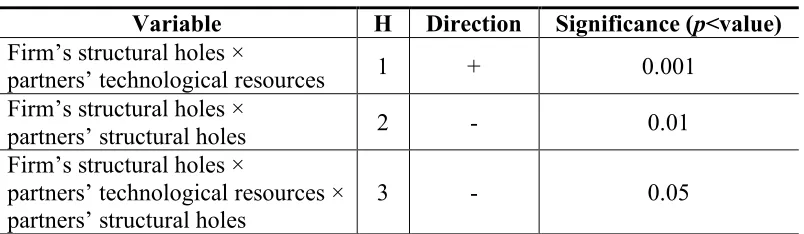
The results of my analysis (summarized in Table 1) broadly support my hypotheses. First, partners’ technological resources significantly enhance a firm’s innovative advantage of spanning structural holes. Second, partners’ structural holes significantly reduce a firm’s innovative
main effect of access to structural holes is consistently positive and significant, whereas the main effect of partners’ access to structural holes is consistently negative and significant. Net of partners’ size, their technological resources are positive and significant throughout.
--- Table 1 about here ---
CONCLUSION
This study has extended research on the scope conditions of a firm’s advantages related to access to structural holes by examining two partner-level contingencies: (1) partners’
technological resources and (2) partners’ access to structural holes. Results of a longitudinal analysis indicated that a firm’s innovative returns of access to structural holes vary systematically with these contingencies. As such, it begins to answer calls for a more extensive analysis of salient partner attributes that are foundational to value creation in interfirm networks (e.g., Gulati, 2007). These findings have implications for our understanding of the relationship between
cooperative R&D and firm-level innovation. They also take a step forward in advancing our understanding of the link between micro- and macro-level network structures (cf. Baum, Van Liere, & Rowley, 2006, and Burt, 2008).
REFERENCES
Baum, J. A. C., Calabrese, T., & Silverman, B. S. 2000. Don’t go it alone: Alliance network composition and startups’ performance in Canadian biotechnology. Strategic Management Journal, 21: 267-294.
Baum, J. A. C., Van Liere, D., & Rowley, T. J. 2006. Between closure and holes: Hybrid network positions and the performance of U.K. investment banks. Working paper, University of Toronto, Ontario, CA.
Burt, R. S. 1992. Structural holes: The social structure of competition. Cambridge, MA: Harvard University Press.
Burt, R. S. 2004. Structural holes and good ideas. American Journal of Sociology, 110: 349-399. Burt, R. S. 2008. Industry performance and indirect access to structural holes. In J. A. C. Baum
and T. J. Rowley (Eds.), Advances in Strategic Management, 25. Oxford UK: JAI/Elsevier. Frankort, H. T. W. 2008. Are cooperative returns historically contingent? A longitudinal study
of R&D cooperation and innovation, 1978-1999. Paper presented at the Strategy Seminar, Maastricht University, the Netherlands.
Gomes-Casseres, B., Hagedoorn, J., & Jaffe, A. B. 2006. Do alliances promote knowledge flows?
Journal of Financial Economics, 80: 5-33.
Studies, 26: 1025-1047.
Gulati, R. 2007. Managing network resources: Alliances, affiliations and other relational assets. Oxford: Oxford University Press.
Hagedoorn, J. 2002. Inter-firm R&D partnerships: An overview of major trends and patterns since 1960. Research Policy, 31: 477-492.
Hall, B. H., Jaffe, A. B., & Trajtenberg, M. 2002. The NBER patent-citations data file: Lessons, insights, and methodological tools. In A. B. Jaffe & M. Trajtenberg (Eds.), Patents,
Citations & Innovations: 403-459. Cambridge, MA: The MIT Press.
Khanna, T., Gulati, R., & Nohria, N. 1998. The dynamics of learning alliances: Competition, cooperation, and relative scope. Strategic Management Journal, 19: 193-210.
Powell, W. W., Koput, K., & Smith-Doerr, L. 1996. Interorganizational collaboration and the locus of innovation: Networks of learning in biotechnology. Administrative Science Quarterly, 41: 116-145.
Rowley, T., Behrens, D., & Krackhardt, D. 2000. Redundant governance structures: An analysis of structural and relational embeddedness in the steel and semiconductor industries. Strategic Management Journal, 21: 369-386.
Silverman, B. S. & Baum, J. A. C. 2002. Alliance-based competitive dynamics. Academy of Management Journal, 45: 791-806.
[image:7.612.107.509.537.654.2]Stuart, T. E. 2000. Interorganizational alliances and the performance of firms: A study of growth and innovation rates in a high-technology industry. Strategic Management Journal, 21: 791-811.
TABLE 1
Panel Regression Results1
Variable H Direction Significance (p<value)
Firm’s structural holes ×
partners’ technological resources 1 + 0.001 Firm’s structural holes ×
partners’ structural holes 2 - 0.01
Firm’s structural holes ×
partners’ technological resources ×
partners’ structural holes 3 - 0.05
1 Firm-level innovative performance, measured as a patenting rate, is the dependent
Copyright of Academy of Management Annual Meeting Proceedings is the property of Academy of
Management and its content may not be copied or emailed to multiple sites or posted to a listserv without the
copyright holder's express written permission. However, users may print, download, or email articles for