1
How technological change affects power relations in global markets: remote developers in the console and mobile games industry
Rachel Parker, Stephen Cox, Paul Thompson Rachel Parker
[email protected] QUT Business School
Queensland University of Technology Brisbane, QLD, 4001
Australia Stephen Cox [email protected] QUT Business School
Queensland University of Technology Brisbane, QLD, 4001
Australia Paul Thompson
University of Strathclyde Business School 16 Richmond Street,
2
How technological change affects power relations in global markets: remote developers in
the console and mobile games industry
Abstract
3
INTRODUCTION
Power relations in global value chains can be disrupted by technological advances that can affect industry architectures and modes of economic coordination (Dedrick et al, 2010; Gereffi et al, 2005; Jacobides et al, 2006; Sturgeon, 2002). The introduction of new technology can drive the evolution of value chains through the development of industry standards and modularization, which increase the capacity of firms to switch between partners, particularly where they previously depended on deep repeat relations with a narrow range of co-specializers in order to facilitate complex information exchange and tailoring of product designs (Sturgeon, 2009). Standards competition can also lead to platform wars whereby platform holders seek to increase their bargaining power by developing an ecosystem of complementors whose products and services utilize their standards and enhance the value of their platform (Gawer and Cusumano, 2008; Tee and Gawer, 2009). As such, technological innovation is potentially disruptive to industry architectures and forms of economic coordination that affect power relations in global markets, creating the possibility for firms to maneuver to achieve architectural advantages, or to increase bargaining power in the changing industry (Dedrick et al, 2010; Gereffi et al, 2005; Jacobides et al, 2006; Pisano and Teece, 2007).
4
markets in the USA, Japan and Europe with console manufacturers and publishers at the centre of the value chain forming deep repeat relations with publishers and developers (Johns, 2006; Kerr, 2006). Console manufacturers hold a very strong position of power at the centre of the console games value chain (Johns, 2006) with small and medium sized (SME) games developers finding it difficult to break into the global market and connect with publishers and manufacturers.
It is estimated that the mobile game industry will reach $US11.4 billion in revenue by 2014. The storage and distribution of entertainment products through digital formats as well as the development of new devices, particularly smartphones, has resulted in direct access to on-line distribution channels for games developers. This could provide a basis for the development of relatively equal power relations, given the codification of information exchange and the transactional nature of governance in these emerging markets (Gereffi et al, 2005). The games industry therefore provides a basis for analyzing whether technology is driving a shift from global value chains (GVCs) in which TNCs occupy positions of power relative to regionally located SMEs towards forms of economic coordination involving arms-length relations that elevate the power of suppliers and break down existing patterns of spatial concentration.
5
power relations in a relatively small and geographically remote segment of the industry. The paper shows that while industry architectures and governance arrangements in the growing industry for mobile games differ from those in the console value chain, the new arrangements have created a different basis for unequal bargaining power for small remote developers, rather than a reconstruction of power relations in markets in which these firms participate.
THE DYNAMICS OF COORDINATION MECHANISMS AND POWER RELATIONS IN GLOBAL
MARKETS
6
particularly regarding power and network embeddedness, that have been developed in prior studies of entertainment industries utilizing a GPN approach (Johns, 2006)1.
A central project of GVC analysis is to identify powerful economic actors and explain the source of their power and its connection with the geographical distribution of economic activity (Özatagan, 2011; Rutherford and Holmes, 2008; Sturgeon, 2009, page 128). A key contribution of GVC analysis is its explication of the varieties of forms of network governance that sit between hierarchies and markets as forms of economic coordination that incorporate varying degrees of power asymmetry (Bair, 2009; Sturgeon, 2009). In earlier approaches, these arrangements were conceptualized as either producer-driven or buyer-driven. In the GVC analysis, producer-driven chains have been dissected into modular and relational forms, while buyer-driven networks are akin to captive value chains (Sturgeon, 2009).
In relational value chains, in which the ability to codify information is limited, trust based social relations form the basis for more equitable power relations and are the necessary mechanism to avoid the opportunistic behaviors that are possible in the presence of complementarity (or highly tailored products and high mutual dependence) (Sturgeon, 2002). Co-located buyers and highly competent suppliers engage in sustained relationships underpinned by trust and tacit knowledge exchange, such as those identified in segments of the fresh produce markets in which UK retailers have formed close relations with fresh produce exporters from Kenya in order to facilitate coordination of imports according to intensifying quality and time pressures (Dolan and Humphrey, 2000). Relational value chains
1Advocates for the adoption of a GPN approach have criticised GVC analysis for its relatively narrow focus on
inter-firm governance, to the neglect of institutional and political governance of markets and broader conceptions of power and embeddedness (Coe et al, 2008). Sturgeon (2009) acknowledges the tendency for GVC analysis to focus on transaction-cost-based approaches, which emphasize issues of industrial
7
depend heavily on coordination through reputation and social relations as Uzzi’s analysis of the New York garment industry illustrates (Uzzi, 1997).
Importantly, relational value chains are more likely to be associated with spatial concentration, given that the development of deep relations depends on repeat transactions and typically face to face knowledge and information exchange as has been depicted in relation to the creative industries (Grabher, 2002; Scott, 2006). Cultural industries are viewed as having a ‘tendency to cluster in tight agglomerations characterized by intense social interactions’ (Cole, 2008, page 892). Within creative industries, trust is frequently operationalized as reputation, a major intangible resource of firms that provides information about the dependability of firms to deliver value; that is, high quality products within the time frames promised and within budget (Scott and Pope, 2007).
8
These spatially extended links allowed access to financing and distribution that was not available in local production centres. However, whether ties are concentrated in spatial or relational networks, there is little debate about the fundamental characteristics of relational value chains in these industries, which depend on deep repeat relations that facilitate the exchange of complex information during the creative design process and which are underpinned by trust in the sense of reliability for delivery on time and within budget (Coe and Johns, 2004; Scott and Pope, 2007).
Technological change, and the development of standards in particular, potentially impacts on the nature and importance of these spatial and network relations. Standards have played an important role in the analysis of how global markets are organized as standards potentially reduce transaction costs by enabling the codification of otherwise highly complex information (Nadvi, 2008; Sturgeon, 2002). In modular value chains, standards have facilitated the exchange of codified information on component, product and process requirements, which in industries such as electronics has replaced previously existing social relations with more arms-length forms of economic coordination. This potentially impacts on the ‘switching’ power of buyers and/or sellers, who may be better able to switch between potential buyers/suppliers than when they were embedded in relational value chains (Sturgeon, 2002; 2009). In such cases, the development of standards has reduced the level of asset specificity, which involved the tailoring of products in such a way that they could not be easily sold to a third party (Williamson, 1975). This potentially leads to the adoption of more arms length relations and reduced coordination by lead firms (Nadvi 2008).
9
relational value chains. In the ICT Industry, platform and standards competition have been particularly influential on the relative power of industry participants (Gawer and Cusumano, 2008; Tee and Gawer, 2009, page 220). Within an industry architecture, platforms are technologies, products or services that are part of a ‘system of use’ in which the system would be unable to operate without the technology, product or service (Gawer and Cusumano, 2008). Platforms often play a significant role in influencing the distribution of value in an industry architecture (West and Dedrick, 2010). Platforms that acquire significant market share achieve lasting economic advantages for the owner of the industry platform. In addition, they attract the supply of complementary assets, which in turn supports the further growth of the market share of the platform owner. This is what has been described as the ‘network effect’ of platforms. As Cusumano (2010, page 33) explains, a critical feature of an industry platform is that it can create ‘network effects’ or ‘positive feedback loops that can grow at geometrically increasing rates as adoption of the platform and the complements rise’ These network effects include an installed base of users and a wide variety of complementary products (Tee and Gawer, 2009).
10
software was possible because IBM adopted an open system architecture rather than seeking to develop its own proprietary software library (Cusumano, 2010; Gawer and Cusumano, 2008; Teece, 1986).
In the ICT industry, the standardized information system or operating system (OS) is the platform or base technology and the application programming interfaces (APIs) are the rules that determine the interaction between software and the underlying platform or OS (West and Dedrick, 2010, page 201). A firm’s platform advantage in this industry will depend in part on it being able to control the APIs which can act as an important barrier to competition (West and Dedrick, 2010). Much of the value of ICT systems arises from end-user capability to demand unique combinations of modular components. Through the contributions of a multitude of complementors, a diverse product is created that is able to satisfy the demands of a range of customers (Meyer and Lehnerd, 1997). As such, it is the ecosystem that surrounds the platform technology, rather than the technology itself, which explains the ultimate success of technological innovation. As Gawer and Cusumano (2008, page 28) and Cusumano (2010) explain, platform success depends on meeting both technological challenges and business challenges, with the latter involving the development of incentives for complementors to develop innovations that further build the market advantage of the platform and improve its competitiveness relative to other platforms.
11
relatively low level of competition and in which the products or services of a particular firm are difficult to replace or replicate. Jacobides et al (2006) argue that firms can extract the greatest value from a technology or innovation when they manage the industry’s architecture so that they become the bottlenecks for the industry. This occurs by ensuring high levels of mobility (or competition) in complementary assets (those assets that are tailored to their own), through, for example, the reduction of barriers to entry through standardization. At the same time, lead firms must retain low levels of mobility or competition in their own assets by establishing barriers to mobility.
12
complementary segments (which are tailored to each other) (Jacobides et al, 2006; Tee and Gawer, 2009).
This paper shows that while technological change in the games industry has resulted in the emergence of new industry segments based on transactional rather than relational forms of economic coordination, in which we might therefore expect less asymmetrical power relations, lead firms retain a position of power in the global games entertainment industry relative to remote developers. This has been possible because lead firms in the emerging mobile devices market have developed and sustained bottlenecks in their segment of the industry through platform competition and the development of an intensely competitive ecosystem of developers. Our research shows the critical role of platform competition and bottlenecks in influencing power asymmetries within global markets. METHOD
13
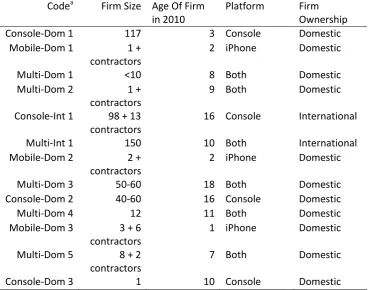
number of employees, and ownership (domestic only versus international ownership). Five of these interviews were in Brisbane and nine were in Melbourne.
Insert Table 1 Here
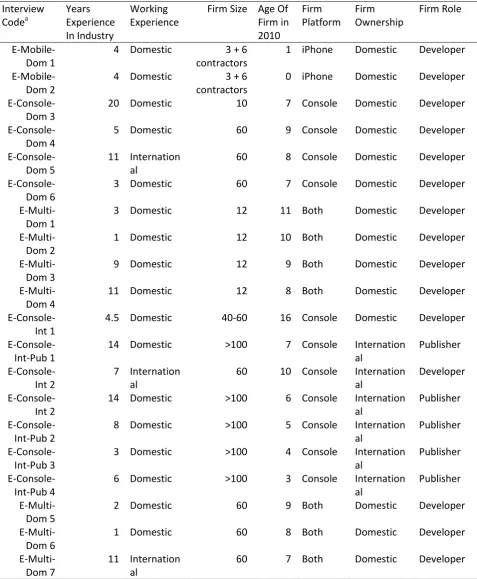
We also conducted twenty secondary semi-structured interviews (9 in Brisbane and 11 in Melbourne) with games developers who work in the games industry, which are cited below with the prefix E- prior to the code. (See Table 2 for sample characteristics and interview codes). The developers experience working in the industry ranged from 1 to 20 years, with an average of 7 years. Three of the more experienced developers had experience working internationally in the games industry. In terms of their current employment, 11 worked in firms developing games solely for consoles, 2 worked in firms focused solely for mobile games, and the remaining 7 worked in firms developing for both segments. Interviews with employees were conducted in November 2010
Insert Table 2 here
14
ranging, and many of the questions focused on additional issues affecting the nature of work not of direct relevance to this paper. Relevant questions included in the interviews concerned changes in the games industry, and the reasons why working conditions within the industry had changed over time. Given their often extensive experience, these interviews provided substantial historical context to the findings reported in this paper. Once we achieved a high convergence of responses we ceased interviews (Corbin and Strauss, 1990).
Interviews lasted for between one and 1½ hours and were recorded and fully transcribed. The first step of the analysis was to conduct open coding of the interviews (Glaser and Strauss, 1967; Strauss and Corbin, 1990). Coding was conducted on segments of the transcripts that formed identifiable ideas, with each segment often coded into multiple categories. The categories and themes identified were theoretically informed by GVC related concepts concerning the structure of chain connections, characteristics of transactions, including their complexity and codifiability, and power relations and partner switching ability, as well as market segments in which work was conducted and the type of (e.g., publishers) or specific actors (e.g., Apple) with which transactions occurred. A form of axial coding (Glaser and Strauss, 1967; Corbin and Strauss, 1990) was then conducted which paid particular attention to the dominant relationships between console and iPhone game developers on the one hand, and publishers, Apple and other actors within the value chain on the other.
The following discussion separately reports a global value chain analysis for each of the console and mobile games segments of the industry.
15
Industry overview
Until the 00s, Australia had a small but relatively healthy games industry with 50 developers and over 2000 employees (1998 figures in ACMI, 2008). In recent years, a large number of development studios in the Australian industry have either been acquired by US publishers or have been closed (E-Console-Dom 6), which reflects the trend towards increasing concentration in the industry more generally (Johns, 2006; Kerr, 2006; Martin and Deuze, 2009). Some of the larger developers in the Australian industry in recent years have been THQ Studio Oz (a foreign multinational corporation), Halfbrick Studios, Big Ant Studios, 2K Martin, Creative Assembly and Team Bondi. Krome Studios closed in 2010, but was until that time the largest employer in the Australian industry with over 350 employees operating in Melbourne, Adelaide and Brisbane. Other studios to close since the global financial crisis (GFC) include Transmission Games, Fuzzyeyes and Auran. THQ closed its Brisbane and Melbourne Studios in 2011 (Launay, 2012). Team Bondi, KMM and Electronic Arts Studio and Visceral Games have also recently ceased operations (Radd, 2011). Halfbrick is now Australia’s largest games developer with 50 employees (Sakuraoka-Gilman, 2011).
16
(Martin and Deuze, 2009, page 283). Games development budgets are now as high as $US50 million with an average multiplatform development budget sitting between 18 and 28 million (Crossley, 2012). It is only the large developers that have the financial capacity to fund the technical development that supports grand titles based on original ideas, which invariably have very large production budgets (Martin and Deuze, 2009, page 283).
As such, Australian firms are dependent on publishers and license holders to finance their operations. Publishers finance developers to create games and make periodic advances to developers throughout the development process in accordance with specific timelines. Publishers assume responsibility for manufacturing (through relations with console manufacturers), marketing and distribution of the game product. Publishers are also intermediaries between developers and license holders who negotiate with publishers to create games according to specific guidelines typically connected to cinematic releases (Megamind), cartoon characters (Scooby-Doo) or toy ranges (Barbie). Johns (2006) has shown that publishers are heavily concentrated in Western Europe, USA and Japan with the top 14 publishers located in France, USA and Japan. As such, Australian firms are spatially remote from the centre of publishing and as will be shown below, they also have a marginal position in relational networks in the global console games industry.
Spatial and relational dimensions of economic coordination for Australian developers
17
remoteness of Australian development firms renders it difficult for them to achieve a central position in the games global production network, given the already marginal position of development firms in those networks: ‘… developers are relatively isolated in terms of network connectivity, occupying a more peripheral position than the console manufacturers and publishers, Consequently, they are often in a weak negotiating position and are unable to capture extra value’ (Johns, 2006, page 169).
In Australia, THQ Studio Oz, which closed in 2011, was the only publisher to engage Australian developers in the creation of games. Sega previously had ownership in the Australian studio Creative Assembly, which it financed to develop games, but Sega appears to be gradually withdrawing from the Australian development market (Souri, 2012). As such, Australian developers now rely on overseas publishers and license holders, predominantly located in the USA. The GFC has meant that USA publishers and license holders have tended to commit their work to USA based developers or in-house studios (Schroeder, 2010), which has created major problems for the Australian industry.
18
number of powerful coordinators of global distribution, located in markets in Japan, Europe and the USA (Johns, 2006), who rely on reputation and trust through prior transactions as the basis for allocating work (Scott, 2006). In GVCs in which relational coordination mechanisms are important, as with the console games industry, co-location and clustering are typically the basis for intense communication and information exchange between firms (Sturgeon, 2009), creating further problems for spatially remote SME developers in Australia trying to connect to the global market:
‘It’s just very difficult being in Australia to be able to be constantly under the nose of these guys in America and the UK, where the money is. It’s not really a matter of just making connections, it’s a matter of developing a relationship (Multi-Dom 5) ’
19
page 81). The relational value chain involving close ties and deep repeat relations between firms, creates challenges for firms that lack network centrality (Johns, 2006) and that are spatially remote from the centre of economic activity in the industry in the USA, Japan and Europe. The remainder of the paper seeks to determine whether technological change and the development of standards in the mobile devices component of the game industry has altered industry power relations and forms of economic coordination from the point of view of developers.
AUSTRALIAN DEVELOPERS IN THE MOBILE DEVICES SEGMENT OF THE GAMES INDUSTRY
Global industry overview
20
is estimated to be worth $US 1.8 billion in 2010 (Jennings, 2011). An increasing number of Australian firms are seeking to capture a share of this growing market.
The emergence of the mobile games industry has created new opportunities for small developers in the Australian industry, particularly given difficulties in accessing the relational console global value chain in which key publishers and console manufacturers are both relationally and geographically remote. Mobile devices require new types of games to be developed; games that are less complex and are faster to play and which are suitable for casual gamers rather than the more established gamers who invest in the console market. This has had the effect of reducing the cost of producing a game as well as expanding the market for games, creating new market opportunities for small independent developers (Bustamante, 2004; Martin and Deuze, 2009). Further, the direct access to market created through on-line retail stores has reduced the dependence of developers on intermediary publishers for access to markets, reducing the role of reputation as a barrier to participation in global markets. The creation of arms length relations with on-line distributors for mobile devices has opened access to the game market for many firms that were closed out of the console value chain. The lower cost of production associated with the development of simple and fast games has reduced the dependence of developers on publishers to finance their development costs, something that has also defined the console games market (Johns, 2006).
21
iPhone platform and controlling access to that platform through its proprietary standard, second by supporting the development of an ecosystem of developers with easy access to its standard and thereby developing a large number and large variety of complementors to its platform and third by developing brand equity through its control over distribution and mobilizing its reputation in the iTunes market. As such, Apple’s powerful position in that market relative to developers can be attributed to its adoption of several of the key strategies for achieving platform leadership. Gawer and Cusumano argue (2010, page 32) that firms seeking to compete in a platform and standards war need to build
complementors by ‘broadly licensing their IP’, investing in ‘brand equity’, and gaining some control over ‘distribution or service capabilities to signal support for the platform’. Apple has done all of these things and it helps to explain its power in the smartphone market.
Establishing a platform technology and ecosystem
In 2007, Apple released the iPhone on to the market, challenging a number of the practices of wireless carriers or operators, building its strength within the broader industry architecture. Prior to the launch of iPhone, manufacturers developed devices that met the specifications of operators and contained operator/carrier specific content2. Apple’s iPhone broke the connection between the carrier and the consumer. Apple’s platform device contained the operating system iOS which contained the proprietary application
programming interface (API), which Apple subsequently licensed to developers. Apple’s iOS thereby became the standard for developers seeking to develop applications for the iPhone. In the US, prior to the launch of Apple iPhone, device manufacturers had to develop
2 This analysis relates to the USA, Australian and European markets; different power relations operated in the
22
handsets that met the demands of carriers, who in turn provided unique content and applications that distinguished their phone in the market (Kenney and Pon, 2011;
FierceWireless, 2012). By changing these arrangements, Apple secured a powerful starting position in the mobile internet or smartphone industry architecture.
23
‘All your entry costs are pretty much negated with iPhone…you can just create your own product and Apple will release it in their store…you don’t need to spend any money on printing medium, or discs or publishing costs or anything like that. It’s just Apple’s 30 percent and that’s it (Multi Dom 1). ’
A consequence of the reduction of barriers to entry is the intensification of competition in the development market, particularly for low end games (high quality games can take three to six months to develop and require a development firm to have significant financial reserves (Mobile-Dom 3)). The result is a large number and variety of complementary products that support the iPhone platform, an essential element of success in platform competition (Teece, 1986; Cusumano, 2010).
A further element of platform success depends on the development of manufacturing and distribution of service capabilities that support the platform technology (Gawer and Cusumano, 2010). Apple was able to achieve that through a strategy of ‘tipping’ whereby it was able to leverage its existing distribution power in the iTunes market by moving into retail distribution for its iPhone through the Apple App Store. As Kenney and Pon (2011, page 9) explain ‘the iPhone success is a typical model of leveraging a previously successfully platform, the Apple iPod, with its extant ecosystem, cachet and market momentum to enter the more contested market, mobile telephony’.
The Apple App Store (for Apple iPhones and iPads) accounts for a large component of the retail sales for the wireless device industry3. Apple takes a commission in the form of
3The number of mobile devices with Android platforms exceeds those with Apple’s iOS. Apple’s App Store
24
30% of the sales of any game purchased from its online store. Apple handles the technology, provides the interface and service necessary to maintain the web space for games. Apple takes 30 percent of in-app purchases (micro-transactions in which gamers can advance their progress in the game or receive access to additional characters or enhancements for a payment) and revenues generated from advertising (which are provided to developers through Apple’s iAd Network) (Fieldman, 2012).
Constraining platform competition
A critical factor influencing the power of platform holders, such as Apple, is the relatively constrained competition in the smartdevice or mobile platform market. Given the intense competition in the developer segment, the limited number of smartphone platforms on which games can be released and the difficulty for developers in switching between platforms becomes the basis for Apple’s bottleneck position (Jacobides et al, 2006).
Apple has been accused of seeking to intensify this bottleneck position through its control over the programming language of games and the way in which games are coded (Gruber, 2010). For example, Unity (a games development tool) makes programming a lot easier; it provides a lot of the nuts and bolts in the sense that it encodes a lot of basic content for the developer. By using a program such as Unity, developers can focus on the game and the content and are not restricted by their sometimes limited programming capabilities (Multi-Dom 1). Whereas focusing on Apple’s preferred language (C++) means that it is a lot harder to do basic things.
25
‘Basically you have to build a whole system to get to do really simple stuff. The existing systems that are around are built to allow people to easily do stuff’ (Multi-Dom 1)
A potentially important implication of any attempt to impose a language preference on developers is that it restricts the capacity of developers to release a game in other formats - the programs such as Unity enable a developer to create applications for multiple platforms (Mobile-Dom 2):
‘Apple is trying to make its own ecosystem in which developers become Apple developers. We are “Apple developers”, rather than we are “developers” – we are “game developers” and suddenly we are “Apple developers” (Mobile-Dom 2) ’. It has been shown in other industries, that restricting the ability of suppliers to ‘switch’ to other buyers is an important basis for maintaining a position of market dominance. As Jacobaides (Jacobaides et al, 2006) explains, firms wishing to benefit from innovation or new technology need to seek to maximize competition in their supplier market while minimizing competition in their own market, thereby maintaining their position as the industry bottleneck.
26
‘The underlying language that it’s written in, it can be made to work on the Android. But it’s a difficult thing to do that. When you do it, you lose some of the functionality that’s explicitly offered by the Android phone. To access that technology you’ve got to explicitly use its language. Or you’ve got to do big workarounds to get it to work and stuff like that’. (Mobile-Dom 3).
One of the reasons Australian developers appear to prefer Apple is because Apple users adopt new versions of the operating system (OS) much more quickly than Android users. As a consequence, the Android market has much more fragmented operating systems, which is difficult for developers who have to ensure their game is compatible with a range of operating systems. As Panzarion (2012) notes:
Unfortunately, only a fraction of Android devices are on the latest version of the OS, which makes it difficult for developers, especially those with limited
resources, to create versions of their apps that work appropriately across all devices. It also makes it difficult for them to adopt the coolest new features of Android very quickly, as they must make sure that their apps work on the most common version of Android, even if it is far older and not as well equipped.
27
provide an opportunity for Australian developers in the future. Halfbrick, currently Australia’s largest developer, has recently acquired Onan Games, which owns the Mandreel Technology, which enables access to platforms such as Facebook and others using HTML5 or open web platforms (Constine, 2012). It would also seem that Facebook and others are using open standards HTML5 for mobile web and the native applications developed for iOS (Apple’s Operating System), Android (Google Phone) and Windows Phone. HTML5 is considered technologically inferior at this point (slower and poorer functionality), however that might be a function of time as HTLM5 develops further technological sophistication (Kosner, 2012). In Australia, Halfbrick has already released both Fruit Ninja and Jetpack Joyride to Facebook. As 12 percent of Facebook’s annual revenue is attributable to cooperative multiplayer games (Indvik, 2012), this might constitute a lucrative market for games developers in the future. However, even if the number of games platforms increases, intensifying competition in the retail end of the market, it remains the case that a small number of large corporations will control the retail end of the games market while access to games development remains open with low barriers to entry in the production of mobile games.
DISCUSSION AND CONCLUSION
28
Our research shows that relational value chains are not always characterized by more equal power relations than those typical of captive value chains (Gereffi et al, 2005; Sturgeon, 2006) because the power of lead firms can be elevated by their bottleneck position in highly concentrated industry segments (Jacobides et al, 2006; Pisano and Teece, 2007).
Further, direct access to consumer markets facilitated through on-line distribution methods has not eroded power asymmetries from the point of view of remote developers. Instead, technological changes associated with the development of mobile internet devices have been manipulated by different lead firms to ensure their dominance in much the same way as lead firms in the console segment of the market. As such developers are price takers in the on-line market who bear all of the risk of development. The mobile market looks more like a market than a relational value chain, in which we would therefore expect reduced asymmetries of power according to GVC analysis (Gereffi et al, 2005; Sturgeon, 2009). However, the limited competition amongst platform providers and intense competition amongst developers renders developers in an equally vulnerable negotiating position to that which they have in the console market.
29
These trends suggest that developers occupy weak positions in the mobile games value chain compared with lead firms that control access to mobile device platforms and online retail distribution. Although the mobile games industry has features of arms-length transactional forms of economic coordination, the high level of concentration in the platform and retail end of the market ensures that the power asymmetries between large multinational corporations and developers remain unfavorable to the latter. This can be explained in part by the intense competition in the development end of the market and the very limited competition in retail and mobile device platforms. Our research therefore shows that technological change and the development of standards do not necessarily result in arms-length transactional forms of market exchange involving more equal power relations (Gereffi et al, 2005; Sturgeon, 2002). Instead, the development of standards can be manipulated by lead firms to ensure their position of power even in industries in which transactional forms of economic coordination prevail (Nadvi, 2004; 2008).
30
value. As we would expect, the transactional nature of relations in the mobile segment of the market means developers have fewer challenges associated with their geographical distance from the main buyers than do developers in the console market. However, as the mobile games market is highly concentrated, like the console segment of the market, power remains highly asymmetrical in both segments of the global games industry.
31
References
Bair J, 2009 Frontiers of Commodity Chain Research (Stanford University Press, California) Bustamante E, 2004, “Cultural industries in the digital age: some provisional conclusions”
Media, Culture and Society26(6) 803–820
Coe N M, 2000, “The view from out west: embeddedness, inter-personal relations and the development of an indigenous film industry in Vancouver” Geoforum31 391–407. Coe N M, 2001, “A hybrid agglomeration? The development of a satellite-Marshallian
industrial district in Vancouver's film industry” Urban Studies38 1753–1775
Coe N, Dicken M P, Hess M, 2008, “Global production networks: realising the potential” Journal of Economic Geography 8 271–295
Coe N M, Johns J L, 2004, “Beyond production clusters: towards a critical political economy of networks in the film and television industries”, in The cultural industries and the production of culture Eds D Power, A J Scott (Routledge, London) pp 188–204 Cole A, 2008, “Distant neighbours: the new geography of animated film production in
Europe” Regional studies (0034-3404)42(6) 891.
Corbin J, Strauss A, 1990 Basics of Qualitative Research: Grounded Theory Procedures and Techniques (Sage, London)
Cunningham S, Silver J, McDonnell J, 2010, “Rates of change: online distribution as disruptive technology in the film industry” Media International Australia 136 119– 132
32
Dedrick J, Kraemer K, Linden G, 2010, “Who profit from innovation in global value chains? A study of the iPod and Notebook PCs” Industrial and Corporate Change 19(1) 81– 116
Dolan C, Humphrey J, 2000, “Governance and trade in fresh vegetables: the impact of UK supermarkets on the African horticulture industry” Journal of Development Studies
37(2) 147–176
Gawer A, Cusumano M A, 2008, “How companies become platform leaders” MIT Sloan
Management Review49(2) 28–36.
Glaser B G, Strauss A, 1967 The Discovery of Grounded Theory: Strategies for Qualitative
Research (Weidenfeld and Nicolson, London)
Gereffi G, Humphrey J, Sturgeon T, 2005, “The governance of global value chains” Review of International Political Economy12(1) 78–104
Grabher G, 2002, “The project ecology of advertising: tasks, talents and teams” Regional Studies36(3) 245–262
Hesmondhalgh D, 2002 The Cultural Industries (Sage, London)
Henderson J, Dicken P, Hess M, Coe N, Yeung H, 2002, “Global production networks and the analysis of economic development” Review of International Political Economy, 9(3): 436–464
33
Jacobides M G, Kundsen T, Augier M, 2006, “Benefiting from innovation: value creation, value appropriation and the role of industry architectures” Research Policy35 1200– 1221
Johns J, 2006, “Video games production networks: value capture, power relations and embeddedness” Journal of Economic Geography6 151–180
Kenney M, Pon B, 2011, “Structuring the smartphone industry: is the mobile internet OS platform the Key? ” Keskusteluaiheita Discussion Papers No. 1238
Kerr A, 2006 The business and culture of digital games (Sage, London)
Levy D L, 2008, “Political contestation in global production networks” Academy of
Management Review33(4) 943–963
Martin C B, Deuze M, 2009, “The independent production of culture: a digital games case study” Games and Culture4(3) 276–295
Meyer M H, Lehnerd A P, (1997) The power of product platforms: Building value and cost leadership (The Free Press, New York)
Nadvi K, 2004, “The effect of global standards on local producers: a Pakistani case study”, in
Local enterprises in the global economy Ed H Schmitz (Edward Elgar, Cheltenham) Nadvi K, 2008, “Global standards, global governance and the organization of global value
chains” Journal of Economic Geography8 323–343
Özatagan G, 2011, “Shifts in value chain governance and upgrading in the European periphery of automotive production: evidence from Bursa, Turkey” Environment and Planning A43 885–903
34
Pisano G, Teece D J, 2007, “How to capture value from innovation: shaping intellectual property and industry architecture” California Management Review50(1) 278–296 Porter, M. 1985 Competitive Advantage: Creating and Sustaining Superior Performance
(Free press, New York)
Rutherford T, Homes J, 2008, “ ‘The flea on the tail of the dog’: power in global production networks and the restructuring of Canadian automotive clusters” Journal of
Economic Geography8 519–544
Scott A, 2006, “Creative cities: conceptual issues and policy questions” Journal of Urban Affairs28 1–17
Scott A J, Pope N E, 2007, “Hollywood, Vancouver, and the world: employment relocation and the emergence of satellite production centers in the motion picture industry”
Environment and Planning A, 391364–1381
Sturgeon T, 2002, “Modular production networks: an American model of industrial organization” Industrial and Corporate Change11(3) 451–496
Sturgeon T, 2009, “From commodity chains to value chains: interdisciplinary theory building in an age of globalisation”, in Frontiers of Commodity Chain Research Ed J Bair (Stanford University Press, Stanford) pp 93–109
Tee R, Gawer A, 2009, “Industry architecture as a determinant of successful platform strategies: a case study of the i-mode mobile internet service” European
Management Review6 217–232
35
Teipen C, 2008, “Work and employment in creative industries: the video games industry: Germany, Sweden and Poland” Economic and Industrial Democracy 29(3) 303–339 Uzzi B, 1997, “Social structure and competition in interfirm networks: the paradox of
embeddedness” Administrative Science Quarterly42(1) 35–67
West J, Dedrick J, 2010, “Innovation and control in standards architectures: the rise and fall of Japan’s PC-98” Information Systems Research11(2) 197–216
Williams D, 2002, “Structure and competition in the U.S. home video game industry” The
International Journal on Media Management4(1) 41–54
Williamson O, 1975 Markets and Hierarchies (Free Press, New York)
Yoon H, Malecki E, 2009, “Cartoon planet: worlds of production and global production networks in the animation industry” Industrial and Corporate Change19(1) 239–271
On-line media sources
ACMI, 2008, “History of game development in Australia”, Australian Centre for the Moving Image, http://www.acmi.net.au/global/docs/games_history_australia.pdf, accessed 8 April 2011
Activision, 2012, “Activision Blizzard announces record fourth quarter and calendar year 2011 earnings”, http://investor.activision.com/releasedetail.cfm?ReleaseID=647732, accessed 28 June 2012
Colwill T, 2010, “The rise and fall of Krome Studios”,
36
Constine J, 2012 19 March, “Halfbrick acquires Onan Games so it can port Fruit Ninja everywhere”, http://techcrunch.com/2012/03/19/halfbrick-studios-onan-games/, accessed 28 June 2012
Crossley R, 2012, “Average development costs as high as $28 million”, Develop,
http://www.develop-online.net/news/33625/Study-Average-dev-cost-as-high-as-28m, accessed 28 June 2012
Fieldman M, 2011, “The top 25 hottest mobile game developers (inforgraphic)”, Seek Omega, http://www.seekomega.com/2011/01/the-top-25-hottest-mobile-game-developers-infographic, accessed 26 June 2012
Fieldman M, 2012, “Why 99.9 percent of all mobile games are not profitable”, Seek Omega, http://www.seekomega.com/2012/02/why-99-9-of-all-mobile-games-are-not-profitable-the-6-things-mobile-game-developers-must-do-to-survive/, accessed 26 June 2012
FierceWireless, 2012, “The ripple effect: how the iPhone impacted the way carriers do business”, http://www.fiercewireless.com/special-reports/ripple-effect-how-iphone-impacted-way-carriers-do-business, accessed 29 October 2012.
Gruber J, 2010, “New iPhone developer agreement bans the use of Adobe’s Flash-to-iPhone Compiler”,
http://daringfireball.net/2010/04/iphone_agreement_bans_flash_compiler, accessed 29 October 2012.
37
Jennings R, 2011, “Rivals nibble into Apple’s app store revenue, report says”,
http://www.cio.com.au/article/376942/rivals_nibble_into_apple_app_store_revenu e_report_says/, accessed 28 June 2012
Kosner A, 2012, “Are Apple and Google playing HTML5 chess with Facebook?”, Forbes, http://www.forbes.com/sites/anthonykosner/2012/04/22/are-apple-and-google-playing-html5-chess-with-facebook/, accessed 26 June 2012
Launay M, 2012, “More THQ troubles in Australia”,
http://geek.pikimal.com/2012/01/30/more-thq-troubles-in-australia/, accessed 28 June 2012
McMillen A, 2011, “A matter of size: the state of triple-a game development in Australia”, http://au.pc.ign.com/articles/114/1149469p1.html, accessed 8 April 2011
Panzarion M, 2012, “Why do developers prefer iOS over Andriod”,
http://thenextweb.com/apple/2012/03/06/why-do-developers-prefer-ios-over-android-try-75-adoption-of-ios-5-while-ics-is-stuck-at-1/, accessed 8 August 2012 Raby M, 2010, “There are now 300,000 apps on Apple’s App Store”,
http://www.tgdaily.com/mobility-brief/52057-there-are-now-300000-apps-on-apples-app-store#, accessed 28 June 2012
Radd D, 2011, “KMM Brisbane closes, developer says Australian dev industry ‘obliterated’ ”, http://www.industrygamers.com/news/kmm-brisbane-closes-developer-says-australian-dev-industry-obliterated/, accessed 28 June 2012
Rose M, 2011, “Modern Warfare 3 sells 6.5M on launch day in North America, UK”,
38
Sakuraoka-Gilman M, 2011, “Halfbrick opens up Sydney office as studio advertises for programmers, artists and designers”,
http://www.pocketgamer.biz/r/PG.Biz/Halfbrick+news/news.asp?c=34402, accessed 28 June 2012
Schroeder J, 2010, “Games development – Canada vs Australia”,
http://blogcampaigning.com/2010/12/game-development-%E2%80%93-canada-vs-australia/
Slattery B, 2010, “App overload: Apple passes 300K apps”,
http://www.pcworld.com/article/208070/app_overload_apple_passes_300k_apps.h tml, accessed 28 June 2012
Souri, 2012, “Mass lay-offs reported at SEGA Studios Australia”,
http://www.tsumea.com/news/070212/mass-lay-offs-reported-at-sega-studios-australia, accessed 29 June 2012
E-Console-Int 1, 2010, Labor interviews page 26 “this is the Australian games industry; at one stage or another every year, every company in this industry in Australia is working on a racing title. So you’re going to have to love it or go overseas.”
Wauters R, 2011, “There are now more free apps for Android than for the iPhone: Distimo”, http://techcrunch.com/2011/04/27/there-are-now-more-free-apps-for-android-than-for-the-ios-platform-distimo/, accessed 30 July 2012
Ziegler C, 2011, “Apple’s App Store hits 10 billion downloads”,
39
Table 1: Characteristics of Games Developer Firms Interviewed
Codea Firm Size Age Of Firm
in 2010
Platform Firm
Ownership
Console-Dom 1 117 3 Console Domestic
Mobile-Dom 1 1 +
contractors
2 iPhone Domestic
Multi-Dom 1 <10 8 Both Domestic
Multi-Dom 2 1 +
contractors
9 Both Domestic
Console-Int 1 98 + 13
contractors
16 Console International
Multi-Int 1 150 10 Both International
Mobile-Dom 2 2 +
contractors
2 iPhone Domestic
Multi-Dom 3 50-60 18 Both Domestic
Console-Dom 2 40-60 16 Console Domestic
Multi-Dom 4 12 11 Both Domestic
Mobile-Dom 3 3 + 6
contractors
1 iPhone Domestic
Multi-Dom 5 8 + 2
contractors
7 Both Domestic
Console-Dom 3 1 10 Console Domestic
40
Table 2: Characteristics of Games Developers Interviewed and Characteristics of the Firm of their Current Employment
Interview Codea Years Experience In Industry Working Experience
Firm Size Age Of Firm in 2010 Firm Platform Firm Ownership Firm Role E-Mobile-Dom 1
4 Domestic 3 + 6
contractors
1 iPhone Domestic Developer
E-Mobile-Dom 2
4 Domestic 3 + 6
contractors
0 iPhone Domestic Developer
E-Console-Dom 3
20 Domestic 10 7 Console Domestic Developer
E-Console-Dom 4
5 Domestic 60 9 Console Domestic Developer
E-Console-Dom 5
11 Internation al
60 8 Console Domestic Developer
E-Console-Dom 6
3 Domestic 60 7 Console Domestic Developer
E-Multi-Dom 1
3 Domestic 12 11 Both Domestic Developer
E-Multi-Dom 2
1 Domestic 12 10 Both Domestic Developer
E-Multi-Dom 3
9 Domestic 12 9 Both Domestic Developer
E-Multi-Dom 4
11 Domestic 12 8 Both Domestic Developer
E-Console-Int 1
4.5 Domestic 40-60 16 Console Domestic Developer
E-Console-Int-Pub 1
14 Domestic >100 7 Console Internation
al
Publisher
E-Console-Int 2
7 Internation al
60 10 Console Internation
al
Developer
E-Console-Int 2
14 Domestic >100 6 Console Internation
al
Publisher
E-Console-Int-Pub 2
8 Domestic >100 5 Console Internation
al
Publisher
E-Console-Int-Pub 3
3 Domestic >100 4 Console Internation
al
Publisher
E-Console-Int-Pub 4
6 Domestic >100 3 Console Internation
al
Publisher
E-Multi-Dom 5
2 Domestic 60 9 Both Domestic Developer
E-Multi-Dom 6
1 Domestic 60 8 Both Domestic Developer
E-Multi-Dom 7
11 Internation al
60 7 Both Domestic Developer