a
Director, Geofem Ltd. and Assistant Professor, Frederick University, Cyprus
b
Senior Lecturer, Department of Mechanical Engineering, University of Strathclyde, UK
SKILLS DEVELOPMENT AND RECORDING IN
ENGINEERING ANALYSIS AND SIMULATION –
INDUSTRY NEEDS
Dr. Andrew Leesa and Dr. James Woodb
THEME
Education.
KEYWORDS
Continuing professional development, engineering analysis and simulation
SUMMARY
The EASIT2 project (Engineering Analysis and Simulation Innovation Transfer), funded under the European Union Lifelong Learning Programme, has the major goal to contribute to the competitiveness and quality of
engineering, design and manufacturing in Europe through identifying the generic competencies that users of engineering analysis and simulation systems must possess. This competency framework will include a comprehensive Educational Base, a web-based interface compatible with other staff
development systems, with links to associated resource material that engineers and analysts can use to develop and track their competencies. The project will also deliver an integrated Registered Analyst (RA) Scheme to provide
recognition of achievement of these competencies. In order to help ensure that the deliverables of this project meet industry needs, a survey was undertaken and this paper summarises the findings of this survey.
development, marketing power and enhanced subcontractor qualification and internal resource management.
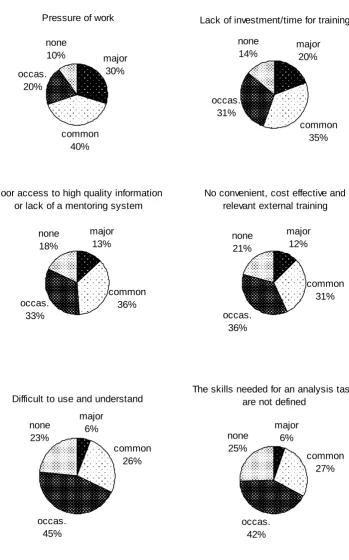
The survey also provided a valuable insight into the current state of the engineering analysis and simulation industry. The most significant barriers to the effective use of engineering analysis were identified as recruitment of suitably qualified and experienced staff and a lack of analysis skills. “Pressure of work” was also identified as the most significant reason why organisations fail to get the most out of engineering analysis software.
1: Introduction
EASIT2 (Engineering Analysis and Simulation Innovation Transfer) is a research project funded by the European Union Lifelong Learning Programme and the project partners (AMEC, E.ON, EADS, Enginsoft, Geofem, NAFEMS, Nevesbu, NOKIA, Renault, SELEX Galileo, Tetra Pak and University of Strathclyde). Its major goal is to contribute to the competitiveness and quality of engineering, design and manufacturing in Europe. It aims to achieve this by delivering the following:
• Educational Base: a list of generic competences that users of engineering analysis and simulation systems must possess, divided into appropriate modules
• Competency Framework: the Educational Base incorporated into a web-based interface (with the ability to interface with other staff development systems), with links to associated resource material that engineers and analysts can use to develop and track their competencies
• Registered Analyst Scheme: an integrated competency-based version of the existing scheme to provide recognition of achievement of these
competencies
These deliverables will be generic in nature and applicable to most areas of engineering analysis and simulation. It will be possible for industry sectors and organisations to tailor these systems, particularly the Educational Base, to meet their own needs. Further information can be found on the project
website: http://www.easit2.eu.
To help ensure that the project deliverables can meet the needs of the
engineering analysis and simulation industry, an extensive survey of industry needs was undertaken, both in Europe and worldwide. This paper describes the survey and summarises its findings.
2: Industry needs survey
Invitations to complete an online questionnaire were sent out by NAFEMS and other organisations to engineering analysts worldwide. A total of 1094
completed questionnaires were received between December 2010 and February 2011. Responses were sought in the following areas:
• Organisation details: engineering and analysis activities, size, barriers to use of engineering analysis tools
• Educational Base and Competency Framework: preferred medium, skill levels and assessment methods, analysis areas; also, details of any such existing systems were sought
• Registered Analyst Scheme: (the term “professional qualification” was adopted in the questionnaire instead of “registration” to provide a clear distinction between this and the competency framework) respondents were asked whether this would be useful to them and for their preferred
assessment methods and acceptable cost.
3: Survey results – respondent details
Responses were received from a total of 50 countries worldwide. In excess of 100 completed surveys were received each from USA, UK, Germany, France and Cyprus. The majority of respondents were engineers/analysts (38%) and senior engineers (26%), while Project Managers (13%) and Directors (10%) were also well represented. The educational level of about half the respondents was to Masters Degree level (46%), with 32% reaching Doctorate level and 22% Diploma or Bachelor’s Degree.
0 5 10 15 20 25 30 35 40
<20%
20-50%
50-80%
80-100%
Percentage of responses from each company size
SME
[image:4.595.121.485.456.652.2]250-500 employees 500+ employees
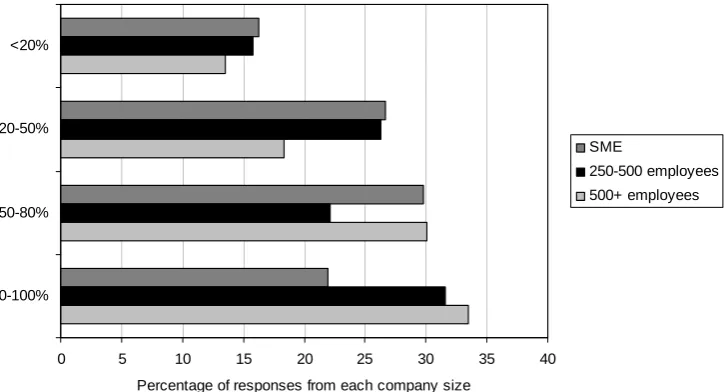
Respondents were generally well experienced in computer-based engineering analysis with 75% indicating over 5 years of experience, which reflects the specialised nature of these activities. Over half (58%) of all respondents spent over 50% of their work time in the preceding 6 months involved in computer-based engineering analysis which, like the experience data described above, suggests that the majority of the respondents have a good knowledge of the engineering analysis industry. Interestingly, as shown in Figure 1, the largest organisations have a greater proportion of near full-time analysts, while smaller companies and small to medium-sized enterprises (SMEs) have a greater proportion of engineers whose time is divided more equally between computer-based analysis and other tasks. Similar trends were observed when plotting the data by Number of Analysts where a small group of analysts tended to be involved in analysis more part-time. This suggests that engineering analysts in small organisations face a greater challenge in developing their competences when they often need to multi-task.
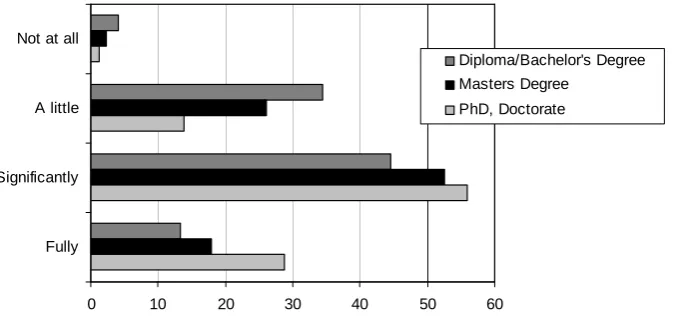
Respondents were asked how they felt their formal education related to their engineering analysis activity. The majority (52%) responded with
“significantly” while about an equal proportion responded with “a little” or “fully” (24% and 21% respectively). Only 2% responded “not at all”. Perhaps predictably, the higher the education level of the respondent, the higher it related to their engineering analysis activity, as shown in Figure 2.
Nevertheless, among even those holding a Doctorate, only 29% felt that their formal education related fully with their engineering analysis activity, so there is clearly a need for further work-based learning in engineering analysis.
0 10 20 30 40 50 60
Not at all
A little
Significantly
Fully
Percentage of responses from each education level
Diploma/Bachelor's Degree Masters Degree
[image:5.595.113.451.470.630.2]PhD, Doctorate
4: Survey results – organisation details
Overall, many of the respondents were employed in organisations involved in Manufacturing (20%), Design office/consultancy (27%) or Research and development (28%). The industrial sector of respondents’ organisations were well distributed among the categories of Energy, Aerospace, Land Transport, Civil & Construction, Consumer Goods, Marine & Offshore, General Industrial Goods, Petrochemical & Process and Defence, with each accounting for
between 5% and 14% of all responses.
Half of the respondents to the survey worked at large organisations (500+ employees) while a significant proportion (20%) worked at very small organisations of 1-20 employees. The proportion of respondents working in organisations falling into the SME category (up to 250 employees) was 40%. Respondents were also asked to state the number of engineering analysts working in the organisation. 45% responded with 1-10 analysts, with a
significant number (7%) having only a single analyst. 32% had 11-100 analysts while 23% had 100+ analysts. Predictably, the larger the organisation, the larger the number of analysts. The wide distribution of responses suggests that in terms of staff development in engineering analysis, there is a need for both a personal approach (where there are a small number of analysts) and a
company-wide approach (where there are a large number of analysts).
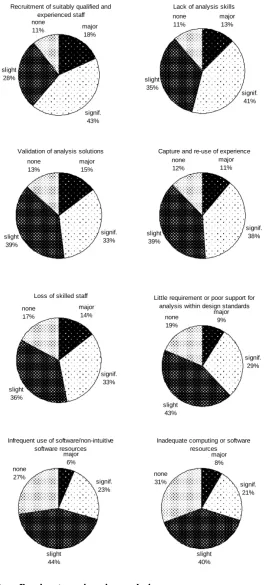
Respondents were asked to rate a number of issues concerning engineering analysis as to what degree they saw them as a barrier to the use of computer-based engineering analysis or as a reason why they failed to get the most out of such software. Firstly, the ratings for barriers to engineering analysis are shown in Figure 3 . The two barriers with the highest proportion of major and
Recruitment of suitably qualified and experienced staff major 18% signif. 43% slight 28% none 11%
Lack of analysis skills major 13% signif. 41% slight 35% none 11%
Validation of analysis solutions major 15% signif. 33% slight 39% none 13%
Loss of skilled staff major 14% signif. 33% slight 36% none 17%
Capture and re-use of experience major 11% signif. 38% slight 39% none 12%
Little requirement or poor support for analysis within design standards
major 9% signif. 29% slight 43% none 19%
Infrequent use of software/non-intuitive software resources major 6% signif. 23% slight 44% none 27%
[image:7.595.159.424.97.684.2]Inadequate computing or software resources major 8% signif. 21% slight 40% none 31%
Pressure of work major 30% common 40% occas. 20% none 10%
Lack of investment/time for training
major 20% common 35% occas. 31% none 14%
Poor access to high quality information or lack of a mentoring system
major 13% common 36% occas. 33% none 18%
Difficult to use and understand
major 6% common 26% occas. 45% none 23%
No convenient, cost effective and relevant external training
major 12% common 31% occas. 36% none 21%
The skills needed for an analysis task are not defined
[image:8.595.140.490.129.690.2]major 6% common 27% occas. 42% none 25%
Respondents were also asked two simple “Yes/No” questions on current practices in their organisations regarding analyst competences. The first asked whether the skills needed to perform analysis tasks are formally defined and the response overall was 57% “No”. It appeared that organisations with fewer analysts had less formal definition of the competences needed to perform analysis tasks, with 71% of lone analysts responding “No”, 59% to 61% for 2-50 analysts and 2-50% for 2-50+ analysts. The second question asked whether a system to record analyst competences existed in the respondent’s organisation. A significant majority (70%) responded “No”, which demonstrates a clear need in industry for a competency framework. A higher proportion (76%) of “No” responses was received from SMEs and a similar trend with number of analysts to the previous question was recorded here with 90% of lone analysts
responding “No” compared with 59% for organisations with 50+ analysts. Clearly, small organisations, or those with small engineering analysis and simulation departments, are in the greatest need of support in terms of setting up a competency framework, perhaps because they lack the resources to do this themselves.
5: Survey results – Educational Base and Competency Framework
When asked whether a system that defines analyst competences and provides links to appropriate training resources would be useful, a large majority (81%) responded “Yes”, which shows that there is enormous interest in industry for the Educational Base and Competency Framework.
Respondents indicated their preferred medium, number of competence levels and assessment methods for an Educational Base and Competency Framework. The highest rated medium was company intranet, particularly by those in large organisations (which are more likely to have an intranet), followed by secure website. In terms of number of competence levels, 3 was the most popular, followed in turn by 4 and 5. Perhaps surprisingly, 1 or 2 levels were preferred by very few respondents. In order to assess whether analysts have achieved competences, the most favoured assessment method was by manager/mentor, followed by online/computer-based test and self-assessment.
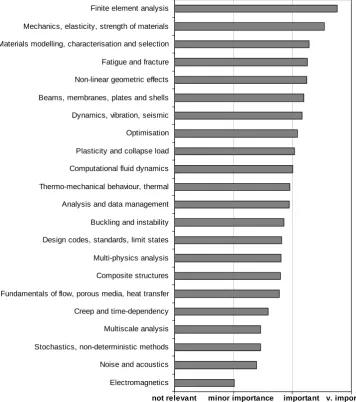
outcomes of the CCOPPS project to the wider engineering community through the EASIT2 project. Across industry sectors there was no significant difference in the overall trend except some obviously more important analysis areas (e.g. “composite structures” in aerospace, “electromagnetics” in consumer goods).
6: Survey results – Registered Analyst Scheme
In the questionnaire the RA scheme was referred to as a “professional qualification” to provide a clear distinction between this and the previous section on recording analyst competences. Respondents were asked whether such a qualification would be useful for their professional development or for their organisation and then they were asked to rate reasons why their
organisation would find it useful. In response to the first question, a significant majority (76%) selected “Yes”, showing that there is clear interest in industry for a professional qualification or formal registration of some form in
engineering analysis and simulation.
Respondents rated equally highly the following reasons why a qualification would be useful: incentive for staff development, marketing purposes, subcontractor qualification, internal resource management, marketing purposes. “Marketing purposes” was rated significantly more highly among SMEs and single analyst organisations than larger organisations. Directors and Project Managers tended to rate all the reasons as more likely.
Respondents were asked to select suitable methods from a list of assessment methods for a professional qualification in engineering analysis and then they were asked to select a maximum amount of money they would be prepared to pay for external assessment for such a qualification. For the former question, professional interview and manager/mentor were overall the most popular, both with about 23% of the responses. For the second question, about 25% of
Finite element analysis
Mechanics, elasticity, strength of materials
Materials modelling, characterisation and selection
Fatigue and fracture
Non-linear geometric effects
Beams, membranes, plates and shells
Dynamics, vibration, seismic
Optimisation
Plasticity and collapse load
Computational fluid dynamics
Thermo-mechanical behaviour, thermal
Analysis and data management
Buckling and instability
Design codes, standards, limit states
Multi-physics analysis
Composite structures
Fundamentals of flow, porous media, heat transfer
Creep and time-dependency
Multiscale analysis
Stochastics, non-deterministic methods
Noise and acoustics
Electromagnetics
[image:11.595.113.470.120.523.2]not relevant minor importance important v. important
Figure 5: Importance of analysis areas
7: Conclusions
incentives for staff development, marketing power and enhanced subcontractor qualification and internal resource management.
Responses to some of the questions confirmed that there exists a significant need in industry for the deliverables of the EASIT2 project. For instance, only 29% of respondents educated even to Doctorate level considered that their formal education related fully with their engineering analysis activity. 57% stated that no formal definition of the skills needed to perform analysis tasks existed in their own organisation while 70% responded that they had no system in place to record analyst skills. A large majority (81%) thought a system to define analyst skills would be useful.
Recruitment of suitably qualified and experienced staff and a lack of analysis skills were identified as the most significant barriers to the effective use of engineering analysis while “Pressure of work” was identified as the most significant reason why organisations fail to get the most out of engineering analysis software.
The findings of this survey are now being used in the development of the deliverables of the EASIT2 project (Educational Base, Competency Framework and revised Registered Analyst Scheme) to ensure that they meet the needs of the engineering analysis and simulation industry as much as possible.
8: Acknowledgements