City, University of London Institutional Repository
Citation
:
Sun, Z., Bruecker, C. & Pointz, B. (2016). Transition of A Vortex Ring Visualized by 3D Scanning TomoPIV. Paper presented at the 18th International Symposium onApplications of Laser Techniques to Fluid Mechanics, 4-7 Jul 2016, Lisbon, Portugal.
This is the published version of the paper.
This version of the publication may differ from the final published
version.
Permanent repository link:
http://openaccess.city.ac.uk/15664/Link to published version
:
Copyright and reuse:
City Research Online aims to make research
outputs of City, University of London available to a wider audience.
Copyright and Moral Rights remain with the author(s) and/or copyright
holders. URLs from City Research Online may be freely distributed and
linked to.
City Research Online: http://openaccess.city.ac.uk/ [email protected]
Transition of A Vortex Ring visualized by 3D Scanning TomoPIV
Zhengzhong Sun1,*, Benjamin Pointz2, Christoph Bruecker1
1: Dept. of Mechanical Engineering & Aeronautics, City University London, UK 2: Institute of Mechanics and Fluid Dynamics, Technical University of Freiberg, Germany
* Correspondent author: [email protected]
Keywords: Vortex ring, Tomographic PIV, Scanning PIV
ABSTRACT
A vortex ring with piston-based Reynolds number Rep=4650 is studied experimentally by means of time-resolved
scanning tomographic PIV. The present measurement technique provides the so-called 4D flow field, thus enables revealing the vortex ring’s transition from laminar to turbulent. The evolution of the ring torus as well as the generation of secondary vortex filaments in transition are first observed through 3D visualization. Analysis on the quantities of the vortex ring, such as circulation and vorticity components, defines the three evolution phases, namely laminar, transition and turbulent. The ring median plane is also examined to provide further insights on flow structure exhibited in transition. The axial vorticity component and radial velocity component are studied respectively and they are found to be organized in a multi-layer concentric-ring pattern. Spectrum analysis on the radial velocity component along the ring core and inner ring where secondary vortical activity happens reveals the dominate wavenumber in transition and broad band of wavenumbers in turbulent phase.
1. Introduction
is a recent development of the original scanning PIV [4] and an alternative voxel based tomographic velocimetry [5]. This work is also a continuation of previous work reported in 2012 in the laser conference [3]. The new results to be presented make use of the 3D cross-correlation of the reconstructed intensity volume, which resolves the entire measurement volume. In the next section, the experimental setup and the technical facts of the present scanning PIV experiment are briefly introduced. The result section first provides an overall understanding of the ring evolution through 3D visualization. Focus is later placed at the transition phase while spectrum analysis is also performed to give further insights. Conclusions on the transition process are finally summarized at the end of the paper.
2. Experimental setup
Fig. 1 Top view of the conceptual experimental setup.
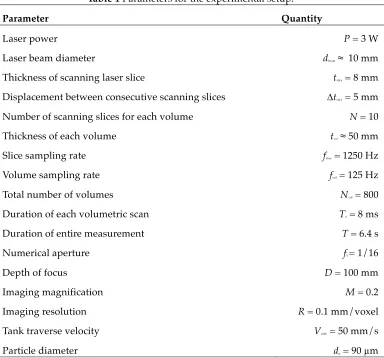
Table 1 Parameters for the experimental setup.
Parameter Quantity
Laser power P = 3 W
Laser beam diameter
Thickness of scanning laser slice
Displacement between consecutive scanning slices
dbeam≈ 10 mm
tslice= 8 mm
∆tslice= 5 mm
Number of scanning slices for each volume N = 10
Thickness of each volume tvol≈ 50 mm
Slice sampling rate fslice = 1250 Hz
Volume sampling rate fvol = 125 Hz
Total number of volumes Nvol = 800
Duration of each volumetric scan T0= 8 ms
Duration of entire measurement T = 6.4s
Numerical aperture f# = 1/16
Depth of focus D = 100 mm
Imaging magnification M = 0.2
Imaging resolution R = 0.1 mm/voxel
Tank traverse velocity
Particle diameter
Vtank = 50 mm/s
dp = 90 µm
3. Volumetric vector field recovery
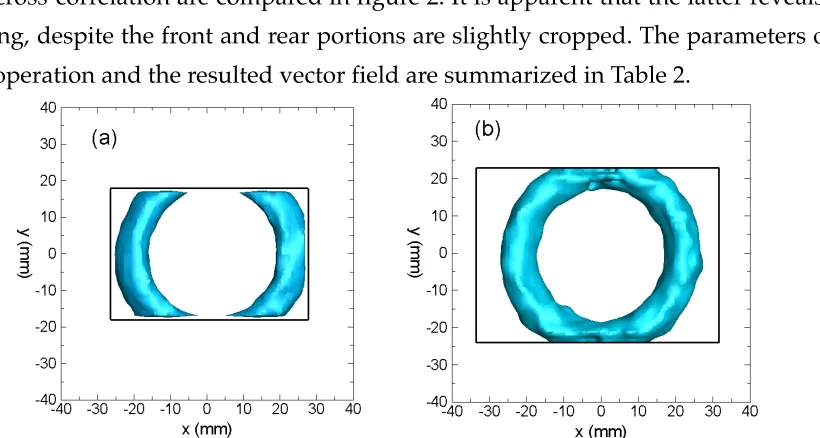
[image:4.595.107.491.275.633.2]reported extensively in the paper of Pointz [3]. The reconstructed intensity volume has 700x519x500 voxels. In the previous work [3], 3D least square matching (LSM) method provided by Dynamic Studio of Dantec Dynamics was used to calculate the particle displacement. However, the flow information at the edge of the volume cannot be recovered. This is due to the insufficient room at the boundary for the cuboid to search the matching particle intensity, which will be overcome in the latest version. 3D cross-correlation is used in the present work for vector calculation, making full use of the entire volume. The final interrogation volume for 3D cross-correlation is 40x40x40 voxels with 75% overlap. A total of 66x48x46 vectors are achieved in the volume with vector spacing of 10 voxels or 1 mm. The vortex ring returned by previous LSM and present 3D cross-correlation are compared in figure 2. It is apparent that the latter reveals almost the entire ring, despite the front and rear portions are slightly cropped. The parameters of cross-correlation operation and the resulted vector field are summarized in Table 2.
Fig. 2 Vortex ring returned by 3D LSM (a) and 3D cross-correlation (b), the ring is represented by isosurface of the
[image:5.595.104.514.244.463.2]same vorticity magnitude.
Table 2 Parameters of volume interrogation
Parameter Quantity
Voxel volume size 700x519x500 voxel
Final interrogation volume 40x40x40 voxel
Overlap of interrogation volume 75%
Number of vectors 66x48x46
Vector spacing 10 voxel or 1 mm
[image:5.595.105.491.541.682.2]3. Results and discussions
3.1 Characteristics of vortex ring and its evolution
The characteristics of the vortex ring is first discussed so as to deliver an overall understanding. The ring evolution is determined by its initial property, which largely depends on the generation mechanism. As introduced earlier, the present ring is generated by a piston nozzle. The velocity of the piston along the forward stroke is 155 mm/s. The piston nozzle outlet has a diameter of 30 mm. As a result, the ring has pistion-based Reynolds number of Rep=4,650. A separate laser
visualization experiment reveals that the generated ring has a travelling speed of 50 mm/s, which is later used for the traverse to lift the water tank.
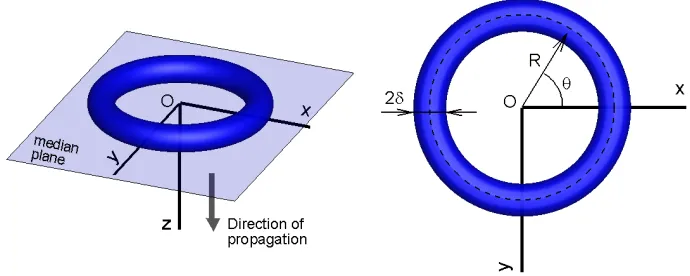
Fig. 3 Cartesian and cylindrical coordinate systems for the vortex ring.
The present scanning PIV experiment resolved the ring evolution for a total duration of 6.4 s with time separation of T0=8 ms. The total duration is long enough to resolve the evolution from laminar
to turbulent, while the time separation is fine enough to capture the temporal variation. The processed velocity fields are originally in Cartesian system, and they are later transformed into cylindrical coordinate system, commonly used in vortex ring or round jet study. The current coordinate systems are shown in figure 3. The azimuthal vorticity 𝜔"distribution along ring radius in the first snapshot is shown in figure 4, where the axial velocity distribution is also overlaid. The peak of 𝜔" appears at r=22.5 mm, which is taken as the ring radius R. The vortex
[image:6.595.121.466.257.395.2]Fig. 4 Distribution of azimuthal vorticity 𝜔" (red curve) and axial velocity w (blue curve) along radius.
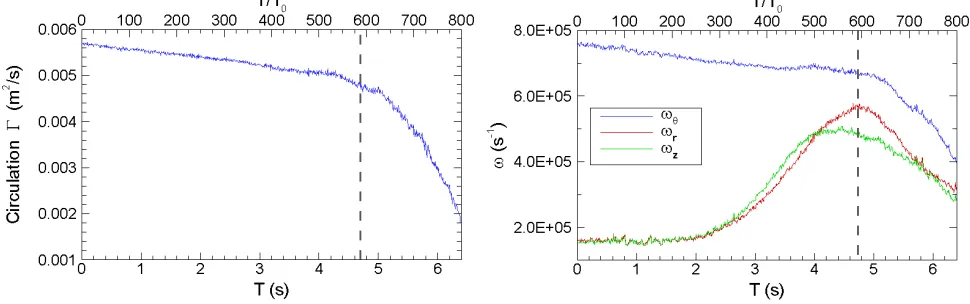
Fig. 5 Evolution of circulation(a) and vorticity components (b)
The variation of the circulation magnitude along the evolution gives an indication of each development phase. The vortex ring initially has circulation of Γ0=0.0057 m
2/s. The decay of
circulation, as visualized in figure 5(a), can be divided into two major phases. The first phase is from the beginning to T=4.7s or 590T0. It is featured by a steady decay. At the end of the first stage
82% of the initial magnitude still remains. However, a “circulation catastrophe” is exhibited in the next phase, where more than 50% of the initial circulation is rapidly lost within 1.8s or 210T0. The
dramatic drop is due to the dissipation after the vortex ring turns into turbulent. The evolution of each vorticity component as shown in figure 5(b) offers further details in the two phases. The quantity of vorticity component at each snapshot is calculated through summation of each component within the entire volume. The azimuthal component ωθ experiences two stages of
decay, similar as circulation. The magnitudes of the radial ωr and axial vorticity ωz components
remain minimum before T=2s or 250T0. Generation of both components takes place as soon as the
[image:7.595.189.412.75.213.2] [image:7.595.56.541.262.414.2]peaks with a slight delay at T=590T0, coinciding with the beginning of ‘circulation catastrophe’. As
a result, the initiation of turbulent phase can also be represented as the peak of radial vorticity. So far the evolution of the vortex ring is divided into laminar (T/T0 = 0~250), transition (T/T0 = 250~590)
and turbulent phase (T/T0 > 590). The fluid dynamics properties of the present vortex ring are
[image:8.595.107.489.192.371.2]summarized in table 3.
Table 3 Fluid dynamic properties of the vortex ring
Parameter Quantity
Ring radius R = 22.5 mm
Core radius δ= 8.4 mm
Slenderness ratio 𝜀 = 𝛿 𝑅 = 0.37
Wavenumber n = 6
Initial circulation Γ0 = 0.0057 m2/s Piston-based Reynolds number Rep = 4650
Laminar life span 250T0
Transition lift span 340T0
3.2 Evolution of the vortex ring
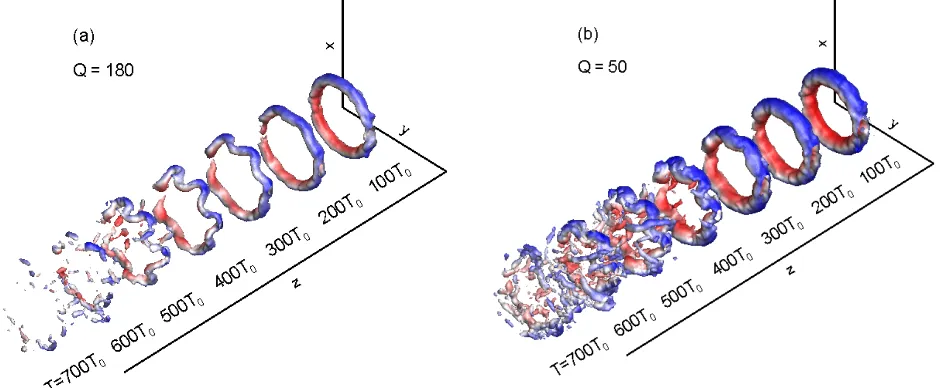
The vortical structure along the evolution process is going to be addressed in this section by taking advantage of the three-dimensional measurement technique. 7 snapshots from T=100T0 to 700T0
are selected to represent the ring at the laminar (100, 200T0), transition (300, 400, 500T0) and
turbulent (600, 700T0) phases respectively. Q-criterion is used for vortex identification.
Fig. 6 Evolution of the vortex ring in laminar phase (100T0, 200T0), transition phase (300T0, 400T0, 500T0), turbulent
[image:8.595.67.537.492.686.2](a) (b)
(c) (d)
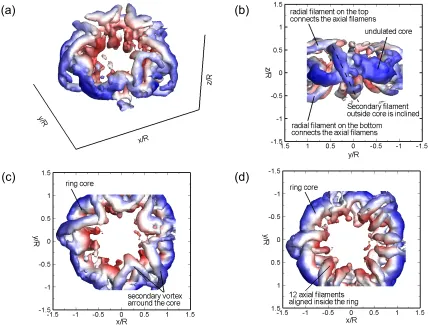
Fig. 7 Vortex ring at T/T0=500 represented by isosurface of Q=30. The vortex surface is colored by the magnitude of
axial velocity: (a) isometric view, (b) side view, (c) top view, (d) bottom view.
A large value of Q=180 is first chosen to visualize the evolution of the ring core, see figure 6(a). The torus remains a smooth ring in the laminar phase. Undulation of the ring core can be observed at 300T0, nearly at the beginning of transition. It results in the development of 6 standing waves
along the ring azimuth, which confirms the empirical estimation. The wave amplitude grows gradually in downstream propagation. Upon entering the turbulent phase from T/T0=600, the ring
core is no longer a complete torus and starts to break up into fragments. Since the torus is subject to rapid decay in circulation in the turbulent phase, it is not surprising that only tiny fragments can be observed at T/T0=700.
[image:9.595.72.500.77.403.2]weaker than the ring core. The axial secondary filaments sustain in early turbulent phase at
T/T0=600. However, they eventually dissipate together with the core into turbulent eddies in much
smaller size.
The ring in the late transition at T/T0=500 is selected and plotted individually in figure 7 for the
purpose of revealing its vortical organization. The secondary vortices extend in both axial and radial directions and wrap around the ring core. The portion located outside the ring core as shown in figure 7(b) is inclined from the axis. This vortex is usually referred as halo vortex, which further extends radially above and below the ring core and finally connects with axial filaments inside the ring. The secondary vortices above the ring are shown in figure 7(c). The pattern resembles hexagram, although one angle is missing due to the weak strength in that corner. The number of the axial filaments within the torus is 12 and is clearly visualized in figure 7(d).
3.3 The median plane in the transition phase
The present section explores the flow features associated with transition in the median plane at
z=0, where the most prominent signature of transition is contained. Note that the location of the median plane is illustrated in figure 3. Evolution of the axial vorticity component in the median plane is first shown, see the contours of ωz in figure 8. The axial vorticity component is important
because the secondary vortices are most evident in axial direction. Moreover, the ring core starts to obtain axial vorticity magnitude initially when torus undulation begins. The distribution of ωz
features three concentric rings: the central one belongs to the ring core, while the outer and inner layers represent the secondary vortex filaments. A striking feature of ring-shaped organization is the packets of ωz with alternating signs, which suggests the 180° phase difference between the
neighboring filaments. In the early and middle stages of transition, namely 300T0 and 400T0, the
vorticity packets align strictly along the three rings. The spacing between packets in the 1st, 2nd and
4th quarters is compact, while that in the 3rd quarter is coarser. Although similar three-layer
structure and opposing patterns can be observed in the late transition (500T0), in-plane motion of
the packets already takes place and gives rise to distortion.
The radial velocity component is also of great interest as it represents the secondary flow motion caused by vortical activity. The distribution of ur, see figure 9, is also organized in focused patterns,
which are aligned along concentric rings. Again, regularity of the pattern is not well followed in the 3rd quarter. For example, the packet containing positive u
r does not show up in the 3rd quarter in
300T0 and 400T0. Therefore the undulation in the 3rd quarter is delayed comparing to the other
Fig. 8 Contour of axial vorticity ωz in the median plane z=0 at T=300T0 (a), 400T0 (b), 500T0 (c).
Fig. 9 Contour of radial velocity ur in the median plane z=0 (a) 300T0, (b) 400T0, (c) 500T0.
The present measurement technique enables to examine the temporal variation of the radial velocity spectrum along the ring azimuth, which adds further insight into the development of the instability in the ring. The radial velocity component along two circles with radii r/R=0.6 and 1.0 are first extracted from the volumetric flow field. These two circular locations go through the major and inner ring respectively. The extracted radial velocity are then stacked along the temporal axis as shown in temporal-azimuthal plane in figure 10. In the initial phase till about 300T0, no
prominent pattern can be seen. Stripes with altering ur start to develop later on and they grow
throughout the transition phase towards 600T0, which confirms the phase classification based on
the vorticity growth. From 600T0 onward, the stripes do not remain straight and divided. Instead,
[image:11.595.60.536.58.215.2] [image:11.595.50.544.261.418.2]Fig. 10 Temporal evolution of the radial velocity extracted form circle with radius of (a) r/R=1.0 (b) r/R=0.6.
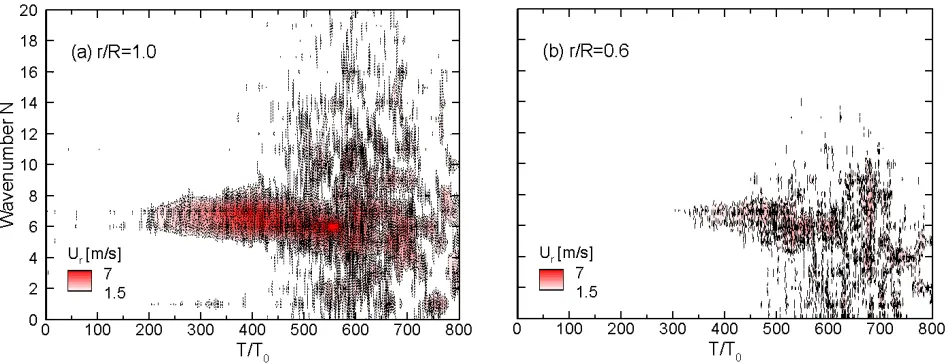
Fig. 11 Temporal evolution of wavenumber for the radial velocity extracted form circle with radius of (a) r/R=0.6 (b)
r/R=0.6.
FFT of the radial velocity distribution in figure 10 is carried out and the decomposed radial velocity amplitudes are presented in the temporal-wavenumber space, intending to reveal the temporal evolution of the embedded wavenumber. In the circular location at r/R=1.0, namely the center of ring core, peaks belong to dual wavenumbers of 6 and 7 can be observed from 200T0 to
about 500T0, suggesting that the major portion of transition is actually dominated by two
wavenumbers. However, the peak of N=7 starts to decay from about 500T0, which means the late
[image:12.595.62.538.266.448.2]The spectrum of the secondary activity is inspected through the circular location at r/R=0.6, see figure 11(b). Peaks of N=6 and 7 are evident in the transition phase, however, with reduced magnitude than that in the core. The peak of N=7 does not emerge from about 320T0, when the
axial vorticity is produced. In the late transition from 500T0, the secondary activity is taken over by
wavenumber of N=6. Similarly, broader and intermittent wavenumbers appears in the turbulent phase.
4 Conclusion
The present experimental work examines the temporal evolution of a vortex ring. The observation takes advantages of the time-resolved 3D measurement technique. The ring evolution is divided into laminar, transition and turbulent phases based on the variation of the vorticity components as well as the ring circulation. In the laminar phase, the vortex ring undergoes steady decay in circulation however no significant deformation happens. The transition phase has a duration twice of the laminar phase. It features the undulation of ring torus and generation of secondary vortical filaments surrounding the torus. Analysis on the axial vorticity and radial velocity in the median plane provides more details of the flow pattern in the transition phase. Both quantities are organized in concentric patterns with alternating signs. However, along each layer of the ring pattern, all the packets are not evenly aligned, instead they tend to be compact in one direction resulting the packets on the opposite corner with lager spacing and weaker intensity. Spectrum analysis on the radial velocity along the circles provides further insight throughout the evolution. It has been revealed that radial velocity along the ring core feature dual wavenumbers of 6 and 7 in transition phase, however, wavenumber N=6 is more dominant in the late transition. The inner ring location, where the secondary vortical activity takes place, is initially affected by N=6 while N=7 takes over in the late transition. The final turbulent phase is dominated by a broad band of wavenumbers, which are weaker intensity and also intermittent in duration.
References
[1] Archer P, Thomas T, Coleman G (2008) Direct numerical simulation of vortex ring evolution from the laminar to the early turbulent regime. J Fluid Mech 598:201-226.
[2] Dazin A, Dupont P, Stanislas M (2006) Experimental characterization of the instability of the vortex ring Part I: linear phase, Exp Fluids 40:383-399.
[3] Pointz B, Sastuba M, Bruecker C, Kitzhofer J (2012), Volumetric velocimetry via scanning back-projection and least-squares-matching algorithms of a vortex ring, 16th Int Symp on Applications
[4] Brücker Ch (1995) Digital-particle-image-velocimetry (DPIV) in a scanning light-sheet: 3D starting flow around a short cylinder, Exp Fluids 19:255–263.
[5] Elsinga G, Scarano F, Wieneke B, van Oudheusden B (2006) Tomographic particle image velocimetry, Exp Fluids 41:933-947.
[6] Pointz B, Sastuba M, Bruecker C (2016) 4D visualization study of a vortex ring lift cycle using modal analysis, J Vis 19:237-259.