1
Transfer Agents, Knowledge Authority, and Indices of Regulatory Quality:
Abstract
In the past two decades, international organizations have been designing and promoting transnational benchmarks for evaluating the quality of governance. The World Bank and the Organisation for Economic Co-operation and Development have been competing in devising and legitimizing indices across policy areas. Previous studies have demonstrated how
international organizations can influence national governments by means of governance indices. However, a comparative analysis is still missing of the choices international
organizations have made in establishing their own indices of good governance. By focusing on regulatory reform, this paper attempts to fill this gap. It first sets a framework to compare the different types of authority that organizations can pursue through benchmarking. It then applies this framework to the specific case of the Organisation for Economic Co-operation and Development and the World Bank, to examine how they differ in their conceptions of and use of policy benchmarking.
Correspondence address: Dr Fabrizio De Francesco, School of Government and Public Policy, University of Strathclyde, Glasgow, UK. Email: [email protected]
In the last two decades, the Organisation for Economic Co-operation and Development (OECD) and the World Bank (WB) have attempted to causally link good governance to economic growth and social development (Holmberg, Rothstein and Nasiritousi 2009, Dellepiane-Avellaneda 2009). Cross-national research has proven that the quality of
institutions matters: market-oriented and investor-friendly public policy promotes economic growth. In an attempt to have “tight, objectified links” (Noordegraaf and Abma 2003: 853) between governance and economic performance, both the OECD and the WB have been engaged in the design and the evaluation of many comparative measures.
Recent surveys have identified approximately 140 measures of the quality of national governance (World Bank Institute 2006), as well as 178 composite indices of country
performance (Bandura 2008). The overall system of governance indices can be explored only through guides and inventories (Arndt and Oman 2006: 30). The purposes and functionalities of indices have evolved, and an ever-increasing number of them supply the growing market for policy benchmarking. For instance, Porter (2012) counted 83 measures dedicated to social and environmental policy. While the first generation of good governance indices aims to rank countries according to their overall quality of democratic and institutional settings, and attempt to evaluate, for example, political instability, political rights, civil liberties, and freedom of information and the press, the second generation is designed to correlate and compare national policy processes with economic outcome.i
good governance (Pollitt 2001, 2002). Cross-sectional time-series analyses of policy performance have become central in the discourse around the modernization of public administration and evidence-based decision-making (Erkkilä and Piironen 2010, Pal 2012). By setting global standards of policy evaluation (Davis et al. 2012), IOs are nodal points capable of framing and promoting policy reforms (Sahlin-Andersson 2001, Sahlin-Andersson and Engwall 2002, Pal 2003, Pollitt and Bouckaert 2004). Ultimately, data sets provide benchmarks, rankings and comparative knowledge and increase the interdependence of governments within transnational networks through both learning and competition.
Although several scholars have agreed on the role played by the OECD and the WB in diffusing new policy ideas and best practices (Stone 2003, Marcussen 2004, Orenstein 2008, Mahon and McBride 2009, Pal 2012), a comparative analysis of their employment of policy benchmarks is still lacking. As devices of transnational governance (Martens and Jakobi 2010, Porter 2012, Davis et al. 2012), indices are a source of the authority for the OECD and the WB as agenda-setters (Ougaard 2010) and transfer agents (Stone 2004). In order to promote policy reforms and to accomplish their missions,ii the OECD and the WB use indices to influence national governments and to communicate with donors, investors, and the general public. However, this paper argues that the two transfer agents have different motivations, produce different types of knowledge (Kramarz and Momani 2013), and, consequently, rely on indicators with different characteristics.
2012). To clarify, this “descriptive argument” (Gerring 2012) is not about the actual influence and impact of indicators on domestic policy (see Pal 2012, Chapter 6, Alasuutari and
Rasimus, 2009, Gibbs and Luczak 2010 for examples of such an analysis). Instead, it derives functional typologies of governance benchmarks.
The choices of the OECD and the WB are analyzed through four case studies of indices of regulatory quality (two from each organization). These indices unify political economy recommendations for liberalization and the institutionalist turn of the OECD and the WB. Given the high level of competition between these suppliers of regulatory reform, one can expect distinctness in benchmarking.
The remainder of this paper is structured as follows. The next section reviews the literature on the technical, conceptual, and political uses of governance indicators. Section 3 puts forward an analytical framework in which the WB and the OECD are set as transfer agents in search of knowledge authority through their benchmarking activities. Section 4 presents a comparative analysis of the four indices of regulatory quality, and Section 5 concludes.
Governance Indices and the Role of International Organizations
There is a fast-growing literature on the composite indices that are used to measure country performance. Following Van Dooren (2009), this literature can be reviewed
data, as well as the transparency and replicability of the methodology (Arndt and Oman 2006, Arndt 2008, Pollitt 2011a).
Second, the concepts to be measured through the use of indices are often contested (van de Walle 2006, 2008, 2009). Governance, for instance, is an all-embracing (Knoll and Zloczysti 2011: 2) and technocratic (Hirst 2000) concept associated with particular
characteristics of democratic regimes, such as the rule of law, accountability, the separation of powers, the existence of checks and balances on the executive, and citizens’ deliberation and participation. Governance can be associated with either specific state functions or informal institutions (Knoll and Zloczysti 2011: 2). Furthermore, it can capture the
transformation of state–citizens relationships. Governance can be also a normative concept meant to measure and promote standards of democracy and state effectiveness (Knoll and Zloczysti 2011: 2), although the underlying normative notion does not often rely on theoretical foundations (Arndt and Oman 2006), as Arndt (2008) discusses specifically in relation to the WB’s “World Governance Indicators” (WGI).
Scholars interested in the political influence of indices have assessed their impact on domestic policy by relying on either a rationalist or a constructivist approach. Rationalist scholars argue that IOs use transnational policy benchmarks for hegemonic purposes (Bonal 2002, Rubenson 2008). For instance, the WB provides loans according to governance indices. On the contrary, social constructivist scholars argue that benchmarks are learning tools. Regular discussions and evaluations of policy outcome lead to the development of “a common value system at the level of civil servants in the OECD countries that should form the basis for consensually shared definitions of problems and solutions in economic
Socialization and identity formation are at the heart of the OECD mechanism of governance (OECD 2004: 4, Porter and Webb 2008).
By transcending the debate between rationalist and constructivist scholarship, several studies have focused on the functional features of governance indices. As technological devices of power and governance at a distance (Noordegraaf and Abma 2003: 856; Davies et al. 2012), indices activate a myriad of communicative relations and connect a dispersed set of actors and objects (Porter 2012). Furthermore, they have “the potential to alter the forms, the exercise, and perhaps even the distributions of power in certain spheres of global
governance” (Davis et al. 2012: 72).
Policy benchmarks have been assessed through their functional features. Groenendijk (2011), for example, has compared the European Union’s open method of coordination with the OECD benchmarking system. Although both are voluntary, cooperative, and open to the particular needs of each member state, he concluded that the OECD’s system is more effective in enhancing policy learning than the European Union’s method. By taking into account the attractiveness, unintended consequences, and methodological transparency of the measurement of national policy performance, Pollitt (2011a, 2011b) has argued that the prominence of governance indices is a symptom of the rise of hypermodernist conception of government. Porter (2012) has relied on actor network theory to emphasize the consequences of the knowledge produced through governance indices and the OECD peer review
mechanism. Peer review is less open to contestation and is more capable of connecting transnational actors than are rankings. Davis, Kingsbury and Merry (2012) have compared the WB Doing Business Indicators with the Human Development Index, by taking into account their design, production, effects, contestation, and regulation.
856). In this light, the authority of such transnational evaluators coincides with the
functionality of their indicators (Mahon and McBride 2009, Davis et al. 2012, Kramarz and Momani 2013). Transnational policy evaluators provide comparative knowledge that national policy-makers are not able to produce (Conzelmann 2010). Benchmarks set standards for monitoring, auditing, and ranking countries’ policy performance (Davies et al. 2012). And the OECD and the WB promote political and economic reforms that adhere to their evaluative standards. Provided that the scope, procedure, and methodology of policy benchmarking are perceived by member states as appropriate and legitimate (Cronin and Hurd 2008: 12, Conzelmann 2010), governance indices are instruments for “naming and shaming,” “horse races” (Benner, Reinicke and Witte 2004), and “aid-allocation conditionality” (Arndt 2008, Knoll and Zloczysti 2011). As a result, the authority of their benchmarking systems allows the OECD to act as a transfer agent (Stone 2004), and the WB to perform as a knowledge bank (Stone 2003, Kramarz and Momani 2013).
Several single-case studies and matched comparisons of governance indices have identified the elements of governance indices (Conzelmman, 2010, Pollitt 2011a, Pollitt 2011b, Groenendijk 2011, Davis et al. 2012, Kramarz and Momani 2013). However, there is still the need for a coherent analytical approach in order to avoid the risk of overlooking important politico-administrative and technical aspects of benchmarking. The next section proposes a framework to distinguish modes of benchmarking and to associate them with different mechanisms of policy interdependence. The framework allows us to assess the variation in the design and use of regulatory governance indicators.
Transfer Agents, Knowledge Management, and the Features of
Benchmarking
“ideational agencies” which transform and depoliticize international best practices (Marcussen 2004, Groenendijk 2011, author 2013). To do so, the OECD and the WB conceive, design, and market prototype instruments for policy benchmarking.
In such a contested environment, expertise in the design of benchmarking indicators is prominent (Davis et al. 2012: 87). The development of indicators resembles the production of scientific knowledge. An indicator builds on theoretical concepts, here principally
statistical properties, as well as on networks of experts. Transnational networks of expertise determine the authority invested in any particular set of indicators, and that in turn is shaped not only by technical factors, but also by relational interactions among the actors involved in policy benchmarking (Davis et al. 2012: 88). An analysis of such relationships reveals that benchmarking encompasses two opposing concepts: benchmarking as competition and
benchmarking as collaboration (Wolfram Cox, Mann and Samson 1997). Benchmarking is “conceived as a measure to assist the gaining of superiority over other/s”. The aim of
benchmarking is “learning with others rather than gaining position over them” and “[t]he
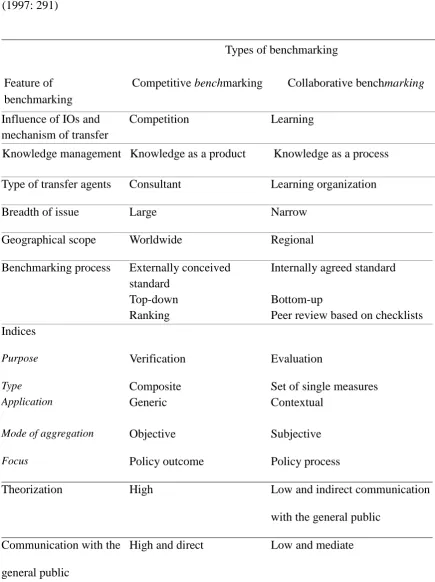
dominant relationship is joint collaboration.” It follows that the features of benchmarking indicators that may be used to characterize them result from “the nature of benchmarking projects” (Wolfram Cox, Mann and Samson 1997: 291).
Table 1 summarizes the analytical framework that encompasses models of knowledge development and benchmarking concepts, as well as the methodological and technical
by means of benchmarking, combining in a unitary framework both rationalist and constructivist approaches. This framework provides an extremely useful dimension for categorizing the entire universe of governance indices.
INSERT TABLE 1 ABOUT HERE
Following Kramaz and Momani (2013), the literature on knowledge management provides two analytical distinctions. Knowledge can be regarded as generic, to produce comparative knowledge of country policy performance, or functional, to produce learning (Lundvall and Tomlinson 2002, Groenendijk 2011). As a product, knowledge can be codified and stored. IOs that are engaged in delivering a commercial product need information
technology and operational processes to make the transfer of best practices more effective. By creating thematic groups and communities of practice, knowledge can be also produced in contextual and dynamic ways through relational interactions (Kramaz and Momani 2013: 417). In other words, “[n]etworks are also the means by which organizations individually and in coalition project their personnel and ideas into policy developments across states and within global and regional forums. Through networks, participants can build alliances, develop a common language, and construct shared knowledge” (Stone 2003: 51).
Turning to the type of transfer agency, and at the cost of oversimplification, an IO that privileges knowledge as a product is similar to a consultancy that follows a rigorous
methodology for collecting, analyzing, and feeding back objective data. Such organizations establish their authority through their roles as advisors, experts, or solution providers
(Caldwell 2003: 137, Kramarz and Momani 2013: 417). In contrast, a learning organization combines inside knowledge and external expertise. Learning is a collective process in which network members work collaboratively and constantly renew and improve their
organizational activities (Caldwell 2003: 138–139).
Groenendijk 2011). Benchmarking is a standard-driven process, external to national governments. IOs compare countries by relying on their own information and knowledge resources. Furthermore, this type of benchmarking tends to spur competition among countries, with “rival entities” being ranked according to policy results. Rank-ordered structure is a technical property of indicators and refers to scaling methods such as ordinal scale, equal-interval scale or ratio scale (Davis et al. 2012: 76). Thus, governance
benchmarks are broad, encompassing numerous concepts and issues (Pollitt 20011b). They rank countries of the world according to policy outcome, through the use of composite indices (Groenendijk 2011).
In contrast, by relying on shared evaluation standards, internal benchmarking is collaborative and involves a joint effort from IOs and their member states. In essence, it is about “learning from others” and it tends to measure policy process. Furthermore, peer review is functional to learning and involves benchmarks of the specific context of a limited number of members of the learning organization (Groenendijk 2011).
The technical property of governance indices is consistent with the type of measurement procedure (Conzelmann 2010). Indices can be classified according to the objectivity of data sources and the weighting of governance benchmarks (Radaelli and De Francesco 2007). The literature on policy evaluation and measurement distinguishes between two broad purposes of indicators. Indicators can be used either for verification or for
that consider benchmarking as an empowering and learning process. The emphasis is given to informants and affected stakeholders. Peer review indicators are more contextualized: a number of indicators are chosen from a range and are left disaggregated. Their validity needs to be cross-checked by using different information sources and methodologies.
The last feature considered in the table is a benchmark’s capacity to reduce the complex nature of reality (Van Dooren 2010: 2, Arndt and Oman 2006; Arndt 2008).
Theorization is an institutional condition of diffusion: “General models facilitate meaningful communication and influence and influence between weakly related actors, and between theorists and adopters” (Strang and Meyer 1993: 493). Accordingly, one can expect benchmarking based on theoretical insights to have a strong influence on the agenda of scientists and the mass media. The proposition is that ranking with strong theorization allows IOs to have direct communication with the general public, for instance through publications.
Comparing Transnational Regulatory Benchmarks
Measurement has been applied in many areas of public policy, such as budget,
Ranking Countries: Regulatory Reform Measured by the WB
The WB has developed several sets of governance indices. The most widely recognized index is the DB. Since 2003 and through a series of annual reports, the DB project ranks countries according to the intrusiveness of various sorts of regulations on business activities (Davis and Kruse 2007: 1097). Regulation is measured throughout the life cycle of a local business. The DB project is part of the WB’s general efforts to enhance the productivity of the private sector and in turn reduce poverty. It has the following four functions:
the ranking and meaningful comparisons of 183 countries’ regulatory environments are used to trigger public demands for deregulation;
policy-oriented indicators and the theoretical relationship between indicators and economic performance help to identify the reforms required in any particular country;
the rankings are used in the allocation of aid and in monitoring use of the WB’s development grants; and
the time-series cross-sectional data produced with the DB are used to test theories of regulatory capture and barriers to market entry.
country’s annual progress towards regulatory reform.
Turning to the methodology, there are five steps in the data collection:
direct analysis of the content of regulations on each specific business activity;iii
surveys of local experts;
discussion of any data differences between the direct analysis ad the survey;
refinement of the questionnaire and further data collection; and
enhancement of data robustness.
Independent Evaluation Group recommended caution in the use of the ranking, and stated that it should be complemented by other country-specific information, in order to
contextualize the theoretical assumptions underpinning this regulatory benchmark. Overall, the WB challenges countries to follow the deregulatory model.iv The BD ranking is obviously not cooperative, but triggers competition among countries to deregulate their business and commercial law, since comparative data on the extent of regulation is available worldwide. The DB reports published by the WB explicitly invites donors of foreign aid, high-level government officials, investors, the media, and the general public to use these indicators as benchmarks against which to assess the performance of various countries and to establish a basis for demands for reform (Davis and Kruse 2007, World Bank 2004: ix–x).
The selection among the existing indicators and the techniques of aggregation are both subjective and controversial (Arndt and Oman 2006, Andrews 2008). The aggregation starts with the calculation of a simple, unweighted average of all the existing indicators of a single source. But in the later stages of aggregation a weight is attributed to each selected indicator according to the strength of its correlations with other indicators (Arndt and Oman 2006). The positive feature of this governance benchmarking system is that it makes explicit and takes into account the substantial margins of error in subjective data sources. However, the same margin of error—Kaufmann and associates (2003) argue—exists in objective measures as well when they are used to portray broader concepts, such as regulatory quality or the efficiency of governance.
Similarly to the DB indicators, the RQ does not rely on government sources. But data sources are in this case perceptions-based, and “include surveys of firms and households, as well as the subjective assessments of a variety of commercial business information providers, non-governmental organizations, and a number of multilateral organizations and other
public-sector bodies” (Kaufmann et al. 2010: 5). Benchmarking has a competitive purpose and, in this case again, the ambition of the WB is to urge governments to pursue
deregulation. The great difference between the two WB benchmarking systems is what they measure. The RQ is clearly a broad index that refers to the overall outcome of a country’s regulatory policy. RQ is not policy-oriented as the DB. Furthermore, it is not based on any specific theory of regulation or governance (Arndt and Oman 2006, Andrews 2008).
Peer Review: Regulatory Reform Measured by the OECD
the more operational Group on Regulatory Policy,vii which has updated the “recommendation on regulatory policy and governance,” which provides the template for peer reviewing government capacity to assure high-quality regulation.
Differently from the WB, “[t]he OECD operates with a special mix of research and country participation” (Pal 2008: 72). Member states agree on the OECD’s research agenda and are involved in the peer review, commenting on country reports before publication. The OECD’s peculiarity is that it can draw on the willing support of its members (and other states) to provide “inside” information about what governments are doing in specific fields. The participation of governments is a constant in all key activities and governance
mechanisms of the OECD. In particular, the OECD influences its members through: seminars and workshops, peer-to-peer visits by government delegations, and best practice; didactic country reports that make evaluations against global standards (for example the 2005 report on China argued for major reforms in public and corporate governance); networks of national officials on specific policy issues (for example the network of Senior Budget Officials); guidelines on the adoption of policy reforms and innovations (for example the guidelines on Managing Conflict of Interest in the Public Service); checklists and frameworks for policy-makers (for example Public Sector Integrity: A Framework for Assessment); and surveys of governments on their practices.
Overall, the OECD peer review process is:
added)
In other words, peer review is an instrument with which to collect information on members’ policy performance and to evaluate this information in the light of shared
standards, norms, and principles (Conzelmann 2010: 1). It is a mechanism of accountability in public policy networks (Benner, Reinicke and Witte 2004). It is also an informal
instrument of pressure through which ideas and standards advocated by a majority of
member states gain agreement (Sullivan 1997: 99). Comparative statistics and best practices not only produce “a constant enticement to encourage ‘laggards’ to catch up to ‘leaders’” (Pal 2009: 12), but also structure multilateral surveillance in the implementation of policies
(Marcussen 2004). The most relevant aspect of this process of networked governance is the production of mutual education. In a nutshell, the OECD’s ambition is “to hard wire
indicators into an ongoing global conversation among practitioners about good governance, in order to facilitate lesson-drawing mechanisms” (Pal 2009: 14).
regulatory quality. The IPMR system refers to specific aspects of the extent of regulatory intervention. Yet, the IPMR rely on periodic surveys of the national administrations (Conway, Janod and Nicoletti 2005: 3). There is, thus, still a strong element of collaboration.
IRMS, instead, are drawn from a checklist based on the OECD’s recommendations on regulatory reform and governance. These recommendations in turn shape the peer review of government capacity to assure high-quality regulation. This benchmark aims to reveal trends across countries (OECD Regulatory Policy Committee 2009: 6). Rather than focusing on the extent of regulation, IRMS measure the quality of regulatory institutions and tools such as: regulatory oversight bodies; reductions in administrative burden; effective consultation and public participation; cost–benefit analysis and impact assessment; and indicators of
regulatory performance and outcomes. The measurement is conducted on the process for making and revising regulations. IRMS are a powerful means of communicating reforms to policy-makers. They highlight priority areas for further action, demonstrate consistency between recommended action and positive outcomes, enhance the legitimacy and accountability of regulatory reform, and raise awareness of regulatory quality (OECD Regulatory Policy Committee 2009: 10). This type of indicator facilitates learning. The aggregation occurs only at the meso-level, of regulatory institutions. The system is
participatory. Governments agree on a set of recommendations and checklists and actively participate in the collection and interpretation of data, information, and knowledge on
regulatory quality. Overall, IRMS aim to empower governments to proceed in their efforts on regulatory reform.
Comparing Choices for Benchmarking
The WB generally provides knowledge as a product. Its indices are well known by international investors and donors. Furthermore, the WB uses a type of benchmarking, namely ranking, that triggers regulatory competition among countries. As a consequence, its communication strategy is extensive and addresses not exclusively national governments but also the scientific community (Kramarz and Momani 2013), as well as the general public (that is, the mass media and citizens) (Davis et al. 2012: 93). The WB expends enormous effort in publishing annual reports that include both indicators (DB and RQ) in order to create easily accessible data sets. This visibility has been appreciated by academics, who have helped to improve the methodology for collecting and aggregating information (Arndt and Oman 2006, Andrews 2008, Davis and Kruse 2007, Davis et al. 2012).viii
It is important to note that the DB project promotes best practice by relying on the theoretical assumption that less regulation facilitates better business outcomes and triggers economic growth. Furthermore, the DB project triggers more competition than the RQ indicator. The former is more objective with respect to the selection and aggregation of data as well as being policy-oriented, specific, and relevant for policy-makers.
Turning to the OECD, this organization has sought to manage its knowledge as a process and to promote its policy recommendations and international best practice through learning. Its main aim is to promote comparative knowledge and to share experience of regulatory reform among its member states. The peer-review process is mainly internal to the learning organization. Both the data sources and the reviewers are governmental. In
institutions and rulemaking process. There is no attempt to prove any theory or to correlate reform efforts with economic growth and performance. Overall, IPMR generate less learning, since no specific model is attached to the proposed reform. Instead, the IRMS is based on well-established recommendations and guidelines for reform. These are a blueprint for sharing information on regulatory reform and learning from the experience of other governments.
Conclusion
By focusing on regulatory governance, this paper has argued that different types of
transnational benchmarking are used by the OECD and the WB. Some governance indices trigger competition. Others facilitate learning. In designing regulatory governance indices the OECD and the WB have made different choices for establishing the authority of their own benchmarks. Similarly to the work of Wolfram Cox et al. (1997) on the benchmarking of the private sector, an analytical framework of policy benchmarking has been proposed to capture the interrelationships between IOs and national governments. Any effort to classify
governance indices should take into account the competition/collaboration typology of benchmarking.
By conceiving indicators as a technology of transnational governance, the framework enables us to bring together two contrasting perspectives on the influence IOs achieve
through their benchmarking: the hegemonic use of rankings, and the ideational role of
communicating the outcome of its ranking activities to international investors and donors, as well as the public, through the mass media.
The competition–collaboration continuum has captured variation across indices conceived by the same IO as well as different IOs. The framework also captures the authority of IOs as policy evaluators. Both the IOs considered here are marginally converging to the middle point. The WB is reconsidering the use of the DB rank, and indeed the contribution of other data sources is now necessary in order to contextualize the assessment of regulatory quality in that model. In other words, the WB has recognized the need “to foster a
collaborative culture, integrating multiple perspectives into the Bank’s work, especially from developing countries, and promoting knowledge sharing and learning” (World Bank 2010: v).
Turning to the OECD, this organization is extending the geographical scope of its transnational governance model. Since 2010 Chile and Israel have become new members; and Brazil, China, India, Indonesia, Russia and South Africa are now “key partners.” In addition, the OECD has become increasingly sophisticated in the statistical use of data collected through peer review, in order to discover general patterns of regulatory reform and clusters of countries (Wölfl et al. 2009, Jacobzone et al. 2010).
Overall, this descriptive analysis contributes to the conceptualization of transnational governance by highlighting the functions and the technical elements of policy benchmarking. As a result, this contribution facilitates future research on the impact of transnational
i Here I take a different perspective to the one taken by Knack, Kugler, and Manning (2003), who depicted the evolution of governance indices in terms of the legitimization of the methodology and the credibility of the data collected.
ii Article 1 of the OECD Convention states that the mission of the OECD is to promote among its members economic and trade expansion policies. The WB has a similar mission: to collect, disseminate, and share knowledge (Kramarz and Momani 2013: 409).
iii The data set now contains 10 firm activities: starting a business, dealing with construction permits, getting electricity, registering property, getting credit, protecting investors, paying taxes, trading across borders, enforcing contracts, and resolving insolvency. It is important to note that the sub-index of “employing workers” has been excluded from the last two publications. There is an ongoing discussion on the most appropriate methodology to find the right balance between regulatory flexibility, enough to help those currently unemployed or working in the informal sector to obtain new jobs in the formal sector, and regulatory protection for those already holding a job, so that their productivity is not stifled. It is interesting to note that the WB faces difficulties when the “less is more” maxim cannot be theoretically applied to the regulatory sector.
iv This is clearly emphasized in several italicized headings such as: “Simplify and deregulate in competitive markets” or “Reduce court involvement in business matters” (World Bank, 2004, 93-4).
v
It is important to note that the WGI dedicated website states that “[T]he WGI are not used by the World Bank Group to allocate resources.” http://info.worldbank.org/governance/wgi/index.aspx#home , accessed on 5 December 2013.
vi RQ variables are aggregated into an overall index that varies between 2.5 and 2.5. “The space above zero ostensibly contains effective governments and the space below zero shows ineffective governments” (Andrews 2008: 383). As a consequence, this equal-interval rank is effective in separating out good and bad performers. High scores mean better governance outcomes. Variations of the index show how countries change their relative position over time.
vii This Group recently became a standalone and independent committee within the Directorate for Public Governance and Territorial Development.
REFERENCES
Alasuutari, Pertti, and Rasimus, Ari, 2009, Use of the OECD in justifying policy reforms: the case of Finland. Journal of power, 2(1), 89-109.
Andrew, Matt, 2008, The good governance agenda: beyond indicators without theory. Oxford Development Studies, 36(4): 379-407.
Arndt, Christiane, 2008, The Politics of Governance Ratings. International Public Management Journal, 11(3), 275–297.
Arndt, Christiane and Oman, Charles, 2006, Use and Abuses of Governance Indicators (Paris: OECD Publishing).
Bandura, Romina, 2008, A Survey of Composite Indices Measuring Country Performance: 2008 Update. (New York: Unite Nations Development Programme).
Barnett, Micheal N. and Finnemore, Martha, 1999, The politics, power, and pathologies of international organizations. International Organization, 53(4): 699-732.
Benner, Thorsten, Reinicke,Wolfgang H., and Witte, Jan Martin, 2004, Multisectoral networks in global governance: Towards a pluralistic system of accountability. Government and Opposition, 39(2), 191–210.
Bonal, Xavier, 2002, Plus ça change... The World Bank Global Education Policy and the Post-Washington Consensus. International Studies in Sociology of Education, 12(1), 3–21.
Caldwell, Raymond, 2003, Models of change agency: A fourfold classification.
British Journal of Management, 14(2), 131–142.
Conway, Paul, Janod, Valerie and Nicoletti, Giuseppe, 2005, Product market regulation in OECD countries: 1998 to 2003. Economic Department Working Paper, 419, ECO/WKP(2005)6, OECD.
Conzelmann, Thomas, 2010, Beyond the carrot and the stick: The authority of peer reviews in the WTO and the OECD. Paper Presented at the ECPR Standing Group for International Relation, Stockholm, 9–11 September.
(London: Routledge), pp. 3-23.
Davis, Kevin E. and Kruse, Micheal B., 2007, Taking the measure of law: The case of the Doing Business project. Law & Social Inquiry, 32(4), 1095–1119. Davis, Kevin E., Kingsbury, Benedict, and Merry, Sally Engle, 2012, Indicators as a technology of global governance. Law & Society, 46(1): 71-104.
Dellepiane-Avellaneda, Sebastian, 2009, Good governance, institutions and economic development: Beyond the conventional wisdom. British Journal of Political Science, 40(1), 195–224.
Drori, Gili S, 2006, Governed by Governance, in John W Meyer Gili S. Drori and H. Hwang (Eds) Globalization and Organization: World Society and
Organizational Change (Oxford and New York: Oxford University Press), pp. 91–118.
Erkkilä, Tero and Piironen, Ossi, 2010, Debating numbers: Expertise, politics, and governance indicators. Paper presented at the SGIR 7th European Conference on IR, Stockholm 9–11 September.
Etsy, Daniel. C. and Micheal. E. Porter, 2005, National environmental performance: An empirical analysis of policy results and determinants.
Environment and Development Economics, 10(4), 391–434.
Etsy, Daniel C, Levy, Marc A, Kim, Christine, de Sherbinin, Alex, Srebotnjak, Tanja and Mara, Valentina, 2008, 2008 Environmental Performance Index. (New Haven, CT: Yale Center for Environmental Law and Policy).
Gerring, John, 2012, Mere description. British Journal of Political Science, 42(4): 721-746.
Gibbs, Holly and Luczak. Alexabdra, 2010, (Il)legitimate subjects: A feminist discourse analysis of Canada’s response to the OECD’s report on early childhood education and care. Paper presented at the Canadian Political Science Association Annual Meeting. Concordia University, Montreal.
Grigorescu, Alexandru, 2003, International organizations and government transparency: Linking the international and domestic realms. International Studies Quarterly, 47(4), 643–667.
Groenendijk, Nico, 2011, EU and OECD benchmarking and peer review
Hirst, Paul 2000. Democracy and governance, in: Jon Pierre (Ed) Debating
Numbers: Authority, Steering, and Democracy (Oxford: Oxford University Press), pp. 13–35.
Holmberg, Sören, Rothstein, Bob and Nasiritousi, Naghmeh, 2009, Quality of government: What you get. Annual Review of Political Science, 12, 135–161.
Jacobzone, Stephen, Steiner, Faye, Lopez Ponton, Erica, Job, Emmanuel, 2010, Assessing the impact of regulatory management systems: Preliminary statistical and econometric estimates, OECD working papers on public governance, No. 17.
Kaufmann, Daniel, Aart Kraay, and Massimo Mastruzzi, 2004, Governance matters III: Governance indicators for 1996, 1998, 2000, and 2002. The World Bank Economic Review, 18(2), 253-287.
Kaufmann, Daniel and Kraay, Aart and Mastruzzi, Massimo, 2007, Worldwide governance indicators project: Answering the critics. World Bank Policy Research Working Paper No. 4149. Available at SSRN: http://ssrn.com/abstract=965077
Kaufmann, Daniel, Aart Kraay, and Massimo Mastruzzi, 2010, The worldwide governance indicators: methodology and analytical issues. World Bank policy research working paper, No. 5430.
Knack, Stephen, Kugler, M. and Manning, N., 2003, Second generation
governance indicators. International Review of Administrative Sciences, 69(3), 345–364.
Knoll, Martin and Zloczysti, Petra, 2011, The good governance indicators of the millennium challenge account: How many dimensions are really being measured. Freie Universität School of Business & Economics Discussion Paper (2011/2). Kramarz, Teresa and Momani, Bessma, 2013, The World Bank as knowledge bank: analyzing the limits of a legitimate global actor. Review of Policy Research, 30(4): 409-430.
Lundvall, Bengt-Åke and Tomlinson, M, 2002, International benchmarking as a policy learning tool, in: Maria João Rodrigez (Ed) The New Knowledge Economy in Europe: A strategy for international competitiveness and social cohesion
(Cheltenham: Edward Elgar), pp. 203-231.
Mahon, Rianne and McBride, Stephen, 2008, The OECD and Transnational Governance (Vancouver: UBC Press).
Science Review, 1(1), 83–101.
Marcussen, Martin, 2004, Multilateral surveillance and the OECD: Playing the idea game, in Klaus Armingeon and Michelle Beyler (Eds) The OECD and European Welfare States (Cheltenham: Edward Elgar), pp. 13–31.
Martens, Kerstin and Jakobi, Anja P., 2010, Mechanisms of OECD Governance: International Incentives for National Policy-making (Oxford and New York: Oxford University Press).
Noordegraaf, Mirko and Abma, Tineke 2003, Management by measurement? Public management practices amidst ambiguity. Public Administration, 81(4): 853–871.
OECD, 2004, Overview of the OECD: What is it? History? Who Does What? Structure of the Organisation? (Paris: OECD Publishing).
OECD, 2011, Regulatory Policy and Governance: Supporting Economic Growth and Serving the Public Interest (Paris: OECD Publishing).
OECD Regulatory Policy Committee, 2009, Indicators of Regulatory Management Systems (Paris: OECD).
Orenstein, Mitchell A, 2008, Privatizing Pensions: The Transnational Campaign for Social Security Reform (Princeton: Princeton University Press).
Ougaard, Morten, 2010, The OECD's global role: Agenda-setting and policy diffusion, in: Kerstin Martens and Anja P. Jakobi (eds) Mechanism of
Governance: International Incentives for National Policy-making? (Oxford: Oxford University Press).
Pagani, Fabrizio, 2002, Peer Review: A Tool for Co-operation and Change (Paris: OECD Publishing).
Pal, Leslie A, 2003, Exporting policy models: The role of international
governmental organization. Paper Presented at Annual Meeting of the Canadian Political Science Association 1–3 June, York University, Toronto, Canada. Pal, Leslie A, 2008, Inversions without end: The OECD and global Public aanagement reform, in: Rianne Mahon and Stephen McBride (Eds) The OECD and Transnational Governance (Vancouver: UBC Press).
May.
Pal, Leslie A, 2012, Frontiers of Governance: The OECD and Global Public Management Reform (Basingstoke: Palgrave Macmillan).
Pollitt, Christopher, 2001, Convergence: The useful myth?. Public Administration, 79(4), 933–947.
Pollitt, Christopher, 2002, Clarifying convergence. Striking similarities and durable differences in public management reform. Public Management Review, 4(1), 471–492.
Pollitt, Christopher, 2011a, Performance blight and the tyranny of light? Accountability in advanced performance measurement regimes, in: Melvin J. Dubnick, H. George Frederickson (Eds) Accountable Governance: Problems and Promises (Amonk, New York: ME Sharpe).
Pollitt, Christopher, 2011, 'Moderation in all things': International comparison of governance quality. Financial Accountability & Management, 27(4), 437-457. Pollitt, Christopher and Bouckaert, Geert, 2004 Public Management Reform: A Comparative Analysis, 2nd edition (Oxford: Oxford University Press).
Polzer, Tara, 2001, Corruption: Deconstructing the World Bank discourse, Development Studies Institute Working Paper 01-18.
Porter, Tony, 2012, Making serious measures: numerical indices, peer review, and transnational actor-networks. Journal of International Relations and
Development, 15(4), 532-557.
Porter, Tony and Webb, Michael, 2007, Role of the OECD in the orchestration of global knowledge networks, in: Rianne Mahon and Stephen McBride The OECD and Transnational Governance, (Vancouver: UBC Press), pp. 43-59.
Radaelli, Claudio M. and De Francesco, Fabrizio, 2007, Regulatory Quality in Europe. Concepts, Measures and Policy Processes (Manchester: Manchester University Press).
Roche, Chris JR., 1999, Impact assessment for development agencies: Learning to value change (Oxford: Oxfam Publishing).
Rubenson, Kjell, 2008, OECD Education Policies and World Hegemony, in: Rianne Mahon and Stephen McBride (Eds) The OECD and Transnational Governance, (Vancouver: UBC Press), pp. 242-259.
(Eds) New Public Management The Transformation of Ideas and Practice, (Aldershot: Ashgate) pp. 43–72.
Sahlin-Andersson, Kerstin and Engwall, Lars, 2002, The Expansion of Management Knowledge. Carriers, Flows, and Sources (Stanford: Stanford University Press).
Stone, Diane, 2003, The "knowledge bank" and the global development network.
Global Governance, 9(1): 43-61.
Stone, Diane, 2004, Transfer agents and global networks in the
'transnationalization' of policy. Journal of European Public Policy, 11(3): 545-566.
Strang, David and Meyer, John W., 1993, Institutional conditions of diffusion.
Theory and Society, 22(4): 487-511.
Sullivan, Scott, 1997, From War to Wealth: Fifty Years of Innovation (Paris: OECD Publishing).
The World Bank, 2004, Doing Business in 2004: Understanding Regulation. (Washington DC: World Bank and Oxford University Press).
Van de Walle, Steven, 2006, The state of the world’s bureaucracies. Journal of Comparative Policy Analysis: Research and Practice, 8(4), 437–448.
Van de Walle, Steven, 2008, Comparing the Performance of National Public Sectors: Conceptual Problems. International Journal of Productivity and Performance Management, 57(4), 329–338.
Van de Walle, Steven, 2009, International Comparisons of Public Sector
Performance: How to Move Ahead?. Public Management Review, 11(1), 39–56. Van Dooren, Wouter, 2009, A politico-administrative agenda for progress in social measurement: the case of government in the gross domestic product. Journal of Comparative Policy Analysis: Research and Practices, 11(3), 309-327.
World Bank, 2002, World Development Report 2002: Building Institutions for Markets (Washington DC: The World Bank).
World Bank, 2010, Transforming the Bank's Knowledge Agenda: A Framework for Action (Washington DC: The World Bank).
Business Indicators. (Washington DC: The World Bank).
World Bank Institute, 2006, Governance Data: Web-Interactive Inventory of Datasets and Empirical Tools (Washington DC: The World Bank).
Wolfram Cox, Julie R., Leon Mann and Danny Samson, 1997, Benchmarking as a mixed metaphor: Disentangling assumptios of competition and collaboration.
Journal of Management Studies, 32(2): 285-314.
Table 1:Types of transnational policy benchmarking, knowledge authority, as well as
methodological and technical properties of governance indices. Based on Wolfram Cox et al. (1997: 291)
Types of benchmarking Feature of
benchmarking
Competitive benchmarking Collaborative benchmarking
Influence of IOs and mechanism of transfer
Competition Learning
Knowledge management Knowledge as a product Knowledge as a process Type of transfer agents Consultant Learning organization
Breadth of issue Large Narrow
Geographical scope Worldwide Regional
Benchmarking process Externally conceived standard
Top-down Ranking
Internally agreed standard Bottom-up
Peer review based on checklists Indices
Purpose Verification Evaluation
Type Composite Set of single measures
Application Generic Contextual
Mode of aggregation Objective Subjective
Focus Policy outcome Policy process
Theorization High Low and indirect communication
with the general public Communication with the
general public