1 ‘Secularization’
Stratos Patrikios
Book chapter In: Phil Zuckerman(ed). 2016. Religion: Beyond Religion. Part of the
Macmillan Interdisciplinary Handbooks: Religion series. Farmington Hills, MI: Macmillan
Reference USA.
The presence and function of religion in society is foundational in Western thought. Since the first attempts by thinkers such as Plato (427–347 BCE), more than two millennia ago, to define the good life, the good citizen, the good judge, and the good ruler, a negotiation between the absolute and revealed, on the one hand, and the rational and relative, on the other, has been the central pursuit of philosophical debate (Tarcov and Pangle 1987). As part of the absolute and taken for granted, religion has played a constant and central part in that negotiation. Centuries after Plato, St. Augustine (354–430 CE), who made explicit the distinction between a religious domain and a separate secular domain, argued that salvation and happiness could come only from divine grace and revelation, rather than from human justice and reason as recommended by the pagan Greek philosophers (Fortin 1987, 197). In the nineteenth century, along this
longstanding normative debate between those for and those against religion’s influence in human affairs, a second question crystallized. The question asked whether modern life would push religion to the brink of extinction, and the anticipated answer was affirmative. This is known as the secularization thesis.
2 designs and data sources that can be used in empirical applications of secularization theory. Apart from the obvious relevance of scholarship produced by sociologists of religion, the text also draws on the work of political scientists, social and cultural anthropologists, media researchers, and the students of organizations.
The focus of the discussion is on organized religions (churches)—that is, as Meredith B. McGuire defines them in Religion: The Social Context (2002), on institutions built around a system of beliefs and rituals that regulate the means of grace or the relationship between a community of individuals and what these individuals perceive as a divine, supernatural being. Therefore, the chapter adopts a substantive definition of religion rather than a functional one, which would treat as religious any phenomenon that uses rituals and symbols and that provides meaning and order in participants’ lives. As Steve Bruce explains in God Is Dead: Secularization
in the West (2002), the latter would allow one to treat football and nationalism as religions, making unfeasible any focused discussion of a specific field of scholarly research.
The Basic Idea
3 In a schematic presentation, the typical study in secularization research examines the impact of modernity on religion. Although modernity can be defined in multiple ways—including
technological advance, the rationalization of knowledge, and the bureaucratization of social interactions—the easiest type of empirical test conducted takes time (i.e., its progression) as a proxy for modernity and the key explanation of the anticipated religious decline. The assumption is that as time progresses from past to present, societies become more advanced. On the other hand of the proposed causal relationship, we encounter religion as an abstract phenomenon.
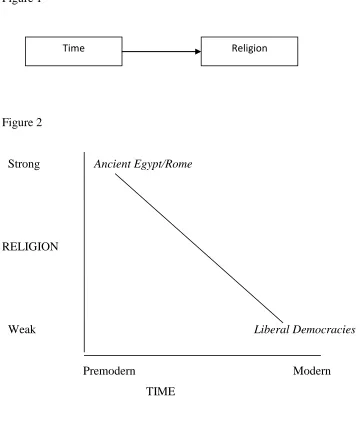
In sum, the simplest expression of the secularization thesis is that of an evolutionary, linear trend: modernity leads to the decline and eventual demise of religion. One now simply has to find indicators or observations of religion as a phenomenon over many time periods, and then examine whether religion actually becomes weaker, or less prominent, or less important as time goes by. Figure 1 illustrates this type of approach, with the cause (independent variable) on the left, and the outcome (dependent variable) on the right:
[Figure 1 here]
The relationship is a negative one. The more modern and advanced a society, the less religious it is expected to become. Figure 2 captures this postulated inverse relationship:
[Figure 2 here]
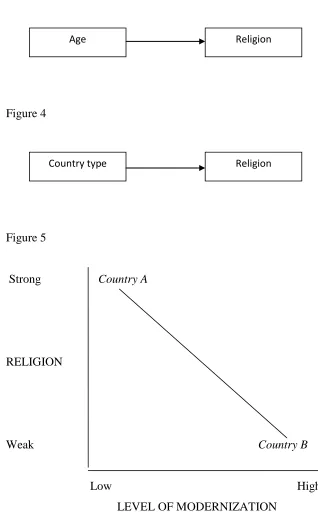
4 [Figure 3 here]
Another alternative type of analysis, in the absence of information from various time points, employs indicators of modernization that vary across countries. The assumption here is that religion in more advanced countries—for instance, those with a higher gross domestic product per capita or with more educated populations—will be weaker than in less advanced countries. Figure 4 illustrates this type of approach, and Figure 5 stresses the negative character of the postulated connection between modernization and religion.
[Figure 4 here]
[Figure 5 here]
The Causal Link
Two urgent questions arise from the previous schematic presentation. First, what is “modern”? Does it have something to do with technological progress? Is it about material prosperity? Is it about being a less rural economy and society? Is it about a more participatory way of governing? Is it about a greater degree of pluralism? Is it a way of thinking? Answering this question will help to explain the expectation of religious decline in modernity (for overviews, see Davie 2007; Fox 2013; Hamilton 1995; Norris and Inglehart 2004).
5 directly with each other and were subject to stronger conformity pressures, depriving on the way churches from an ideal social basis. Globalization and the increased mobility of people and ideas also expose individuals to competing frames of reference and a relativist way of thinking about the world, making any institution that claims to hold the absolute truth sound less credible. The wider participation of ordinary citizens in the political process, another feature of modernity, is also thought to diminish the hold of various elites, secular and religious alike, on individuals.
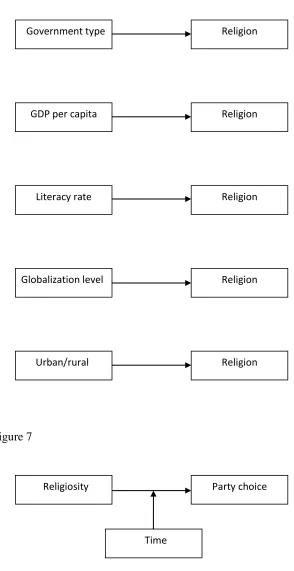
Depending on how one defines a modern or advanced society, there are numerous ways of measuring modernity. Various indicators of modernity are readily available from the research conducted by large international organizations, not to mention various academic programs that produce their own measures. The World Bank and the United Nations, for instance, provide access to economic and social development information about countries. Organizations such as the Economist Intelligence Unit, Freedom House, Polity, the World Bank and the Central
Intelligence Agency provide details on the type of government that operates in each country. So, the diagrams in Figures 4 and 5 become a little more concrete in Figure 6, because “country type” is more specific now:
[Figure 6 here]
Levels of Analysis
The second question we need to answer is the following: what is religion exactly? To find measures or observations of the religious phenomenon one has to first know what to look for. A useful conceptual tool suggested by Chaves (1994) and Dobbelaere (1999, 2002) is to think about religion, and by extension secularization, as a phenomenon that exists at three levels of analysis.
Societies and States
First, there is the presence and influence of religion at the societal or macro level. This includes the significance of religion as reflected in a society’s norms and its institutions. The degree of differentiation or autonomy between religious and state authority, that is, the church-state
6 a more advanced society—compared with the same society in the past or with a less advanced society of the present—religion would be less visible as a public influence.
American Austrian sociologist Thomas Luckmann (1927–) describes the process in the following manner: “[t]he more ‘complex’ a society, the more likely it is to develop distinct institutions supporting objectivity and social validity of the sacred cosmos” (1967, 63). Once institutions like education, the military and government have been separated from the “sacred canopy” of the church (Berger 1967), they can then begin to seek legitimacy from sources other than God and to function according to nonmetaphysical criteria: science, rationality, productivity, liberalism, and profit. The religious sphere eventually becomes another institutional domain, without a
predominant grip on other spheres of human interaction. This differentiation can be interpreted as the first act in the distancing of social institutions from religious control. It is evident that this type of grand institutional differentiation of religion from other domains of social activity has taken place in most advanced societies in the world. One simply has to think of whether education remains the exclusive remit of clerical personnel (it does not) or whether most countries in the world enforce the formal separation of government and religion (they do) (Fox 2008).
Apart from this general phenomenon of societal secularization as institutional separation and differentiation, or once this development has taken place, other kinds of secularization pressures may be of interest at the macro level. These would involve the waning or increasingly contested presence of religious symbols in public spaces (courtrooms and public squares); the
disappearance of religious cues from important (constitutions) and less important texts (party manifestos, the media, and the publishing industry); and the further weakening of the influence of religious institutions, their personnel, and their values over public bodies (the justice system, education, health, and social services).
7 Set, and Brian Grim and Roger Finke’s International Religious Freedom Data Set) provide information on whether a country’s legal system makes special religious provisions and on the
nature of the relationship between states and organized religions. International organizations, such as the United Nations, can even provide access to the more specialized cross-national indicators, such as the annual production of religious titles by the publishing industry (see Wuthnow 1977). Various online search tools of published content, such as Google Ngrams, facilitate the systematic analysis of general cultural trends in the use of religious terminology in a society’s corpus of books, as recorded by Google Books. In addition, as Birgit Meyer and
Annelies Moors explain in Religion, Media, and the Public Sphere (2006), even though studies of the religious presence in the media usually rely on in-depth, qualitative case studies, tools are available that make possible more systematic comparisons of published news content, both over time and cross-nationally. The Lexis database allows the collection and analysis of information on specific phenomena, such as reporting on controversies that surround the presence of Nativity scenes in public spaces.
As a recent example of a macro-level analysis of the secularization thesis, Fox has compiled and analyzed the cross-national Religion and State Data Set (version 1). In A World Survey of
Religion and the State (2008), he found stability over time in the bonds that connect governments and organized religion. These bonds cover dimensions such as religious discrimination,
regulation, and legislation, and they do not seem to be weakening over the time period covered by the Religion and State Data Sets (1990–2008). One should note, however, that the classic secularization thesis describes a more glacial, slow erosion of the state–religion connection, one that takes place across centuries rather than decades.
In a different type of analysis, studies that take a long-term, historical perspective (e.g., see Lipset and Rokkan 1967; Madeley 2003; Martin 1978; Rokkan 1970) have documented the changing nature of the church–state relationship in Europe, which has been particularly affected by two critical events: the Reformation and the French Revolution. The evolution of the
8 negative stance toward religion in general started to became more prominent in the twentieth century.
The following list provides details of some relevant religious indicators that are ideal for this type of analysis:
The Constitute Project. The Culture and Identity topic includes a Religion category,
which allows the user to assess what a country’s constitution has to say about the role of God and organized religion in state affairs.
The Religion and State Data Set. The data set codifies information from human rights
reports, academic research, and news content to create information across various countries and over two decades (1990–2008, version 2) on the legal aspects of the religion–state relationship, including formal church–state arrangements, religious observance, the link between citizenship and organized religion, conversion and proselytizing, clerical and faith-based education, clerical appointments, marriage, blasphemy, censorship, religious holidays, and courts.
The International Religious Freedom Data Set. This is a source that codifies annual
reports on the religious situation of various countries (2001–2008) produced by the State Department on religious freedom, discrimination, violence, prejudice, persecution, forced migration, and general favoritism and harassment by the state and other collective actors. Google Ngrams. This online search engine allows the user to search for the frequency of
appearance of specific terms in the corpus of books available in the Google Books
9 Religion as an Organizational Phenomenon
At the organizational or meso level of analysis, religion can be thought of as an institution, usually an ecclesiastical bureaucracy or church. Because of the difficulties in accessing the relevant information, especially from a perspective that would allow contrasts either over time (longitudinal) or across countries and organizations (comparative), this is the most under-researched level of analysis in secularization studies (e.g., see Berger 1969; Chaves 1994; Dobbelaere 1999; Luckmann 1967). Internal secularization, the meso-level version of the thesis, is seen as an organizational transformation of religious institutions. These are expected to become more worldly and businesslike over time as a consequence of exposure to various “pressures of scale, complexity, markets, resource flows [and] environmental uncertainty”
(Hinings and Raynard 2014, 166).
Empirical applications of the internal secularization thesis are heavily influenced by the view that all large, complex organizations that want to survive, including religious ones, have to adopt external models of bureaucratic and management structures, which have little to do with the original (nonprofit) purpose or the theological orientation of the religious organization (see neoinstitutional theory in DiMaggio and Powell 1983; see also Hinings and Raynard 2014; Weber 1949). Investigations of secularization tendencies would look at the extent to which churches allow nonclerical (lay) personnel to rise to positions of power or the degree to which church bureaucracies become similar to commercial firms in the way they operate and interact with the outside world.
In an example of this type of empirical analysis titled “Intraorganizational Power and Internal Secularization in Protestant Denominations,” American sociologist Mark Chaves applies organization theory to the study of personnel dynamics within American Protestant
denominations. He treats personnel trends in these denominations as an indicator of internal secularization processes. Adapting theoretical expectations regarding intraorganizational power struggles between personnel subunits in the corporate world, in “Denominations as Dual
Structures: An Organizational Analysis,” Chaves highlights two key subunits that compete for
10 (“priests”) that controls access to religious goods, and the economy-driven administrative
structure (“managers”) that is in charge of the more mundane function of religious institutions, such as health services, publishing, and public relations. His analysis of the career backgrounds of top religious officials finds that these come increasingly from the administrative structure with a parallel decline in officials originating from the authority structure (active clergy, such as bishops and pastors).
In another rare study of the phenomenon titled “Professionalization and Secularization in the Belgian Catholic Pillar,” Dobbelaere (1979) employs the insider–outsider distinction to study the increase of lay teachers and principals in Belgian Catholic schools, and the parallel decrease of clerical personnel (see also Canavan’s 1999 article “The Transformation of Catholic Schools in Australia”). These findings can be viewed as evidence of ongoing internal secularization
processes, in which religious organizations begin to emulate the workings and structures of secular, particularly for-profit, organizations. In a sense, the internal secularization thesis posits an increasing isomorphism between religious and secular organizations, with the universal adoption of the latter’s form and content (DiMaggio and Powell 1983; Weber 1949).
Individuals and Publics
The individual or micro level of analysis refers to religion as experienced by the individual. This is the most popular level of analysis in recent research. Religion here simply means religiosity. The abundance of census and social survey data sets, from the General Social Survey, the National Election Studies and the Pew Research Center surveys in the United States, to comparative programs, such as the International Social Survey Program, the World/European Values Survey, and the Eurobarometer series in Europe, provides access to a wealth of individual-level measures of belief (in God, heaven and hell, the afterlife, the inerrancy of the Bible), religious attendance (frequency of church going), and membership or affiliation (belonging to or identifying with a religious tradition). The triptych “believing, behaving, belonging” is a common way of defining religiosity in empirical research.
11 young and the old—are indeed influenced negatively by the pressures of modernization.
Evidence of this can be twofold. In the classic sense, one would have to analyze trends over time in these indicators to establish whether, for instance, the percentage of frequent (typically, weekly) church attendance among the population is declining. In an alternative approach, the analysis would compare the overall level of attendance in more advanced societies compared with less advanced societies, anticipating a lower religiosity level in the former. Both of these findings would suggest the presence of advancing secularization at the individual level.
Numerous examples of empirical studies examine the secularization thesis at the individual level as a question of religiosity trends over time. In “How Secular Is Europe?” (2006), Dutch
sociologists Loek Halman and Veerle Draulans analyzed survey data from the European Values Study program to find that indeed religiosity (belief and practice) is declining in European countries, although the speed of decline depends on factors such as a country’s religious tradition. In Sacred and Secular: Religion and Politics Worldwide (2004), American political scientists Pippa Norris and Ronald Inglehart analyzed survey data from consecutive waves of the World Values Study (1981–2001) and Eurobarometer surveys (1970–1998) to document a general decline in religious attendance across countries, particularly in predominantly Catholic ones, although they found some exceptions to the overall trend (most notably, the United States). In addition to the comparison of religiosity trends over time, the two authors also conducted a comparison of religiosity indicators by country type, focusing on the level of development of each country. They first categorized countries into three groups based on levels of
socioeconomic development, using information from the United Nations Human Development Index (HDI). The HDI is a standard measure of societal modernization, and scores countries based on their literacy, life expectancy, and prosperity rates. Norris and Inglehart came up with three country types: agrarian, industrial, and postindustrial societies. They found that the latter group was the more secularized in terms of overall religiosity rates.
This, however, is only one type of evidence that can test the secularization thesis at the
12 be more interesting to examine any changes in the influence of religiosity on various individual preferences and practices.
To clarify the usefulness of this alternative approach, which is known as the “declining religious authority” thesis, consider a country where the percentage of frequent church goers (or believers
in God or identifiers with a particular denomination) remains stable over time. At face value, this would challenge the validity of the secularization thesis, which expects that over time religiosity would decline. This is the example of the United States at the time of Chaves’s contribution— that is, a modern country with historically stable religiosity levels. His argument was that stability in religiosity levels is misleading as evidence of secularization and that the actual focus of secularization research should be on religious authority, that is, whether and to what extent religiosity shapes people’s beliefs and practices beyond the religious realm.
These beliefs and practices can include the following: sexual preferences (if your religion forbids premarital sex, do you engage in it anyway?), dietary habits (if your religion allows the
consumption of certain foods only on particular days, do you consume them outside those days?), and political preferences (if your church is closer to the Republican Party, do you vote for some other party; if your church is against worldly habits such as voting in elections, do you vote anyway?). An affirmative answer to these questions would be in line with the “declining religious authority” version of the secularization thesis, despite the presence of stable, healthy
levels of religiosity.
In a detailed example of Chaves’s reformulation of the secularization thesis, consider the
following research question: has the influence of religiosity on party choice become weaker over time? The erosion of the bond that connected American Catholics with the Democratic Party in national elections would serve as evidence of secularization tendencies from the “declining religious authority” perspective, irrespective of the fluctuation of religiosity levels. This
13 independent variable. The diagram describes an interaction between religiosity and time,
meaning that the effect of religiosity on party choice is expected to decline over time. In other words, time is likely to mitigate the ability of religion to affect political preferences.
[Figure 7 here]
Studies that set out to test explicitly the religious authority variant of the secularization thesis are not common (e.g., see Hoffmann 1998; Kleiman, Ramsey, and Palazzo 1996; Patrikios 2009). However, any study of the relationship between religiosity and social or political behavior, also known as “the religious cleavage,” can serve as a test of the secularization thesis (e.g., see Kotler-Berkowitz 2001; Lijphart 1979; Raymond 2011; Tilley 2015). A useful example is “Belonging, Behaving, and Believing: Assessing the Role of Religion on Presidential Approval”
(2008) by Laura Olson and Adam Warber on the influence of religiosity indicators on
presidential approval in a series of US presidential elections. The authors utilized survey data from the American National Election Studies program to find that religious affiliation was a weaker influence on presidential approval than belief and attendance. The work by American sociologists Jeff Manza and Clem Brooks in “The Religious Factor in US Presidential Elections, 1960–1992” (1997) and Social Cleavages and Political Change (1999) is equally relevant, as they are able to show a fading effect of religious affiliation on presidential vote choice over time. In their cross-national study, Sacred and Secular: Religion and Politics Worldwide (2004), Norris and Inglehart find a similar pattern of overall decline in the strength of the relationship between religiosity and support for right-wing ideology and religious parties among developed countries.
The following list provides details of relevant religious indicators that are ideal for this type of analysis. All data sets rely on nationally representative samples of each population. Most data sets cover several decades and include the standard questions on religious practice (church attendance or prayer), religious preference (tradition), and religious belief:
The General Social Survey. These surveys began in 1972 and continue to the present. The
14 of respondent’s confidence in organized religion, religion in which respondent was
raised, whether respondent considers herself as a religious person, evangelical or born-again status, and attitudes toward religious freedom.
The American National Election Studies. These surveys began in 1948 and continue to
the present. The questionnaires on which the data sets are based record responses on the following: the importance of religion or God in respondent’s life; individual stances on Biblical literalism, that is, the authority of the Bible as God’s or man’s word; and evangelical or born-again status.
The Pew Research Center Surveys. These surveys record responses on the following:
religious knowledge; religion in which respondent was raised; partner’s religion; prayer habits; religious identification; religious experiences, such as exorcisms and divine healings; attitudes toward the public display of religious symbols and religious involvement in public life; attitudes toward the factual accuracy of holy texts; and attitudes toward religious extremism and violence. The center also conducts cross-national surveys.
The International Social Survey Program. This cross-national program has conducted
surveys dedicated to religion (in 1991, 1998, and 2008). The questionnaires on which the data sets are based record responses on the following: partner’s religion, parental religion, born-again experiences, confidence in organized religion, attitudes toward the presence and influence of religion in politics, attitudes toward modern science, Biblical literalism, position on religion’s contribution in peace or conflict, religion’s role in interpersonal
relations, attitudes toward religious extremism, spiritualism, and subjective images of God (as a mother, master, judge and the like).
The World/European Values Survey. These surveys began in 1981 and continue to the present. The questionnaires on which the data sets are based record responses on the following: whether the respondent thinks that churches can solve various problems (family, social, and moral), confidence in religious institutions, various attitudes toward the presence of religion in politics, and the role of religion in parenting.
The Eurobarometer Series. These surveys began in 1970 and continue to the present. The
15 importance of religion in respondent’s life, along with the other standard measures of religiosity.
A note of caution is in order at this junction. This discussion has reviewed mostly quantitative strategies in the study of religion and secularization at the individual level. Qualitative attempts, which are usually narrower in scope and time span, but afford a closer, more meaningful look at the content of individual beliefs and practices, are also abundant in this scholarly field. The interested reader may want to consult a variety of collective works and academic journals, which cover topics that range from everyday expressions of religiosity (e.g., see Ammerman 2007) to the changing nature of funeral preferences (the Mortality and Omega journals, published by Taylor & Francis and SAGE, respectively).
Critiques of the Secularization Thesis
This section reviews some of the challenges to the validity of the secularization thesis. As a theory with a long history, the thesis has been criticized from various perspectives. Quite often, secularization trends take place only at some levels of analysis and are not present at others. In addition, as mentioned in the introduction, there are definitional questions regarding what counts as religion. Adopt a definition that is too broad, and you can gain in scope and flexibility as you are able to transcend understandings of religion that are too context and period specific, but you can also risk studying any social phenomenon as religious. A major critique of the thesis is that it is unable to explain the continuing strength of religion in one of the most advanced societies in the world, the United States. Competing explanations have been put forward to account for this discrepancy. In another challenge, the thesis appears to downplay the ability of religious actors to react against the advance of secularization. Too much secularization seems to trigger a religious backlash in many cases. Last, perhaps what is described in the secularization paradigm is not about religion per se, which is able to adopt and survive, but rather is about formal membership to hierarchical organizations.
One or Three?
16 secularization takes place on one of these levels but not on others. The position of the Church of England in Britain is a good example. The church operates in a state that is undergoing clear secularization at the individual level (for information on decline of church attendance, belief, and affiliation, see Bruce 1995; Voas and Crockett 2005). The church, however, still remains the official, established religion of the nation (England), despite the religious decline taking place among the population (see also the concept of “vicarious religion” in Davie 2007).
In addition to this independent movement of trends on the various levels, there is the possibility of connected but diverging trends across levels. For instance, a religious organization that transforms the content of its teachings, and their packaging, to render them more similar to their secular counterparts (e.g., a carefree night out at the movies) and therefore more appealing, could trigger an influx of converts. In other words, secularization tendencies at the meso level could trigger the opposite development at the individual level, by energizing the religious base.
According to Donald Miller in Reinventing American Protestantism (1997), an illustration of this type of cross-level relationship, in which organizational or meso-level secularization is followed by the inverse trend at the micro level, can be seen in the rise of megachurches in the American religious landscape. These institutions are large Protestant congregations with 2,000 or 3,000 followers, and they are close to the evangelical family. American sociologist Scott Thumma has studied extensively this relatively recent phenomenon. In “Megachurches of Atlanta” (1996), he defines megachurches as mall-like congregations targeting the baby-boomer generation. In their attempt to attract mainly the unchurched population, these institutions tend to follow a more consumer-friendly approach to worship. Entertainment-oriented activities take place in their facilities, which often include gyms and cafeterias. These rapidly and massively growing nondenominational congregations made the following impression on a visitor, which may explain their success and growth:
You pull into a mall-sized parking lot and an attendant directs you to a special visitor parking section near the church entrance . . . You
17 window, no cross . . . You enter through one of a series of smoked glass
double doors and walk into a large atrium full of people milling about café tables and numerous informational kiosks which remind you of the food court area at your local mall. You are directed to the worship center and are surprised when you enter a space that looks like a theatre and must seat well over 1,000 . . . On a large stage that juts out into the seating area, a rock band is playing softly. You notice two large video screens high on the back wall of the worship center.
(Ellingson 2009, 16).
In “Globalization and Religious Nationalism: Self, Identity, and the Search for Ontological Security” (2004), Catarina Kinnvall writes about a different type of cross-level development: a state that decides to sever ties with a historically dominant church could trigger a defensive, backlash reaction from individual believers. In this case, secularization tendencies at the macro level could lead to the opposite move at the individual level. In “Identity Crisis: Greece,
Orthodoxy, and the European Union” (2003), Lina Molokotos-Liederman suggests that the crisis
that erupted between church and state in Greece in 2000–2001 is an illustration of this type of phenomenon. The Greek state had previously introduced Law 2472/1997 on the Protection of Individuals with Regard to the Processing of Personal Data, which prohibited the inclusion of religious affiliation on national identification cards. The Greek state’s decision was an attempt by a member state of the European Union to create some separation between church and
government. But this took place in a country where approximately 95 percent of the population identify as members of the (Orthodox) Church of Greece, the country’s established religion, and where the country’s constitution makes explicit reference to the dominance of Orthodox
18 government. In other words, the macro-level development seems to have triggered the opposite move, by stimulating the religious base, among individual believers.
Conceptual Issues
There is another type of challenge to the expectations of secularization theory (for a critical overview, see Bruce 2011). These expectations may not hold at all if we adopt a functional definition of religiosity, focusing on phenomena that seem to serve similar functions as religion used to—for instance, to provide meaning in one’s life by explaining one’s place in the world as part of a greater scheme (e.g., communism or Marxism and its eschatological promise of a socialist revolution); to create a feeling of collective effervescence (e.g., yoga or other types of recreational exercise); to promote causes and treat their symbols as “sacred” (e.g., nationalist movements, their notion of “fatherland,” and their use of flags); to involve the regular repetition of rituals and the use of religion-related words such as miracle, sacrifice, and devotion (the coverage of sports events and the hymns of sports fans). It is not hard to see how such a broader definition of religion allows one to treat any collective phenomenon that involves enthusiasm, symbolism, and repetition, topped with a message that transcends the mundane character of everyday life—and these are in abundance—as evidence against secularization theory.
Using the example of sports fans, Los Angeles Times religion editor Russell Chandler once reported the following quotation by social scientist Charles Prebish: “For many, such sporting events have taken on a religious quality, conferring meaning and cohesiveness upon their lives . . . For growing numbers of Americans . . . sport religion has become a more appropriate
19 A simple online search of news content that contains the terms “quasi-religious experience,” “almost religious,” or “a religion?” also reveals a wealth of results that cover various aspects of
human existence beyond sports. A quick online search, for example, returned results that referred to coffee drinking, using Apple gadgets (the term cult was employed), buying a particular model of car, attending a rock concert, being an atheist or a humanist, visiting an exhibition of musical instruments (likened to attending a shrine), or believing in equality of opportunity. These practices and beliefs are definitely not in decline compared with past decades, but they do not seem to qualify as definitions of religiosity in the substantive sense of a structured system of interactions between humans and a supernatural entity. What is more, most of them usually are not covered in the major national and cross-national survey programs, which are the main sources of empirical information in this field of study.
Not Proven
Another typical critique of secularization theory raises the question of an idealized, supposedly religious past (e.g., see Martin 1969). For instance, William Williams’s 1956 ethnographic study of an English village suggests that the local parishioners were clearly apathetic to religion for centuries. Yet, it was “widely believed that the poor attendance at Church dates from the arrival of the present Rector and that it would immediately improve on the induction of a new
incumbent. This is symptomatic of a general tendency to use the shortcomings of the parson as an excuse for the worldliness of his flock” (Williams 1956, 183). It is fortunate that records existed for this particular village. It is usually the case that official statistics and other concrete accounts of past religiosity rates either do not go deep enough in the past, or do not cover geographic areas wide enough to be useful for generalizable comparisons between the present and the distant past. As a counterargument to this critique regarding a fictitious golden religious past, survey evidence from Norris and Inglehart (2004) that begins in the second half of the twentieth century suggests an overall decline of religious participation and belief across most advanced societies, with exceptions.
20 United States, one of the most advanced countries in the world. If modernity creates
secularization tendencies, then the hypothesized decline is apparently not taking place in a country where advanced modernity—reflected in church–state separation, scientific advance, urbanization, and intense social and physical mobility—coexists with persistently high levels of religious commitment, and the high visibility of religion in politics and public life. This is what the rational choice theory of religion, or religious economy–markets approach attempts to explain (e.g., see Finke and Stark 1988; Iannaccone 1991; Stark and Finke 2000). The approach is a prominent theoretical challenge that has emerged from the failure of secularization theory to explain the strength of American religiosity.
The religious economy approach argues that contrary to the expectations of secularization theory, religious pluralism and the separation of church and state do not lead to the decline of religion. Instead they represent a market mechanism, with positive consequences for churches and believers alike. The mechanism pushes churches to become more active in looking for members, if they want to survive in a competitive religious marketplace. It also provides a greater amount of choice that can cater to the diverse needs of individual worshippers. These rational choice expectations are able to explain the vitality of religion in a pluralistic religious marketplace, such as the American one. They also can explain the decline of religion in European countries, where many dominant churches are historically linked with and reliant on state subsidies, and do little to attract believers, who in turn, have a limited amount of choice. In a nutshell, the degree of competition, and not of modernization, is the relevant explanation of religious growth and decline.
To look at this from a different perspective, the previous distinction between Europe and the United States may suggest that context matters when evaluating the empirical accuracy of the predictions of secularization theory. According to David Martin in A General Theory of
Secularization (1978), the historical legacy that shapes the relationship between church and state determines the presence and extent of secularization pressures. This, says the British sociologist Grace Davie (1946–) in Europe: The Exceptional Case: Parameters of Faith in the Modern World (2002), supports the position of “European exceptionalism” with reference to
21 of church and state, which sustained the lazy religious “monopolies” largely responsible for the decline. Europe, then, cannot be treated as a typical situation, although it formed the basis of most theorizing behind the secularization thesis.
Reversible and Not Linear
Some of the most prominent events and actors that have appeared in the international political terrain in the post-Soviet era seem to disconfirm the expectations of secularization theory. The rise of religious fundamentalism in recent decades, and of various nativist movements fueled by religious concerns, is a fitting example. Research on the fundamentalist phenomenon explains the growth of these religious movements as a response to advanced modernity and the
marginalization of religion (e.g., see Almond, Appleby, and Sivan 2003; Kinnvall 2004; Patrikios and Xezonakis 2016). As discussed by Peter Beyer in Religion and Globalization (1994) and Peter Berger in The Desecularization of the World (1999), as the pressures of modernity, exemplified in complex phenomena such as globalization, create a state of anxiety and insecurity (see the post-2007 global financial troubles), individuals are likely to turn to sources of guidance that offer renewed certainty and a stable point of reference. In this view, modernity triggers positive developments for churches, as it makes the absolute truths they espouse more appealing. Therefore, contrary to the predictions of secularization theory regarding the decline of religion for individuals and societies, it seems that advancing modernity has led to the exact opposite reaction from certain populations and in certain parts of the world. A similar reading by Philip Jenkins in The Next Christendom: The Coming of Global Christianity (2002) applies to other cases of religious resurgence and other types of religious growth that accompany the advance of modernization in Latin American, Asia and Africa.
22 focused on Islam. The question posed in those analyses summarizes quite neatly the inability of the secularization thesis, which expects negative outcomes for religion in modernity, to explain such developments.
Only about Organized Religion
Concepts such as “implicit religion,” “believing without belonging” and “belonging without believing” (e.g. “cultural” Catholics), privatized religiosity, or spirituality outside the church can
serve as yet another critique of the secularization thesis. This type of argument has been adopted by Davie, among others. Her “believing without belonging” thesis builds on statistical trends that make it clear that the indicators of individual religiosity more closely related to “institutional” forms of religion, namely attendance and membership, are declining in Britain and in many other European countries. It is then argued that this does not signify the disappearance of religion and confirmation of secularization theory, but simply the decline of specialized, institutional forms of religion, and its transformation and survival outside the institutional domain. Faith’s survival in this postsecular age seems to be about individuals retaining a belief in God or some other supernatural entity, which is held in private or in unconventional settings rather than within an orthodox, organized context.
Although, according to British sociologists David Voas and Alasdair Crockett in “Religion in Britain: Neither Believing nor Belonging” (2005), the available statistics seem to contradict the
idea that religious belief survives outside churches, this is an interesting critique of the
secularization thesis as it makes the distinction between organized–hierarchical (declining) and private forms of faith (growing). It belongs to a larger body of research dealing with
23 Summary
A proposition with a long pedigree, the secularization thesis revolves around a positive statement about the relationship between modernity and religion. The thesis expects that material and intellectual advances will weaken religion’s influence in society at large, in the way religious organizations operate, and in individuals’ lives. In classic versions of the thesis, this is usually seen as a linear, irreversible trend. By extension, the end point of the process may lead to the disappearance of religion from modern life.
It is possible to discard the thesis on various grounds. Even a quick inspection of today’s newspapers shows that it would be misleading to expect the theory to apply uniformly at all levels (societies, organizations, individuals) and across all countries. This might be interpreted as advice to study the thesis empirically only on one level of analysis. Such a decision would probably provide a “clean” solution and permit straightforward conclusions. Specifically, one would find that religiosity trends are either going up, remaining stable, or declining (micro-level analysis); that a church is either changing internally to become more customer friendly or is retaining the structure and content it had in the past (meso-level analysis); and, finally, that religion either persists as an influence in society, for instance, in public debates regarding life and death issues, or is retreating from that space (macro-level analysis).
This narrow focus on a single level of analysis, however, would be misleading. A final example, the case of American religiosity and how to approach it analytically, will illustrate why this might be the case. Despite the most recent surveys, which according to the Pew Research Center (2015) reveal a decline in the Christian population in the United States and the rise of the
nonreligious, almost four out of five Americans still report some type of religious affiliation. Yet, this individual-level picture ignores some interesting observations about the content of religious affiliation in America, which seems to carry a heavy nonreligious load.
24 within the church, but also extend to Independence Day celebrations and the inauguration of a new president (the original work used as its primary source Kennedy’s inaugural speech; see
Bellah’s “Civil Religion in America” 1967). In Civil Religion and the Presidency (1988),
Richard Pierard and Robert Linder note the office of president is the focal point of this American civil religion: citizens see the president as a “high priest” who provides guidance in times of suffering.
With this in mind, a visit to the Washington National Cathedral in Washington D.C., an
Episcopal congregation, reveals some interesting elements of the worship environment to which the American believer is exposed. Most notably, the worshipper is encountered by statues of presidents Abraham Lincoln and George Washington, stained glass window portrayals of Confederate generals Robert E. Lee and Stonewall Jackson, a carving that depicts the Magna Carta signing, not to mention references to popular culture—particularly, the Star Wars movie series. Therefore, the high religiosity rates that surveys document among the American
population are not exclusively a matter of religion in the traditional definition of the phenomenon but are partly about being American. This “natural melding of religion and nationhood”
(Demerath 1998, 30), which is a piece of the societal-level picture, provides a plausible
25 Bibliography
<bibcit>Almond, Gabriel R., R. Scott Appleby, and Emmanuel Sivan. Strong Religion: The Rise of Fundamentalisms around the World. Chicago: University of Chicago Press, 2003.</bibcit> <bibcit>Ammerman, Nancy T., ed. Everyday Religion: Observing Modern Religious Lives. Oxford: Oxford University Press, 2007.</bibcit>
<bibcit>Bellah, Robert. “Civil Religion in America.” Daedalus 96 (1967): 1–21.</bibcit> <bibcit>Berger, Peter. The Desecularization of the World: Resurgent Religion and World Politics. Washington, DC: Ethics and Public Policy Center, 1999.</bibcit>
<bibcit>Berger, Peter. The Sacred Canopy: Elements of a Sociological Theory of Religion. Garden City, NY: Doubleday, 1967.</bibcit>
<bibcit>Beyer, Peter. Religion and Globalization. London: Sage, 1994.</bibcit> <bibcit>Bruce, Steve. God Is Dead: Secularization in the West. Oxford: Blackwell, 2002.</bibcit>
<bibcit>Bruce, Steve. Religion in Modern Britain. Oxford: Oxford University Press, 1995.</bibcit>
<bibcit>Bruce, Steve. Secularization: In Defence of an Unfashionable Theory. Oxford: Oxford University Press, 2011.</bibcit>
<bibcit>Canavan, Kelvin. “The Transformation of Catholic Schools in Australia.” Journal of Religious Education 47 (1999): 19-24.</bibcit>
<bibcit>Casanova, José. Public Religions in the Modern World. Chicago: University of Chicago Press, 1994.</bibcit>
<bibcit>Chandler, Russell. “Team Spirit: U.S. Sports Mania Called Folk Religion.” The Los Angeles Times, December 31, 1986.</bibcit>
<bibcit>Chaves, Mark. “Denominations as Dual Structures: An Organizational Analysis.” Sociology of Religion 54 (1993a): 147–169.</bibcit>
<bibcit>Chaves, Mark. “Intraorganizational Power and Internal Secularization in Protestant Denominations.” American Journal of Sociology 99 (1993b): 1–48.</bibcit>
<bibcit>Chaves, Mark. “Secularization as Declining Religious Authority.” Social Forces 72 (1994): 749–774.</bibcit>
26 <bibcit>Davie, Grace. Religion in Modern Britain: A Memory Mutates. Oxford: Oxford
University Press, 2000.</bibcit>
<bibcit>Davie, Grace. The Sociology of Religion. London: Sage, 2007.</bibcit> <bibcit>Demerath, Nicholas Jay. “Excepting Exceptionalism: American Religion in Comparative Relief.” Annals of the American Academy of Political and Social Science 558
(1998): 28–37.</bibcit>
<bibcit>DiMaggio, Paul J., and Walter W. Powell. “The Iron Cage Revisited: Institutional Isomorphism and Collective Rationality in Organizational Fields.” American Sociological
Review 48 (1983): 147–160.</bibcit>
<bibcit>Dobbelaere, Karel. “Professionalization and Secularization in the Belgian Catholic Pillar.” Japanese Journal of Religious Studies 6 (1979): 39–64.</bibcit>
<bibcit>Dobbelaere, Karel. Secularization: An Analysis at Three Levels. Bern: Peter Lang, 2002.</bibcit>
<bibcit>Dobbelaere, Karel. “Towards an Integrated Perspective of the Processes Related to the
Descriptive Concept of Secularization.” Sociology of Religion 60 (1999): 229–248.</bibcit> <bibcit>Ellingson, Stephen. “The Rise of the Megachurches and Changes in Religious Culture: Review Article.” Sociology Compass 3, no. 1 (2009): 16–30.</bibcit>
<bibcit>Finke, Roger, and Rodney Stark. “Religious Economies and Sacred Canopies: Religious Mobilization in American Cities, 1906.” American Sociological Review 53 (1988): 41–
49.</bibcit>
<bibcit>Firebaugh, Glenn, and Brian Harley. “Trends in U.S. Church Attendance: Secularization and Revival, or Merely Lifecycle Effects?” Journal for the Scientific Study of Religion 30
(1991): 487–500.</bibcit>
<bibcit>Fortin, Ernest L. “St. Augustine.” In History of Political Philosophy, edited by Leo Strauss and Joseph Cropsey, 3rd ed, 176–205. Chicago: Chicago University Press,
1987.</bibcit>
<bibcit>Fox, Jonathan. An Introduction to Religion and Politics: Theory and Practice. Abingdon: Routledge, 2013.</bibcit>
27 <bibcit>Greeley, Andrew. Religion in Europe at the End of the Second Millennium. New
Brunswick, NJ: Transaction, 2003.</bibcit>
<bibcit>Halman, Loek, and Veerle Draulans. “How Secular Is Europe?” British Journal of Sociology 57 (2006): 263–288.</bibcit>
<bibcit>Hamilton, Malcolm B. The Sociology of Religion: Theoretical and Comparative Perspectives. London: Routledge, 1995.</bibcit>
<bibcit>Hinings, Christopher R., and Mia Raynard. “Organizational Form, Structure, and Religious Organizations.” Research in the Sociology of Organizations 41 (2014): 159– 186.</bibcit>
<bibcit>Hoffmann, John. “Confidence in Religious Institutions and Secularization: Trends and Implications.” Review of Religious Research 39 (1998): 321–343.</bibcit>
<bibcit>Iannaccone, Laurence. R. “The Consequences of Religious Market Structure.” Rationality and Society 3 (1991): 156–177.</bibcit>
<bibcit>Jenkins, Philip. The Next Christendom: The Coming of Global Christianity. Oxford: Oxford University Press, 2002.</bibcit>
<bibcit>Kaufmann, Eric P., Vegard Skirbekk, and Anne Goujon. “The End of Secularization in Europe? A Socio-demographic Perspective.” Sociology of Religion 73, no. 1 (2012): 69–
91.</bibcit>
<bibcit>Kinnvall, Catarina. “Globalization and Religious Nationalism: Self, Identity, and the Search for Ontological Security.” Political Psychology 25, no. 5 (2004): 741–767.</bibcit> <bibcit>Kleiman, Michael, Nancy Ramsey, and Lorella Palazzo. “Public Confidence in
Religious Leaders: A Perspective from Secularization Theory.” Review of Religious Research 38 (1996): 79–87.</bibcit>
<bibcit>Kohut, Andrew, and Bruce Stokes. America against the World: How We Are Different and Why We Are Disliked. New York: Times Books, 2006.</bibcit>
<bibcit>Kotler-Berkowitz, Laurence. “Religion and Voting Behaviour in Great Britain.” British Journal of Political Science 31 (2001): 523–554.</bibcit>
<bibcit>Lijphart, Arend. “Religious vs. Linguistic vs. Class Voting.” American Political Science Review 73 (1979): 452–458.</bibcit>
28 <bibcit>Luckmann, Thomas. The Invisible Religion: The Problem of Religion in Modern
Society. New York: Macmillan, 1967.</bibcit>
<bibcit>Lundskow, George. The Sociology of Religion: A Substantive and Transdisciplinary Approach. Thousand Oaks, CA: Sage, 2008.</bibcit>
<bibcit>Madeley, John. “A Framework for the Comparative Analysis of Church–State Relations in Europe” West European Politics 26 (2003): 23–50.</bibcit>
<bibcit>Manza, Jeff, and Clem Brooks. “The Religious Factor in US Presidential Elections, 1960–1992.” American Journal of Sociology 103 (1997): 38–81.</bibcit>
<bibcit>Manza, Jeff, and Clem Brooks. Social Cleavages and Political Change. Oxford: Oxford University Press, 1999.</bibcit>
<bibcit>Martin, David A. A General Theory of Secularization. Oxford: Blackwell, 1978.</bibcit>
<bibcit>Martin, David A. The Religious and the Secular: Studies in Secularization. London: Routledge, 1969.</bibcit>
<bibcit>McGuire, Meredith B. Religion: The Social Context, 5th ed. Belmont, CA: Wadsworth, 2002.</bibcit>
<bibcit>Meyer, Birgit, and Annelies Moors, eds. Religion, Media, and the Public Sphere. Bloomington: Indiana University Press, 2006.</bibcit>
<bibcit>Miller, Donald. Reinventing American Protestantism. Berkeley: University of California Press, 1997.</bibcit>
<bibcit>Molokotos-Liederman, Lina. “Identity Crisis: Greece, Orthodoxy, and the European Union.” Journal of Contemporary Religion 18 (2003): 291–315.</bibcit>
<bibcit>Norris, Pippa, and Ronald Inglehart. Sacred and Secular: Religion and Politics Worldwide. Cambridge: Cambridge University Press, 2004.</bibcit>
<bibcit>Olson, Laura, and Adam Warber. “Belonging, Behaving, and Believing: Assessing the Role of Religion on Presidential Approval.” Political Research Quarterly 61, no. 2 (2008): 192–
204.</bibcit>
<bibcit>Patrikios, Stratos. “Religious Deprivatization in Modern Greece.” Journal of Contemporary Religion 24 (2009): 357–362.</bibcit>
29 Public Opinion, edited by Jack Vowles and Georgios Xezonakis. Oxford: Oxford University Press, 2016.</bibcit>
<bibcit>Pew Research Center. America’s Changing Religious Landscape. 2015.
http://www.pewforum.org/2015/05/12/americas-changing-religious-landscape/.</bibcit> <bibcit>Pierard, Richard, and Robert Linder. Civil Religion and the Presidency. Grand Rapids, MI: Zondervan, 1988.</bibcit>
<bibcit>Raymond, Christopher. “The Continued Salience of Religious Voting in the United States, Germany, and Great Britain.” Electoral Studies 30 (2011): 125–135.</bibcit>
<bibcit>Rokkan, Stein. Citizens, Elections, Parties: Approaches to the Comparative Study of the Processes of Development. Oslo: Universitetsforlaget, 1970.</bibcit>
<bibcit>Stark, Rodney, and Roger Finke. Acts of Faith: Explaining the Human Side of Religion. Berkeley: University of California Press, 2000.</bibcit>
<bibcit>Tarcov, Nathan, and Thomas L. Pangle. “Epilogue: Leo Strauss and the History of Political Philosophy.” In History of Political Philosophy, edited by Leo Strauss and Joseph
Cropsey, 3rd ed., 907–938 Chicago: Chicago University Press, 1987.</bibcit>
<bibcit>Thumma, Scott. “Megachurches of Atlanta.”In Religions of Atlanta: Religious Diversity in the Centennial Olympic City, edited by Gary Laderman, 199–214. Atlanta: Scholars Press, 1996.</bibcit>
<bibcit>Tilley, James. “We Don't Do God?’ Religion and Party Choice in Britain.” British Journal of Political Science 45 (2014): 907–927.</bibcit>
<bibcit>Tschannen, Olivier. “The Secularization Paradigm: A Systematization.” Journal for the Scientific Study of Religion 30 (1991): 396–415.</bibcit>
<bibcit>Voas, David, and Alasdair Crockett. “Religion in Britain: Neither Believing nor Belonging.” Sociology 39, no. 1 (2005): 11–28.</bibcit>
<bibcit>Weber, Max. The Theory of Social and Economic Organization. Glencoe, IL: Free Press, 1949.</bibcit>
<bibcit>Williams, William M. The Sociology of an English Village: Gosforth. London: Routledge, 1956.</bibcit>
30 <bibcit>Wuthnow, Robert. “A Longitudinal, Cross-National Indicator of Cultural Religious Commitment.” Journal for the Scientific Study of Religion 16 (1977): 87–99.</bibcit>
<bibcit>Yamane, David. “Secularization on Trial: In Defense of a Neosecularization Paradigm.” Journal for the Scientific Study of Religion 36 (1997): 109–122.</bibcit>
Websites
<bibcit>American National Election Studies. http://www.electionstudies.org/.</bibcit> <bibcit>Constitute Project. http://www.constituteproject.org.</bibcit>
<bibcit>Eurobarometer Series. http://www.gesis.org/en/eurobarometer.</bibcit> <bibcit>General Social Survey. http://www3.norc.org/Gss+website/.</bibcit> <bibcit>Google Ngrams. https://books.google.com/ngrams.</bibcit>
<bibcit>Google Trends. https://www.google.com/trends/.</bibcit> <bibcit>International Religious Freedom Data Set.
http://www.thearda.com/Archive/CrossNational.asp.</bibcit>
<bibcit>International Social Survey Program. http://www.issp.org/.</bibcit> <bibcit>Pew Research Center Surveys. http://www.pewresearch.org/.</bibcit> <bibcit>Religion and State Data Set. http://www.thearda.com/ras.</bibcit>
31 Figure 1
Figure 2
Strong Ancient Egypt/Rome
RELIGION
Weak Liberal Democracies
Premodern Modern
TIME
32 Figure 3
Figure 4
Figure 5
Strong Country A
RELIGION
Weak Country B
Low High
LEVEL OF MODERNIZATION
Age Religion
33 Figure 6
Figure 7
Government type Religion
GDP per capita Religion
Literacy rate Religion
Globalization level Religion
Urban/rural Religion
Religiosity Party choice