HYDROCHLORIDE FOR IRRITABLE BOWEL SYNDROME A Dissertation submitted to
THE TAMIL NADU Dr. M.G.R MEDICAL UNIVERSITY CHENNAI – 600 032
in partial fulfilment of the requirements for the award of degree of
MASTER OF PHARMACY
IN
PHARMACEUTICS
submitted by
Register Number:
261411270
under the guidance of
Dr. N. Deattu, M.Pharm., Ph.D.,
Department of Pharmaceutics
COLLEGE OF PHARMACY
MADRAS MEDICAL COLLEGE
COLLEGE OF PHARMACY
MADRAS MEDICAL COLLEGE
CHENNAI-600 003
TAMILNADU
DATE:
CERTIFICATE
This is to certify that the dissertation entitled “FORMULATION
DEVELOPMENT AND EVALUATION OF COLON TARGETED
COMPRESSION COATED TABLETS OF AMITRIPTYLINE
HYDROCHLORIDE FOR IRRITABLE BOWEL SYNDROME” submitted by
the candidate with Register No. 261411270 to The Tamil Nadu Dr. M.G.R. Medical
University is evaluated.
1.
2.
MADRAS MEDICAL COLLEGE
CHENNAI-600 003
TAMILNADU
CERTIFICATE
This is to certify that the dissertation entitled “FORMULATION
DEVELOPMENT AND EVALUATION OF COLON TARGETED
COMPRESSION COATED TABLETS OF AMITRIPTYLINE
HYDROCHLORIDE FOR IRRITABLE BOWEL SYNDROME” submitted by
the candidate with Register No. 261411270 in partial fulfilment of the requirements
for the award of the degree of MASTER OF PHARMACY in
PHARMACEUTICS by The Tamil Nadu Dr. M.G.R. Medical University is a
bonafide work done by him during the academic year 2015-2016.
Place: Chennai – 03
Date :
(Dr. A. JERAD SURESH, M.Pharm., Ph.D., M.B.A)
COLLEGE OF PHARMACY
MADRAS MEDICAL COLLEGE
CHENNAI-600 003
TAMILNADU
CERTIFICATE
This is to certify that the dissertation entitled “FORMULATION
DEVELOPMENT AND EVALUATION OF COLON TARGETED
COMPRESSION COATED TABLETS OF AMITRIPTYLINE
HYDROCHLORIDE FOR IRRITABLE BOWEL SYNDROME” submitted by
the candidate with Register No. 261411270 in partial fulfilment of the requirements
for the award of the degree of MASTER OF PHARMACY in
PHARMACEUTICS by The Tamil Nadu Dr. M.G.R. Medical University is a
bonafide work done by him during the academic year 2015-2016.
Place: Chennai – 03
Date :
[Prof. K.ELANGO, M.Pharm., (Ph.D.)]
COLLEGE OF PHARMACY
MADRAS MEDICAL COLLEGE
CHENNAI-600 003
TAMILNADU
CERTIFICATE
This is to certify that the dissertation entitled “FORMULATION
DEVELOPMENT AND EVALUATION OF COLON TARGETED
COMPRESSION COATED TABLETS OF AMITRIPTYLINE
HYDROCHLORIDE FOR IRRITABLE BOWEL SYNDROME” submitted by
the candidate with Register No. 261411270 in partial fulfilment of the requirements
for the award of the degree of MASTER OF PHARMACY in
PHARMACEUTICS by The Tamil Nadu Dr. M.G.R. Medical University is a
bonafide work done by him during the academic year 2015-2016 under my guidance.
Place: Chennai – 03
Date :
vacuum in this journey. At the end of my thesis I would like to thank all those people
who made this thesis possible and an unforgettable experience for me.
I consider this as an opportunity to express my gratitude to all the dignitaries
who have been involved directly or indirectly with the successful completion of this
dissertation.
First of all I thank the Almighty for giving me the strength, endurance and
showering his blessing to undertake this project with full dedication and giving me
courage always to do hard work.
Most of I would like to thank my beloved parents for their priceless support,
love and encouragement throughout the entire tenure of this course.
I consider myself very much lucky with profound privilege and great pleasure
in expressing my deep sense of gratitude to Prof. K. Elango, M.Pharm.,(Ph.D.),
Head of Department of Pharmaceutics, College of Pharmacy, Madras Medical
College, Chennai., for his supportive suggestions, innovative ideas, help and
encouragement which has always propelled me to perform better. It is my privilege
and honour to extend my gratitude and express my indebtedness for his enduring
support. He has been generous with providing the facilities to carry out this work.
It is my privilege to express my gratitude to my guide Dr. N. Deattu,
M.Pharm., Ph.D., for his guidance, help and encouragement to complete my project
with precision. I acknowledge my sincere thanks to him for his support during the
entire project work.
I acknowledge my sincere thanks to Dr. A. Jerad Suresh, M.Pharm., Ph.D.,
MBA, Principal, College of Pharmacy, Madras Medical College, Chennai, for his
continuous support in carrying out my project work in this institution.
I am thankful to all of my teaching staff members Mr. K. Ramesh Kumar,
M.Pharm., Dr. S. Daisy Chellakumari, M.Pharm., Ph.D., Dr. R. Devi
Damayanthi, M.Pharm., Ph.D., of the Department of Pharmaceutics, College of
Pharmacy, Madras Medical College, Chennai., for their valuable suggestions, constant
Chennai., for her kind support and co-operation.
I extend my thanks to all teaching staff members of College of Pharmacy,
Madras Medical College, Chennai.
I extend my thanks to all non-teaching staff members Mr. M. Siva Kumar,
Department of Pharmaceutical Chemistry and Mr. R. Marthandan,
Mrs. R. Shankari, Mrs. Razia Sultana, Department of Pharmaceutics, College of
Pharmacy, Madras Medical College, Chennai.
I am indebted to my many student colleagues for providing a stimulating and
fun filled environment. My special thanks go in particular to my beloved seniors
D. Jaison, V.Sundar Raj, B.Prabakaran, K.Gnanasuriyan with whom I started my
journey in M.Pharmacy course and many rounds of discussions on my project with
them helped me a lot.
I would like to thank my classmates M. Nivedita, D. Sai Dharshini, Deepa
Joseph, D. Immanuel Nesakumar, M. Meenakshi, C. Kanchana, D. Mohanapriya
and T. Nandhini who stoodbeside me throughout my project.
It’s a great pleasure for me to acknowledge my sincere thanks to my friend
C. Saranya for her supportive suggestions, help and encouragement throughout the
study to perform better and make my work easy.
I extend my cordial thanks to Mr. N. Murugesan, Director, CDTL, Chennai.,
for his kind support and co-operation.
It’s a great pleasure for me to acknowledge my sincere thanks to
Mr. R.V. Ram Prabhu, Drugs Inspector for his timely help and support.
I extend my cordial thanks to my Junior V. Vivek for his support and
co-operation.
It’s a great pleasure for me to thank my friends L. Nithiyanandham,
C. Lokesh, K.P. Balasubramani, K. Nirmal kumar and M. Udhayakumar for
their encouragement.
I extend my cordial thanks to all my Seniors, Juniors and all my M. Pharm.,
No. No.
1 INTRODUCTION 1
1.1. Oral solid dosage forms - A convenient drug delivery system 1
1.1.1. Tablets 1
1.1.2. Different types of Tablets 2
1.2. Immediate-release Tablets 3
1.2.1. Desired criteria for Immediate release Drug Delivery
System 3
1.2.2. Super Disintegrants 4
1.3. Compression Coated Tablets (CCT) 4
1.3.1. Classification of Compression-Coated Tablets based on
core surface coating 6
1.3.2. Formulation consideration of Compression coating
technique 8
1.3.3. Factors affecting drug release in Compression Coated
Tablets 9
1.3.4. Recent technologies used in Compression coating method 9
1.4. Targeted Drug Delivery System 9
1.4.1. Properties of an Ideal TDDS 10
1.4.2. Strategies for drug targeting 10
1.5. Colon Targeted Drug Delivery System 11
1.5.1. Advantages of CTDDS 11
1.5.2. Limitations of CTDDS 12
1.5.3. Factors to be considered in the design of Colon-specific
Drug Delivery System 12
2 REVIEW OF LITERATURE 16
3 AIM AND PLAN OF WORK 29
4 RATIONALE OF THE STUDY 31
4.1. Rationale for selection of Drug 31
4.2. Rationale for selection of Polymer 31
5.2. Etiology of IBS 34
5.3. Pathophysiology of IBS 35
5.4. Risk factors 36
5.5. Symptoms of IBS 37
5.6. Management of IBS 37
6 DRUG PROFILE 42
7 EXCIPIENTS PROFILE 45
7.1. Croscarmellose sodium 46
7.2. Sodium Starch Glycolate 47
7.3. Crospovidone 48
7.4. Gelatin 49
7.5. Magnesium Stearate 50
7.6. Talc 51
7.7. Lactose 52
7.8. Eudragit L-100 53
7.9. Eudragit S-100 54
7.10. Brilliant Blue FCF 55
8 MATERIALS AND METHODS 56
8.1. Pre-formualtion studies 58
8.1.1. Drug-Excipient compatibility study 58
8.1.2. Preparation of Buffer solutions 58
8.1.3. Calibration curve 59
8.2. Pre-compression parameters 60
8.2.1. Evaluation of Micromeritic properties of drug, granules
and compressible blend 60
8.3. Formulation 63
8.3.1. Formulation of Immediate-release Core Tablets of
Amitriptyline Hydrochloride 63
8.3.2. Formulation of Amitriptyline hydrochloride Compression
Coated Tablets 65
9 RESULTS AND DISCUSSION 72
9.1. Pre-formulation studies 72
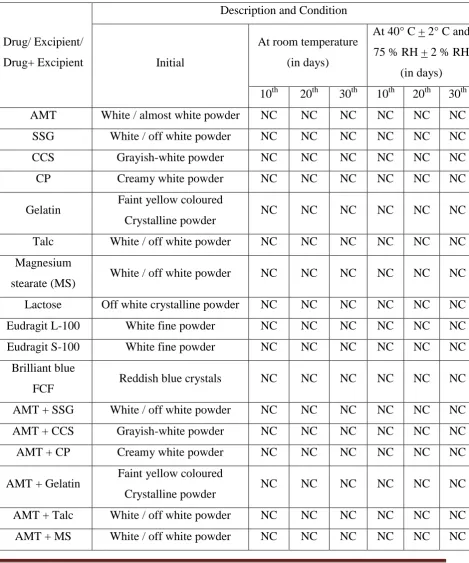
9.1.1. Drug-Excipient compatibility study 72
9.1.1.1. Physical compatibility study 72
9.1.1.2. Chemical compatibility study 74
9.2. Calibration curves of Amitriptyline Hydrochloride in three
different pH 81
9.3. For AMT Immediate-release Core Tablets
9.3.1. Pre-compression study 83
9.3.2. Post-compression study 86
9.4. For AMT Compression Coated Tablets
9.4.1. Pre-Compression study 92
9.4.2. Post-Compression study 93
9.5. Release kinetics and mechanism 98
9.6. Stability studies 102
10 SUMMARY AND CONCLUSION 104
IR Immediate Release
SSG Sodium Starch Glycolate
CCS Croscarmellose sodium
CP Crospovidone
MS Magnesium Stearate
CCT Compression Coated Tablets
PCT Press Coated Tablets
OSDRC One-Step Dry Coated Tablet manufacturing method
TDDS Targeted Drug Delivery System
IV Intra-venous
DDS Drug Delivery System
CTDDS Colon Targeted Drug Delivery System
GIT Gastro-Intestinal Tract
IBS Irritable Bowel Syndrome
FGIDs Functional gastro-intestinal disorders
5 – HT 5 Hydroxy Triptamine
SIBO Small Intestinal Bacterial Overgrowth
SERT Serotonin Reuptake Transporter
IgE Immunoglobin E
PI-IBS Postinfective - Irritable Bowel Syndrome
TCA’s Tricyclic Anti-depressants
SSRI’s Selective Serotonin Reuptake Inhibitors
BD Twice daily
g Gram
mg Milli gram
ng Nano gram
BP Blood Pressure, British Pharmacopoeia
IP Indian Pharmacopoeia
PhEur European Pharmacopoeia
USP United States Pharmacopoeia
JP Japanese Pharmacopoeia
NF National Formulary
AMT Amitriptyline hydrochloride
ED L-100 Eudragit L-100
ED S-100 Eudragit S-100
AMT CCT Amitriptyline hydrochloride Compression Coated Tablets
API Active Pharmaceutical Ingredients
M.W Molecular Weight
NC No change
θ Theta
º Degree
% Percentage
cum. Cumulative
S.D Standard Deviation
RPM Revolution Per Minute
UV Ultra violet
Vis Visible
USFDA United States Food and Drug Administration
cm Centi meter
mm Milli meter
L Litre
nm Nano meter
ml Milli litre
h Hours
min Minutes
No. TITLE PAGE No.
1 Compression Coated Tablet 6
2 Anatomy of Colon 13
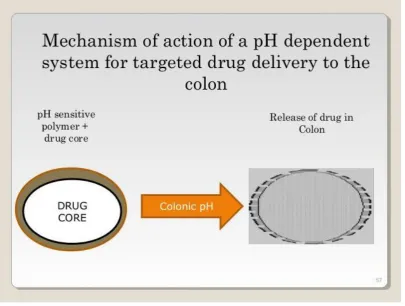
3 Mechanism of drug release by pH dependent system to Colon 15
4 Colon in IBS 33
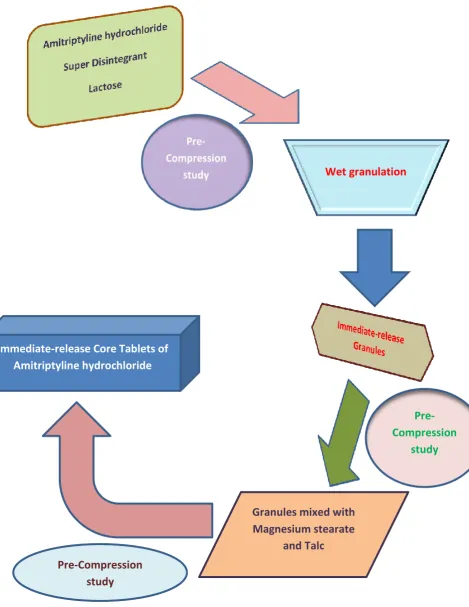
5 Flow chart for formulation of Amitriptyline hydrochloride
Core Tablets 64
6 Flow chart for formulation of Amitriptyline hydrochloride
Compression Coated Tablets 66
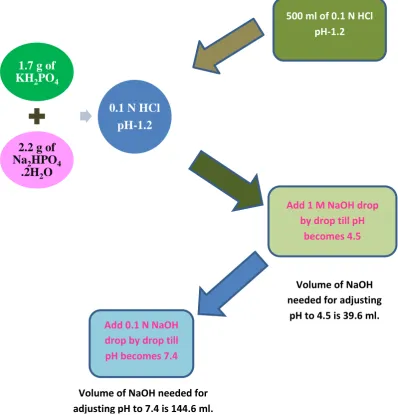
7 Flow chart for adjusting pH of dissolution medium for
simulation of GI transit (Simulated Gastro-Intestinal Fluid) 69
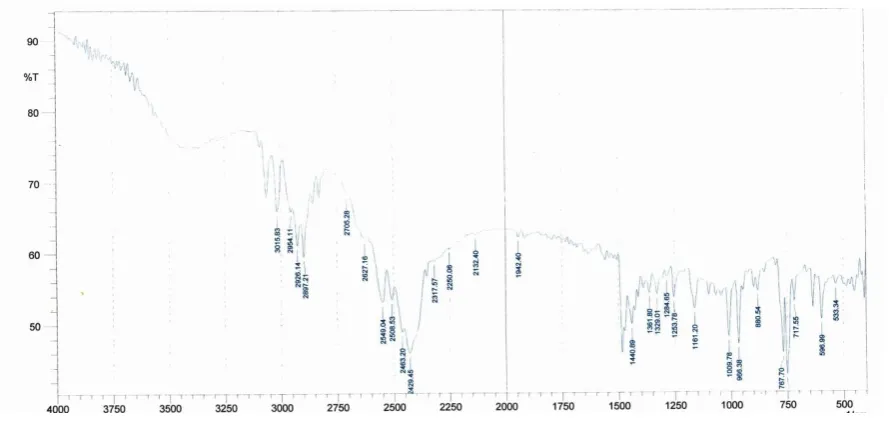
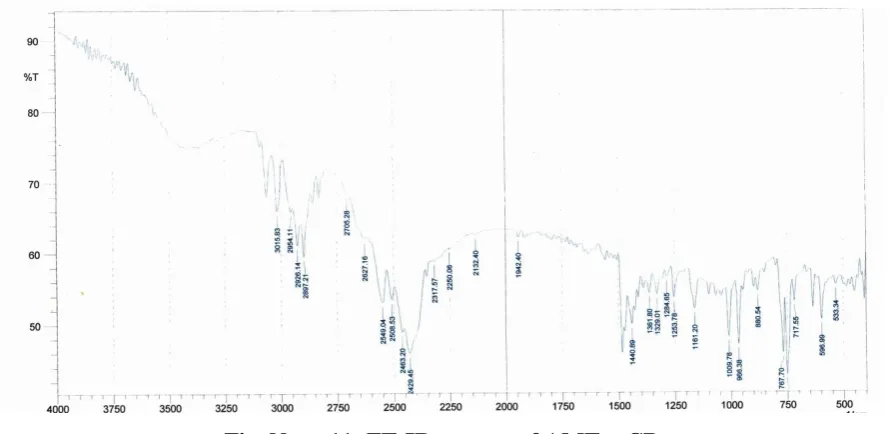
8 FT-IR spectra of Amitriptyline hydrochloride 74
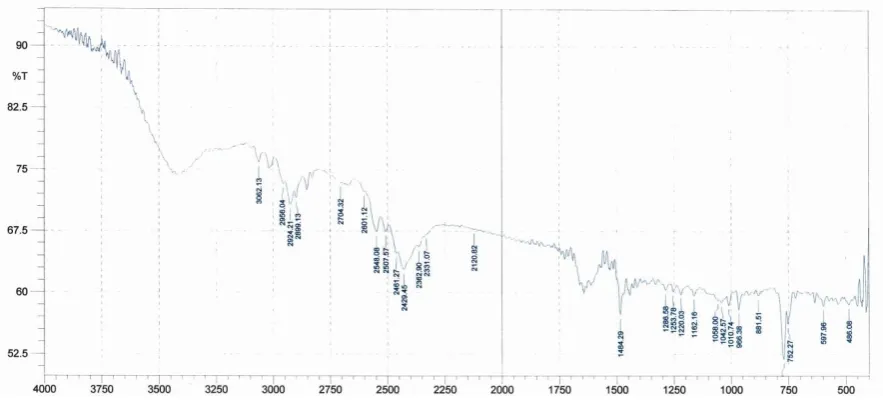
9 FT-IR spectra of AMT + SSG 75
10 FT-IR spectra of AMT + CCS 76
11 FT-IR spectra of AMT + CP 77
12 FT-IR spectra of AMT + ED L-100 78
13 FT-IR spectra of AMT + ED S-100 79
14 FT-IR spectra of formulation blend 80
15 Standard curve of AMT in 0.1 N HCl (pH-1.2) 81
16 Standard curve of AMT in Phosphate buffer (pH-4.5) 82
17 Standard curve of AMT in Phosphate buffer (pH-7.4) 82
18 Drug content of the formulated Core Tablets 89
19 In-vitro drug release study of IR AMT Core Tablets 91 20 In-vitro drug release study of IR AMT Core Tablets 91
21 Drug content of the formulated AMT CCT 95
22 In-vitro drug release study of AMT CCT 97
23 Zero order release kinetics 99
24 First order release kinetics 99
25 Higuchi diffusion kinetics 100
26 Hixon-Crowell release kinetics 100
No.
1 Transit time of different parts of GIT 13
2 pH in the different parts of GIT 14
3 List of Materials and their application in formulation 56
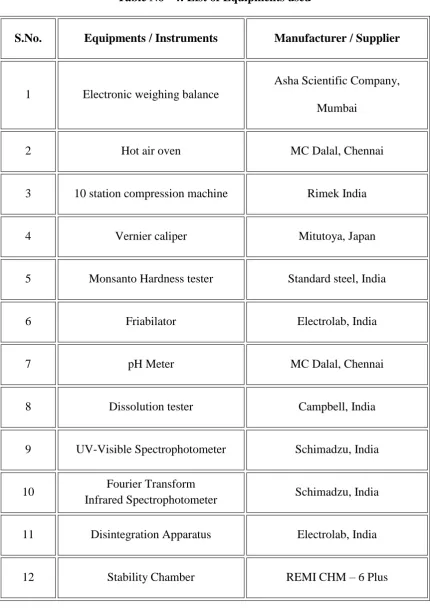
4 List of Equipments used 57
5 Pre-compression parameter 62
6 Formulation of IR Core Tablets of AMT 63
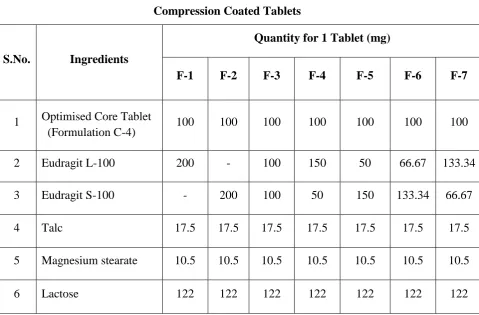
7 Formulation of AMT CCT 65
8 Eudragit L-100 and Eudragit S-100 ratio in AMT CCT 65
9 Uniformity of Weight 67
10 Physical compatibility study of Drug and Excipients 72
11 FT-IR Spectral interpretation of Amitriptyline hydrochloride 74
12 FT-IR Spectral interpretation of AMT + SSG 75
13 FT-IR Spectral interpretation of AMT + CCS 76
14 FT-IR Spectral interpretation of AMT + CP 77
15 FT-IR Spectral interpretation of AMT + ED L-100 78
16 FT-IR Spectral interpretation of AMT + ED S-100 79
17 FT-IR Spectral interpretation of formulation blend 80
18 Data for Calibration curve of AMT 81
19 Micromeritic properties of Drug and Powder blend 83
20 Micromeritic properties of IR granules of AMT 84
21 Micromeritic properties of IR granules with Glidant and
Lubricant (Compressible blend) 85
22 Uniformity of weight of formulated Core Tablets 86
23 Thickness and Diameter of formulated Core Tablets 86
24 Hardness of the formulated Core Tablets 87
25 % Friability of the formulated Core Tablets 87
26 Disintegration time of the IR Core Tablets of AMT 88
27 Drug content of formulated Core Tablets 89
28 In-vitro drug release study of IR formulation of AMT 90
32 Hardness of the formulated AMT CCT 94
33 % Friability of the formulated AMT CCT 94
34 Drug content of formulated AMT CCT 95
35 In-vitro drug release study of AMT CCT 96
36 Drug release kinetics of Optimized AMT CCT 98
Department of Pharmaceutics, Madras Medical College Page 1
1.1. ORAL SOLID DOSAGE FORMS - A CONVENIENT DRUG DELIVERY
SYSTEM1 - 3
A drug can be administered through various routes to produce prompt
therapeutic action. An Oral delivery is currently the gold standard in the
pharmaceutical industry where it is regarded as the safest, most convenient, most
economical method and having the highest patient compliance. The conventional oral
drug delivery is the most widely utilized route of administration among all the routes.
It remains the preferred route of administration in the discovery and development of
new drugs. The popularity of oral route will provide patient acceptance, ease of
administration, accurate dosing, cost effective manufacturing methods and generally
improve the shelf life of the product.
Oral solid forms such as Tablets and Capsules are most useful dosage forms
for the administration of a new drug. Pharmaceutical products designed for oral
delivery and currently available on the prescription and over the counter products are
mostly Immediate-release type, which are designed for Immediate-release of drug for
rapid absorption.
1.1.1. TABLETS – Ruling dosage form since year’s overview2
Tablet is defined as a compressed solid dosage form containing medicaments
with or without excipients. According to the Indian Pharmacopeia Pharmaceutical
Tablets are solid, flat or biconvex dishes, unit dosage form, prepared by compressing
a drug or a mixture of drugs, with or without excipients. They vary in shape and
different greatly in size and weight, depending on amount of Active Pharmaceutical
Ingredient (API) and the intended mode of administration. It is the most popular
dosage form and 70% of the total medicines are dispensed in the form of Tablets.
Advantages of the Tablet dosage form
Tablets are unit dosage form and greatest capabilities of all oral dosage form
for the greatest dose precision and the least content variability.
Less economic formulation.
Lighter and compact.
Easy to swallowing with least tendency for hang-up.
Modified release products can be formed easily by utilizing polymers.
Objectionable odour and taste can be masked by coating the Tablets.
Department of Pharmaceutics, Madras Medical College Page 2
Greatest chemical and microbial stability over all oral dosage form.
Product identification is easy and rapid requiring, no additional steps when
employing an embossed and / or monogrammed punch face.
Disadvantages of Tablet dosage form
Difficult to swallow the Tablets in case of children and unconscious patients.
Some drugs resist compression into dense compacts, owing to amorphous
nature, low density character.
Drugs with poor wetting, slow dissolution properties, may difficult to
formulate as a Tablet that will still provide adequate or full drug
bioavailability.
1.1.2. Different types of Tablets
A. Tablet ingested orally
1. Compressed Tablets
2. Multiple compressed Tablets
Compression Coated Tablets
Layered Tablets
Inlay Tablets
3. Repeat action Tablets
4. Delayed release Tablets
5. Sugar coated Tablets
6. Film coated Tablets
7. Chewable Tablets
8. Targeted Tablets
B. Tablets used for oral cavity
1. Buccal Tablets
2. Sublingual Tablets
3. Troches or Lozenges
4. Dental cones
C. Tablets administered by other route
1. Implantation Tablets
Department of Pharmaceutics, Madras Medical College Page 3
D. Tablets used to prepare solution
1. Effervescent Tablets
2. Hypodermic Tablets
3. Tablet Triturates
1.2. IMMEDIATE-RELEASE TABLETS10
Immediate-release (IR) Tablets are those which disintegrate rapidly and get
dissolved to release the medicaments. Immediate-release may be provided for by way
of an appropriate pharmaceutically acceptable diluent or carrier, which diluent or
carrier does not prolong, to an appreciable extent, the rate of drug release and/or
absorption. This term excludes formulations which are adapted to provide for
“modified”, “controlled”, “sustained”, “prolonged”, “extended” or “delayed” release
of drug.
1.2.1. DESIRED CRITERIA FOR IMMEDIATE-RELEASE DRUG
DELIVERY SYSTEM
Immediate-release dosage form should dissolve or disintegrate in the stomach
within a short period of time.
In the case of liquid dosage form it should be compatible with taste masking.
Be portable without fragility concern.
Have a pleasing mouth feel.
It should not leave minimal / no residue in the mouth after oral administration.
Should exhibit low sensitivity to environmental condition as humidity and
temperature.
Manufactured using conventional processing and packaging equipment at low
cost.
Rapid dissolution and absorption of drugs, which produces rapid onset of
action.
Disintegrating agents or Disintegrants
A disintegrants are substance in a Tablet formulation that enables the Tablet to
break up into smaller fragments upon contact with gastrointestinal fluids. Such a rapid
rupture of the Tablet matrix increased the surface area of the Tablet particles, thereby
increasing the rate of absorption of the active ingredient and producing the desired
Department of Pharmaceutics, Madras Medical College Page 4 In the past, starch was one of the most widely used, inexpensive and effective
disintegrant but high concentration of starch is required to bring effective
disintegration this is overcome by using “Superdisintegrants”.
1.2.2. SUPER DISINTEGRANTS10, 70
A super disintegrant is an excipient, which is added to a Tablet or Capsule
blend to aid in the breakup of the compacted mass when it is put into a fluid
environment.
Some super disintegrants are
1. Sodium Starch Glycolate
It is used in concentration of 2-8% & optimum concentration is 4%.
Mechanism of Action: Rapid and extensive swelling with minimal
gelling.
2. Cross-linked Povidone (Crospovidone)
It is used in concentration of 2-5% of weight of Tablet. Completely
insoluble in Water.
Mechanism of Action: Water wicking, swelling and possibly some
deformation recovery rapidly disperses and swells in water, but does
not gel even after prolonged exposure. Having greatest swelling rate
compared to other disintegrants.
3. Cross-linked carboxyl methyl cellulose sodium (Croscarmellose sodium):
Mechanism of Action: Wicking due to fibrous structure, swelling with
minimal gelling.
Effective Concentrations: Upto 5%, normally 2% for direct
compression and 3% for wet granulation process.
1.3. COMPRESSION COATED TABLETS (CCT)1, 7, 8, 9
Tablets are coated in number of ways. Coating is one of the important part in
the formulation of pharmaceutical dosage form to achieve excellent formulation
quality (e.g., color, texture, mouth feel, and taste masking), to provide physical and
chemical protection to drugs in the dosage forms and to modify release
characteristics. Coating techniques mostly used in pharmaceutical industry are
aqueous or organic coating, which has some disadvantages. They are time consuming,
stability for heat labile and hydrolysis of degradable drug and polluted environment
Department of Pharmaceutics, Madras Medical College Page 5 overcome these disadvantages. Non-solvent coatings have been categorized as Press
coating, Hot melt coating, Supercritical fluid spray coating, Electrostatic coating, Dry
powder coating. Among these techniques, Compression coating or Press coating is the
absolute dry coating without solvent and heat use. Additionally Compression coating
technique has no limitation for the Core Tablets and hence overcomes the adhesion
problem found in spraying methods.
Tablet-in-a-Tablet technology gained increased interest in the recent years for
creating modified released products. It involves the compaction of granular materials
around a preformed Tablet core using specially designed tableting equipment.
Compression coating is completely dry coating process. The Compression Coated
Tablet has two parts, internal core and surrounding coat. The Core Tablets are
generally small in size and prepared on one turret. Then the prepared Core Tablets are
transferred (centrally positioned) to another slightly larger die that is partially filled
with coating powder (half of the amount), remaining coating powder is filled on the
top of the core and compressed again resulting to form Tablet-in-a-Tablet. Mostly, the
coat is water soluble and disintegrates easily after swallowing, in order to achieve
Immediate-release product. This Tablet readily lend itself in to a Repeat action Tablet
as the outer layer provides the initial dose while the inner core release the drug later
on. But, when the core quickly releases the drug, entirely different blood level is
achieved with the risk of over dose and toxicity occurs. To avoid Immediate-release
of both the layers, the Core Tablet is coated with enteric polymer so that it will not
release the drug in Stomach while, the first dose is added in outer sugar coating.
Advantages of Tablet-in-a-Tablet technology
Simple and in-expensive.
It is useful for formulation of Tablets containing two incompatible materials
(one in the core and the other in the coat).
Can be used to formulate Modified-release products such as Delayed-release
(i.e. drug release in Intestine, Colon).
It is not hazardous to the environment since it does not require the use of high
amounts of organic solvents.
Compression Coated Tablet (CCT) can also be used to avoid pharmacokinetic
Drug–Drug interactions between concomitantly administered medications,
creating a time interval between their releases into the gastrointestinal tract.
Department of Pharmaceutics, Madras Medical College Page 6
Fig. No - 1: Compression Coated Tablet
1.3.1. CLASSIFICATION OF COMPRESSION-COATED TABLETS BASED
ON CORE SURFACE COATING7
A compression Coated Tablet is a system in which the all surface of an inner
core is completely surrounded by coat. These coats prevent drug release from the core
until the polymeric coat is entirely eroded, dissolved or removed (breaking down).
Different drug release fashion could be obtained depending on coating layer and core
composition.
1) Controlled release systems from Compression Coated Tablets
Compression Coated Tablet consists of a core (rapid release or modified
release) which is coated by compression with a coating layer which contains
polymeric material, diluent etc., and drug. Compression Coated Tablets could be
modulated to provide different release patterns depending on the drug distribution and
different type of controlling polymer used in core and coat. Extended release and
Delayed release (time, pH and microbial control) for specific region of
gastrointestinal tract, products can be formulated by using this concept.
2) Multiphasic release
Multiphasic release is a delivery system designed for many diseases which
have marked diurnal rhythms, while constant drug release does not meet the optimum
therapeutic efficiency. In such diseases, drug concentrations are needed to vary during
the day. Drug levels need to be highest when symptoms are most severe. In the
system, drug is presented in coat and core as a non-uniform drug distribution matrix
which results in biphasic drug release. With the combination of therapeutic drugs in
one Tablet, a variety of drug release. i.e. sequential release of different drugs or
multi-phasic release of drugs is achievable. Compression Coated Tablets with multiple
Department of Pharmaceutics, Madras Medical College Page 7
3) Delayed release
Delayed-release defined with lag phase and followed with release phase, is
obtained when all surface of core is compression-coated. Pulsatile release defined by
fast drug release after a certain lag time could be categorized within this group as
well. Lag time for drug release could be controlled by the application of different
polymeric coats which were differentiated with triggering factors to control drug
release as mainly mentioned in Colonic Drug Delivery System.
4) Time-controlled release
A delayed-release Tablet consists of a drug core which is Compression coated
with different polymeric (pH-independent) barriers. This delayed drug release is
programmed for the treatment of disease that depends on circadian rhythms. The lag
time of drug release is controlled by the compression coating, which prevents drug
release from the core until the polymer coat is completely eroded, swollen or
ruptured. Drug release pattern depends on the compression-coat properties.
5) pH-controlled release
A delayed release system using enteric polymers as a coating can provide
site-specific drug delivery especially for Colon. This system has attracted a great interest
for improving systemic absorption of therapeutic agents susceptible to enzyme
digestion in the upper gastrointestinal (GI) tract, while time controlled release cannot
achieve owing to large variations in gastric emptying time.
6) Microbial controlled release
A delayed release system may be aimed for Colon targeting. This system is
based on the degradation of the polymeric compression-coat by specific enzymes
produced by entero-bacteria in the Colon. Microbial degradable polysaccharides
containing glycosidic bonds such as alginates, arabinogalactan, arabinoxylan,
cellulose, chitosan, amylase, chondroitin sulfate, dextran, inulin, galactomannan (guar
gum, locust bean gum), karaya gum, laminarin, pectins, starch, tragacanth gum,
xanthan gum and xylan, could be employed as a coat. The investigated
polysaccharides used for Colon-specific drug delivery which could also be used in
Department of Pharmaceutics, Madras Medical College Page 8
1.3.2. FORMULATION CONSIDERATION OF COMPRESSION COATING
TECHNIQUE7
1) Compression coating amount
Coating amount is the most important parameter to achieve a coating
uniformity in compression Coated Tablets. Generally, Compression Coated Tablet
requires a coating material which is about twice the weight of the Core Tablet or
more, the volume must be greater than that of the core itself. If the Core Tablet
contains low density materials, such as fats and waxes, the amount or weight of
coating must be even greater to assure a uniform volume of coating material for
covering the core and adhesion of core and coating. Recently, increasing the drug
loading by decreasing the compression coat could be performed with a novel
compression tool (one-step dry coated tablet manufacturing method; OSDRC-system)
2) Position of core in coated layer
The main drawback of this system is to centralize the core in the Compression
Coated Tablets. The reproducibility of drug release from Compression Coated Tablet
is questionable, since the faults of coating may occur. Examples of
press-coating fault are unequal press-coating, cocking and off-center. However, this drawback has
been recently overcome by the novel compression tools (OSDRC-system) which
placed a Core Tablet in a certain position. X-ray computed tomography as
non-invasive and rapid characterization method in online processing control for Press
Coated Tablets (PCT).
3) Compression force and Compressibility of materials
The compressibility of coated Tablets is mainly depended on the coating
material. Thus, cohesiveness and plasticity of the powder coat are needed to obtain
satisfactory mechanical strength of the coating. The cohesiveness indicates the
continuity of the coating around the edge of the core, which depends on its strength
and the plasticity responses for the expansion of the core after the final Tablets are
released from the die. The final compression force applied to prepare Compression
Coated Tablets need to be higher than the compression force which was applied to the
core, to ensure the adhesion between core and coat. Tablets with adhesive coating can
be applied as core to ensure adhesion of compression coat and core.
4) Interaction between drug and compression coat
The interaction of drug and coating is needed to be considered especially when
Department of Pharmaceutics, Madras Medical College Page 9 Coated Tablets diffuses through the swollen coat. This process might enhance some
possible interaction between drug and coat. The difference in drug release of the
enantiomers of verapamil hydrochloride from Compression Coated Tablets containing
chiral polymers (pectin, galactomannan and sclera glucan) as the coat has been found.
1.3.3. FACTORS AFFECTING DRUG RELEASE IN COMPRESSION
COATED TABLETS7
1. Tablet cores
Drug solubility
Release modifiers used in Core Tablet formulation
2. Compression coating
Polymer type
Particle size of polymer used
Porosity or release modifier incorporated in coat
Core-Coat ratio
Compression force
1.3.4. RECENT TECHNOLOGIES USED IN COMPRESSION COATING
METHOD7
1. One -Step Dry Coated Tablet manufacturing method (OSDRC)
2. Dividable Compression Coated Tablets
3. Inlay Tablets
1.4. TARGETED DRUG DELIVERY SYSTEM (TDDS)4, 5
The concept of designing Targeted Drug Delivery System has been originated
from the Paul Ehrlich, who was a microbiologist, proposed the idea of drug delivery
in the form of “Magic bullet”. Selective drug targeting yet remains unachieved.
Targeted drug delivery means accumulation of pharmacologically active moiety at
desired target in therapeutic concentration at the same restricting its access to normal
cellular lining. In site specific targeted drug delivery, active drug is delivered to very
specific preselected compartments with maximum activity while reducing the
concentration of drug to normal cells. In traditional drug delivery systems like oral
ingestion and IV injection, the medication is distributed throughout the body through
the systemic blood circulation. For most drugs, only a small portion of the medication
reaches the affected organ. The drug can be targeted to intracellular sites, virus cells,
bacteria cell and parasites using different scientific strategies have proven highly
Department of Pharmaceutics, Madras Medical College Page 10 higher and effective concentration at the targeted site certainly maximize the benefits
of targeted drug delivery. This helps in reducing the side effects and improving the
efficacy.
1.4.1. PROPERTIES OF AN IDEAL TDDS4
It should be non-toxic, non-immunogenic, biocompatible, physiochemically
stable in-vivo and in-vitro.
Restrict drug distribution to target cells or tissues or organs or should have
uniform capillary distribution.
Controllable and predictable rate of drug release.
Drug release should not affect the drug distribution.
Therapeutic amount of drug release.
Drug leakage during transit must be minimal during transit.
Carriers used should be bio-degradable or readily eliminated from the body.
The preparation should be easy or reasonably simple, reproductive and cost
effective.
A Targeted Drug Delivery System is preferred in the following situations.
Pharmaceutical: drug instability and low solubility.
Pharmacokinetic: short half-life, large volume of distribution and poor
absorption.
Pharmacodynamics: low solubility and low therapeutic index.
1.4.2. Strategies for drug targeting4, 6
1. Passive targeting
2. Active targeting
3. Inverse targeting
4. Dual targeting
5. Double targeting
6. Combination targeting
Active targeting can be further classified into three broad categories-
1. First - order targeting: refers to DDS that delivers the drugs to the capillary bed
or to the active site.
2. Second - order targeting: refers to DDS that delivers the drug to a specific cell
type such as the Tumour cells or Kupffer cells in lives and not to the normal cells.
3. Third - order targeting: refers to DDS that delivers the drug to the intracellular
Department of Pharmaceutics, Madras Medical College Page 11
1.5. COLON TARGETED DRUG DELIVERY SYSTEM (CTDDS) 5, 11, 12, 13
Most of the conventional drug delivery systems for treating the Colon
disorders such as Inflammatory Bowel Diseases (e.g. Irritable Bowel Syndrome,
Ulcerative colitis, Crohn‟s disease etc.,), infectious diseases (e.g Amoebiasis) and
Colon cancer are failing as the drugs do not reach the site of action in appropriate
concentrations. Thus, an effective and safe therapy of these Colonic disorders, using
site-specific drug delivery systems is a challenging task to the pharmaceutical
technologists.
The delivery of drugs to the Colon via gastrointestinal tract requires the
protection of a drug from being released in stomach and small intestine. The drug
must be released in the colon from the drug delivery system. Targeting depends on
exploiting a unique feature of specific site and protecting the drug until it reaches to
the site.
Targeted drug delivery to the Colon is highly desirable for local treatment of a
variety of bowel diseases. Inflammatory Bowel Diseases including Irritable Bowel
Syndrome, Ulcerative Colitis and Crohn‟s disease are considered serious Colonic
disorders. The advent of slow release technologies increases the chances for a drug to
be released in the Colon and thus this organ has an important role to play in drug
absorption from oral sustained release formulations.
Colonic drug delivery has gained increased importance not just for the
delivery of drugs for the treatment of local diseases associated with the Colon but also
for its potential for the delivery of proteins and therapeutic peptides.
1.5.1. Advantages of CTDDS5
Local treatment requires small drug quantities than quantity required for
conventional dosage forms
Frequency can be reduced, hence lower the cost of expensive drug
Side effects and interactions can be minimized
The colon is the attractive site of poorly absorbed drugs, so the bioavailability
can be increased by colon targeting
Reduces gastric irritation caused by many drugs
Bypasses initial first pass metabolism
Improved patient compliance
It has longer retention time and appears highly responsive to agents that
Department of Pharmaceutics, Madras Medical College Page 12
It has low hostile environment, less peptidase activity so peptides, oral
vaccines, insulin, growth hormones can be given through this route.
1.5.2. Limitations of CTDDS5
One challenge in the development of Colon-specific Drug Delivery Systems is
to establish an appropriate in-vitro dissolution testing method to evaluate the
designed system. This is due to the rationale after a Colon-specific Drug
Delivery System is quite diverse.
The targeting of drugs to the Colon is very complicated. Due to its location in
the distal part of the alimentary canal, the Colon is particularly difficult to
access. In addition to that the wide range of pH values and different enzymes
present throughout the gastrointestinal tract, through which the dosage form
has to travel before reaching the target site, further complicate the reliability
and delivery efficiency.
Successful delivery through this site also requires the drug to be in solution
form before it arrives in the colon or alternatively, it should dissolve in the
luminal fluids of the Colon, but this can be a limiting factor for poorly soluble
drugs as the fluid content in the colon is much lower and it is more viscous
than in the upper part of the GIT.
Lower surface area and Relative „tightness‟ of the tight junctions in the Colon
can also restrict drug transport across the mucosa and into the systemic
circulation
1.5.3. FACTORS TO BE CONSIDERED IN THE DESIGN OF
COLON-SPECIFIC DRUG DELIVERY SYSTEM5, 11
1.5.3.1. Anatomy and Physiology of Colon
The GIT is divided into Stomach, Small Intestine and Large Intestine. The
Large Intestine extending from the ileocaecal junction to the anus is divided into three
main parts. These are the colon, the rectum and the anal canal. The colon itself is
made up of the caecum, the ascending colon, the hepatic flexure, the transverse colon,
the splenic flexure, the descending colon and the sigmoid colon. It is about 1.5 meters
long. The transverse colon being the longest and most mobile part and has an average
diameter of about 6.5 cm, although it varies in diameter from approximately 9 cm in
caecum to 2 cm in the sigmoid colon. The Colon is a cylindrical tube that is lined by
moist, soft pink lining called mucosa; the pathway is called the lumen and is
Department of Pharmaceutics, Madras Medical College Page 13 forms the first part of the colon and leads to the right colon or the ascending colon
followed by the transverse colon, the descending colon, the sigmoid colon, rectum
and the anal canal. The major function of the colon is to create a suitable environment
for the growth of colonic microorganisms, absorption of potassium and water from
lumen concentrating the faecal content and secretion & excretion of potassium and
bicarbonate, storage reservoir of faecal contents and expulsion of the contents of the
[image:30.595.153.480.216.457.2]colon at an appropriate time.
Fig. No - 2: Anatomy of Colon
Table No - 1: Transit time of different parts of GIT5, 6, 11
Part of GIT Transit time
Stomach < 1 hours (Fasting)
> 3hours (Fed)
Small intestine transit
Duodenum
Jejunum
Ileum
5 minutes
2 hours
3 to 6 hours
Large intestine transit
Caecum
Colon
0.5 to 1 hours
Department of Pharmaceutics, Madras Medical College Page 14
1.3.5.2: pH in the various parts of GIT5, 11
Table No – 2: pH in the different parts of GIT
Location pH
Oral cavity 6.2-7.4
Oesophagus 5.0-6.0
Stomach Fasted condition – 1.5 to 2.0
Fed condition – 3.0 to 5.0
Small intestine Jejunum – 5.0 to 6.5
Ileum – 6.0 to 7.5
Large intestine Right colon – 6.4
Mid colon and Left colon – 6.0 to 7.6
1.3.5.3: pH dependent system as an approach for Colon targeting4
The basic principle in this method is the coating of the dosage form with
various pH-dependent polymers which protects the drug release in upper GIT and
produces the delayed release products. The selected polymer for the Colon targeting
should be able to withstand the pH in stomach and small intestine. Methacrylic acid
esters are commonly used polymers for Colon targeting because they are soluble at
pH above 6. The ideal polymer characteristic used in Colon targeting is to prevent the
drug release in the stomach and the proximal part of small intestine, but able to
Department of Pharmaceutics, Madras Medical College Page 15
Fig. No – 3: Mechanism of drug release by pH-dependent system to Colon
1.3.5.4. Delayed (Time-controlled release system) release Drug Delivery to Colon
Small Intestinal transit time is relatively constant and is hardly influenced by
the nature of the formulation administered. The formulation once having left the
stomach, the formulation arrives at the ileocaecal junction about 3 to 4 hours after
dosing. The pH dependent polymers are utilized for this type of formulation. The drug
Department of Pharmaceutics, Madras Medical College Page 16
1. Murat Turkoglu et al., 14 developed pectin–HPMC Compression Coated 5-Amino
Salicylic Acid Tablets for Colonic delivery. They Prepared 5-ASA Core Tablets by
wet granulation method using PVP (K 29-32). Each 100 mg Core Tablet contained
5-ASA and was compression coated at 20 kN or 30 kN using 100% pectin, 80%
Pectin–20% HPMC and 60% pectin–40% HPMC at two different coat weights as 400
or 500 mg. Drug dissolution/system erosion/degradation studies were carried out in
pH - 1.2 and 6.8 buffers using a pectinolytic enzyme. HPMC addition was required to
control the solubility of pectin. The optimum HPMC concentration was 20% and such
system would protect the cores up to 6 h that corresponded to 25–35% erosion and
after that under the influence of pectinase the system would degrade faster and
delivering 5-ASA to the Colon.
2. Toyohiro Sawada et al., 15 developed Time-release Compression Coated Core
Tablet containing Nifedipine. The Solid dispersion of Nifedipine was prepared by
spray drying method. The Core Tablets of Nifedipine were prepared by direct
compression technique. The Compression coating is done by using different
concentrations of polyethylene oxide-polyethylene glycol mixtures. Four formulations
were done. Each formulation showed a clear lag period before Nifedipine release
initiation, followed by sustained drug release lasting up to 24 h. The plasma
Nifedipine profiles after oral administration of CC-2 Tablet suggest that a formulation
that achieves clinically appropriate plasma Nifedipine concentration in the early
morning might effectively regulate the morning surge in blood pressure responsible
for myocardial infarction and stroke in hypertensive patients.
3. Eiji Fukui et al., 16 formulated and evaluated the Timed-release Press Coated
Tablets of Diltiazem hydrochloride (DIL) as a model drug for Colon targeting. Outer
shell composed of Hydroxypropylcellulose. The Core Tablets were prepared by wet
granulation method using 33% w/v PVP ethanolic solution as binder. In-vitro drug
release study was done in JP 1st fluid (pH-1.2) and JP 2nd fluid (pH-6.8) indicated that
these Tablets showed both acid resistance and Timed-release. ETP Tablets with a
layer of phenylpropanolamine hydrochloride (PPA) (a marker of gastric emptying)
Department of Pharmaceutics, Madras Medical College Page 17 dogs. The gastric emptying time and lag time after gastric emptying were evaluated
by determining the times at which PPA and DIL first appeared in the plasma.
4. Nikhil Biswas et al., 17 developed Pulse release of Doxazosin from
Hydroxyethylcellulose Compression Coated Tablet. The Core Tablets were prepared
by direct compression method. The influence of disintegrants CCS,
l-Hydroxypropylcellulose (l-HPC), gellan gum on drug release and in-vivo performance
were investigated. The compression coating is done by using Ethyl cellulose and PEG
6000. In-vitro optimized Croscarmellose sodium–HEC matrix showed significantly
faster (p < 0.05) drug release (t90%= 46 min) after an initial lag of 243 min.
Disintegrant –HEC blended matrices were found significantly superior (p < 0.05) in
terms of in-vitro release and bioavailability in comparison to plain HEC matrices.
5. Sateesh Kumar Vemula et al., 18 formulated and evaluated Colon-specific double
Compression Coated Mini-Tablets of Ketorolac tromethamine. Double Compression
Coated Tablets were prepared based on Time-controlled Hydroxypropyl
methylcellulose K100M inner compression coat and pH-sensitive Eudragit S-100
outer compression coat. 6 formulations were done. From the in-vitro drug release
studies, F6 Tablets was considered as the optimized formulation, which retarded the
drug release in stomach and small intestine (3.51 + 0.15% in 5 h) and progressively
released to colon (99.82 + 0.69% in 24 h). The release process followed supercase-II
transport with zero order release kinetics. From the pharmacokinetic evaluation, the
Immediate-release Core Mini-Tablets reached peak plasma concentration (C-max of
4532.68 + 28.14 ng/ml) at 2 h T-max and Colon targeted Tablets showed C-max of
3782.29 + 17.83 ng/ml at 12 h T-max. The area under the curve and mean resident
time of Core Mini-Tablets were found to be 11,278.26 + 132.67 ng.h/ml and 3.68 h
respectively while 17,324.48 + 56.32 ng.h/ml and 10.39 h for Compression Coated
Tablets.
6. SM Chick Petty et al.,19developed novel Combined Time dependent Solvent less
Compression Coated Delivery Systems for Colonic Delivery of Diclofenac Sodium.
The present study was aimed to develop rapidly disintegrating Diclofenac sodium
Core Tablets compression coated with a mixture of time dependent hydrophilic
Department of Pharmaceutics, Madras Medical College Page 18 soluble polymer Eudragit S-100 in different ratios. The formulations released 1.24%
to 6.82% of drug in physiological environment of stomach and small intestine
depending upon proportion of HPMC and ED in the coat. The Core Tablets
compression‐coated with HPMC and ED mixture in the ratio 6:4 was found to be
suitable for targeting Diclofenac sodium to the Colon owing to its minimal drug
release in physiological environment of stomach and small intestine and releases 92%
of drug in the target area.
7. Patel Rushikesh Chandubhai et al., 20 formulated and evaluated an oral Time- controlled Drug Delivery System of Flurbiprofen, based on chronotherapeutic
approach for the treatment of Rheumatoid arthritis (RA). In this study, Flurbiprofen
CCT were prepared by compression coating the Core Tablet with different polymers
like HPMC K4M, HPMC K15M and HPC in various proportions. Different ratios of
polymers were selected to achieve suitable lag time for the treatment of RA. The CCT
were evaluated for their hardness, thickness, friability, weight variation, drug content
uniformity and core erosion ratio. The in-vitro drug release profile of the formulations
was performed in simulated gastric and intestinal pH conditions up to 8 h. The desired
lag time of 6 h was obtained for selected formulations and burst release was obtained
after the lag time, which was consistent with the demands of chronotherapeutic drug
delivery.
8. Dr. S.S. Khadabadi et al., 21 formulated and evaluated the Press Coated Tablet of
Ketoprofen. The PCT containing Ketoprofen in the inner core were formulated by
direct compression method. SSG is used as a super disintegrant in Core Tablet. The
HPMC K4M is used as a coating material to modify the release in outer coat. Totally
9 formulations were made by varying amounts of SSG and HPMC K4M. Evaluations
were done. The release profile of PCT exhibited a lag time depending upon the
amount of HPMC K4M in compression coating, followed by burst release.
Optimization was done using 32 factorial design considering two independent factors
at three levels. The optimized batch F6 gave a lag time of 6 h and drug release of
95.74% which consisted of 40% HPMC K4M and 2% SSG.
Department of Pharmaceutics, Madras Medical College Page 19 Tablet of Nisin was compression coated with 100% pectin, 90% pectin–10% HPMC,
85% pectin–15% HPMC, 80% pectin–20% HPMC, 75% pectin–25% HPMC, 100%
HPMC at a coat weight of 400 mg. Core Tablets of Nisin is formulated by wet
granulation method. The concentration and the activity of Nisin were quantified using
Well Diffusion Agar Assay. Drug release studies were carried out in pH-3.3 buffer
solution. System degradation/erosion experiments were carried out in pH-1.2, 3.3, and
6.8 buffers using a pectinolytic enzyme. It was found that pectin alone was not
sufficient to protect the Nisin containing Core Tablets. At the end of the 6 h 40%
degradation was observed for 100% pectin tablets. HPMC addition required to control
the solubility of pectin, a 5% increase in HPMC ratio in pectin/HPMC mixture
provided a 2 h lag time for Nisin release.
10. Pruthviraj S Pawar et al., 23 formulated and evaluated the oral Colon targeted
Compression Coated Tablet of budesonide. Colon targeted Tablets of budesonide
were prepared using pectin, guar gum as enzyme dependent polymers along with
HPMC, HEC as time dependent polymers followed by pH-dependent polymers like
Eudragit S100 and Cellulose acetate phthalate. Fast dissolving core tablet of
Budesonide was prepared by using CCS as a superdisintegrant by direct compression
method which showed rapid release within 2 min. The compression coating was done
over the Core Tablets by using pectin, guar gum, HPMC and HEC in different ratios
by direct compression method. The enteric coating was done on the CCT using ED
S-100 and CAP in different ratios by dip coating method. The evaluations were done
for all the formulations. In-vitro swelling and in-vitro drug release studies were
carried out at different pH (1.2, 6.8 and 7.4). The compression coated formulation C1
(pectin: guar gum 1:2), C2 (HPMC: HEC 1:2) and C3 (HPMC, HEC: pectin, guar
gum 2:1) showed good swelling (493.42%, 411.08% and 393.61%) up to 18, 20 and
21 h respectively. pH dependent polymers ED S-100: CAP in the ratio 2:1 as an
enteric coating material applied over CCT was capable of protecting the drug from
being released in physiological environment of stomach and small intestine. This
study proved that Budesonide CCT, enteric coated with ED S-100: CAP in the ratio
2:1 may be beneficial in the treatment of IBS and Nocturnal Asthma.
Department of Pharmaceutics, Madras Medical College Page 20 Diclofenac sodium as a model drug. In this present study fast disintegrating Core
Tablets of Diclofenac sodium were coated with coating material granules containing
okra mucilage or modified okra mucilage in combination with HPMC K15M (totally
10 formulations are made) and evaluated for pre and post compression parameters.
The in-vitro disintegration time for Core Tablets was 64.66±0.577 sec. and the wetting time was 41.66 ±0.57 sec. All other parameters were satisfactory for core and
coated formulations. Formulations P1, P2 and P3 showed drug release of 96.789 ±
0.66994%, 100.86 ± 0.42729% and 95.15±0.7180 % in 24 h respectively. There was
no significant difference in in-vitro dissolution in presence and absence of rat caecal
content indicating drug release depends on pH, swelling and erosion.
12. Krishnaveni.G et al., 25 Developed and Evaluated of Pulsatile Drug Delivery
System containing Montelukast Sodium by Press Coated Tablet using Natural
Polysaccharides. Totally 9 different Montelukast sodium Core Tablet formulations
were prepared by direct compression method using different concentrations of SSG,
CCS, Crospovidone. Then the optimized F3 formulation was coated with a natural
polymers such xanthan gum, guar gum and mixture of it respectively. The evaluations
were done. Formulation P5-F3 shows great ideal in pulsatile drug delivery. The
release data from the formulation was found to fit in peppas model with r2 of 0.983.
Stability studies also performed for 3 months at 40ºC and 55ºC at 75% RH as per ICH
guidelines for optimized formulation and it was found to be stable.
13. Tarak J. Mehta et al.,26 optimized Metronidazole Compression Coated Tablets. The Core Tablets were prepared by wet granulation method using PVP-K30 as binder.
SSG is used as super disintegrant. Chitosan and Carbopol 934-P is utilized to coat the
Metronidazole Core Tablets in different concentrations. The evaluations were done
for all the formulations. Optimization was performed using a 32 full factorial design.
14. K. V. Krishna et al., 27 designed and evaluated the Extended-release Tablet of
Venlafaxine hydrochloride using Compression coating technology. Venlafaxine HCl
pellets were prepared. The compression coating of the pellets are done by both direct
compression method and wet granulation method. As per USP Dissolution profiles for
Department of Pharmaceutics, Madras Medical College Page 21 Compression Coated Tablets formulated by wet granulation method are performed in
0.1 N HCl.
15. Nandini et al., 28 formulated and evaluated the Compression Coated Tablets Of
Cefpodoxime Proxetil. The floating Core Tablets are prepared by direct compression
technique. 9 formulations were made by using polymers such as HPMC, EC, Xanthan
gum, Carbopol. Then Core Tablets were coated with coating material containing CCS
in Immediate-release. This outer layer is so formulated to release its drug content in a
period of 15 min, so as to achieve the initial burst release and then after 2 hours as the
plasma concentration of the drug decreases then the core layer starts releasing its drug
content so that the plasma concentration of the drug is maintained in the therapeutic
window for the duration of 12 h. Thus the dosing interval is increased from 4 h to
12 h.
16. Sagar J. Sonawane et al.,29 developed and evaluated the Press Coated Tablets of Losartan potassium. The inner Core Tablets were prepared by direct compression
method. SSG is used as Super disintegrant. The coat layer consists of HPMC K100M
and Ethyl cellulose in different ratio. Results of in- vitro drug release profile from all
formulations (F1-F4) showed slow and sustained release of Losartan potassium over a
period of 12 hours. Hydrophilic polymers like HPMC K100M (60%) and Ethyl
cellulose (10%) was found to be optimum.
17. Yeswanth reddy musukula et al., 30 designed and evaluated the Compression Coated Colon Targeted Tablets of Ketorolac tromethamine by using Natural polymers
and their combination with HPMC K100M. In this study, they develop Compression
Coated Tablets of Ketorolac Tromethamine (KTM) with a view of minimizing the
drug release in the physiological environment of stomach and small intestine and to
achieve maximum drug release in the physiological environment of Colon by
applying Natural polymers like Xanthan Gum, Guar Gum, Karaya Gum and
combination of Xanthan Gum/ Guar Gum with HPMC K100M as a compression coat
over the KTM Core Tablets. The KTM Core Tablets are prepared by direct
compression method. The Compression coating is done by using polymers such as
Xanthan gum, HPMC K100M, Guar gum, Karaya gum. The results of the study
Department of Pharmaceutics, Madras Medical College Page 22 gum with HPMC K100M / Guar gum would be potential in delivering the drug to the
Colon.
18. D. Pavani et al., 31 developed and evaluated the Metoprolol Tartrate Compression
Coated Tablets for Chronotherapeutic drug delivery system. The Core Tablets of
Metoprolol Tartrate was prepared by direct compression method using various
concentrations of super disintegrants. Three different formulations of Core Tablets
were formulated. From this F1 shows faster drug release. Then the coating is done by
using Ethyl cellulose N 50 and Methocel K100M. All the Core and Press Coated
Tablet formulations were subjected to various physical and chemical evaluation tests
for Core and Press Coated Tablets. Ten formulations of Compression Coated Tablets
were made. From this C1, C2 and C3 produces maximum drug release after 3 hours,
C5 and C9 produces maximum drug release after 8 hours. Time-dependent Pulsatile
Drug Delivery System has been achieved from Tablet of formulation C5 and C9 with
98.37% and 99.9%.
19. Dahal Amit et al.,32 designed and evaluated the Compression Coated Tablets of
Nifedipine. In this study, Core Tablets are prepared using solid dispersion of
Nifedipine. Solid dispersion contains Nifedipine : Mannitol (1:2), prepared by hot
melt method. The coat layer consists polymers such as PEG 6000, HPMC K4M,
HPMC K15M and HPMC K100M in different ratios. Totally 12 formulations were
done. All the evaluation parameters are checked out for both Core and Compression
Coated Tablets. The mechanism of drug release was Higuchi’s model release kinetics
with r2 value between 0.983-0.997. Hence, Compression Coated Tablets of Nifedipine
prepared with hydrophilic polymers showed promising results to be chosen for
chronotherapeutic treatment of Hypertension.
20. Kommineni veditha et al., 33 designed and developed the Pulsin cap and Press Coated Tablets of Salbutamol sulphate. Press coated systems were prepared with
different ratios of swelling and rupturable polymers [HPMC: Eudragit]. The lag time
was dependent on composition of these polymers and the desired lag time was
observed form the formulation containing only Eudragit. Modified Pulsin cap is based
on cross linked hard gelatin capsules with formaldehyde and filled with Hydrogel
Department of Pharmaceutics, Madras Medical College Page 23 HPMC and diluent Dicalcium phosphate. The lag time was dependent on the polymer
and diluent ratio. The desired lag time was observed form the formulation containing
HPMC: DCP (3:1) ratio. Pulsin cap technique was found to be more suitable to
achieve prolonged lag time when compared with the Compression Coated Tablets.
21. Mohd abdul hadi et al., 34 formulated and evaluated of Compression Coated
Tablets of Lornoxicam for targeting early morning peak symptoms of Rheumatoid
Arthritis. The Core Tablets of Lornoxicam were prepared by direct compression
technique using different concentration of Crospovidone. From this, the optimized
formulation is compression coated with combination of different concentrations of
polymers such as HPMC K4M, L-HPC, Na-CMC and EC (18-22 cps). Pre and post
compression parameters were studied. The F5 formulation was chosen as better one as
it releases 9.13 + 0.79% and 99.81 + 0.81% at the end of 5.5 and 8 hours respectively.
22. J.Josephine leno jenita et al., 35 formulated and evaluated the Compression Coated Tablets of Mesalazine for Colon delivery. In this study, Natural
Polysaccharide; Locust bean gum (550,450,350 and 250 mg) are used. The in-vitro
release studies carried out in 0.1 N HCl, Phosphate buffer pH-7.4 and Phosphate
buffered saline pH-6.8 containing 4% w/v of rat caecal contents. These studies proved
the Locust bean gum can able to protect the Core Tablet containing Mesalazine under
conditions mimicking Mouth to Colon transit and clearly established that Locust bean
gum in the form of compression coat is a potential carrier for Colon targeting.
23. Renu dinkar et al., 36 developed and evaluated the Nifedipine loaded Tablet
formulation for Colonic delivery. The objective of present study was to develop a
Pulsatile Compression Coated Tablet. The Core Tablets of Nifedipine were prepared
by wet granulation method. Then the Core Tablets are coated with different ratios of
Ethyl cellulose and Eudragit L-100. Six formulations were made by varying coating
level (%w/w of core) and weight ratio of Ethyl cellulose to Eudragit L-100. The drug
release study is carried out in 0.1 N HCl for 2 hours and in Phosphate buffer pH-6.8
for 10 hours. The formulation having coating level of 50 % w/w of core and weight
ratio of Ethyl cellulose to Eudragit L-100 (20%) produces the lesser release profile