Innovative and Technology Based Methods of Teaching Statistics
Concepts
MEHRYAR NOORIAFSHAR [email protected]
University of Southern Queensland, Toowoomba, Australia
Abstract
This paper is based on a research project with the main purpose of identifying and using students’ preferences for developing more effective teaching methods for statistics and related fields.
The findings have demonstrated that students, regardless of their geographical location and cultural background, have a preference for visual features in teaching materials. In other words, students would like to be involved in real-life problems.
The latest interactive technologies such as the Classroom Performance System (CPS) were, for the first time at the University of Southern Queensland (USQ), adopted by the author for teaching Business Forecasting. Positive feedback from the students who participated in a survey, have demonstrated that the system can be used as an effective teaching and learning environment in the classroom. A methodology for utilizing CPS in such a way that it incorporates students’ learning preferences has been presented.
Key words: Statistics, Learning, Technology, Classroom Performance System
Introduction
The majority of the Business students do not possess a very strong background in mathematics and they do not always like to study further the subject. Hence, the topic of Forecasting would certainly become a challenging subject to teach the Business students.
In teaching Business Forecasting the following were taken into consideration:
1. Convey the underlying message and concept. 2. Adopt innovative methods of teaching. 3. Consider students’ learning style preferences.
The message that in many cases there is no final solution but only some alternatives should also be conveyed to the students.
using the latest technologies in classroom teaching. The initial phase consisted of collecting data on these students’ perception on learning styles and methods. Hence, a questionnaire was developed and used as the data collection instrument. This questionnaire contained questions on the following categories:
• students’ background;
• students’ learning preferences; and
• students’ future goals and aspirations.
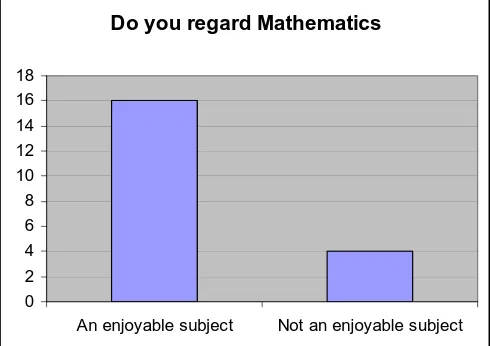
According to the data collected, the majority (80%) of the students regarded mathematics in general as an enjoyable subject. See Figure 1.
Do you regard Mathematics
0 2 4 6 8 10 12 14 16 18
An enjoyable subject Not an enjoyable subject
Figure 1 – Students Perception of Mathematics as an Enjoyable Subject
It is interesting to note that a similar study on a sample of 60 students from Kathmandu in Nepal has shown very similar results. This finding is indicative of the fact that regardless of the geographical location and cultural background, students enjoy learning mathematics. Hence, it would be a logical approach to maintain mathematics’ acceptance as a fun subject and attempt to entice even more students to the “enjoyable subject” category.
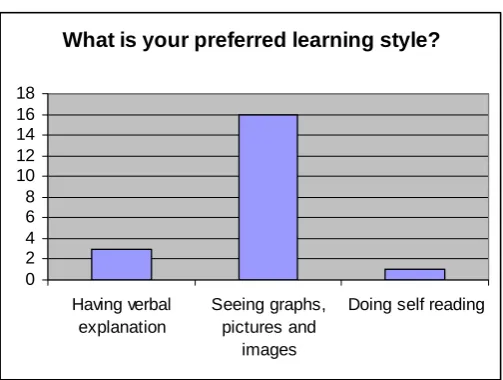
[image:2.595.182.427.245.418.2]What is your preferred learning style?
0 2 4 6 8 10 12 14 16 18
Having verbal explanation
Seeing graphs, pictures and
images
[image:3.595.179.431.69.259.2]Doing self reading
Figure 2 – Students’ Learning Style preference
Towards Full Participation in the Classroom
Classroom Performance System (CPS) by eInstruction (www.eInstruction.com) is the state-of-the-art in bringing full participation and interactivity to the classrooms. Students are provided with handsets (clickers) which are used to respond to questions provided by the teacher. The correct answers to questions along with the results are shown immediately on the screen without identifying individual students. The system also presents the percentages of the responses in the forms of Histograms or Pie Charts.
CPS encourages all students to participate in discussions. Students who are not sure about the right answers would be able to participate without being recognized and embarrassed. Students who know the correct answer will receive the confirmation about their response. Hence, they will be further motivated.
As reported by Hafner (2004) Paul Caron uses CPS in his law classes at the University of Cincinnati to break through the “cone of silence”.
The CPS technology was adopted by the author for the undergraduate course on Business Forecasting in 2005 and was used to:
1. Test the students’ understanding for the topics presented in the session. 2. Motivate and generate discussion based on class opinion during the session. 3. Guide students towards identifying appropriate factors for solving case
studies.
4. Assign tests and quizzes at appropriate stages of the course to assess progress.
The following methodology was developed to utilize the system in a constructivist manner:
1. Present a case study.
2. Provide the necessary guidance. 3. Receive feedback from students.
5. Allow students to develop solutions.
6. Receive feedback from students based on their solutions. 7. Initiate Discussion based on the Feedback.
8. Recommend the final Solution.
It should be noted that under constructivism, the learner is guided to find the solution by constructing his/her own understanding. Obviously this process is assisted by the teacher’s guidance. An interactive system such as CPS can be utilized to provide the necessary guidance in a multimedia manner. It should be noted that a rich learning environment such as an interactive multimedia would satisfy a major objective of the constructivist approach (Phillips, 1998). See Bruner (n.d.), Dougiamas (1998) and Mahoney (2004) for some examples of introduction to constructivism. Figure 3 is a graphical representation of the constructivist approach to utilizing CPS.
Figure 3 – Graphical Representation of the Constructivist Approach
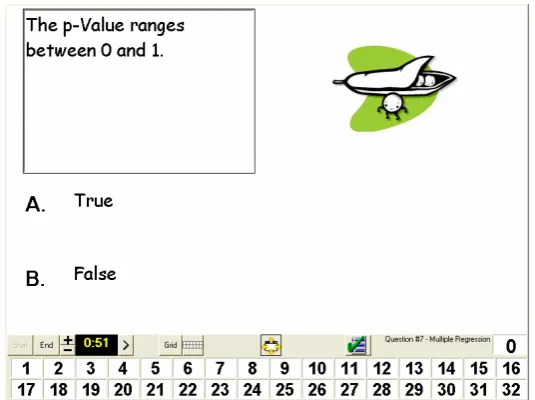
In addition to case studies, quizzes with specially chosen images were also used with CPS. These images were, in an entertaining manner, associated with the question and/or expected answer. This approach proved to be successful due to the fact that the majority of the students were inclined towards visual style of learning.
[image:4.595.184.428.278.450.2] [image:4.595.171.439.547.747.2]Students’ Perception of CPS
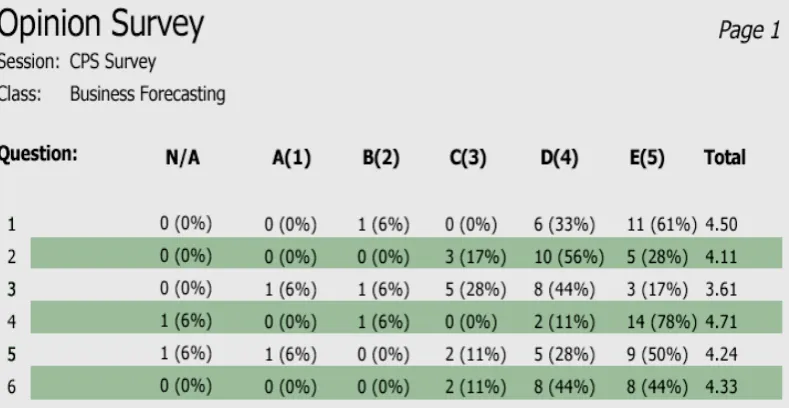
At the time of feedback data collection, 15 students who were in possession of the CPS handsets agreed to participate in the survey. The initial findings have confirmed that Classroom Performance System is regarded as an effective teaching and learning environment. See Figure 5 for a summary of the results (as generated by CPS) on the following six questions:
Please indicate your answer to the following questions on a scale of 1 to 5
(1=Strongly Disagree, 2=Disagree, 3=Neither Agree or Disagree, 4=Agree, 5=Strongly Agree):
1. I enjoyed my experience with CPS
2. CPS contributed to the speed of my learning process. 3. CPS made my learning experience easy.
4. The interactivity provided by CPS made the sessions more interesting.
5. CPS allowed me to participate in answering questions without being embarrassed.
[image:5.595.108.503.350.554.2]6. I would very much like to have CPS incorporated into my learning materials.
Figure 5 – Students’ Feedback on Classroom Performance System (CPS)
Conclusions
The methods of teaching quantitative subjects have certainly been influenced by modern computing (multimedia and online). They will change even more dramatically in the years to come. One thing however remains the same; and that is the ability of the teacher to convey the underlying concepts to the learner. This can be enhanced by using the latest technology. The main purpose is to make it possible for the learner to build new meanings without simply memorizing pieces of information received from the teacher. Hence, the student will be able to adopt or customize methods to suit the real problems in the real world. It is interesting to note that about 2400 years ago, Plato suggested that knowledge should be acquired via a process of criticism and questioning without compulsion. In modern times, we refer to this method as reflective learning.
The majority of the students who participated in the study reported in this paper have indicated their preference for visual features. These features represent the mathematical concepts, relationships and patterns which were demonstrated to them visually. It should be noted that most of the students who participated in this study regarded learning mathematical topics an enjoyable experience.
Therefore, as demonstrated, the latest technologies such as Classroom Performance System (CPS) can certainly assist in teaching and learning. It is envisaged that the applications and effectiveness of CPS for teaching will be further investigated in the near future.
References
Bruner J. (n.d.), Constructivism Theory Retrieved August 15, 2004 from http://www.artsined.com/teachingarts/Pedag/Constructivist.html
Dougiamas M. (1998), A journey into Constructivism Retrieved September 15, 2004 from http://dougiamas.com/writing/constructivism.html#intro
Hafner K. (2004), In Class, the Audience Weighs In Retrieved March 15, 2004 from http://www.nytimes.com/2004/04/29/technology/circuits/29hand.html?pagewante d=all&position=
Mahoney M. (2004), What is Constructivism and Why is it Growing? Retrieved October 8, 2004 from
http://www.constructivism123.com/What_Is/What_is_constructivism.htm Nooriafshar M., Maraseni T.N. (2005), “A Comparison of Learning Preferences and
Perceptions of High School Students for Statistics”, Proceedings ofthe Hawaii International Conference on Statistics, Mathematics and Related Fields, Honolulu, Hawaii, USA, 9th-11th January.
Nooriafshar M., Williams R. and Maraseni T.N. (2004), “The Use of Virtual Reality in Education”, The American Society of Business and Behavioral Sciences
(ASBBS) 2004 Seventh Annual International Conference, Cairns, Queensland, Australia, 6th-8th August.
Phillips R. (1998), Models of learning appropriate to educational applications of information technology Retrieved October 4, 2004 from