Context and Models for the Analysis
of Individual and Group Needs
Wendy Patton
Peter McIlveen
This article summarizes the papers presented in the discussion group focused on the theme “Models for the Analysis of Individual and Group Needs” at the joint sym-posium of the International Association for Educational and Vocational Guidance, Society for Vocational Psychology, and National Career Development Association held in Padua, Italy, in September 2007 titled Vocational Psychology and Career Guidance Practice: An International Partnership. The predominant theme that emerged from papers and discussion was that theory and practice need to be positioned within their proximal and distal contexts, ranging from personal to societal contexts.
In the 2007 joint symposium of the International Association for Educa-tional and VocaEduca-tional Guidance, Society for VocaEduca-tional Psychology, and National Career Development Association, participants in the discussion group that addressed the analysis of individual and group needs were challenged to consider the role of theory in research and practices, inclu-sive of individual, organizational, community, or government practices. A range of theories, many derived from the constructivist and social constructionist schools of thought, were discussed in relation to both research and practice. Discussions emphasized the need for practices to be located with the individual’s presenting issue, within relevant context, and not from the standpoint of theory alone. Respecting a synthesis of models, this article highlights the importance of viewing the concepts of career and career development from the proximal and distal contexts of the person. Examples of practice or empirical studies have been included to expand on the importance of context for the analysis of individual and group needs.
Context: A Metatheoretical Lens for Analysis
as examples, its explicit positioning within the systems theory framework (STF; Patton & McMahon, 2006) and the contextualist-action theory (Young, Valach, & Collin, 2002) and its relation to cultural psychology and social practices (Richardson, Constantine, & Washburn, 2005). Indeed, theories and practices may be better understood and applied when situated within a dimension of context. In this way, context can be taken as a metatheoretical heuristic lens (cf. Chen, 2003). It should be noted that although there is conceptual correspondence between the notions of context and culture (Young, Marshall, & Valach, 2007), they are not necessarily ethnically bound concepts, because they may refer to practices associated with geographic location, social class, organization, family, or workplace.
To illustrate the theoretical and pragmatic value of context as an organiz-ing framework, Heppner (2007) set the scene for the discussion group by drawing on Bronfenbrenner’s (1977) ecological model to consider vocational behavior in a globalized, multicultural world of work. Heppner suggested that the training of career development practitioners may need to be reviewed with respect to how it prepares practitioners to understand issues that are not fully appreciated within traditional theories (e.g., social class, internalized oppression). Heppner argued that an ecological ap-proach would provide a means of including those issues that are currently excluded or inadvertently minimized in theory and practice. Heppner suggested that an ecological perspective would assist practitioners and researchers to think and act beyond the intrapersonal domain and to position the person within nested layers of ecological systems. She also suggested that future research and practice in the field of career devel-opment should include the develdevel-opment of methods to enable clients to assess the impact of their ecosystem on their career.
Contextualized Sites for Analysis
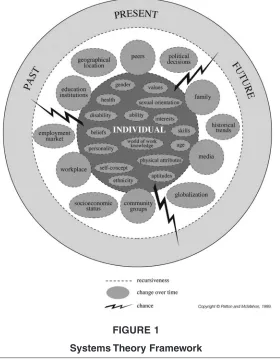
In framing the analysis of individual and group needs from the perspective of context, we have formulated a summary of the papers and research outcomes around sites within contexts. The term site indicates a position-ing within the contextual world of individuals, rangposition-ing from the proximal to the distal. We commence with the proximal site of conversation and end with the distal site of national, international, and cultural influences. This analysis is consistent with the tenets of the STF, which comprehensively contextualizes the individual (Patton & McMahon, 2006) as an entity-in-context. Figure 1 depicts the STF and the range of influences that make up the individual in his or her context.
The STF holds that an individual’s experience of career is best understood when the entire host of recursively interacting career influences of the person’s life are included in the formulation process, however significant they may be. The STF also offers a higher level theoretical framework that facilitates scholarly endeavors to synthesize theories, research, and practices (McMahon & Watson, 2007a, 2007b). In this case, we have used the STF to structure our thinking on the research presented in the discussion group.
social entity-in-dialogue (cf. Sarbin, 1986) and using the theory of dia-logical self (Hermans & Kempen, 1993), McIlveen (2007) argued that personal identity and career identity were dialogical transactions inextri-cably bound to the historical, environmental, and cultural discourses in which a person exists and evolves (cf. Guichard, 2005). This dialogical approach assumes that identity is an ongoing story lived in conversations with oneself or others—real or imagined—in a feed-forward and constant process of editorial revision. McIlveen (2006) exemplified this assump-tion through a narrative career assessment and counseling procedure he called “My Career Chapter.” This procedure requires individuals to construct a short story of their career by writing specifically in relation to the many systems of influences in their career life. The resulting story becomes the grist for the counseling process of storying.
FIGURE 1
Systems Theory Framework
The working alliance as a site. Extending from the site of conversation into the therapeutic domain, the microsystem of the career counseling relationship, Collins and Arthur (2007) argued that the working alli-ance is a site at which to understand and transcend cultural differences, whether in counseling, supervision, or higher level processes such as organizational consulting. Indeed, it has been lauded as an important site for research in vocational psychology (Heppner & Heppner, 2003).
Working alliance has been defined in various operational terms (e.g., A. O. Horvath & Greenberg, 1989). In their work, Collins and Arthur formulated working alliance as extending from the usual microlevel through to the macrosystems levels. This inclusive model accounts for personal factors (e.g., family, personality, education), contextual factors (e.g., social norms, environment, rural and urban location), universal factors (e.g., spirituality, mortality, physiology), cultural factors (e.g., social class, ethnicity, language), and ideological factors (e.g., ageism, sexism, heterosexism, elitism, racism, ableism). Their broad and inclu-sive approach echoes other approaches that specifically recognize the myriad systems of influences in the client–practitioner relationship (e.g., McMahon & Patton, 2006; Richardson, 2000).
While suggesting that working alliance can include a host of intrapersonal through to broader cultural factors, Collins and Arthur (2007) included, moreover, the notion of ideological factors as being crucial to the estab-lishment of a wholesome working alliance. The recognition of ideological factors has implications for what transpires in counseling, because it is within the confluence of the client–counselor dyad that ideologies may synergize or clash (cf. McIlveen & Patton, 2006; Richardson, 2000). The relevance of ideological factors was exemplified in the presentation by Castellini and Sacchi (2007), whose empirical study indicated that university students’ career choices respecting occupational aspirations may be differentiated on the basis of political attitudes.
Learning as a site. Learning and career development have a long associa-tion (Guichard, 2001). Bassot (2007) continued the social construcassocia-tionist argument that self- and career identity are personally felt as psychological experiences but are also formed in social and cultural transactions. Bassot used Vygotsky’s (1978) notion of the proximal zone of development as an explanatory model to argue that individuals engage in social construc-tion of their career identity. This approach to the individual-in-context assumes that an individual may develop and evolve his or her career identity through engaging in communities of practice that enable him or her to reposition in a new discursive context. Bassot exemplified her theoretical assertion through a visuo-graphical career assessment and counseling pro-cedure of joining the dots. Through this process, the client is given space to draw graphical images that represent elements of his or her career, all the while engaging in dialogue with the practitioner. Through dialogical interaction, the client moves from one place of understanding himself or herself in dialogue and learning through others, to another career identity. Bassott’s approach reflects the argument that career intervention may be conceptualized as a learning process (see Heppner & Heppner, 2003).
transform-ing the educational system. Oomen argued that the implementation of a career development strategy for school children positively influenced the staff of the school because of their regarding it as a resource for school improvement according to national standards. In this way, students’ learning transformed their teachers’ learning, thus it exemplified the re-flexivity of engagement in discursive contexts and movement across zones of proximal development. Within a framework of adult lifelong learning, de Gregorio and Pavoncello (2007) presented a study demonstrating how Italian organizations’ human resources departments emphasized career development coaching for their employees as a process to enhance performance and less as a strategy for staff retention.
The body as a site. Wehmeyer’s (2007) presentation of a study of persons with a disability suggested that their attitudes of self-determination were related to life satisfaction. In view of the working alliance and issues pertaining to disability (e.g., ableism in the form of not being treated as an adult), one must consider afresh the assumptions of practitioners in a client–counselor relationship with a person with a disability. Gender and age were also shown to be issues in the career development of ado-lescents and young adults in Spain, particularly in reference to different traditional cultural expectations pertaining to finances, family, and work (Sanchez et al., 2007). The study presented by Sanchez et al. highlighted that although young Spanish women were relatively free of gender-based expectations for themselves as women, young men held stereotypical views of what women should consider appropriate for their career.
Work as a site. Massoudi’s (2007) study reaffirmed that the psychological experience of stress in the workplace was a phenomenon that could only be understood from a transactional perspective in which the individual’s cognitive and emotional states and traits were interconnected with work-environment factors. T. Horvath (2007), for example, suggested that Hungarians in their mid-20s were experiencing angst as a quarter-life crisis because of issues pertaining to their transition into the workforce and the struggle to establish career stability in the early phases of their careers. Both studies reinforced the argument that vocational psychology must reconsider the position, value, and meaningfulness of work in an individual’s life (cf. Blustein, 2006).
In summarizing the papers of the discussion group, Chung (2007) ex-tended Watson’s (2007) high-level analysis and raised concerns regarding the predominance of the North American approach and the pressing need for other nations’ theories and practices to be raised and considered in a global context, rather than from the lens of a Western context. Chung used the term
globalocalization to emphasize that, as vocational guidance professionals, we need to localize what we learn globally and noted that it is dangerous to try to talk about career development knowledge without understanding localiza-tion. Chung was not disparaging of North American theory and practices per se, instead he argued that healthy diversity of theory and practices was reliant on the encouragement of other perspectives. He emphasized the importance of truly globalizing, rather than “Westernizing,” and the need for us to be more culturally sensitive with respect to our theory and our practice.
Conclusion
In summary, the discussion group’s papers and discussions pertaining to the analysis of individual and group needs centered on the potential for context as a broad organizing framework for theorizing, research, and practice. Discussions on defining context ensued, including a focus on issues of diversity and inclusivity. In addition, participants discussed the recognition that context can be acted on by individuals, as well as having an impact on individuals. Finally, the importance of synthesiz-ing the context of the practitioner and of the client was emphasized. Supporting meaningfulness in all work activity was expressed as a goal of career development practice. In recognizing the vitality of context, a concomitant goal for research and practice includes working toward broadening the range of people served by career development.
References
Bassot, B. (2007, September). Me and my future: Constructing career in the zone of proximal development. In S. Soresi & L. Nota (Cochairs), Vocational psychology and career guidance practice: An international partnership. Symposium conducted at the joint meeting of the International Association for Educational and Vocational Guidance, Society for Vocational Psychology, and National Career Development Association, Padua, Italy.
Blustein, D. L. (2006). The psychology of working: A new perspective for career development, counseling, and public policy. Mahwah, NJ: Erlbaum.
Bronfenbrenner, U. (1977). Toward an experimental ecology of human development.
American Psychologist, 32, 513–531.
Castellini, F., & Sacchi, S. (2007, September). The role of values and political orientation in vocational choice. In S. Soresi & L. Nota (Cochairs), Vocational psychology and career guidance practice: An international partnership. Symposium conducted at the joint meet-ing of the International Association for Educational and Vocational Guidance, Society for Vocational Psychology, and National Career Development Association, Padua, Italy. Chen, C. P. (2003). Integrating perspectives in career development theory and practice.
The Career Development Quarterly, 51, 203–216.
Collins, S., & Arthur, N. S. (2007, September). Reconceptualizing the working alliance to bridge complex cultural identities. In S. Soresi & L. Nota (Cochairs), Vocational psychology and career guidance practice: An international partnership. Symposium conducted at the joint meeting of the International Association for Educational and Vocational Guidance, Society for Vocational Psychology, and National Career Development Association, Padua, Italy. de Gregorio, D., & Pavoncello, D. (2007, September). Lifelong career coaching: A new
approach. In S. Soresi & L. Nota (Cochairs), Vocational psychology and career guidance practice: An international partnership. Symposium conducted at the joint meeting of the International Association for Educational and Vocational Guidance, Society for Vocational Psychology, and National Career Development Association, Padua, Italy. Guichard, J. (2001). A century of career education: Review and perspectives. International
Journal for Educational and Vocational Guidance, 1, 155–176.
Guichard, J. (2005). Life-long self-construction. International Journal for Educational and Vocational Guidance, 5, 111–124.
Hansen, E. (2006). Career guidance. A resource handbook for low- and middle-income countries. Geneva, Switzerland: International Labour Office.
Heppner, M. J. (2007, September). Using ecological models to understand vocational behavior in a global context. In S. Soresi & L. Nota (Cochairs), Vocational psychology and career guidance practice: An international partnership. Symposium conducted at the joint meet-ing of the International Association for Educational and Vocational Guidance, Society for Vocational Psychology, and National Career Development Association, Padua, Italy. Heppner, M. J., & Heppner, P. P. (2003). Identifying process variables in career
counsel-ing: A research agenda. Journal of Vocational Behavior, 62, 429–452.
Hermans, H. J. M., & Kempen, H. J. G. (1993). The dialogical self: Meaning as move-ment. San Diego, CA: Academic Press.
Horvath, A. O., & Greenberg, L. S. (1989). Development and validation of the Working Alliance Inventory. Journal of Counseling Psychology, 36, 223–233.
Horvath, T. (2007, September). Quarter-life crisis: New perspective for the theme of career beginning. In S. Soresi & L. Nota (Cochairs), Vocational psychology and career guidance practice: An international partnership. Symposium conducted at the joint meeting of the International Association for Educational and Vocational Guidance, Society for Vocational Psychology, and National Career Development Association, Padua, Italy. Irving, B. A., & Malik, B. (Eds.). (2005). Critical reflections on career education and
guidance. Promoting social justice within a global community. London: Routledge-Falmer.
Massoudi, K. (2007, September). Interactional model for the analysis of professional stress: Identification of individual vulnerabilities and environmental risk factors. In S. Soresi & L. Nota (Cochairs), Vocational psychology and career guidance practice: An international partnership. Symposium conducted at the joint meeting of the International Associa-tion for EducaAssocia-tional and VocaAssocia-tional Guidance, Society for VocaAssocia-tional Psychology, and National Career Development Association, Padua, Italy.
McIlveen, P. (2006). My Career Chapter: A dialogical autobiography. Unpublished manuscript. McIlveen, P. (2007, September). Positioning dialogical self amidst systems of career
in-fluences. In S. Soresi & L. Nota (Cochairs), Vocational psychology and career guidance practice: An international partnership. Symposium conducted at the joint meeting of the International Association for Educational and Vocational Guidance, Society for Vocational Psychology, and National Career Development Association, Padua, Italy. McIlveen, P., & Patton, W. (2006). A critical reflection on career development.
Interna-tional Journal for EducaInterna-tional and VocaInterna-tional Guidance, 6, 15–27.
McMahon, M., & Patton, W. (2006). The systems theory framework: A conceptual and practical map for career counselling. In M. McMahon & W. Patton (Eds.), Career counselling: Constructivist approaches (pp. 94–109). London: Routledge.
McMahon, M., & Watson, M. (2007b). The systems theory framework of career devel-opment: Expanding its research influence. Australian Journal of Career Development, 16, 47–53.
Oomen, A. (2007, September). The meaning of existing career concepts and instruments in the Dutch education system. In S. Soresi & L. Nota (Cochairs), Vocational psychol-ogy and career guidance practice: An international partnership. Symposium conducted at the joint meeting of the International Association for Educational and Vocational Guidance, Society for Vocational Psychology, and National Career Development As-sociation, Padua Italy.
Patton, W., & McMahon, M. (1999). Career development and systems theory: A new rela-tionship. Pacific Grove, CA: Brooks/Cole.
Patton, W., & McMahon, M. (2006). Career development and systems theory: Connecting theory and practice. Rotterdam, The Netherlands: Sense.
Richardson, M. S. (2000). A new perspective for counsellors: From ideologies to empower-ment through work and relationship practices. In A. Collin & R. A. Young (Eds.), The future of career (pp. 197–211). Cambridge, UK: Cambridge University Press. Richardson, M. S., Constantine, K., & Washburn, M. (2005). New directions for theory
develop-ment in vocational psychology. In M. Savickas & W. B. Walsh (Eds.), Handbook of vocational psychology: Theory, research, and practice (3rd ed., pp. 51–83). Mahwah, NJ: Erlbaum. Sanchez, M., Lozano, S., Malik, B., Manzano, N., Oliveros, L., & Fernandez, B. (2007,
September). Spanish students values, work representations and stereotyped thoughts in career development: Results of a gender and career social-cognitive perspective. In S. Soresi & L. Nota (Cochairs), Vocational psychology and career guidance practice: An international partnership. Symposium conducted at the joint meeting of the Interna-tional Association for EducaInterna-tional and VocaInterna-tional Guidance, Society for VocaInterna-tional Psychology, and National Career Development Association, Padua, Italy.
Sarbin, T. R. (1986). The narrative as a root metaphor for psychology. In T. R. Sarbin (Ed.), Narrative psychology: The storied nature of human conduct (pp. 3–21). New York: Praeger.
Vygotsky, L. S. (1978). Mind in society: The development of higher psychological processes. Cambridge, MA: Harvard University Press.
Watson, M. (2006). Voices off: Reconstructing career theory and practice for cultural diversity. Australian Journal of Career Development, 15, 47–53.
Watson, M. (2007, September). An interactive systemic model of socio-cultural influences, macro economic development, the education system, and the state of career guidance services. In S. Soresi & L. Nota (Cochairs), Vocational psychology and career guidance practice: An international partnership. Symposium conducted at the joint meeting of the International Association for Educational and Vocational Guidance, Society for Vocational Psychology, and National Career Development Association, Padua, Italy. Wehmeyer, M. L. (2007, September). Self-determination and vocational planning in
persons with disabilities. In S. Soresi & L. Nota (Cochairs), Vocational psychology and career guidance practice: An international partnership. Symposium conducted at the joint meeting of the International Association for Educational and Vocational Guid-ance, Society for Vocational Psychology, and National Career Development Associa-tion, Padua, Italy.
Young, R. A., & Collin, A. (2004). Introduction: Constructivism and social construction-ism in the career field. Journal of Vocational Behavior, 64, 373–388.
Young, R. A., Marshall, S. K., & Valach, L. (2007). Making career theories more culturally sensitive: Implications for counseling. The Career Development Quarterly, 56, 4–18. Young, R. A., Valach, L., & Collin, A. (2002). A contextualist explanation of career. In