
The construction of undergraduate student engineering
design teams using the MBTI and Belbin Test
Frank Bullen
University of Tasmania, Hobart, Australia [email protected]
David Wood
University of Tasmania, Hobart, Australia [email protected]
Abstract: The use of teams in engineering education is well established throughout the depth and breadth of most undergraduate programs. While the pedagogical benefits of teamwork are well recognised and documented, the construction of undergraduate design teams remains largely an
uninformed process. The paper reviews the use of the Belbin Test and the Myers-Briggs Type Indicator (MBTI) instrument to build undergraduate engineering teams. It is concluded that the MTBI is useful in a secondary role, once the Belbin Test is used to form balanced precise teams. The paper describes their combined use in the construction of freshmen civil engineering infrastructure design teams at the University of Colorado, Boulder (UCB). A survey of the students indicated that they appreciated the approach and rated their teams’ performance very high. It is recommended that the approach used for the freshmen design course be adopted widely when forming undergraduate design teams.
Keywords: Teams, design, competition.
Introduction
The first author was provided with the opportunity to teach the course CVEN1317 –
Since the students were mainly freshmen and had very little exposure to any type of engineering design it was considered very important to first expose the students to the
concepts of ethical, sustainable development. This would be followed by constructing design teams that would ensure optimum team collaboration and performance. Since the Myers-Briggs Type Indicator (MBTI) (2006) instrument has been used extensively in the U.S. for understanding the learning styles of engineering students, and the Belbin Test (2006) had been often used by the first author at his home university, it was decided to use these tools to
construct the design teams for the major design component of CVEN1317.
A Review of Team Learning and Formation
The Team Learning Approach
With the trend towards outcome based engineering programs around the world, the use of teamwork has become embedded into curricula. Most members for the Washington Accord (2006) now specify teamwork skills in the programs accredited by the individual member nations. For example ABET (2006) requires under Criterion 3 – Program Outcomes and Assessment, that graduates possess “an ability to function on multi-disciplinary teams”, Engineers Australia (2006) under their Specification of Educational Outcomes state that graduates should have the “ability to function effectively as an individual and in multi-disciplinary and multi-cultural teams, with the capacity to be a leader or manager as well as an effective team member”, and Engineers New Zealand (2006) under their Graduate
Capability Profile, must be provided with evidence that graduates , “function effectively in a team by working co-operatively with the capacity to become a leader or manager;
communicate effectively, comprehending and writing effective reports and design”. Team based activities also help develop other graduate attributes such as the ability to identify, formulate, and solve engineering problems and the ability to communicate effectively.
Team based project work can serve as a carriage for many sound teaching and learning techniques and this has been well documented in the literature. The flexibility within teams helps cater for different learning styles, assessment can be varied and active learning is encouraged. Much team activity in engineering is of the cooperative project based type where students work together in small groups to achieve common goals (Ledlow et al 2002, Mehta 1998). Finelli et al (2001) indicate that it is essential to integrate the five elements of; positive interdependence, interaction, individual accountability, interpersonal skills and group
processing into the activity. One important aspect of active-collaborative learning as iterated by Ledlow et al (2002) is that the team building process cannot be uninformed. Teachers should construct teams with care and ensure that each team incorporates the individual skills to undertake and complete the project together
Effective Undergraduate Engineering Design Teams
“A team of students had four members called Everybody, Somebody, Anybody and Nobody. There was an important job to be done. Everybody was sure that Somebody would do it. Anybody could have done it, but Nobody did it. Somebody got angry about that because it was Everybody’s job. Everybody thought Anybody could do it but Nobody realized that Everybody wouldn’t do it. It ended up that Everybody blamed Somebody when Nobody did what Anybody could have done”.
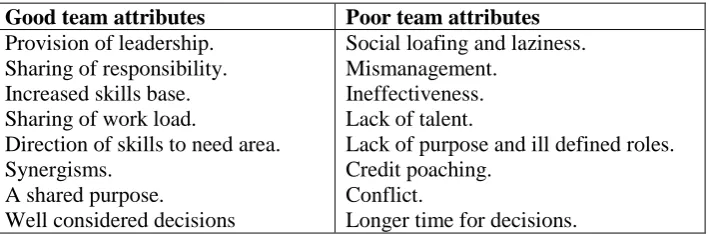
A well-constructed design team communicates well, has good leadership, is cohesive, incorporates diversity of skills, knowledge and personality, and creates synergies. However, we must look at how a well-constructed team can be achieved, given the positive and negative attributes of teams as outlined in Table 1 and the above quote. Often teachers form teams by allowing students to self select, by simple alphabetic groupings, or by random number
generation in a spreadsheet. In some cases an attempt is made to balance the teams’ scholastic levels. None of these methods are appropriate as students can be disadvantaged by being placed in an unbalanced team, which is unable to complete the project satisfactorily.
Table 1. Positive and negative attributes of teams
Good team attributes Poor team attributes
Provision of leadership. Sharing of responsibility. Increased skills base. Sharing of work load.
Direction of skills to need area. Synergisms.
A shared purpose.
Well considered decisions
Social loafing and laziness. Mismanagement.
Ineffectiveness. Lack of talent.
Lack of purpose and ill defined roles. Credit poaching.
Conflict.
Longer time for decisions.
Many theories have been expounded about the selection and role of team members and the optimum size for teams. In engineering education the most common methods used in team building are the Myers-Briggs Type Indicator (used to identify an individual’s psychological type preferences), the Belbin Test (used to identify the role that an individual may fulfill in a team) and the functional approach (used to identify and provide the necessary skills). All these approaches can be complementary and it should be recognised that while team roles and/or skills may be balanced, care must be taken with personality conflict (Figure 1).
An Optimal Team (Size 5 to 9): Incorporates:
Natural Team Roles Functional Team Roles Psychological Types Teams should be balanced
such that individual behaviour with respect to other team members facilitates progress and efficiency of the team. Often termed a “meeting function”.
Teams should be balanced such that the necessary (technical) skills to
complete the task exist. For example a writer, designer, programmer, graphic artist, mathematician.
[image:3.595.122.477.313.430.2]The personality profile of the team is balanced with respect to personality preferences to help ensure team compatibility and to minimise potential conflict.
Figure 1. An “Optimal” Team
Dore (2002) points out that “heterogeneity is a sword with two edges”, where different perspectives can help generate superior outcomes, but may also cause loss of time and
size increases the team becomes unmanageable and when the size decreases below 5 the desired natural (Belbin) team role and functional skills cannot always be covered.
Background of the Myers-Briggs Type Indicator Instrument
The Myers and Briggs Foundation states that the Myers-Briggs Type Indicator (MBTI) instrument, “sorts for preferences and does not measure trait, ability, or character” (2006). The MBTI has been found to be a good indicator of student learning styles and has been used in engineering education for many years (McCaulley 1976, O’Brien et al 1998, Felder and Brent 2005). The data can be used by teachers to help identify students who are at risk in the typical “engineering” teaching and learning environment. While the MBTI outcomes are important in recognising student learning styles they may be relatively unimportant in the post-student professional setting given that “professionals must function in all type modalities to be fully effective” (Felder et al 2002). The structure of the MBTI is well known and details are not repeated here although Table 2 does provide a very basic description of the 8
preferences that combine to form the 16 personality types of the MBTI instrument.
Table 2. Outline of the MBTI
Dichotomies Preferences Symbol Brief description
Your World Extraversion E focus on the outer world Introversion I focus on the inner world
Information Sensing S focus on basic information received Intuition N prefer to interpret and add meaning Decisions Thinking T look at logic and consistency
Feeling F look at people and circumstances Structure Judging J prefer to get things decided
Perceiving P stay open to new information and options
Broadly speaking, each personality type has a certain learning style and will react differently to a specific teaching approach. If teachers use a predominant teaching methodology then it would be expected that some types will be favoured and outperform others. For example in engineering the INTJ type has been found to outperform their ESFP colleagues. This is not unexpected given the relative impersonal nature and course content of engineering. This is especially relevant to female students who often are often of a feeling (F) preference and are disadvantaged in engineering programs. For example Felder et al (2002) found that only one female student (F) earned an A in a survey of 116 students that included 34 female students. The goal of engineering education should be to provide a diverse and balanced instruction and attempts should be made to identify, and teach to suit, the preference types distributed through the class. The construction of well balanced design teams is useful in this aspect.
MBTI and Design Teams
The best role of MTBI is to help ensure diversity within the groups; for example McCaulley (1990) pointed out, S and N types approach problems from different directions. She indicates that an S moves from detail to general, while the N moves from the big-picture to the specific. Once design teams are created (using the Belbin Test), feelers (F) are able to play a very important role (in a well balanced team), with subsequent benefits to both their team and personal grades, as they are able to add a dimension missing in many undergraduate
engineering teams. This supports the hypotheses of Felder et al (2002) who found that active group exercises, such as team based design, helped to overcome the extroverts’ and feelers’ “historical disadvantage,” during their engineering education. The initial stages of group based design work tend to favour the intuitor (N) type as they tend to perceive possibilities. Once the big-picture comes into focus, the design work lends to the skills of the sensing types (S), who look for immediate and practical solutions. The sensing-intuition (S-N)
balance/difference has been found to be the most important of the preferences as a predictor of student success (McCaulley 1990) and this can be used when fine tuning design teams
Background to the Belbin Test
In a study of team roles, Park and Bang (2002) describe some of more common theories put forward over the last 20 years. They range from Belbin (1981 with 8 team roles plus
[image:5.595.70.517.409.666.2]specialist), Margerison and McCann (1985 with 8 team roles), Parker (1990 with 4 team roles), Francis and Young (1992 with 10 team roles) and Davis et al (1992 with 20 team roles). The Belbin Test with 9 roles is still very widely used in team building exercises and that approach was used to identify team roles for the students in CVEN1317.
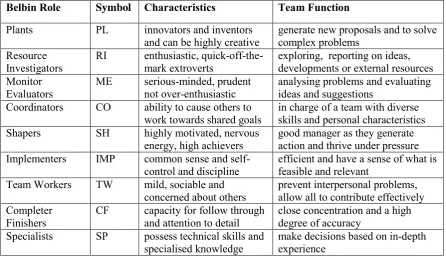
Table 3. Outline of the Belbin team roles
Belbin Role Symbol Characteristics Team Function
Plants PL innovators and inventors and can be highly creative
generate new proposals and to solve complex problems
Resource Investigators
RI enthusiastic, quick-off-the-mark extroverts
exploring, reporting on ideas, developments or external resources Monitor
Evaluators
ME serious-minded, prudent not over-enthusiastic
analysing problems and evaluating ideas and suggestions
Coordinators CO ability to cause others to work towards shared goals
in charge of a team with diverse skills and personal characteristics Shapers SH highly motivated, nervous
energy, high achievers
good manager as they generate action and thrive under pressure Implementers IMP common sense and
self-control and discipline
efficient and have a sense of what is feasible and relevant
Team Workers TW mild, sociable and concerned about others
prevent interpersonal problems, allow all to contribute effectively Completer
Finishers CF capacity for follow through and attention to detail close concentration and a high degree of accuracy Specialists SP possess technical skills and
specialised knowledge
make decisions based on in-depth experience
behaviour with respect to others in a team with the object being to facilitate team progress and efficiency. The real value of Belbin team-role theory rests in both individual and the team being aware of all its members’ roles and using that information to help manage the team and to deal with external parameters. An individual’s Belbin team role is not fixed and people can consciously change their behaviour in a team environment. The 9 Belbin roles are listed in Table 3 along with a brief outline of the characteristics and team function, the reader is referred to JTILTD (2006) for a more detailed description. In a “good” team, all roles would be represented, and equally distributed as that ensures that a counterpart exists for each role, as shown in Figure 2 (Vinter 2006). For example a “creative” PL has a “common sense” IMP as a counterpart, and the “smoothing” TW balances the “driven” SH. Vinter (2006) sees the ME as not having a counterpart, but playing the role as the impartial arbitrator for the team.
Creating Belbin Teams
[image:6.595.102.507.354.609.2]Park and Bang (2002) indicated that the most important aspect of (Belbin) team role theory is when team roles are balanced, and all roles exist at above the “natural team role level” of 70. The individual Belbin score is calculated by completing a Self-Perception Inventory (SPI). The criticisms of the Belbin approach are that the 3 basic Belbin assumptions: there is a link between a balanced team and the team’s performance; the reliability of the SPI; and that there are 9 unique team roles - equally distributed in the population, are invalid.
Figure 2. Balancing team roles [24]
The Case Study
CVEN1317 MBTI Data
Students in the course were provided with an “Introduction to Engineering Teams”, lecture outlining the basics of team roles, development and performance. This was followed by a lecture, “Construction of Engineering Teams - Applications of Psychometric Tests”. After the lectures were completed students were requested to take an on-line test that would provide them with their type formula according to Jung - Myers-Briggs typology, strength of the preferences and the description of their type (Human Metrics 2006). Results were then emailed to the author and it was very pleasing that all students completed the exercise. The outcomes for 26 freshmen plus 8 sophomores are shown in Table 3 under “UCB Class”.
After reviewing the requirements in Figure 1 with regard to the desired outcomes of the CVEN1317 class, it was considered best to create teams of 4 or 5 students. Although the teams with 4 members reduced access to some natural team roles, this size would allow 8 teams to be constructed within the class. Since most of the class was freshmen, students possessed very few engineering technical skills (functional roles) and indeed the course was intended to help develop some of those skills. It was decided to use the Belbin Test to form the basic design teams and the MBTI to fine tune them.
[image:7.595.116.478.517.651.2]The data for engineering students (Eng Stud) is from Felder et al (2002), Wankat and Oreovicz for Chemical Engineering at Purdue (2006) and Scott et al from the University of Tennessee [22]. The data for engineering faculty (Eng Fac) and professional engineers (PEs) come from Scott et al [22]. The CVEN1317 data was on the low side for I, P, S and T and high for E, J, N and F compared to the published data for “engineering students”. One most interesting aspect is the reversal of the I-E balance of the student cohort (67-33) compared to faculty (30-70) and the T-F balance (56-44) compared to (82-18). This reversal is not explored and could be attributable to the relatively small sample size and/or the limitation to a freshmen class. The UTas data (unpublished) from a 2006 first year class of about 70 students reflected the data from the CVEN1317 class.
Table 4. MBTI preference data
MBTI UCB
Class
Eng Stud
Eng Stud
Eng Stud
Eng. Fac
PEs UTas
Introvert (I) 33 52 67 51 70 52 29
Extrovert (E) 67 48 33 49 30 48 71
Judging (J) 84 62 61 50 71 60 62
Perceiving (P) 16 38 39 50 29 40 38
Sensation (S) 37 58 53 54 38 53 42
Intuition (N) 63 42 47 46 62 47 58
Thinking (T) 56 69 74 69 82 64 40
Feeling (F) 44 31 26 31 18 36 60
CVEN1317 Belbin Data
variation above 35%. The methodology was to balance teams initially using the prime Belbin role then to attempt to incorporate other roles into teams using the secondary Belbin role. This follows the Belbin view that people can play dual roles at the same time.
The data in Table 5 is the final team role distribution for each team constructed for the
[image:8.595.94.519.258.394.2]infrastructure design project. A “P” indicates that this is a team member’s prime team role and an “S” indicates that this is a team member’s secondary role. As can be seen in Table 5 the CO and TW roles predominate. There was an acute shortage of CF and RI students, which meant that these roles could not be covered in all teams. In all cases at least 6 of the 8 team roles were covered at the primary or secondary level and one team incorporated all Belbin team roles.
Table 5. Roles within freshmen design teams
Belbin Role
Team Identity (number of members) Class Split % 1 (4) 2 (4) 3 (4) 4 (4) 5 (5) 6 (4) 7 (4) 8 (5) P P&S
SH S S S S S P P P 9 11
CO P, S P, S P P P, S P, S P, S P, S 23 24
PL P P P P P 14 9
RI S S P, S S, S P 6 4
ME S S P P P, S S, S 9 11
IMP P P P P S S S S 11 13
TW P, S P P, S P, S P P S P, P, S 23 23
CF S S S S P 3 4
Correlating MTBI Type and Belbin Team Role
As expected a review of the literature does not show any correlation between the MBTI and Belbin Test, and the data set for this study was too small to attempt any statistical analysis. A summary for the CVEN1317 data is shown in Table 6. The highest numbers of Belbin role were CO (8), TW (8), PL (5) and IMP (4). The CO and TW were heavily biased towards judging extrovert preferences (EJ). Women in general classify more as F than T, while overall engineering classifies more as T than F. In the study all of the small CVEN1317 group, all the women (6 out of 32) were F, while 8 of the males were F.
Table 6. Belbin-MTBI data
Belbin Role
Students with MBTI Preference
I E S N T F P J CO 1 7 4 4 4 4 0 8 TW 1 7 4 4 1 7 1 7 PL 0 5 2 3 4 1 2 3 IMP 2 2 1 3 3 1 1 3
Outcome from Student Surveys
[image:8.595.178.410.552.644.2]surveys 1 and 2 are summarised in Table 7, the numbers are the average responses from the class on a Lickert scale of 1 to 5, with 5 indicating a high level of understanding.
The third survey was a simple scoring exercise where students were asked to rank; their team performance, how much they enjoyed the course and the work load for the course. Each was scored out of 10 with a high value being good. On average individual students ranked the course at 66% (with a standard deviation of 17%), their team performance at 88% (with a standard deviation of 9%) and the workload at 34% (with a standard deviation of 16%). The data was confirmed with written comments, which in general were concerned with; the high workload for a 1-hour course, how much they enjoyed the team work, and that they learnt a lot about civil engineering. It was obvious that a much higher satisfaction level could have been obtained by reducing team workload. However this approach would not have permitted the teams to gain an appreciation of the big-picture design aspects of civil engineering. The UTas data (unpublished) is from the 2006 first year class of about 70 students referred to earlier in Table 4.
Table 7. Change in student understanding
Engineering Concept CVEN1317 UTas
Survey 1 Survey 2 Change Survey 1 Survey 2 Change
Sustainable development 2.31 3.17 37% 2.31 3.80 64% Community responsibility 2.47 3.30 34% 2.26 3.53 56% Project management 2.59 3.37 30% 2.26 3.17 40% Teamwork and team roles 3.53 3.72 5% 2.97 3.77 26%
Internationalization 1.97 2.47 25% NA NA NA
Infrastructure design 1.78 2.63 48% 2.26 3.00 33%
Summary
The approach for teaching the Introduction to Civil Engineering course at UCB was based on developing team skills while also imparting to the students an appreciation of engineering ethics, sustainability and infrastructure design. Outcomes from the Belbin Test for primary and secondary team roles were used to construct student teams while information for the MBTI preference type was used in an evaluative function for members in the team. The Belbin Test was used for the precise construction of the engineering design team and then the MBTI applied to help balance the team’s overall social and teamwork aptitudes. The approach was deemed a success with students indicating via a survey that they enjoyed the course and ranked their team performance very highly. It was also noted that students saw the workload as being much too high for a 1 hour course and in some cases it was suggested that the course should be offered to the senior civil engineering students.
In general students obtained a much better understanding of civil engineering concepts such as project management and community responsibility as a result of the course. It was interesting to note that the smallest increase occurred in the area of “teamwork and team roles”, and the author believes that this was due to misconceptions held by the students about engineering teamwork as compared to “teams” at high school. However, it was this aspect that showed the highest level of student understanding (3.72/5.0) by the end of the course. The highest
increases in understanding occurred in the areas of sustainable development (37%) and infrastructure design (48%), which was pleasing given the nature of the course and the topic of the major team assignment.
References
College of Engineering and Applied Science, University of Colorado at Boulder. Retrieved from http://engineering.colorado.edu/index.htm
The Myers and Briggs Foundation. Retrieved from http://www.myersbriggs.org/ Belbin Test. http://www.belbin.com/
Washington Accord, Retrieved from http://www.washingtonaccord.org/
ABET., Criteria for Accrediting Engineering Programs, Effective for Evaluations During the 2005-2006 Accreditation Cycle. Retrieved from
http://www.abet.org/Linked%20Documents-UPDATE/Criteria%20and%20PP/05-06-EAC%20Criteria.pdf. 2005
Engineers Australia., Accreditation Management System, Accreditation Criteria Guidelines., Retrieved from http://www.ieaust.org.au/membership/res/downloads/G020%20Accreditation%20Criteria%20Guidelines.pdf Engineers New Zealand, Requirements for Initial Academic Education for Professional Engineers. Retrieved
from http://www.ipenz.org.nz/ipenz/forms/pdfs/Initial_Academic_Education.pdf
Ledlow, S., White-Taylor, J., and Evans, D.L., Active/Cooperative learning: A discipline- specific resource for engineering education. Proc. 2002 ASEE Annual Conference and Exposition, session 2793, 2002.
Mehta, S., Cooperative learning strategies for large classes. Proc 1998 ASEE Annual Conference, Session 3230, 1998.
Finelli, C.J., Klinger, A., and Budny, D.N., Strategies for improving the classroom environment. Journal of Engineering Education, 90, 4, pp.491-498, 2001.
Winter, M., Developing a group model for student software engineering teams, M.Sc. Thesis, University of Saskatchewan, Saskatoon, Saskatchewan, 2004.
Gibbs, G. Research into student learning. In Smith B, Brown S (EDs) Research, Teaching and Learning in Higher Education 1995 – Retrieved from http://www.samford.edu/pbl/process_group.html
Dore, S., Use of personality type as a means of team building, Proc. 2002 ASEE Annual Conference and Exposition, Session 2525, 2002.
McCaulley, M., Psychological types in engineering: Implications for teaching, Eng Educ., 66, 729, April 1976 O’Brien T.P, Bernold, L.E. and Akroyd, D., Myers-Briggs Type Indicator and Academic Achievements in
Engineering Education. Int. J. Engng Ed. Vol4. No.5, pp. 311-315, 1998.
Felder, R.M., and Brent, R., Understanding student differences, Journal of Engineering Education. pp.57-72, January 2005.
Felder, R.M., Felder, G.N. and Dietz, E.J. The Effects of Personality Type on Engineering Student Performance and Attitudes. Journal of Engineering Education, 91(1), 3-17 (2002).
Varvel, T., Stephanie, M.S., Adams, G., and Pridie, S.J., A study of the effect of the Myers-Briggs Type Indicator on team effectiveness. Proc. 2003 ASEE Annual Conference and Exposition, Session 1706, 2003. McCaulley, M.H., The MBTI and individual pathways in engineering design, Engineering Education, Vol.80,
537-542, 1990.
Human Metrics, Retrieved from http://www.humanmetrics.com/
Wankat, P.C. and Oreovicz. F.S. Teaching Engineering. Chemical Engineering, Purdue University. Retrieved from https://engineering.purdue.edu/ChE/News and Events/Publications.
Scott., T.H., Parsons, R., and Seat, J.E., Use of the Myers-Briggs Type Indicator in the University of Tennessee engage Freshman engineering program.
Park, Won-Woo, and Bang, H., Team role balance and team performance. Proc. Belbin Biennial Conference 2002 - Changing the Role of Management in the 21st Century. 19 pages, Seoul, 2002.
![Figure 2. Balancing team roles [24] The Park and Bang (2002) review of the literature found that none of the 3 issues could be](https://thumb-us.123doks.com/thumbv2/123dok_us/299071.62364/6.595.102.507.354.609/figure-balancing-roles-park-bang-review-literature-issues.webp)


