
This is a repository copy of Connectivity and ecological networks : Technical Information
Note 01/2016.
White Rose Research Online URL for this paper:
http://eprints.whiterose.ac.uk/106609/
Version: Published Version
Monograph:
Harrison, Laura Jane orcid.org/0000-0003-3923-7083, White, Piran Crawfurd Limond
orcid.org/0000-0002-7496-5775 and Odell, Simon (2016) Connectivity and ecological
networks : Technical Information Note 01/2016. Research Report. Technical Information
Note . The Landscape Institute
[email protected] https://eprints.whiterose.ac.uk/ Reuse
Items deposited in White Rose Research Online are protected by copyright, with all rights reserved unless indicated otherwise. They may be downloaded and/or printed for private study, or other acts as permitted by national copyright laws. The publisher or other rights holders may allow further reproduction and re-use of the full text version. This is indicated by the licence information on the White Rose Research Online record for the item.
Takedown
If you consider content in White Rose Research Online to be in breach of UK law, please notify us by
Connectivity and Ecological Networks
Technical Information Note 01/2016 April 2016
Contents
1. Introduction
2. Why consider connectivity? 3. Ecological Networks
4. Different aspects of connectivity 5. Benefits and risks to biodiversity 6. Connectivity and ecosystem services 7. Connectivity as a unifying concept 8. Modifying connectivity in design plans 9 Summary
10. Further resources 11. References
1.
Introduction
1.1 For a variety of reasons, people and organisms need to be able to move through the landscape and to do so at different scales. Many landscapes are patchy, with areas that are favoured by organisms or people separated by less favoured ones. Connectivity describes the extent to which favoured areas are linked up.
1.2 For many species, this linking is often provided by linear features such as hedgerows or river corridors, which then enhance movement across the landscape. The combination of favoured areas and linking features is called an ecological network.
1.3 This Technical Information Note introduces connectivity and ecological networks within the context of landscape planning, design and management.
1.4 The Note examines the evidence for benefits resulting from increasing landscape connectivity, and considers some of the possible risks that increasing connectivity may bring. It also highlights how connectivity can be modified as part of the landscape design process. 1.5 Although much of the material contained within this Note is suitable to be widely adopted as
guidance, the Note is at this stage for information only and should not be considered as a substitute for obtaining advice from a professional ecologist during the design process.
2.
Why consider connectivity?
2.1 The impact of fragmentation and severance on biodiversity
2.1.1 The decline in biodiversity in the UK has been caused largely by habitat loss driven by changing land use [2]. Habitat loss not only reduces the total habitat area, but also usually fragments the remaining habitat. What remains are often small and scattered habitat patches, such as remnants of woodland or heathland, sitting within a wider landscape of less suitable habitat, termed the matrix, such as intensive agricultural land or urban areas. 2.1.2 Barriers such as fences and motorways can also deny some species freedom to move
between patches. Such disconnection of habitats is termed severance.
2.1.3 Species vary in their ability to use and successfully cross the matrix between their favoured habitat patches [3] and to cross barriers.
2.1.5 This situation is often exacerbated by climate change, which is altering the geographical range in which species can survive and putting pressure on some species to move [4].
2.2 The impact of fragmentation and severance on ecosystem services
2.2.1 As a society, our health, wellbeing and economy depend upon sustaining the ecosystem services we obtain from biodiversity within ecosystems.
2.2.2 Fragmentation can affect the supply and flow of different ecosystem services to people, such as the ability to go for a healthy walk in green surroundings. Linear infrastructure such as railways, motorways and rivers can sometimes limit physical access to areas offering some ecosystem services. However, in other situations, for example in relation to recreational services, they may help to increase access.
2.2.3 The function of linear habitats such as river corridors and railway lines in terms of connectivity or severance therefore depends on their position in the landscape relative to other habitat patches and linear elements, and the species concerned.
2.3 Connectivity and the Ecosystem Approach
2.3.1 Recognition of the impact of fragmentation, severance, the challenge of climate change and the need to manage often conflicting societal needs has led to a more integrated landscape-scale approach to conservation and land management [5-7] and interest in nature-based solutions to societal and environmental problems.
2.3.2 The Ecosystem Approach is an approach to landscape management that recognises the interdependence of the goals of economic development, social development and
environmental protection. This approach aims to involve the whole of society in decisions about the management and use of natural resources.
2.3.3 Because of their areas of expertise and the opportunities presented on sites of all sizes, landscape professionals are in a key position to enhance habitat management, networks and connectivity for both ecological and wider societal benefit.
2.3.4 For further information about the Ecosystem Approach and Ecosystem Services see the Landscape Institute Technical Information Note on the subject.
3.
Ecological networks
3.1 Green infrastructure as an ecological network
green roofs, green walls, green bridges and urban street trees, that support natural and ecological processes [8], as well as providing benefits for human health and wellbeing. 3.1.2 The Landscape Institute has published a Position Statement on Green Infrastructure which
explains this concept more fully. Green infrastructure can provide a means for enabling wildlife and human movement through less suitable matrix and across barriers.
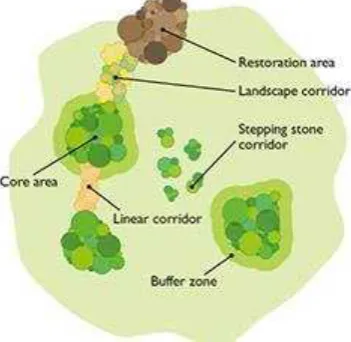
3.1.3 The components of an ecological network can include many different component of green infrastructure:
Core nature areas are areas of high quality habitat that are managed primarily for
T
the ecological network.
Stepping stones or stepping stone corridors are smaller areas of quality habitat that are intended to aid movement of individuals by serving as islands of favourable habitat in
T .
Landscape corridors are linear elements of quality habitat, containing elements of the favoured habitat, that connect the core nature areas and stepping stones. These
Linear corridors are linear elements of connecting habitat, normally narrower or less varied than landscape corridors, and therefore often suited to movement alone. These
Restoration areas are degraded areas where management is focused on restoring habitat that might become core nature areas or corridors.
[image:5.595.110.286.517.688.2] Buffer zones are transitional areas situated between habitat and the matrix, with a land use that is intended to reduce the impact that the matrix has on the habitat area.
Figure 1. An ecological network. Reproduced from Lawton (2010).
3.2 Ecological networks and connectivity
3.2.1 T L to Government E
network [6] T works (its connectivity) promotes the ability of individuals to move across landscapes.
3.2.2 The G L N E
White Paper [9] and included Nature Improvement Areas (NIAs), with 12 pilot projects funded April 2012 - March 2015. NIAs aimed to create more joined up and resilient
ecological networks, with multiple benefits resulting for wildlife, society and the economy. 3.2.3 Creating more resilient landscapes by increasing connectivity is a widespread aspiration in
national and international planning and conservation guidance [10, 11]. Increasing connectivity is the most frequently recommended conservation action for adaptation to climate change [7]. However, it is important to be clear about objectives to ensure that promoting connectivity will have the desired impact [12, 13].
4.
Different aspects of connectivity
4.1 Structural connectivity
4.1.1 Given the description of an ecological network, it might appear that connectivity is simply the extent to which habitat patches in the landscape are linked physically. This structural concept of connectivity views the landscape from a human perspective at human spatial scales. It is relatively straightforward to understand, measure and communicate. However, it does not consider how people and organisms actually move through and use the
landscape, or the consequences of these movements for ecosystem functions and services.
4.2 Functional connectivity
4.2.1 E ilitates or
[14]. This functional concept of connectivity (also known as behavioural or habitat connectivity) includes the combined effects of both the physical configuration of elements in the landscape and the behaviour of a particular species in that landscape [15, 16]. Behaviour includes the species use of, responses to and movements within different landscape elements and also their reactions to boundaries between habitat and non-habitat [15].
4.2.2 Different species vary in their ability to move successfully through the matrix and corridors between their habitat patches. Some species will not move at all through the matrix, while others may move relatively freely, but may be unable to cross hard barriers such as fences or roads. This means that the same landscape will have different levels of functional
connectivity for different organisms [15].
may be the case for some plant species, such as ancient woodland flora with poor dispersal abilities.
Functional connectivity can exist without structural connectivity if a species is able to use and move successfully through the matrix between habitat patches. This can be the case for species with relatively generalist habitat requirements such as badgers or highly mobile ones such as many bird species. However, the habitat patches must be relatively close together in relatio
Structural and functional connectivity are synonymous if a species tends to move only within habitat patches and along physically connected habitat corridors. This is the case for species with very specific habitat requirements and relatively limited mobility such as dormice and water voles.
4.2.3 Movement of organisms includes:
Relatively restricted movements of individuals during their day-to-day activities (e.g. foraging, seeking shelter, seeking mates and flight from threats).
More wide-ranging one-directional movements by individuals (e.g. the dispersal of individuals, seeds and spores).
Wide-ranging return movements of individuals and populations (e.g. seasonal migration).
Slower, long-term shifts in population range over multiple generations due to external factors such as human pressures and changing environmental conditions.
4.2.4 Different species have different habitat requirements and will perceive and respond to a landscape at different spatial scales. Consider for example the different habitat needs and movement ranges of lowland juniper, white-clawed crayfish and peregrine falcons. Different types of habitat patches within an ecological network will be specific to different groups of species. Indeed, what may be the matrix or barrier for some species could be habitat for others. So, both the components and connectivity of an ecological network may be experienced very differently by different species.
4.2.5 Functional connectivity is therefore species- and context-specific [1, 15]. This can make it challenging to measure functional connectivity and to meet the connectivity needs of all people, species and processes within any one landscape.
5.
Benefits and risks to biodiversity
5.1 Benefits to biodiversity
5.1.2 Corridors have been shown to increase plant biodiversity both in main habitat patches [20]
5.1.3 Corridors also promote pollination across habitat patches by promoting the movement of pollinating insects [22].
5.2 Risks to biodiversity
5.2.1 Despite the overall conservation benefits of increasing connectivity, there are some potential risks that it is important to consider in planning and design.
5.2.2 The main potential risks to biodiversity within the UK are edge effects causing increased mortality within corridors, increased predation and the spread of invasive species and disease.
5.3 Edge effects
5.3.2 Fragmentation increases the amount of edge between habitat and the amount of matrix habitat that species experience. Environmental conditions and species interactions differ at the edge compared with the core of a habitat and this can have a negative impact on populations of species. Corridors have high edge to area ratios, so there is concern that corridors might act as sinks (traps) for some species, whereby species moving along corridors are exposed to higher rates of mortality. There is limited empirical evidence to support this, although sink effects have been recorded for bees and wasps on continental Europe [23].
5.3.2 A review of studies that considered edge effects of corridors found eight studies where corridors had some negative effects on target species due to edge effects, six with positive effects, and eight with no effect [24]. The effect of edges is the only negative effect of corridors that has been shown to reduce the population size or persistence of target species.
5.4 Predation
5.4.1 There have been concerns that increased predation on a particular species of conservation concern might occur because of edge effects or through increased connectivity for
predators.
5.5 Invasions by exotic species and disease
5.5.1 Just as corridors can enhance movement of species of conservation concern, they can also increase routes of access to invasive species, pests and disease.
5.5.2 Haddad and colleagues [24] argue that introducing corridors seems unlikely to worsen existing invasions by exotic species in most circumstances, since invasive species in
terrestrial systems are usually good dispersers. There was no evidence from six studies that corridors increase exotic invasions [24].
5.5.3 The spread of infectious disease is related to the distribution of hosts and the structure of habitat that the hosts occupy. In certain situations, the spread of disease has been linked closely to habitat structure. For example, the early spread of myxomatosis among rabbits in Australia was through river corridors [26]. However, in many cases, host density seems to be more important than habitat structure in determining the spread of disease [26], and the relative importance of different factors will depend on the transmission characteristics of the disease of concern.
5.5.4 In aquatic systems, promoting connectivity, such as by removing dams, does have the potential to increase the dispersal of invasive species [27]. Intentionally reducing connectivity to halt the dispersal of invasive species can therefore be an effective
conservation strategy in aquatic systems [27]. This has been used to protect native brown trout populations in parts of the Rocky Mountains and to prevent invasive carp in Australia reaching spawning grounds.
5.5.5 The relative merits of introducing or removing movement barriers will usually need to be evaluated on a case-by-case basis [27], by considering the characteristics of the matrix, the proposed changes and the particular invasive species of concern.
5.6 Relative importance of benefits and risks
5.6.1 A review of 33 studies concluded that the conservation benefits of corridors outweigh their potential costs [24], and that there are no consistent negative effects.
5.6.2 There is still a lack of studies at larger spatial scales that evaluate the effect of corridors on population persistence, rather than just species presence or movement in corridors [24].
6.
Connectivity and ecosystem services
6.0 The movement and distribution of people, organisms and materials (such as nutrients, water, soil and pollutants) will have varying impacts on ecosystem service provision [28].
6.1.1 Increased connectivity can directly increase the supply of ecosystem services [28]. For example, adding non-crop habitat margins to fields can support the movement of natural predators of pest species into the crops and therefore increase pest regulation [29]. 6.1.2 Increased connectivity can also indirectly increase ecosystem services through effects on
biodiversity and ecosystem function [28]. For example, the regulation of insect pests of crops depends on the variety and quantity of predators and parasites of these pests, which in turn are affected by the connectivity of non-crop habitats [29].
6.1.3 Generally, the effect of habitat fragmentation in reducing connectivity will have a negative effect on the supply of ecosystem services, for example through decreasing populations of pollinator species [30].
6.1.4 Sometimes, reduced connectivity increases the supply of certain ecosystem services from the matrix [31]. For example, severance of a woodland by a road could improve public access to the woodland and result in an increase in cultural ecosystem services, with more people enjoying recreation in the woodland. However, for designated sites, this effect may in itself have a detrimental impact on biodiversity and conservation objectives.
6.1.5 Ecosystem Services are discussed further in TIN 02/2016
7
Connectivity as a unifying concept
7.1 Connectivity and conservation
7.1.1 Some ecologists caution that the current enthusiasm for connectivity and ecological networks within policy and practice is not supported by evidence [1, 32-34]. Arguments include:
There is a lack of precise definitions and practical evidence regarding the implementation of ecological networks [1].
Actions to improve connectivity may be relatively less effective than alternative investments for biodiversity conservation [32].
Evidence of the benefits of connectivity is limited, and there is more evidence to support the beneficial effects of increasing the area of high quality habitat, prioritising areas of high heterogeneity, and controlling threats to habitat, in supporting the viability of populations [32].
Connectivity could be increased co-incidentally while increasing habitat area and improving habitat quality [32].
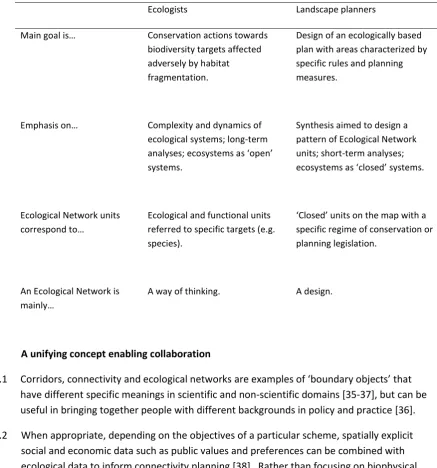
7.2.1 Some of the mismatch between the perception of ecological networks in practice and research has been attributed towards a difference in approach and attitude taken by landscape professionals and ecologists (Table 1) [33].
[image:11.595.87.525.250.719.2]7.2.2 The training which landscape planners and designers have received may make them more likely to focus on the structural features of landscapes and to interpret ecological networks as a design to be achieved [33]. In contrast, ecologists tend to focus on the functional aspects of connectivity for particular species and processes. They are more likely to approach ecological networks as a way of thinking to inform decision making [33].
Table 1. Different goals, emphases and units between ecologists and environmental planners in Ecological Network strategies. Adapted from Battisti [33].
Ecologists Landscape planners
M Conservation actions towards biodiversity targets affected adversely by habitat fragmentation.
Design of an ecologically based plan with areas characterized by specific rules and planning measures.
E Complexity and dynamics of ecological systems; long-term
systems.
Synthesis aimed to design a pattern of Ecological Network units; short-term analyses;
Ecological Network units Ecological and functional units referred to specific targets (e.g. species).
C
specific regime of conservation or planning legislation.
An Ecological Network is A way of thinking. A design.
7.3 A unifying concept enabling collaboration
7.3.1 Corridors, connectivity and ecological networks are examples of that have different specific meanings in scientific and non-scientific domains [35-37], but can be useful in bringing together people with different backgrounds in policy and practice [36]. 7.3.2 When appropriate, depending on the objectives of a particular scheme, spatially explicit
8.
Modifying connectivity in design plans
8.0 Landscape professionals have considerable opportunity to influence functional connectivity across a landscape. Actions taken with the intention of increasing connectivity as part of an ecological network (Fig. 1) include:
Creating new corridors or improving the quality of existing corridors between habitat patches (section 8.1).
Creating new stepping stones or improving existing stepping stones between habitat patches (section 8.2).
Changing aspects of the matrix to improve permeability, use and to reduce mortality for particular species (section 8.3).
Introducing buffer zones around core habitat patches (section 8.3).
8.1 Corridors
8.1.1 Corridors are usually defined as an area of habitat that is longer than it is wide connecting two or more habitat patches that would otherwise be isolated within a non-habitat matrix [17]. Occasionally, the term corridor is used to refer to anything in the landscape that facilitates movement [6].
8.1.2 Corridors are often equated with connectivity, although the existence of a corridor does not guarantee that it will function as a conduit for movement, and there are also other
landscape elements that influence connectivity (sections 8.2 & 8.3) [15].
8.1.3 Corridors can exist naturally or be created by restoring habitat or constructed through hard barriers (such as wildlife bridges). The term corridor has been used to refer to:
Greenbelt
Buffers in urban areas
Greenways
Underpasses
Green bridges
Habitat alongside roads, waterways or railways
Wind breaks (vegetative)
Visual screens (vegetative)
Hedgerows
8.1.4 Although corridors are usually thought of as movement conduits, they can actually function in six ways [12]. Corridors might function differently during the night compared with the day, because impacts of the surrounding matrix (such as light spill) might affect how well it functions as a conduit.
Conduit organisms or materials move along the corridor
Filter only some organisms or material can cross or move along the corridor
Barrier organisms or material cannot cross the corridor
Source organisms emanate from the corridor into the connected habitat or matrix because reproduction in the corridor exceeds mortality.
Sink - organisms or materials enter the corridor and are destroyed.
8.1.5 When designing or modifying any landscape element, it is useful to consider the multiple intended aims and to consider how it is likely to function. For example, might a corridor intended to promote connectivity for people or a particular species actually function as a filter or a barrier for another species or process? In such instances, it may be helpful to choose a representative group of species and to follow the principles of the Ecosystem Approach [40] to consider different perspectives and viewpoints.
8.1.6 Completing a corridor design table (Table 1) or running through a checklist of possible aims with an ecologist can help to prioritise relevant species and bring to light any potential conflicts [12].
8.1.7 Greenways created with the primary intention of promoting the movement and recreation of people have the potential to conflict with the movement of some wildlife [12].
8.1.8 Brownfield sites are sometimes planted with grass or ornamental trees for aesthetic reasons [41]. Rather than providing corridor stepping stones, this might result in lower biodiversity value and reduced connectivity for invertebrates that need the open mosaic habitats that some of these sites provide[41].
8.1.9 Corridors only increase functional landscape connectivity if a species or group of species are actually using them to move between habitat patches. There is little evidence about the optimum width of corridors and other attributes needed by different species [42]. However, protecting existing landscape elements that function as corridors is likely to be more
effective than creating new corridors [42].
8.1.10 The Landscape Institute has published a technical guidance note on the development of green bridges, which can be important as corridors linking habitats across roads and railways.
8.2 Stepping stones
8.2.1 Stepping stones are patches of habitat that are smaller than the core habitat patches. They are positioned between core habitat patches with the intention of improving functional connectivity by supporting movement through the matrix. Stepping stones may be pre-existing habitat remnants, or they may be created by restoration or improving the quality of existing habitat for particular species.
travelled by species between core habitat patches [44]. Stepping stones can be particularly important in allowing rare long distance dispersal and dispersal across generations, where reproduction occurs between habitats.
Table 1. A corridor design table modified from Hess and Fischer [12], completed for an
example for an urban meadow corridor created primarily for pollinator conservation purposes.
Function
category
Primary
purpose
Secondary purpose Potential problems and conflicts
Conduit Movement of
pollinators between flower rich habitat areas.
Movement of other grassland invertebrate species
N/A
Habitat N/A Cover & food resources for invertebrates and birds.
N/A
Barrier N/A N/A Potentially a barrier for
dog walkers and other recreational use in the park
Filter N/A N/A N/A
Source N/A Potentially a source of
pollinators in longer term
N/A
Sink N/A N/A N/A
Ecosystem services
N/A Enhancing important
ecosystem services such as carbon sequestration, nutrient cycling and soil quality regulation
P
8.2.3 It cannot be assumed that creating stepping stones will result in functional connectivity for a particular species and compensate for the negative effect of habitat loss and fragmentation. 8.2.4 The size, type of habitat and the distance needed between stepping stones and core habitat
patches to ensure functional connectivity will vary depending on the species. For example:
Stag beetles need very small stepping stone nest sites (piles of logs) less than 1km apart in order for them to colonise new areas [45].
Bat activity increases in farmland matrix when there is a variety of both linear and patchy habitat such as hedgerows and groups of trees close to larger habitat areas[46]. Brownfield sites can be very important for invertebrates, as they contain a mosaic of
different habitat patches within and between sites that act as an ecological network [41].
8.2.5 Stepping stones can also function as habitat in themselves and supply ecosystem services. For example, stepping-stone meadow patches in urban parks may provide habitat for insects and enhance aesthetics, in addition to promoting the movement of insects between larger habitat patches.
8.3 Softening the matrix and adding buffer zones
8.3.1 The effectiveness of corridors and stepping stones in enhancing movement of individuals can depend on the landscape elements and activities in the matrix [47]. For example, species may be affected by the following activities occurring within habitat patches, stepping stones and corridors:
Disturbance.
Pollution (including light).
Increased predation.
Changes to species behaviour near the edges of habitat.
8.3.2 “
matrix less hostile as an area to move in. In situations where most of the favourable habitat has been destroyed and what remains is already protected, actions to soften the matrix might have the most influence on biodiversity conservation [48].
8.3.3 There are a number of actions that can soften a matrix:
Change in management to restore and improve the ecological and landscape value of existing habitats such as hedgerows, parkland, wetlands and field margins [46, 49].
linking different woodlands, or providing small ponds to act as stepping stones in between larger ones.
Reduction of pesticide and fertiliser inputs [49].
Provision of resources in the matrix for the species of interest, such as providing
additional food resource for birds [49], e.g. fruit trees within urban areas or buffer strips as part of agri-environment schemes.
B
that is intended to reduce negative impacts of the matrix on habitat.
9.
Summary
9.1 Actions taken by landscape professionals will influence connectivity. Landscape professionals are in a strong position to reduce the damaging impact of habitat loss, climate change, fragmentation and severance on biodiversity.
9.2 These actions can also have wider benefits, by influencing the provision of ecosystem services that the landscape provides.
9.3 Structural and functional connectivity are different. Functional connectivity relates to ecological processes and its effects will be different for different species.
9.4 Improvements to connectivity will be most effective if carried out in conjunction with other measures to improve habitat quantity and quality.
9.5 Connectivity is not just about the provision of corridors. Other factors to consider include:
The site as part of the wider landscape, including how actions might affect the functional connectivity at different spatial scales for various species of interest.
Impact of design or management actions in altering the permeability of the matrix between habitat patches for your species of interest.
Effect of design or management actions in increasing or decreasing negative impacts of the matrix on existing habitat patches, corridors and stepping stones.
Ways in which corridors are likely to function as movement conduits, habitats or barriers for different species and processes.
Effects of design or management actions on supply and flow of ecosystem services to people.
Trade-offs between the needs of different species and different groups of people. 9.6 Actions such as introducing corridors and stepping stones are not without risks and
trade-offs, although in general the benefits to biodiversity usually outweigh the risks.
10.
Further resources
Aune, K. et al (2011) Assessment and planning for ecological connectivity: a practical guide. Wildlife Conservation Socieity, Bozeman.
http://www.wcs-ahead.org/kaza/ecological_connectivity_07_20_11_2.pdf
Billings, P. (2014) The West Weald landscape project 2009 2014.
http://westweald.org.uk/pdf/WWLP%20full%20summary.pdf
Conservation Corridors (2015) List of technical papers and methods.
http://conservationcorridor.org/corridor-toolbox/technical-papers-and-methods/
Conservation Corridors (2015) List of programs and tools.
http://conservationcorridor.org/corridor-toolbox/programs-and-tools/
Cranborne Chase & West Wiltshire Downs AONB (2016) Stepping Stones project. http://ukbars.defra.gov.uk/project/show/36406
International Association for Landscape Ecology. (2016) http://www.landscape-ecology.org/
Landscape Institute (2013) Green Infrastructure: an integrated approach to land use.
Position Statement.
Landscape Institute (2015) Green Bridges. Technical Guidance Note.
Landscape Institute (2016) Ecosystem Services. Technical Information Note.
Landscope (2016) Connecting Landscapes: a practitioner's resource for assessing and planning for habitat connectivity. http://www.landscope.org/focus/connectivity
Lawton, J.H. et al (2010) Making space for nature: E wildlife sites and ecological network. Report to Defra.
Wildlife & Countryside LINK (2015) Open mosaic habitats high value guidance: when is
11.
References
1. Boitani, L., et al., Ecological Networks as Conceptual Frameworks or Operational Tools in Conservation. Conservation Biology, 2007, 21:1414-1422.
2. UK National Ecosystem Assessment, The UK National Ecosystem Assessment: Synthesis of the Key Findings. UNEP-WCMC, Cambridge. 2011.
3. Krosby, M., et al., Ecological connectivity for a changing climate. Conservation Biology, 2010,
24:1686-1689.
4. Parmesan, C. and G. Yohe, A globally coherent fingerprint of climate change impacts across natural systems. Nature, 2003, 421:37-42.
5. Pearson, K., et al., Futurescapes: promoting the development of green infrastructure in 38
UK A L ‘ ‘SPB LIFE+ Information and
Communication Futurescapes programme. (LIFE10INF/UK/000189). 2015. 6. Lawton, J.H., et al., M S N A E W S
Ecological Network. Report to Defra. 2010.
7. Heller, N.E. and E.S. Zavaleta, Biodiversity management in the face of climate change: A review of 22 years of recommendations. Biological Conservation, 2009, 142:14 32.
8. The Landscape Institute, Green Infrastructure: an integrated approach to land use. Position statement. 2013.
9. Defra, The Natural Choice: securing the value of nature. 2011.
10. Kettunen, M., et al., Guidance on the maintenance of landscape features of major importance for wild flora and fauna - Guidance on the implementation of Article 3 of the Birds Directive (79/409/EEC) and Article 10 of the Habitats Directive (92/43/EEC). Institute for European Environmental Policy (IEEP), Brussels, 114 pp. & Annexes. 2007.
11. Town and Country Planning Association and The Wildlife Trusts, Planning for a healthy environment: good practice guidance for green infrastructure and biodiversity. 2012. 12. Hess, G.R. and R.A. Fischer, Communicating clearly about conservation corridors. Landscape
and Urban Planning, 2001, 55:195 208.
13. Tischendorf, L. and L. Fahrig, On the usage and measurement of landscape connectivity.
Oikos, 2000, 90: 7-19.
14. Taylor, P.D., et al., Connectivity is a vital element of landscape structure. Oikos, 1993,
68:571-573.
15. Tischendorf, L. and L. Fahring, On the usage and measurement of landscape connectivity.
Oikos, 2000, 90: 7-19.
16. With, K.A., The application of neutral landscape models in conservation biology.
Conservation Biology, 1997, 11:1069-1080.
17. Mitchell, M.E., E. Bennett, and A. Gonzalez, Linking landscape connectivity and ecosystem service provision: current knowledge and research gaps. Ecosystems, 2013, 16:894-908. 18. Haddad, N.M. Corridor and distance effects on interpatch movements: a landscape
experiment with butterflies. Ecological Applications, 1999, 9:612-622.
19. Levey, D.J., B.M. Bolker, J.J. Tewksbury, S. Sargent, and N.M. Haddad. Effects of landscape corridors on seed dispersal by birds. Science, 2005, 309:146-148.
20. Brudvig, L.A., et al. Corridors promote biodiversity spillover into adjacent habitat. Proceedings of the National Academy of Sciences, 2009, 106:9328-9332.
21. Damschen, E.I., et al. Corridors increase plant species richness at large scales. Science, 2006,
313:1284-1286.
23. Krewenka, K.M., Holzschuh, A., Tscharntke, T. and Dormann, C.F., Landscape elements as potential barriers and corridors for bees, wasps and parasitoids. Biological Conservation, 2011, 144:1816-1825.
24. Haddad, N.M., et al., Potential negative ecological effects of corridors. Conservation Biology, 2015. 28: 1178-1187.
25. Batary, P. and Baldi, A. Evidence of an edge effect on avian nest success. Conservation Biology, 2004, 18:389-400.
26. McCallum, H., 2008. Landscape structure, disturbance, and disease dynamics. Infectious disease ecology: effects of ecosystems on disease and of disease on ecosystems. Princeton University Press, Princeton, New Jersey, USA, pp.100-122.
27. Rahel, F.J., Intentional fragmentation as a management strategy in aquatic systems. BioScience, 2013, 63:362-372.
28. Mitchell, M.G.E., et al., Reframing landscape fragmentation's effects on ecosystem services.
Trends in Ecology & Evolution, 2015. 30:190-198.
29. Tscharntke, T., et al., Landscape perspectives on agricultural intensification and biodiversity ecosystem service management. Ecology Letters, 2005, 8:857-874.
30. Mitchell, M.G.E., et al., Reframing landscape fragmentation's effects on ecosystem services.
Trends in Ecology & Evolution, 2015, 30: 190-198.
31. Andrieu, E., A. Vialatte, and C. Sirami, Misconceptions of fragmentation's effects on
ecosystem services: a response to Mitchell et al. Trends in Ecology & Evolution, 2015, 30 :633-634.
32. Hodgson, J.A., et al., Climate change, connectivity and conservation decision making: back to basics. Journal of Applied Ecology, 2009, 46:964-969.
33. Battisti, C., Ecological network planning from paradigms to design and back: a cautionary note. Journal of Land Use Science, 2013, 8: 215-223.
34. Hodgson, J.A., et al., Habitat area, quality and connectivity: striking the balance for efficient conservation. Journal of Applied Ecology, 2011, 48:148-152.
35. Wyborn, C., Connectivity conservation: boundary objects, science narratives and the co-production of science and practice. Environmental Science & Policy, 2015, 51:292-303. 36. Van Der Windt, H.J. and J.A.A. Swart, Ecological corridors, connecting science and politics:
the case of the Green River in the Netherlands. Journal of Applied Ecology, 2008, 45:124-132. 37. Opdam, P., E. Steingröver, and S.v. Rooij, Ecological networks: A spatial concept for
multi-actor planning of sustainable landscapes. Landscape and Urban Planning, 2006, 75:322-332. 38. Lechner, A., G. Brown, and C. Raymond, Modeling the impact of future development and
public conservation orientation on landscape connectivity for conservation planning.
Landscape Ecology, 2015, 30:699-713.
39. The Quintessence Consortium, Networking our way to better ecosystem service provision.
Trends in Ecology & Evolution, 2016, 31:105-115.
40. Beier, P., D. Majka, and W. Spencer, Forks in the road: choices in procedures for designing wildland linkages. Conservation Biology, 2008, 22:836-851.
41. Wildlife & Countryside LINK, Open mosaic habitats high value guidance: when is brownfield
A https://www.buglife.org.uk/brownfield-hub.
2015.
42. Gilbert-Norton, L., et al., A meta-analytic review of corridor effectiveness. Conservation Biology, 2010, 24:660-668.
43. Uezu, A., D.D. Beyer, and J.P. Metzger, Can agroforest woodlots work as stepping stones for birds in the Atlantic forest region? Biodiversity Conservation, 2008, 17:1907-1922.
44. Saura, S. and M.J. Fortin, Editor's choice: stepping stones are crucial for species'
45. Rink, M. and U. Sinsch, Radio-telemetric monitoring of dispersing stag beetles: implications for conservation. Journal of Zoology, 2007, 272:235-243.
46. F E A Landscape connectivity, habitat structure and activity of bat guilds
Journal of Applied Ecology, 2015, 50:252-261.
47. Baum, K.A., et al., The matrix enhances the effectiveness of corridors and stepping stones.
Ecology, 2004, 85:2671-2676.
48. Driscoll, D.A., et al., Conceptual domain of the matrix in fragmented landscapes. Trends in Ecology & Evolution, 2013, 28:605-613.
49. Donald, P.F. and A.D. Evans, Habitat connectivity and matrix restoration: the wider implications of agri-environment schemes. Journal of Applied Ecology, 2006, 43:209-218. 50. Eycott, A., et al., Do landscape matrix features affect species movement? (systematic
review). Environmental Evidence, 2015.
51. Prevedello, Does the type of matrix matter? A quantitative review of the evidence.
Biodiversity and Conservation, 2010, 19:1205-1223.
Acknowledgements
This work was partly funded with support from the Biodiversity and Ecosystem Service Sustainability (BESS) programme (NE/K001620/1). BESS is a six-year programme (2011-2017) funded by the UK Natural Environment Research Council (NERC) and the Biotechnology and
B “ ‘ C BB“‘C UK L ing with Environmental
Note authored by Dr Laura Harrison and edited by Professor Piran White, University of York
© Mar 2016 Landscape Institute 107 Grays Inn Road
London WC1X 8TZ
www.landscapeinstitute.org
![Table 1. A corridor design table modified from Hess and Fischer [12], completed for an example for an urban meadow corridor created primarily for pollinator conservation purposes](https://thumb-us.123doks.com/thumbv2/123dok_us/7844916.177269/14.595.108.542.165.762/modified-fischer-completed-corridor-primarily-pollinator-conservation-purposes.webp)
