UNIVERSITI TEKNIKAL MALAYSIA MELAKA
THE STUDY OF CONVERSION UNIT FROM PIXEL TO A
DISTANCE MEASUREMENT ACQUIRED BY VISION SYSTEM
USING MATLAB SOFTWARE.
This report is submitted in accordance with the requirement of the Universiti Teknikal Malaysia Melaka (UTeM) for the Bachelor of Engineering Technology
(Industrial Electronics) (Hons.)
by
FARAH EZLIN BINTI SAMAD FATIMI B071310188
910307146008
UNIVERSITI TEKNIKAL MALAYSIA MELAKA
BORANG PENGESAHAN STATUS LAPORAN PROJEK SARJANA MUDA
TAJUK: THE STUDY OF CONVERSION UNIT FROM PIXEL TO A DISTANCE MEASUREMENT ACQUIRED BY VISION SYSTEM USING MATLAB SOFTWARE.
SESI PENGAJIAN: 2016/17 Semester 2
Saya FARAH EZLIN BINTI SAMAD FATIMI
mengaku membenarkan Laporan PSM ini disimpan di Perpustakaan Universiti Teknikal Malaysia Melaka (UTeM) dengan syarat-syarat kegunaan seperti berikut:
1. Laporan PSM adalah hak milik Universiti Teknikal Malaysia Melaka dan penulis. 2. Perpustakaan Universiti Teknikal Malaysia Melaka dibenarkan membuat salinan
untuk tujuan pengajian sahaja dengan izin penulis.
3. Perpustakaan dibenarkan membuat salinan laporan PSM ini sebagai bahan pertukaran antara institusi pengajian tinggi.
4. **Sila tandakan ( )
SULIT
TERHAD
TIDAK TERHAD
(Mengandungi maklumat yang berdarjah keselamatan atau kepentingan Malaysia sebagaimana yang termaktub dalam AKTA RAHSIA RASMI 1972)
(Mengandungi maklumat TERHAD yang telah ditentukan oleh organisasi/badan di mana penyelidikan dijalankan)
Alamat Tetap: 23-01-15
Bandar Baru Sentul Kuala Lumpur,
Tarikh: ________________________
Disahkan oleh:
Cop Rasmi:
FAKULTI TEKNOLOGI KEJURUTERAAN Tel : +606 234 6623 | Faks : +606 23406526
Rujukan Kami (Our Ref) : Rujukan Tuan (Your Ref) :
28 DEC 2016
Pustakawan
Perpustakaan UTeM
Universiti Teknikal Malaysia Melaka Hang Tuah Jaya,
76100 Durian Tunggal, Melaka.
Tuan/Puan,
PENGKELASAN LAPORAN PSM SEBAGAI SULIT/TERHAD LAPORAN PROJEK SARJANA MUDA TEKNOLOGI KEJURUTERAAN ELEKTRONIK (ELEKTRONIK INDUSTRI) : FARAH EZLIN BINTI SAMAD FATIMI
Sukacita dimaklumkan bahawa Laporan PSM yang tersebut di atas bertajuk
The Study of Conversion Unit from Pixel to a Distance Measurement Acquired by Vision System Using Matlab Software.
mohon dikelaskan sebagai *SULIT / TERHAD untuk tempoh LIMA (5) tahun dari tarikh surat ini.
2. Hal ini adalah kerana IANYA MERUPAKAN PROJEK YANG DITAJA OLEH SYARIKAT LUAR DAN HASIL KAJIANNYA ADALAH SULIT.
Sekian dimaklumkan. Terima kasih.
Yang benar,
________________
Tandatangan dan Cop Penyelia
iv
DECLARATION
I hereby, declared this report entitled “The Study of Conversion Unit from Pixel to a Distance Measurement Acquired by Vision System Using Matlab Software.
” is the results of my own research except as cited in references.
Signature : ……….
Author’s Name : FARAH EZLIN BINTI SAMAD FATIMI
v
APPROVAL
This report is submitted to the Faculty of Engineering Technology of UTeM as a partial fulfillment of the requirements for the degree of Bachelor of Engineering Technology (Industrial Electronics) with (Hons.). The member of the supervisory is as follow:
vi
ABSTRAK
vii
ABSTRACT
viii
DEDICATION
ix
ACKNOWLEDGEMENT
First of all, I would like to thank my family for their love and support throughout my life. My sincere indebtedness for their patience and understanding that were inevitable to make this work possible. Thank you for giving me strength to reach this level.
I am grateful and would like to express my sincerely gratitude to my supervisor, Mr. Khairul Anuar Bin Abd Rahman, for continuous encouragement and constant support. I express my heartfelt gratefulness for his guidance from initial to final level that enabled me to develop an understanding of this project.
xi
TABLE OF CONTENT
Declaration iv
Approval v
Abstrak vi
Abstract vii
Dedication viii
Acknowledgement ix Table of Content x List of Tables xiii
List of Figures xiv
List Abbreviations, Symbols and Nomenclatures xv
CHAPTER 1: INTRODUCTION 1
1.1 Introduction 1
1.2 Background 1
1.3 Problem Statement 2
1.4 Objectives of The Study 3
1.5 Scope of The Study 3
1.6 Project Outline 3
CHAPTER 2: LITERATURE REVIEW 4
2.0 Introduction 4
2.1 Introduction of Inspection System 4
2.2 Introduction to Vision System 5
2.3 Pixels 7
2.4 Camera 8
2.4.1 Charge-Couple Device (CCD) Sensor Camera 9
2.5.2 Complementary Metal Oxide Silicon (CMOS) Sensor Camera 9
2.5.3 Difference Between CCD’s and CMOS’s Sensor Camera 10
xii
CHAPTER 3: METHODOLOGY 12
3.0 Introduction 12
3.1 Methodology 12
3.1.2 Process of Project 13
3.2 Project Flowchart 14
3.2.1 Image Acquisition 15
3.2.2 Determine Algorithms 15
3.2.3 Testing Simulation Algorithms 15
3.2.4 Hardware 15
3.2.5 Analysis 16
3.2.6 Documentation and Reporting 16
3.3 Software Development 16
3.3.1 Matlab Software 16
3.4 Process Flowchart 18
3.4.1 Image Acquisition 19
3.4.2 Conversion Algorithms 19
3.4.2 Calculation Total Number of Pixels 19
3.4.3 Pixel Conversion 19
3.5 Hardware Development 20
3.5.1 Camera 20
3.6 Expected Result 21
CHAPTER 4: RESULT AND DISCUSSION 22
4.0 Introduction 22
4.1 Result 22
4.2 Simulation using Matlab 22
4.3 Analysis 25
4.3.1 Nail Analysis 25
4.3.2 Screw Analysis 29
4.3.3 Battery Analysis 34
xiii
CHAPTER 5: CONCLUSION AND RECOMMENDATION 40
5.0 Introduction 40
5.1 Conclusion 40
5.2 Recommendation 41
REFERENCE 42
xiv
LIST OF TABLES
2.1 Difference Between CCD’s and CMOS’s Camera Sensor 10
4.1 Horizontal Real Time Measured Data. 26
4.2 Vertical Real Time Measured Data. 28
4.3 Vertical Real Time Measurement Data. 30
4.4 Horizontal Real Time Measurement Data. 32
4.5 Horizontal Real Time Measurement Data. 35
xv
LIST OF FIGURES
1.1 Clarity of image captured depends on the number of pixel. 2
2.1 Pixels representation. 8
3.1 Project Flowchart 14
3.2 MatLab main window. 17
3.3 Process Flowchart 18
3.4 Calculation total number of pixel. 19
3.5 The algorithms to convert the pixel to mm. 20
3.6 USB webcam 20
4.1 Webcam list in Matlab code. 23
4.2 Resolution of an image. 23
4.3 The algorithms conversion process. 24
4.4 DPI value and value of 1px in millimeter. 24
4.5 Object Measured (Nail). 25
4.6 Scatter Horizontal Real Time Measured Image. 27
4.7 Scatter Vertical Real Time Measured Image. 29
4.8 Object Measured (Screw). 29
4.9 Scatter Vertical Real Time Measured Image. 31
4.10 Scatter Horizontal Real Time Measured Image. 33
4.11 Object Measured (Battery) 34
xvi
LIST OF ABBREVIATIONS, SYMBOLS AND
NOMENCLATURE
DIP - Digital Image Processing PCB - Printed Circuit Board PNSR - Peak Signal to Noise RGB - Red, Green, Blue CCD - Charge-Couple Device
CMOS - Complementary Metal Oxide Silicon USB - Universal Serial Bus
1
1.0 Introduction
This chapter provides an overview of the inspection system done by the industries. The problem background and problem statement are described next. This is followed by research objectives and scope of the study which involves the research study on the conversion unit from pixel to one distance measurement acquired by vision system using MATLAB software.
1.1 Background
Product visual inspection is still manually or semi-automatically in most industries. Some sophisticated optical inspection methods have already been developed in recent years. Quality is one of the most important factors because it is related to customer satisfactory and its interchangeability. This project is aimed to present intelligent visual inspection system which it is compared with human that can operate untiringly and provide consistent quality and accuracy of the inspected product. The scheme is concerning the conversion unit from pixels to one distance measurement acquired by the vision system using MATLAB Software. The camera will capture the visual images and the visual image enters the software which to determine the algorithm conversion from pixel to measurement acquired by vision system. This result need to be analysing and processed to obtain the result.
2
1.2 Problem Statement
[image:18.595.132.504.404.635.2]The ideas for this project is come out after doing a research on the efficiency of the inspection doing by the human and compared with the intelligent visual inspection system. The most difficult task for inspection system is inspecting by the visual appearance of the object. The visual inspection in most manufacturing process mainly depends on the operators whose performance is generally inadequate and variable. The efficiency and the accuracy of the inspection system doing by the humans are not 100% accurate. The image captured by the camera may have some infirmity. On every captured image has different pixels depends on the size of the images. Each camera also has difference resolution, it is depends on the horizontal and vertical pixels in an images. So, come with the idea to convert the reading of the pixel to the distance measurement acquired by vision system using Matlab software for facilitate process intelligent inspection system.
3
1.3 Objectives of The Study
1. To determine the conversion algorithm from pixels to millimeter measurement acquired by vision system.
2. To design the simulation of the unit conversion of pixels to millimeter using MATLAB software.
1.4 Scope of The Study
The scopes of this project are to study the conversion unit of pixels to a distance measurement acquired by the vision system. The captured images need to convert to the millimeter to obtain the clarity of the images that acquired by a vision system. Other than to obtain the clarity of the images, it also will focus on the distance measurement that can read by any kind of camera even though it has difference resolution. The images are captured by using a webcam. This camera is connected with Matlab Software to convert the images to the algorithms. From the images captured, the algorithms will be created to convert the pixel to the millimeter measurement
1.5 Project Outline
4
2.0 Introduction
This chapter summarizes prior works related to the research on the unit conversion from pixel to a distance measurement acquired by the vision system. It will cover the background and definition of image processing and elementary visual system. In addition, it will summarize the usability of hardware and software to be used for this project. On top of that, this chapter will summarize and discuss the research previous inspection system undertaken by industry.
2.1 Introduction of Inspection System.
M. Jalili, H. Dehgan, and E. Nourani (2013) proposed that a Cheap Visual Inspection System for Measuring Dimensions of Brass Gear. It is only used to measure the dimensions of the brass gear. The inspection systems to recognize a circular object on the images which take from the metal lids on the conveyor and it will detect the defect on the circular object. The system of inspection to identify the object of the circular on the image that takes from the sender's metal lid and it will detect the defects in object of the circular. The visual dimension inspection problems cleared and some solutions have been proposed to improve this system. In the process of examination is done through four steps, namely, image acquisition, image enhancement, thresholding and object matching.
5 All physical object can be identified by using image signature. However, image representation have a limited number of physical characteristics which it is depends on the object observation and not included in any non-visual features such as the mass of the object or the sound which may present.
Saad Mohamed Darwish (2013) suggested a Soft Computing Applied to The Build of Textile Defects Inspection System. This inspection system provides the ability to analyze images textiles when compromise uncertain and can also to online learning through adaptability based on an ants colony. An algorithmic starting point is an image of the examination that contains textile defects captured by digital cameras in RGB format and via serial port to the computer. These images are converted into greyscale images, and then strained to make it smooth and remove noises. However, this system only in specific fabrics and is not suitable for detecting defects on all fabrics.
Human eye has good capabilities to find imperfections in structure and surface, the defect perceived as irregularities. However, the conclusion on the product quality is subjective. This is means that is influenced by prior knowledge and by fatigue due to repetitiveness work. Automated system inspection helps operators from the visual inspection system, but it cannot be replaced or duplicate many of the unique abilities which the human being has. An automatic system must ensure several advantages compared to inspection that carried out by the human, such as accuracy, quality control and cost reduction. Computer visual techniques do involve many tasks that difficult to do by human and should take several important aspects, such as analysis time, orientation position of the object, calibration of the system and lighting factor.
2.2 Introduction to Vision System
6 is used to recognize9, and positioned the apple orchard image for the performance test of vision system. As a result, the fruit of the best short distance to the centre after recognized and positioned showing the effectiveness of the research and design method.
Vision systems are a prior consideration by any manufacturer to desire an improvement of the quality or automated production. Vision systems may be conceived that computer can identify, check and communicate critical information to eliminate the costly errors, enhance productivity and give satisfaction to customers through consistent delivery quality products. It used for online inspection, that vision system can make difficult task very quickly with high precision and high consistency. Xu, Yafan, Zhao Yan, Wu Falin, Yang Kui (2013) discussed an Error Analysis of Calibration Parameters Estimation for Binocular Stereo Vision System. This research paper system reconstruction accuracy of binocular stereo vision system using black box methods. First, the system of binocular stereo equipment is considered as black release a box that a variety of inputs. Second, a system error calibration is seen as input, and error reconstruction system seen as an output. Finally, the papers provide quantitative and qualitative analysis and evaluation of system reconstruction accuracy according to the journal. The reference value is determined based on parameter measurement system calibration algorithms. A large number of experimental simulation show the radial distortion effect parameter error system reconstruction of small faults and mistakes would never exceed 1mm.
7
2.3 Pixels
Digital image formed from lots different colored dots, known as the pixel. The pixel is small and tightly packed, so when viewed on a screen, individual dots are not perceptible and give illusion a perfectly smooth yet the sharp image. Picture Element (Pixel) is a single point in a graphic image. Graphics monitors display pictures by dividing the displayed on the screen into thousands or even millions of pixels, it is arranging in rows and columns.
Sherin Sugathan and James Pappachen Alex (2014) has proposed an irregular pixel imaging techniques to improve the quality of object edges and details in the image. Irregular pixel used sensor level so that it can reach the digital image better visual picture. This technique offers the same quality to better visual quality while removing part of the calculations involved to find the optimum pixel mask. Various remains messy image pixels in the mask are a solution rather than finding the right image masks based on numerical calculations. This experiment was conducted to analyze the value of PNSR (peak signal-to-noise) irregular pixel image to be represented and compared with the value of the corresponding pixel square image PNSR representatives. Tests have been carried out because of the noise and it uses several arrays of sensors to capture on the spot and that the probability of higher than noise compared to single the various sensors.
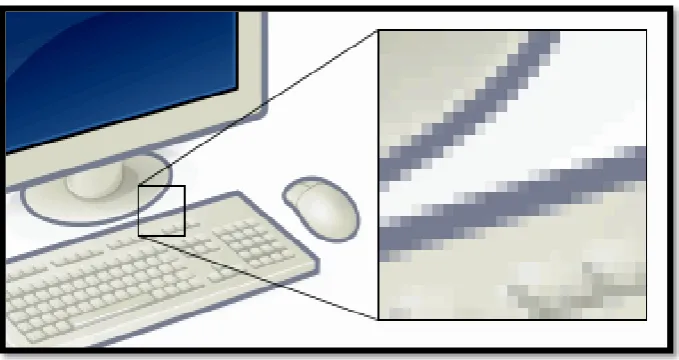
8 Figure 2.1: Pixels representation.
Chuanyong Bai, Richard Conwell, Hetal Babla, and all proposed on Handling of Bad Pixels on Pixelated Solid State Detectors. Methods for handling of Bad Pixels on Pixelated Solid State Detector are the AVG Approach, the LGA Approach, AVG Approach Evaluation - Cardiac Imaging, AVG Approach evaluation - High Resolution Planar Imaging, and LGA Approach evaluation -High Resolution Planar Imaging. As a result, the data that generated randomly have a bad pixel with 50% of sensitivity using AVG approach. Approach from the average pixel neighbours directly effective for low resolution images, such as SPECT imaging where resources are distributed without sharp edges, while the gradient approach less developed in this work is more effective for bad pixel correction in high resolution imaging.
2.6 Camera