Perspective
Enhancing the contribution and role of practitioner knowledge in the
Intergovernmental Panel on Climate Change (IPCC) Working Group (WG)
II process: Insights from UK workshops
Candice Howarth
a,⇑, David Viner
b, Suraje Dessai
c, Christopher Rapley
d, Aled Jones
e aFaculty of Arts and Social Sciences, University of Surrey, Guildford GU2 7XH, UK b
Mott MacDonald, Cambridge CB1 2JD, UK c
Sustainability Research Institute, School of Earth and Environment, The University of Leeds, Leeds LS2 9JT, UK d
Department of Earth Science, University College London, London WC1E 6BT, UK e
Global Sustainability Institute, Anglia Ruskin University, Cambridge CB1 1PT, UK
a r t i c l e i n f o
Article history:
Received 20 July 2016
Received in revised form 5 December 2016 Accepted 19 April 2017
Available online xxxx
Keywords:
IPCC Climate change Practitioners Decision-making Adaptation
a b s t r a c t
This perspective critically assesses how the Intergovernmental Panel on Climate Change (IPCC) could facilitate a closer alignment of its activities and include lessons drawn from the policy and decision-making communities working on the ground at the regional/local levels. The objective is to facilitate practitioner input into the detailed choice of topics and priorities for IPCC review and in the conclusions drawn (we define practitioners as those engaged in the development and application of practical responses to climate change on the ground). By means of a series of workshops with academics, policy officials and decision-makers in the United Kingdom, the research reported here illuminates how the IPCC’s Working Group II (WGII) has been used in the past to inform decision-making and how practi-tioner responses to climate change could better inform the IPCC process in the future. In particular, we recommend three key actions. Firstly that IPCC WGII should incorporate more practitioners as authors to improve the awareness and understanding amongst the writing teams of the nature and detail of deci-sions being made in response to climate change; secondly a practitioner-led IPCC Special Report should be commissioned on good-practice responses to climate change; and thirdly a new body should be cre-ated, attached to the IPCC, to synthesise and report on good practice on climate response strategies in a timely manner. By adopting these recommendations, the IPCC could become more directly useful to decision-makers working on adaptation at the national, regional and local levels and enable more action-able decision-making.
Ó2017 The Authors. Published by Elsevier B.V. This is an open access article under the CC BY license (http:// creativecommons.org/licenses/by/4.0/).
1. Introduction: A linear approach to science-based decision making
Despite the best efforts of international global change coordina-tion bodies such as the World Climate Research Programme, the International Geosphere-Biosphere Programme and the Interna-tional Human Dimensions Programme, the process by which knowledge on climate change is generated and disseminated is lar-gely undirected. Individual scientists or groups of scientists select their topics of study and apply for funds, and, if successful, execute their research and publish their results in reports or the refereed literature. This research on occasion incorporates academic obser-vation of practitioner work and as stated inViner and Howarth
(2014: 848): ‘‘a close look at the content, author lists and refer-ences shows that the ‘adaptation’ chapters [of the IPCC] lack prac-titioner experience, evidence and case studies that demonstrate how adaptation is being carried out on the ground. In other words, they provide an observational, top-down account rather than a practitioner-led evidence base.” Here we define practitioners as those engaged in the development and application of practical solutions to climate change on the ground. Whilst acknowledging the social significance of the work of these individuals and bodies, the priorities of many global change scientists tend to focus on understanding the nature and functioning of coupled human-environment systems, and in making best estimates of their future trajectory. As a result, multiple interfaces are created between sci-entists, policymakers and practitioners that are generally ad hoc, often superficial, and function in the ‘technocratic mode’ (Rapley et al., 2014). This linear model in which science (facts) speaks truth
http://dx.doi.org/10.1016/j.cliser.2017.04.003
2405-8807/Ó2017 The Authors. Published by Elsevier B.V.
This is an open access article under the CC BY license (http://creativecommons.org/licenses/by/4.0/).
⇑ Corresponding author.
E-mail address:[email protected](C. Howarth).
Contents lists available atScienceDirect
Climate Services
j o u r n a l h o m e p a g e : w w w . e l s e v i e r . c o m / l o c a t e / c l i s e r
to power (political realities, practicalities and values) (Jasanoff and Wynne, 1998) is still the dominant paradigm. Beck (2010) has shown that the Intergovernmental Panel on Climate Change’s (IPCC) use of the linear model constrains the scientific and political debates about adaptation. A shift is needed to include bottom-up approaches, with the involvement of local and regional stakehold-ers and experts (Howarth and Painter, 2016). Whilst some aca-demic research includes observation of practitioner’s work (Ryghaug and Solli, 2012), Beck argues for an opening up of exper-tise in the IPCC process.
The Intergovernmental Panel on Climate Change (IPCC) is a body set up to ‘‘assess on a comprehensive, objective, open and trans-parent basis the scientific, technical and socio-economic information relevant to understanding the scientific basis of risk of human-induced climate change, its potential impacts and options for adapta-tion and mitigaadapta-tion‘‘ (IPCC, 2013). The IPCC’s Working Group II (WGII) on Impacts, Adaptation and Vulnerability assesses the liter-ature on the wide range of impacts and risks of climate change and identifies impediments and opportunities for responses. The IPCC conducts no research of its own. In its Principles for Governing IPCC work, the IPCC has a range of recommendations on the type of literature to be assessed as part of the review process for pro-ducing the Assessment Reports (AR). The use of non-academic evi-dence such as reports from government or industry, is encouraged, but with a clear emphasis on the need for transparency and caution in the type of literature drawn upon. Consequently it is apparent that non-academic evidence and expertise also has a place in the first and second review stages of the IPCC’s Assessment Reports (IPCC, 1999). Despite this, and despite increasing efforts to improve the science–policy interface, the disconnect between science and practitioners remains a barrier to progress in climate change adap-tation (Viner and Howarth, 2014).
The synthesis and interpretation of evidence from the scientific literature by IPCC authors is an exercise commissioned specifically to inform governments and the United Nations Framework Con-vention on Climate Change (UNFCCC). Climate change requires responses from across scales (international to local) and jurisdic-tions (public, private, third sector) to manage the challenge of its impacts. As such, the reports produced are not necessarily well-matched to the needs of the host of decision-makers and practi-tioners working on practical aspects of mitigation and adaptation in the public, private and third sectors. Whilst it is not the direct role of the IPCC to inform practitioner decisions the evidence assessments produced by the IPCC are widely used and required to be used in operational planning and policy delivery decisions that shape how society is responding to climate change. This pre-sents both a challenge and an opportunity to the IPCC, and leaves room for the IPCC to usefully engage with this sector in developing its evidence.
2. Suggested enhancements to the IPCC
The structure and content of the IPCC reports are determined by the scientific community, with oversight and guidance from the national entities responsible for agreeing a collective international response, who are the prime audience for the scientific insights generated. Yet climate change requires action at multiple levels of governance in a multiplicity of spheres of human activity. A con-sequence of the approach taken has all too often been a mismatch between the information provided and the specific needs of deci-sion makers tasked with formulating appropriate climate change related responses at the national, regional, local levels, particularly for adaptation (Viner and Howarth, 2014).
The IPCC has been scrutinised in recent years with scientific and political communities seeking to assess its future role. The
InterAcademy Council was commissioned by the UN and IPCC to review the IPCC’s process and procedures; it urged the IPCC to con-tinue to adapt to the changing contexts to ‘continue to serve society well in the future’(InterAcademy Council, 2010) through a set of recommendations on its governance and management, its review process, communication and transparency in its assessment pro-cess. In addition, the UK’s House of Commons Energy and Climate Change Committee led an inquiry into the IPCC’s Fifth Assessment Working Group I report concluding ‘‘the [IPCC] would benefit from increasing the level of transparency by recruiting a small team of non-climate scientists to serve the review process from start to finish” (House of Commons Energy and Climate Change Committee, 2014). Following the publication of the IPCC’s Fifth Assessment report (AR5), the IPCC issued a request for views to inform its scope and process post AR5. The UK’s Department for Energy and Climate Change as an example, consulted its devolved administrations, rel-evant departments, UK based review editors and Coordinating Lead authors (DECC, 2013) and suggested the IPCC address issues sur-rounding the complexity and volume of material that needed to be synthesised, adopt a more flexible approach to communication, consider the requirements of its end users and review its processes to ensure better transparency and inclusivity in the authors and experts participating. Whilst much feedback has been provided by wider stakeholder communities on how the IPCC could revise its processes and evolve to better suit the needs of its end users, suggestions from end users themselves have also been made. In February 2015, the IPCC assessed submissions on how it could review its future work, in particular related to the frequency and scheduling of reports, the structure and operations of the IPCC (notably to increase the number of members from developing countries in the IPCC Bureau from 31 to 34), making reports more user friendly, making the SPMs more useful, and enhancing the role of developing countries (IPCC Secretariat, 2015). Despite this, the content and form of the latest findings from the IPCC’s WGII report are the consequence of a process which is highly academic and results from a synthesis of the scientific literature with long lag times (Jasanoff and Wynne, 1998). As a result there exist issues of focus, framing, language and priority, as well as significant com-munication challenges for decision-makers arising from mis-matched languages and cultural interpretations. For example the practitioner community is increasingly framing its actions in terms of ‘‘resilience” instead of ‘‘climate change adaptation” (Sakai and Dessai, 2015).
Furthermore, a multilateral process such as the IPCC plenary (where decisions are made) is not conducive to illuminating ‘good’ decision-making and improvements of the organisation itself. There is therefore a risk that science conducted to feed into the IPCC process is addressing issues inadequately aligned with policy priorities and the needs of society, whilst not always using suitable approaches, and adopting unhelpful scientific jargon. There is also a tendency to concentrate on long-term trends whilst ignoring key and immediate decisions that confront practi-tioners and decision-makers (King et al., 2015). We propose that an approach that co-produces these reports across the three com-munities of academics, policy makers and practitioners, as defined above, could address these shortcomings and make the review process, especially of WGII more relevant to the decision makers, funders and deliverers of adaptation and resilience solutions.
3. Assessing the value of practitioner knowledge and expertise in the IPCC process
As we have noted, the gathering of evidence for the IPCC reports is an exercise conducted primarily by the scientific community,
albeit with a small number of practitioners involved in the IPCC as authors and possibly as review editors. Current practice in the IPCC does allow practitioners to be admitted into sessions with observer status as long as they are ‘‘qualified in matters covered by the Inter-governmental Panel on Climate Change” (IPCC, 2012, p1). However, the IPCC does not explicitly consider the extent to which its find-ings will be accessible to or utilised by practitioner communities or wider audiences. Hoesung Lee, the IPCC’s new chair, has announced that it is his objective to better incorporate experts from developing countries and expertise from business and indus-try (Schiermeier and Tollefson, 2015). He aims to incorporate a stronger focus on solutions, providing more justification for the incorporation of practitioners relative to academics. This is further reflected in the appointment of the new co-chair of IPCC WGII, Debra Roberts, an experienced regional decision-maker in Dur-ban’s municipality.
A number of research programmes exist to address gaps in knowledge on adaptation to climate change that incorporate practitioner-based evidence. The UNFCCC Adaptation Committee, set up as part of the Cancun Adaptation Framework in 2010, has as its remit the promotion of enhanced action on adaptation (UNFCCC, 2011) and as part of this has set up the Nairobi Work Programme to address the ‘‘knowledge needs arising from, inter alia, the Cancun Adaptation Framework”. The Work Programme also rec-ognizes that its value and relevance will be enhanced by incorpo-rating ‘‘activities that build upon each other and are linked to issues that are practical and that engage adaptation practitioners” (UNFCCC, 2013). PROVIA, the global Programme of Research on Cli-mate Change Vulnerability, Impacts and Adaptation aims to respond to the challenge of providing relevant information to deci-sion makers on adaptation and vulnerability to climate change by ‘‘harmonizing, mobilizing and communicating the growing knowledge-base on VIA (Vulnerability, Impacts, Adaptation) to rele-vant audiences” (UNEP, 2013a). Following consultation on the issue with scientists and experts, it has published a guidance document to assess impacts, vulnerabilities and adaptation to climate change (UNEP, 2013b) and has devised a set of Research Priorities for indi-vidual researchers and research institutions to align with the ‘sup-ply’ of evidence from experts to align with the ‘demand’ set out by policy makers and decision makers. Its Scientific Committee con-sists of IPCC WGII Lead Authors thus providing a strong link back to the AR process in the IPCC. However the majority of these authors are academics with the limitations of this outlined earlier in this paper.
Another initiative is the Country Level Impacts of Climate Change (CLICC) which assesses the impacts of climate change at the national level. It is supported by UNEP and the UK Department of Energy and Climate Change, and works closely with PROVIA to inform decision makers. By July 2015, CLICC will have ‘‘facilitated global understanding of country-level impacts to support action on cli-mate change” (HM Government/PROVIA, 2014) and provided rec-ommendations on the establishment of a long-term strategy for sustainability. At the national level in the UK, the Climate Change Risk Assessment assesses current and future risks from climate change and works with experts, including practitioners, to review the evidence to inform its publication (CCC, 2014). In addition ini-tiatives such as ICLEI, the C40 Programme Initiative, weADAPT and CLIMADAPT (Sanderson et al., 2015) and specific plans for cities such as the London Climate Change Partnership (LCCP) and the New York City Panel on Climate Change (NPCC) demonstrate how programmes at the national or city level are able to help meet emissions targets and deliver action. Unfortunately, these different approaches add further complexity to the coordination of climate policy and areas of synergy need to be identified to ensure effi-ciency of delivery and to enable lessons to be captured and shared (Hjerpe and Nasiritousi, 2015).
4. Methods
In order to explore in more detail some of the challenges out-lined in this paper, three workshops were conducted in June 2015 in London, United Kingdom (UK) to address the extent to which the incorporation of practitioner-based evidence in the IPCC reports can enable better scientific advice for decision-making.
A total of 46 participants (Table 1) were recruited from three pre-defined categories: (i) academic, (ii) practitioner (directly involved in implementation of climate-related solutions or deci-sion making processes on the ground) and (iii) policy communities (involved in formulating policies and decisions on climate change and nexus related issues). Participants were approached based on their knowledge, expertise and experience of decision-making on climate change, adaptation and resilience. These were identified using an assessment of the literature and of UK institutions and individuals in positions that fit one of the aforementioned cate-gories, approached via the project contacts and networks. Partici-pants were invited to one or more of the workshops with sufficient notice to maximise the chances of their availability, on occasions where specific invitees were unable to attend, they were asked to send a substitute from their organisation. Workshops were conducted over three consecutive days and addressed the fol-lowing three questions:
1. How are the IPCC outputs used to inform decision making? 2. What is the role of practitioner-based evidence in the IPCC WGII
process?
3. Can a process of co-production facilitate this process?
Each workshop adopted a semi-structured approach, with an approach piloted and refined beforehand. Workshops lasted half a day each. Participants were randomly split into two or three groups within each workshop, and discussions were recorded in written format with consent from all participants. The workshops where conducted under the Chatham House rule (where partici-pants can use the information received but may not reveal the identity or the affiliation of the speaker) to encourage open con-structive dialogue on the key themes discussed. Discussions were analysed using thematic analysis and were drafted as an internal document (Howarth and Viner, 2015) which was then shared with participants to review and comment on as part of the internal review process. This document was considered by workshop par-ticipants to be an accurate and representative account of the dis-cussions held in the workshops, and assessment of these findings is presented and discussed below.
5. Results
Each workshop began with a rapid exercise to assess and discuss participant’s use of IPCC outputs and challenges and opportunities they had experienced through this. Participants represented UK organisations such as SMEs, scientific organisations, non-governmental organisations, international consultancies, govern-ment departgovern-ments, universities, private sector organisations, and the finance sector. The sample size (n = 46) and geographic
Table 1
Workshop participants.
Academic Practitioner Policy
Workshop 1 3 6 5
Workshop 2 5 7 3
Workshop 3 7 6 4
Total 15 19 12
representation of the participants (i.e. United Kingdom) necessitates caveats with regards to the representation of our findings and sug-gest the need for further research with larger sample sizes and rep-resentation from different geographical and sectorial populations. Nevertheless, findings from these workshops provide valuable insights into how the IPCC WGII reports are used and perspectives on the role of practitioner evidence in their production.
Analysis of workshop discussions identified three overarching themes: (i) usage of IPCC WGII outputs in informing decision mak-ing, (ii) the role of practitioner evidence and expertise in the IPCC WGII process, and (iii) recommendations to the IPCC. Analysis and discussion of each theme is presented below and summarised in
Tables 2–4.
5.1. Use of IPCC WGII outputs
A recurring issue throughout the workshop discussions was the relevance of the IPCC. When asked what they used the IPCC for, most participants stated that they predominantly used the Work-ing Group I report on the science of climate change. They use a range of outputs including Assessment Reports, the Summary for Policy Makers (SPM) and press releases, as a reference point to
ensure their work and decision-making is well grounded in aca-demic rigour and in-line with the current scientific thinking.
‘‘The IPCC is useful to anchor research. If you cite the IPCC, you pass the sniff test and your work will be considered credible”
[(Workshop 2, Group 3).]
This is in part due to what the IPCC represents: an international body created to assess the science of climate change and ‘‘provide rigorous and balanced scientific information to decision makers because of its scientific and intergovernmental nature”. The quality of the science, as perceived by participants, is assured through its review process whereby hundreds of expert scientists who are chosen through a defined process volunteer their time to write the assessments as Coordinating Lead Authors and Lead Authors. The reports’ peer review process also is highly regarded with recognition of the enormous task involving multiple rounds of drafting and review. As a result the IPCC has built a reputation – or a ‘‘brand” (Workshop 2, Group 2) as some participants described it – for ensuring their outputs are comprehensive and objective.
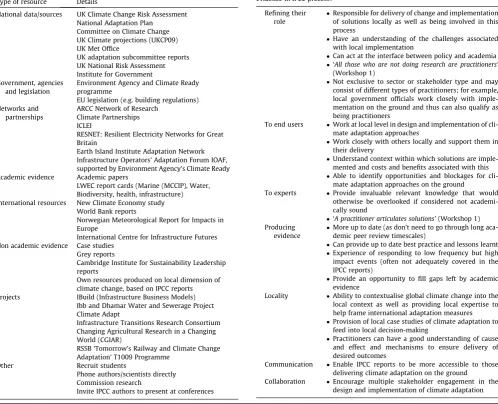
[image:4.595.45.544.355.759.2]The IPCC outputs are valued in general, however in terms of WGII on Impacts, Adaptation and Vulnerability to climate change, not all participants find them useful for their own work. This in part is due to the focus of the science community in providing best estimates of future circumstances, whilst, as a result of scientific
Table 2
Alternative resources used by participants to inform their work on climate change. Type of resource Details
National data/sources UK Climate Change Risk Assessment National Adaptation Plan
Committee on Climate Change UK Climate projections (UKCP09) UK Met Office
UK adaptation subcommittee reports UK National Risk Assessment Institute for Government Government, agencies
and legislation
Environment Agency and Climate Ready programme
EU legislation (e.g. building regulations) Networks and
partnerships
ARCC Network of Research Climate Partnerships ICLEI
RESNET: Resilient Electricity Networks for Great Britain
Earth Island Institute Adaptation Network Infrastructure Operators’ Adaptation Forum IOAF, supported by Environment Agency’s Climate Ready Academic evidence Academic papers
LWEC report cards (Marine (MCCIP), Water, Biodiversity, health, infrastructure) International resources New Climate Economy study
World Bank reports
Norwegian Meteorological Report for Impacts in Europe
International Centre for Infrastructure Futures Non academic evidence Case studies
Grey reports
Cambridge Institute for Sustainability Leadership reports
Own resources produced on local dimension of climate change, based on IPCC reports Projects IBuild (Infrastructure Business Models)
Ibb and Dhamar Water and Sewerage Project Climate Adapt
Infrastructure Transitions Research Consortium Changing Agricultural Research in a Changing World (CGIAR)
RSSB ‘Tomorrow’s Railway and Climate Change Adaptation’ T1009 Programme
Other Recruit students
Phone authors/scientists directly Commission research
Invite IPCC authors to present at conferences
Table 3
Workshop responses to ‘What is the value of incorporating practitioner based evidence in IPCC process?’
Refining their role
Responsible for delivery of change and implementation of solutions locally as well as being involved in this process
Have an understanding of the challenges associated with local implementation
Can act at the interface between policy and academia
‘All those who are not doing research are practitioners’
(Workshop 1)
Not exclusive to sector or stakeholder type and may consist of different types of practitioners; for example, local government officials work closely with imple-mentation on the ground and thus can also qualify as being practitioners
To end users Work at local level in design and implementation of cli-mate adaptation approaches
Work closely with others locally and support them in their delivery
Understand context within which solutions are imple-mented and costs and benefits associated with this
Able to identify opportunities and blockages for cli-mate adaptation approaches on the ground
To experts Provide invaluable relevant knowledge that would otherwise be overlooked if considered not academi-cally sound
‘A practitioner articulates solutions’(Workshop 1) Producing
evidence
More up to date (as don’t need to go through long aca-demic peer review timescales)
Can provide up to date best practice and lessons learnt
Experience of responding to low frequency but high impact events (often not adequately covered in the IPCC reports)
Provide an opportunity to fill gaps left by academic evidence
Locality Ability to contextualise global climate change into the local context as well as providing local expertise to help frame international adaptation measures
Provision of local case studies of climate adaptation to feed into local decision-making
Practitioners can have a good understanding of cause and effect and mechanisms to ensure delivery of desired outcomes
Communication Enable IPCC reports to be more accessible to those delivering climate adaptation on the ground Collaboration Encourage multiple stakeholder engagement in the
design and implementation of climate adaptation
[image:4.595.291.547.361.748.2]uncertainties, exploring less thoroughly the question ‘‘What is the worst that can happen?”. Whilst the IPCC WG reports are known as the authoritative outputs on climate change, workshop partici-pants recognised that they have been predominantly used to inform the international negotiations process, with a secondary use as a core knowledge base for wider audiences.
The results from WGII were found to be less precise than WGI, partly due to the condensing of the results of many thousands of climate change impact assessments into short review chapters, and partly because of the difficulty climate science has in providing reliable information at the regional and local scale. The chapters referring to adaptation provide a limited meaningful basis for use by practitioners, even those who work specifically in this area. They were discussed as serving merely as a review process and in essence attempting to describe real world approaches to adapta-tion in academic prose. At the local level in particular, WGII is spar-sely used to inform decision makers on climate change with participants highlighting the wide range of alternative sources of evidence they use to inform their decision-making (Table 2). How-ever, practitioner-based evidence was considered to add value to the IPCC WGII reports due to it being better aligned with end user needs, being more representative of practical implementation of adaptation on the ground and encouraging cross-sectorial and cross-stakeholder collaboration (Table 3). For example, an impor-tant evidence gap identified by participants is practitioner’s expe-rience of responding to low frequency, high impact events. These events, by the nature of probabilities, tend to occur within much shorter timescales, timescales more aligned with current practi-tioner decision making processes.
5.2. Utilising practitioner evidence and expertise in the IPCC reports
When considering the use of the IPCC WGII reports, practition-ers, implementing action on the ground, highlighted the challenge related to the IPCC’s outputs lacking the required specificity and scale of focus. In addition it was felt that there is a lack of suitable case studies from which lessons could be drawn. Many of the aca-demic and policy-makers who attended the workshops, as well as the practitioners, felt that scale was an important limiting factor in determining the usefulness of the IPCC. Evidence of climate change impacts and vulnerability are especially useful for local planning, as such practitioners have need for local, specific data. However the broad body of scientific research drawn upon by the IPCC offers only limited information at this degree of granularity. Hence the focus on the regional levels in WGII, consequently the Assessment Reports and other outputs, reflect a more general picture which limits their usefulness for those implementing adaptation strate-gies at the local level and misses opportunities to understand how the effectiveness of adaptation measures is influenced in prac-tice. When asked about alternative resources to fill these gaps, practitioners provided examples (Table 2), which included a wide range including the UK Climate Projections 2009, the UK Climate Impacts Programme, the UK National Adaptation Programme, World Bank Reports, UK adaptation sub-committee reports, UK Environment Agency’s Climate Ready programme, the UK Climate Change Risk Assessment and the New Climate Economy report. Adaptation itself is a context-specific issue, and participants sug-gested the IPCC could make its WGII reports more useful in inform-ing action against climate change by incorporatinform-ing evidence from the local level, in addition to evidence from the national or interna-tional levels.
It was suggested that incorporating practitioners into the pro-cess could bring opportunities to address concerns about scale. For example, locality of evidence is salient for practitioners and actors working in the Global South where countries face a crisis of data and information regarding vulnerability to climate change
is sparse (e.g. on demographics, geography and biodiversity), par-ticularly in rural areas (Workshop 1, Group 3; Workshop 3, Group 2). It was agreed that practitioners, working at a local scale, are uniquely placed to provide the IPCC and its scientists with evi-dence regarding best practice at the local level, giving concrete examples and case studies where traditionally the IPCC has been unable to access such evidence.
‘‘Practitioners are at the forefront of planning and implementing solutions therefore the case studies that arise from this are essential evidence of what works and what doesn’t work at any scale (national, local, household, individual).”
[(Workshop 2, Group 2)]
Several practitioners claimed they did not use WGII at all, with one academic (having worked with practitioners) indicating he did not find WGII suitable for use by practitioners (Workshop 2, Group 3). As discussions evolved, practitioners who did use them, raised concerns about the usefulness of WGII specifically for them.
‘‘I would never send the practitioners that I work with in adapta-tion to [consult] the IPCC [reports]”
[(Workshop 2, Group 3)]
When assessed in more detail this was the result of decision-makers finding the information lacking relevance to them and their work due to a significant gap in IPCC reports. Discussions revealed that participants recognise that the IPCC process is primarily an academic exercise to inform the UNFCCC, and that to be included in the report, data and evidence will have undergone an extensive academic peer review process designed to maintain the legitimacy of the science itself. Workshop discussions suggested that by excluding the evidence that does not go through the academic peer review process (such as some practitioner evidence), the IPCC is failing to capture a complete picture of the implementation and assessment of climate adaptation work on the ground. In particular one participant (Workshop 3, Group 2) explained how, in their experience of contributing to the IPCC reports, if something had not been covered in academic literature, and hence was not incor-porated in the body of academic evidence assessed in the IPCC WG reports, then it, in effect, did not exist. This is a significant short-coming as practitioners may have the knowledge and expertise to help provide a more complete and rounded assessment of cli-mate change impacts, adaptation and vulnerability in a given loca-tion and relevant to a specific or multiple sectors.
The distinction in cultural contexts within which academics, decision makers and practitioners work was discussed at length and identified as a barrier to better alignment between each stake-holder’s evidence base. Participants discussed the delivery of cli-mate adaptation strategies for example which was seen to differ for practitioners and academics leading to a disconnect of methods used: the former is driven by the need for timely interventions (often less than a year) and sit within existing legal frameworks which may influence the specific nature of the interventions. In addition they often need to balance the competing demands of a number of stakeholders. On the other hand, academics tend to work on much longer timescales ranging from months to years, often driven by research agendas (which do not always align with policy agendas) and responding predominantly to the require-ments agreed with their funders. In addition, practitioners based in commercial organisations (e.g. engineering, design and advisory companies) are limited by the need to provide a commercial justi-fication for any engagement with research activities or reviews such as the IPCC. For example, practitioners in commercial consul-tancies taking part in the workshops explained how the majority of their work is fee earning, in many cases at least 80% utilization. Consequently, any work that is non-fee earning requires business development objectives (such as thought leadership, position and
profile), partnership development or research into new methods, techniques and materials.
5.3. Moving forward: Recommendations to the IPCC
The IPCC process, set up in the late 1980s was designed to pro-vide authoritative and credible information to inform national level policy makers on climate mitigation and adaptation mea-sures. The remit of the IPCC is to be policy-relevant without being policy-prescriptive, this remit however, and as discussed in this paper, needs to be set more effectively in the context: that the results of the review process are widely used by the practitioner community, even if this was not the original intention of the IPCC. Workshop discussions suggest that scientists’ roles in the IPCC could evolve without jeopardising their academic credentials and requirements to remain policy neutral.
This Perspective does not seek to alter the IPCC’s Terms of Ref-erence, rather to build on its existing success at engaging with non-academic communities and utilising the resource expenditure to be of increased benefits to those delivering adaptation. The IPCC mechanisms however could be improved to be more inclusive of practitioner and grey evidence in innovative ways to maximise innovation and impactful action on climate change. Practitioner and decision maker’s evidence for example identifies, assesses and overcomes numerous barriers that affect sustainable long-term decision making on climate change. This knowledge on over-coming or understanding these barriers is often a result of climate action in practice and therefore is an evidence base climate scien-tists could do more to engage with when producing the Assess-ment Reports. It is important to reiterate that non-academic stakeholders already play a part in the IPCC Working Group reports either as experts, co-chairs, authors and reviewers, however cur-rent limitations mean their input is limited (such as accessibility to practitioner evidence or data).
Building on existing processes adopted by the IPCC, an assess-ment of findings from this research leads us to suggest three alter-native recommendations of differing levels of ambition to better
incorporate practitioner based evidence in the IPCC process and achieve some of the benefits identified earlier:
Recommendation 1: Incorporate more practitioners as WGII authors to gain a more balanced account of best practice along-side academic evidence as well as building experience on their specific information needs. This would build on existing pro-cesses where non-academics play an important role in shaping the content of certain chapters but would ensure this were to occur in more of the chapters, for example on urban areas [chapter 8], climate resilient pathways [chapter 20]. By working alongside practitioners to design their research aims and imple-ment and complete research projects, they could simultane-ously (i) engage in a cross-stakeholder skills and knowledge transfer on norms, cultures and practices as well as (ii) gain first-hand experience of what practitioner work entails and how this informs decision making and action on the ground. In parallel, practitioners would also gain a deeper understand-ing of academic rigour and practices and what the academic peer review process is. This would encourage them to consider developing an approach to practitioner peer review, for exam-ple by sending out reports to competitors, academics and other stakeholders in a transparent way to gain feedback and review through a practitioner-led peer review college. This practitioner peer review would not need to take significant amount of time and could be managed by a specific group set up for this pur-pose, modelled on the editorial team of academic journals. This would enable more practitioner reports to be considered for future Assessment Reports but would be a lighter touch process than recommendation 3 below.
Recommendation 2: Commission a practitioner-led special report on good practice examples of implementation and eval-uation of climate adaptation and resilience work on the ground. This could be the result of an IPCC Expert Meeting to help inform the Sixth Assessment Report, and would draw on the vast evidence base which exists, and predominantly unpub-lished in academic literature, which provides national and local accounts of climate action on the ground. This could also incor-porate an analysis and comparison of approaches and method-ologies with suggestions of possible transferability of practice to other geographic contexts. The latter analysis could incorporate both academics and non-academic audiences to provide space for academic rigour thus presenting minimal impact on existing IPCC processes.
Recommendation 3: Establish a new body, attached to the IPCC similarly to the Taskforce on National Greenhouse Gas Invento-ries (IPCC, 2012), which synthesises practitioner evidence on climate adaptation and resilience. With transparency on moti-vations, methodologies and data (where appropriate and possi-ble), this body would incorporate both academics and practitioners providing rigorous and regular (e.g. annual) assessments of best practice of climate adaptation globally, feeding in directly with the UNFCCC international process through which evidence of action could help shape future negotiations.
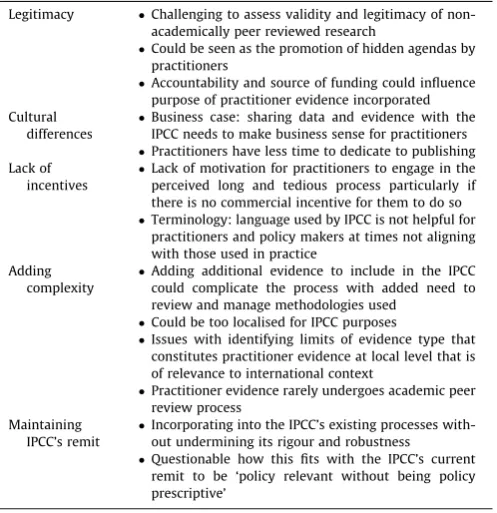
[image:6.595.37.286.498.755.2]These recommendations present their own challenges, particu-larly where objectivity, purpose and legitimacy are concerned. At each of the workshops, discussions raised concerns of the impact that incorporating more practitioner-based evidence would have on the perceived legitimacy of the IPCC more generally (Table 4) – several questioned if it would be in danger of losing the academic rigour that gives it its current high level of credibility and legiti-macy (Workshop 2). The reason for this could be that practitioner input may be tainted by hidden agendas and create conflicts of interests, such as commercial interests associated with some of Table 4
Challenges with incorporating more practitioner evidence in the IPCC.
Legitimacy Challenging to assess validity and legitimacy of non-academically peer reviewed research
Could be seen as the promotion of hidden agendas by practitioners
Accountability and source of funding could influence purpose of practitioner evidence incorporated Cultural
differences
Business case: sharing data and evidence with the IPCC needs to make business sense for practitioners
Practitioners have less time to dedicate to publishing Lack of
incentives
Lack of motivation for practitioners to engage in the perceived long and tedious process particularly if there is no commercial incentive for them to do so
Terminology: language used by IPCC is not helpful for practitioners and policy makers at times not aligning with those used in practice
Adding complexity
Adding additional evidence to include in the IPCC could complicate the process with added need to review and manage methodologies used
Could be too localised for IPCC purposes
Issues with identifying limits of evidence type that constitutes practitioner evidence at local level that is of relevance to international context
Practitioner evidence rarely undergoes academic peer review process
Maintaining IPCC’s remit
Incorporating into the IPCC’s existing processes with-out undermining its rigour and robustness
Questionable how this fits with the IPCC’s current remit to be ‘policy relevant without being policy prescriptive’
the practitioners taking part in the process. This is currently addressed under the IPCC’s Conflict of Interest (CoI) Policy (IPCC, 2011), whose purpose it is to ‘‘protect the legitimacy, integrity, trust and credibility of the IPCC” (p4). However increased input from non-academic contributors could enable a refinement and tightening of the CoI procedures to better reflect the evolving nature of the con-cerns raised and therefore benefit the process as a whole.
In addition, the risk of subjectivity in practitioner-based evi-dence in comparison to the academic peer review process was raised in the workshops. Whilst both practitioners and academics have their own rigorous processes, objectivity remains a concern. A remedy for this was through the recommendation that the IPCC produce a transparent and clear set of criteria for the practitioner-based evidence to follow, ensuring that high standards are main-tained and, while not comparable, at least understood in both aca-demic and practitioner evidence (Workshop 2). The details of how this would be designed, implemented and evaluated would need to be carefully co-constructed by the IPCC, scientists and non-academics and could either be a formal process (as described in recommendation 3) or a practitioner led editorial college which would form the basis for peer review for their reports.
Despite the concerns raised around the usefulness of the IPCC WGII report in terms of scale, the recommendations that emerged from workshop discussions were further explored by participants who argued that it was not within the IPCC’s remit to focus on the local level (even though local case studies are used) and that instead the IPCC’s role was to inform national decision makers (Workshop 1, Group 3). Several participants, particularly practi-tioners, also discussed how costly this could become potentially leading to an a ‘‘bureaucratic nightmare” (Workshop 1, Group 2) if IPCC scientists were required to work with practitioners for gather-ing, organising and synthesising data into an IPCC-approved for-mat. A process of co-production however would present a viable solution to address this by inviting different experts with specialist knowledge to contribute in numerous ways earlier on in the pro-cess. It was felt, particularly by academics, that in order for co-production to adequately capture local scales, the process would require the participation of social scientists. These would provide expertise and insights into cultural impacts and implications for climate change, along with an understanding of the likelihood of people adopting different adaptation strategies. Therefore, by using a process of co-production (Viner and Howarth, 2014), in which all relevant stakeholders and disciplines are invited to share knowledge with one another, the IPCC would be able to benefit from existing knowledge.
6. Conclusions
This research has explored how the IPCC’s processes can evolve to ensure it is fit for purpose to inform specific responses to climate change required to adapt to current and future challenges. The findings discussed in this paper have highlighted the value that the IPCC brings in informing the evidence base on climate change and the benefits of incorporating practitioner based evidence in the process.
Practitioners have both a local and global presence and work on a range of projects in all sectors across developed and developing nations. In addition, practitioners have experience of working with and delivering projects on adaptation within timescales better aligned with current decision-making processes (particularly in comparison with academic time scales).
By incorporating practitioner based evidence in the IPCC pro-cess, the produced outputs (e.g. Assessment Reports, Special Reports etc.) could more accurately reflect the evidence base on cli-mate adaptation on the ground and simultaneously increase the
use of these outputs by a broader audience. Article 7 of the UNFCCC Paris Agreement describes the need for ‘‘cooperation to enhance adaptation” and states that UN agencies (i.e. the IPCC) ‘‘support the efforts of Parties to implement the actions”. This type of broader cooperation was alluded to by the new Chair of the IPCC, who indicated that there should be a more diverse range of con-tributors to the process.
Acknowledgements
The research for this paper was financially supported by the ESRC Centre for Climate Change Economics and Policy (CCCEP). We thank Mott MacDonald for further supporting this work through providing in kind contribution and for providing rooms in which to conduct the workshops detailed in this paper. We would like to extend our thanks to the two anonymous reviewers.
References
Beck, S., 2010. Moving beyond the linear model of expertise? IPCC and the test of adaptation. Reg. Environ. Change 11 (2), 297–306.
CCC, 2014. UK Climate Change Risk Assessment Evidence Report 2016. Frequently Asked Questions. Available online at https://documents.theccc.org.uk/wp-content/uploads/2014/02/CCRA-FAQ.pdf.
DECC, 2013. Future of the IPCC – UK Government Response to IPCC. Published 25 June 2013. Last accessed 21 June 2015. Available online:https://www.gov. uk/government/uploads/system/uploads/attachment_data/file/210342/Future_ of_IPCC_-_UK_response_25_June_2013.pdf.
Hjerpe, M., Nasiritousi, N., 2015. Views on alternative forums for effectively tackling climate change. Nature Climate Change. http://dx.doi.org/10.1038/ nlcimate2684. Advance online publication.
HM Government/PROVIA, 2014. CLICC. Country Level Impacts of Climate Change. Available online athttp://www.unep.org/provia/Portals/24128/CLICC_Project_ Outline.pdf. Last accessed 22 June 2015.
House of Commons Energy and Climate Change Committee, 2014. Intergovernmental Panel on Climate Change Fifth Assessment Report: view of Working Group 1 contribution.London: The Stationery Office. Last Accessed 21 June 2015. Available online: http://www.publications.parliament.uk/pa/ cm201415/cmselect/cmenergy/587/587.pdf.
Howarth, C., Painter, J., 2016. The IPCC and local decision making on climate change: a robust science-policy interface? Palgrave Commun. 2, 16058.http://dx.doi. org/10.1057/palcomms.2016.58.
Howarth, C., Viner, D., 2015. The Role of Practitioner-Based Evidence in the IPCC Process Internal report to funder. Global Sustainability Institute.
InterAcademy Council, 2010. Climate Change Assessments: Review of the Processes and Procedures of the IPCC. InterAcademy Council, October 2010. Accessed 1 September 2015, available online at: http://reviewipcc.interacademycouncil. net/reportnewsrelease.html.
IPCC, 1999. Appendix A to the Principles Governing IPCC Work. Updated October 2013. Accessed 21 June 2015, available on line: http://www.ipcc.ch/pdf/ipcc-principles/ipcc-principles-appendix-a-final.pdf.
IPCC, 2011. IPCC Conflict of Interest Policy. Decisions Taken in Respect to the Review of IPCC Processes and Procedures. Last accessed 15 January 2015, available online at https://www.ipcc.ch/pdf/ipcc-principles/ipcc-conflict-of-interest_ decision.pdf.
IPCC, 2012. Taskforce on National Greenhouse Gas Inventories (TFI) . Last accessed 15 November 2015, available online athttp://www.ipcc-nggip.iges.or.jp/org/ ipcc_tfi_leaflet.pdf.
IPCC, 2013. Principles governing IPCC work. Approved at the Fourteenth Session, updated at the Thirty-Seventh session, October 2013. Available online at
https://www.ipcc.ch/pdf/ipcc-principles/ipcc-principles.pdf.
IPCC Secretariat, 2015. IPCC takes decisions on future work. Press Release 27 February 2015. Accessed 2 March 2015, available online:http://www.ipcc.ch/ news_and_events/docs/p41/P41_closing_press_release.pdf.
Jasanoff, S., Wynne, B., 1998. Science and Decision making. In: Rayner, S., Malone., E. L. (Eds.), Human Choice and Climate Change. Batelle Press, Columbus, OH, pp. 1–87.
King, D., Schrag, D., Zhou, D., Ye, Q., Ghosh, A., 2015. Climate Change: A Risk Assessment. Report commissioned by the Foreign and Commonwealth Office, available online at http://www.csap.cam.ac.uk/media/uploads/files/1/climate-change–a-risk-assessment-v9-spreads.pdf.
Rapley, C., de Meyer, K., Carney, J., Howarth, C., Clarke, R., Smith, N., Stilgoe, J., Youngs, S., 2014. Time for a change? Climate Science Reconsidered. The Report of the UCL Policy Commission on Communicating Climate Science.
Ryghaug, M., Solli, J., 2012. The appropriation of the climate change problem among road managers: fighting in the trenches of the real world. Climatic Change 114 (3–4), 427–440.
Sakai, P., Dessai, S., 2015. Can resilience framing enable adaptation to a changing climate. Insights from the UK water sector. SRI Paper No. 88, CCCEP Paper No.
228. Available online at http://www.see.leeds.ac.uk/fileadmin/Documents/ research/sri/workingpapers/SRIPs-88.pdf.
Sanderson, H., Hilden, M., Russel, D., Dessai, S., 2015. Database support for adaptation to climate change: an assessment of web-based portals across scales. Integr. Environ. Assess. Manage.http://dx.doi.org/10.1002/ieam.1755. Schiermeier, Q., Tollefson, J., 2015. Four challenges facing newly elected climate
chief. Nature.http://dx.doi.org/10.1038/nature.2015.18492.
UNEP, 2013a. Research Priorities on Vulnerability, Impacts and Adaptation. Responding to the Climate Change Challenge. Last accessed 22 June 2015. Available online: http://www.unep.org/provia/Portals/24128/ PROVIAResearchPriorities.pdf.
UNEP, 2013b. PROVIA Guidance on Assessing Vulnerability, Impacts and Adaptation to Climate Change. Last accessed 22 June 2015. Available online:http://www. unep.org/provia/Portals/24128/PROVIA_guidance_report_low_resolution.pdf.
UNFCCC, 2011. Report of the Conference of the Parties on its sixteenth session, held in Cancun from 29 November to 10 December 2010. Addendum. Part two: Action taken by the Conference of the Parties at its Sixteenth Session. Decision 17/CP19. Last accessed 21 June 2015. Available online: http://unfccc. int/documentation/documents/advanced_search/items/6911.php?priref= 600006173.
UNFCCC, 2013. Report of the Conference of the Parties on its nineteenth session, held in Warsaw from 11 to 23 November 2013. Addendum. Part two: Action taken by the Conference of the Parties at its nineteenth session. Last accessed 22 June 2015. Available online: http://unfccc.int/documentation/documents/ advanced_search/items/6911.php?priref=600008086.
Viner, D., Howarth, C., 2014. Practitioner’s work and evidence in IPCC reports. Nat. Clim. Change 4.