Chemistry &
Engineering
COMMUNICATION
Cite this:React. Chem. Eng., 2017,2,
103
Received 26th May 2016, Accepted 23rd September 2016
DOI: 10.1039/c6re00109b
rsc.li/reaction-engineering
Rapid multistep kinetic model generation from
transient flow data
†
Christopher A. Hone,
aNicholas Holmes,
aGeoffrey R. Akien,
abRichard A. Bourne*
aand Frans L. Muller*
aToday, the generation of kinetic models is still seen as a resource intensive and specialised activity. We report an efficient method of generating reaction profiles from transient flows using a state-of-the-art continuous-flow platform. Experimental data for multistep aromatic nucleophilic substitution reactions are collected from an automated linear gradient flow ramp with online HPLC at the reac-tor outlet. Using this approach, we generated 16 profiles, at 3 dif-ferent inlet concentrations and 4 temperatures, in less than 3 hours run time. The kinetic parameters, 4 rate constants and 4 ac-tivation energies were fitted with less than 4% uncertainty. We de-rived an expression for the error in the observed rate constants due to dispersion and showed that such error is 5% or lower. The large range of operational conditions prevented the need to isolate individual reaction steps. Our approach enables early identification of the sensitivity of product quality to parameter changes and early use of unit operation models to identify optimal process-equipment combinationsin silico, greatly reducing scale up risks.
Over the past decade flow technologies have become established for the discovery and manufacture of active pharmaceutical ingredients.1,2A plethora of synthetic organic methods have been developed using flow reactors.3,4However the development of new strategies that give fundamental understanding of complex reaction systems using flow reactors has not received as much attention.5,6 In this communication, we demonstrate the rapid collection of experimental data using an automated flow reactor for the generation of kinetic models.
Reaction profiling for reaction kinetics is easily achieved under batch conditions due to the ability to collect multiple time points within a single experiment, often with only
milli-grams of material used.7 Flow reactors give precise control over the reaction parameters. The key benefit of flow is that the system reaches steady-state thus providing a consistent output quality. There are many examples of kinetic investiga-tions in small-scale flow systems.8 For instance Reizman
et al. used steady state flow measurements to fit four rate constants and four activation energies from a small number of flow profiles.9The authors concluded that high confidence parameter estimates require isolation of the individual path-ways by measurements starting from each intermediate.
Kinetic profiling in flow systems suffers from three signifi-cant issues: (i) signifisignifi-cant time is required to get to steady state; (ii) flow experiments require unnecessary material us-age, approx. 1.5 reactor volumes per measurement, due to the transient period prior to reaching steady-state,10and (iii) dispersion in flow systems can influence the outlet concen-tration resulting in errors in the derived rate constants. In this paper we address these three issues by use of online measurements in a system with transient flow.
Several authors have generated kinetic data based on tran-sient flows. Mozharovet al.applied a step change in flow rate to study a Knoevenagel condensation reaction using inline non-invasive Raman spectroscopy.11 The response analysis was hindered by convolution of the step change by ‘real sys-tem’response times, and the approach is infeasible for analy-sis techniques with longer acquisition times, such as HPLC and GC. Moore et al.studied a Paal–Knorr pyrrole synthesis using an exponential flow ramp with online infrared spectro-scopy.12 The effect of residence time and temperature were investigated, at constant inlet concentrations. The experimen-tal data were successfully fitted to a priori rate expressions. Schaber et al. extended the approach in terms of model discrimination.13
This communication demonstrates a fully automated ap-proach for collecting experimental data for kinetic model gen-eration using transient flow data. The approach is illustrated using a nucleophilic aromatic substitution (SNAr) of
2,4-difluoronitrobenzene1with pyrrolidine2in ethanol to give a
aInstitute of Process Research and Development, School of Chemistry and School
of Chemical and Process Engineering, University of Leeds, LS2 9JT, UK. E-mail: [email protected], [email protected]
bDepartment of Chemistry, Lancaster University, Lancaster, LA1 4YB, UK
†Electronic supplementary information (ESI) available. See DOI: 10.1039/ c6re00109b
Open Access Article. Published on 03 October 2016. Downloaded on 18/07/2017 15:45:11.
This article is licensed under a
Creative Commons Attribution 3.0 Unported Licence.
View Article Online
mixture: desired productortho-substituted3,para-substituted
4andbis-adduct5as side products (Scheme 1).
In this study an automated mesoscale flow reactor system (5 mL reactor volume, 0.79 mm internal diameter, 1.58 mm outer diameter) with online HPLC, see Fig. 1, was used. A lin-ear gradient flow ramp, see Fig. 2, which allows for investi-gating a complete reaction profile from a single transient ex-periment was developed. A transient profile measurement starts by setting the maximum flow for all pumps. The flow rate ratio of P3 (pyrrolidine in EtOH) and P2 (EtOH) is varied at the beginning of each ramp to obtain different molar equivalents (1.5, 4 and 7) of pyrrolidine 2. As a sudden in-crease in flow rate produces unstable flow, pump flow rates were kept constant long enough to establish steady-state. Subsequently the flow rate,Q, is slowed at a constant rate,α (0.836 mL s−2), so as to increase the residence time (τres) over timet, whilst maintaining constant inlet concentrations. Re-actor effluent is injected into the HPLC at 2 min time inter-vals. The pump flow ramps, reactor temperature and sample loop injection were automatically controlled by a MATLAB based computer program. Rather than isolate the individual pathways we extended the range of reaction conditions so as to over- and under-react significantly. Application of the full operational range allowed by the equipment e.g. from the mildest (e.g. dilute, low temperature) to the harshest (e.g.
concentrated, high reagent to substrate ratios, high tempera-ture) results in higher concentrations of intermediates and by-products. This represents a richer dataset that increases the confidence in parameters of the fitted kinetic motifs.14 Hessel et al. introduced the concept of novel process win-dows (high temperature, high pressure and high concentra-tion) for accessing conditions in flow which are not typically accessed in conventional practice for organic synthesis in batch.15Thus linear gradient flow ramps (Fig. 2) were devel-oped to explore from the mildest (2= 1.5 mol eq., = 0.5 min andT= 30°C) to the harshest conditions (2= 7 mol eq., = 2 min and T = 120 °C). Residence time points less than 0.5 min were not collected as transient effects dominate.16 The approach focuses on using reaction conditions that maximise the confidence in the kinetic parameter estimates.
The transformation of the data is shown in Fig. 3. For a linear flow ramp the velocity in the coil is described by:
u(t) =β(T)(uo−αt) (1)
whereuo is the initial velocity,α the rate of change andβ(T) = 1 + αv(T1−T0) is the correction for the thermal expansion of EtOH due to the temperature rise from ambient to the re-actor temperature. A fluid element leaving the coil at time t
will have travelled the length of the tube (L) and resided a to-tal timeτresso:
(2)
Integration leads to a second order equation from which the residence time τres of a sample taken at time t can be worked out as:
Scheme 1 SNAr reaction of 2,4-difluoronitrobenzene 1 with
pyrrolidine2.
Fig. 1 Automated continuous-flow reactor system equipped with software for controlled flow ramps. The reactor comprises of three Jasco PU-980 dual piston HPLC pumps which feed into Swagelok tee-pieces for mixing. A polar bear flow synthesiser (Cambridge Reactor Design, UK) was used for heating and cooling PTFE reactor tubing (5 mL internal volume, 0.79 mm internal diameter). A VICI Valco internal sample injector (SL) extracted aliquots of neat reaction for HPLC analy-sis. The composition of the reactor outlet was determined by online HPLC. Pressure control was achieved with a back-pressure regulator at the outlet of the system. The internal reactor temperature was mea-sured by a thermocouple inserted into the centre of the reactor.
Fig. 2 Changes in volumetric flow rate over time, whereQP1,QP2,QP3
and Qtotal were for pump 1 (Ar in EtOH), pump 2 (EtOH),
pump 3 (pyrrolidine in EtOH), total volumetric flow rate, and◆ HPLC injection respectively. The linear flow ramps correspond to pyrrolidine2to 2,4-difluoronitrobenzene1molar ratios: (i) 1.5 : 1, (ii) 4 : 1 and (iii) 7 : 1 usingQtotalfrom 10 to 1.5 mL min−1.
Open Access Article. Published on 03 October 2016. Downloaded on 18/07/2017 15:45:11.
This article is licensed under a
[image:2.595.314.544.46.159.2] [image:2.595.309.550.482.654.2](3)
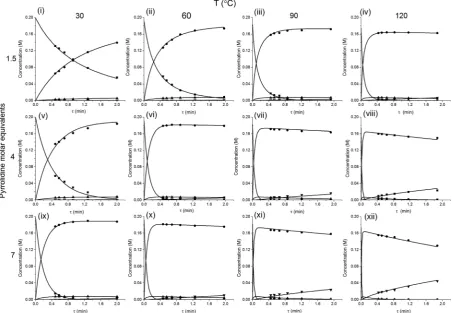
The method was applied to generate a series of concentration-time profiles at four temperature levels (30, 60, 90 and 120 °C) giving a total of 12 profiles (Fig. 5). The 72 data points shown in Fig. 5 were collected in less than 3 hours collection time. The reaction conditions were selected to give a wide range of conversions values for the different re-action components.
The data were then fitted to the kinetic scheme shown in Scheme 1, with different orders assessed with respect to the aromatic components and pyrrolidine (see ESI†). The kinetic motif in which all steps are second order gave the best fit. The rate constants were initially fitted at isothermal condi-tions (90 °C) using the Levenburg–Marquardt algorithm, a non-linear least squares algorithm, in DynoChem software (Scale-up Systems). Subsequently all the experimental data (72 data points) were simultaneously fitted to give all the ki-netic parameters (Table 1). The kiki-netic model very closely corresponded to the experimental data, with R2 = 0.9995 (Fig. 4). The rate constant k1 for ortho-3 is 20 times larger thank2 of thepara-4 product formation and their activation
energies are 33.3 ± 0.3 kJ mol−1 and 35.3 ± 0.5 kJ mol−1 re-spectively; thus temperature influences the rate, but not se-lectivity. Parameter uncertainties were all less than 4%. Even the rate parameters for the overreaction pathways identified with minimal uncertainty. Unsteady-state results were com-pared to results at steady-state, the two methods gave statisti-cally similar results to data collected at steady-state condi-tions (ESI†). More aggressive conditions e.g. high molar equivalents of pyrrolidine and high temperature result in ele-vated formation of the bis adduct5product to whichk3and
k4were fitted with high confidence, thus preventing the need to synthesise and isolate each reaction component. Our ap-proach offers significant time savings and minimises mate-rial consumption compared to a steady-state approach, ad-dressing shortcomings (i) time required to reached steady-state for each measurement and (ii) material wastage reaching steady-state. Further material savings could be made using a flow system with a small internal volume, such as on a microliter scale as reported by McMullenet al.17
Limitation (iii) concerned the influence of dispersion on the measured rate constants. If the coil reactor is described by a plug flow model the conversion for a first order reaction is:
(4)
It is well established that dispersion can have a significant effect on the progress of a reaction.18In the 1950s Taylor de-scribed dispersion in of a solute a straight pipe with laminar parabolic flow and this was modified by Aris,19,20to give:
Fig. 3 i) Total volumetric flow rate (Qtotal) change throughout the
duration of a ramp, ♦ HPLC injection; (ii) residence time, τ, as a function of operation time, t; (iii) resulting concentration-residence time profile generated from a typical multi-step reaction scenario,■ 2,4-DF1,●ortho-3,●para-4,▼bis-5.
Fig. 4 The dispersion ratio κ vs. DeSc0.5 for various literature data.
Where possible data have or correlations have been taken from the papers. If the data could not be retrieved and no correlation was given the data has been fitted with a line that visually represents the data well.
Open Access Article. Published on 03 October 2016. Downloaded on 18/07/2017 15:45:11.
This article is licensed under a
[image:3.595.314.548.45.277.2] [image:3.595.66.262.47.334.2](5)
WithDSthe dispersion coefficient,Dmthe diffusion
coeffi-cient, dt the tube diameter and u the mean velocity in the
tube. In liquid systems the termDmis negligible, andκ
repre-sents the ratio of dispersion in a conduit to dispersion in a straight tube with similar diameter; for a straight cylindrical tube under laminar flowκ = 1. The dispersion ratio κ is de-pendent on the channel geometry and the flow regime (e.g.
laminar or turbulent). Laminar flow in coiled tubes deviates from the parabolic velocity profile as a result from centrifugal forces. So called Dean vortices form which introduce radial flow that reduces dispersion. The intensity of the radial flow is characterised by the Dean number:
(6)
Re is the Reynolds number (ρudt/μ) anddcthe coil diame-ter (0.79 mm in our case). In the 1970s dispersion in coils un-der laminar conditions was studied experimentally in the group of Vasudeva in wide bore tube (4.4–20 mm),21–23and by Van den Berg and Kockmann in 0.5 and 1 mm ID tubes.24,25They found that the dispersion ratioκreduces sig-nificantly below 1 (Fig. 4). Theoretical work by Janssen and later by Johnson showed dispersion ratio in coils may be cor-related by DeSc0.5, where the Schmidt number (Sc) is defined as μ/ρDm.26,27 In the 1960s the effect of dispersion was coupled to a reaction system by Wehner28 to give a general equation for the effect of dispersion on the conversion of a solute due to a first order reaction with rate constantk:
(7)
In which dispersion is characterised with the dimension-less Péclet number Pe = D/uL. Eqn (7) can be simplified for
[image:4.595.72.526.46.359.2]Fig. 5 Concentration-time profiles from simultaneous parameter fitting, points = experiments■2,4-DF1,●ortho-3,●para-4,▼bis-5, lines = model using Table 1 kinetic parameter estimates (i–xii).
Table 1 Kinetic parameter estimates and standard errors (SE) from the fitting based on 95% confidence level. Rate constants,k, are given atTref
= 90°C
k± SE (10−2M−1s−1) Ea± SE (kJ mol−1)
Step 1 57.9 ± 0.7 33.3 ± 0.3
Step 2 2.70 ± 0.06 35.3 ± 0.5
Step 3 0.865 ± 0.004 38.9 ± 1.5
Step 4 1.63 ± 0.11 44.8 ± 1.8
Open Access Article. Published on 03 October 2016. Downloaded on 18/07/2017 15:45:11.
This article is licensed under a
[image:4.595.43.289.661.725.2]values of Pe<0.05 by applying a second order Taylor series expansion fora:
a≈1 + 2kτresPe−2(kτresPe)2 (8)
wherekτresPe = kD/u2 is assumed to be small, therefore the dispersion is small and peaks remain symmetrical. Combin-ing eqn (5) and (7), and the observation that (i) in liquid sys-tems the termDmbecomes negligible compared toDsand (ii)
τres=L/u, it follows that:
(9)
This shows that in a coil the observed rate constantkobs
may be given as:
(10)
where the Damköhler number for radial diffusion may be de-fined as Dar=kdt2/Dm. The deviationεDCin the observed rate
constantkobsobtained from the profiles measured in contin-uous flow in a coil with respect to the true rate constant k
will be:
(11)
Eqn (11) shows the kinetic constants will always be underestimated if dispersion is significant. The above result shows that for a tube with 1 mm internal diameter and a typ-ical value forDm= 0.8×10⁻⁹m2s−1in EtOH (ref. 29) the re-duction in rate constant isεDC≈ −500%κk. For instance, Du-rant measured the rate constant for the thermolysis of 1,3-dioxin-4-ones to be<0.015 s−1in a 1 mm ID coil at DeSc0.5= 13.8, 138 and 1380.30This corresponds to a deviation εDC ≤ −5.6%,−1.5%, 0.38% respectively (κfrom Fig. 4), which corre-sponds well to their observation of a negligible effect of dis-persion. In a 1 mm coil system withκ <0.1 rates as fast as 0.1 s−1 can be measured accurately. Smaller tube diameters will reduce the error, asκDarreduces.
To assess the impact of dispersion on the second order rate constants for conversion of 2,4-difluoronitrobenzene1, at a particular excess of pyrrolidine the first order rate constant
kmay be approximated by:
k≈(k1+k2)C2,0 (12)
In our system we measured anFcurve at 6 min residence time giving Dar = 788 and DeSc0.5 = 65 (ESI†). This resulted
in a dispersion ratio ofκ= 0.31 which corresponds well with the data from Van den Berg.24 Using the correlation from Van den Berg forκin coiled tubes we estimate that for the ex-perimental conditions used to generate the data on which
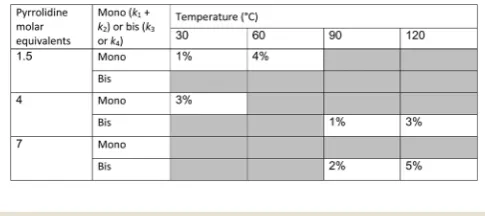
Table 1 is based κ, is in the range of 0.05 to 0.15 (Fig. 4). Using eqn (11) the extent to whichk1+k2is underestimated can be evaluated for profiles where the starting material concentration deviates significantly from zero e.g. plots i, ii and v for 1in Fig. 5 (for the profiles where the reactant has fully converted or no stating material is available at all resi-dence times no sensible estimate dispersion effect on kcan be made). To be conservative we assumed a value of κ = 0.15 for all errors in Table 2. The unshaded cells represent profiles with significant concentrations of reacting compo-nents. The fitted motif is thus fit for purpose with respect to evaluate parameter sensitivity, alternate unit operations and scale-up.
Conclusions
[image:5.595.307.550.98.206.2]An automated continuous-flow platform with quantifiable online analysis has been developed as an enabling tool for the rapid and economic collection of kinetic profiles. In less than 3 hours, 12 reaction profiles were collected; sufficient to fit a kinetic motif consisting of 4 reactions, 8 fitting pa-rameters, with less than 4% uncertainty. Furthermore, it has been demonstrated that the effect of dispersion in these sys-tem results in an underestimation of the rate constants by 5% or less. The efficiency of the linear flow ramp is reduced if the product analysis takes a long time, however; with re-cent advances in analytical techniques, e.g. UPLC and FlowIR many reaction systems can be analysed successfully within seconds to minute timescales. Data collected from transient flow profiles gave statistically similar results to data collected at steady-state further validating the flow ramp approach. The combination of a linear gradient flow ramp and extreme conditions far away from the preferred operating point, easily accessed in continuous-flow reactors, enables rapid data generation with a quality suitable for fitting parameters of multistep kinetic motifs. Our approach allows kinetic models to be generated much earlier in pro-cess development, allowing early estimation of the sensitiv-ity of product qualsensitiv-ity to input parameter changes. The model can be applied in silico to simulate alternative optimisation
Table 2 Estimated predicted % effect in rate constantsk1+k2andk3+ k4from dispersion. The cells highlighted in grey show where the
devia-tion in concentradevia-tion is too low to significantly affect the fitting of the rate constants
Open Access Article. Published on 03 October 2016. Downloaded on 18/07/2017 15:45:11.
This article is licensed under a
scenarios, equipment configurations, and to achieve signifi-cant reductions in scale up risks and costs.
Acknowledgements
The authors gratefully acknowledge the generous support by AstraZeneca, EPSRC DTG funding and the University of Leeds. RAB thanks the Royal Academy of Engineering for an Indus-trial Secondment at AstraZeneca.
References
1 A. Adamo, R. L. Beingessner, M. Behnam, J. Chen, T. F. Jamison, K. F. Jensen, J.-C. M. Monbaiu, A. S. Myerson, E. Revalor, D. R. Snead, T. Stelzer, N. Weeranoppanant, S. Y. Wong and P. Zhang,Science, 2016,352, 61–67.
2 B. Gutmann, D. Cantillo and C. O. Kappe,Angew. Chem., Int. Ed., 2015,54, 6688–6728.
3 L. Malet-Sanz and F. Susanne, J. Med. Chem., 2012, 55, 4062–4098.
4 N. G. Anderson,Org. Process Res. Dev., 2012,16, 852–869. 5 R. L. Hartman, J. P. McMullen and K. F. Jensen, Angew.
Chem., Int. Ed., 2011,50, 7502–7519.
6 P. Poechlauer, J. Colberg, E. Fisher, M. Jansen, M. D. Johnson, S. G. Koenig, M. Lawler, T. Laporte, J. Manley, B. Martin and A. O'Kearney-McMullan, Org. Process Res. Dev., 2013,17, 1472–1478.
7 D. G. Blackmond, Angew. Chem., Int. Ed., 2005, 44, 4302–4320.
8 For selected kinetic examples see; (a) J. Weon, Z. Horváth, A. G. O'Brien, P. H. Seeberger and A. Seidel-Morgenstern,
Chem. Eng. J., 2014,251, 355–370; (b) D. M. Roberge, C. Noti, E. Erle, M. Eyholzer, B. Rittiner, G. Penn, G. Sedelmeier and B. Schenkel,J. Flow Chem., 2014,4, 26–34; (c) H. Song and R. F. Ismagilov, J. Am. Chem. Soc., 2003,125, 14613–14619; (d) A. Gholamipour-Shirazi and C. Rolando,Org. Process Res. Dev., 2012,16, 811–818.
9 B. J. Reizman and K. F. Jensen, Org. Process Res. Dev., 2012,16, 1770–1782.
10 F. E. Valera, M. Quaranta, A. Moran, J. Blacker, A. Armstrong, J. T. Cabral and D. G. Blackmond,Angew. Chem., Int. Ed., 2010,49, 2478–2485.
11 S. Mozharov, A. Nordon, D. Littlejohn, C. Wiles, P. Watts, P. Dallin and J. M. Girkin, J. Am. Chem. Soc., 2011, 133, 3601–3608.
12 J. S. Moore and K. F. Jensen, Angew. Chem., Int. Ed., 2014,53, 470–473.
13 S. D. Schaber, S. C. Born, K. F. Jensen and P. I. Barton,Org. Process Res. Dev., 2014,18, 1461–1467.
14 G. E. P. Box and W. G. Hunter, Technometrics, 1965, 7, 23–42.
15 V. Hessel, D. Kralisch, N. Kockmann, T. Noël and Q. Wang,
ChemSusChem, 2013,6, 746–789.
16 K. B. Nagy, B. Shen, T. F. Jamison and K. F. Jensen, Org. Process Res. Dev., 2012,16, 976–981.
17 J. P. McMullen and K. F. Jensen, Annu. Rev. Anal. Chem., 2010,3, 19–42.
18 C. B. Rosas,Ind. Eng. Chem. Fundam., 1969,8, 361–364. 19 G. Taylor, Proc. R. Soc. London, Ser. A, 1953, 219,
186–203.
20 R. Aris,Proc. R. Soc. London, Ser. A, 1956,235, 67–77. 21 R. N. Trivedi and K. Vasudeva, Chem. Eng. Sci., 1975, 30,
317–325.
22 K. D. P. Nigam and K. Vasudeva,Chem. Eng. Sci., 1976,31, 835–837.
23 V. D. Shetty and K. Vasudeva, Chem. Eng. Sci., 1977, 32, 782–783.
24 J. H. Van den Berg and R. S. Deelder, Chem. Eng. Sci., 1979,34, 1345–1347.
25 M. G. Gelhausen, S. K. Kurt and N. Kockmann,Mixing and Heat Transfer in Helical Capillary Flow Reactors With Alternating Bends, 12th International Conference on Nanochannels, Microchannels and Minichannels, Chicago, Illinois, USA, 2014.
26 L. A. M. Janssen,Chem. Eng. Sci., 1976,31, 215–218.
27 M. Johnson and R. D. Kamm, J. Fluid Mech., 1986, 172, 329–345.
28 J. F. Wehner and R. H. Wilhelm, Chem. Eng. Sci., 1956, 6, 89–93.
29 E. E. Hills, M. H. Abraham, A. Hersey and C. D. Bevan,Fluid Phase Equilib., 2011,303, 45–55.
30 T. Durand, C. Henry, D. Bolien, D. C. Harrowven, S. Bloodworth, X. Franck and R. J. Whitby,React. Chem. Eng., 2016,1, 82–89.
Open Access Article. Published on 03 October 2016. Downloaded on 18/07/2017 15:45:11.
This article is licensed under a