This is a repository copy of Adapting Cognitive Task Analysis to Elicit the Skill Chain of a
Game.
White Rose Research Online URL for this paper:
http://eprints.whiterose.ac.uk/120653/
Version: Accepted Version
Proceedings Paper:
Horn, Britton, Cooper, Seth and Deterding, Christoph Sebastian
orcid.org/0000-0003-0033-2104 (2017) Adapting Cognitive Task Analysis to Elicit the Skill
Chain of a Game. In: CHI PLAY'17. The ACM SIGCHI Annual Symposium on
Computer-Human Interaction in Play, 15-18 Oct 2017, Parkhuis de Zwijger. Association for
Computing Machinery (ACM) .
https://doi.org/10.1145/3116595.3116640
[email protected] https://eprints.whiterose.ac.uk/ Reuse
["licenses_typename_other" not defined]
Takedown
If you consider content in White Rose Research Online to be in breach of UK law, please notify us by
Adapting Cognitive Task Analysis
to Elicit the Skill Chain of a Game
Britton Horn
Northeastern University
Boston, Massachusetts
[email protected]
Seth Cooper
Northeastern University
Boston, Massachusetts
[email protected]
Sebastian Deterding
University of York
York, United Kingdom
[email protected]
ABSTRACT
Playing a game is a complex skill that comprises a set of more basic skills which map onto the component mechanics of the game. Basic skills and mechanics typically build and depend on each other in a nested learning hierarchy, which
game designers have modeled asskill chainsofskill atoms.
For players to optimally learn and enjoy a game, it should introduce skill atoms in the ideal sequence of this hierarchy or chain. However, game designers typically construct and use hypothetical skill chains based solely on design intent, theory, or personal observation, rather than empirical obser-vation of players. To address this need, this paper presents an adapted cognitive task analysis method for eliciting the empirical skill chain of a game. A case study illustrates and critically reflects the method. While effective in foregrounding overlooked low-level skills required by a game, its efficiency and generalizability remain to be proven.
ACM Classification Keywords
H.5.m Information interfaces and presentation: Miscellaneous; K.8.0 Personal Computing: General: Games
Author Keywords
cognitive task analysis; game atoms; learning hierarchy; skill atoms; skill chains
INTRODUCTION
Like cooking, driving, and many other everyday activities,
playing a video game is a complex skill [60].Complex skills
integrate a network of more basic skills. Driving, for in-stance, requires independently mastering braking, steering, and switching gears, but also integrating and fluently switch-ing between them [49]. These constituent basic skills hang
together in alearning hierarchy: the logical order in which
they build and depend on each other and therefore, in which they are ideally learned. For instance, we have to learn count-ing before we can learn addition and subtraction, and it is easier to learn these before multiplication [26, 4, 64]. Identi-fying the learning hierarchy of a to-be-taught complex skill
Permission to make digital or hard copies of all or part of this work for personal or classroom use is granted without fee provided that copies are not made or distributed for profit or commercial advantage and that copies bear this notice and the full citation on the first page. Copyrights for components of this work owned by others than the author(s) must be honored. Abstracting with credit is permitted. To copy otherwise, or republish, to post on servers or to redistribute to lists, requires prior specific permission and/or a fee. Request permissions [email protected].
CHI PLAY ’17, October 15–18, 2017, Amsterdam, Netherlands
©2017 Copyright is held by the owner/author(s). Publication rights licensed to ACM. ACM ISBN 978-1-4503-4898-0/17/10. . . $15.00
DOI:https://doi.org/10.1145/3116595.3116640
is therefore a key task of instructional design, as it directly informs what learning goals to pursue, what outcomes to as-sess, and what tasks and material to present in what order to optimally support learning [35].
We find the very same need in entertainment and serious game design. No matter if designers want to create good tutorials and level progressions for a game [48, 8]; balance level difficulty or procedurally generate levels to fit player skill [45]; create educational games whose mechanics train targeted capacities and assess whether they serve their intended outcomes [23]; or gamefully restructure everyday activities [21]–they are faced with the question what component skills a given game entails or ought to entail, and in what order the game should introduce these to players. If games are learning machines we enjoy to master [27, 42], it stands to reason they benefit from a well-designed sequence of learning.
Unsurprisingly, game design has developed a range of formal models that describe games as nested networks of mechanics, atoms, or core loops which each revolve around a specific action or skill [21]. One particularly popular model
devel-oped by Dan Cook describes games asskill chains, directed
graphs ofskill atomsor core loops that logically build on each
other – mirroring learning hierarchies in everything but name
[14]. Likewise, there are many design methods such as
Ra-tional Level Designfor prospectively deriving optimal level progression sequences from a given atom model [47, 48].
However, these models and methods provide little if any guid-ance how to reliably deduce the skill chain or learning hierar-chy of a given game. Models are either sketched as blueprints for a new game or based on a designer’s or researcher’s in-dividual reading of a game. This risks overlooking essential skills, not introducing them to players or introducing them in a suboptimal sequence. Scarcely any game research methods exist to empirically deduce the skill chain of a game from actual player experience, or assess to what extent the skills and ideal sequencing order predicted by a model matches the actual skills it requires from players, or their actual learning hierarchy.
identify-ing the learnidentify-ing hierarchies or skill chains of games. Although CTA techniques have existed for decades, to our knowledge, they haven’t been adopted in games research and design for this purpose. Hence, this paper develops, demonstrates, and critically reflects an adapted cognitive task analysis method for extracting the skill chain of a game from actual game-play. Akin to prior work on method development [36], we
conducted a case study in a mode of criticalreflective practice
[54], continually reflecting (and documenting observations and reflections) on our design process, emergent challenges and limitations to understand where modifications could improve future implementations.
The next section reviews existing work in games research related to modeling and identifying the component skills of games and introduces cognitive task analysis. We then lay out the rationale behind our adapted CTA method and provide a concrete procedure for following. Through our case study, using the method to identify the skill chain of the human
computation gameParadox, we illustrate the method in use
and reflect on emerging observations and challenges. We discuss the contribution and limitations of the presented work and derive ramifications for future research.
BACKGROUND
Formal Modeling of Games
Church [11] initiated contemporary work on “formal abstract design tools”: developing grammars and tools to describe, analyze, and design the structural components of a game (for recent reviews, see [2, 22]). Following Almeida and da Silva [2], one can roughly distinguish (a) broad models like the MDA framework [34], (b) collections of descriptive terms and patterns (e.g. [6]), (c) design guidelines such as playability heuristics [41], and (d) modeling languages and tools of the coremechanicsof a game, such as Machinations [22, 1]. Game mechanics describe the “core verbs” or “methods” by which players change the game state, such as moving, shooting, or
trading [56]. They form part ofgame atoms[43] orgame
loops[57]—feedback loops between player input (invoking a particular mechanic, e.g. shooting), rules processing (e.g. adjudicating whether the shot hit), and computer output. A game atom is the smallest indivisible functional unit of a game. However, games are usually composed of nested networks of interlinked atoms: In a cover shooter, the “shooting” atom is part of a larger “defeating enemies” atom, which also entails a “cover” atom and may connect to an “upgrading atom,” etc.
Skill Chains
As noted, game atom modeling is highly similar to model-ing the learnmodel-ing hierarchies of complex skills—both capture nested relations of basic to complex capacities, mechanics here, skills there—with one crucial difference: most game
atom models concern themselves with asynchronic overview
of thegameand how the outputs of one atom (e.g. in-game
resources like health or experience points) feed into others [2,
22]. They do not capture thediachronic sequencein which
players(ought to) acquire proficiency in each atom. The
ex-ception is theskill atom modelfirst articulated by Cook [14]
and since extended by Deterding [21]. It expressly models
���������������
������
����������
��������
���������
����������������������
��������������
������
����������
��������
���������
�������������������������������� ��������������������
���������������
������
����������
��������
���������
[image:3.612.347.539.73.312.2]���������������������� ���������������������������������
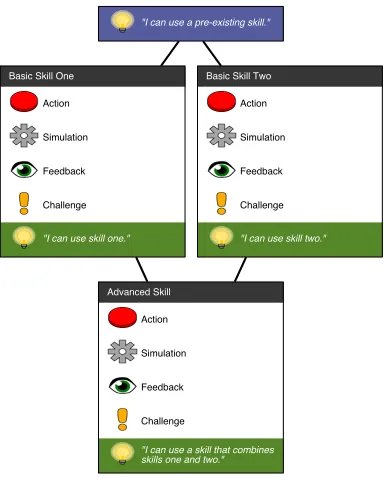
Figure 1. A sample example skill chain.
game mechanics and their relation from the perspective of player learning. A skill atom describes a game loop between player and game comprising five elements:
1. action: the player invoking a mechanic (e.g. shooting);
2. simulation: the game processing the action according to rules and changing its internal game state (adjudicating whether the shot hit, changing the location and health score of the hit enemy);
3. feedback: the game informing the player (displaying an animation of the hit enemy);
4. challenge: the parameters that make executing this particu-lar action differently easy or difficult; and
5. synthesis: the player incorporating the feedback, adjusting their mental model of the game state and improving the skill(s) required to master this particular atom (e.g. fast hand-eye coordination to aim and shoot).
Skill atoms exist in nestedskill chains: directed graphs of the
order in which skills build on each other and in which players necessarily or ideally acquire them [14]. For instance, a player
has to know how toequipa gun before learning how toaim
andshootwith it. Skill chains bottom out inpre-existing skills: capacities game designers can assume players already bring to the game. Most PC games assume that players know how to move and click a mouse, for instance. Figure 1 presents a simple skill chain of one pre-existing skill, two basic skills, and one advanced skill that builds on them. Figure 2 shows a
skill chain for the gameTetris.
��������������
�����������������
���������������
���������������������������������� ��������
���������������
���������������������������������������
�����������������������
�������������������������������������� �������������������
����
������������������������������
����������
������������������������� ����������������
�������������������������������� �������
�������������������
�������������������������������
���������
������������������������������������� ��������������
������������������
�����������������������
�������������������������������������
�����������������������
������������������������������������ ��������������������������������
���������������������������
������������������������������������ �������������
���������������������������
�������������������������������������� ��������������������������������
��������
������������������������������� ���������������������������������
�������
����������������
��������������������������������������
�������������
[image:4.612.68.551.70.294.2]����������������������������������
Figure 2. Skill chain forTetris, taken and simplified from Cook [14].
[23] used it to improve an educational physics game. They analyzed which physical concepts the game ought to teach and which concepts it actually incorporated as skill atoms. Redesigning the game to incorporate previously missing skill atoms led to statistically significant learning improvements. Deterding’s [21] method for gameful design similarly uses skill atoms to tease out the latent ’mini-games’ of existing real-life activities and then redesign these to make them more explicitly and enjoyably game-like.
While not using Cook’s [14] explicit articulation, Rational Level Design (RLD) [47, 48] has brought game atom analy-sis to broad use in entertainment games, chiefly for difficulty balancing. Following flow theory [17], RLD assumes that players have an optimal or “flow” experience when the diffi-culty of challenges presented matches player skill. As player skill grows over time, games have to increase difficulty in lockstep to avoid frustrating or boring players. This raises
the question how to systematically design thedifficulty curve
of a game—the rate at which it increases difficulty. To this end, RLD suggests to identify (a) the atoms of a given game and (b) the parameters which affect the challenge of each game atom. For instance, the difficulty of “shooting” may be affected by parameters like enemy distance and speed. De-signers should then craft a level sequence that systematically (a) introduces and involves new mechanics and (b) varies and increases the difficulty of the parameters of each atom. RLD essentially translates a synchronic map of game atoms into a recipe for diachronic level sequences. Yet crucially, RLD
is chiefly interested indifficultyas anaggregate effectof the
number of atoms involved and the configuration of their pa-rameters. Unlike skill chains, it doesn’t concern itself with logical or pragmatic dependencies—how skills build on each other.
Methods for Atom Identification
Either way, both skill chain mapping and RLD require means to elicit the actual skill atoms a game consists of. Cook [14], Echeverría [23] and Deterding [21] are notably silent about how they arrived at the skill atoms and chains they discuss. Where they mention the underlying process, it essentially bottoms out in "expert evaluation". This is a common issue of formal game analysis methods: most are some form of expert review whose content and quality hinge on the unvalidated and tacit expertise of the reviewer. Guidance only concerns the format of the presented result, not the review process, leading to low replicability [44]. RLD [47, 48] similarly provides no method how to initially identify the atoms of a game and its parameters. Only once designers prototype actual levels with hypothetical difficulty measures based on hypothesized atoms and parameters does RLD loop in playtesting to assess the
actualdifficulty of each level as a player fail rate. From there, RLD focuses on iteratively understanding and tweaking the impact of atom parameters (enemy speed and distance) on difficulty. No similar process is provided to identify the game atoms themselves.
Existing playtesting and game user research methods are like-wise of little help. No matter if based on player self-report, observation, psychophysiological measures, game telemetry, or a mixture thereof, they revolve around capturing constructs
of playerexperience(like flow or immersion) and how game
level and when the game required a new skill. This provides an aggregate measure of difficulty and a description of actual
sequence in which skills are introduced, but not thelearning
sequence in which these build on each other andshouldbe
introduced to players. The same holds for recent methods in serious or applied game design[50, 65] developed to identify the game and learning mechanics of a given game by providing reviewers with a codebook of predefined components to code for [3, 9]: they also capture the actual game design sequence, not the ideal learning sequence.
A final source of potential methods is recent work merging intelligent tutoring systems with educational games. Thus, Butler and colleagues [8] present a system for automatic game progression design for a game teaching fractions that mod-els the algorithm required to solve all possible basic fraction problems, generates a large number of game levels, assesses each level’s complexity on the number and kind of involved solution features (substrings of the total algorithm required to solve it), and serves players levels matching their measured mastery of solution features. While promising, this approach by definition only works for skills that are easily formalized into an algorithm, and offers no means of empirically identify-ing what atoms or skills a game entails and therefore needs to formalize. Harpstead and Aleven [29] use empirical learning curve analysis, a performance data analysis method from in-telligent tutoring systems, to evaluate how well hypothesized models of player skills predict player success in an educational game. While this method does help assess whether there are hidden, non-modeled skills, again, it provides no means to empirically develop initial models.
In summary, skill atom chains formally model the component mechanics and skills of a game and their logical dependencies. Thus, they lend themselves readily to map a game’s learn-ing hierarchy. Current game user research, applied gamlearn-ing, and intelligent tutoring research provide no reliable empirical method to identify the learning hierarchy or skill chain of a
given game – theactualskills a player needs to acquire to
master a game, and theidealorder in which they build on each
other. Existing methods are limited to either (a) charting the actual (not ideal) order in which a game introduces mechanics, (b) generating, testing, and optimizing level progression in terms of difficulty given an initial model, or (c) testing the statistical fit of a given model.
Cognitive Task Analysis
Faced with the same question – how to identify the skills involved in a domain – instructional design has developed a cluster of methods called Cognitive Task Analysis (CTA). CTA involves a variety of interview, observation, and modeling techniques to elicit and describe the knowledge and skills experts use to solve complex tasks [15]. CTA is the currently prevalent method for determining how people solve complex problems and for eliciting their learning hierarchies, forming the bedrock of any instructional design [35]. Recent systematic reviews suggest that basing instruction on CTA has strong positive effects on learning outcomes [62].
That said, there is no one single CTA. With over 100 CTA techniques available [15], choosing an appropriate method is
challenging. A review by Wei and Slavendy [63] distinguishes four families of CTA methods and derive guidelines when to
apply which: (1) more informalobservations and interviews
are advisable when the domain in question is very broad,
ill-defined, or ill-understood; (2) more rigorousprocess tracing
captures the actual steps and involved knowledge and skills of performing a given task through think-aloud or stimulated recall techniques, and is advised when exemplary tasks are
easily identified; (3)conceptual techniques generate
struc-tured representations of domain concepts and their relations and are used to either analyze and represent data collected through other techniques, or when the domain in question mainly involves conceptual knowledge; (4) computer
simula-tions testingformal modelsare used when task models already
exist and quantitative predictions or measures are required. Combining multiple techniques is generally recommended to reduce errors and improve validity; also, CTA is inherently iterative: data analysis and representation may prompt addi-tional, different data collection [15, 63, 13]. No matter what technique, CTA generally involves a five-step process [13]:
1. Collect preliminary knowledge to identify learning goals, tasks and subjects: The analyst familiarizes themselves with the domain and desired learning outcomes to identify tasks to analyze and experts to recruit through e.g. document analysis, observation, or initial interviews.
2. Identify knowledge types: The analyst determines what kind of knowledge and skills the given tasks comprise and there-fore, what specific elicitation, analysis and representation techniques are best suited (e.g., cooking a meal is a highly sequential task involving lots of tacit skills and knowledge around preparation techniques, suggesting close observa-tion and stimulated recall techniques and a flow chart as a representation).
3. Apply focused knowledge elicitation methods: The analyst uses the chosen techniques to elicit the knowledge and skills involved in the observed tasks. These typically involve some form of verbal report by the expert to surface covert cognitive processes.
4. Analyze and verify data: The analyst codes the generated data following the chosen method and produces initial rep-resentations of the involved skills and knowledge. Data and representations are cross-checked with the involved experts for potential errors and unclear points, and compared and contrasted between multiple elicitations to arrive at a final, integrated model.
5. Format results for intended application: The analyst pre-pares a formal presentation of the resulting model depend-ing on the intended purpose of the CTA.
ADAPTING CTA FOR SKILL CHAIN ELICITATION
an implicit learning hierarchy[14], and CTA is recommended specifically to analyze complex problem solving and its learn-ing hierarchies [35]. In the followlearn-ing, we will first explain why we chose specific techniques and adaptations for each of the five steps of CTA methods. We will then give idealized step-by-step instructions for the final procedure we used to allow others to replicate our method.
Method Development and Rationale
1. Collect preliminary knowledge to identify learning goals, tasks and subjects. In the case of game analysis, domain and learning goals are determined by the game in question and what counts as successfully completing it. The task is naturally a stretch of gameplay, which should be long enough for players to demonstrate the skills in question without putting undue hardship on subject or analyst. Depending on the size of the game, analysts may therefore want to focus on a particular aspect or stretch of the game, e.g. end-game raiding or crafting in a massively multiplayer online role-playing game.
In terms of subject recruitment, most CTA techniques rely on subject matter experts as they intend to train all novices to expert level. Games in contrast often target a quite diverse au-dience. In addition, especially basic, low-level gameplay (like using controls) is a highly automated skill [12] that experts are rarely able to consciously explicate. A proven technique for foregrounding these skills is comparing novice and expert performance [55]. We therefore concluded that recruiting a diverse set of players, comprising both novice and expert play-ers of the game in question, is a preferable strategy, though obviously adapted to the particular target stretch of gameplay: ’later’ portions of games (such as end game raiding) may only be suitable for observing with experienced players. While CTA gives no hard recommendations on sample sizes beyond involving more than one expert [13], and qualitative research paradigms replace fixed sample sizes with criteria like theoret-ical saturation (data collection should cease when additional data doesn’t challenge the developed model anymore), a recent meta-analysis of qualitative interview methods suggest theo-retical saturation is reached at around 12 or more participants [28], which we therefore chose as our lower bound.
2. Identify knowledge types: Playing any game is a well-defined task that usually involves complex problem-solving with a wide variety of required skills and knowledge types [12]. Given our particular interest in skills, we chose Seamster and colleagues’ [55] skill-based CTA (SBCTA) framework as our baseline. SBCTA combines a number of specific techniques to identify five types of cognitive skills that capture the range
of skills required by video game play well: automated(e.g.
hand-eye coordination),procedural(e.g. how to open menus),
representational(mental models like predictions of enemy
movement patterns),decision-making, andstrategies. Both
Seamster and colleagues and Wei [63] suggest to elicit auto-mated and procedural skills through process tracing combined with verbal reports such as think-aloud. However, gameplay is highly cognitively involving, making parallel think-aloud
problematic [31]. We therefore chose to usestimulated recall,
likewise a common process tracing technique in CTA [16]. Here, the subject is video-recorded while performing the task
in question. Afterwards, the analyst replays the video to the subject, stopping the video at relevant moments to ask the sub-ject to explicate its thoughts and decision-making processes at the recorded time. This method allows the subject to perform tasks without interruption in a more natural setting while also cueing fresh memories and double-checking recall against actual recorded behavior, reducing false memories and post-rationalization [18]. For these and other reasons, variants of stimulated recall have been in active use in game research for
some time [52, 7, 37, 38]. Following SBCTA,representational
anddecision-makingskills are captured through the critical decision method [40] and error analysis, focused interview probing of moments in task performance when subjects made
decisions or errors. Finally,strategyskills are likewise elicited
with structured interview probing on decision points and/or scenarios [55].
3. Apply focused knowledge elicitation methods: Each subject is video-recorded playing the gameplay stretch investigated. Since gameplay occurs both on and in front of the screen, both should be captured and merged into a single picture-in-picture or picture-next-to-picture video file for replay and analysis [52, 59]. We decided to instruct players to think-aloud
while they playto the extent possible, since think-aloud data
provides additional cues and checks on the player’s memory during stimulated recall [58, 61]. To elicit representational and decision-making skills via critical decisions and errors, the analyst watches the unfolding play and makes time-stamped notes on these incidents for focused follow-up. Indicators for relevant incidents are moments such as the player taking additional time to figure something out; struggling, pausing, or making errors; expressing an "aha" moment verbally or through body language; making a decision; or deviating from expected gameplay.
The play session is followed by a video-aided recall session that is also recorded. These generally follow a semi-structured interview pattern of initial scripted questions to elicit the sub-ject’s thinking at a given point, followed up by further, more open probing [46]. Concretely, we decided to show the player the record of each point in gameplay marked by the inter-viewer, and ask them (a) what elements of the game they interacted with or paid attention to, (b) what they were think-ing at this point, and (c) why they took the action they took. These questions try to elicit procedural, automated knowledge around low-level gameplay (a) as well as representational decision-making and strategy skills (b and c). Finally, subjects are asked (d) what aspects of the game made it more or less difficult to complete the particular game goal at that point in order to identify the "challenge" component of the skill atom.
content analysis method [32]: each unit of the first transcript
is parsed for anyactionsthe player takes in the game at that
point. These actions are then contextualized in the video record and transcript to assess whether it forms part of a skill
atom, meaning it involves somesimulation,game feedback,
challenge, and playersynthesis.
Thesimulationportion of a coded atom can be determined by observing audiovisual feedback indicating a game state
change, or additional knowledge of the game itself.
Feed-back is determined by observing the audiovisual record of
gameplay and analyzing a subject’s statements directly after an action is performed to see what feedback (if any) they no-ticed and (rightly or wrongly) interpreted as a result of their
action. Challengeis explicitly derived from subject’s
state-ments about what makes a given moment of gameplay hard or easy to master, and implicitly from moments of pausing or
failures at performing a given action.Synthesiscan be derived
from moments where the player explicitly voices a particular "aha" moment or implicitly demonstrates new competent per-formance of an action that requires some skill or knowledge. Each instance showcasing all five elements is coded as a skill atom. A second pass through the transcript codes for further instances of the identified skill atoms or their components, e.g. additional dimensions of challenge.
Dependenciesbetween atoms in the skill chain are discovered through (a) analyzing the transcript for the sequence in which players showed or reported to learn a given atom, and (b) subsequent logical challenging whether the observed sequence expresses a necessary dependency or not. After analyzing the first transcript, transcripts of additional subjects are coded for the already-identified and additional skill atoms, also revising or refining prior skill atoms as needed.
5. Format results for intended application: Wei and Slavendy recommend conceptual CTA techniques such as visual dia-gramming to articulate and present the structure and relation-ships of knowledge of a domain [63]. Cook [14] already pro-vides a visual diagramming language for skill chains, which we chose to adopt. Interestingly, skill chains parallel the graph-ical structure of concepts maps, a common conceptual tool for diagramming results of a CTA [51]: both are constructed of nodes representing a specific concept and edges connect-ing nodes that represent their relationships. We took this as further support for our approach. We programmed a script to automatically generate a visualization from a simple XML file. True to the iterative of CTA [13], we found it useful to already sketch and iteratively revise and refine a draft diagram skill chain in parallel to data analysis.
Method Procedure
The following is a streamlined set of instructions for replicat-ing the final methodology of our adapted CTA.
1. Identify analysis goals, tasks and subjects. Determine which game and particular aspect of its gameplay you wish to map as a skill chain. Choose a portion of gameplay that requires players to learn and/or demonstrate mastery of the focused aspect and does not overburden subjects – assume that interview sessions last at least double the time of the recorded
gameplay stretch plus 20 minutes of briefing and debriefing. Unless you focus on a particular audience or gameplay aspect (e.g. end-game content), recruit a diverse pool of 12+ subjects that involves both novices and experts at the game.
2. Elicit knowledge. Instruct subjects to play the selected stretch of gameplay, verbalizing what is going through their head as they do so. During gameplay, audiovisually record both on-screen game events and off-screen player activity and take notes including time stamps on critical moments when players (a) seem to make a decision; (b) struggle, pause, or make an error; (c) express an "aha" moment; or (d) deviate from expected gameplay. After the play session, replay the video recording to the subject. Fast forward to and play each critical moment you noted and ask the subject to verbalize (a) what game elements they were paying attention to or in-teraction with, (b) what was going through their mind at that point, (c) why they took the action they took, and (d) what aspects of the game made it more or less difficult to complete the particular game goal at that point.
3. Analyze data.Transcribe all stimulated recall session with time codes, noting (a) the recall dialogue and (b) recorded gameplay and think-aloud verbalizations it refers to. Upload video data and transcript to a CAQDA software that can dis-play and code both. For analysis, parse each unit of the first
transcript foractionsthe player takes. Contextualize each
action in video record and transcript to determine whether it forms part of a skill atom comprising
• anaction,
• simulationor rule processing and game state change based on recorded game screen feedback,
• gamefeedbackbased on recorded game screen feedback and subject statements directly after an action indicating whether they (in)correctly perceived a game state change as feedback on their action,
• dimensions ofchallengebased on subject statements about
what makes a given moment of gameplay hard or easy, as well as play pauses or failures at performing a given action,
• moments ofsynthesis where the player demonstrates or
voices insight into or competent enactment of some required knowledge or skill connected to the action.
Code each instance showcasing all five elements as a skill atom and label it based on the main synthesis knowledge or
skill. Cross-validate player-derivedsimulationwith the actual
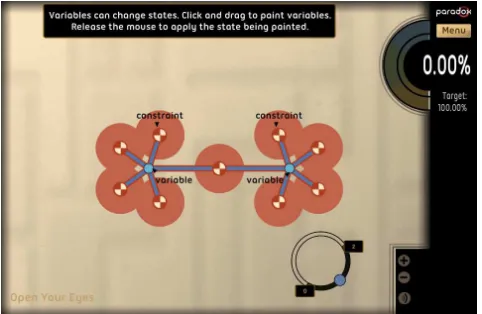
Figure 3. A screenshot of the gameParadoxanalyzed in our case study.
already-identified and additional skill atoms, iteratively revis-ing or refinrevis-ing prior skill atoms and re-codrevis-ing prior transcripts as needed.
4. Visualize skill chain.Already during data analysis, draft a first skill atom list and skill chain diagram as a reference and cross-check for coding. Once all transcripts are analyzed and have informed the draft skill chain, draw up a final clean skill
chain diagram using the provided script.1
CASE STUDY
Game and background
We developed and tested the above CTA method by eliciting
the skill chain of the human computation game (HCG)
Para-dox(Figure 3). This was part of a larger project aimed at
developing automatic level progression algorithms for HCGs that crowdsource scientific tasks like classifying images of galaxies. Notably, HCGs suffer from poor player retention at least partially due to poor progression design: instead of sequencing tasks in an order matching the learning curve of players, they predominantly serve tasks at random, risking both player frustration and boredom [53]. To inform machine learning algorithms that would automatically assess the
diffi-culty of each task inParadox, we wanted to get a grounded
understanding of what component skills are required to play
the game and thus, how difficult eachParadoxtask would be,
depending on what skills it required (akin to [8]). Paradox
was designed to crowdsource software verification, checking how many given conditions a given piece of code could satisfy. Each level or task presents players with a visualization of an underlying code piece as a graph of variables (displayed as nodes that can take different states) and conditions pertaining to pairs of variables (visualized as edges). Players can man-ually click individual variables to change their states or use various "brushes" to select subsets of variables to be modified. Different brushes trigger different approaches to modifying variables, from simple brushes that immediately set all to a cer-tain value, to brushes that run specific optimization algorithms. The player’s goal is to configure variables so that the highest possible number of conditions are satisfied. To complete a
1Available at http://github.com/crowdgames/skillchain.
level, a player must reach a given target score, where the score is the percentage of conditions satisfied. In general, it is not known in advance whether the target percentage of conditions (let alone all conditions) of a level can be satisfied.
Procedure, Observations and Reflections
In the following, we report on how we concretely implemented our method step by step and what generally relevant observa-tions we made for that step.
Identify analysis goals, tasks and subjects. To make sure
subjects were exposed to the same gameplay, we used a stable
local version ofParadox2that featured seven tutorial levels
in-troducing gameplay followed by a fixed series of 20 challenge levels, which were generally larger, more open-ended and more difficult than the tutorials. Levels were chosen to cover a range of level sizes and likely solution strategies. Tutorial levels were gated: players had to complete a level by reaching its target score before being able to proceed to the next tutorial level. In contrast, players were able to skip challenge levels without completing them if they desired. We asked partici-pants to play the game for 30 minutes, immediately followed by a 30 minute stimulated recall session. Gameplay length was determined by estimating how long players typically take to get through the tutorial and five challenge levels, which we as-sumed sufficient for novice players to acquire and demonstrate basic gameplay skills and for expert players to be challenged in the breadth of their expertise.
To record at least 12 subjects (ensuring theoretical saturation [28]), we recruited 15 subjects, preparing for a number of no-shows. We recruited 5 "expert" subjects who had played
Paradoxextensively in the past and 10 "novice" players who
had never seenParadoxbefore, otherwise aiming for
maxi-mum diversity in gender, age, and socio-economic background.
Observations and Reflections. Novices are more valuable
than experts. As expected, novices proved much more valuable for discovering low-level interface and gameplay skills than expert players. Indeed, analyzing expert gameplay only added minor refinements to the emerging skill chain. This somewhat contradicts standard CTA philosophy to rely on experts, but may be at least partially due to the relatively simple gameplay ofParadoxor the fact that expert traces were analyzed last.
Quick saturation. We identified the vast majority of skill atoms during analysis of the first five recall transcripts, with subse-quent transcripts adding only about one additional skill atom (3 percent of all codes) each. This suggests that future analy-ses may work sufficiently with a smaller number of subjects than we used – although this has to be tested with larger, more complex games.
Recognize and bracket shortcuts.At the conclusion of the first three recall sessions, we noticed that players heavily relied on the so-called optimizer brush. This brush automatically maximized satisfied conditions in a given graph area. While generating a good first score, the global maximum of pos-sible satisfied conditions cannot usually achieved with the
��� ���������� ��������� ����� �� ���������� ������ �� ����� ���� �� ������ ������ ����� ������ �������� �� ��� ������ �������� �� ���� ��� � ����� �� ���� ������� ��� ������� ��������� ��� ������ ���������� ����� ����� ��� ����� ���� �� ����� ��� ����� ���� ��� ��� ����� ����� ������ ������� ���� ��� ������ ����� ������ ��� ������ ���� ������ ������� �������� �� ��� ������� ���� �� ��� ���� ������ ��� ������ �� �������� ���� �������� ����� �� ���� ������ � ���� ��� �������� ��� ������ ���������� ������ ����� ��� � ��� � ������� ���� ��� ������ ����� �� ��� ��� ���� �� ��� ���� �� �� ��� ���� ������ �� ��� ������ � ��� ���� ��� �� ���� ������ ��� ������ �������� ��� ������ ���������� ���� ����� ������ ���� �� �������� ���� ��� ����� ���������� ������� ������� ������� ���� ���� �� ��� �� ��������� ������� ���� �� ���������� �� �������� ��� ����� ������ ��� ������ ������� ������� ��������� ������ �� ������� ������� ����� ����������� ��� ������ ��������� ������ ���� ����� ���� ������� ������ ��� ������� �� � �������� ���� ������� ���� �������� � ������ ����� ����� �������� �� ��� ������ ������� �������� �� ������ �� ��� ������� �� �� ������ �� ��� ����� ��� ���� �� ������ ���� ��� ������� ��� ����� ��� ���� ���������� ����� ��� ���� ������ ��������� ��������� ��� ��������� �� ��� ���� ��������� ������ �� ������ ���� �� ��� ������ ���� ��������� �� �������� �� ������� ����� �� � ����� �� ��� ���� ��� ������������ �� ����� �� ��������� ����� ����� �� ���� �������� ����� ����������� ��� ������ �������� ��� ������� ���������� ����� ���������� ������� ������ ����� ������� ���� ����� �������� �� �� ��� �� ���� ����� ����� � ����� �� ��� ���� �������� ��������� ��� ��� ������� �� ������ ��� �������� ����� ����� ����� ������ ����� ������ ����� �� ������� ���� ��� ����� ����� ��� ������ ���� �� ��� � ��� ����� ����� ���������� ��� ������� ����� �� ���������� ���� ����������� ������ ����� �� ������ ���������� �� ��������� ���� ���� ���� ������� ����� ��� �� ������� ���� ����� �� ��� ����� ���������� ������� ��� �� ����� �� ���� ����� �� ��� ������������� ����� ��� ���� ���� ���� ����������� ������������� �� ��� ������������� ��� ��� ������� ��� ���������� ������ ������ �� �������� ����������� ������ ������� ��� ��������� ��� ���������� ���� ����� �� ���� �������� ����� ������� ��������� ����� ����� ����������� ��� ������ ��������� ���� ������� ��������� �� ������ �������� ��������� ��������� �� ��������� ������� �� ������ ������� ������ ������ �� ���������� ��������� ������ ��� � ������ ���� �������� �� ����� � ��� �������� ��� ����� �������� �� ����� ��������� ������� ��������� ����������� ������ ����� ��������� ������� �� ������ ���������� ����� ��� �������� ������� ��� ������� ����� ��������� ������� ��� ������� ���� ��� ��������� �������� ���� ������ ������� ���� ������ ��� ���� ������� ���� �������� ������� �������� �� ����� ���� ���� ������� ���� ���� ���� �� ����� ����� ���� ���� ���� �� ��� �������� ������ ������� �� � ����� �� ����� ���� ��� ���� ������ �� ���������� ��� ������ �� ������� �������� ����� ��������� �������� ������ ���� ���� ������� �� ���� ������� ���� ���� ���� �� ��� �������� ������ ���������� �� � ����� ���� ��� ������ ��� ������� �������� ��������� �� ���� ������������ �� ���� ������ ���� ������������ ���� ���� ���� ������ ��� �������������� ����������� ��� ������������ �� ��� ����� ���� �� ��� ���������� ������� ��� ��������� �� ��������� ���������� � ����� ����� �� �� ��� ������ �� ���������� ���� ������� ���������� ������ ���� ������� �� ������ ���� ���� ���� ������� ������� ��� �� ������� ����� ������� ��� ������ ������������� ��� ������ ������� ������ ������� �� ������ ����� �� ������ ���� ���� �������� �� ��� ������ ������ �� ��� ������� �������� �� ��� ��� ��� ������ ������ �� ��� ������� ���� �� ��� ������ ���� ��� ���� ������� �������� ����������� ������ ������� ��� ��������� ��� ���������� ���� ����� ����� ����������� ��� ������ ��������� ��������� ��������� ��������� ���������� ���� ����� ��������� �������� ��� �� ��������� ��������� ��������� ��������� �� ��������� ������� �� ������ ������� ������ �� ��� ������ ����� �������� ����� �� ��������� ������� ��� ��������� ��� ���������� ���� ��������� ��� ���� ����� ������ ����� ����� ������ ���� ��� ����� ����� ��� ������ ���� �� ����� �� ��� ���� ����� ������ �� ���� �� �� � ��� �������� ��� ��� ������� ������ �� ������ ����� ����� �� ��������� ������ �������� ������ ��� ����� �������� ��� ��������� ������ ��� ����� ������ ������ ����� ��������� ��������� ����� �������� �� ��� ������ �� �� ���������� ���� ��� ��������� ������ ������ �� ������ ���� � ������ �� � ���� �� ����� �� ���� � ���� ����� ��� �� ��� ������ ��� ��������� ����� ������ ��������� ����� ���� ����� ��������� �������� �������� ���� �������� ��������� �������� ��������� ��� �� ��� ��� ������ ����� ��������� �� ������� ������������ ������ ������� ���������� ��� ��������� ������ ��� ������ �������� ������� ������� ������ ��������� ���� �� ��� ���� ������ ��� ����� �� �� ���� �� ������ ���� ��� ��� ��������� ������ ���� � ��� ���� ������ ����� ��� ��� ������ ��� ��� �� ��� ���� ����� ����� ���� ������� ��� ������� �� ������ �������� ����� ��������� �������� ������� ���� ���� ������ �� ���� ������� ���� ���� ���� �� ��� �������� ������ ���������� �� � ����� ���� ��� ������� ��� ������� �������� �������� ������� ��� ������ ��� ������ ������ �� �������� ����������� ������ ������� ��� ��������� ��� ���������� ���� ����� �� ���� �������� ����� ����������� ��� ������ ��������� ��������� ��������� ��������� ���������� ���� ����� ��������� �������� ��� �� ��������� ��������� ��������� ��������� �� ��������� ������� �� ������ ������� ������ ������ �� ���������� ��� ������ ��������� � ��� ��������� ������ ��� ������� ������ �� ���������� �� ��� ��������� ������� ����������� ����������� ������ ��� ��������� ������� �� ������ �������� ������� ���������� ����� ��� �������� ������� ��� �������� ��� ������� ��� ������ ����� ��� �������� ��� �������� ��� ������ ���������� ���� ���� ������� ���� ����� �� ������ ��� �������� �������� ���� ��� ��������� ����������� ��������� ��� ����� ���� ��� ��������� ����� �������� ����� ����������� ��� ������ ��������� ��� ������� ���������� ����� ���������� ��������� ���������� ����� �������� ��������� ��� ��������� ������ ���� ���������� ������ ��� ��������� ���� ����� ��� ������ ��� ��� ���������� �� ���������� ������� ������ ����� �� ��� ����� �� ������ ��������� ������� �� ����� �������� �������� ���������� �� ������� ���������� ���������� �� ����� ��������� ��� ������ ���� ���� �� ��� ������ ����� ������� ����� ��� ������� �� ����� ���� ������ ���� ���� ��������� ��� ������ ���� ������� ������� ��� ��������� ����� ����� ��� ���� ������ ��������� ��������� ��� ��������� �� ��� ���� ��������� ������ �� ������ ���������� �� ����� ��� ��� ��������� �� ���� ��� ����������� �� ��� ���� ������ ��������� �� �� ��� ������ ��������� �� �� �������� �� ������ ���� �� ������ ���� ��� ����� �� ��� �������� ��� ���� ����� ������ ����� ����� ������ ���� ��� ����� ����� ��� ������ ���� �� ����� �� ��� ���� ����� ������ �� ���� �� �� � ��� �������� �� ������ ���������� ������ ������ ����� �� ��� ����� �� ������ ���� ����� ����� ���� ����� �� �������� ���� ��� ����� �� ����� ��� ������ ������ � ���� �� ���� ������� ��� �������� ������������������� ���� ������������ ���� ���� ���� ������������ ����� ����� ���� �� ��� �� ������ �� ���� ������� ������� ����������� ���� ����� �������� �� ����� ��� �������� ����������� ���� ���� ��� �������
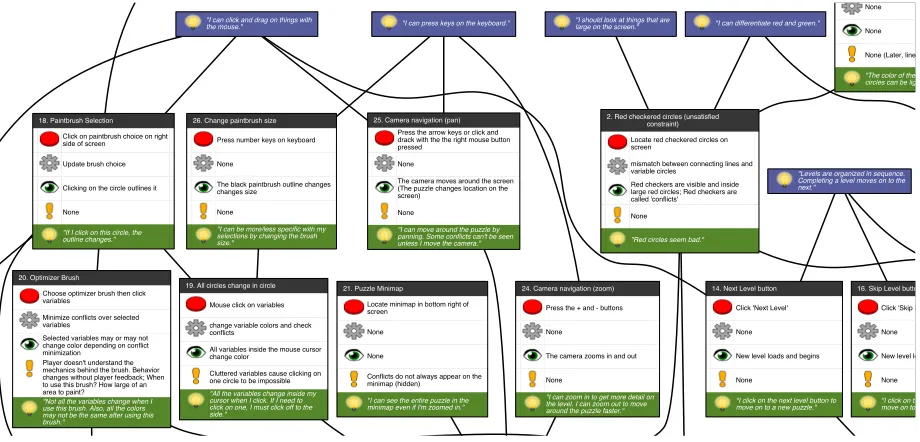
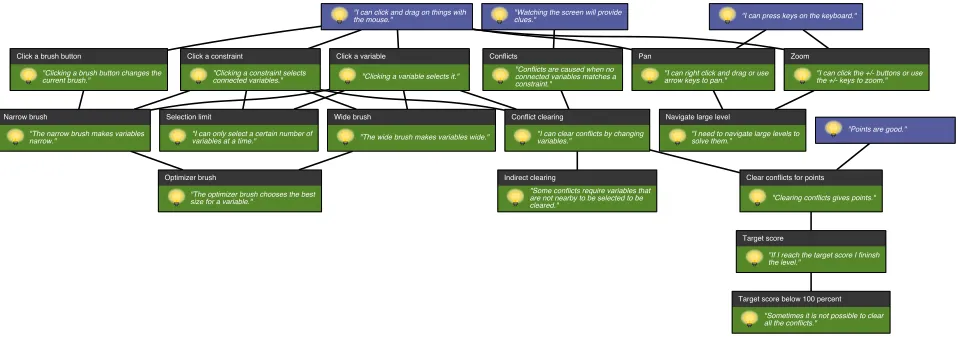
Figure 4. Detail ofParadoxskill chain produced by our method.
optimizer; it requires deeper analysis and probing of the total graph. However, since the optimizer brush was introduced early on in the tutorial and was enough to complete early tu-torial levels, novices tended to learn the heuristic to simply use the brush to clear each level, rather than learning how the constraint satisfaction mechanic worked and how to manually analyze and manipulate the graph. Hence, they would often become frustrated in later challenge levels when the brush alone didn’t suffice, and were not able to switch to manual optimization. (One participant even said that the optimizer felt "like cheating" because it would do all the work without players understanding how.) In terms of CTA, this highlights that the availability of "power tools", "exploits", or "shortcuts" as part of the analyzed task can prevent certain procedural skills from being actively performed and thus made observ-able. Observed tasks should therefore ideally be trialled in advance of actual analysis to check for and eliminate undesired shortcuts. In our case, we later on manipulated the game and restricted two novices and one expert from using the optimizer brush at all, requiring them to manipulate each variable of a level individually. This helped discover particular skill atoms for novices as well as challenge features of graph layouts we hadn’t observed before.
Elicit knowledge and analyze data. We began stimulated
recall sessions with novice players as we assumed that their play would feature many critical moments foregrounding basic
Paradoxskills which expert players had already perfected and would therefore be hard to notice. Gameplay sessions were
captured usingMorae3, which allows to make categorized
notes during screen and camera recording that are logged on the recording timeline. We used this to log critical moments we would then replay to subjects to stimulate recall after the play session. Stimulated recall sessions were recorded with
3https://www.techsmith.com/morae-features.html
Camtasia Studio4, as this program allowed to display and screen capture play session video and audio in addition to the camera video and audio of analyst and subject conversing. Stimulated recall sessions were transcribed and coded using
MaxQDA5.
Observations and Reflections. Skill dependencies are
un-clear and confounded by level design. We found it hard to identify clear dependencies between skill atoms and to disen-tangle (a) the order in which the game’s progression design required certain skills, (b) the order in which players developed insights, and (c) the ideal learning hierarchy in which both should occur. Instead, the order in which the game tutorial introduced skill atoms strongly shaped player perceptions and analyst coding: both tended to state that the order in which the game presents skill atoms is the order in which players learned them. This indicates a strong limitation in using qualitative analysis of fixed games with fixed progressions for eliciting skill chains. Ideally, players would be exposed to a random-ized multivariate ordering of skill atoms to the observe which order empirically produces the fastest learning gains.
Strategy skills are unvalidated. In alignment with Seamster and colleagues’ [55] hierarchy of cognitive skills, we found
strategiesto be at the ’highest’ level of our skill chain. The distinction between procedural skills and decision-making and strategy skills is fuzzy. A good indicator for strategies was that players consciously identified different approaches or composite applications of procedural skills and chose between them based on context. For example, players chose from
what location to begin solvingParadoxlevels and in which
order to move through the graph depending on level geometry. Sometimes a player would work from the periphery to the center, other times a player would choose to start in an area that had the most conflicts, and players would generally verbalize
![Figure 2. Skill chain for Tetris, taken and simplified from Cook [14].](https://thumb-us.123doks.com/thumbv2/123dok_us/7757477.169011/4.612.68.551.70.294/figure-skill-chain-tetris-taken-simplied-cook.webp)