UNIVERSITI TEKNIKAL MALAYSIA MELAKA
DESIGN AND DEVELOPMENT OF CYLINDER LPG TROLLEY
FOR DOMESTIC USE
This report submitted in accordance with requirement of the Universiti Teknikal Malaysia Melaka (UTeM) for the Bachelor Degree of Manufacturing Engineering
(Manufacturing Design) (Hons.)
by
NURUL AKMAR BT MOHD TAJWI B051210116
930703-03-5068
FACULTY OF MANUFACTURING ENGINEERING 2015
ABSTRAK
Dalam tesis ini, pembangunan LPG silinder troli untuk kegunaan domestik dibentangkan. Untuk merangka mekanisme baru yang cekap, kajian telah dijalankan mengenai produk silinder LPG troli sedia ada untuk kegunaan domestik. Pada asasnya, LPG silinder troli yang sedia ada telah menjadi satu produk yang penting di kalangan pengguna-pengguna yang perlu untuk mengangkut LPG silinder ke tempat lain. Walau bagaimanapun, LPG silinder troli yang sedia ada tidak selamat untuk digunakan kerana masalah ergonomik, ketahanan dan kestabilan. Oleh itu, untuk menyelesaikan isu ini, projek ini mencadangkan mekanisme pemegang untuk mengatasi isu ergonomik, manakala menukar bahan dari nilon ke polipropilena untuk meningkatkan ketahanan produk. Selain itu, mekanisme pemegang digunakan pada troli untuk meningkatkan kestabilan LPG silinder semasa pengendalian troli. Analisis struktur kekuatan produk itu telah dilaksanakan dan hasil ujian mengesahkan ketahanan bahan yang disyorkan. Sementara itu, analisis ergonomik produk telah dilakukan dengan menggunakan analisis Rula dan hasil ujian mengesahkan bahawa tidak ada kegagalan ergonomik. Prototaip direka mengesahkan ergonomik dan fungsi mekanisme pemegang dan pemegang.
ABSTRACT
In this thesis, the development of cylinder LPG trolley for domestic use is presented. In order to design an efficient new mechanism, studies were carried out regarding existing product of cylinder LPG trolley for domestic use. Basically, the existing cylinder LPG trolley has become an important product among the users who need to transport the cylinder LPG to other place. However, the existing cylinder LPG trolley is not being safe to use due to the ergonomic, durability and stability problem. Thus, to solve this issue, this project proposes handle mechanism to overcome the ergonomic issue, while change the material from nylon to polypropylene to increase the durability of the product. Besides that, the holder mechanism is applied on the trolley to increase the stability of the cylinder LPG during handling the trolley. The structure strength analysis of the product has been performed and the results confirmed the durability of the suggested material. Meanwhile, the ergonomic analysis of the product has been performed by using the RULA analysis and the results confirmed that there are no ergonomic failure. The fabricated prototype validate the ergonomic and functionality of the handle and holder mechanism.
DEDICATION
To my beloved mother, father, sister and brother.
ACKNOWLEDGEMENT
Firstly, I would like to express my greatest gratitude to Allah S.W.T., for His will, this project has finally completed. Thousands of thanks to my supervisor, Encik Khairul Fadzli Bin Samat for his kind and patience, his valuable advices, concern, guidance and support throughout the process of completing my degree project.
I would also like to express my sincere gratitude to my parents and family, who had continuously giving out their support financially and emotionally for me to complete my project. Also lots of thanks to my beloved friends and lecturers for all the knowledge, helps and guidance to complete this project.
Last but not least, I have the greatest hope that my degree project, ‘Design and Development of Cylinder LPG Trolley for Domestic Use’ will give its benefit in making more discovery of new technology in future.
TABLE OF CONTENT
Abstrak i
Abstract ii
Dedication iii
Acknowledgement iv
Table of Content v
List of Tables viii
List of Figures x
List of Abbreviations, Symbols and Nomenclatures xiv
CHAPTER 1: INTRODUCTION 1
1.1 Background 1
1.2 Problem Statement 2
1.3 Objective 3
1.4 Scope 3
1.5 Project Schedule 4
CHAPTER 2: LITERATURE REVIEWS 6 2.1 Introduction 6
2.2 Engineering Design Process of the Cylinder LPG Trolley 7
2.3 The Selected Design Process 10
2.3.1 Quality Function Deployment (QFD) 10
2.3.2 Pugh Concept Selection Method 12
2.4 Design Analysis 13
2.4.1Solidworks 13
2.4.2 Solidworks Simulation Analysis 14
2.4.3 Theories of strength analysis 16
2.5 Ergonomic 19
2.5.1 Ergonomic Analysis 19 2.5.1.1 RULA Assessment Worksheet 19
2.6 Rapid Prototyping 22
2.7 Fused Deposition Modelling (FDM) 22 2.7.1 Process of FDM Technology 24
CHAPTER 3: METHODOLOGY 25
3.1 Introduction 25
3.2 Methodology 25
3.3 Problem Identification 27
3.4 Survey Analysis: Customer Requirement 27
3.4.1 Basket to Counter the Ergonomic Problem 28
3.5 Establishment of Product Specification 32
3.5.1 House of Quality (HOQ) 35
3.6 Development of Conceptual Design 37
3.6.1 Morphological Chart 37
3.6.2 Concept Generation 38
3.7 Selection Process of Conceptual Design 44
3.7.1 PUGH Method 44
3.7.1.1 Concept screening 45
3.7.2 Concept Scoring 46
3.8 Development of Detail Design 47 3.8.1 Component Part in Cylinder LPG Trolley 47
3.8.2 Exploded View of Cylinder LPG Trolley 49
3.8.3 Assembly of Cylinder LPG Trolley 51 3.8.4 Dimension of Cylinder LPG Trolley 53
CHAPTER 4: RESULTS AND DISCUSSION 54
4.1 Overview of Final Design Model 55
4.2 Boundary & Properties of Structure Strength Analysis 56
4.2.1 Body Base 56
4.2.2 Connector of Body Base 59
4.2.3 Handle 63
4.2.4 Summary of Structure Strength Analysis 67
4.3 Ergonomic Analysis 68
4.3.1 RULA Assessment for Existing Product 68
4.3.2 RULA Assessment for New Design Product 71
4.3.2.1 RULA Assessment in Worksheet 71
4.4 Validation Result 74
4.4.1 Validation of Proposed Mechanism 74
4.4.1 Validation of Ergonomic Issue 75
4.5 Summary of Ergonomic Analysis 76
CHAPTER 5: CONCLUSION 79
5.1 Conclusion 79
5.2 Sustainability 81
5.3 Recommendation in Future 82
REFERENCES 83
APPENDICES 88
LIST OF TABLES
1.1 Project schedule for Degree Project I 4
1.2 Project schedule for Degree Project II 5
2.1 Existing LPG Gas Trolley for Domestic Use 7
2.2 Existing LPG Gas Trolley for Commercial Use 8
2.3 The Score of Respective Level of MSD Risk 21
3.1 Customer needs for the suspension LPG gas trolley and their relative Importance 32
3.2 List metrics for the suspension 33
1.3 The Target Specification 33
3.4 The final specifications 34
3.5 Morphological chart of Cylinder LPG Trolley 37
3.6 Concept Screening of Cylinder LPG Trolley 45
3.7 Concept Scoring of Cylinder LPG Trolley 46
3.8 Parts of Cylinder LPG Trolley 47
3.9 Component of Cylinder LPG Trolley 50
4.1 Force Value at Different Angle 60
4.2 Summary of Structure Strength Analysis 67
4.3 The comparison of previous and improved design in handling trolley
based on RULA score. 77
LIST OF FIGURES
2.1 Technique of House of Quality 10
2.2 Example of House of Quality 11
2.3 Example of Pugh Selection Matrix 12
2.4 Example of Stress Distribution (Von Mises) 15
2.5 Example of Displacement Distribution 15
2.6 RULA Employee Assessment Worksheet 21
2.7 Example of Product Produced using FDM 23
3.1 The flow of the development of Cylinder LPG Trolley 26
3.2 Survey Question 1 28
3.3 Survey Question 2 28
3.4 Survey Question 3 29
3.5 Survey Question 4 30
3.6 Survey Question 5 31
3.7 Basket Trolley Concept 31
3.8 HOQ of Cylinder LPG Trolley 35
3.9 Concept A 38
3.10 Concept B 39
3.11 Concept C 40
3.12 Concept D 41
3.13 Concept E 42
3.14 Concept F 43
3.15 Exploded View of Cylinder LPG Trolley 49
3.16(a) Cylinder LPG Trolley with Cy;inder LPG 51
3.16(b) Cylinder LPG Trolley 52
3.16(c) Folder Handle of Cylinder LPG Trolley 52
3.17 Dimension of Cylinder LPG Trolley 53
4.1 Perspective View of Cylinder LPG Trolley 55
4.2 Location of Load/Force 56
4.3 Location of Fixture 56
4.4 Von Mises Stress of Body Base 57
4.5 Displacement of Body Base Structure 58
4.6 Location of force at connector 59
4.7 Location of fixture at connector 59
4.8 Maximum stress of connector structure strength analysis 61
4.9 Max displacement of connector structure strength analysis 61
4.10 Location of fixture at handle condition I 63
4.11 Location of force at handle condition II 63
4.12 Location of force at handle condition II 64
4.13 Location of fixture at handle condition II 64
4.14 Maximum stress of Handle 65
4.15 Maximum Displacement of Handle 65
4.16 Side view of the model that is handling the cylinder LPG trolley 68
4.17 Front view of the model that is handling the cylinder LPG trolley 68
4.18 The RULA analysis of the handling posture without load for existing product 69
4.19 The RULA analysis of the handling posture with load for existing product 70
4.20 Side View of the Model Handling the Cylinder LPG Trolley 72
4.21 Front View of the Model Handling the Cylinder LPG Trolley 72
4.22 Result of RULA analysis of handling without load for new design 72
4.23 Result of RULA analysis of model handling with load for new design 73
4.24 Fabricated Product 74
4.25 Mechanism of Product 74
4.26 Posture When Handling the Prototype 75
4.27 RULA employee assessment worksheet 75
4.28 Analysis of existing trolley 76
4.29 Analysis of new trolley 76
LIST OF ABBREVIATIONS, SYMBOLS AND
NOMENCLATURE
LPG - Liquefied Petroleum Gas MSD - Musculoskeletal Disorders FDM - Fused Deposition Modelling QFD - Quality Function Deployment HOQ - House of Quality
VOC - Voice of Customer CAD - Computer Aided Design Pa - Pascal
M - MEGA
FEM - Finite Element Method FEA - Finite Element Analysis RULA - Rapid Upper Limb Analysis ABS - Acrylonitrile Butadiene Strene PPS - Polyphenylsulfone
CHAPTER 1
INTRODUCTION
1.1 Background
Liquefied Petroleum Gas (LPG) trolley is widely used in industry and society for ease of transportation to any location. There are two types of cylinder LPG trolleys which are used for commercial and domestic. The commercial used is defined as the use of the cylinder LPG trolley by the delivery men who delivered the LPG to the house, while the domestic use is defined as the use of the cylinder LPG trolley at home. The cylinder LPG trolley for domestic use is faced a lot of problems such as ergonomic, stability and durability problem. Ergonomics is a science focused on the study of human fit, and decreased fatigue and discomfort through product design. When products fit the user, the result can be more comfort, higher productivity, and less stress (Jorge Oishi, 2008). Based on the observation, the ergonomic problem faced by existing trolley is the trolley does not have handle which cause people to bend the body to push it. Bad posture put excessive force on the joints and muscles and tendons load around joints implemented. Body joints is most memorable when they operate closest to the mid-range of movement of joints. Musculoskeletal disorders (MSD) risk increases when the joint work beyond the middle of this range repeatedly or for the entire period that quest period without sufficient recovery time (Jorge Oishi, 2008 ). The other problem faced by the cylinder LPG trolley is the stability of the cylinder gas during handling it. Stability is the ability of a product to remain unchanged over time under stated or reasonably expected
conditions of storage and use. Based on the observation, the problem occurs when a force is apply on the top of the cylinder gas. The cylinder gas will fall down if a horizontal force is applied on it. Due to the force applied on the cylinder gas, the trolley would not be able to maintain stability, thus make the cylinder gas falling down. Furthermore, the other problem is durability of the trolley’s material. The durability of the product depends on type of material to build up the product. Based on the observation, most of the existing trolley is made up by plastic which could not withstand excessive load. This situation will make the trolley only can be used for a short time. By understanding of the characteristic’s problem, the effect of using LPG gas trolley is predicted.
In this report, the design and development of LPG gas trolley for domestic use to encounter the ergonomic, stability and durability problems is presented.
1.2 Problem Statement
In transferring cylinder LPG gas to desired place, it is essential to use a trolley because the LPG gas trolley is too heavy to lift. As already know, there are plenty types of trolley available in this industry but it does not fulfill the customer requirement such as durability, stability and ergonomic characteristics. Some people might be noticed about the ergonomic problems, stability and durability of the products. This situation had been proved by the survey among the customers. The users argue about need to bend their body during handling the trolley due to the height. Moreover, most of the existing trolley have low center of gravity which can cause the cylinder LPG gas trolley to fall down. If the LPG gas trolley is redesign and improve ease of use, people will not face the back pain during handling the trolley and use the trolley without any problems. Due to this reason, this study aims to design an LPG gas trolley for domestic use. The Pugh’s method was integrated to design the LPG cylinder trolley, so that it can fulfill the customer's requirements, thus, an effective device to assist the delivery task is produced.
1.3 Objective
The aim of this project is to design and develop the cylinder LPG trolley for domestic uses. This can be accomplishing by following the objectives:
1. To design cylinder LPG trolley based on ergonomic, stability and durability perspective through an engineering design.
2. To perform ergonomic and structure strength analysis for the final design.
3. To produce the product through rapid prototyping machine for the functionality of handle and holder mechanism and ergonomic evaluation.
1.4 Scope
This project comprises the design of LPG gas trolley for the domestic uses. In order to design the LPG gas trolley, many important designing factors must be taken into consideration which are ergonomic, stability and durability. The best proposal design of the cylinder LPG gas trolley was selected by using Pugh’s method. In the Pugh’s method a decision matrix is prepared with column to identify design concepts and the rows to represent criteria. The project must perform the modeling and design analysis by using Solidworks software. Then produce the prototype by Fused Deposition Modeling (FDM) machine. FDM machine is an additive manufacturing technology commonly used for modeling, prototyping and production applications. FDM works on the prototype to ensure the functionality and ergonomic of the product.
1.5 Project Schedule
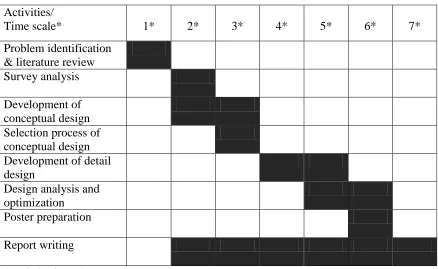
[image:18.612.110.548.304.573.2]Table 1.1 shows the project schedule for project 1 which is start from problem identification and literature review. The survey analysis is conducted after the problem identification, then proceed with development of conceptual design, selection process of conceptual design, development of detail design, design analysis and optimization and poster preparation. Each column of the table represent for two weeks.
Table 1.1: Project schedule for Degree Project I
Activities/
Time scale* 1* 2* 3* 4* 5* 6* 7*
Problem identification & literature review Survey analysis Development of conceptual design Selection process of conceptual design Development of detail design
Design analysis and optimization
Poster preparation Report writing
1 unit *= 2 weeks
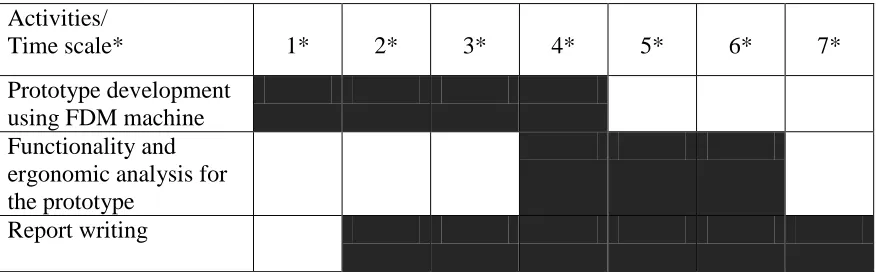
Table 1.2 shows the project schedule for degree project II which are prototype development using FDM machine, functionality and ergonomic analysis for the prototype and report writing.
Table 1.2: Project schedule for Degree Project II
Activities/
Time scale* 1* 2* 3* 4* 5* 6* 7*
Prototype development using FDM machine Functionality and ergonomic analysis for the prototype
Report writing
1 unit *= 2 weeks
CHAPTER 2
LITERATURE REVIEW
2.1 Introduction
Cylinder LPG gas trolley is used for ease of transportation of LPG gas to any location. Mostly the person who used the LPG gas trolley are the delivery men who in-charge of delivering the LPG cylinders to the customers and for the domestic use. There are two types of LPG gas trolley use which are LPG gas trolley for domestic use and for commercial use.
2.2 Engineering Design Process of the LPG Gas Trolley
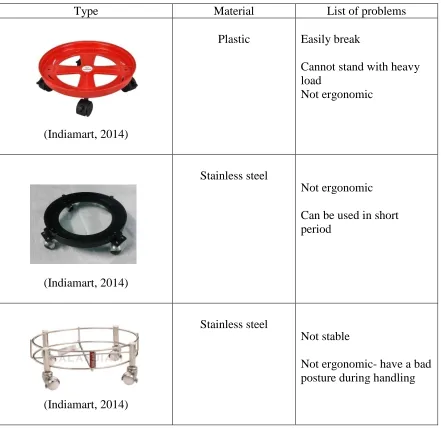
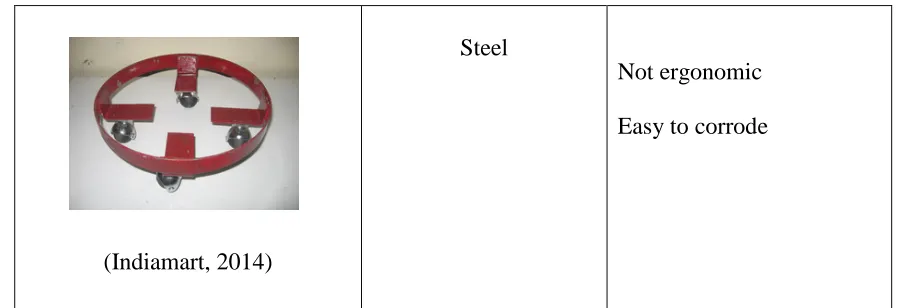
[image:21.612.109.550.201.629.2]Table 2.1 and table 2.2 show the ergonomic of the LPG trolleys which describe the types, materials and list of problems faced by the existing trolley.
Table 2.1: Existing LPG Gas Trolley for Domestic Use
Type Material List of problems
(Indiamart, 2014)
Plastic Easily break
Cannot stand with heavy load
Not ergonomic
(Indiamart, 2014)
Stainless steel
Not ergonomic Can be used in short period
(Indiamart, 2014)
Stainless steel
Not stable
Not ergonomic- have a bad posture during handling
(Indiamart, 2014)
Steel
[image:22.612.101.550.68.222.2]Not ergonomic Easy to corrode
Table 2.2: Existing LPG Gas Trolley for Commercial Use
Type Material List of problems
(Indiamart, 2014)
Steel Do not ergonomic
Have a bad posture during handling the trolley
(Indiamart, 2014)
Steel Not stable
Not ergonomic- have a static pressure during handling
(Indiamart, 2014)
Steel Need a lot of energy to push the trolley
Easy to corrode
(Indiamart, 2014)
Steel Not stable
Not ergonomic- face a static pressure during handling
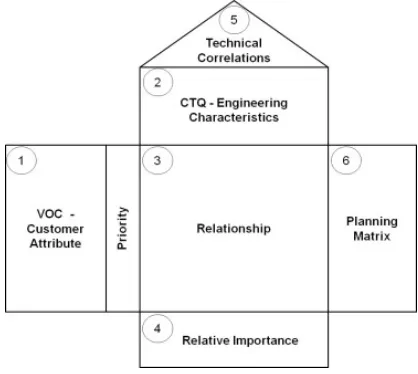
Figure 2.1: Technique of House of Quality (HOQ) (Gulcin,2012)
2.3 The Selected Design Process
2.3.1 Quality Function Deployment (QFD)
The Quality function deployment (QFD) or named as matrix product planning. It
is a method which is widely used to transform the qualitative user demands into quantitative parameters. Then used to deploy methods for achieving the design quality into subsystem and component, and to specify elements of the manufacturing process. The QFD is a measure of customer satisfaction with a product. A seven management and planning tools is used in methodology of a product (Carlo, 2012).
The technique is characterized by a matrix called the House of Quality (HOQ) which is represented in Figure 2.1. The matrix contains information about what to do (what customer want), how to do (how technically customer requirements can be achieved), and the relationships between each of these aspects; prioritization of customer requirements and technical requirement and what the company’s target levels (Gulcin, 2012).