RESTRICTIVE AND NON-RESTRICTIVE ADJECTIVES~
A CROSS-LANGUAGE STUDY
SVETLANA BYRNE
A THESIS SUBMITTED IN PARTIAL FULFILMENT OF THE
REQUIREMENTS FOR THE DEGREE OF MASTER OF ARTS
OF THE AUSTRALIAN NATIONAL UNIVERSITY
CONTENTS
ACKNOWLEDGEMENTS ABBREVIATIONS
INTRODUCTION 1
CHAPTER ONE: Inda-European family 4
1.1 Restrictive and non-restrictive
adjectives in English 4
Footnotes 23
1.2 Restrictive and non-restrictive
adjectives 1n French 24
1.3 . Duality of adjectival category
in Old Church Slavonic 35
1.4 Restrictive and non-restrictive
adjectives in Serbo-Croatian 45
Footnotes 109
1.5 Restrictive and non-restrictive
adjectives 1n Russian 110
1.6 Two categories of adjectives
in Lithuanian 127
CHAPTER TWO: Niger-Congo family 132
2.1 Adjectival parts of speech
in Lam Nso' 132
2.2 Noun class markers in Lam Nso'
and their functions 158
2.3 Concord markers and their
functions 173
2.4 Other restrictive and
and nominalisation 194
2.7 Adjectives , n
.
Igbo 1982.8 Adjectives , n Tu p u r i 200
Footnotes 203
CHAPTER THREE: Australian family 204
3. Restrictive and non-restrictive
modifiers ,n Kuniyanti 204
3.1 Introduction 204
3.2 Restrictive and non-restrictive
demonstratives ,n Kuniyanti 206 3.3 Restrictive and non-restrictive
adjectives ,n Kuniyanti 208 3.4 Nominalisations of restrictive
adjectives ,n Kuniyanti 212
3.5 Summary 213
CHAPTER FOUR: Austronesian family 214
4. Restrictive and non-restrictive
adjectives in Tagalog 214
4.1 Noun markers in Tagalog and
their .function 214
4.2 Restrictive and non-restrictive
modification in Tagalog 225 4.3 Unmarked NPs with adjectives as
modifiers 239
4.4 Nominalisation of restrictive
adjectives in Tagalog 246
CONCLUSION BIBLIOGRAPHY
Footnotes 251
ACKNOWLEDGEMENTS
I would like to thank my informants John and Marianna Fondzenyuy (Lam Nso'), Amy Kempis (Tagalog) and Nevenka Petrovic (Serbo-Croatian) for many hours of patient co-operation with my linguistic interrogations.
I am grateful to J. Mayrhofer, G. Halligan and J. Grieve of the A.N.U. Department of Romance Languages for some data and information about French adjectives.
Bill McGregor of the Linguistics Department,
University of Sydney, has been kind in allowing me access to his unpublished data in Kuniyanti.
The understanding of some aspects of Tagalog grammar was helped by discussions with Dr Bill Foley, Department of Linguistics, Arts, A.N.U.
My supervisor Dr Harold Koch has been of great assistance with his advice and encouragement. His non-restrictive approach to supervision helped me to develop my own ideas while keeping me from jumping to too
hasty conclusions.
Dr Bernard Comrie's course of lectures on
Language Typology and Language Universals which he gave at this University in 1980 was the source of inspiration for this study.
I would like to thank my daughter Julia for typing a part of the first draft and tidying up the tables; Alison Russel for typing two chapters of the first draft, but most of all, Jennifer Hyles for her excellent job in typing parts of this thesis at such short notice.
ACC
AF
ALLAN
AUX
CAUS
CLCONT
DAT
DC
DEF
ERG
F
GEN
GF
accusative case actor focus
allative case animate
.
auxiliary verb
causative rna.rker noun class marker
continuous tense/aspect
dative ca.se
directional complement
definite form of the adjective
ergative case
feminine gender
IMP
INC
IND
INF
IN
INS
LOC
M
N
NOM
NS
oc
p PART PAST POSS PL PRES
imperative mood inchoative
indefinite form of infinitive
inanimate
instrumental case
locative case
masculine gender
neuter gender nominative case
nominalising suffix
object complement
person
participle past tense possessive plural
present tense
SG
T
singular
1
Introduction
This work is intended to be an exploratory study of a possible language universal. Limitations on time and resources did not allow a statistically valid sampling
technique to be employed in collecting data for the study. Instead, a convenience sampling technique was used
(Bell 1978: 123-56). The choice of languages ,n the
study was influenced by my familiarity with them as well as by the availability of informants and recorded/published data. An attempt was made however, to select languages from as divergent genetic and geographic sources as the above
mentioned restrictions allowed. The number of languages examined is skewed towards the I.E. family, also because of the limitations mentioned above. The examination of a larger sample of languages from the I.E. family proved to be useful as it illustrated the possible typology of formal
expression of differences between adjectival categories and thus helped to identify these distinctions in less familiar languages.
The genetic families represented ,n this study include the following:
Family
Indo-~uropean
Niger-Congo
Languages
English, French, Old Church
Slavonic, Serbo-Croatian, Russian, Lithuanian
Australian Austronesian
Kuniyanti Tagalog
There is a variation in the amount of discriptive details of the adjectival systems of languages in the study.
I n th e c a s e o f I nd o - Eu r o p ea n l a n g u a g e s , g r a mm a t i c a l
descriptions of which are numerous and readily available, no attempt was made in the study to give detailed
descriptions of their adjectival system, but rather the
study focuses directly on the restrictive and non-restrictive categories within the system. Very little has been published on Lam Nso' and none on its adjectival grammar, so I provide a detailed outline of the adjectival system in this language
before proceeding with the analysis of the restrictive and non-restrictive distinction. The adjectival system of
Tagalog has been described 1n the grammars of Schachter and Otanes (1972) and by Ramos (1976). Again the study focuses directly on the restrictive and non~restrictive adjectives
in Tagalog after a brief re-evaluation of the function of the noun markers in the language.
Data in the analysis of English, French, Serbo-Croatian,
Russian and Tagalog comes both from the published sources and the informants. Data for the analysis of adjectives in Old Church Slavonic, Lithuanian, Igbo, Tupuri and Kuniyanti comes from published/recorded material. Analysis of adjectives
3
The sequence in which the chapters of the final draft were written is not that of this study. The Tagalog chapter, the last in this study, was written first, followed by some I.E. languages, then Lam Nso' and finally, English and Russian. The sequence of completing the chapters of the final draft may account for slight variations in
emphasis and method of analysis. These variations were not great enough to justify altering them.
The method used to differentiate the two categories of
adjectives in the study was applied to all languages where it was possible to have access to informants. Otherwise the presence of the distinction was assessed from descriptions of adjectival categories and examples provided in the previous works/publications.
My approach to the analysis of the distinction between restrictive and non-restrictive adjectives and the use of various terms in the analysis would be best illustrated by describing it for a familiar language like English. It 1s
INDO-EUROPEAN FAMILY
1. Restrictive and non-restrictive adjectives ,n English 1.1 Previous works on adjectives ,n English
I will not attempt to find a cover term for my approach to the analysis of restrictive and non-restrictive adjectives, but
perhaps it can be said that it has some elements of both pragmatics and psycholinguistics. Dependence of each category of adjectives
on context, linguistic, extra-linguistic or cultural, and the
relative importance of each category as essential or non-essential information in conveying the intentions of the speaker are the main
,
pragmatic aspects of the analysis.9
The role of each adjectival cateory ,n identification or
sub-categorization of referents, temporarily or permanently, perhaps, represents the psychological element of the analysis.
Most works on adjectival categories in English are concerned with the syntax and semantics of these categories, that ,s with the relationship between lexically determined features of adjectives and their syntactic distribution. I will briefly survey two of the most important works.
Bolinger 1967 in 'Adjectives 1n English: attribution and predication 1 examines relationship between lexical features of adjectives and
their syntactic occurence. He also relates these features to two types of modification; referent and reference modification. In
reference modification, the adjective occupies the 'kind of' slot as ,r (l) Henry is a kind of policeman
and functions as a determiner. In referent modification
the adjective has, according to Bolinger, a predicative
origin where it 1s joined to the noun by conjunction.
He proposes the following derivation for the referent
modification construction (p. 21).
(2) Henry is a policeman7 - - 7 Henry 1s a policeman and Henry is drowsy .:S
drowsy~ Henry is a drowsy policeman.
5
According to Bolinger, the conjunction 'expresses the
independent relationship of adjective and noun: his being
drowsy has nothing to do with his being policeman 1 (p. 21).
Adjectives occuring only in reference modification are almost
exclusively attributive while adjectives occuring in referent
modification may be only predicative or both predicative and
attributive. This distribution is conditioned by the
interaction between semantic features of the adjective and
the modified noun.
Bolinger also notes the nominalizing potential of attributive
only adjectives: 'a good case could be made for recognizing
most instances of exclusively attributive adjectives as raw
material for compounding 1
(p. 32). He ascr-f ~es 'most
instances of the 'kind of+noun' generation (other than the
good-bad ones), i.e. generation that has nothing to do with
-predication, to the level of word formation, i.e. to the
lexicon, leaving referent modification as a genuine syntactic
transformational source for attributive phrases that are not
partly through contextual stereotyping ,n the course of time: freshman, wet nurse, easy chair, single file, cold cream, silent partner, a likely story, a cool head. Compounds in this sense would cover the spectrum of freedom, all the way from a phrase
like grammatical thinking which is almost free to one like (
heavenly host (p. 34).
Bolinger's article is a valuable contribution to understanding restrictive ( 'a kind of+ noun') and non-restrictive (predicative source) modification as conditioned by the lexical features of adjectives, or according to my approach, the restrictive and non-restrictive distinction between the adjectives in English at the level of lexicon. My analysis attempts to examine this distinction both at the level of discourse and lexicon.
An example will illustrate a parallelism between the two levels: the reference modification (or what I term the restrictive
modification at the level of lexicon), is, according to Bolinger, characterised by the 'kind of+ noun' generation and 1s
strictly attributive, for example, 1n:
(3) Henry is a rural policeman' ( p • 1 5 )
rural policeman ,s 'a kind of I
policeman and it 1s not possible to use the adjective predicatively:
(4) *The policeman is rural.
This type of generation has a parallel generation 1n discourse:
( 5 )
( 6 )
What kind of table are you looking for?
A
A
round table in the above sentence 1s not an example of reference modification (or, in my approach, restrictive modification at the level of lexicon) since the adjective can also occur predicatively:'
(7) The table is round
(compare it with ungrammaticality of (4) above)
1--But round table 1s 1
a kind of' table and 1s an example of restrictive use of adjectives in English at the level of discourse.
7
A more recent study by Siegel (1980) is concerned with
semantic-syntactic criteria differentiating the two categories of adjectives in English within the framework of Montague
grammar. The adjective meanings are divided, according to interaction of their meaning with the meaning of the noun
they modify into intersective and non-intersecti ve. Adjectives that are bound to the meanings of their 'common nouns I are
'
non-intersective and those that are not bound-intersective. The meaning of a non-intersective adjective ;according to Siegel, is 'always relative to that of the common noun it modifies 1
(p. 3). The non-intersective adjective meanings
can always be separated by a test (seep. 4 of her work) while for the intersective readings 'we are left to rely on our
intuitions as to what properties can be non-relative in order to identify intersective readings of adjectives 1
• (Siegel: 9-10)
versions, while some will be either only intersective or
non-intersective. The adjectives with 'double' readings
occur both as CN/CN category (a term in Montague grammar
-attributive adjectives, or 1
things that combine with a
common noun to make a new common noun by means of the
j
semantic and syntactic rules, for these see Siegel: 27)
and t///e category (a verbal category, see Siegel: 22-31).
The CN/CN category is generated only prenominally, but it may
modify the dummy CN in the predicate, in which case this dummy
CN is deleted, with some exceptions.
t///e versions of adjectives are generated only in the
predicate, but can be fronted by the relative clause reduction
and fronting.
Siegel 1
s analysis 1s an attempt to formalize within the
frame-work of a particular syntactic theory, the relation between
the lexical features of adjectives 1n combinations with nouns
and their syntactic distribution. It is not concerned with
pragmatic explanations for the duality of adjectives which are
of greater interest to the present study.
The work that became a point of departure for this study is
the analysis of ~nglish adjuncts in Jespersen 1
s The Philosophy
of Grammar 1
( 1924).
Jespersen defines the function of restrictive or 1qualifying 1
adjuncts (including adjectives) as 'to restrict the primary, to
other words, to specialize or define it. Thus red in the red rose restricts the applicability of the word rose to one particular sub-class of the whole class of roses, it specializes and defines the rose of which I am speaking by excluding white and yellow roses 1 (1924: 108).
9
The non-restrictive adjuncts as in my dear little Ann are
used, according to Jespersen, not to tell which among several Anns I am speaking of (or to) but simply to characterise her, they may be termed ornamental or parenthetical adjuncts 1
(1924: 112).
The recognition of an adjunct as restrictive or non-restrictive may be, according to Jespersen, ambiguous; however, the two
uses of adjuncts 'may be made clear in the spoken language by the tone (intonation) and in the written language by a comma! An example of a phrase with possible ambiguity between the
restrictive and non-restrictive interpretation:
(BJ Hts first important poem (Jespersen: 112)
Thi s p hr as .e genera l l y me a n s the f i rs t among hi s imp or tan t poems, after 'he had written others of no importance 1
-the restrictive use of -the adjective important. It may also mean 'the first he ever wrote and adds information that it was
important• (p. 112) - the non-restrictive use of the adjective important.
The readings of this phrase by the native speaker of English
placing the emphatic prominence on the adjective in restrictive function.
A
(9) His first important poem.
The non-restrictive use of this adjective in the phrase above is marked by the absence of emphatic prominence on it and the presence of a pause between the first and the important in example (8).
The term 'emphatic prominence' is used throughout this study as defined by Liebermann (1~67: 146-7). It occurs 'in instances where the distinctive feature (+Ps) produces
extra prominence on the vowel or vowels of the word (and
its consonants) apart from the stress (or tone - my addition) that the vowels of the word would have received from the
phonological stress rules 1
• My addition to this definition is that the extra prominence is defined relative to the
other words in the noun phrase, that is, the domain of the emphatic prominence is the noun phrase.and it appears to be independent of overall sentence intonation. The emphatic prominence is retained by the adjective irrespective of its position in a sentence or the type of sentence (interrogative, imperative, declarative). These statements and the recogni-tion of either the presence or the absence of the feature
•emphatic prominence' are based only on perceptual judgements. The emphatic prominence is perceived as the 'loudness' of the adjective relative to other words in the noun phrase* (and
A
1 . 2
not relative to the overall sentence intonation) when the speaker intends to use the adjective restrictively and the lack of 'loudness' of the adjective relative to other words in the noun phrase when the speaker intends
11
it to be non-restrictive. This binary distinction in marking applies to the prototypical categories (Comrie
1981: 98-104) of restrictive and non-restrictive adjectives in English (and other languages where it is employed).
My approach to the analysis
Jespersen's definition of the distinction between the restrictive and non-restrictive modifiers emphasises the
individuating, identifying and selective function of
restrictive adjuncts (including adjectives) and the parenthe-tical function of non-restrictive adjuncts.
The restrictive and non-restrictive modifiers (including
adjectives) also vary with respect to the relative importance of the information carried by either category. The modifier of the noun is the essential information in restrictive
modification, without it the addressee would not be able to successfully identify the referent 1 (Parisi 1976: 102); ,n non-restrictive modification the modifying adjective is only an additional information and may be omitted. This difference
modifiers. There will be other cases where the concept
I
of 1
a degree of restrictiveness will apply rather than
binary categorization.
Restrictiveness of an adjective (or other modifiers) wi 11
depend on such factors as the lexical features of the
adjective and the modified noun, information contained
in the rest of the utterance and information in the
preceding context. A demonstrative in English (and other
languages) may have a certain degree of restrictiveness,
it may contribute, to some degree, to the identification
of a particular referent in terms of its location relative
to the speaker. This appears to be the case below:
(lOJ What do you want?
(llJ Give me that book!
Omission of this demonstrative and substitution of article
in place of it 1s possible, but subtracts from the
informa-tion necessary to identify the correct referent.
(12) Give me the book!
(11)
t
(12) ,n information contentIn the example above the referent is identified mainly in
terms of properties, encoded by the noun with some
contri-bution from the demonstrative. (The preceding text asks
for identification minimally ,n terms of nominal properties)
The demonstrative may become fully restrictive and in this
marked by the emphatic prominence (it lacks it 1n the
example (11) above)
( 13 J
( 14)
Which book do you want?
A. "
Give me that book/that one!
13
In this case the referent is identified in terms of its
location relative to the speaker and other referents of
the same kind are excluded. The nominal category 1s
presupposed, 2 , .e. it is known to the speaker and the
addressee from the context (in this case it is given in
the question). The presupposed noun may be omitted an/d
substituted by one, which I wi 11 term a 'lexical pronoun'.
(15) Give me that one!
The lexical pronoun 'one' marks the cohesive relation on
the lexicogrammatical level, it 1s a case of substitution
(Halliday 1976: 89). The pronoun carries grammatical
marking characteristic of the English noun - its number.
A demonstrative can also function non-restrictively and may
be omitted (marked by bracketing):
(16) Do you know of anyone who could help me?
(17) There is (that) Mr Brown over on the other side of
the street, you could ask him.
The demonstrative carries no emphatic prominence as also .\
the
1n example below where it 1s also non-restrictive and may J
be omitted as the proper name is sufficient to identify.
(18) Do you know where I can find any relevant information?
The demonstrative here is superflous, the referent is adequately identified by the phrase by Prof. Brown.
A similar variation in the degree of restrictiveness, depending on the type of information contained in the context,linguistic and extra-linguistic,applies to adjectives. In sentences containing request, the
adjective has a degree of restrictiveness (but carries no emphatic prominence).
(20) What do you want?
(21) Give me the/a blue biro.
The correct referent cannot be identified by the addressee unless the properties encoded by the adjective blue are
taken into account.
However, in:
(22) What do you see from your window?
(23) I see the blue sky, the green fields and a big mountain in the distance.
The adjective blue (and other adjectives) 1s non-restrictive; it carries no emphatic prominence and may be omitted.
The same adjective may be used unambiguously restrictively ,n (24) What kind of/which biro would you like?
A
(25) Give me a/the blue biro!
A
The adjective blue 1s marked by the emphatic prominence. The referent here is identified by the speaker in terms of
15
same kind with similar properties are excluded. The
nominal category biro, encoding the class of the referent is presupposed, it is given in the question. The
interrogative phrase what kind of when referring to
adjectival modifiers is unmarked for the specification
of the modified referent in the answer. This is indicated by the indefinite article.
'a I
in (25) can also mark a specific referent. In this case it means 'one of the blue biros (there are sets of biros of different colours in view of the speaker).
The interrogative which requires the modified referent to always be a specific category.
example (25) may be omitted: (26) Give me a/the blue one!
The presupposed noun in the
This combination of adjectives (or any other modifiers) and the lexical pronoun one is referred to ,n this study as a
temporary nominalization of the adjective (or other modifier). The adjective functions temporarily as a nominal category
and is used to identify the referent. This category is
created only for the duration of discourse; it is dependent on the context (linguistic or extra-linguistic) for its
interpretation. There are permanently nominalised adjectives in English (usually referring to people), e.g. blacks,
the poor, the old, etc. which are independent lexical
the adjective~ Permanent nominalization of adjectives
appears to be culture specific, the presupposed category
is part of general knowledge.
The above discussion suggests a method of differentiating
the two categories of adjectives in English (and other
languages in the study). An adjective is unambiguously
non-restrictive when it is used i·n the contexts where it
does not contribute to the identification of the referent
(as in examples (17) and (23) above).
This context is provided when one is required to identify a
referent solely in terms of properties encoded by the noun,
i.e. when one is required to identify the nominal class of
the referent. The interrogative pronouns what and who require
the referent to be minimally identified 1n terms of a nominal
category, the adjective in this case is an additional
informa-tion. So if the answer to ··the ·question:
(27) What is it?
also contains an adjective, it functions non-restrictively
(except for the compound lexemes of adjective+ noun, e.g.
easy chair, black bird etc. which can be differentiated from
non-restrictive adjectives by the emphatic prominence or
stress (if it is a single word) falling on the adjective, while
for non-restrictive adjectives there is no emphatic prominence).
The answer to above:
t28) it is a (short) dress. Brackets indicate optionality.
17
when it is necessary for the identification of a
referent, when other referents in the set of the same
class are excluded. There is also a provision that the
number of referents ,n the set= 1. The referent (see
definition of the term 'referent' in the footnote (1) at
the end of the chapter) can be a generic or specific
category.
The interrogative modifiers what kind and which require
the referent to be identified in terms of properties
encoded by the modifier (including adjectives). The
nominal class is given in the question containing these
interrogatives. Both interrogatives require a restrictive
modifier in the answer; the modifier cannot be omitted.
In the case of what kind interrogative modifier, the set
from which the referent is selected 1s usually (but not
necessarily) a generic set:
(29) What kind of dress would you like?
A
(30) I would like a short dress/a short one.
However, a specific referent can be pointed out. In this
case it ,s possible to use the definite article:
(31) I would like the short dress/the short one (accompanied
by pointing).
In the case of which interrogative modifier the set from
which the referent is selected is always a specific set.
(32)
(33)
Which dress would you like? ~
It would be ungrammatical to answer this using the
indefinite article:
(34) *I would like a short dress/a short one.
This method of identifying restrictive and non-restrictive
use of adjectives by means of interrogatives 3 was used in
the study to establish the associations between the forms
of adjectives and their restrictive and non-restrictive
functions and thus identify restrictive and non-restrictive
categories of adjectives in a language.
The method was employed only for the languages where it
was possible to have access to informants.
Summary
Our test for distinguishing restrictive function of
adjectives in English from their non-restrictive use 1n
discourse indicates that prosodic features are important ,n
describing these distinctions in the adjectival system of
English. The restrictive. category of adjectives is used in
discourse to identify the referent ,n terms of properties
encoded by the adjective and exclude others of the same kind;
it is marked by the feature of emphatic prominence on the
modifying adjective.
The emphatic prominence also indicates the presupposed status
of the modified noun (when it is not el I ipsedJ. When the
19
noun 1s marked by substitution with the lexical
pronoun 1
one 1
• The restrictive adjective retains the
emphatic prominence. The restrictive adjective+ one
combination represents temporary nominalization of that
adjective; this nominalization is created only for the
duration of discourse and 1s marked by substitution.
Permanent nominalizations of restrictive adjectives occur
when the presupposed modified noun is permanently ellipsed
and is part of general knowledge. Ihe permanent
nominaliza-tion is marked by ellipsis (in contrast to temporary one)
and the number marking attached directly to the adjective,
or the definite article modifying the adjective alone.
Non-restrictive adjectives do not carry the feature of
emphatic prominence. These generalizations apply to
prototypical categories of restrictive and non-restrictive
adjectives.
1.3 Restrictive adjectives ,n English and nominalizations at
the level of lexicon
So far we have discussed the restrictive function of
adjectives in English mainly on the level of discourse.
The examples
(
29
)
and (3D) suggest that restrictive adjectivesalso have subcategorizing potential, i.e. they combine with
the modified noun to form a subcategory of that noun. The
A
subcategory short dresses in ( 30 has only a temporary
status. The restrictive adjectives can also subcategorise
lexical compounds. The lexical compounds are permanent
nominalizations of restrictive adjectives+ noun.
These nominalizations can be distinguished from the
temporary nominalizations 1n discourse by the substitution
I\
test. In the temporary subcategory short dresses in (30)
the noun can be substituted by the lexical pronoun 'one'
-short ones. In compound lexemes this substitution 1s
usually not possible in the same context.
e . g . easy chair * easy one
black/board * black one
'w'hite House * \./hi t e one
dark/ioom * dark one
short,.,.bread * short one
This test applies to the prototypical examples of lexical
compounds. Other examples may not be compounded to the same
degree e.g. madman may be substituted by the mad one,
restricted zone (Lees 1968: 130) by the restricted one.
The test below demonstrates it:
(35) What kind of chair is it?
(36) It is an easy chair/*an easy one.
(37) What kind of house is it?
( 3 8 ) I t i s t h e W h i t e H o u s e / * t h e Win i t e o n e .
But in:
(39) What kind of man 1s he?
(40) He is a mad one.
(41) What kind of zone 1s it?
21
In lexical compounds both the restricting, subcategorising
adjective and the modified noun are essential information.
In identification the subcategory can always be substituted
by the supercategory, ,n which the subcategory is included.
One can always identify:
the easy chair as the chair;
the blackboard as the board;
the dark/room as the room.
The compound lexemes in many cases are characterised by
the shift in meaning: the meaning of the compound is not
simply the sum of meanings of its components. The black/board
1s not simply any board which is black, it is a special kind
of board for special use.
In the compound lexemes above the restrictive adjective
component is marked by the stress (emphatic prominence
becomes stress in fully compounded lexemes). However in
compound lexemes where the adjective is lexically restrictive
in combination with a particular noun, there is a tendency
not to mark the adjective with the stress. Using one of
Bolinger 1
s examples: rural policeman, and some from Lees
(1968: 130) general store, polar bear, postal service, tidal
wave, medical book.
Summary
At the level of lexicon the restrictive adjectives have a
adjective+ -noun becomes a compound lexeme of varying
degrees of stability. When lexically non-restrictive
adjectives are used restrictively in the compound lexemes,
they are usually marked by stress (emphatic prominence->
stress). However, the lexically restrictive adjectives tend
23
FOOTNOTES
1. The term referent as used here is based largely on Chafe 1
s definition of it (1976:28): 1
a referent is the idea a noun is used to express ... we may have in mind a particular person and we may express our idea of this person on one occasion as Bob on
another as the guy I bought the boat f r ~ on another as he or whatever. The referent in all these is theconstant idea of this person•. This definition is important as a linguistically rather than a philosophically based definition and allows the use of the term 1
referent 1
for ideas that have no extralinguistic reality.
Givon (1978:293) prefers a linguistic definition of a related concept of referentiality to a philosophical one: 'the philosophers most often assume, I suppose erroneously, that the Universe of Discourse 1s
somehow coexistant with the re~l world, but language is clearly concerned with the former, often 1n
relative disregard of the latter'.
2. Presupposition. This term is used here without any connotations from its use in logic or
philosophy, but purely in a linguistic sense, as used by Halliday (1976:3-9;14,17).
3. A similar method of differentiating categories by the use of interrogatives is employed by Dixon
(1982:190-91). Classifiers in Yidiny are distinguished on the basis of use of an
1.2 Restrictive and non-restrictive adjectives 1n French
1.2.1. Adjectives 1n French and the word order
Adjectives in French usually occur either before or after the noun they modify. In Old French the position of adjectives relative to the noun they modified was much freer. Even colour adjectives, which in Modern French always follow the noun, could occur either before or after the noun.
e. g •
I• k &ouge Mer blanches mains
(Ewert 1933:147)
'the Red Sea• 'white hands'
In Modern French the position of adjective either
+he--before or after noun depends on its semantic type:
adjectives denoting colour, shape, nationality, religion, profession, social class, political persuasion, usually follow the noun they modify:
une robe jaune 1
a yellow dress' une table ronde .. 1
a round table 1
le parti socialiste · he Socialist party•
25
Adjectives which precede the noun are the .adjectives most commonly used (Farrer 1975:156). These are:
petit 'small'
grand 1 big/great 1
gros 'large'
Jeune 'young'
ban 'good'
and a few others.
The · compound lexemes also have adjectives preceding the noun, as in un jeune homme 'a young man, you.ngster 1
• In emotionally coloured descriptions adjectives precede the modified noun.
guelle merveilleuse sensation! 'what a marvelous feeling! 1
Some adjectives occur before and after the noun they modify, with a change in meaning for each position.
(This differentiation in meaning has been a gradual dev~lopment - Ewert 1933:147).
un ancien roi un roi anc,en
1
a terrible man•
1
a horrible-looking man• 'a private•
un affreux homme un homme affreux un simple soldat un soldat simple un grand homme un homme grand un nouvel effort
•a simple-minded soldier• 'a great man•
•a tall man•
/ ~
un procede nouveau
1
a fresh effort• 'a new procedure' un mechant ~crivain
un ecrivain mechant
'a bad, poor writer' 'a evil, wicked writer•
There are adjectives which can occur in either order, without an obvious change in meaning.
below:
/ /
un mechant homme vs un homme mechant
both mean I
a wi eked, mean person 1 •
un bon homme vs un homme bon
'a good, simple man, a nice fellow'.
une mauva,se route vs une route mauva1se
'a poorly-paved road'
There are many studies on the position of the adjective with respect to the noun in French. A survey
27
of these works can be found in Linda Waugh's study (1977) of the position of the adjective in French. This study examines the word order of adjectives and nouns within the framework of Jackobson's approach to linguistic analysis. A large sample of minimal pairs of adjectives preceding nouns and the same adjectives following the nouns were
examined for the meaning differences. The conclusions she draws are summarised as follows:
'Any adjective in French 1n post-position modifies a preceding substantive just as it would modify any
substantive 1n the language. An adjective in this position (minimally and invariantly) modifies the substantive qua substantive, i.e. as a part of speech and not as a
substantive with a specific lexical meaning. This 1s what gives impression, for example, that there are objectively definable means of establishing the sense of an adjective
in post-position~ The combination of pauvre 'poor' in homme pauvre 'a poor man' does not differ significantly from that of pauvre in ~glise pauvre 'a poor church 1
• The
quality attributed to the substantive will be such that it might be found 1n any substantive. In poete heureux the poet 1s happy 1n the way any person might be happy'.
Another important characteristic of modification with the adjective in post-position is that 'a comparison
within the part of speech substantive to other substantives is implied' (pl04).
In the case of pre-position the adjective 'modifies the substantive with a specific lexical meaning. In other words, the lexical distinctive features of the substantive must have already cumulated with the distinctive features of the part of speech substantive to form a particular lexical item before modification can take place in the marked word order• (p95). Furieux menteur 'a compulsive
liar' is concerned with particular liar-like qualities, un furieux mangeur 'a compulsive eater• directs our
attention to distinguishably eater-like qualities. In any use of furieux in pre-position the distinguishing features singled out by the adjective are just those which are the salient characteristics of the substantive being modified'
(p96).
She sums up the difference between the pre-position and post-position as related to the status of the
substantive 'as deictically presupposed in the linguistic context: in pre-position it is invariably a combination of the part of speech substantive and its lexical meaning
while in post-position it is (minimally) the part of speech substantive. The part of speech adjective and the nature of the modification process (intersection) remains constant'
29
1.2.2. Pre-position and post-position of adjectives and their restrictive and non-restrictive function
It is not my intention to provide here a critical review of Waugh's work on French adjectives (one can
analyse adjectives in French with various theoretical
approaches). I would like only to indicate some similarities and differences between our approaches to the analysis of
adjectives.
Waugh's analysis of differences in meaning between post-posed and pre-posed adjectives in modification seems to be concernad_ with the difference in meaning at the
level of lexicon; her analysis of examples of adjectives in pre-position and the semantics associated with this order correspond closely to my analysis of restrictive use of
adjectives at the level of lexicon where the adjectives subcategorise the nominal category to form another
subcategory, identified in terms of properties encoded
by both the adjective and the substantive. This subcategory consisting of adjective+ noun has a potential to become a compound lexeme (with frequent change in meaning, not simply the sum of its component meanings) and many examples of pre-posed adjectives in French suggest that they have become
meaning between the pre-posed and post-posed adjec t ives is often due 'to the tendency of adjective+ noun to become more or less fused'.
un simple soldier 'private' 1n contrast to un soldier simple 'simple minded soldier'
which is lexically non-restrictive.
un Jeune homme 'a youngster, a boy' - a compound lexeme, in contrast to:
un homme jeune 1
a man still young' - lexically non-restrictive.
(examples from Waugh 1977:185)
Other pre-posed uses of adjectives appear to be due to their lexical restrictiveness: e.g. adjective ancien 1n un ancien roi 'a former king' is lexically restrictive while in un roi ancien 'an ancient king' the adjective is lexically non-restrictive.
Waugh's approach appears to provide adequate
explanations (within her theoretical framework) of semantics of post vs pre-position at the level of lexicon, where
31
orders. However, for the adjectives which do not show any
obvious changes in meaning (as minimal pairs) her
explanation does not seem to be adequate, since the changes
in meaning in these cases may become apparent only at the
level of discourse, in full utterances rather than ,n
minimal pairs. It may be the case that these changes are
associated with the restrictive use of adjectives in
pre-position and non-restrictive use in post-pre-position
(unfortunately, due to lack of time, it was not possible
to check the use of these adjectives with an informant).
Her approach does not provide an adequate explanation
of the adjectives occurring only in pre- or post-position.
In cidre doux 'sweet cider' it is not clear why the
post-posed adjective can no t be analysed as 'a type of cider',
in which case it would qualify for the semantics of the
pre-position, or ,n une table ronde (which occurs only 1n
post-position), the adjective may also be analysed as
contributing to subcategorization, and thus having the
semantics of pre-position.
My analysis of some adjectives of fixed position
suggest that the semantics of word order as described by
Waugh for a large number of minimal pairs are not
applicable to the fixed position adjectives (except for
The adjectives in these positions can function both restrictively and non-restrictively, with restrictive use marked by the emphatic prominence on the adjective.
Adjectives 1n fixed order used non-restrictively
Question:
(1) Que voyez-vous? 'What do you see?'
Answer:
(2) Je vo1s une table brune, un petit cendrier et une assiette ronde.
'I see a brown table, a small ashtray and a round plate'.
Adjectives in fixed order used restrictively
(3) Quelle sorte de table/ cendrier / assiette voyes-vous?
A ~
(4) Je vo1s un table brune / un petit cendrier / ~
33
This use of adjectives qualifies them for the semantics of pre-position, however the semantics
associated with the particular word order are marked here prosodically.
1.2.3. Summary
I would like to suggest that the following
tendencies are present in the Modern French in relation to restrictive and non-restrictive use of adjectives.
1. The word order appears to be important 1n
differentiating restrictive (subcategorising) use of
adjectives in French from non-restrictive (non-subcategorising·) use of the same adjectives at the level of lexicon. The
pre-position of the adjective marks the restrictive
function, with frequent compounding between the adjective and the noun; the post-position of the adjective marks the non-subcategorizing function.
3. For qdjectives occurring 1n fixed order, either
before or after the modified noun, the restrictive and
non-restrictive use of the adjectives is marked by the
35
1.3. Duality of adjectival category 1n Old Church Slavonic
1.3.1 Old Church Slavonic and its or1g1n
Old Church Slavonic is the first literary Slavonic language. It is based on the South
Slavonic dialect of Macedonia and was used in the nineth century by two Greek scholars, Constantine (Cyril) and Methodius of Thessalonica for missionary purposes 1n the Slav countries of Moravia and
Pannonia (Nandri \ 1969: 1). The linguistic unity of the Slavonic languages started breaking up only ,n the Middle Ages so OCS can be regarded as a close approximation to the Common Slavonic, a proto-language of the modern Slavonic languages.
1.3.2 Adjectival categories 1n OCS
Qualitative adjectives (as well as participles and, to some degree, ordinal numerals) appeared in two forms: short or nominal form and long or
pro-nominal, with a pronominal suffix (Nandri 1969: 91).
predicate with the copula 1
be 1
• The long form is
also referred to as definite and the short form -indefinite.
( 1 ) novu v
new-M-SG-NOM-IND
(2) novu + ji
new-M-SG-NOM-DEF
( 3 ) domu
house-M-SG-NOM
'The house 1s new'
domu
house-M-SG-NOM
domu
house-M-SG-NOM
jestu
be-PRES-3P-SG
(Transcription 1s as 1n Nandris, _, §1)
1
a new house 1
'house, a/the new one'
v
nov u
new-M-SG-NOM-IND
The short or indefinite forms of adjectives had declension ,identical to declension of nouns; the long
forms had pronominal declension. The long form adjectives are thought to have derived from short forms by addition of an anaphoric/demonstrative pronoun:
- i/ji - J a
- J e
1.3.3 Semantic distinction between the long and short forms of adjectives in OCS
37
The grammars of Old Church Slavonic describe the difference in meaning between the two forms with
emphasis on various aspects of it: (i) presupposed
status of the modified noun, (ii) the given-new status of the modifying adjective, (iii) the roles the long and short forms of adjective play in the identification of the referent of the noun.
Nandri (1969: 113) sees the difference in meaning
between the two categories as related to definiteness or the presupposed status of the noun: 'the first (short form) category has a general indefinite meaning ... the second refers to a certain, definite category'. He does not mention the role adjectives themselves contribute to the meaning differences.
Gorshkov (1963: 192-194) also suggests that 'pronominal (long) forms of adjectives were used when one was talking about definite, known person or object; the nominal (short) forms of adjectives were used when one was talking about an unknown person or object which was being mentioned for the first time.
(5) clovE¥kd j ed in
u
one-M-SG-NOM
sutvori
make - PAST
( 6 )
man-M-SG-NOM
vecerJQ,
feast-F-SG-ACC
velikQ.,
g ra nd-F -SG-ACC
'A certain/one man had a grand feast'.
The long forms were most frequently found before the modified noun:
Vi
1 n
n e pr av, d
1
n emu unholy-N-SG-LOC'In unholy life'.
1
it i il ife-N-SG-LOt
v
(Gorskov 1963: 192-193)
Haburgayev (1974: 229) describes the difference 1n meaning in relation to the given-new status of the short or long form of adjectives. The role of the long form 1s
'primarily to indicate or point out an individuated
property, i.e. a property which, according to the spea ker, is already known to the addressee as specific for the
qualified referent. Because of this aspect of their meaning the long forms of adjectives were used only in
modifying positions and as substantivised adjectives. The
\
used as modifiers only when indication of a quality
or a property of the referent didn't require stressing
it being known or specific, or simply when it was
39
new information. Only short forms were used in the
predicate since the predicate has the role of presenting
new information to the addressee!
Lunt (1955: 125) also sees the difference between
the two forms as related to the given-new status of the
modifying adjective. 'The juxtaposition of a short form
adjective and a substantive denotes that the combination
is presented as a new one •.. The long form adjective
presents the quality as one already known and specifically
known to belong to the particular substantive it modifies 1 •
Yolkina 1s definition (1960: 140-141) of differences
between the two forms is a much broader one and focuses not
only on the presupposed status of the modified noun, but
also emphasises the role the short and long forms of
adjectives themselves play in contributing to the
difference in meaning:
'Short and long forms of adjectives in modifier
(attributive) function indicated the differences in
definiteness of the modified noun. Besides that, the
40
referred was selected from a set of referents of the same kind, possessing similar kinds of properties; it
indicated that the referent was individuated and was seen as one of a kind, distinct from many others, identical 1n kind. The short form of adjectives most frequently simply indicated that a referent had some quality or
property, without giving any other additional information 1 •
According to Seliscev (1952: 127) the pronominal forms of adjectives were substantivised adjectives, e.g. malyi =
I I
a small one, a child. He also points out another character-istic of the long form : 'they emphasise a quality or a proper-ty of a referent which distinguishes it among other referents possessing the same kind of property or quality; they
indicate the speakerJs emphasis on this particular character-istic of the referent'.
Krivtik and Mozejko (1974: 121-124) also see the difference in meaning between the two forms as primarily associated with the role of each adjectival form in identi-fication of a referent: 'the short form adjective only
indicates a quality or a property of the referent and does not characterise it any further; the long form adjective qualifies the referent and, at the same time, selects it from a number of referents of the same kind 1
1 . 3 . 4
These interpretations of differences in meaning
between the long and short forms of adjectives in
41
OCS suggest that the differences 1n meaning associated
with the long and short forms were related to their
restrictive and non-restrictive functions. In
restric-tive modifications the modified noun is presupposed
(or 'definite') and the referent is identified or
individuated in terms of properties, encoded by' the
adjective, from a set of present or potential referents
with the same kind of quality; in non-restrictive
modifi-cations the adjective simply ascribes the quality to the
referent; i t i s a co mm en t a bout i t .
The long form adjectives and nominalization
The long form adjectives, according to Seliscev,
were 'substantivised adjectives 1
, i.e. they had potential
to be used as nouns as they were marked for the
pre-supposition of the nominal class of the referent, which
they subcategorized. This subcategorization potential
1 . 3 . 5 . The short and long forms of adjectives ,n other Slavonic languages
0CS reflects more fully than any contemporary Slavonic language the nature of the relationship that existed between the short and long forms of qualitative adjectives. The original meaning differences associated with these forms are also sufficiently clear (Yolkina 1960:140). The morphological distinction between the two categories existed in all genders.
The presence of two morphologically distinct adjectival forms was characteristic of all Slavonic languages in their early history (Yolkina 1960:140). However, not all of them retained this type of
distinction. The West Slavonic languages almost
completely lost the short form and generalised the long form for all functions, retaining only a few adjectives with dual forms. This is the case in Czech and Polish
(de Bray 1951:473, 639). In the East Slavonic group the short form was retained in Russian only in the
f
43
in the long form. Just a few adjectives retain the short form ending in a consonant for the masculine
singular only. This form is used mostly predicatively, but it also may be used attributively (de Bray 1951:99). Only the South Slav group has languages which still
retain, though only partially, the long and short forms. These languages are Serbo-Croatian and Slovenian.
According to de Bray, the two adjectival categories 1n Slovenian differ morphologically 'only in the Nominative and (inanimate) Accusative singular masculine, their
endings being otherwise identical. Most adjectives distinguish the definite from the indefinite form by intonation• (de Bray 1951:401). In Serbo-Croatian
the long and short forms of adjectives are also retained only partially. The situation in Serbo-Croatian will be discussed in detail in the next section.
The disappearance of the morphologically marked distinction between adjectival categories during the development of Slavonic languages does not, however,
indicate that the original semantic categories associated with the dual forms have disappeared as well. Analysis of two Slavonic languages Serbo-Croatian and Russian
suggests that the original restrictive and non-restrictive distinction associated with the long and short forms
a different marking. In the case of Russian the long form was generalised for both functions in modifier position and the difference between the two functions is marked by the emphatic prominence on the adjective
when it is used as a restrictive modifier. The existence of a contrast between the short and the long form in the predicate for many adjectives appears to be a particularly Russian development. This could be a result of a
1.4 Restrictive and non-restrictive adjectives ,n
Serbo-Croatian
45
1.4.1 Formal expression of the distinction between adjectival
categories in Standard Literary language and in the speech of my informant
Grammars describing the distinction between adjecti-val categories in Serbo-Croatian refer to it as
indefinite-/
definite (Partridge 1964, Stevanovic 1975). The existence
of two adjectival categories in Serbo-Croatian represents a continuation of a distinction found in Common Slavonic
(as Old Church Slavonic data suggests). In Old Church Slavonic this distinction was marked morphologically
(Nandris 1969: 113-115). In Contemporary Serbo-Croatian
we find a mixture of morphological and prosodic features employed to differentiate between the two categories.
Most of the masculine adjectives (modifying
masculine nouns) mark this distinction morphologically in the nominative and accusative singular (for inanimate
nouns) and prosodically in al I other cases and in the
plural. There are some exceptions, e.g. colour adjectives
even 1n the masculine nominative and accusative singular (for inanimates) have only definite forms and the distinc-tion between the two semantic categories is carried by
the feature of emphatic prominence1 (Liebermann
Feminine and neuter adjectives (modifying
feminine and neuter nouns) in singular and in plural
mark the distinction between the two functions only
prosodically.
The type of formal characteristic employed to
differentiate the two categories of adjectives varies
according to the speaker 1
s dialect of Serbo-Croatian.
According to Stevanovi( (1975: 261-264) the usage of
indefinite forms in the oblique cases in eastern dialects
{including Belgrade) 1s becoming rare, but is still the
norm for predicative use. This however does not mean that
the semantic difference between what are traditionally
termed categories of indefinite and definite adjectives
,n Serbo-Croatian 1s disappearing, it is rather the case
of a morphological distinction being replaced by a
prosodic one. (This change will be discussed fully ,n the
following section). In the central dialects, including
Bosnia the nominal declension of indefinite adjectives is
often used in the spoken language. My analysis of
Serbo-Croatian definite and indefinite adjectives is based on
work with a native speaker of an Eastern dialect, in
parti-cular that of Belgrade. The following three tables compare
the formal distinction between definite and indefinite
adjectives for masculine, feminine and neuter genders,
for all cases and numbers, in the standard literary language
¥
(SLLJ as quoted by Stevanovic and in the dialect of my
NOM
GEN
* DAT ACC
voe
INS LOe NOM GEN DATAce
voe
INS LOC* DAT
47
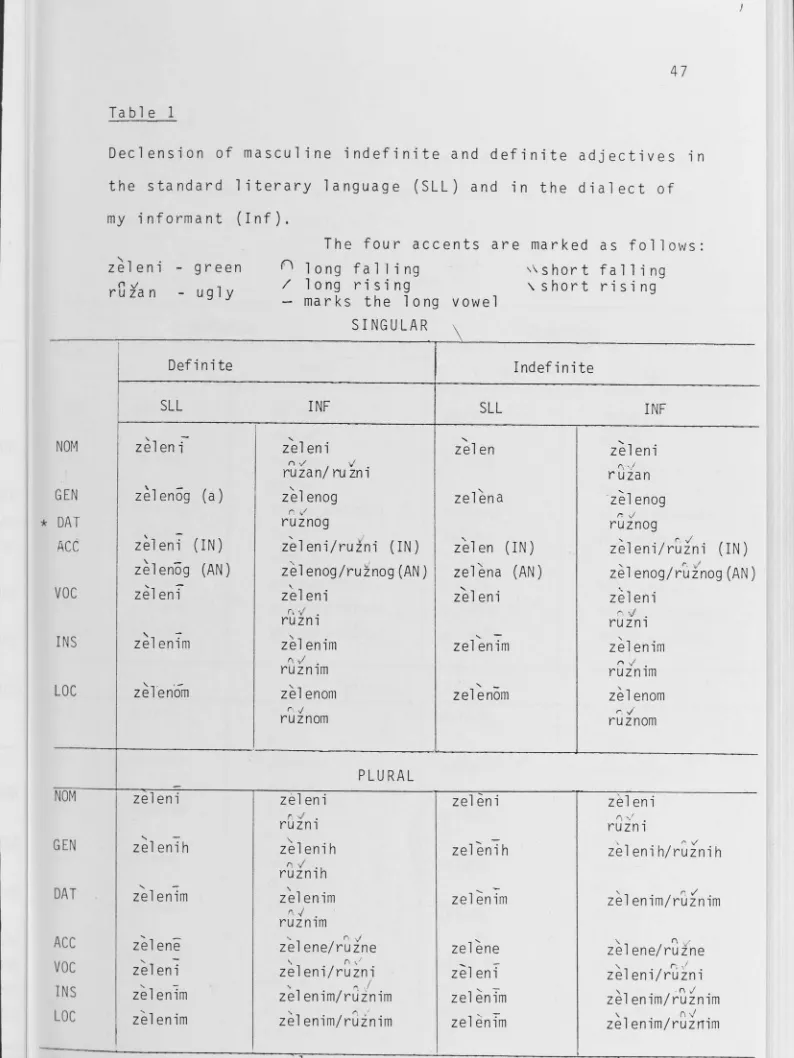
Table 1
Declension of masculine indefinite and definite adjectives ,n
the standard literary language (SLL) and in the dialect of
my informant (Inf).
The four accents are marked as follows: zeleni - green
(l v
r u za n - ugly
Definite
SLL
'
-ze 1 en i
zelenog (a)
n
long falling/ long rising marks the long
SINGULAR
INF
'
zeleni
n ·/ v
ru zan/ ru zn i
'
zelenog
r ,/
ruznog vowel
\
SLL ' zelen ' zelena,\short falling '\Short rising
Indefinite INF ... zeleni (\ ,/ ruzan ... -zelenog
("; J
ruznog
J
\
-zeleni (IN) zeleni/ruzni (IN) ' zelen (IN) ' zel eni/rufni (IN)
zelenog (AN)
'
-zeleni ' -zelenim '·
-ze lenom zeleni .... -zelenih ' -zelenim zelene ... -zeleni .... -zelenim zelenim ' -zelenorn zelenog/ruznog(AN) ' zeleninv .
ruzn, zelenim
{'\ ./
ruzn,m zelenom
" J
ruznom
zeleni r. "
ruzn, z~lenih
"'
,/ruznih
'
zelenim "' -I ruzn,m
PLURAL
' n ..j
zelene/ruzne
\ ('\ \ I
zeleni/ruzni
' "· . I
zelenim/ruinim zel enim/ruz'nim
zelenom ('\ I
ruznom
[image:55.817.5.799.33.1091.2]zelena (AN) zeleni ....
-zelenim ' -zel enom zeleni zelenih ' -zelenim ... zelene zeleni '- -zelenim zelenim ... zelenu, r, I
zelenog/ruznog(AN) zeleni
(i ,j .
ruzn, '
zelenim
" ,/ .
ruzn,m '
zelenom
r, , / ruznom
zeleni
r, ,I
' . .
ruzn,
' r- v
zelenih/ruznih
zel enim/rufnim
" (', ,I
zel ene/ruzne z
e
1 en i / r~~
n i. ('\ ..j zel enim/ruznim
' ~·J
zel enim/ruznim
zktenom