R E S E A R C H A R T I C L E
Open Access
Systematic review of the costs and
effectiveness of interventions to increase
infant vaccination coverage in low- and
middle-income countries
Cristina Munk
1†, Allison Portnoy
1,2*†, Christian Suharlim
2, Emma Clarke-Deelder
1, Logan Brenzel
3,
Stephen C. Resch
2and Nicolas A. Menzies
1,2Abstract
Background:In recent years, several large studies have assessed the costs of national infant immunization
programs, and the results of these studies are used to support planning and budgeting in low- and middle-income countries. However, few studies have addressed the costs and cost-effectiveness of interventions to improve immunization coverage, despite this being a major focus of policy attention. Without this information, countries and international stakeholders have little objective evidence on the efficiency of competing interventions for improving coverage.
Methods:We conducted a systematic literature review on the costs and cost-effectiveness of interventions to improve immunization coverage in low- and middle-income countries, including both published and unpublished reports. We evaluated the quality of included studies and extracted data on costs and incremental coverage. Where possible, we calculated incremental cost-effectiveness ratios (ICERs) to describe the efficiency of each intervention in increasing coverage.
Results:A total of 14 out of 41 full text articles reviewed met criteria for inclusion in the final review. Interventions for increasing immunization coverage included demand generation, modified delivery approaches, cash transfer programs, health systems strengthening, and novel technology usage. We observed substantial heterogeneity in costing methods and incompleteness of cost and coverage reporting. Most studies reported increases in coverage following the interventions, with coverage increasing by an average of 23 percentage points post-intervention across studies. ICERs ranged from $0.66 to $161.95 per child vaccinated in 2017 USD. We did not conduct a meta-analysis given the small number of estimates and variety of interventions included.
Conclusions:There is little quantitative evidence on the costs and cost-effectiveness of interventions for improving immunization coverage, despite this being a major objective for national immunization programs. Efforts to improve the level of costing evidence—such as by integrating cost analysis within implementation studies and trials of immunization scale up—could allow programs to better allocate resources for coverage improvement. Greater adoption of standardized cost reporting methods would also enable the synthesis and use of cost data.
© The Author(s). 2019Open AccessThis article is distributed under the terms of the Creative Commons Attribution 4.0 International License (http://creativecommons.org/licenses/by/4.0/), which permits unrestricted use, distribution, and reproduction in any medium, provided you give appropriate credit to the original author(s) and the source, provide a link to the Creative Commons license, and indicate if changes were made. The Creative Commons Public Domain Dedication waiver (http://creativecommons.org/publicdomain/zero/1.0/) applies to the data made available in this article, unless otherwise stated.
* Correspondence:[email protected]
†Cristina Munk and Allison Portnoy contributed equally to this work.
1
Department of Global Health and Population, Harvard T.H. Chan School of Public Health, Boston, MA, USA
2Center for Health Decision Science, Harvard T.H. Chan School of Public
Health, Boston, MA, USA
Background
A large body of evidence has demonstrated the effective-ness and cost-effectiveeffective-ness of infant immunization for re-ducing the burden of vaccine-preventable diseases [1, 2]. Routine immunization programs, supplemented by peri-odic campaigns, cover the majority of the target popula-tion in most countries, yet in many settings coverage remains below program goals [3]. Expanding coverage is a major objective of immunization programs, both to in-crease the magnitude of health benefits from vaccination and to reduce disparities in outcomes among underserved populations [4]. The remaining gaps in target coverage are especially prominent in low- and middle-income countries (LMICs), and so these settings have been a focus for on-going efforts to improve immunization efforts with both vertical and horizontal programs.
Several recent studies have been undertaken to de-scribe the costs of providing national immunization ser-vices [5–12]. This research provides precise estimates of the cost of providing services at current coverage levels in a range of countries, and describes variation in the costs and operating practices of individual immunization sites. However, these studies do not provide direct evi-dence on the costs or cost-effectiveness of strategies and interventions used to scale up immunization coverage. Without this information, countries and the inter-national stakeholders have little quantitative evidence on the best ways to use scarce resources to achieve immunization objectives. One possible source of infor-mation is studies that report the costs and effects of spe-cific coverage-enhancing interventions.
We conducted a systematic review on the costs and ef-fects of interventions to improve immunization coverage in LMICs, including research reported in the grey litera-ture. This review updates past initiatives to survey the evidence on interventions to improve immunization coverage in low-income, high-burden settings [1,2]. Sev-eral recent and historical studies have reviewed evidence related to immunization coverage improvements, but the majority of these have limited their scope to reporting effects on coverage or related programmatic outcomes, and excluded costs [13–19]. Three reviews have consid-ered both costs and effectiveness. In 2004, Pegurri, et al. summarized evidence in the peer-reviewed literature [1] and Batt, et al. reviewed the relevant grey literature [2]. Both of these reviews identified a limited number of LMIC studies meeting inclusion criteria, and concluded that heterogeneity in methods adopted by these studies prevented quantitative synthesis of results. Both reviews found that few studies reported costs, with 10 out of 60 and 15 out of 34 identified studies including costs, re-spectively. A recent review by Ozawa, et al. including ar-ticles through 2016, adopted a broader scope, including peer-reviewed studies from both low- and high-income
country settings, and covering all age groups, but ex-cluding grey literature [20]. While this study was able to undertake some quantitative synthesis of results, the au-thors acknowledged difficulties due to the heterogeneity of methods and reporting adopted by included studies, and the majority of estimates in their final sample came from high-income settings.
Our review returns to the approach of the earlier re-views with a focus on LMIC settings. In our review, we extracted data for studies conducted after the period covered by the Pegurri, et al. and Batt, et al. reviews (prior to 2003), as earlier studies were already included in these prior reviews, and following the reasoning that older research would be less relevant to contemporary planning and budgeting decisions. These earlier reviews stressed the importance of the grey literature in docu-menting findings in this field, and consequently we in-cluded both the peer-reviewed and grey literature in our review [1,2]. The objective of this review was to describe the incremental cost and effectiveness of interventions to increase coverage of infant immunization in LMICs, as defined by World Bank income group. The primary outcomes of interest were the incremental costs and in-cremental changes in target population coverage associ-ated with a coverage-improvement intervention, as compared to routine program performance.
Methods
This systematic review was registered with PROSPERO, an international prospective register of systematic reviews (record number 69586). We included interventions di-rected solely at increasing infant immunization coverage, as well as interventions designed to improve multiple as-pects of immunization performance including coverage. The target age group for infants was defined as age 1 year and below; therefore, measles, mumps, rubella, and vari-cella vaccination interventions were included. We only in-cluded studies that reported empirical data, and exin-cluded modeled analyses to minimize the introduction of add-itional bias into any summary results. We excluded inter-ventions designed to improve health service delivery generally (e.g., improvements in access to primary health care). We also excluded studies that reported changes in immunization coverage but did not describe specific inter-ventions used to impact infant immunization coverage. Studies with no data on intervention costs were excluded, as were those targeting adult immunization and animal studies. We included studies published between January 2003 (the end date of the period covered by older reviews [1,2]) and May 2019.
Search strategy and extraction
language limitations: CEA Registry, Cochrane Library, EconLit, Embase, PubMed, Social Science Research Net-work (SSRN), and Web of Science [21–23]. We also reviewed the reference lists of recent reviews of coverage improvement interventions [13, 20] as well as selected studies found in the initial title search [24–30].
We identified eligible studies in the grey literature by searching relevant databases and repositories, including World Health Organization (WHO) regional databases Lit-eratura Latino-Americana e do Caribe em Ciências da Saúde (LILACS) and African Index Medicus (AIM), ELDIS, the World Bank working papers, GreyNet, and Grey Litera-ture Report [31]. Reports found to have a matching publica-tion in the published literature were excluded.
We adopted previously developed sensitivity- and specificity-optimized search strategies for identifying healthcare cost studies and economic evaluations [31–34]. We tested the robustness of our search strategy by apply-ing it to the timeframe of the Pegurri, et al. review in PubMed and confirming that all studies included in the earlier review were identified by our search terms. Add-itional file 1 lists the complete search terms utilized for each of the databases. Search terms fell into four categor-ies: (1) immunization terms; (2) coverage terms; (3) cost terms; and (4) LMIC terms. Some databases limited the number of terms that could be searched; in such cases, the number of search terms was consolidated and, when necessary, distinct searches were performed for each cat-egory. Due to these limitations, LMIC search terms could not be included in every database.
Record titles and abstracts were independently screened by one of two reviewers (CM and AP) to iden-tify studies that met the inclusion criteria. Reports not meeting study inclusion criteria were excluded. Uncer-tainty about study inclusion was resolved by a third in-dependent investigator (NM).
From each of the included studies, we extracted infor-mation on the type of vaccination coverage intervention and study design; urban vs. rural setting; campaign vs. routine delivery; vaccination delivery platform; the base-line and endbase-line coverage or incremental coverage, where applicable; the intervention costs and intervention cost per person exposed; and the incremental cost-effectiveness ratio. This information was extracted for each unique intervention or country in a study. For ex-ample, if a study analyzed two different interventions in two different countries, we extracted information related to each of the four observations.
Analysis
Quality evaluation
We evaluated the methodological quality and risk of bias of included studies using the Consensus on Health Eco-nomic Criteria (CHEC) list [35]. We excluded the CHEC
list items that were specific to modeling analyses, as our review focused on empirical analyses. For each of the relevant items on the checklist, we assigned studies a score of zero or one (Additional file 2) [35]. A score of
“0” indicated that the selected element was not present in the article;“1”indicated the element was present.
Calculating incremental coverage
The primary outcomes of interest were the incre-mental costs and increincre-mental changes in target population coverage associated with a coverage-improvement intervention, as compared to routine program performance. We calculated incremental coverage (defined as the percentage point change in vaccination coverage for the target group) based on the reported study design and outcomes. For studies that measured coverage at baseline and at the vention conclusion, in both control (ctl) and inter-vention (int) groups (pre-post with control, including randomized control trials), incremental coverage was calculated as:
Incremental coverage¼ Intervention coverageint−Baseline coverageint
−Intervention coveragectl−Baseline coveragectl
:
In studies which measured coverage only at the inter-vention conclusion (post-test with control), incremental coverage was calculated as:
Incremental coverage¼ Intervention coverageint−Intervention coveragectl
In studies that measured coverage before and after the intervention without a control group (pre-post without control), incremental coverage was calculated as:
Incremental coverage¼ Intervention coverageint−Baseline coverageint
Calculating incremental intervention cost
For studies that measured costs at baseline and at the intervention conclusion, incremental intervention costs were calculated as:
Incremental intervention cost¼ðIntervention cost−Baseline costÞ
If studies included only incremental intervention costs, with no baseline costs stated, the stated intervention costs were listed. All costs were converted to 2017 USD using local inflation according to the consumer price index and local currency to USD exchange rates [36,37].
ICER¼Incremental intervention costs=ðIncremental coverage
Population exposed to interventionÞ
Some studies evaluated interventions that combined multiple health services, some of which were not focused on immunization [38, 39]. The costs reported by these studies were not broken out by immunization activities vs. other areas. For these studies, the ICER assumes that the costs of all included interventions are attributable solely to increasing immunization coverage, while the in-cremental coverage benefit is specific to immunization.
In other studies, the currency years of costs were un-clear. We contacted the authors of these studies to re-quest clarification of cost currency years, where possible, and assumed a currency year according to the year of the intervention otherwise. Nevertheless, several studies remained in which the ICER could not be calculated with the cost and coverage data provided.
Results
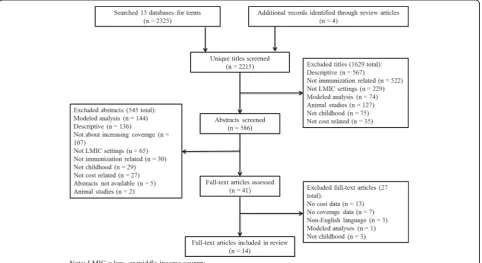
A total of 2325 records were identified from 15 data-bases (Fig.1), with an additional 4 records obtained from reference lists of other articles. After removing 114 du-plicates, 2215 titles were screened for eligibility, of which 1629 were removed. Of the 586 records remaining, 545 were removed after abstract review, leaving 41 articles which received full-text review. Of these, 27 were cluded for not meeting study inclusion criteria. We ex-amined the LMIC studies included in the Ozawa review
and added two relevant articles that we had previously excluded [40,41]. Fourteen studies were included in the final analysis [38–51].
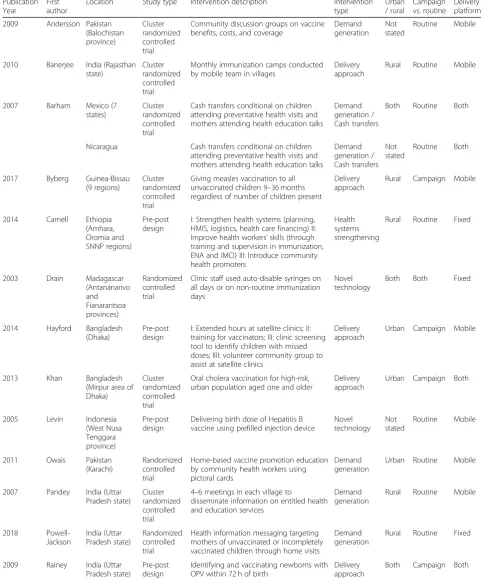
Table 1 describes general characteristics of the 14 studies. One study describes interventions from two countries (Mexico and Nicaragua); these were consid-ered separate observations when extracting cost and ef-fectiveness data [44]. More than half of the observations (n= 10) were conducted in Asia, with the remaining in Africa (Ethiopia, Guinea-Bissau, and Madagascar) and Central America (Mexico and Nicaragua). Observations were nearly evenly split with regard to setting: 6 were conducted in rural areas; 3 in urban; 3 in mixed settings and 3 were not specified. About half of the interventions (n= 7) were delivered in a mobile outreach format; 4 were delivered in a fixed (i.e., health facility) format, and 4 interventions utilized both a mobile and fixed format. Additionally, 10 interventions were administered within routine vaccination systems, while 5 were administered using a campaign format. One study utilized both rou-tine and campaign formats. Intervention duration ranged from 2 weeks to 5 years.
More than half of the studies (n= 9) reported random-ized controlled trials, with the remaining studies report-ing non-randomized pre-post evaluations (1 with control group, 3 without control groups) or cross-sectional de-signs. The majority of interventions were aimed at ap-proaches for vaccine delivery (n= 5) or approaches to encourage additional vaccine uptake (i.e., demand
[image:4.595.58.541.446.709.2]Table 1General features of the interventions
Publication Year
First author
Location Study type Intervention description Intervention type Urban / rural Campaign vs. routine Delivery platforma
2009 Andersson Pakistan (Balochistan province) Cluster randomized controlled trial
Community discussion groups on vaccine benefits, costs, and coverage
Demand generation
Not stated
Routine Mobile
2010 Banerjee India (Rajasthan state)
Cluster randomized controlled trial
Monthly immunization camps conducted by mobile team in villages
Delivery approach
Rural Routine Mobile
2007 Barham Mexico (7
states)
Cluster randomized controlled trial
Cash transfers conditional on children attending preventative health visits and mothers attending health education talks
Demand generation / Cash transfers
Both Routine Both
Nicaragua Cash transfers conditional on children attending preventative health visits and mothers attending health education talks
Demand generation / Cash transfers Not stated Routine Both
2017 Byberg Guinea-Bissau (9 regions)
Cluster randomized controlled trial
Giving measles vaccination to all unvaccinated children 9–36 months regardless of number of children present
Delivery approach
Rural Campaign Mobile
2014 Carnell Ethiopia (Amhara, Oromia and SNNP regions)
Pre-post design
I: Strengthen health systems (planning, HMIS, logistics, health care financing) II: Improve health workers’skills (through training and supervision in immunization, ENA and IMCI) III: Introduce community health promoters
Health systems strengthening
Rural Routine Fixed
2003 Drain Madagascar
(Antananarivo and Fianarantsoa provinces) Randomized controlled trial
Clinic staff used auto-disable syringes on all days or on non-routine immunization days
Novel technology
Both Both Fixed
2014 Hayford Bangladesh (Dhaka)
Pre-post design
I: Extended hours at satellite clinics; II: training for vaccinators; III: clinic screening tool to identify children with missed doses; IIII: volunteer community group to assist at satellite clinics
Delivery approach
Urban Campaign Mobile
2013 Khan Bangladesh
(Mirpur area of Dhaka)
Cluster randomized controlled trial
Oral cholera vaccination for high-risk, urban population aged one and older
Delivery approach
Urban Campaign Both
2005 Levin Indonesia
(West Nusa Tenggara province)
Pre-post design
Delivering birth dose of Hepatitis B vaccine using prefilled injection device
Novel technology
Not stated
Routine Mobile
2011 Owais Pakistan
(Karachi)
Randomized controlled trial
Home-based vaccine promotion education by community health workers using pictoral cards
Demand generation
Urban Routine Mobile
2007 Pandey India (Uttar Pradesh state)
Cluster randomized controlled trial
4–6 meetings in each village to
disseminate information on entitled health and education services
Demand generation
Rural Routine Mobile
2018 Powell-Jackson India (Uttar Pradesh state) Randomized controlled trial
Health information messaging targeting mothers of unvaccinated or incompletely vaccinated children through home visits
Demand generation
Rural Routine Fixed
2009 Rainey India (Uttar Pradesh state)
Pre-post design
Identifying and vaccinating newborns with OPV within 72 h of birth
Delivery approach
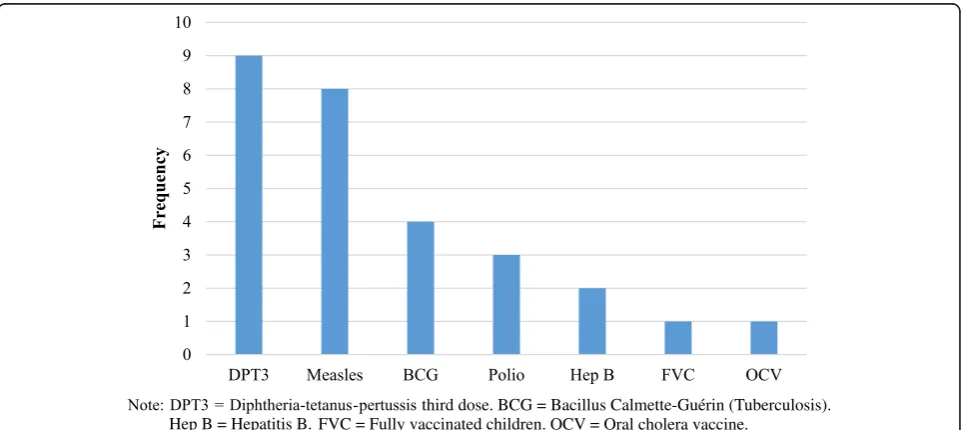
generation; n = 5). Additional studies were aimed at health systems strengthening or the introduction of novel vaccine technologies (e.g., syringes). The interven-tions targeted coverage improvements for a range of vac-cines, with DPT3 (diphtheria-pertussis-tetanus vaccine third dose) and measles vaccination most commonly ad-dressed (Fig.2).
Coverage and cost information
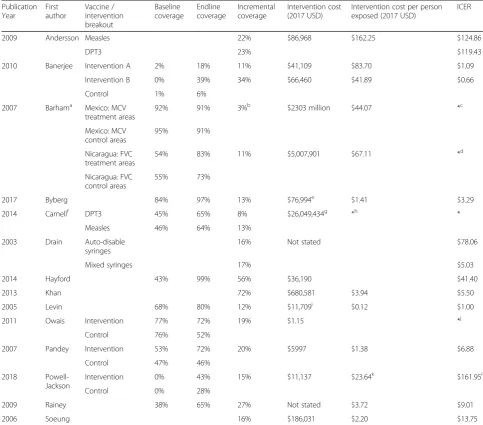
Table 2 summarizes coverage and cost data in the reviewed studies. If relevant values were not provided directly by studies, values were derived from the study data, such as incremental coverage, intervention cost (converted to 2017 USD), intervention cost in 2017 USD per person exposed, and ICERs. Intervention and base-line costs were primarily presented as total costs, with some studies presenting cost per person exposed [50] or cost per community health worker trained [49].
Most studies reported increases in vaccination coverage following the interventions. In our review coverage in-creased by an average of 23 percentage points post-intervention across the studies, with rates ranging from 8 [38] to 72 [40] percentage points. Interventions aimed at
improving and increasing delivery mechanisms saw the largest incremental coverage increases, at an average of 36 percentage points post-intervention [40, 43, 45, 47, 50]. While some studies did not provide baseline coverage, there was no apparent relationship between incremental coverage and baseline coverage, even when looking across intervention types. There was no discernable pattern be-tween low-income and middle-income country studies.
Given the small total number and methodological het-erogeneity of included studies, we decided not to at-tempt a quantitative synthesis of results. For those studies reporting coverage improvements with the inter-vention, ICERs ranged from $0.66 [43] to $161.95 [51] per child vaccinated in 2017 USD. There was also vari-ation in the intervention costs reported. Studies most commonly reported site-level immunization costs (46%, n= 6). The next most common reported costs were sup-ply chain and management costs (38%, n= 5), other costs (36%, n = 5), and vaccine costs (31%,n= 4).
Quality ratings
[image:6.595.57.540.99.170.2]Additional file 2 lists the quality scores each study received, according to the CHEC list, out of a total
Table 1General features of the interventions(Continued)
Publication Year
First author
Location Study type Intervention description Intervention type
Urban / rural
Campaign vs. routine
Delivery platforma
2006 Soeung Cambodia
Cross-sectional design
Developing and implementing immunization microplans that are supported by performance based agreements and a secure system of financing
Health systems strengthening
Rural Routine Fixed
a‘
Fixed’refers to vaccinations delivered in a health facility;‘mobile’refers to vaccinations delivered through mobile outreach services
[image:6.595.58.540.487.702.2]of 17 possible points. Scores ranged from 12 to 17, with a mean score of 14. Studies with the highest overall scores (averaging greater than or equal to 14
[image:7.595.55.539.99.524.2]out of 17) were more likely to include appropriate costs and outcomes, as well as incremental analysis. Seven out of 14 included studies were missing items Table 2Coverage and cost characteristics of included studies
Publication Year
First author
Vaccine / intervention breakout
Baseline coverage
Endline coverage
Incremental coverage
Intervention cost (2017 USD)
Intervention cost per person exposed (2017 USD)
ICER
2009 Andersson Measles 22% $86,968 $162.25 $124.86
DPT3 23% $119.43
2010 Banerjee Intervention A 2% 18% 11% $41,109 $83.70 $1.09
Intervention B 0% 39% 34% $66,460 $41.89 $0.66
Control 1% 6%
2007 Barhama Mexico: MCV treatment areas
92% 91% 3%b $2303 million $44.07 *c
Mexico: MCV control areas
95% 91%
Nicaragua: FVC treatment areas
54% 83% 11% $5,007,901 $67.11 *d
Nicaragua: FVC control areas
55% 73%
2017 Byberg 84% 97% 13% $76,994e $1.41 $3.29
2014 Carnellf DPT3 45% 65% 8% $26,049,434g *h *
Measles 46% 64% 13%
2003 Drain Auto-disable
syringes
16% Not stated $78.06
Mixed syringes 17% $5.03
2014 Hayford 43% 99% 56% $36,190 $41.40
2013 Khan 72% $680,581 $3.94 $5.50
2005 Levin 68% 80% 12% $11,709i $0.12 $1.00
2011 Owais Intervention 77% 72% 19% $1.15 *j
Control 76% 52%
2007 Pandey Intervention 53% 72% 20% $5997 $1.38 $6.88
Control 47% 46%
2018
Powell-Jackson
Intervention 0% 43% 15% $11,137 $23.64k $161.95l
Control 0% 28%
2009 Rainey 38% 65% 27% Not stated $3.72 $9.01
2006 Soeung 16% $186,031 $2.20 $13.75
DPT3diphtheria-pertussis-tetanus vaccination third dose,MCVmeasles-containing vaccine,FVCfully-vaccinated children,ICERincremental cost-effectiveness ratio *Data required to calculate ICER not included in study
a
Selected interventions listed here; full results can be found in the paper
b
Endline levels lower than baseline levels for both treatment and control areas, but the“program did lead to an equalization of vaccination rates between the treatment and control group, despite the treatment group’s coverage rate being 3 percentage points lower than in the control area at baseline”[44]
c
Intervention contained a package of health services (immunization and other health activities). However, intervention costs were given only at an aggregate level and therefore immunization ICERs could not be calculated
d
Intervention contained a package of health services (immunization and other health activities). However, intervention costs were given only at an aggregate level and therefore immunization ICERs could not be calculated
e
Intervention cost minus hospital cost savings (both in USD 2017)
f
Baseline and endline coverage estimates compiled from aggregating values for children 12–23 months in 6 intervention / control areas
g
Includes both vaccination and non-vaccination interventions
h
Size of the population exposed to the intervention not stated
i
Only one province (of three described in study) was scaling up pre-existing immunization services. However, costs were reported as an annual net cost to the government for the new device across all three provinces. We conservatively assumed this aggregate cost was specific to the single relevant province for the cost per person exposed and ICER calculations
j
Costs were only reported per community health worker. Costs per exposed child could not be determined
k
Cost per mother given the information intervention
l
required for the incremental analysis that we con-ducted, indicating a risk of bias within the calculated ICERs.
Discussion
We reviewed the recent literature describing the incre-mental cost and impact of efforts to improve immunization program coverage in LMIC, and identified 14 studies that containing sufficient cost and coverage data to be included in this study. The interventions reviewed in these studies covered a wide range of geo-graphic settings, vaccines, intervention types, delivery mechanisms and scales. About half of the studies were randomized controlled trials, and the average study score on the CHEC list was 14 out of 17. The majority of included studies reported increases in vaccination coverage following the examined interventions, similar to the results of the Pegurri, et al. 2004 and Batt, et al. 2004 reviews [1,2], which found coverage improvements of 27 percentage points and 20 percentage points on average, respectively.
Although all reviewed studies provided costs of the intervention itself, only 2 studies also considered changes in the costs of providing routine immunization services, despite the fact that such changes are a likely consequence of efforts to increase coverage. Eleven stud-ies (79%) provided adequate data to calculate ICERs. From these, 14 ICERs of different interventions were cal-culated, ranging from $0.66 [43] to $161.95 [51] per child vaccinated in 2017 USD. In several cases, calcula-tions of ICERs relied on substantial assumpcalcula-tions. Given the considerable differences in settings and perspectives, as well as different methods and cost categories in-cluded, an observed difference between ICERs may well reflect an artifact of the different study designs rather than a true feature of the interventions under study. Therefore, estimates should be compared with caution, and with full knowledge of the methodological and con-textual differences between two studies. Funding devoted to coverage improvements may not be utilized efficiently in the absence of better evidence on optimal approaches. Several factors prevented ICERs from being calculated in all studies. The interventions described in some stud-ies [38, 44] contained a package of health services (immunization and other health activities). However, intervention costs were given only at an aggregate level and therefore immunization ICERs could not be calcu-lated. Additionally, in one study the size of the popula-tion exposed to the intervenpopula-tion was not stated [38]. Similarly, in one study the costs were calculated at the level of health workers, so cost per exposed child could not be determined [49]. Due to the small total number and methodological heterogeneity of the extracted stud-ies, we were unable to conduct a quantitative synthesis
with cost estimates stratified by intervention type and country category.
Despite the 15-year gap since previous systematic re-views focusing on LMICs, there is still a scarcity of evi-dence on the cost-effectiveness of options for improving immunization coverage [1,2,20]. Studies rarely report es-timates of the incremental change in both cost and cover-age. Several of the studies that do provide such information failed to report key features of the study methods, which limits the utility of their results. In par-ticular, future studies should include detailed discussions of the intervention type (i.e., aimed at demand generation, delivery mechanisms, etc.), target population, baseline and endline coverage, specific intervention costs, changes in costs of routine service provision as well as information on effect modifiers that could affect incremental costs and coverage. Such information should be reported at a level of granularity that other programs would be able to inter-pret and modify those costs to fit their individual setting. These details are necessary to navigate the heterogeneity of the studies and to directly compare and synthesize the results to produce generalizable conclusions. The biggest challenge is that efforts to scale up immunization coverage often lack provision for a costing study, which represents a huge missed opportunity to understand the best use of scarce resources for improving coverage. We challenge the immunization community at country, regional, and global levels to incorporate costing studies into scaling up efforts.
Conclusions
This research underscores the need for broad adoption of standardized reporting methods in immunization costing studies [52,53]. This will be essential to increase our knowledge of improving immunization coverage as well as child immunization intervention costs.
Additional file 1:Search terms for each database. (DOCX 16 kb)
Additional file 2:Consensus on Health Economic Criteria (CHEC) list for health economic evaluations35and study scores. (DOCX 19 kb)
Abbreviations
AIM:African index medicus; CHEC: Consensus on health economic criteria; DPT3: Diphtheria-pertussis-tetanus vaccine third dose; ICER: Incremental cost-effectiveness ratio; LILACS: Literatura Latino-Americana e do Caribe em Ciências da Saúde; LMIC: Low- and middle-income country; SSRN: Social Science Research Network; USD: United States dollar; WHO: World Health Organization
Acknowledgements Not applicable.
Authors’contributions
Funding
Bill & Melinda Gates Foundation. An employee of the Bill & Melinda Gates Foundation participated as a co-investigator and author on this study. The funder of the study had no role in study design, or data collection, analysis, or interpretation. The funders were given the opportunity to review this paper prior to publication, but the final decision on the content of the publication was taken by the authors. The corresponding author had full access to all the data in the study and had final responsibility for the decision to submit for publication.
Availability of data and materials
The dataset supporting the conclusions of this article is included within the article (and its additional files).
Ethics approval and consent to participate Not applicable.
Consent for publication Not applicable.
Competing interests
The authors declare that they have no competing interests.
Author details
1Department of Global Health and Population, Harvard T.H. Chan School of
Public Health, Boston, MA, USA.2Center for Health Decision Science, Harvard T.H. Chan School of Public Health, Boston, MA, USA.3Bill & Melinda Gates
Foundation, Seattle, WA, USA.
Received: 26 March 2019 Accepted: 27 August 2019
References
1. Pegurri E, Fox-Rushby JA, Walker DG. The effects and costs of expanding the coverage of immunisation services in developing countries: a systematic literature review. Vaccine. 2004;23(13):1624–35.
2. Batt K, Fox-Rushby JA, Castillo-Riquelme M. The costs, effects and cost-effectiveness of strategies to increase coverage of routine immunizations in low- and middle-income countries: systematic review of the grey literature. Bull World Health Organ. 2004;82(9):689–96.
3. World Health Organization. Global vaccine action plan 2011–2020. Geneva; 2013. Available at:http://www.who.int/immunization/global_vaccine_ action_plan/GVAP_doc_2011_2020/en/. Accessed 1 Mar 2018 4. World Health Organization. Immunization, vaccines and biologicals: GIVS
goals. 2009 Available at:http://www.who.int/immunization/givs/goals/en/. Accessed 1 Mar 2018
5. Ahanhanzo CD, Huang XX, Le Gargasson JB, et al. Determinants of routine immunization costing in Benin and Ghana in 2011. Vaccine. 2015;33(Suppl 1):A66–71.
6. Brenzel L, Young D, Walker DG. Costs and financing of routine immunization: approach and selected findings of a multi-country study (EPIC). Vaccine. 2015;33(Suppl 1):A13–20.
7. Geng F, Suharlim C, Brenzel L, Resch SC, Menzies NA. The cost structure of routine infant immunization services: a systematic analysis of six countries. Health Policy Plan. 2017;32(8):1174–84.
8. Goguadze K, Chikovani I, Gaberi C, et al. Costs of routine immunization services in Moldova: findings of a facility-based costing study. Vaccine. 2015; 33(Suppl 1):A60–5.
9. Janusz CB, Castaneda-Orjuela C, Molina Aguilera IB, et al. Examining the cost of delivering routine immunization in Honduras. Vaccine. 2015;33(Suppl 1):A53–9. 10. Le Gargasson JB, Nyonator FK, Adibo M, Gessner BD, Colombini A. Costs of
routine immunization and the introduction of new and underutilized vaccines in Ghana. Vaccine. 2015;33(Suppl 1):A40–6.
11. Menzies NA, Suharlim C, Geng F, Ward ZJ, Brenzel L, Resch SC. The cost determinants of routine infant immunization services: a meta-regression analysis of six country studies. BMC Med. 2017;15(1):178.
12. Schutte C, Chansa C, Marinda E, et al. Cost analysis of routine immunisation in Zambia. Vaccine. 2015;33(Suppl 1):A47–52.
13. Johri M, Perez MC, Arsenault C, et al. Strategies to increase the demand for childhood vaccination in low- and middle-income countries: a systematic review and meta-analysis. Bull World Health Organ. 2015;93(5):339–46c.
14. LaFond A, Kanagat N, Steinglass R, Fields R, Sequeira J, Mookherji S. Drivers of routine immunization coverage improvement in Africa: findings from district-level case studies. Health Policy Plan. 2015;30(3):298–308.
15. Nelson KN, Wallace AS, Sodha SV, Daniels D, Dietz V. Assessing strategies for increasing urban routine immunization coverage of childhood vaccines in low and middle-income countries: a systematic review of peer-reviewed literature. Vaccine. 2016;34(46):5495–503.
16. Oyo-Ita A, Wiysonge CS, Oringanje C, Nwachukwu CE, Oduwole O, Meremikwu MM. Interventions for improving coverage of childhood immunisation in low- and middle-income countries. Cochrane Database Syst Rev. 2016;7:Cd008145.
17. Ryman TK, Dietz V, Cairns KL. Too little but not too late: results of a literature review to improve routine immunization programs in developing countries. BMC Health Serv Res. 2008;8:134.
18. Sridhar S, Maleq N, Guillermet E, Colombini A, Gessner BD. A systematic literature review of missed opportunities for immunization in low- and middle-income countries. Vaccine. 2014;32(51):6870–9.
19. Steinglass R. Routine immunization: an essential but wobbly platform. Global Health Sci Pract. 2013;1(3):295–301.
20. Ozawa S, Yemeke TT, Thompson KM. Systematic review of the incremental costs of interventions that increase immunization coverage. Vaccine. 2018; 36(25):3641–9.
21. Aguiar-Ibanez R, Nixon J, Glanville J, et al. Economic evaluation databases as an aid to healthcare decision makers and researchers. Expert Rev Pharmacoecon Outcomes Res. 2005;5(6):721–32.
22. Alton V, Eckerlund I, Norlund A. Health economic evaluations: how to find them. International journal of technology assessment in health care. Fall. 2006;22(4):512–7.
23. Royle P, Waugh N. Literature searching for clinical and cost-effectiveness studies used in health technology assessment reports carried out for the National Institute for clinical excellence appraisal system. Health Technol Asses. 2003;7(34):iii, ix–x, 1-51.
24. Brenzel L. Can investments in health systems strategies lead to changes in immunization coverage? Expert Rev vaccin. 2014;13(4):561–72.
25. Bassani DG, Arora P, Wazny K, Gaffey MF, Lenters L, Bhutta ZA. Financial incentives and coverage of child health interventions: a systematic review and meta-analysis. BMC Public Health. 2013;13(Suppl 3):S30.
26. Ranganathan M, Lagarde M. Promoting healthy behaviours and improving health outcomes in low and middle income countries: a review of the impact of conditional cash transfer programmes. Prev Med. 2012;55 Suppl: S95–s105.
27. Babigumira JB, Morgan I, Levin A. Health economics of rubella: a systematic review to assess the value of rubella vaccination. BMC Public Health. 2013; 13:406.
28. Martin S, Lopez AL, Bellos A, et al. Post-licensure deployment of oral cholera vaccines: a systematic review. Bull World Health Organ. 2014;92(12):881–93. 29. Owusu-Addo E, Cross R. The impact of conditional cash transfers on child
health in low- and middle-income countries: a systematic review. Int J Public Health. 2014;59(4):609–18.
30. Patel AR, Nowalk MP. Expanding immunization coverage in rural India: a review of evidence for the role of community health workers. Vaccine. 2010; 28(3):604–13.
31. Glanville J, Paisley S. Identifying economic evaluations for health technology assessment. Int J Technol Assess Health Care. 2010;26(4):436–40.
32. Glanville J, Kaunelis D, Mensinkai S. How well do search filters perform in identifying economic evaluations in MEDLINE and EMBASE. Int J Technol Assess Health Care. 2009;25(4):522–9.
33. McKinlay RJ, Wilczynski NL, Haynes RB. Optimal search strategies for detecting cost and economic studies in EMBASE. BMC Health Serv Res. 2006;6:67.
34. Wilczynski NL, Haynes RB, Lavis JN, Ramkissoonsingh R, Arnold-Oatley AE. Optimal search strategies for detecting health services research studies in MEDLINE. CMAJ. 2004;171(10):1179–85.
35. Evers S, Goossens M, de Vet H, van Tulder M, Ament A. Criteria list for assessment of methodological quality of economic evaluations: consensus on health economic criteria. Int J Technol Asses Health Care. 2005;21(2):240–5. 36. World Bank. World development indicators. Washington, DC: The World Bank;
2018. (Last updated: 31-Jan-2019). Available at:http://data.worldbank.org/ 37. International Monetary Fund. World Economic Outlook. Washington, DC.
38. Carnell MA, Dougherty L, Pomeroy AM, Karim AM, Mekonnen YM, Mulligan BE. Effectiveness of scaling up the‘three pillars’approach to accelerating MDG 4 progress in Ethiopia. J Health Popul Nutr. 2014;32(4):549–63. 39. Pandey P, Sehgal AR, Riboud M, Levine D, Goyal M. Informing resource-poor
populations and the delivery of entitled health and social services in rural India: a cluster randomized controlled trial. JAMA. 2007;298(16):1867–75. 40. Khan IA, Saha A, Chowdhury F, et al. Coverage and cost of a large oral
cholera vaccination program in a high-risk cholera endemic urban population in Dhaka, Bangladesh. Vaccine. 2013;31(51):6058–64. 41. Soeung SC, Grundy BM, Ly CK, et al. Improving immunization coverage
through budgeted microplans and sub-national performance agreements: early experience from Cambodia. Asia Pac J Public Health. 2006;18(1):29–38. 42. Andersson N, Cockcroft A, Ansari NM, et al. Evidence-based discussion
increases childhood vaccination uptake: a randomised cluster controlled trial of knowledge translation in Pakistan. BMC Int Health Hum Rights. 2009; 9(Suppl 1):S8.
43. Banerjee AV, Duflo E, Glennerster R, Kothari D. Improving immunisation coverage in rural India: clustered randomised controlled evaluation of immunisation campaigns with and without incentives. BMJ. 2010;340:c2220. 44. Barham T, Brenzel LE, Maluccio JA. Beyond 80%: are there new ways of
increasing vaccination coverage? Evaluation of CCT programs in Mexico and Nicaragua. SSRN Electron J. 2007.
45. Byberg S, Fisker AB, Thysen SM, et al. Cost-effectiveness of providing measles vaccination to all children in Guinea-Bissau. Glob Health Action. 2017;10(1):1329968.
46. Drain PK, Ralaivao JS, Rakotonandrasana A, Carnell MA. Introducing auto-disable syringes to the national immunization programme in Madagascar. Bull World Health Organ. 2003;81(8):553–60.
47. Hayford K, Uddin MJ, Koehlmoos TP, Bishai DM. Cost and sustainability of a successful package of interventions to improve vaccination coverage for children in urban slums of Bangladesh. Vaccine. 2014;32(20):2294–9. 48. Levin CE, Nelson CM, Widjaya A, Moniaga V, Anwar C. The costs of home
delivery of a birth dose of hepatitis B vaccine in a prefilled syringe in Indonesia. Bull World Health Organ. 2005;83(6):456–61.
49. Owais A, Hanif B, Siddiqui AR, Agha A, Zaidi AK. Does improving maternal knowledge of vaccines impact infant immunization rates? A community-based randomized-controlled trial in Karachi, Pakistan. BMC Public Health. 2011;11:239.
50. Rainey JJ, Bhatnagar P, Estivariz CF, et al. Providing monovalent oral polio vaccine type 1 to newborns: findings from a pilot birth-dose project in Moradabad district, India. Bull World Health Organ. 2009;87(12):955–9. 51. Powell-Jackson T, Fabbri C, Dutt V, Tougher S, Singh K. Effect and
cost-effectiveness of educating mothers about childhood DPT vaccination on immunisation uptake, knowledge, and perceptions in Uttar Pradesh, India: a randomised controlled trial. PLoS Med. 2018;15(3):e1002519.
52. Vassall A, Sweeney S, Kahn J, et al. Reference Case for Estimating the Costs of Global Health Services and Interventions. 2017 Last Updated: September 12, 2017. Available at:https://ghcosting.org/pages/standards/reference_case. Accessed 13 February 2019
53. Wilkinson T, Sculpher MJ, Claxton K, et al. The international decision support initiative reference case for economic evaluation: an aid to thought. Value Health. 2016;19(8):921–8.
Publisher’s Note