Correspondence
Analysis of research output parameters: Density equalizing
mapping and citation trend analysis
Beatrix Groneberg-Kloft*
1,2, Cristian Scutaru
2,3, Axel Fischer
1, Tobias Welte
2,
Carolin Kreiter
3and David Quarcoo
3Address:1Otto-Heubner Centre, Charité-Universitätsmedizin Berlin, Free University Berlin and Humboldt-University Berlin, Berlin, Germany, 2Department of Respiratory Medicine, Hannover Medical School, Hannover, Germany and3Institute of Occupational Medicine, Charité-Universitätsmedizin Berlin, Free University Berlin and Humboldt-University Berlin, Berlin, Germany
E-mail: Beatrix Groneberg-Kloft* - [email protected]; Cristian Scutaru - [email protected];
Axel Fischer - [email protected]; Tobias Welte - [email protected]; Carolin Kreiter - [email protected]; David Quarcoo - [email protected];
*Corresponding author
Published: 27 January 2009 Received: 19 May 2008
BMC Health Services Research2009,9:16 doi: 10.1186/1472-6963-9-16 Accepted: 27 January 2009
This article is available from: http://www.biomedcentral.com/1472-6963/9/16 ©2009 Groneberg-Kloft et al; licensee BioMed Central Ltd.
This is an Open Access article distributed under the terms of the Creative Commons Attribution License (http://creativecommons.org/licenses/by/2.0), which permits unrestricted use, distribution, and reproduction in any medium, provided the original work is properly cited.
Abstract
Background: Burden of disease studies indicate major socio-economic burdens since many years. They should be used for the allocation of funding. However, imbalances are present in funding policies and therefore benchmarking becomes increasingly important in health services research.
Methods: The present study assessed benchmarking approaches. Using large data base analyses, research was analyzed for different health research output parameters. The fields of cardiovascular and respiratory medicine served as models to assess irregular patterns of health research. For visualization, density equalizing mapping procedures were used.
Results: Specific areas of major research activity were identified for European countries and large differences were found. Spatial distribution of published items for cardiac and cardiovascular systems differed in comparison to the distribution for the respiratory system. In general, large countries dominated the overall number of published items. When qualitative measures such as citation analysis were assessed, differing results were achieved. In this category, mostly Scandinavian countries dominated.
Conclusion: The present approach of comparative output benchmarking can be used to assess institutional operating figures at the national and international level and to analyze imbalances in health and research funding.
Background
Respiratory and cardiovascular diseases play a prominent role in burden of disease studies [1] and the global burden studies indicate major socio-economic burdens of these diseases since many years [2].
Disease burden can be defined as the impact of a health problem in an area measured by financial cost, mortality, morbidity, or other indicators. The burden is often quantified in terms of Disability-adjusted life years (DALYs) [3] or Quality-adjusted life years
(QALYs) [4, 5]. They combine the burden due to both death and morbidity into one index. This allows the comparison of the disease burden in relation to various risk factors or diseases.
With regard to the different diseases listed in the burden of disease ranking, respiratory diseases play a prominent role [1]. In this respect, four of the top ten listed diseases are disorders of the respiratory tract [2]. In view of the anticipated socio-economic burden, it should be expected that there are major health system and research invest-ments into this field of medicine in developed countries. Next to respiratory diseases, disorders of the cardiovascular system also play a prominent role in health systems of industrialized countries and major funding is directed to the treatment and research in this area.
In contrast to these clear socio-economic features, research funding policy is partly controversy in many countries. A variety of publications addressed these issues for areas of medicine and research which are heavily funded by governmental and non-governmental sources. These areas are i.e. cardiovascular medicine [6], neurosciences [7], gastroenterology [8], genetics [9], stem cell research [10-12], or rehabilitation sciences [13, 14].
Reviewing the diversity of policies in Europe [15] and general statements [16-20], it is obvious that studies are urgently needed that compare input and output in socio-economic important fields of medicine in order to evaluate funding policy. To meet this goal systematic scientometric analysis of the existing research data in one field has been undertaken in the recent years [21, 22]. To handle the enormous amount of data a method has been developed to illustrate the findings in an appealing way. Density-equalizing maps alter the size of regions according to a parameter found in this region, like population or incidence of a disease. Thereby maps are created with easy accessible visual information about the given parameter in a geographic context [23].
The present study was conducted to evaluate different research output parameters. The two important fields of respiratory and cardiovascular diseases which are ranked high in the burden of diseases studies were chosen as target fields. Europe was used as model since there are various centers related to cardiology and respiratory medicine.
Methods and design
Data source
Data was retrieved from the biomedical database Web of Science provided by the Thomson Institute for Scientific Information (ISI) [24].
Search strategies
For the different searches, phrases joined together with Boolean operators, i.e. AND, OR and NOT were used.
Time frame
A time frame was set and all entries between the years 1900 and 2007 were analyzed. The year 2008 was not included since entries for 2008 are still not terminated in 2008. Some data were added up to five year periods (1973–1977; 1978–1982; 1983–1987; 1988–1992; 1993–1997; 1998–2002; 2003–2007) to provide an overview over a larger period of time.
Number and origin of publications
The phrases heart* OR cardiac* OR cardio* combined with the names of the European Union countries and Switzerland were used to find articles related to the cardiac system. Using the filter function from ISI Web only articles which were assigned to the subject category "Cardiac & Cardiovascular system" were filtered and analyzed. Analogue, using the search words lung* OR Airway* OR Respirat* or pneumo* and respectively the subject area "Respiratory system", provided the respiratory articles. All publication that were retrieved using the below mentioned search strategies that were published in the investigated timeframe were used.
Quality analysis: Number of citations in relation to origin of publications
To provide data on the quality of the published items, the citation information of the articles was used for the articles that were identified in the previous step. This method was used to assess the average citations per item, indicating the average number of citing articles for all items in the set. It is the sum of the times cited divided by the number of results found. In specific, every single of the identified 89604 articles in the category "cardiac and cardiovascular systems" and the 36322 in the category "respiratory systems" were analyzed for the number of its citations. Values were displayed with the introduction of a threshold of at least 30 published items per country in order to filter out mavericks.
Density-equalizing mapping
Statistical analysis
Correlation between publication number or citation rate and socioeconomic variables were calculated by using the Pearson correlation analysis in SPSS 17.0. All parameters were first checked for normal distribution using the non-parametric Kolmogorov-Smirnov-test. The gross domestic product was correlated to the purchasing power parity (IMF http://www.imf.org/external/data. htm). The data for population was retrieved from the WHO (WHOSIS http://www.who.int/whosis/en/index. html).
Results
Published items in cardiac medicine
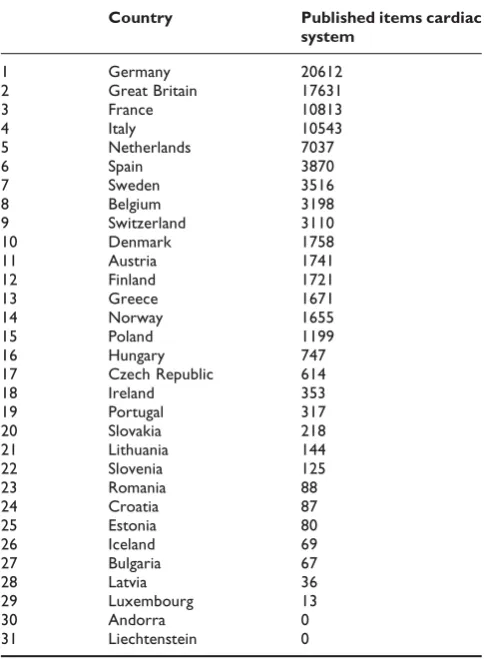
Large differences between the various European Union countries were found (Table 1). In specific, Germany published 23% of all items in "cardiac and cardiovas-cular systems". Thus the relative proportion of Germany increased in the density equalizing score (Fig. 1). Germany was followed by the UK (19.67%), France (12.06%), Italy (11.76%), the Netherlands (7.85%) and Spain (4.31%). All other countries contributed with
25.14%. Due to international cooperation, multiple assignment of an article occured.
Published items in respiratory medicine
As seen with cardiology, large differences between the European countries were present (Table 2). In specific, UK contributed 27.28% of all published items in the category "respiratory medicine". Thus the relative pro-portion of the UK increased in the density equalizing score (Fig. 2). The UK was followed by France (16.66%), Germany (12.62%), Italy (10.12%), the Netherlands (7.26%) and Spain (6.37%). All other countries con-tributed with 26.88%. As previously stated, due to international cooperation, multiple assignment of an article occured.
Published items: time course
To evaluate the kinetic of publication we analyzed the total publication output of the countries in five years intervals (see additional files 1 and 2). For both fields a continuing rise of publication was found with a tendency to increased progression after the year 1997. Except for one case (respiratory systems, Poland 1983– 1987) we did not detect great country based variations of output. The increase of publications was also visualized for respiratory medicine in one-year steps using density-equalizing calculations (see additional files 3).
Citations per published items in cardiac medicine
[image:3.610.314.551.83.266.2]To provide qualitative data the citation report analysis was used for all articles that were found in the previously assigned published items. With a threshold of 30 Table 1: Country-specific total number of published items in the
category "cardiac and cardiovascular systems" (89604 identified articles in 131 journals analyzed)
Country Published items cardiac
system
1 Germany 20612
2 Great Britain 17631
3 France 10813
4 Italy 10543
5 Netherlands 7037
6 Spain 3870
7 Sweden 3516
8 Belgium 3198
9 Switzerland 3110
10 Denmark 1758
11 Austria 1741
12 Finland 1721
13 Greece 1671
14 Norway 1655
15 Poland 1199
16 Hungary 747
17 Czech Republic 614
18 Ireland 353
19 Portugal 317
20 Slovakia 218
21 Lithuania 144
22 Slovenia 125
23 Romania 88
24 Croatia 87
25 Estonia 80
26 Iceland 69
27 Bulgaria 67
28 Latvia 36
29 Luxembourg 13
30 Andorra 0
[image:3.610.54.297.396.726.2]31 Liechtenstein 0
Figure 1
published items (Table 3), three Scandinavian countries Iceland and the Netherlands were ranked in the first 5 positions (Finland with a mean citation per item of 23.57 followed by Iceland (20.45), the Netherlands (20.15), Sweden (19.80) and Denmark (19.29). Germany that led the overall number of published items analysis was ranked 12 with a value of 13.36. When the data of the citation analysis was transferred to density-equalizing mapping and the threshold of at least 30 publications was used, the resulting map is presented in Fig. 3.
Citations per published items in respiratory medicine
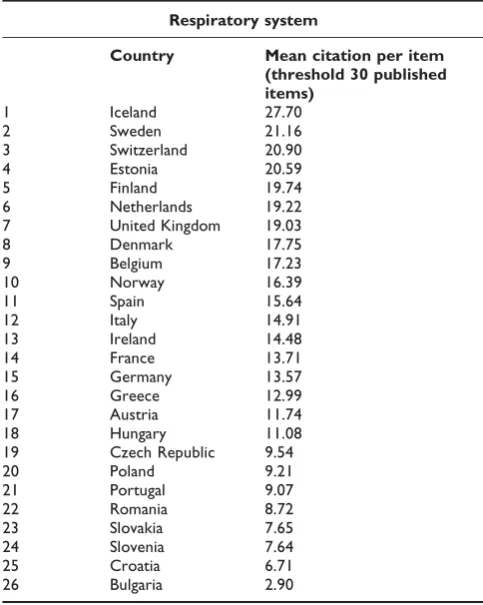
[image:4.610.313.552.82.274.2]The citation analysis for the articles published in the respiratory system category led to slightly differing results (Table 4). Here, Iceland dominated the ranking with a relation of 27.70 citations per item followed by Sweden (21.16). Switzerland were ranked 3 (20.90), Estonia 4 (20.59), and Finland 5 (19.74. United King-dom placed 7th with a value of 19.03 before Germany which placed 15th(13.57). Density-equalizing mapping produced a continental shape presented in Fig. 4.
Table 2: Country-specific total number of published items in the category "respiratory system" (36322 identified articles in 58 journals analyzed)
Country Published items
respiratory system
1 Great Britain 9908
2 France 6052
3 Germany 4585
4 Italy 3675
5 Netherlands 2636
6 Spain 2313
7 Belgium 1831
8 Sweden 1824
9 Switzerland 1382
10 Denmark 737
11 Finland 695
12 Greece 601
13 Austria 601
14 Poland 513
15 Norway 402
16 Ireland 283
17 Czech Republic 205
18 Hungary 180
19 Portugal 95
20 Slovakia 79
21 Bulgaria 59
22 Iceland 57
23 Croatia 51
24 Romania 47
25 Estonia 46
26 Slovenia 44
27 Lithuania 15
28 Latvia 6
29 Andorra 5
30 Luxembourg 4
31 Liechtenstein 0
Figure 2
[image:4.610.301.552.371.725.2]Spatial distribution of published items using density-equalizing mapping: respiratory medicine. Color coding encodes total number of published items per country.
Table 3: Country-specific mean citation per published item in the category "cardiac and cardiovascular systems"
Cardiac system
Country Mean citation per Item (threshold 30 published items)
1 Finland 23.57
2 Iceland 20.45
3 Netherlands 20.15
4 Sweden 19.80
5 Denmark 19.29
6 United Kingdom 17.47
7 Ireland 17.33
8 Belgium 17.29
9 Norway 17.17
10 Switzerland 16.50
11 Italy 15.71
12 Germany 13.36
13 Austria 12.73
14 France 12.47
15 Hungary 10.71
16 Spain 10.69
17 Romania 10.40
18 Poland 10.11
19 Czech Republic 9.51
20 Portugal 8.52
21 Greece 8.26
22 Estonia 8.05
23 Slovenia 7.72
24 Latvia 7.39
25 Slovakia 6.59
26 Croatia 4.69
27 Lithuania 3.40
28 Bulgaria 2.60
29 Andorra 0.00
30 Liechtenstein 0.00
[image:4.610.54.299.394.727.2]Cooperation analysis
[image:5.610.314.548.83.269.2]Country identity analysis demonstrated that the USA and Germany are the leading countries concerning bilateral cooperation in cardiac medicine with a total of 1990 cooperation articles (Fig. 5). For respiratory medicine USA and UK lead the international cooperation with 616 articles (Fig. 6). A country specific analysis of coopera-tion for Germany and UK is presented in the addicoopera-tional files 4 and 5.
Figure 3
Spatial distribution of citations per published item: cardiac and cardiovascular systems. Density equalizing mapping with threshold of 30 published item per country. Color coding encodes average citation per published item per country.
Table 4: Country-specific mean citation per published item in the category "respiratory system"
Respiratory system
Country Mean citation per item (threshold 30 published items)
1 Iceland 27.70
2 Sweden 21.16
3 Switzerland 20.90
4 Estonia 20.59
5 Finland 19.74
6 Netherlands 19.22
7 United Kingdom 19.03
8 Denmark 17.75
9 Belgium 17.23
10 Norway 16.39
11 Spain 15.64
12 Italy 14.91
13 Ireland 14.48
14 France 13.71
15 Germany 13.57
16 Greece 12.99
17 Austria 11.74
18 Hungary 11.08
19 Czech Republic 9.54
20 Poland 9.21
21 Portugal 9.07
22 Romania 8.72
23 Slovakia 7.65
24 Slovenia 7.64
25 Croatia 6.71
[image:5.610.58.296.83.269.2]26 Bulgaria 2.90
Figure 4
Spatial distribution of citations per published item: respiratory system. Density equalizing mapping with threshold of 30 published item per country. Color coding encodes average citation per published item per country.
Figure 5
[image:5.610.53.295.424.727.2] [image:5.610.315.553.459.674.2]Correlation of bibliometric with socioeconomic data
For cardiac medicine a strong correlation was found for the number of articles and the gross domestic product (r = .952, p = 0.01) and population (r = .889, p = 0.01). The average citation per item neither correlate with population nor with the gross domestic product.
For respiratory medicine a strong correlation was found for the number of articles and the gross domestic product (r = .953, p = 0.01) and population (r = .926, p = 0.01). The average citation per item neither correlate with population nor with the gross domestic product.
Discussion and conclusion
The current policy settings for health system and research funding allocation urgently needs to be reviewed, since there may be imbalances present regarding socio-economic features. Research evaluation and policy projects in countries such as the US or Australia have demonstrated the existence and nature of this problem in their countries but there is still a lack of a scientific approach for many areas of research especially in European countries where only little data is available [25-27]. Therefore, the present study aimed to assess different output parameters using the fields of respira-tory and cardiovascular medicine. In contrast to some of the recent studies with similar a goal we choose a category-, rather than journal-based searching strategy thereby avoiding the omittance of journals that have changed their status [28, 29] (e.g. being renamed or closed down). Also, this approach bears the advantage of including important articles that have been published in
journals that are of more general orientation, never the less containing important new diagnostic, pathophysio-logical or therapeutical aspects of respiratory, respec-tively cardiac diseases. For the general output parameter of published items major differences were found between single countries: The UK led the field of respiratory medicine with 9908 published items in total. In this category, Germany was ranked third behind France (6052) with less than half the amount of published articles (4585). By contrast, in the category cardiac and cardiovascular systems, Germany ranked #1 with 20612 published items followed by the UK with 17631 and France with 10813 published items. The reasons for these differences may be at least two-fold: 1) It is known that Germany, although economically strong, has a low ratio of respiratory physicians in comparison to other European countries [30]. Therefore, a lower number of specialists may lead to a lower number of studies. 2) The number of full professorships and department chairs for respiratory medicine (C4/W3 salary level) is disproportional in Germany in compar-ison to other countries: There are 37 medical school department chairs for cardiology but only 7 for respiratory medicine. This imbalance might also be a reason for the lower number of entries in the database. Reasons for the low numbers of respiratory medicine chairs at German medical school may base on traditional and economic interests: 1) Historically, respiratory disorders in the times of tuberculosis were treated in remote hospitals but not in university medical school departments [31, 32]. Therefore, respiratory medicine might have been underrepresented at the faculties. 2) Economically, diagnostic procedures in cardiology such as left heart catheters bring a larger financial benefit than respiratory diagnostic procedures [33]. Therefore, med-ical faculties may be biased to the direction of cardiologic professorships due to economical reasons. Future studies should analyze these imbalances in closer detail.
As a second approach in the present study, the average citation for each published item was calculated for each country in both categories. Since a low number of published items with no first or senior authorship could lead to a major distortion of the real scientific output, a threshold was included to the density equalizing calculations leading to a more proportional visualization with regard to the overall numbers of published items.
[image:6.610.57.298.84.269.2]The following problems can occur within the present study setting: Database biases. There is a bias towards English-speaking countries. In this respect, the issue of linguistic differences and its effects on publication quantity should be taken into account. In the present data base searches all languages were included. The majority of publications are Figure 6
published in English and it is more difficult for non-English journals to get included in the data bases. Therefore, a higher proportion of scientific publications in languages other than English are not accessible in comparison to English-written publications. Therefore, English speaking countries such as the UK or Ireland should have an advantage. However, it is generally accepted that scientists from non-English speaking coun-tries in Europe publish their high quality research in scientific journals that use English as language. It can therefore be estimated that the number of highly cited publications is relatively low in journals not listed in the presently analyzed two categories of "cardiac and cardio-vascular systems" and "respiratory system".
In summary, the present study encompasses a novel approach to assess and compare research output para-meters. The study was conducted to provide and interpret quantitative benchmarking data in the European Union. Benchmarking systems basing on research output can be efficiently used to identify individual and regional differences. However, these approaches should be backed up by detailed analyses of socio-economic features to improve European policy settings for research evaluation.
Competing interests
The authors declare that they have no competing interests.
Authors' contributions
BGK conceived the scientific study, participated in the design and co-ordination of the study, performed the analysis, and drafted and prepared the manuscript. CS, CK and DQ conceived the scientific study and partici-pated in the interpretation, AF and TW helped to interpret the data. All authors read and approved the final manuscript.
Additional material
Additional file 1
Cardiac system time evolution of published items per country.The data provided represent the number of published items related to the cardiac system between 1973 and 2007.
Click here for file
[http://www.biomedcentral.com/content/supplementary/1472-6963-9-16-S1.tiff]
Additional file 2
Respiratory system time evolution of published items per country.The data provided represent the number of published items related to the respiratory system between 1973 and 2007.
Click here for file
[http://www.biomedcentral.com/content/supplementary/1472-6963-9-16-S2.tiff]
Additional file 3
Time-space distribution of published items related to respiratory medicine using density-equalizing mapping and one-year steps. The film sequence visualizes the total increase in respiratory medicine publications. The color coding encodes the total number of published items per country over the time.
Click here for file
[http://www.biomedcentral.com/content/supplementary/1472-6963-9-16-S3.avi]
Additional file 4
Radar chart–unilateral cooperation of Germany for cardiac and respectively respiratory systems.These 2 radar charts represent the unilateral cooperations of Germany for publications related to the cardiac and the respiratory system.
Click here for file
[http://www.biomedcentral.com/content/supplementary/1472-6963-9-16-S4.tiff]
Additional file 5
Radar chart–unilateral cooperation of UK for cardiac and respectively respiratory systems.These 2 radar charts represent the unilateral cooperations of the UK for publications related to the cardiac and the respiratory system.
Click here for file
[http://www.biomedcentral.com/content/supplementary/1472-6963-9-16-S5.tiff]
References
1. Chung F, Barnes N, Allen M, Angus R, Corris P, Knox A, Miles J, Morice A, O'Reilly J and Richardson M:Assessing the burden of respiratory disease in the UK.Respir Med2002,96:963–975. 2. Lopez AD, Mathers CD, Ezzati M, Jamison DT and Murray CJ:
Global and regional burden of disease and risk factors, 2001: systematic analysis of population health data. Lancet 2006, 367:1747–1757.
3. Murray CJ, Kreuser J and Whang W:Cost-effectiveness analysis and policy choices: investing in health systems. Bull World Health Organ1994,72:663–674.
4. Nord E: The significance of contextual factors in valuing health states.Health Policy1989,13:189–198.
5. Donaldson C, Atkinson A, Bond J and Wright K:QALYS and long-term care for elderly people in the UK: scales for assess-ment of quality of life.Age Ageing1988,17:379–387.
6. Fuster V: Dilemmas of NIH funding for cardiovascular research.Circulation1998,98:1253–1254.
7. Time to reform European science funding. Nat Neurosci2004, 7:895.
8. Lewison G, Grant J and Jansen P:International gastroenterology research: subject areas, impact, and funding. Gut 2001, 49:295–302.
9. Schiermeier Q: Berlin places genomics among top funding priorities.Nature1999,402:568.
10. Campbell A:Ethos and economics: examining the rationale underlying stem cell and cloning research policies in the United States, Germany, and Japan.Am J Law Med2005,31:47– 86.
11. Stevens D: Embryonic stem cell research: will President Bush's limitation on federal funding put the United States at a disadvantage? A comparison between U.S. and interna-tional law.Houst J Int Law2003,25:623–653.
12. Taylor PL: The gap between law and ethics in human embryonic stem cell research: overcoming the effect of U. S. federal policy on research advances and public benefit.Sci Eng Ethics2005,11:589–616.
14. DeLisa JA and Rosenthal M: Funding for rehabilitation medi-cine: building research capacity.Am J Phys Med Rehabil 2005, 84:991–998.
15. Anderson A: Funding in Europe: how the big three cope. Science1991,254:1118.
16. Beauchamp TL: Ethical issues in funding and monitoring university research.Bus Prof Ethics J1992,11:5–16.
17. Jellinek MS and Levine RJ:IRBs and pharmaceutical company funding of research.IRB1982,4:9–10.
18. Gronbjerg KA: How nonprofit human service organizations manage their funding sources: key findings and policy implications.Nonprofit Manag Leadersh1991,2:159–175. 19. Ratcliffe J:The influence of funding agencies on international
health policy, research and programs.Mobius1985,5:93–115. 20. Geisow MJ: Public funding of research and development: a
broad picture.Trends Biotechnol1991,9:76–77.
21. Fritzsche FR, Oelrich B, Dietel M, Jung K and Kristiansen G: European and US publications in the 50 highest ranking pathology journals from 2000 to 2006.J Clin Pathol2007. 22. Klaic B: The use of scientometric parameters for the
evaluation of scientific contributions. Coll Antropol 1999, 23:751–770.
23. Gastner MT and Newman ME:From The Cover: Diffusion-based method for producing density-equalizing maps.Proc Natl Acad Sci USA2004,101:7499–7504.
24. Sevinc A:Web of science: a unique method of cited reference searching.J Natl Med Assoc2004,96:980–983.
25. France G: Centralised versus decentralised funding of evaluative research: impact on medical technology policy in Italy.Soc Sci Med1994,38:1635–1641.
26. Boldt J and Zoch TB: [Funding of research projects – the importance of foundations]. Anasthesiol Intensivmed Notfallmed Schmerzther2002,37:600–603.
27. Wiley MM: The Irish health system: developments in strategy, structure, funding and delivery since 1980.Health Econ2005,14:S169–186.
28. Garcia-Rio F, Serrano S, Dorgham A, Alvarez-Sala R, Ruiz Pena A, Pino JM, Alvarez-Sala JL and Villamor J:A bibliometric evaluation of European Union research of the respiratory system from 1987–1998.Eur Respir J2001,17:1175–1180.
29. Michalopoulos A and Falagas ME: A bibliometric analysis of global research production in respiratory medicine. Chest
2005,128:3993–3998.
30. European Respiratory Society: European Lung White Book.2003.
31. Breu K:[History of the tuberculosis care in Germany].Offentl Gesundheitswes1971,33(Suppl 2):37–42.
32. Tegtmeier A:[The development of tuberculosis santoria and tuberculosis care in Germany.]. Z Arztl Fortbild (Jena) 1960, 54:580–583.
33. van Hout BA, Goes ES, Grijseels EW and van Ufford MA:Economic evaluation in the field of cardiology: theory and practice.Prog Cardiovasc Dis1999,42:167–173.
34. Rosell R, Gomez-Codina J, Camps C, Javier Sanchez J, Maestre J, Padilla J, Canto A, Abad A and Roig J:Preresectional chemother-apy in stage IIIA non-small-cell lung cancer: a 7-year assessment of a randomized controlled trial. Lung Cancer
1999,26:7–14.
Pre-publication history
The pre-publication history for this paper can be accessed here:
http://www.biomedcentral.com/1472-6963/9/16/prepub
Publish with BioMed Central and every scientist can read your work free of charge
"BioMed Central will be the most significant development for disseminating the results of biomedical researc h in our lifetime."
Sir Paul Nurse, Cancer Research UK
Your research papers will be:
available free of charge to the entire biomedical community
peer reviewed and published immediately upon acceptance
cited in PubMed and archived on PubMed Central
yours — you keep the copyright
Submit your manuscript here:
http://www.biomedcentral.com/info/publishing_adv.asp