Calculation of the probability of quantum transitions
in the system by the method of functional integration
AlexanderBiryukov1,∗,IgorMatveev2,, andMarkShleenkov1,∗∗
1Samara National Research University, 34, Moskovskoye shosse, Samara, 443086, Russia
2Povolzhskiy State University of Telecommunications and Informatics, 23, L. Tolstoy str., Samara, 443010, Russia
Abstract.The probabilities of quantum transitions are described by integrals over trajectories in the space of energy states of a system exposed to an electro-magnetic field. We describe quantum transitions in hydrogen atom.
1 Introduction
Describing the interaction between a quantum system and an intense electromagnetic field is quite difficult when using means of the theory of perturbation [1, 2]. Developing nonpertur-bative ways of describing the evolution of a quantum system exposed to an elec- tromagnetic field is therefore important. One non-perturbative approach is the formalism of functional integration (integrating over trajectories) [3, 4].
In this work, the probability of transitions over any interval of time between the states of a quantum system interacting with an electromagnetic field are presented in the form of an integral over trajectories in the space of the energy states of a system. Since it is difficult to obtain an analytical solution for these integrals, we propose an algorithm for their numerical integration that is based on recurrent relationships.
2 Probabilities of transitions in the formalism of functional integrals
in the space of energy states
Let us consider a multilevel quantum system that interacts with an electromagnetic field. It is described by Hamiltonian ˆH, written as
ˆ
H=Hˆsyst+Vˆ, (1)
where ˆHsystis the Hamiltonian of the quantem system that determines its stationary states|n
with energiesEn:
ˆ
Hsyst|n=En|n, n|n=δnn
N
n=1
|nn|=1, n=1,2, . . . (2)
where ˆV is the operator of interaction between the system and the electromagnetic field, and Nis the number of quantum states of the system. We shall describe a system at momenttby state vector|t, whose equation of evolution in our concept of interaction has the form
|t=UˆD|0, UˆD(t)=Tˆexp
−ı
t
0 ˆ VD(τ)dτ
(3)
ˆ
VD(τ)=exp ı
Hˆsystτ
ˆ
VD(τ) exp
−ıHˆsystτ
(4)
where ˆUD(t), ˆVD(τ) are the operators of evolution and interaction in Dirac’s concept.
We shall assume that in our model, the operator of interaction between an electron of the system and a plane electromagnetic wave is determined by the expression
ˆ
V(τ)=exEˆ x0(τ) cos (Ωτ), (5)
where ˆx,eare the coordinate and the electron charge, respectively;E0
x(τ) is the projection of
the wave amplitude onto axisx, wich can change over time; andΩis the field’s frequency of vibration. In the basis presented by vectors (2), we write operator (4) in the form
ˆ VD=
N
n,n=1 1
2ΩRnn(τ)exp [−ı(Ω−ωnn)τ]+exp [ı(Ω +ωnn)τ]|nn|, (6)
whereΩRnn(τ) = e|n|xˆ|n|Ex0(τ)/ is the Rabi frequency andωnn = (En−En)/ is the frequency of a transition between levels.
Our problem is to determine probabilitiesP(nf,t|nin,0) of transitioning between quantum
states|ninand|nfwhent=0 andt>0 for a system under the influence of an
electromag-netic field.
We write Eq. (3) in the energy representation, using the basis presenter by vectors (2),
nf|t= N
nin=1
nf|UˆD(t)|ninnin|0, (7)
wherenf|UˆD(t)|ninis the amplitude of a quantum transition from state|ninat momentt=0 to state|nfat momentt >0. ProbabilityP(nf,t|nin,0) of this quantum transition is
corre-spondingly expressed as
P(nf,t|nin,0)=nf|UˆD(t)|ninnin|UˆD†(t)|nf. (8)
To calculate probability of transition (8), we must specify the explicit form of transition amplitudenf|UˆD(t)|ninfor finite interval of timet, using the group properties of operator
ˆ
UD(t) and the entirety of state vectors|n, which we write in the form
nf|UˆD(t)|nin= N
n1,...,nK−1
K
k=1
nk|UˆD(t)|nk−1, (9)
wheretk=t,nK =nf,t0 =0,nin=n0and|nkare the vectors of state at momenttk;
nk|UˆD(t)|nk−1=nk|Tˆexp
−ı
t
0 ˆ VD(τ)dτ
where ˆVis the operator of interaction between the system and the electromagnetic field, and Nis the number of quantum states of the system. We shall describe a system at momenttby state vector|t, whose equation of evolution in our concept of interaction has the form
|t=UˆD|0, UˆD(t)=Tˆexp
−ı t 0 ˆ VD(τ)dτ
(3)
ˆ
VD(τ)=exp ı
Hˆsystτ
ˆ
VD(τ) exp
−ıHˆsystτ
(4)
where ˆUD(t), ˆVD(τ) are the operators of evolution and interaction in Dirac’s concept.
We shall assume that in our model, the operator of interaction between an electron of the system and a plane electromagnetic wave is determined by the expression
ˆ
V(τ)=exEˆ 0x(τ) cos (Ωτ), (5)
where ˆx,eare the coordinate and the electron charge, respectively;E0
x(τ) is the projection of
the wave amplitude onto axisx, wich can change over time; andΩis the field’s frequency of vibration. In the basis presented by vectors (2), we write operator (4) in the form
ˆ VD=
N
n,n=1 1
2ΩRnn(τ)exp [−ı(Ω−ωnn)τ]+exp [ı(Ω +ωnn)τ]|nn|, (6)
whereΩRnn(τ) = e|n|xˆ|n|E0x(τ)/ is the Rabi frequency andωnn = (En−En)/ is the frequency of a transition between levels.
Our problem is to determine probabilitiesP(nf,t|nin,0) of transitioning between quantum
states|ninand|nfwhent=0 andt>0 for a system under the influence of an
electromag-netic field.
We write Eq. (3) in the energy representation, using the basis presenter by vectors (2),
nf|t= N
nin=1
nf|UˆD(t)|ninnin|0, (7)
wherenf|UˆD(t)|ninis the amplitude of a quantum transition from state|ninat momentt=0 to state|nfat momentt >0. ProbabilityP(nf,t|nin,0) of this quantum transition is
corre-spondingly expressed as
P(nf,t|nin,0)=nf|UˆD(t)|ninnin|UˆD†(t)|nf. (8)
To calculate probability of transition (8), we must specify the explicit form of transition amplitudenf|UˆD(t)|ninfor finite interval of timet, using the group properties of operator
ˆ
UD(t) and the entirety of state vectors|n, which we write in the form
nf|UˆD(t)|nin= N
n1,...,nK−1
K
k=1
nk|UˆD(t)|nk−1, (9)
wheretk=t,nK=nf,t0=0,nin=n0and|nkare the vectors of state at momenttk;
nk|UˆD(t)|nk−1=nk|Tˆexp
−ı t 0 ˆ VD(τ)dτ
|nk−1, tk>tk−1 (10)
is the amplitude of the quantum transition between states|nk−1and|nkfor the brief interval
of time tk−tk−1. Once amplitude nk|UˆD(t)|nk−1 of transition is plotted in explicit form according to formula (9), we find explicit amplitude of transition for any range of timest.
We now show for proposed model of interaction (6) that amplitude (10) of quantum tran-sition for the fairly brief interval of timetk−tk−1= ∆tkhas the form [5]
nk|UˆD(tk,tk−1)|nk−1= 1
0
exp[−ıS[nk,tk;nk−1,tk−1;ξk−1]]dξk−1, (11)
where operationS[nk,tk;nk−1,tk−1;ξk−1] in units ofis defined by the expression
S[nk,tk;nk−1,tk−1;ξk−1]= 2π(nk−nk−1)ξk−1+ ΩRnknk−1∆tk
cos2π(nk−nk−1)ξk−1−
Ω−ωnk,nk−1tk
+
+cos2π(nk−nk−1)ξk−1−
Ω +ωnk,nk−1tk
. (12)
wheretk= 12(tk+tk−1) andωnknk−1= 1
E
nk−Enk−1
is frequency of thatsition between levels. The amplitude of a system transitioning between quantum states for any interval of time t is determined by (9) with allowance for formulas (11) and (12):
nf|UˆD|nin=RˆKexp
−ıSnf,nK−1, ξK−1;. . .;n1,nin, ξ0
, (13)
where
S nf,nK−1, ξK−1;. . .;n1,nin, ξ0
=
K
k=1
Snk,tk,nk−1,tk−1, ξk−1, (14)
ˆ RK =
K
k=0 ˆ
Rkand operators ˆRkhave the form
ˆ Rk=
N
nk=1
N
mk=1
1
0 dξk
1
0
dχk, k=1,2, . . . (15)
ˆ R0=
1
0 dξ0
1
0
dχ0, (16)
It is clear that the conjugate amplitude of transition has exactly the same structure with a change in the sign before imaginary unit i. Substituting formula (13) and conjugate amplitude into expression (8), we obtain the probability of a quantum transition from state|ninin to state
|nffor finite interval of timet.
3 Calculation of transitions probabilities for hydrogen atom
For the numerical calculation of the amplitude, we present it in the form of a recurrent
formula whereS is defined by (12). We calculate the probabilities of hydrogen atom staying
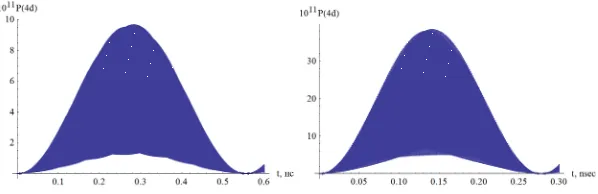
at the levels 3s, 3p, 4s, 4p, 4d, initially prepared in the state 2s. The electic fieldEis directed
along thezaxis. Non-zero Rabi frequencies between quantum states forE =0.5·106V/m
are ΩR2s,3p/2π = 1.80 GHz, ΩR2s,4p/2π = 0.75 GHz, ΩR3s,4p/2π = 3.22 GHz, ΩR3p,4s/2π =
2.87 GHz,ΩR3p,4d/2π=3.98 GHz.
Figure 1.The probability of detecting an atom in a state of 3p.E=0.5·106V/m (left), 106V/m (right)
Figure 2.The probability of detecting an atom in a state of 4p.E=0.5·106V/m (left), 106V/m (right)
Figure 3.The probability of detecting an atom in a state of 4s.E=0.5·106V/m (left), 106V/m (right)
For the numerical calculation of the amplitude, we present it in the form of a recurrent
formula whereS is defined by (12). We calculate the probabilities of hydrogen atom staying
at the levels 3s, 3p, 4s, 4p, 4d, initially prepared in the state 2s. The electic fieldEis directed
along thezaxis. Non-zero Rabi frequencies between quantum states forE =0.5·106V/m
are ΩR2s,3p/2π = 1.80 GHz, ΩR2s,4p/2π = 0.75 GHz, ΩR3s,4p/2π = 3.22 GHz, ΩR3p,4s/2π =
2.87 GHz,ΩR3p,4d/2π=3.98 GHz.
Figure 1.The probability of detecting an atom in a state of 3p.E=0.5·106V/m (left), 106V/m (right)
Figure 2.The probability of detecting an atom in a state of 4p.E=0.5·106V/m (left), 106V/m (right)
Figure 3.The probability of detecting an atom in a state of 4s.E=0.5·106V/m (left), 106V/m (right)
Figure 4.The probability of detecting an atom in a state of 4d.E=0.5·106V/m (left), 106V/m (right)
The results of the numerical calculation are presented in figures 1-4 (there are the results
for the amplitude of the electric fieldE=0.5·106V/m (left) andE=106V/m (right).
The figure 1 illustrate the classical Rabi oscillations. The figure 2 shows the probability of detection of the system in the 4p state. Here we illustrate the process of multiphoton transition from the 2s state. Figures 3 and 4 shows the probability of system detection in the 4s and 4d states from the 3p state.
Thus, the proposed the method successfully describes both single-photon and multi-photon transitions and transitions through virtual levels. The presence of multimulti-photon pro-cesses is confirmed by the probability of transitions increasing with an increase in the electric field strength. The presence of multiphoton processes is confirmed by the dependence of the probability of transitions on the electric field.
4 Conclusion
The proposed method successfully describes quantum transitions in the system under the action of an electromagnetic wave. This formalism describes both single-photon processes and multi-photon processes. The analysis shows that it is suitable for describing a wide class of quantum systems.
References
[1] Ge, W., Hemmer, P.R., Suhail Zubairy, M., Phys. Rev. A,87, 023818 (2013)
[2] Biryukov, A.A., Danilyuk, B.V., Proc. SPIE,7024, 702405 (208)
[3] Feynman, R.P. and Hibbs, A.R.Quantum Mechanics and Path Integrals(McGraw-Hill,
1965) 365
[4] Biryukov, A.A., Shleenkov, M.A., Vestn. Samar. Gos. Tekh. Univ., Ser. Fiz.-Mat. Nauki,
19, 221 (2015)
[5] Biryukov, A. A., Degtyareva Ya. V., Shleenkov M. A., Bulletin of the Russian Academy