RESEARCH NOTE
Validity and reliability of the Utrecht Work
Engagement Scale-Student Version in Sri Lanka
Nuwan Darshana Wickramasinghe
1*, Devani Sakunthala Dissanayake
2and Gihan Sajiwa Abeywardena
3Abstract
Objective: The present study was aimed at assessing the validity and the reliability of the Sinhala version of the Utre-cht Work Engagement Scale-Student Version (UWES-S) among collegiate cycle students in Sri Lanka.
Results: The 17-item UWES-S was translated to Sinhala and the judgmental validity was assessed by a multi-discipli-nary panel of experts. Construct validity of the UWES-S was appraised by using multi-trait scaling analysis and explora-tory factor analysis (EFA) on data obtained from a sample of 194 grade thirteen students in the Kurunegala district, Sri Lanka. Reliability of the UWES-S was assessed by using internal consistency and test–retest reliability. Except for item 13, all other items showed good psychometric properties in judgemental validity, convergent validity and item-discriminant validity. EFA using principal component analysis with Oblimin rotation, suggested a three-factor solution (including vigor, dedication and absorption subscales) explaining 65.4% of the total variance for the 16-item UWES-S (with item 13 deleted). All three subscales show high internal consistency with Cronbach’s α coefficient values of 0.867, 0.819, and 0.903 and test–retest reliability was high (p < 0.001). Hence, the Sinhala version of the 16-item UWES-S is a valid and a reliable instrument to assess work engagement among collegiate cycle students in UWES-Sri Lanka. Keywords: Work engagement, UWES-S, Collegiate cycle, Sri Lanka, Exploratory factor analysis, Validity, Reliability
© The Author(s) 2018. This article is distributed under the terms of the Creative Commons Attribution 4.0 International License (http://creat iveco mmons .org/licen ses/by/4.0/), which permits unrestricted use, distribution, and reproduction in any medium, provided you give appropriate credit to the original author(s) and the source, provide a link to the Creative Commons license, and indicate if changes were made. The Creative Commons Public Domain Dedication waiver (http://creat iveco mmons .org/ publi cdoma in/zero/1.0/) applies to the data made available in this article, unless otherwise stated.
Introduction
Keeping on par with the emerging trend towards a posi-tive psychology focusing on optimal functioning rather than on malfunctioning, a growing enthusiasm is evident in student engagement research during the last few dec-ades [1].
Work engagement is defined as, “a positive, fulfilling, work-related state of mind that is characterised by vigor (VI), dedication (DE), and absorption (AB). Rather than a momentary and specific state, engagement refers to a more persistent and pervasive affective-cognitive state that is not focused on any particular object, event, indi-vidual or behaviour” [2].
Engagement of students in their academic environment has been studied in numerous disciplines [3–10] and the global literature suggests that students’ engagement is positively linked with their academic performances [11,
12] and positive academic outcomes [13–16]. Hence, educators and policymakers are increasingly focusing on student engagement as a means of addressing problems of negative academic outcomes of varying student groups [17].
Amongst the different assessment tools of student work engagement, the most commonly used instrument is the Utrecht Work Engagement Scale-Student Version (UWES-S) [2, 18–22], which is a 17-item self-report measure assessing VI, DE, and AB subscales.
Even though a plethora of research has been conducted on work engagement among varying student populations across the globe, there is a paucity of literature in the South Asian context with no published literature on work engagement among Sri Lankan students, mainly owing to the lack of validated assessment tools. In the context of ever-increasing burden of mental health problems in the Sri Lankan collegiate cycle students [23–26], explo-ration of effective strategies for mental health and well-being promotion has become a timely need. Hence, the present study was designed to assess the validity and the
Open Access
*Correspondence: [email protected]
1 Department of Community Medicine, Faculty of Medicine and Allied
reliability of a culturally adapted Sinhala version of the UWES-S among collegiate cycle students in Sri Lanka.
Main text
Methods
Structure of the UWES‑S
The 17-item UWES-S is a self-administered question-naire (SAQ) with six, five, and six items assessing VI, DE and AB subscales respectively, measured on a seven-point Likert scale anchored by the response options from 0 (never) to 6 (every day).
Translation and pre‑testing of the UWES‑S
The 17-item UWES-S was translated to Sinhala by using the forward–backward translation method [27–29], involving two independent bilingual translators, who are fluent in Sinhala and English.
The synthesised forward translation of UWES-S was pre-tested among a sample of 25 grade thirteen students outside the study setting. In a subsequent structured interview, the clarity in understanding, acceptability, and comprehension of items and feasibility of using the tionnaire were assessed. None of the items of the ques-tionnaire was claimed to be difficult to understand.
Appraising the judgemental validity of the UWES‑S
The face, content, and consensual validity were assessed. Using a modified Delphi technique, a multi-disciplinary panel of experts in the fields of psychiatry, psychology, public health, teaching, student counseling, and medi-cal education has assessed each item on its relevance, appropriateness, and acceptability in the local context for assessing burnout among collegiate cycle students based on a rating scale from 0 (strong disagreement) to 10 (strong agreement). At the end of this iterative pro-cess, except for the item 13 stating, “When studying, I am very resilient, mentally”, all other items had a median score more than 7 for all the aspects. Thus, it was decided to include all 17 items for the assessment of construct validity.
Study design and setting
This school-based, cross-sectional validation study was conducted in the Kurunegala district, North Western province, Sri Lanka from May 2014 to April 2015. In Sri Lanka, the collegiate cycle in the education system con-sists of grade twelve and thirteen. Three Sinhala medium government schools in the Kurunegala district having all four collegiate cycle subject streams, viz., Science, Arts, Commerce and Technology were selected.
Study participants
From the selected schools, three grade thirteen classes each were selected representing both male and female students studying in all four subject streams. A total of 194 students participated in the study in their classrooms and each participant filled the SAQ inde-pendently. The response rate was 100.0% and 55.2% (n = 107) of the sample were females. The mean age was
18.3 years (SD = 0.43 years). The majority of students
were studying in the Science stream (n = 78, 40.2%).
The numbers of students in the Arts, Commerce and the Technology streams were 60 (30.9%), 41 (21.2%), and 15 (7.7%) respectively.
Data analysis
Data were analysed by using the Statistical Package for Social Sciences (SPSS) version 17.0. Preparatory data analysis showed that there were no violations of the assumptions related to the data analytic techniques. Given that the participants to variables ratio was 11.4, the sample size was adequate for factor analysis [30]. Even though there were few items that showed non-normal distribution of data, it is considered to be a ubiquitous phenomenon in psychological assessment research.
Multi‑trait scaling analysis
Item-scale correlations were analysed and item-con-vergent and item-discriminant validity were assessed. A stringent criterion of correlation of 0.40 or greater between an item and its own subscale was considered as a success for assessing item-convergent validity. Furthermore, in assessing item-discriminant validity, items that correlated significantly higher (more than 1.96 standard errors) with its own subscale than with the other two subscales, were considered as scaling successes.
Exploratory factor analysis (EFA)
EFA was conducted by Principal Component Analy-sis (PCA) with Oblimin rotation. Kaiser’s criterion/ eigenvalue, scree plot and parallel analysis were used to decide the number of factors to retain. The factors that lead to a meaningful interpretation and theoretical sense were ultimately selected.
Assessment of reliability
Results
Descriptive statistics of the UWES‑S scores
Descriptive statistics of UWES-S subscales are given in Table 1. The mean item score was highest in the AB subscale (4.52, SD = 1.40) and was lowest in the DE subscale (3.70, SD = 1.23).
Multi‑trait scaling analysis
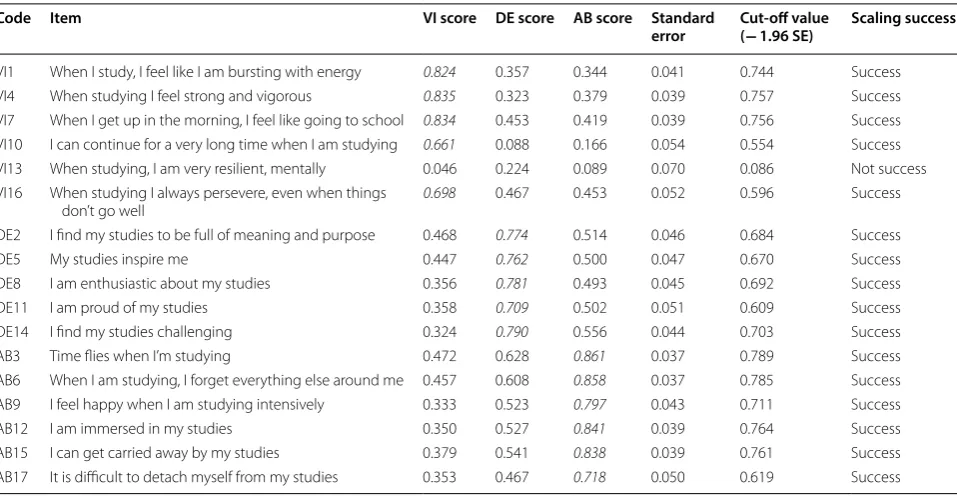
Table 2 summarises the results of the multi-trait scal-ing analysis and as per the predetermined cut-off values, except for item 13, convergent validity and item-discriminant validity were confirmed for other 16 items in the UWES-S.
Exploratory factor analysis
Item 13 was found to have poor psychometric proper-ties in judgemental validity, item-convergent validity, and item-discriminant validity. Deletion of item 13 from the
subscale also improved the internal consistency. Hence, both 17-item UWES-S and 16 items of the UWES-S (item 13 deleted) were subjected to PCA. The Kaiser– Meyer–Olkin Measure were 0.851 and 0.855 respectively and Bartlett’s test of sphericity reached statistical signifi-cance (p < 0.001) for both versions.
Only three factors had eigenvalues more than 1.0, which cumulatively explained 63.9% and 65.5% of the total variance for the 17-item and 16-item UWES-S ver-sions respectively. For both verver-sions, the parallel analysis showed only two factors with eigenvalues exceeding the corresponding criterion values and the screeplot showed a clear break after the second factor.
However, for both versions, the component matrix in PCA with unrotated loadings revealed a number of items of UWES-S loading on the third factor with values greater than 0.3. Furthermore, the pattern matrix gener-ated in PCA using direct Oblimin rotation revealed that seven items had loading values more than 0.3. Based on this collective evidence, it was decided to ‘force’ a three-factor solution for further investigation.
[image:3.595.56.290.113.181.2]Even though both Varimax rotation and Oblimin rota-tion was used, it was decided to report statistics related to Oblimin rotation as the factors were strongly corre-lated (> 0.3). The rotated three-factor solution revealed a simple structure with all three factors showing a num-ber of strong loadings. In the 17-item UWES-S version, the three-factor solution explained a total of 63.9% of
Table 1 Descriptive statistics of the UWES-S subscale scores among grade thirteen students (n = 194)
Subscale Mean total score SD Mean item
score SD
VI 22.66 6.34 3.78 1.06
DE 18.48 6.14 3.70 1.23
[image:3.595.59.538.477.725.2]AB 27.14 8.43 4.52 1.40
Table 2 Analysis of item-scale correlations to determine item-discriminant scaling successes for the UWES-S scores (n = 194)
Code Item VI score DE score AB score Standard
error Cut‑off value(− 1.96 SE) Scaling success
VI1 When I study, I feel like I am bursting with energy 0.824 0.357 0.344 0.041 0.744 Success
VI4 When studying I feel strong and vigorous 0.835 0.323 0.379 0.039 0.757 Success
VI7 When I get up in the morning, I feel like going to school 0.834 0.453 0.419 0.039 0.756 Success VI10 I can continue for a very long time when I am studying 0.661 0.088 0.166 0.054 0.554 Success VI13 When studying, I am very resilient, mentally 0.046 0.224 0.089 0.070 0.086 Not success VI16 When studying I always persevere, even when things
don’t go well 0.698 0.467 0.453 0.052 0.596 Success
DE2 I find my studies to be full of meaning and purpose 0.468 0.774 0.514 0.046 0.684 Success
DE5 My studies inspire me 0.447 0.762 0.500 0.047 0.670 Success
DE8 I am enthusiastic about my studies 0.356 0.781 0.493 0.045 0.692 Success
DE11 I am proud of my studies 0.358 0.709 0.502 0.051 0.609 Success
DE14 I find my studies challenging 0.324 0.790 0.556 0.044 0.703 Success
AB3 Time flies when I’m studying 0.472 0.628 0.861 0.037 0.789 Success
AB6 When I am studying, I forget everything else around me 0.457 0.608 0.858 0.037 0.785 Success
AB9 I feel happy when I am studying intensively 0.333 0.523 0.797 0.043 0.711 Success
AB12 I am immersed in my studies 0.350 0.527 0.841 0.039 0.764 Success
AB15 I can get carried away by my studies 0.379 0.541 0.838 0.039 0.761 Success
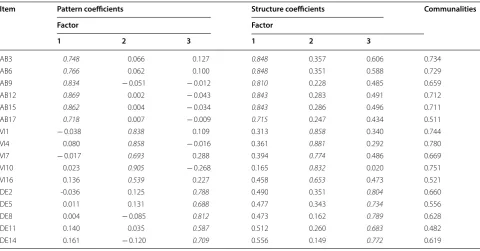
the variance, with factor one contributing 41.4%, factor two contributing 14.9%, and factor three contributing 7.6%, whereas, the corresponding values for the 16-item UWES-S version were 65.4, 44.0, 14.2, and 7.2%. Table 3 shows the pattern and structure matrix for PCA with Oblimin rotation of three-factor solution of 16-item UWES-S.
The interpretation of three-factor solution of the UWES-S with item 13 deleted, was consistent with pre-vious research on the UWES-S, with subscale items of VI, DE, and AB loading strongly on three different fac-tors. Hence, the three-factor solution with item 13 deleted was considered as the validated Sinhala version of the UWES-S.
Assessment of reliability
The impact of each item on the related subscale was assessed by computing Cronbach’s α when the respec-tive item is deleted. None of the items in DE subscale and AB subscale improved the overall Cronbach’s α value; however, deletion of item 13 improved the Cronbach’s α value from 0.696 to 0.867. Hence, item 13 was removed from the UWES-S and the reliability was re-assessed for internal consistency and all three subscales show high internal consistency with Cronbach’s α coefficient values of 0.867, 0.819, and 0.903 for VI, DE, and AB subscales respectively.
There were strong, positive statistically significant (p < 0.001) correlations for each of the three subscales of the UWES-S in test–retest reliability assessment. The correlation coefficients were 0.831, 0.866 and 0.839 for the VI, DE, and AB subscales respectively.
Discussion
The present study was designed to validate the Sinhala version of the UWES-S among Sri Lankan collegiate cycle students addressing an important research vacuum on work engagement research in high school students in the South Asian context. A cross-sectional study design and the sample size of the study deemed appropriate with the study objective.
In assessing the judgemental validity, item 13 (“When studying, I am very resilient, mentally”) had the least median rating score and the main concern raised regard-ing the item was the difficulty in explainregard-ing the phrase “mentally resilience” in Sinhala language. The global lit-erature suggests that modified versions of the UWES-S with removal of several items have been used in work engagement among high school, college, and university students [21, 22, 31].
Even though the three-factor structure of the Utrecht Work Engagement Scale (UWES) has been confirmed in a large number of studies [32–36], the limited num-ber of studies that explored the factor validity of the UWES-S have failed to provide convincing evidence to support the three-factor structure of the UWES-S [37].
Table 3 Pattern and structure matrix for PCA with Oblimin rotation of three-factor solution of 16-item UWES-S
Item Pattern coefficients Structure coefficients Communalities
Factor Factor
1 2 3 1 2 3
AB3 0.748 0.066 0.127 0.848 0.357 0.606 0.734
AB6 0.766 0.062 0.100 0.848 0.351 0.588 0.729
AB9 0.834 − 0.051 − 0.012 0.810 0.228 0.485 0.659
AB12 0.869 0.002 − 0.043 0.843 0.283 0.491 0.712
AB15 0.862 0.004 − 0.034 0.843 0.286 0.496 0.711
AB17 0.718 0.007 − 0.009 0.715 0.247 0.434 0.511
VI1 − 0.038 0.838 0.109 0.313 0.858 0.340 0.744
VI4 0.080 0.858 − 0.016 0.361 0.881 0.292 0.780
VI7 − 0.017 0.693 0.288 0.394 0.774 0.486 0.669
VI10 0.023 0.905 − 0.268 0.165 0.832 0.020 0.751
VI16 0.136 0.539 0.227 0.458 0.653 0.473 0.521
DE2 -0.036 0.125 0.788 0.490 0.351 0.804 0.660
DE5 0.011 0.131 0.688 0.477 0.343 0.734 0.556
DE8 0.004 − 0.085 0.812 0.473 0.162 0.789 0.628
DE11 0.140 0.035 0.587 0.512 0.260 0.683 0.482
[image:4.595.57.538.100.351.2]Furthermore, the findings of the study conducted by Sonnentag [38], raises concerns about the three-factor structure of UWES. This evidence coupled with the fact that UWES-S is a relatively novel measure in the South Asian context, EFA was employed to assess the construct validity, instead of using confirmatory factor analysis [39].
The three-factor solution of the original 17-item UWES-S, explained 63.9% of the variance, whereas the three-factor solution of the UWES-S with item 13 deleted, explained 65.4% of the variance. Furthermore, the interpretation of the three-factor solution of the UWES-S with item 13 deleted, was consistent with pre-vious research on the UWES-S with subscale items of VI, DE, and AB loading strongly on three different fac-tors [2, 22].
In assessing the internal consistency, deletion of item 13 improved the Cronbach’s α value from 0.696 to 0.867 and all three subscales showed high internal consist-ency. This finding is consistent with findings of studies using the Portuguese version [22], Spanish version [22], Dutch version [2, 22], Turkish version [21] and Roma-nian version [20] of the UWES-S.
The present study also revealed that there were statis-tically significant strong positive correlations for each of the three subscales of UWES-S in the test–retest reliability assessment. Though these findings are con-sistent with the previous study findings [21], the values were not as high as those reported in that study.
In conclusion, the study findings indicate that the Sinhala version of the 16-item UWES-S is a valid and a reliable instrument to assess work engagement among collegiate cycle grade thirteen students in Sri Lanka. Due to its brevity, ease of administration and sound psychometric properties, it could be used as an effec-tive screening tool at the school level. The study find-ings pave the way to establish the initial evidence base for the relevance and the applicability of the concept of work engagement in the South Asian context.
Limitations
This study has some limitations. Given that the study sample was recruited not using a probability sampling technique in a selected district of Sri Lanka, the general-isability of the study findings to other populations should be done with caution, considering the variations in edu-cational and cultural contexts. Furthermore, given that the three-factor structure of the UWES-S is established in the present study, confirmatory factor analysis proce-dures are recommended for future studies.
Abbreviations
AB: absorption; DE: dedication; EFA: exploratory factor analysis; PCA: principal component analysis; SPSS: Statistical Package for Social Sciences; UWES-S: Utrecht Work Engagement Scale-Student Version; VI: vigor.
Authors’ contributions
NDW, DSD and GSA were involved in the conception and design of the study. NDW collected, analysed and interpreted data. DSD and GSA made substantial contribution to data analysis and interpretation. NDW prepared the manu-script. DSD and GSA made substantial contribution to revise the manumanu-script. All authors read and approved the final manuscript.
Author details
1 Department of Community Medicine, Faculty of Medicine and Allied
Sci-ences, Rajarata University of Sri Lanka, Saliyapura 50008, Sri Lanka. 2
Depart-ment of Community Medicine, Faculty of Medicine, University of Peradeniya, Peradeniya 20400, Sri Lanka. 3 Teaching Hospital-Kandy, Kandy 20000, Sri
Lanka.
Acknowledgements
Authors would like to acknowledge all the students who participated in the study for their support, all experts involved in assessing the judgmental valid-ity of the study instrument for their valuable contribution and guidance, and Mrs Shanthi Attanayake and Mrs Bhagya Senanayake for their support during data collection.
Competing interests
The authors declare that they have no competing interests.
Availability of data and materials
The datasets used and analysed during the present study are available from the corresponding author on reasonable request.
Consent for publication
Not applicable.
Ethics approval and consent to participate
Ethical clearance to conduct the study was obtained from the Ethics Review Committee of the Faculty of Medicine and Allied Sciences, Rajarata University of Sri Lanka (Reference No: ERC/2014/057). Informed written consent form all the participants were obtained prior to data collection. (All the participants were above the age of 16 years.)
Funding
This work was supported by the University Grants Commission-Sri Lanka, under the Postgraduate Research Grant scheme [Grant Number: UGC/DRIC/ PG/2015(I)/RUSL/01]. The funding body did not involve in the design of the study and collection, analysis, and interpretation of data and in writing the manuscript.
Publisher’s Note
Springer Nature remains neutral with regard to jurisdictional claims in pub-lished maps and institutional affiliations.
Received: 29 March 2018 Accepted: 2 May 2018
References
1. Seligman MEP, Csikszentmihalyi M. Positive psychology. Am Psychol. 2000;55(1):5–14. https ://doi.org/10.1002/jclp.20593 .
2. Schaufeli WB, Bakker AB. Utrecht work engagement scale: preliminary manual. 2003. http://www.wilma rscha ufeli .nl/publi catio ns/Schau feli/ Test%20Man uals/Test_manua l_UWES_Engli sh.pdf. Accessed 13 Jan 2015. 3. Cadime I, Lima S, Marques Pinto A, Ribeiro I. Measurement invariance
•fast, convenient online submission
•
thorough peer review by experienced researchers in your field
• rapid publication on acceptance
• support for research data, including large and complex data types
•
gold Open Access which fosters wider collaboration and increased citations maximum visibility for your research: over 100M website views per year
•
At BMC, research is always in progress.
Learn more biomedcentral.com/submissions
Ready to submit your research? Choose BMC and benefit from:
4. Casuso-Holgado MJ, Cuesta-Vargas AI, Moreno-Morales N, Labajos-Manzanares MT, Barón-López FJ, Vega-Cuesta M. The association between academic engagement and achievement in health sciences students. BMC Med Educ. 2013;13(1):33.
5. Mostert K, Pienaar J, Gauché C, Jackson LTB. Burnout and engagement in university students: a psychometric analysis of the MBI-SS and UWES-S. S Afr J High Educ. 2007;21(1):147–62.
6. Pekrun R, Linnenbrink EA. Academic emotions and student engagement. Handbook of research on student engagement. Boston: Springer; 2012. p. 259–82.
7. Strauser DR, O’Sullivan D, Wong AWK. Work personality, work engage-ment, and academic effort in a group of college students. J Employ Couns. 2012;49(2):50–61.
8. Stoliker BE, Lafreniere KD. The influence of perceived stress, loneliness, and learning burnout on University Students’ Educational experience. Coll Stud J. 2015;49(1):146–60.
9. Trowler P, Trowler V. Student engagement evidence summary. York: The Higher Education Academy; 2010. p. 1–15.
10. Zhang Y, Gan Y, Cham H. Perfectionism, academic burnout and engage-ment among Chinese college students: a structural equation modeling analysis. Personal Individ Differ. 2007;43(6):1529–40.
11. Carini RM, Kuh GD, Klein SP. Student engagement and student learning: testing the linkages. Res High Educ. 2006;47(1):1–32.
12. Pike GR, Kuh GD, Massa-McKinley RC. First-year students’ employment, engagement, and academic achievement: untangling the relationship between work and grades. J Stud Aff Res Pract. 2009;45:560–83. 13. Ouweneel E, Schaufeli WB, Le Blanc PM. Believe, and you will achieve:
changes over time in self-efficacy, engagement, and performance. Appl Psychol Heal Well-Being. 2013;5(2):225–47.
14. Salmela-Aro K, Upadyaya K. School burnout and engagement in the con-text of demands-resources model. Br J Educ Psychol. 2014;84(1):137–51. 15. Siu OL, Bakker AB, Jiang X. Psychological capital among University
students: relationships with study engagement and intrinsic motivation. J Happiness Stud. 2014;15(4):979–94.
16. Stoeber J, Childs JH, Hayward JA, Feast AR. Passion and motivation for studying: predicting academic engagement and burnout in university students. Educ Psychol. 2011;31(4):513–28.
17. Fredricks JA, Blumenfeld PC, Paris AH. School engagement: potential of the concept, state of the evidence. Rev Educ Res. 2004;74(1):59–109. 18. Çapri B, Gündüz B, Akbay SE. Utrecht work engagement scale-student
forms’ (UWES-SF) adaptation to Turkish, validity and reliability studies, and the mediator role of work engagement between academic procrasti-nation and academic responsibility. Kuram ve Uygulamada Egit Bilim. 2017;17(2):411–35.
19. Gómez HP, Pérez VC, Parra PP, et al. Academic achievement, engage-ment and burnout among first year medical students. Rev Med Chile. 2015;143(7):930–7.
20. Cazan A-M. Learning motivation, engagement and burnout among University students. Procedia Soc Behav Sci. 2015;187:413–7. 21. Bilge F, Tuzgöl Dost M, Çetin B. Factors affecting burnout and school
engagement among high school students: study habits, self-efficacy beliefs, and academic success. Educ Sci Theory Pract. 2014;14(5):1721–7. 22. Schaufeli WB, Martinez IM, Pinto AM, Salanova M, Bakker AB. Burnout and
engagement in University students: a cross-national study. J Cross Cult Psychol. 2002;33(5):464–81.
23. UNICEF Sri Lanka. National survey on emerging issues among adoles-cents in Sri Lanka. 2004. https ://www.unice f.org/srila nka/Full_Repor t.pdf. Accessed 12 Jan 2016.
24. Perera H. Mental health of adolescent school children in Sri Lanka—a national survey. Sri Lanka J Child Health. 2004;33:78–81.
25. Rodrigo C, Welgama S, Gurusinghe J, Wijeratne T, Jayananda G, Rajapakse S. Symptoms of anxiety and depression in adolescent students; a per-spective from Sri Lanka. Child Adolesc Psychiatry Ment Health. 2010;4:10. 26. Wickramasinghe ND, Dissanayake DS, Abeywardena GS. Prevalence and
correlates of burnout among collegiate cycle students in Sri Lanka: a school-based cross-sectional study. 2017 (Manuscript submitted for publication).
27. Gjersing L, Caplehorn JR, Clausen T. Cross-cultural adaptation of research instruments: language, setting, time and statistical considerations. BMC Med Res Methodol. 2010;10(1):13.
28. Guillemin F, Bombardier C, Beaton D. Cross-cultural adaptation of health-related quality of life measures: literature review and proposed guidelines. J Clin Epidemiol. 1993;46(12):1417–32.
29. World Health Organization. Process of translation and adaptation of instruments. http://www.who.int/subst ance_abuse /resea rch_tools /trans latio n/en/. Accessed 11 Feb 2017.
30. Gaskin CJ, Happell B. On exploratory factor analysis: a review of recent evidence, an assessment of current practice, and recommendations for future use. Int J Nurs Stud. 2014;51(3):511–21.
31. Tsubakita T, Shimazaki K, Ito H, Kawazoe N. Item response theory analysis of the Utrecht Work Engagement Scale for Students (UWES-S) using a sample of Japanese university and college students majoring medical science, nursing, and natural science. BMC Res Notes. 2017;10:528. 32. Schaufeli WB, Taris TW, Van Rhenen W. Workaholism, burnout, and work
engagement: three of a kind or three different kinds of employee well-being? Appl Psychol. 2008;57(2):173–203.
33. Seppälä P, Mauno S, Feldt T, et al. The construct validity of the Utrecht Work Engagement Scale: multisample and longitudinal evidence. J Hap-piness Stud. 2009;10(4):459–81.
34. Ugwu FO. Work Engagement in Nigeria: adaptation of the Utrecht Work Engagement Scale for Nigerian Samples. Int J Multidiscip Acad Res. 2013;1(3):16–26.
35. Gilchrist RM, Villalobos CEP, Fernández LR. Factorial structure and internal consistency of the Utrecht Work Engagement Scale (Uwes) 17 among health workers of Chile. Liberabit. 2013;19(2):163–71.
36. Shimazu A, Schaufeli WB, Kosugi S, et al. Work engagement in Japan: vali-dation of the Japanese version of the Utrecht Work Engagement Scale. Appl Psychol. 2008;57(3):510–23.
37. Wefald A, Downey R. Construct dimensionality of engagement and its relation with satisfaction. J Psychol Interdiscip Appl. 2009;143(1):91–111. 38. Sonnentag S. Recovery, work engagement, and proactive behavior: a
new look at the interface between nonwork and work. J Appl Psychol. 2003;88(3):518–28.