Article
1
Constructing a Reference Genome in a Single Lab:
2
The Possibility to Use Oxford Nanopore Technology
3
Yun Gyeong Lee1, Sang Chul Choi1, Yuna Kang1, Kyeong Min Kim1, Chon-Sik Kang2,*and
4
Changsoo Kim1,*
5
1 Department of Crop Science, College of Agricultural and Life Sciences, Chungnam National University,
6
Daejeon, 34134, Republic of Korea
7
2 National Institute of Crop Science, Rural Development Administration (RDA), Wanju, 55365, Republic of
8
Korea
9
* Correspondence: [email protected] (C.-S.K.); Tel.: +82-63-238-5227(C.-S.K.); [email protected] (C.K.);
10
Tel.: +82-42-821-5729 (C.K.)
11
Abstract: The whole genome sequencing (WGS) has become a crucial tool to understand genome
12
structure and genetic variation. The MinION sequencing of Oxford Nanopore Technologies (ONT)
13
is an excellent approach for performing WGS and has advantages in comparison with other
Next-14
Generation Sequencing (NGS): It is relatively inexpensive, portable, has simple library preparation,
15
can be monitored in real-time, and has no theoretical limits on read length. Sorghum bicolor (L.)
16
Moench is diploid (2n = 2x = 20) with a genome size of about 730 Mb, and its genome sequence
17
information is released in the Phytozome database. Therefore, sorghum can be be used as a good
18
reference. However, plant species have complex and large genomes compared to animals or
19
microorganisms. As a result, complete genome sequencing is difficult for plant species. MinION
20
sequencing that produces long-reads can be an excellent tool to overcome the weak assembly of
21
short-reads generated from NGS by minimizing the generation of gaps or covering the repetitive
22
sequence that appears on the plant genome. Here, we conducted the genome sequencing for S.
23
bicolor cv. BTx623 using the MinION platform and obtained 895,678 reads and 17.9 gigabytes(Gb)
24
(ca. 25X coverage of reference) from long-read sequence data. Through a de novo assembly using
25
two different tools and mapped assembled contigs against the sorghum reference genome, a total
26
of 6,124 contigs (covering 45.9%) were generated from Canu, and a total of 2,661 contigs (covering
27
50%) were generated from Minimap and Miniasm with a Racon pipeline. Our results provide a
28
pipeline of long-read sequencing analysis for plant species using the MinION platform and a clue
29
to determine the total sequencing scale for optimal coverage based on various genome sizes.
30
Keywords: sorghum; Canu; Miniasm; MinION; long-read sequencing
31
32
1. Introduction
33
The whole genome sequencing (WGS) has become a crucial tool to understand genome structure
34
and genetic variation. Next-generation sequencing (NGS) technology, which has been actively used
35
over the past decade, has revolutionized the genomic research of plants as well as animals and
36
microorganisms, consequently leading to a high-throughput WGS [1,2]. However, most of the
37
existing NGS techniques typically generate short-reads (35-700 bp) and the assembled sequences
38
from these short-reads have resulted in an occurrence of gaps. This is because short-reads are not
39
able to span repetitive sequences longer than their length due to the limitations of assembly
40
completeness, thereby causing an incomplete genome assembly [1,3].
41
Unlike NGS, the third-generation sequencing (TGS) technology enables the generation of
long-42
reads as a single molecule by preserving the native DNA state as much as possible during library
43
construction and performing sequence detection through electrical or optical signals [2-4]. The major
44
advantage of long-read sequencing is that it may be able to resolve gaps that occurred from
short-45
read assemblies [5]. Although the TGS market is overwhelmingly controlled by Pacific Biosciences
46
(PacBio), the MinION platform [4] of Oxford Nanopore Technologies (ONT) is relatively inexpensive
47
in comparison with other NGS platforms and allows the production of long-reads by only using small
48
portable devices. In addition, the simple preparation of a sequencing library does not require a
49
specific large instrumentation and complicated library preparation [2,6]. The MinION platform [4] is
50
able to monitor sequence information in real-time as well as directly detect nucleotide modifications.
51
As a result, this platform may be desirable for a small-scale laboratory to run and manage it in-house.
52
Moreover, there is no theoretical limit on the read length, so if a high-molecular weight (HMW)
53
genomic DNA (gDNA) and sequencing library were properly prepared, they could obtain a read
54
sequence that has several hundred kilo base pairs or more [4,7]. If the high-error rate can be overcome,
55
Nanopore sequencing may be very useful for the de novo assembly or for studying structural or
single-56
nucleotide variations [4].
57
Sorghum bicolor (L.) Moench is one of the most consumed crops in the world and represents the
58
C4 model plant. The WGS for sorghum has been performed and publicly available [8]. Sorghum is
59
diploid (2n = 2x = 20) with a genome size of about 730 Mb and a repeat content of ~61% (from
60
homozygous sorghum genotype BTx623) [8,9]. Currently, the genome sequence information can be
61
found in the Phytozome database (https://www.phytozome.net/, [10]) and is being continuously
62
updated. However, to date, even though 4,426 gaps were closed, and the overall contiguity increased
63
by 5.8X in a recent update (S. bicolor v3.1.1 in Phytozome database), Sorghum still remains an
64
incomplete genome sequence. It is difficult to complete genome sequencing for plant species, since
65
plant species have a more complex genome structure and larger genome size than animal species
66
[11]. Plants have evolved through expanding or altering genomes, for example, the whole genome
67
duplication, as a way to adapt to the external environment due to sessility, which results in a lot of
68
repeated sequences [11-13]. During the evolutionary process, factors, such as polyploidy, repetitive
69
sequences, heterozygosity, and transposable elements, have contributed to the plant genome size and
70
complexity [11,14].
71
Recently, Nanopore sequencing using the MinION platform has been applied in various fields
72
for plant species, but remains somewhat limited. The detection of transposable elements associated
73
structural variants (TEASVs) in Arabidopsis [15], the validation of assemblers for the Arabidopsis
74
genome [16], the de novo assembly of the Solanum pennellii genome through hybrid sequencing [17],
75
the identification of novel genes related to nucleotide-binding leucine-rich repeat (NLR)[18], the
76
improvement of maize reference genomes [19], and the field-based analysis for identifying
closely-77
related plants (Arabidopsis spp.)[20]are some examples of this application. Moreover, apart from
78
recent improvements in the accuracy of the Nanopore sequencing, there is a trend in an improved
79
accuracy of assembled sequences by bioinformatically compensating long-reads using short-reads,
80
leading to the obtaining of a high-contiguity genome assembly [21,22].
81
In this study, we conducted the genome sequencing for S. bicolor cv. BTx623 using the MinION
82
platform [4] and obtained 895,678 in the read number and 17.9 Gb (ca. 25X coverage of the entire
83
sorghum genome) from the long-read sequence data. We performed de novo assembly using two
84
different tools and mapped the assembled contigs against the sorghum reference genome to
85
determine how much the MinION sequencing results cover the entire genome. As a result, from
86
Canu[23], a total of 6,124 contigs (344,453,188 bp in length covering 45.9% of reference) were
87
generated, and from Minimap and Miniasm [24] with five rounds of Racon [25] polishing pipeline, a
88
total of 2,661 contigs (375,105,174 bp in length covering 50% of reference) were generated. Our results
89
provide a pipeline of long-read sequencing analysis for plant species using the MinION platform [4]
90
and a clue to determine the total sequencing scale for optimal coverage based on various genome
91
sizes in order to obtain satisfactory results for the de novo assembly.
92
2. Results
93
2.1. MinION sequencing of sorghum accession BTx623 genome
We conducted the sequencing of sorghum HMW gDNA by using the MinION platform [4] to
95
assess the high quality de novo assembly for the sorghum genome (cv. BTx623). The summary
96
statistics for each run were calculated separately and combined into one table (Table 1). We
97
constructed three libraries: DNA fragmentation was performed (around 20 Kbp) in one of the three
98
libraries (2nd in Table 1), and the remaining libraries used an intact HMW gDNA. MinION sequencing
99
for each library was conducted using the standard script provided in the MinKNOW software. The
100
total yielded amount of sequencing data varied between 2.85 Gb, 11.71 Gb, and 3.34 Gb with different
101
initial HMW gDNAs for library preparation. The 2nd result generated the largest data size compared
102
to the other two results (1st and 3rd) since it used fragmented HMW gDNA. A total of 17.9 Gb of raw
103
reads were generated, representing 25X of the total sorghum genome (based on 730 Mb). Overall, the
104
longest read length was up to 110 Kbp, while the most abundant reads were in the range of 908 bp to
105
1,028 bp in length.
106
The raw sequences were aligned to the sorghum BTx623 reference genome using the BWA-mem
107
version 0.7.15 [26] with the default option. All of the raw reads were separately analyzed and
108
combined before downstream processing. The average depth was approximately 8.6X and the
109
mapping rate was 97% for the combined data (Table 2). The Q-score was around 10, indicating that a
110
read error rate should be around 10%. The coverage distribution was plotted using the Mosdepth
111
[27] output (Figure 1). The depth of coverage calculation results from both the SAMtools [28] and
112
Mosdepth [27] showed that only 7.0X to 8.56X of the sorghum genome were covered by using the
113
combined sequencing data (17.9 Gb in total) generated from the three libraries. However, the
114
mapping rates were more than 97%, indicating that the sequencing data generated from the MinION
115
platform could contain redundant coverage in the specific regions of the sorghum genome. This
116
redundant coverage was particularly concentrated in regions having highly repeated DNA contents.
117
Furthermore, in many cases, certain regions are difficult to sequence and/or map because of repetitive
118
DNA or sequences aligned to multiple places in the genome. We will need additional data to resolve
119
these problems.
120
Table 1. The statistics of the raw fastq file
121
122
Table 2. Results of average depth and mapping rate for raw reads against reference genome.
123
Result 1st 2nd 3rd Combineda
Average depth
2.01 5.64 2.10 8.56
Mapping rate (%)
97.93 96.87 97.14 97.08
aCombined all three results
124
125
126
Result 1st 2nd 3rd
Total generated file size (Gb) 2.83 11.71 3.34
Total number of .fastq files 35 170 37
Total read numbers 136,769 679,658 146,883
The shortest read length (bp) 167 74 38
The longest read length (bp) 190,250 110,486 217,000
The most abundant read length (bp) (no. of reads)
908 (61) 947 (111) 1,028 (69)
127
Figure 1. The coverage graph using Mosdepth. In this graph, the legend indicates the coverage graph
128
for each result. The numbers in the parentheses indicate an average depth of coverage.
129
130
2.2. Assembly results using Canu
131
The processed raw reads (from UniTigging/READs) were de novo assembled using Canu (version
132
1.6) [23]. The correction step in the Canu assembly [23] improves the accuracy of each read base by
133
building read and overlapped databases and choosing overlaps for correction. For the AT/GC rich
134
eukaryotic genome, the corMaxEvidenceErate = 0.15 parameter is suggested from the Canu
135
documentation. Therefore, this parameter was added to run our data analysis and other options were
136
used as the default.
137
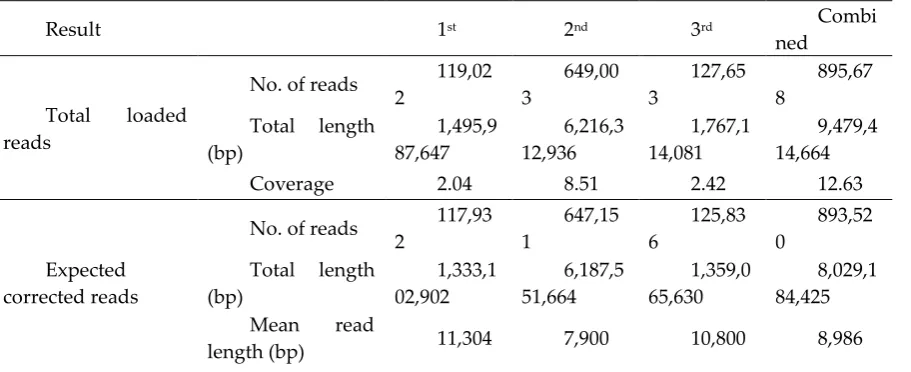
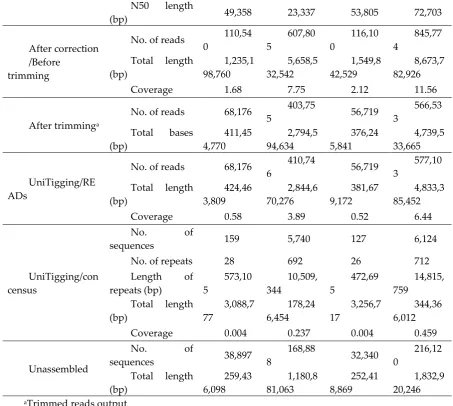
A total of 9.4 Gb out of 17.9 Gb raw reads were loaded due to the specific feature that the low
138
coverage data less than 10X in any region are eliminated by the Canu [23] program. After the
139
correction step, only 8.0 Gb (11.56X) remained (Table 3). The correction phase improved the accuracy
140
of bases in the reads, while the trimming phase cleaned the reads to the portion that appeared to be
141
a high-quality sequence, as well as removed suspicious regions such as the remaining SMRTbell
142
adapter. However, this was only applicable to the PacBio data. Therefore, the trimming phase may
143
not drastically affect the entire read contents for MinION [29] trials. The final assembly phase ordered
144
the reads into contigs and generated consensus sequences (unitigging concensus sequence). The final
145
unitigging concensus sequence length was about 344 Mbp (344,366,012 bp) with N50, 98 Kbp (97,987
146
bp).
147
148
Table 3. Summary of read data for the results of Canu.
149
Result 1st 2nd 3rd Combi
ned
Total loaded
reads
No. of reads 119,02
2
649,00 3
127,65 3
895,67 8
Total length (bp)
1,495,9 87,647
6,216,3 12,936
1,767,1 14,081
9,479,4 14,664
Coverage 2.04 8.51 2.42 12.63
Expected corrected reads
No. of reads 117,93
2
647,15 1
125,83 6
893,52 0
Total length (bp)
1,333,1 02,902
6,187,5 51,664
1,359,0 65,630
8,029,1 84,425
Mean read
N50 length
(bp) 49,358 23,337 53,805 72,703
After correction /Before
trimming
No. of reads 110,54
0 607,80 5 116,10 0 845,77 4
Total length (bp) 1,235,1 98,760 5,658,5 32,542 1,549,8 42,529 8,673,7 82,926
Coverage 1.68 7.75 2.12 11.56
After trimminga
No. of reads 68,176 403,75
5 56,719
566,53 3
Total bases
(bp) 411,45 4,770 2,794,5 94,634 376,24 5,841 4,739,5 33,665 UniTigging/RE ADs
No. of reads 68,176 410,74
6 56,719
577,10 3
Total length (bp) 424,46 3,809 2,844,6 70,276 381,67 9,172 4,833,3 85,452
Coverage 0.58 3.89 0.52 6.44
UniTigging/con census
No. of
sequences 159 5,740 127 6,124
No. of repeats 28 692 26 712
Length of
repeats (bp) 573,10 5 10,509, 344 472,69 5 14,815, 759
Total length (bp) 3,088,7 77 178,24 6,454 3,256,7 17 344,36 6,012
Coverage 0.004 0.237 0.004 0.459
Unassembled
No. of
sequences 38,897
168,88
8 32,340
216,12 0
Total length (bp) 259,43 6,098 1,180,8 81,063 252,41 8,869 1,832,9 20,246
aTrimmed reads output
150
151
2.3. Assembly results using Minimap, Miniasm, and Racon
152
The raw read overlapper, Minimap [24], was used to find overlaps, and Miniasm [24] was used
153
to complete de novo assemblies using Minimap [24] results (Table 4). They directly produce
154
unpolished and uncorrected contig sequences from the overlaps of raw reads. As a result, polishing
155
steps should be indispensable to improve their credibility. The five rounds of Racon [30] were used
156
to correct raw contigs to produce better quality sequences. The file size differences between the raw
157
file (17.9 Gb) and Minimap (13.2 Gb) indicated that our combined data had about 4.7 Gb file size of
158
duplicated overlaps. By using 13.2 Gb size of raw read overlaps, the unpolished and uncorrected
159
contig sequences with a file size of 368 Mb and a contig length of 370 Mbp were generated. The final
160
length of consensus sequences for the three combined data sets after five rounds of Racon [30]
161
polishing steps was about 375 Mbp with a N50 value of 199 Kbp (Table 4). In this consensus sequence,
162
the longest contig was 1 Mbp in length and the shortest contig was 779 bp. The final sequence length
163
for the combined data from the Racon result (375,105,174 bp) (Table 4) was slightly longer than that
164
of the Canu [23] result (344,366,012 bp) (Table 3).
165
166
Table 4. Summary of Miniasm assemblies with Minimap and Racon.
167
Result
N
o. of
round
1st 2nd 3rd Combine
Ra w file
Total size
(Gb) 2.83 11.71 3.34 17.9
Mi nimap
File size (byte)
607,227, 298
5,089,82 4,937
546,909, 744
13,226,11 0,131
Mi niasm
File size (byte)
1,282,82 2
177,933, 354
2,126,52 5
368,271,9 34
Total length (bp)
1,286,78 2
176,978, 175
2,139,68 2
370,303,4 49
Rac on
Total length (bp)
1 1,289,49
2
177,650, 167
2,145,74 9
373,675,1 34
2 1,278,46
7
177,931, 139
2,141,27 7
374,668,3 65
3 1,262,94
7
177,915, 228
2,127,08 9
374,934,5 32
4 1,247,13
8
177,805, 838
2,112,23 9
375,048,7 32
5 1,232,80
8
177,683, 528
2,097,34 1
375,105,1 74
168
2.4. Confirmation of de novo assembly
169
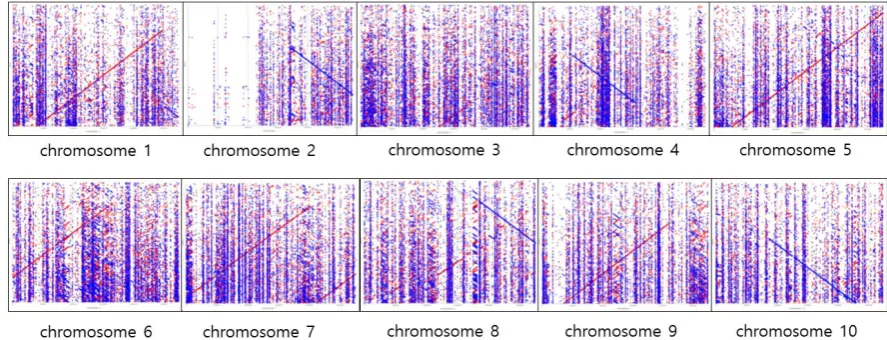
To visualize the alignments between the assembled sequences from Miniasm [24] and each of
170
the sorghum reference chromosomes, the mummerplot option from the Mummer software version
171
3.0, [31] with default parameters (Figure 2) was used. A total of 2,661 contigs from 375,105,174 bp in
172
length were generated after doing polishing steps five times with Racon [30]. The x-axis represents
173
each chromosome of reference and the y-axis represents 2,261 contigs. A perfect alignment between
174
the contigs and each chromosome would completely fill the positive diagonal (slope == 1), while a
175
line of slope == -1 represents an inverted segment of conservation between the two sequences. In
176
chromosome 2, the contigs were not aligned either forward or reverse in some parts of the
177
chromosome. In other chromosomes, the contigs tended to partially align to chromosomes either
178
forward or reverse (Figure 2). It was almost impossible to confirm the alignment trend between the
179
Canu [23] consensus sequences and sorghum reference, since the Canu [23] generated relatively short
180
and almost three times more contigs (6,124 contigs) than Racon (2,661 contigs) [30] that used the
181
mummerplot (refer to Table 5 for comparison).
182
183
184
Figure 2. The five rounds polishing with Racon after Miniasm assembly versus each chromosome of
185
the sorghum reference. The x-axis represents each chromosome of reference, and the y-axis represents
2,261 contigs. The forward matches are displayed in red, while the reverse matches are displayed in
187
blue.
188
189
Table 5. Comparison between Canu and Miniasm using final assembly results.
190
Canu Miniasm
Number of Conigs 6,124 2,661
Assembled read length
(bp) 344,366,012 375,105,174
N50 (bp) 98,000,000 199,000,000
191
3. Discussion
192
Optimization of genome assembly by using different assemblers
193
We performed MinION sequencing [29] for the sorghum and compared the final results obtained
194
from two different de novo assemblies against the reference genome in this study. With the ca. 12.63X
195
coverage raw reads, the de novo assemblies from Canu [23] and Miniasm [24] showed 0.459X and 0.5X
196
coverages for the sorghum genome, respectively. In other words, the completion of the de novo
197
assembly can be mathematically achieved by increasing the amount of raw data to ca. 25X for the
198
sorghum example. However, the quality of the de novo assembly can be affected by a plethora of
199
factors such as the contents of genes, GC ratio, and the length of repetitive sequences, genome size,
200
and ploidy numbers. We once tried to formulate the relationship between the minimum coverage
201
required for the de novo assembly and the amount of raw reads. However, it was not feasible due to
202
various factors. Nonetheless, our results showed that the de novo assembly for any species that does
203
not have reference sequences can be performed in the single laboratory with cost-effective ways due
204
to the newly developed ONT apparatus. In addition, a comparison between the two representative
205
long-reads assemblers, Canu [23] and Miniasm [24], indicates that Miniasm [24] with Racon [30]
206
correcting steps provides a better assembly in terms of the number of contigs and N50 values.
207
Depending on the type of assembler, different assembly results may be obtained for the
208
genome of the plant species [16,32]. As aforementioned, we showed the de novo assembly results using
209
Canu and Miniasm (with Minimap and Racon) for the sorghum genome. However, considering the
210
genome size, structural variation, and genome complexity of the genome in the genome assembly of
211
a particular plant species, it is imperative to determine which assembler is suitable for optimal results.
212
In addition, bioinformatic efforts should be used to ensure that the misassembled or ambiguous
213
sequences, such as repetitive regions of the genome, gaps, discrimination between paralogues and
214
alleles or between genes and pseudogenes [11], are properly assembled. RNA sequencing using the
215
MinION platform can be used to identify the isoforms of transcripts. Through this, various isoforms
216
have been identified without any assembly process, followed by non-redundant isoform clustering.
217
The resulting information can be used for genome annotation, and, consequently, can be integrated
218
to increase the contiguity and accuracy of the results from the existing genome assembly [5].
219
220
Advantages of current combinational sequencing
221
Compared with studies on microorganisms or animal species, there is still not a lot of research
222
in plant species because of its genome complexity. Genome sequencing has continued to develop
223
through the classical Sanger method and NGS to TGS. Plant species have been actively studied in this
224
process, but already-sequenced plant species have genomes with low complexity and are of relatively
225
small size until the advent of NGS [11]. NGS technology makes it possible to perform sequencing
226
regardless of genome size, which is a substantial technical breakthrough to overcome these
227
limitations. However, sequencing for plant species with large and complex genomes was not resolved
228
in terms of contiguity and accuracy due to the limitations of the short-read assembly. In this respect,
229
TGS that produces long-reads can be an excellent tool. For instance, wheat (Triticum aestivum) has a
230
genome size of about 15Gb, an allohexaploid (2n = 6x = 42), and a high repetitive character. The
231
International Wheat Genome Sequencing Consortium (IWGSC) has carried out wheat genome
assembly through a chromosome-based approach to conquer the genome nature of wheat, but it
233
contained only 10.2 Gb of genomes with low contiguity [33,34]. Despite these efforts, the
near-234
complete assembly of wheat has been achieved in a recent study [22].
235
This study demonstrates the possibility of assembling high complex genomes through a
236
combination of sequencing Illumina short-reads and PacBio long-reads. The production of long-reads
237
using TGS is able to overcome the weakness of assembling short-reads by minimizing the generation
238
of gaps or covering the repetitive sequence that appears on the plant genome. In another aspect, when
239
considering only the accuracy, short-reads can be used for error-correction by aligning them to
long-240
reads, which enable the increased accuracy of the genome assembly [35]. Therefore, a hybrid
241
assembly through combinational sequencing is a useful approach, at least until now, to overcome the
242
limitations of the current two techniques. As a result, more accurate sequence data would be
243
obtained. Even though the PacBio Single Molecule and Real-Time (SMRT) sequencing played a
244
leading role, given the ease of performance and utilization of the MinION sequencing [29], the
245
MinION sequencing is expected to replace the PacBio sequencing in laboratory-level sequencing. In
246
the future, MinION sequencing [29] will play a significant role in noticeably improving the assembly
247
of high complex genomes.
248
249
Improvements in the accuracy of long-reads sequencing and assembly
250
We did not perform the Illumina sequencing in this study since the sorghum genome sequence
251
was already released. However, for a reference-free species, the de novo genome assembly is required.
252
Therefore, the hybrid assembly will be sufficient to overcome the incompleteness caused by using a
253
single platform. However, the hybrid assembly is more difficult than an assembly that uses a single
254
platform. If the accuracy of the raw long-reads is high, or it can be increased by using the MinION
255
platform [29] alone, the genome assembly of plant species with a highly complex genome is possible.
256
However, the accuracy of Nanopore sequencing (85% accuracy for R9 version) is not high compared
257
to that of the NGS generating short-reads [36]. Currently, even with the R9.5 flow cell using 1D2
258
chemistry for the MinION [29], the model accuracy of sequences obtained using Nanopore
259
sequencing is about 97% (http://nanoporetech.com) [29]. In contrast, the short-read from the Illumina
260
platform has a maximum length of 150-300 bp, but most bases have more than 30 in quality score
261
(99.9% accuracy) for single and paired-end reads (https://www.illumina.com). In addition, the
262
improvement in sequencing accuracy can lead to the conclusion that the consensus accuracy will gain
263
a high value from a small amount of raw read coverage [4]. For the de novo genome assembly, a raw
264
read coverage of about 50-60X is needed to generate enough coverage of reads to cover repetitive
265
regions in the genome assembly [37]. At this time, Nanopore sequencing for raw reads is not able to
266
be more accurate than the accuracy of NGS, such as the Illumina sequencing, which produces highly
267
accurate reads. Thus, an error-correction process is indispensable to increase the accuracy in
268
Nanopore sequencing. Because of this, if only MinION is used as a single platform, the significance
269
of correction tools for raw reads is greater. Nanocorrect (https://github.com/jts/nanocorrect/), PoreSeq
270
[38], and nanoCORR (Goodwin et al., 2005) have been developed as a representative error-correction
271
tool for the Nanopore sequence data. Recently, Canu [23], Falcon
272
(https://github.com/PacificBiosciences/FALCON/), and Miniasm [24] assemblers are more commonly
273
used for error correction as well as the assembly. However, we should be aware that when
274
sequencing using MinION [29] as a single platform, it is advantageous to obtain long-reads using
275
HMW gDNA, since adding reads to reduce the average length of reads is able to reduce the
276
assembly’s quality [39].
277
278
DNA fragmentation effect on MinION sequencing
279
The MinION flow cell (R9.4) that consists of 512 channels and four wells (four nanopores) are
280
included in each channel. However, the read data are only generated from one of the four wells at a
281
time [37]. From our results, the 2nd result that used fragmented gDNA produced more read data than
282
the 1st and 3rd results that used intact HMW gDNA. However, the read length showed the opposite
283
pattern. This may be due to the feature that the Nanopore sequencing could not be performed
simultaneously in four wells in each channel. As a result, the following possibilities can be
285
considered. First, in the process of tethering DNA molecules onto a membrane near a pore protein,
286
HMW DNA molecules may cause the spatial hindrance to deteriorate the accessibility of the other
287
DNA molecules to the nanopore. Second, the time required for the HMW gDNA molecule to pass
288
through the nanopore is too long to allow for sequencing in the other wells of the same channel. This
289
may result in a decrease in sequencing efficiency. For example, when using R9 chemistry (about 250
290
bp sequencing speed per second; https://nanoporetech.com), it takes about 1,000 seconds for 250 kb
291
of the DNA molecule to sequence. In this case, assuming that it shows 100% efficiency, the number
292
of reads obtained through MinION [29] sequencing for 48 h is only 172.8 reads in each channel. For
293
now, depending on the experimental purpose, we need to choose whether to get a relatively large
294
number of reads or to get reads that are as long as possible. We expect to meet both through future
295
technical advances.
296
297
Requirement of effective size selection for long-reads sequencing
298
It is important to remove short-reads for high quality assembly. In this study, a large amount of
299
reads (around 1 kb) was generated by MinION sequencing [29]. As aforementioned, if
short-300
reads less than the average length are produced, the assembly quality can decrease. Thus, we should
301
consider the possibility of generating a lot of short-reads, even though HMW gDNA is used as an
302
initial material. In general, a certain level of DNA supercoiling is maintained in vivo [40]. However,
303
during DNA extraction, the DNA may be damaged, and the DNA supercoil level may decrease. After
304
DNA extraction, DNA repair and adapter ligation steps are performed during the DNA library
305
preparation for MinION sequencing [29]. At this time, the efficiency of library production may vary
306
depending on the structural complexity of the DNA. Highly ordered structures of genomic DNA may
307
reduce the accessibility of enzymes involved in the DNA repair or adapter ligation, while short DNA
308
fragments are expected to increase the efficiency of library production due to the relatively high
309
accessibility of the enzymes. We also cannot rule out the possibility of DNA shearing by physical or
310
chemical reactions during the DNA library preparation.
311
Another possibility is limiting the use of magnetic beads in the size selection and purification of
312
the DNA library. Magnetic beads make it easy to remove small DNA that are less than 500 bp, but
313
they are not effective in removing large size DNA. In addition, when a relatively small amount of
314
beads is used to obtain large-sized DNA fragments (e.g., DNA fragments of 1-10 kb in size), the yield
315
of the DNA itself is greatly reduced. It is possible that the limitations of the protocols used in this
316
study may not have effectively removed small size DNA. This can be overcome by conventional size
317
selection methods such as using gel electrophoresis and gel elution or automated DNA size selection
318
(e.g. Pippin). However, until now, automated size selection is the most effective method, although it
319
does not completely remove the short-reads. If a more convenient and efficient size selection method
320
is developed, more accurate Nanopore sequencing and subsequent analysis will be possible.
321
4. Materials and Methods
322
Plant material and genomic DNA extraction
323
The sorghum reference accession BTx623 was obtained from the National Agrobiodiversity
324
Center of the Rural Development Administration in Korea. Sorghum plants were grown on a
325
Murashige and Skoog (MS) medium (Duchefa) in an artificial growth chamber (25°C, 14 h light/10 h
326
dark) for 7-10 days. Shoot parts were only used for genomic DNA (gDNA) extraction, and the
327
procedure of the gDNA extraction was performed following the method previously described ([41];
328
[42]) with some modifications. Shoots of sorghum seedling were ground into a fine powder in liquid
329
nitrogen by using a mortar and pestle. 100 mg of the sample powder was transferred into a 2 mL tube
330
(eppendorf) containing 600 µL of a modified Carlson buffer [100 mM Tris-HCl, pH 8.0, 2% CTAB, 1.4
331
M NaCl, 1% PEG 8000, 20 mM EDTA, 2% PVP40, 0.1% ascorbic acid] pre-warmed to 60°C and 20 µL
332
of RNase A (20 mg/mL; invitrogen). The sample was immediately homogenized by inverting it gently
333
20 times and incubating it in a water-bath at 60°C for 30 min with gentle inverting 20 times every 10
334
min. After incubation, the sample was cooled-down to room temperature, and 600 µL of chloroform
was added. The sample was inverted carefully 60 times. Afterwards, the sample was centrifuged at
336
5,000 g for 10 min at 4°C, and 400 µL of the supernatant was transferred to a new 2 mL tube. 400 µL
337
of the binding buffer (20% PEG 8000, 3 M NaCl) and 50 µL of the AMPure XP beads solution were
338
added to the sample and incubated with rotation (6 rpm) at room temperature for 10 min. The sample
339
was briefly centrifuged and kept on a magnetic rack (Thermo Scientific) until the magnetic beads
340
were completely separated. The supernatant was removed without disturbing the pellet, and then 1
341
mL of 70% ethanol was added to the pellet. The pellet was incubated in ethanol for 1 min, and the
342
supernatant was removed. The ethanol washing step was repeated 3 times. After the ethanol was
343
removed, the sample was air-dried for 1 min. The pellet was eluted using a Buffer EB (Qiagen). At
344
that moment, the amount of the Buffer EB was adjusted so that the eluate concentration was 80 ng/µL
345
or more. As a result, HMW gDNA with a size longer than at least 50 kb was obtained.
346
347
Preparation of sequencing library and MinION sequencing
348
12 µg of HMW gDNA was fragmented using a g-TUBE (Covaris) by centrifuging at 3,170 g for
349
60 sec (Labogene 1730R; rotor GRF-M-m2.0-24). Of the three flow cells, the HMW gDNA of one flow
350
cell was only fragmented, and the rest was used in its native state. The DNA library was prepared
351
with the ONT Ligation Sequencing Kit 1D (SQK-LSK108), and the DNA preparation method was
352
based on "1D gDNA long reads without BluePippin protocol" provided by the Nanoporetech
353
community
(https://community.nanoporetech.com/protocols/1d-gdna-without-354
bluepippin/v/1/all_steps). A total of 2 µg of gDNA (80 ng/µL) was used to construct the DNA library
355
in each flow cell. MinION sequencing was performed using a R9.4 SpotON flow cell (FLO-MIN106),
356
and the default script "NC_48Hr_Sequencing_Run_FLO-MIN106_SQK-LSK108" from the
357
MinKNOW program was used to run the sequencing. Finally, the read sequence files (fastq format)
358
were obtained from the MinKNOW workflow.
359
Nanopore sequencing data have been deposited in NCBI (
360
https://www.ncbi.nlm.nih.gov/sra/PRJNA544582) with the accession number of PRJNA544582.
361
362
MinION raw sequences mapped against the reference genome
363
The generated raw fastq files from the MinKNOW workflow were mapped to the sorghum
364
BTx623 reference genome (v.3.1.1) and downloaded from the plant genomics resource
365
(https://phytozome.jgi.doe.gov/pz/portal.html) by using the BWA mem (version 0.7.15) [26] with
366
default parameters.
367
The average depth was evaluated with a depth option, and the mapping rate was conducted
368
with the flagstat option in SAMtools version 1.3.1 [28]. The Mosdepth program version 0.2.3 [27] was
369
used to calculate the depth from the BAM file at each nucleotide position in a genome and produce
370
coverage graph (Figure 1).
371
372
De novo whole genome assembly
373
In order to handle these noisy long MinION reads efficiently, some specially designed tools were
374
adopted. Two de novo assemblers were selected to compare their performances: Canu (version 1.6)[23]
375
and Minimap and Miniasm (version 0.2-r168-dirty) [24]. Canu [23] is a new single-molecule sequence
376
assembler that improves the Celera Assembler. Canu operates in three phases: Correction, trimming,
377
and assembly. The correction step improves the accuracy of each read base. For the AT/GC rich
378
eukaryotic genomes, the corMaxEvidenceErate = 0.15 parameter is suggested by the developer’s
379
instructions. Therefore, this parameter was incorporated to run our sorghum data, and other options
380
were set as a default.
381
Minimap [24] with -Sw5 -L100 -m0 -t8 options and a de novo assembler, Miniasm [24] with default
382
parameters were used to assemble MinION sequencing reads without an error correction stage.
383
Minimap is an all-against-all read self-mapping tool, and Minasm is composed of simple
384
concatenated pieces of the read sequence to generate the final unitig sequences. This pipeline allows
385
sequencing data to be assembled into a single contig in a relatively short time. However, the
386
consensus sequence error rate is as high as the raw reads. Therefore, Racon
(https://github.com/isovic/racon)[30] coupled with the Miniasm pipeline could be used to generate
388
similar or better quality final unitig sequences. Multiple rounds of Racon polishing have given a good
389
final sequence accuracy and produced the best possible consensus sequence. To improve the
390
sequence’s quality, we conducted five rounds of Racon [30] using Minimap and Miniasm [24] results.
391
Confirmation of de novo assembly against the sorghum reference genome
392
To test the structural correctness of the unitig genome, we aligned the assembly results from the
393
Miniasm against the sorghum BTx623 reference genome. The nucmer option from the MUMmer
394
software version 3.0 [31] was used to get an overview of the global alignment between the contigs
395
and reference genome. In addition, the delta-filtering option with the –r and –q parameters were used
396
to filter the alignment results. The mummerplot option from the MUMmer [31] was used to draw the
397
dotplot.
398
The MUMmer sequence alignment package [31] was designed to detect the homology regions
399
in genome sequences. For a dotplot, the reference sequence is laid across the x-axis, while the query
400
sequence is on the y-axis. Wherever the two sequences agree, a colored line or dot is plotted. The
401
forward matches are displayed in red, while the reverse matches are displayed in blue.
402
403
5. Conclusions
404
Since the advent of TGS, Minion sequencing has developed rapidly in less than five years.
405
Advances in its chemistry have elevated the speed and accuracy of sequencing, and the contiguity of
406
genome assembly was improved by enabling long-reads. These developments have enhanced the
407
high utilization and value of genome assemblies for plant species with highly complex genomes. We
408
showed the results of MinION sequencing [29] for the S. bicolor cv. BTx623, in which the accuracy and
409
coverage of raw data against the reference genome changed during the process of error-correction,
410
de novo assembly, and polishing. Our results not only illustrate the use of appropriate tools for
411
genome assembly through MinION sequencing [29] in plant species, but also provide information on
412
the amount of raw data required for a more accurate genome assembly. This is expected to contribute
413
to complete genome sequencing in a variety of plant species, including reference-free species.
414
415
5. Patents
416
Acknowledgements: This work is supported by the “Cooperative Research Program for Agriculture
417
Science and Technology Development (Project No. PJ01252701)”, Rural Development
418
Administration, Republic of Korea
419
420
References
421
1. Goodwin, S.; McPherson, J.D.; McCombie, W.R. Coming of age: ten years of next-generation sequencing
422
technologies. Nature Reviews Genetics 2016, 17, 333.
423
2. Levy, S.E.; Myers, R.M. Advancements in next-generation sequencing. Annual review of genomics and
424
human genetics 2016, 17, 95-115.
425
3. Rhoads, A.; Au, K.F. PacBio sequencing and its applications. Genomics, proteomics & bioinformatics 2015,
426
13, 278-289.
427
4. Jain, M.; Olsen, H.E.; Paten, B.; Akeson, M. The Oxford Nanopore MinION: delivery of nanopore
428
sequencing to the genomics community. Genome biology 2016, 17, 239.
429
5. Li, C.; Lin, F.; An, D.; Wang, W.; Huang, R. Genome sequencing and assembly by long reads in plants.
430
Genes 2017, 9, 6.
431
6. Shendure, J.; Balasubramanian, S.; Church, G.M.; Gilbert, W.; Rogers, J.; Schloss, J.A.; Waterston, R.H.
432
DNA sequencing at 40: past, present and future. Nature 2017, 550, 345.
7. Jain, M.; Koren, S.; Miga, K.H.; Quick, J.; Rand, A.C.; Sasani, T.A.; Tyson, J.R.; Beggs, A.D.; Dilthey, A.T.;
434
Fiddes, I.T. Nanopore sequencing and assembly of a human genome with ultra-long reads. Nature
435
biotechnology 2018, 36, 338.
436
8. Paterson, A.H.; Bowers, J.E.; Bruggmann, R.; Dubchak, I.; Grimwood, J.; Gundlach, H.; Haberer, G.;
437
Hellsten, U.; Mitros, T.; Poliakov, A. The Sorghum bicolor genome and the diversification of grasses.
438
Nature 2009, 457, 551.
439
9. McCormick, R.F.; Truong, S.K.; Sreedasyam, A.; Jenkins, J.; Shu, S.; Sims, D.; Kennedy, M.;
440
Amirebrahimi, M.; Weers, B.D.; McKinley, B. The Sorghum bicolor reference genome: improved
441
assembly, gene annotations, a transcriptome atlas, and signatures of genome organization. The Plant
442
Journal 2018, 93, 338-354.
443
10. Goodstein, D.M.; Shu, S.; Howson, R.; Neupane, R.; Hayes, R.D.; Fazo, J.; Mitros, T.; Dirks, W.; Hellsten,
444
U.; Putnam, N. Phytozome: a comparative platform for green plant genomics. Nucleic acids research 2011,
445
40, D1178-D1186.
446
11. Claros, M.G.; Bautista, R.; Guerrero-Fernández, D.; Benzerki, H.; Seoane, P.; Fernández-Pozo, N. Why
447
assembling plant genome sequences is so challenging. Biology 2012, 1, 439-459.
448
12. Crow, K.D.; Wagner, G.P. What is the role of genome duplication in the evolution of complexity and
449
diversity? Molecular biology and evolution 2005, 23, 887-892.
450
13. Wendel, J.F.; Jackson, S.A.; Meyers, B.C.; Wing, R.A. Evolution of plant genome architecture. Genome
451
biology 2016, 17, 37.
452
14. Jackson, S.A.; Iwata, A.; Lee, S.H.; Schmutz, J.; Shoemaker, R. Sequencing crop genomes: approaches
453
and applications. New Phytologist 2011, 191, 915-925.
454
15. Debladis, E.; Llauro, C.; Carpentier, M.-C.; Mirouze, M.; Panaud, O. Detection of active transposable
455
elements in Arabidopsis thaliana using Oxford Nanopore Sequencing technology. BMC genomics 2017,
456
18, 537.
457
16. Michael, T.P.; Jupe, F.; Bemm, F.; Motley, S.T.; Sandoval, J.P.; Lanz, C.; Loudet, O.; Weigel, D.; Ecker,
458
J.R. High contiguity Arabidopsis thaliana genome assembly with a single nanopore flow cell. Nature
459
communications 2018, 9, 541.
460
17. Schmidt, M.H.-W.; Vogel, A.; Denton, A.K.; Istace, B.; Wormit, A.; van de Geest, H.; Bolger, M.E.;
461
Alseekh, S.; Maß, J.; Pfaff, C. De novo assembly of a new Solanum pennellii accession using nanopore
462
sequencing. The Plant Cell 2017, 29, 2336-2348.
463
18. Giolai, M.; Paajanen, P.; Verweij, W.; Witek, K.; Jones, J.D.; Clark, M.D. Comparative analysis of
464
targeted long read sequencing approaches for characterization of a plant’s immune receptor repertoire.
465
BMC genomics 2017, 18, 564.
466
19. Jiao, Y.; Peluso, P.; Shi, J.; Liang, T.; Stitzer, M.C.; Wang, B.; Campbell, M.S.; Stein, J.C.; Wei, X.; Chin,
467
C.-S. Improved maize reference genome with single-molecule technologies. Nature 2017, 546, 524.
468
20. Parker, J.; Helmstetter, A.J.; Devey, D.; Wilkinson, T.; Papadopulos, A.S. Field-based species
469
identification of closely-related plants using real-time nanopore sequencing. Scientific reports 2017, 7,
470
8345.
471
21. Yang, J.; Liu, D.; Wang, X.; Ji, C.; Cheng, F.; Liu, B.; Hu, Z.; Chen, S.; Pental, D.; Ju, Y. The genome
472
sequence of allopolyploid Brassica juncea and analysis of differential homoeolog gene expression
473
influencing selection. Nature genetics 2016, 48, 1225.
474
22. Zimin, A.V.; Puiu, D.; Hall, R.; Kingan, S.; Clavijo, B.J.; Salzberg, S.L. The first near-complete assembly
475
of the hexaploid bread wheat genome, Triticum aestivum. Gigascience 2017, 6, gix097.
23. Koren, S.; Walenz, B.P.; Berlin, K.; Miller, J.R.; Bergman, N.H.; Phillippy, A.M. Canu: scalable and
477
accurate long-read assembly via adaptive k-mer weighting and repeat separation. Genome Res 2017, 27,
478
722-736, doi:10.1101/gr.215087.116.
479
24. Li, H. Minimap and miniasm: fast mapping and de novo assembly for noisy long sequences.
480
Bioinformatics 2016, 32, 2103-2110, doi:10.1093/bioinformatics/btw152.
481
25. Vaser, R.; Sovic, I.; Nagarajan, N.; Sikic, M. Fast and accurate de novo genome assembly from long
482
uncorrected reads. Genome Res 2017, 27, 737-746, doi:10.1101/gr.214270.116.
483
26. Li, H.; Durbin, R. Fast and accurate long-read alignment with Burrows–Wheeler transform.
484
Bioinformatics 2010, 26, 589-595.
485
27. Pedersen, B.S.; Quinlan, A.R. Mosdepth: quick coverage calculation for genomes and exomes.
486
Bioinformatics 2017, 34, 867-868.
487
28. Li, H.; Handsaker, B.; Wysoker, A.; Fennell, T.; Ruan, J.; Homer, N.; Marth, G.; Abecasis, G.; Durbin, R.
488
The sequence alignment/map format and SAMtools. Bioinformatics 2009, 25, 2078-2079.
489
29. de Lannoy, C.; de Ridder, D.; Risse, J. The long reads ahead: de novo genome assembly using the
490
MinION. F1000Research 2017, 6.
491
30. Vaser, R.; Sović, I.; Nagarajan, N.; Šikić, M. Fast and accurate de novo genome assembly from long
492
uncorrected reads. Genome research 2017, 27, 737-746.
493
31. Kurtz, S.; Phillippy, A.; Delcher, A.L.; Smoot, M.; Shumway, M.; Antonescu, C.; Salzberg, S.L. Versatile
494
and open software for comparing large genomes. Genome biology 2004, 5, R12.
495
32. Bouri, L.; Lavenier, D.; Gibrat, J.-F.; del Angel, V.F.D. Evaluation of genome assembly software based
496
on long reads. France Genomique, 2017.
497
33. Gill, B.S.; Appels, R.; Botha-Oberholster, A.-M.; Buell, C.R.; Bennetzen, J.L.; Chalhoub, B.; Chumley, F.;
498
Dvořák, J.; Iwanaga, M.; Keller, B. A workshop report on wheat genome sequencing: International
499
Genome Research on Wheat Consortium. Genetics 2004, 168, 1087-1096.
500
34. International Wheat Genome Sequencing, C. A chromosome-based draft sequence of the hexaploid
501
bread wheat (Triticum aestivum) genome. Science 2014, 345, 1251788, doi:10.1126/science.1251788.
502
35. Jayakumar, V.; Sakakibara, Y. Comprehensive evaluation of non-hybrid genome assembly tools for
503
third-generation PacBio long-read sequence data. Briefings in bioinformatics 2017.
504
36. Mahmoud, M.; Zywicki, M.; Twardowski, T.; Karlowski, W.M. Efficiency of PacBio long read correction
505
by 2nd generation Illumina sequencing. Genomics 2017.
506
37. Lu, H.; Giordano, F.; Ning, Z. Oxford Nanopore MinION Sequencing and Genome Assembly. Genomics
507
Proteomics Bioinformatics 2016, 14, 265-279, doi:10.1016/j.gpb.2016.05.004.
508
38. Szalay, T.; Golovchenko, J.A. De novo sequencing and variant calling with nanopores using PoreSeq.
509
Nature biotechnology 2015, 33, 1087.
510
39. Tyson, J.R.; O'Neil, N.J.; Jain, M.; Olsen, H.E.; Hieter, P.; Snutch, T.P. MinION-based long-read
511
sequencing and assembly extends the Caenorhabditis elegans reference genome. Genome research 2018,
512
28, 266-274.
513
40. Corless, S.; Gilbert, N. Investigating DNA supercoiling in eukaryotic genomes. Briefings in functional
514
genomics 2017, 16, 379-389.
515
41. Carlson, J.; Tulsieram, L.; Glaubitz, J.; Luk, V.; Kauffeldt, C.; Rutledge, R. Segregation of random
516
amplified DNA markers in F 1 progeny of conifers. Theoretical and Applied Genetics 1991, 83, 194-200.
42. Mayjonade, B.; Gouzy, J.; Donnadieu, C.; Pouilly, N.; Marande, W.; Callot, C.; Langlade, N.; Muños, S.
518
Extraction of high-molecular-weight genomic DNA for long-read sequencing of single molecules.
519
BioTechniques 2016, 61, 203-205.