R E S E A R C H A R T I C L E
Open Access
Effectiveness of a multifaceted
implementation strategy compared to
usual care on low back pain guideline
adherence among general practitioners
Arnela Suman
1, Frederieke G. Schaafsma
2*, Peter M. van de Ven
3, Pauline Slottje
4, Rachelle Buchbinder
5,
Maurits W. van Tulder
6and Johannes R. Anema
2Abstract
Background:To improve patient care, and to reduce unnecessary referrals for diagnostic imaging and medical specialist care for low back pain, an evidence-based guideline for low back pain was developed in the Netherlands in 2010. The current study evaluated the effect of a multifaceted implementation strategy on guideline adherence among Dutch general practitioners.
Methods:The implementation strategy included a multidisciplinary training, provision of educational material and an interactive website for healthcare professionals, supported by a multimedia eHealth intervention for patients with low back pain. Adherence was measured using performance indicators based on 3 months data extracted from the contacts with patients with low back pain recorded in the electronic medical records of participating general practitioners. Performance indicators were compared between two groups: a usual care group and an implementation group. Performance indicators were referrals to consultations with medical specialists, to diagnostic imaging, and to psychosocial and/or occupational physician consultations, and inquiries about psychosocial and occupational risk factors.
Results:The electronic medical records of 5130 patient contacts for LBP were analysed; 2453 patient contacts in the usual care group and 2677 patient contacts in the implementation group. Overall, rates of referral and of recorded inquiries regarding psychosocial and occupational risk factors remained low in both groups over time. The only statistically significant difference found was a reduction in the number of referrals to neurologists in the implementation group (from 100 (7%) to 50 (4%)) compared to the usual care group (from 48 (4%) to 50 (4%), (p< 0.01)). There were no other between-group differences in referrals.
Conclusion:In the short term, the strategy did not result in improved guideline adherence among general practitioners, and it is not recommended for widespread use. However, baseline referral rates in participating practices were already low, possibly leaving only little room for improvement. Inquiries for psychosocial and occupational risk factors remained low and this leaves room for improvement.
Trial registration:This trial is registered in the Netherlands Trial Register (NTR):NTR4329. Registration date: December 20th, 2013.
Keywords:Primary health care, Low back pain, Health plan implementation, Guidelines, Referral and consultation
* Correspondence:[email protected] 2
Department of Public and Occupational Health, Amsterdam Public Health research institute, VU University medical centre, Amsterdam, The
Netherlands, and the Research Centre for Insurance Medicine, Collaboration between AMC-UMCG-UWV-VUmc, Amsterdam, The Netherlands
Full list of author information is available at the end of the article
Background
Low back pain (LBP) is the leading cause of disability worldwide [1]. In the Netherlands, LBP and neck pain were the most prevalent disorders in 2015, with a year preva-lence of 2 million among a total population of 16.7 million [2]. In the same year, almost 587,000 new cases of LBP were reported, making it also the disorder with the highest inci-dence [3]. The majority of LBP cases cannot be attributed to a specific underlying pathophysiological cause and are thus referred to as non-specific [4,5].
Non-specific LBP is one of the most common conditions for which people in high-income countries seek medical care [6]. In the Netherlands in 2011, over 90% of patients registered at a GP practice that are known to have LBP contacted their general practitioner (GP) at least once per year regarding their LBP. A number of patients also seek help from other professionals (e.g. physiotherapist), seek only help from other professionals than their GP, or do not seek healthcare at all. In 2008, about 32% of LBP patients who visited their GP were referred to a medical specialist [7,8]. Sixty per cent of these referrals were to neurology, 29% to orthopaedics, and 11% to neurosurgery [8]. Inter-nationally, almost half of LBP patients (42%) are referred for LBP diagnostic imaging within 1 year of their first visit to a physician [9]. Research suggests that consultations with medical specialists often lead to further medical procedures, including diagnostic imaging [9]. Furthermore, there is evi-dence indicating that diagnostic imaging for LBP without any suggestion of a serious underlying cause, i.e. non-specific LBP, does not improve patient outcomes, and can in fact be harmful to patients, due to for example the risks of radiation and labelling of patients [9,10].
To improve patient care by focusing more on psychosocial and occupational risk factors for LBP, and to reduce un-necessary referrals for diagnostic imaging and medical spe-cialist care for non-specific LBP, an evidence-based guideline for LBP was developed in the Netherlands in 2010 [11]. The current study describes the effects of a multifaceted strategy to implement this guideline in Dutch general practice. Specifically, guideline adherence of GPs is evaluated by means of performance indicators based on the guideline, and the effectiveness of the imple-mentation strategy is compared to usual care in a before-after design. Indicators and outcomes include: referrals to medical specialist care, referrals for diag-nostic imaging, inquiries about psychosocial and work-related risk factors, and referrals for psycho-social consultation and to occupational physicians.
Methods
This controlled before-after study was part of a stepped-wedge cluster-randomised controlled trial (RCT), that was registered in 2013 with the Netherlands Trial Register (NTR) under number NTR4329. The Medical Ethics
Committee of the VU University medical centre assessed this study design and procedures, and in accordance with the local regulatory guidelines and standards for human subjects protection in the Netherlands (Medical Research Involving Human Subjects Act [WMO], 2005), this study proved to be exempt from further medical ethical review.
Study design
The current paper reports the effectiveness of the im-plementation strategy on guideline adherence of GPs. While the study initially had a stepped-wedge design, it was not feasible to perform the evaluation of the guideline adherence by GPs according to this design [12]. Therefore, these outcomes were evaluated in a controlled before-after design. For the present analysis, the general practices were randomly ordered into two groups: an implementa-tion group and a usual care group. The implementaimplementa-tion group was studied by comparing a baseline period of 3 months (January–March 2014) at the start of the study (prior to the start of the implementation) and a follow-up period covering the same calendar period 1 year later, i.e. the first 3 months after the general practices in this group had received the implementation strategy. The usual care group was studied by comparing a baseline period of 3 months during the year prior to the start of the study (Oc-tober–December 2013) and a follow-period covering the same calendar period 1 year later (prior to the start of the implementation in this group). The periods were different for the two groups due to the randomisation and the planned start and timing of the intervention. Electronic medical records (EMRs) of patients with LBP who con-tacted or visited the participating GPs were reviewed, and performance indicators extracted from these records were compared between these two groups.
Implementation strategy
Participants and study settings
GPs were eligible to participate in this study if they were practising within the municipality of Amsterdam, and if they had patients with LBP registered in their practice. GPs were recruited within the Academic Network of General Practice of the department of General Practice and Elderly Care Medicine at the VU University medical centre (ANH-VUmc). A detailed description of the re-cruitment procedure has been described elsewhere [13]. Anonymised information related to LBP contacts were extracted from the EMRs of all patients that contacted the participating GPs at least once regarding LBP (coded according to the International Classification for Primary Care (ICPC) as L02, L03, L86) in the selected 3 month periods, and who had a date of birth between the years 1939 and 1996 (i.e. aged 18–76 years).
Outcomes
The outcomes for this study were measures of guideline adherence by GPs. Guideline adherence was assessed using performance indicators. These performance indi-cators were operationalisations of the recommendations made in the guideline. The indicators are presented in Table1.
Indicators were measured at the level of all GP-patient con-tacts (i.e. consultations, home visits, telephone consultations)
regarding LBP per general practice in the given time period. To account for potential seasonal differences, the calendar time periods for the baseline and follow-up periods from which the LBP contacts were ex-tracted from the EMRs were matched per group. The indicators were scored based on anonymised data ex-tracted from the ANH-VUmc database. This database contains pseudonymised general practice care data from the EMRs of the general practices participating in ANH-VUmc, according to Dutch privacy legisla-tion. From all patient records that fulfilled the selec-tion criteria, the following data were selected for review: sex, age category (18–65 versus 65+ years), and the free text annotations made by the GP. The indicators were scored by reviewing the free text an-notations from the selected records by two re-searchers (AS, FGS) blinded to the group and calendar period allocation. A first set of records was reviewed by AS and FGS to reach consensus over scoring of indicators. One researcher (AS) reviewed all other records.
Statistical methods
[image:3.595.62.535.434.708.2]Descriptive statistics were used to summarise and compare the demographic information of GPs in the implementation group and usual care group. Performance indicators were
Table 1Performance indicators based on guideline recommendations to measure guideline adherence among GPs [12]
Guideline recommendation Performance indicator for LBP Operationalization
A small proportion of patients will not recover with help from the primary care sector, these patients should be referred to secondary care
Referral to consultation with medical specialists (neurology, orthopaedics or other specialty)
Referrals as percentage of total consultations for LBP per GP, reported separately per specialty
Diagnostic imaging is not routinely indicated for acute non-specific LBP; Diagnostic imaging is not recommended for patients with chronic non-specific LBP
Referral for diagnostic imaging Referrals for MRI, X-ray, CT, Dexa or ultrasound as percentage of total consultations for LBP per GP, reported separately for every imaging technique
Be alert to psychosocial risk factors that can influence the prognosis of LBP, and analyse these if recovery does not occur; Evaluation of psychosocial risk factors that can influence the prognosis of LBP is recommended
Inquiries about psychosocial risk factors Consultations where psychosocial risk factors were discussed and reported, as percentage of total consultations for LBP per GP
Cognitive behavioural therapy is recommended for patients with cognitive (and) behavioural problems; Patients with LBP that do not recover within 2–3 weeks and have psychosocial risk factors should be referred to a psychologist
Referral for psychosocial care as indicator for multidisciplinary collaboration
Referrals as percentage of total consultations for LBP per GP
In employed patients with LBP a prognosis and recovery expectations for return to work should be discussed
Inquiries about work-related risk factors Consultations where occupational risk factors were reported as percentage of total consultations for LBP per GP
The general practitioner and the occupational physician should contact each other to coordinate care if the patient’s recovery is stagnating
Referral to and/or contact with occupational physician as indicator for multidisciplinary collaboration*
Consultations where referral to and/or contact with occupational physician was made as percentage of total consultations for LBP per GP, reported separately for referral to and contact between GP and occupational physician
compared between groups using Generalized Estimating Equations (GEEs) with a logistic link function, a fixed effect for time (baseline/follow-up measurement period), group (implementation/usual care), and an interaction between time and group. An exchangeable correlation structure was used to take into account the correlation between outcomes within the same group. Unadjusted analyses assessing differences over time between implementation group and usual care group were performed first, followed by adjusted multivariable models to correct for poten-tial confounders: average GP age per practice, average years of working as GP per practice, and proportion of patients aged 65+ per practice. Potential con-founders were included in final adjusted models when at least one of the regression coefficients for the cat-egorical variable time changed by more than 10% compared to the unadjusted analyses.P-values were con-sidered statistically significant at < 0.05. All statistical pro-cedures were performed in IBM SPSS Statistics 22.
Results
Effects of the strategy on GP guideline adherence
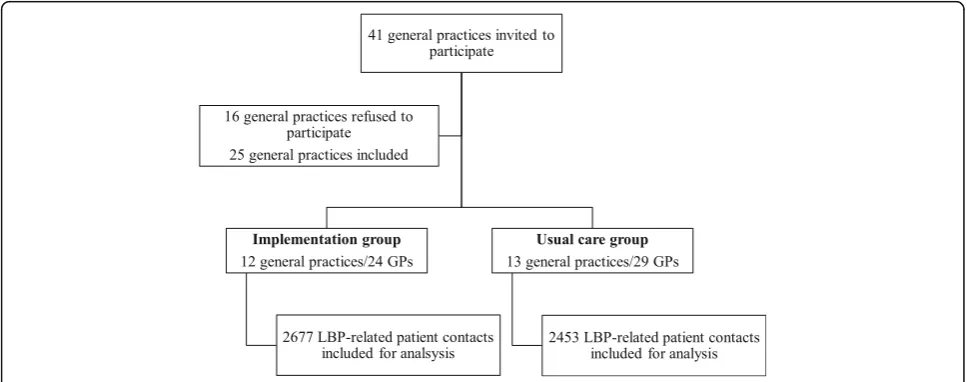
Twenty-five general practices, accounting for 53 individ-ual GPs, participated in this study. The mean age of the participating GPs was 46.2 years (SD 10.2), 22 were male (41.5%), and they had an average of 14.3 (SD 9.3) years of work experience as GP. Within the time frame of data collection for this analysis, 19 GPs (from 11 practices) in the implementation group attended the CME training. All GPs, including those who did not attend the CME training, provided EMRs for analysis. These were 24 GPs from the implementation group, and 29 GPs from the usual care group. The EMRs of 5130 registered LBP contacts, belonging to 2549 unique LBP patients, were
selected for review of performance indicators. Of these patients, 1515 were female (59.4%), and 328 (12.9%) pa-tients were aged 65 years (statutory retirement age) or older. Figure 1 shows the flowchart of the inclusion process.
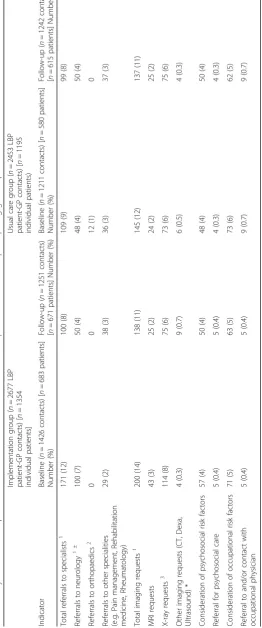
Table 2shows the adjusted effects of the implementa-tion strategy per performance indicator, i.e. the number of referrals and inquiries, respectively, as a proportion of total number of LBP patient contacts in each time period for both groups. In general, the numbers at base-line as well as the changes over time were small. The only statistically significant adjusted between-group dif-ference over time was for the number of referrals to neurology. The number of referrals to neurologists de-creased in the implementation group from 100 (7%) to 50 (4%), while it remained similar in the usual care group (48 referrals (4%) at baseline, and 50 referrals (4%) at follow-up), p< 0.01. There was no difference between groups over time with regards to the number of total referrals to medical specialist care. Total referral rates reduced over time from 171 (12%) to 100 (8%) in the im-plementation group, compared with 109 (9%) to 99 (8%) in the usual care group. The number of referrals to other medical specialities (e.g. rheumatology, rehabilitation, pain management) was very low and remained similar in both groups over time.
The overall rate of imaging requests decreased over time in both groups. While the decrease appeared larger in the implementation group (from 200 referrals (14%) at base-line to 138 referrals (11%) at follow up) than in the usual care group (from 145 referrals (12%) at baseline to 137 re-ferrals (11%) at follow up), this difference was not statisti-cally significant. There was also no statististatisti-cally significant difference over time in the number of requests for specific
[image:4.595.56.540.525.716.2]imaging, although there appeared to be a decrease over time in the number of requests for X-rays in the imple-mentation group (from 114 requests (8%) at baseline to 75 requests (6%)) while it remained the same in the usual care group over time (73 requests (6%) at baseline to 75 requests (6%) at follow-up). The number of requests for MRI imaging and other imaging techniques was very low in both groups at baseline, and remained similar over time.
There was no increase in either group over time in the number of times GPs registered consideration of psycho-social or occupational factors, or in the number of refer-rals for psychosocial care. The numbers of referrefer-rals to occupational physicians was very low in both groups at baseline and remained low over time.
Discussion
This paper described a before-after study evaluating the effectiveness of a multifaceted strategy for the imple-mentation of a multidisciplinary guideline for LBP in general practices in the Amsterdam area. The results of this study indicate that the strategy did not result in improvements in guideline adherence of GPs, as mea-sured by performance indicators based on 5130 regis-tered LBP patient contacts in the EMRs of GPs.
These results need to be interpreted within the context of the study population and GP behaviour changes that may have already occurred over time reducing the po-tential need and additional effect of implementing a LBP guideline in GP practice. On average, 32% of LBP pa-tients visiting their GP in the Netherlands are referred to medical specialist care (numbers from 2008) [8]. In contrast, the GPs in the current study had an average re-ferral rate to medical specialist care of only 9% per LBP contact at baseline in 2013. While the denominators of these percentages are not directly comparable (i.e. unique LBP patients versus LBP-GP contacts), it appears that our study population already had a lower referral rate compared to the nationwide average in 2008, which would mean there was less necessity to reduce their medical specialist referral rate [8]. Similarly, while na-tionwide 42% of patients that visited their GP for LBP were referred for diagnostic imaging in 2008, the average referral rate for diagnostic imaging in our study in 2013 through 2015 was only 12% per LBP-GP contact [8]. Re-ferrals are not necessarily a bad clinical decision, but de-pend on the situation of the individual patient. Without extensive clinical data, it is not possible to rule out that the referral rates seen in the present study are inappro-priate, but it is known that referrals for imaging and sec-ondary care are not recommended for non-specific LBP [8,11].
Conversely, at baseline occupational risk factors and psychosocial risk factors were only recorded in 5 and 4%
of the LBP patient-GP contacts, respectively, indicating that improved guideline adherence regarding consider-ation of these risk factors for LBP is still a worthwhile goal. Research has shown that occupational and/or psy-chosocial factors can increase the risk of chronic LBP [14-16]. Paying more attention to these risk factors in in-dividual patients to prevent chronicity, might improve patient outcomes, and reduce the prevalence of chronic LBP. It seems that since 2008, something has happened to improve GPs behaviour regarding referrals to medical specialists and diagnostic imaging, although this change apparently did not affect consideration of psychosocial or occupational aspects. It might be that the belief that referrals are unnecessary in many cases is now more widespread. It is unclear whether this is truly the case, or whether GPs are consistently not explicitly recording consideration of these aspects in EMRs, e.g. only record-ing this when it proved to be relevant for this patient, or that psychosocial and occupational problems were known to the GP under another ICPC code, such as burnout (Z29.01 Burn-out) or problem with work situ-ation (Z05), which were not included in the present analysis.
The current study was inspired by a mass media population-based campaign that aimed to improve back beliefs of the general public and influence management of LBP by GPs in the state of Victoria in Australia [16, 17]. The Australian campaign was adapted to the Dutch context and was specifically tar-geted to GPs and patients with LBP. While using similar campaign messages, the results of the current study differ from the Australian study, where an im-provement in GP beliefs and intended behaviour to-wards LBP over time was found. These differences may be due to different timings (1999 vs. 2013), and the advice received through the campaign messages might already have been widely adopted by the GPs in the current study, and therefore did not trigger changes in thinking, and thereby in behaviour. The differences in effects can also be explained by the dif-ferent approaches (population-based versus targeted approach) and population (primary versus secondary prevention).
and guideline adherence [19]. The lack of success of mass-media population-based and targeted multifaceted strat-egies in improving GPs management of LBP in primary care, suggests that it remains difficult to change clinical practice behaviour. This is also highlighted by a Cochrane systematic review that showed varying effects of interven-tions aimed at improving clinicians’imaging requests for patients with LBP [20].
Various barriers to guideline adherence have been re-ported previously. A systematic review on barriers to guideline adherence for LBP in primary care physicians showed that perceptions and beliefs were important bar-riers, and while healthcare is supposed to be evidence-oriented, the actual uptake of evidence in practice re-mains a challenge [21, 22]. A survey among 703 GPs in the Netherlands showed that 89% of GPs believed that following guidelines leads to improved patient care, while perceived adherence to guidelines varied between 50 and 95% [23]. Barriers to guideline adherence in this study were mostly patient-related such as their prefer-ences [23]. Other studies found that although GPs expressed confidence in guidelines, they more often re-port practical barriers for adherence than other health-care providers, and that organisational constraints (e.g. logistic problems with office hours) are the most fre-quently perceived environmental barrier to guideline ad-herence [24, 25]. A process evaluation alongside the current study showed that the GPs participating in this study experienced several barriers for guideline adher-ence in practice, in which contextual and organisational factors played an important role [13]. The barriers in-cluded a lack of time, lack of usable technology, and lack of trust between healthcare professionals, in line with findings in other studies [26, 27]. These and possibly other, yet unknown, barriers may have contributed to the lack of effectiveness observed in the current study. Future guideline developers, and intervention and imple-mentation providers are recommended to take these bar-riers into account.
Over the past decades, ongoing debate over the effect-iveness of CME on changing professional performance has been observed [28, 29]. A systematic review of 136 articles and 9 systematic reviews suggested that CME is an effective method for knowledge transition and for changing attitudes in practicing physicians, although the evidence for this conclusion was of low quality [30]. In contrast, a recent Cochrane review focusing on manage-ment of musculoskeletal conditions suggested that guideline dissemination and CME for GPs will lead to little or no improvement on guideline adherence by GPs, whereas the combination of guidelines and feedback will reduce requests for diagnostic imaging only slightly [31]. The results of the current study are in line with these conclusions, and suggest that CME might not be the
most promising tool for changing clinician behaviour. However, as the current implementation strategy was multifaceted, there is no certainty as to which compo-nent was effective and to what extent. The need to de-velop effective ways of improving guideline adherence remains high.
Strengths and limitations
The strength of the current study lies in the fact that the outcomes (i.e. performance indicators) were based on the review of a large number of EMRs of LBP patients. Also, the usual care group allowed for a controlled before-after analysis. One limitation is that not all GPs per general practice attended the CME training, and the use of the other components of the implementation strategy was rather low among GPs (i.e. professionals in-dicated that they did not use the social media platforms due to a lack of time) [13]. Due to the low attendance rates, it is uncertain whether the absence of effects is a result of theory failure or process failure. Another limita-tion is that the data colleclimita-tion method was based on routine care data, i.e. GPs were not stimulated to make more elaborate notes of LBP patient contacts for this study, and no specific guidelines exist as to what infor-mation they should note down in the records. However, this may also be a strength, because it represents actual practice and is a reliable representation of usual care. Furthermore, the performance indicators reflect regis-tered care of all patient contacts, without a qualitative assessment of their appropriateness for a particular pa-tient contact (e.g. whether referral was indicated accord-ing to the guideline or not), and without consideraccord-ing whether the contact was a first contact or a follow-up consultation (e.g. when the same patient has contacted the GP multiple times, there will be more information recorded on which indicators were scored). The per-formance indicators reflect the behaviour of a GP in a patient consultation to the extent to which the GP docu-ments his or her findings and decisions in the EMR. It is not possible to fully link behaviour to clinical outcomes, which are the ultimate end points for guidelines. Bias may also have occurred due to the fact that all GPs were participating in the academic network of general practice of VUmc. They may already have been more informed about or keen to follow existing guidelines, explaining the relatively low referral rates at baseline.
Implications for research and practice
types of strategies. Furthermore, studies will need to in-vest in increasing GP engagement and attendance at training, while also targeting more high-risk practices, i. e. practices where the number of referrals for LBP is high and there is room for improvement.
Conclusion
A multifaceted implementation strategy aiming to im-prove guideline adherence among GPs in managing pa-tients with LBP, did not result in relevant reductions of referral rates to medical specialist care or diagnostic im-aging as measured by performance indicators. However, baseline referral rates were already low, possibly leaving little room for improvement. Inquiries for psychosocial and occupational risk factors remained low leaving room for improvement.
Abbreviations
ANH-VUmc:Academic network of general practice of VU University medical centre; CI: Confidence interval; CME: Continuing medical education; CT-scan: Computed tomography scan; EMR: Electronic medical record; GEE: Generalized estimating eqs.; GP: General practitioner; ICPC: International classification of primary care; LBP: Low back pain; MRI: Magnetic resonance imaging; NTR: Netherlands trial register; OR: Odds ratio; RCT: Randomised controlled trial; SD: Standard deviation; WMO: Medical research involving human subjects act (Netherlands); X-ray: Rontgen radiation
Acknowledgements
The authors would like to thank all participating GPs for their participation, and for sharing their anonymised routine care data for this study.
Funding
This project was funded by The Netherlands Organisation for Health Research and Development (ZonMw). De funding body had no role in design, data collection, data analysis, interpretation of data, or writing of the manuscript.
Availability of data and materials
The datasets used and/or analysed during the current study are available from the corresponding author on reasonable request.
Authors’contributions
AS, FGS, RB, MWvT, and JRA were involved in the conception and design of the study. AS and PS were involved in acquisition of data. AS, FGS, and PMvdV were involved in analysis of data. All authors were involved in interpretation of data. AS wrote the initial manuscript for this study, and all authors revised the manuscript. All authors read and approved of the final manuscript. All authors agreed to be accountable for all aspects of the work.
Ethics approval and consent to participate
The Medical Ethics Committee of VU University medical centre assessed this study design and procedures, and in accordance with the local regulatory guidelines and standards for human subjects protection in the Netherlands (Medical Research Involving Human Subjects Act [WMO], 2005), this study proved to be exempt from further medical ethical review. HCPs consented to participate. The analysis of performance indicators was exempted from informed consent from the patients, since the electronic medical record data were anonymised and taken from the ANH database, which is carried out according to Dutch privacy legislation.
Competing interests
The authors declare that they have no competing interests.
Publisher’s Note
Springer Nature remains neutral with regard to jurisdictional claims in published maps and institutional affiliations.
Author details
1Department of Public and Occupational Health, Amsterdam Public Health research institute, VU University medical centre, Amsterdam, The Netherlands.2Department of Public and Occupational Health, Amsterdam Public Health research institute, VU University medical centre, Amsterdam, The Netherlands, and the Research Centre for Insurance Medicine, Collaboration between AMC-UMCG-UWV-VUmc, Amsterdam, The Netherlands.3Department of Epidemiology and Biostatistics, Amsterdam Public Health research institute, VU University medical centre, Amsterdam, The Netherlands.4Department of General Practice and Elderly Care Medicine, Academic Network of General Practice (ANH), Amsterdam Public Health research institute, VU University medical centre, Amsterdam, The
Netherlands.5Monash Department of Clinical Epidemiology, Cabrini Institute and Department of Epidemiology and Preventive Medicine, School of Public Health and Preventive Medicine, Monash University, Melbourne, Australia. 6
Department of Health Sciences, Faculty of Science, Vrije Universiteit, Amsterdam Movement Science research institute, Amsterdam, The Netherlands.
Received: 7 February 2018 Accepted: 30 April 2018
References
1. Global Burden of Disease Study 2013 Collaborators. Global, regional, and national incidence, prevalence, and years lived with disability for 301 acute and chronic diseases and injuries in 188 countries, 1990-2013: a systematic analysis for the global burden of disease study 2013. Lancet. 2015;386:743–800.
2. National Institute of Public Health and the environment (RIVM). Ranking diseases based on prevalence. 2015.https://www.volksgezondheidenzorg.
info/ranglijst/ranglijst-aandoeningen-op-basis-van-v%C3%B3%C3%B3rkomen. Accessed April 3 2018.
3. National Institute of Public Health and the environment (RIVM). Ranking diseases based on incidence. 2011.https://www.volksgezondheidenzorg. info/onderwerp/nek-en-rugklachten/cijfers-context/huidige-situatie#node-aantal-nieuwe-gevallen-van-nek-en-rugklachten-bij-de-huisarts. Accessed April 4 2018.
4. Duthey B. Update on 2004 background paper, BP 6.24 low back pain. Geneva: World Health Organization; 2013.
5. Hoy D, Brooks P, Buchbinder R. The epidemiology of low back pain. Best Pract Res Clin Rheumatol. 2010;24(6):769–81.
6. Williams JS, Ng N, Peltzer K, Yawson A, Biritwum R, Maximova T, et al. Risk factors and disability associated with low back pain in older adults in low- and middle-income countries. Results from the WHO study on global AGEing and adult health (SAGE). PLoS One. 2015;10(6):e0127880.
7. Hek K, Ursum J, Barten JA, Verheij RA. Primary care use in low back pain: an overview. 2016.http://www.nivel.nl/node/4391. Accessed March 31 2017. 8. Theus R, Zaat JOM, Uijen A, Enzing JJ. Rugpijn: patiënten versus onderzoek.
(Back pain: patients versus research). Ned Tijdschr Geneesk. 2014;158:A7456. 9. Srinivas SV, Deyo RA, Berger ZD. Application of“less is more”to low back
pain. Arch Intern Med. 2012;4:1–5.
10. Lin EC. Radiation risk from medical imaging. Mayo Clin Proc. 2010;85(12):1142–6. 11. van Tulder MW, Custers JWH, de Bie RA, Hammelburg R, Hulshof CTJ,
BGM K, et al. Ketenzorgrichtlijn Aspecifieke Lage Rugklachten. The Netherlands: KKCZ; 2010.
12. Suman A, Schaafsma FG, Elders PJ, van Tulder MW, Anema JR. Cost-effectiveness of a multifaceted implementation strategy for the Dutch multidisciplinary guideline for nonspecific low back pain: design of a stepped-wedge cluster randomised controlled trial. BMC Public Health. 2015;15:522.https://doi.org/10.1186/s12889-015-1876-1.
13. Suman A, Schaafsma FG, Buchbinder R, van Tulder MW, Anema JR. Implementation of a multidisciplinary guideline for low back pain: process-evaluation among health care professionals. J Occup Rehabil. 2016;https://doi.org/10.1007/s10926-016-9673-y.
14. Hoogendoorn WE, Poppel MNM, va Bongers PM, Koes BW, Bouter LM. Systematic review of psychosocial factors at work and private life as risk factors for back pain. Spine. 2000;25:2114–25.
16. Buchbinder R, Jolley D, Wyatt M. Population based intervention to change back pain beliefs and disability: three part evaluation. BMJ. 2001; 23(322(7301)):1516–20.
17. Buchbinder R, Jolley D, Wyatt M. 2001 Volvo award winner in clinical studies: effects of a media campaign on back pain beliefs and its potential influence on management of low back pain in general practice. Spine. 2001; 26(23):2535–42.
18. French SD, McKenzie JE, O'Connor DA, Grimshaw JM, Mortimer D, Francis JJ, et al. Evaluation of a theory-informed implementation intervention for the management of acute low back pain in general medical practice: the IMPLEMENT cluster randomised trial. PLoS One. 2013;13(8(6)):e65471.
https://doi.org/10.1371/journal.pone.0065471.
19. Suman A, Dikkers MF, Schaafsma FG, van Tulder MW, Anema JR. Effectiveness of multifaceted implementation strategies for the implementation of back and neck pain guidelines in health care: a systematic review. Implement Sci. 2016; 11:126.https://doi.org/10.1186/s13012-016-0482-7.
20. French SD, Green S, Buchbinder R, Barnes H. Interventions for improving the appropriate use of imaging in people with musculoskeletal conditions. Cochrane Database Syst Rev. 2010;1: CD006094.https://doi.org/10.1002/14651858.CD006094.pub2. 21. Slade SC, Kent P, Patel S, Bucknall T, Buchbinder R. Barriers to primary care
clinician adherence to clinical guidelines for the Management of low Back Pain: a systematic review and Metasynthesis of qualitative studies. Clin J Pain. 2016;32(9):800–16. doi: 10.1097/AJP.0000000000000324.
22. Huckson S, Davies J. Closing evidence to practice gaps in emergency care: the Australian experience. Acad Emerg Med. 2007;14(11):1058–63. 23. Lugtenberg M, Burgers JS, Besters CF, Han D, Westert GP. Perceived barriers
to guideline adherence: a survey among general practitioners. BMC Fam Pract. 2011;12(98)https://doi.org/10.1186/1471-2296-12-98.
24. Carlsen B, Bringedal B. Attitudes to clinical guidelines—do GPs differ from other medical doctors? Qual Saf Health Care. 2011;20:158–62.
25. Lugtenberg M, Zegers-van Schaick JM, Westert GP, Burgers JS. Why don’t physicians adhere to guideline recommendations in practice? An analysis of barriers among Dutch general practitioners. Implement Sci. 2009;4(45)
https://doi.org/10.1186/1748-5908-4-54.
26. Fewster-Thuente L, Velsor-Friedrich B. Interdisciplinary collaboration for healthcare professionals. Nurs Adm Q. 2008;32(1):40–8.
27. VanWormer A, Lindquist R, Robiner W, Finkelstein S. Interdisciplinary collaboration applied to clinical research: an example of remote monitoring in lung transplantation. Dimens Crit Care Nurs. 2012;31(3):202–10. 28. O’Daniel M, Rosenstein AH. Chapter 33: professional communication and
team collaboration. In: Patient safety and quality: an evidence-based handbook for nurses. Agency for Healthcare Research and Quality (US): Rockville MD. p. 2008.
29. Grimshaw JM, Thomas RE, MacLennan G, Fraser C, Ramsay CR, Vale L, et al. Effectiveness and efficiency of guideline dissemination and implementation strategies. Health Technol Assess. 2004;8(6):iii–v. 1-72
30. Davis DA, Thomson MA, Oxman AD, Haynes RB. Changing physician performance: a systematic review of the effect of continuing medical education strategies. JAMA. 1995;274(9):700–5.
![Table 1 Performance indicators based on guideline recommendations to measure guideline adherence among GPs [12]](https://thumb-us.123doks.com/thumbv2/123dok_us/8276374.282144/3.595.62.535.434.708/table-performance-indicators-guideline-recommendations-measure-guideline-adherence.webp)