R E S E A R C H A R T I C L E
Open Access
Characterization and effectiveness of
pay-for-performance in ophthalmology:
a systematic review
Tim Herbst
1*and Martin Emmert
2*Abstract
Background:To identify, characterize and compare existing pay-for-performance approaches and their impact on the quality of care and efficiency in ophthalmology.
Methods:A systematic evidence-based review was conducted. English, French and German written literature published between 2000 and 2015 were searched in the following databases: Medline (via PubMed), NCBI web site, Scopus, Web of Knowledge, Econlit and the Cochrane Library. Empirical as well as descriptive articles were included. Controlled clinical trials, meta-analyses, randomized controlled studies as well as observational studies were included as empirical articles. Systematic characterization of identified pay-for-performance approaches (P4P approaches) was conducted according to the“Model for Implementing and Monitoring Incentives for Quality”(MIMIQ). Methodological quality of empirical articles was assessed according to the Critical Appraisal Skills Programme (CASP) checklists.
Results:Overall, 13 relevant articles were included. Eleven articles were descriptive and two articles included empirical analyses. Based on these articles, four different pay-for-performance approaches implemented in the United States were identified. With regard to quality and incentive elements, systematic comparison showed numerous differences between P4P approaches. Empirical studies showed isolated cost or quality effects, while a simultaneous examination of these effects was missing.
Conclusion:Research results show that experiences with pay-for-performance approaches in ophthalmology are limited. Identified approaches differ with regard to quality and incentive elements restricting comparability. Two empirical studies are insufficient to draw strong conclusions about the effectiveness and efficiency of these approaches.
Keywords:Pay for performance, P4P, Ophthalmology, Systematic comparison
Background
Remuneration systems applied within national health-care systems are frequently discussed and criticized [1–3]. A central point of discussion is that physicians and medical institutions are paid for their services without incorporating the provided quality of care. During recent years, the implementation of pay-for-performance pro-grams (P4P propro-grams) has become a popular tool to foster quality improvements in healthcare [4, 5]. Public and private initiated pay-for-performance programs pursue
this goal by linking financial payments to the achievement of predefined quality targets [6].
Various systematic reviews have summarized existing P4P programs and evaluated their empirical evidence based on different criteria [7–15]. With regard to changes in the quality of care after implementing P4P, improvement effects were primarily apparent. Although a number of studies showed clear quality improvements [16–21], a few studies found no quality effects [22, 23] or even negative quality effects [24]. Similar unambigu-ous results were summarized for cost effects. While some studies resulted in positive cost effects (cost sav-ings, cost efficiency) [18, 21, 24–27], others found increased costs after P4P implementation [16, 20, 22]. The mixed results appear to have multiple causes, such * Correspondence:[email protected];[email protected]
1nordBLICK Augenklinik Bellevue, Lindenallee 21-23, 24105 Kiel, Germany 2Friedrich-Alexander-University Erlangen-Nuremberg, School of Business and
Economics, Institute of Management (IFM), Lange Gasse 20, 90403 Nuremberg, Germany
© The Author(s). 2017Open AccessThis article is distributed under the terms of the Creative Commons Attribution 4.0
as differences in the P4P program structure and the de-sign of the empirical studies, which limit the compar-ability of the results [9–11, 13]. Nevertheless, several studies found the choice of quality measures and the design of the incentive structure to be crucial for the success of P4P programs [9, 11, 28, 29].
Little is known regarding P4P programs in oph-thalmology and the available empirical evidence. To elucidate the existing P4P approaches for this med-ical specialty, a systematic review was conducted, which pursued the following objectives: 1) to provide an comparative overview of existing P4P programs in ophthalmology; 2) to compare the identified P4P approaches by applying the Model for lmplementing and Monitoring lncentives for Quality (MIMIQ) by Van Herck et al.; and 3) to summarize their empir-ical evidence, particularly with regard to the quality and cost effects.
Methods
In this review, a systematic search of existing literature published between January 2000 and May 2015 was con-ducted. Studies written in English, French, or German have been included, and the review complied with the Guidelines from the Cochrane Collaboration [30].
First, the following databases were searched: PubMed, the NCBI website, Scopus, the Web of Knowledge, EconLit, and the Cochrane Library. In addition, refer-ence lists of identified systematic reviews were screened for additional empirical papers.
As a second step, a systematic internet search was conducted to identify additional P4P programs. Google and Google Scholar were used to identify additional pa-pers, studies, articles, and initiatives concerned with P4P in ophthalmology. The websites of several governmental institutes and healthcare insurances (e.g., theInstitut für Qualität und Wirtschaftlichkeit im Gesundheitswesen (IQWIG) and the National Health Service, UK) were scanned for additional P4P initiatives and for further in-formation regarding already identified P4P programs. Finally, experts were contacted to receive further indica-tions of ongoing or finished studies.
The following search terms have been selected on the basis ofMehrotraet al. [14] and further extended: ophthal-mology and pay-for-performance, paying for quality, P4P, physician incentive, incentive payment, pay for value, pay for quality, payment for quality, value-based purchasing, performance-based payment, performance-based reimburse-ment, performance-based pay, output-based payments, output-based pay, incentive reimbursement, incentive pro-gram, quality-based purchasing, financial incentives, quality and bonus, quality and reward, or monetary incentive.
The titles and abstracts of potentially relevant studies were judged against the predefined inclusion and exclusion
criteria (see below). If a paper appeared to comply with the criteria, a full text version has been supplied to judge whether to include it in this review.
Inclusion and exclusion criteria
In general, empirical studies as well as purely descriptive papers were included. We utilized controlled clinical tri-als and randomized controlled studies as well as obser-vational studies. The studies were further required to measure at least one of Donabedians` quality dimension (the structure, process, or outcome quality) [31] as the basis for compensation. Both positive (bonus) and nega-tive (penalty) types of financial incennega-tives were accepted. Variable, as well as fixed amount, payments were ap-proved. News reports, presentations, and recommenda-tions as well as comments were excluded.
Study Scoring
To assess the methodological quality of identified empir-ical studies, Critempir-ical Appraisal Skills Programme (CASP) checklists were used [32]. Depending on the study de-sign, eight different checklists are available including 10 to 12 questions grouped into three checklist-depending sections. The score possibilities for each checklist criterion were 1 (checklist criterion satisfied) and 0 (checklist criterion not satisfied, or unclear) [33]. The total scoring (percentage value) was calculated for each empirical study by dividing the total amount of the achieved points by the maximum number of achievable points. The scoring calculation was con-ducted by the authors (TH, ME).
Systematic characterization of the identified pay-for-performance approaches
Characterization of the identified P4P approaches was conducted according to the MIMIQ developed by van Herck et al. [34]. The model provides an overview re-garding the crucial factors for successfully establishing a P4P program and defines 23 steps that should be considered when developing and implementing a P4P program. Characterization of P4P programs will be carried out by applying the 14 steps concerned with quality and incentives.
Results
empirical studies and 11 descriptive papers met the predefined inclusion criteria. In total, 13 identified papers led to the identification of four pay-for-performance programs concerned with ophthalmology (see Fig. 1 and Additional file 1).
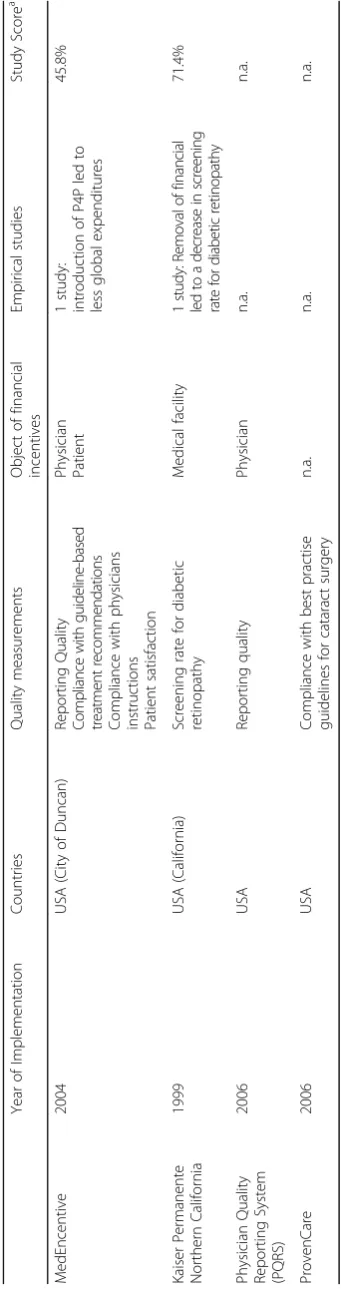
The MedEncentive Information Therapy Programis a web-based incentive system that rewards the primary care physician as well as the patient for adhering to evidence-based medicine (EBM) guidelines and a healthy lifestyle. This P4P approach, first introduced as a pilot program in Duncan, Oklahoma in August 2004, pursues the aim of enhancing communication between the phys-ician and patient via a web-based platform named MedEncentive [26] (Table 1).
Regarding the quality aspects, MedEncentive focuses on the cost effectiveness of the quality of health services. The platform aimed for high patient satisfaction and centeredness. Licensed health plans and self-insured em-ployers (per member per month fee) were able to par-ticipate. Twenty ophthalmic outcome indicators covered the process and outcome quality. Based on the ICD-9 diagnosis code, MedEncentive searches for appropriate EBM guidelines, which were proposed to the treating
physician via email. The measurability of SMART criteria (specific, measurable, achievable, relevant, and timely) was restricted because of the nominal scale level of the quality indicators. The risk adjustment was taken into consideration in the cost calculation (e.g. for “ cata-strophic cases”) [26] (Table 2).
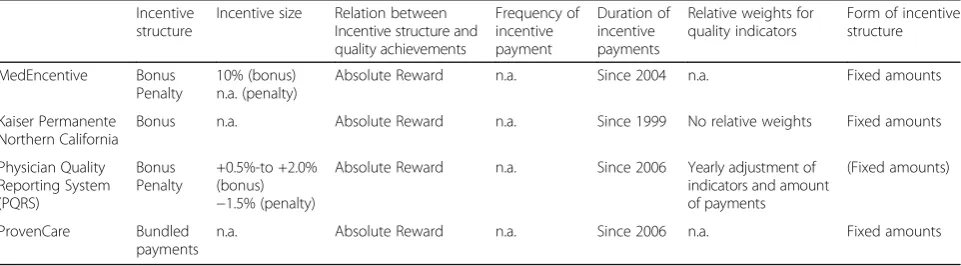
Concerning theincentive elements, the bonus and pen-alty payments were defined as the “absolute rewards”. The physicians were financially rewarded for transcrib-ing information via MedEncentive regardtranscrib-ing the applied patient-based therapy, which might deviate from recom-mended EBM guidelines. When physicians approved treatment according to EBM guidelines, or a reason for deviation was mentioned, the reimbursement increased by 10%. Reimbursement decreased if physicians rejected the proposed treatment without valid justification [26, 35]. The patient’s remuneration was determined primarily by compliance with physician’s orders. By reading diagnosis-related information, therapy information, and answering questions regarding his/her personal health status and level of satisfaction with the physi-cian’s performance, the patients could be financially rewarded, which was reflected in reduced co-payments [35].
Electronic Data Base Search (N=591)
[Pubmed=20, Wiley Online Library=526, NCBI=16, Web of knowledge=6, the Cochrane Library=6, Scopos=17, Econlit=0]
Titles after elimination of duplicities (N=551)
Full text reviewed (N=35)
Articles included in the review (N=13)
Excluded articles after title/abstract review (N=527)
Reasons for exclusion:
1. No Financial incentives and no opthalmology (n=501)
2. Financial incentive were found but not linked to ophthalmology (n=3) 3. Ophthalmology was not related to financial incentives (n=23)
Articles excluded meeting at least one exclusion criteria (N=22)
Reasons for exclusion:
1. No Financial incentives and no opthalmology (n=5)
2. Financial incentive were found but not linked to ophthalmology (n=6) 3. Ophthalmology was not related to financial incentives (n=11)
Papers retrieved by internet research, expert consultation and advanced internet search (N=11)
[image:3.595.58.540.88.415.2]No information was available regarding the frequency of payments (Table 3).
In 1999, Kaiser Permanente of Northern California in-troduced a pay-for-performance system in 35 of their medical facilities. For 20 clinical quality indicators, the regional operations leadership specified financial incen-tives for reaching predefined target goals. Financial incentives were paid to medical facilities, which could autonomously determine the use of the funds (funding core facilities, staffing, and quality improvements). Concerning ophthalmology, screening for diabetic retinop-athy was included as one quality indicator [36] (Table 1).
With regard toquality elements,patient safety was de-fined as one quality aim. According to recommendations of the American Diabetes Association and the American Academy of Ophthalmology, screening for diabetic retin-opathy should begin regularly for patients at the age of 31 years [37, 38]. The quality requirements for diabetic retinopathy screening were considered to be met if a pa-tient’s visit to the optometry or ophthalmology depart-ment was recorded within 2 years after the end of the assessment year. In best practice and SMART criteria, measurability was fulfilled to a limited extent because of the nominally scaled quality indicator. Risk adjustment of the outcome measurement was partially implemented because the target group was limited to a minimum age of 31 years (Table 2).
Bonus payments (incentive elements) were imple-mented in 1999 as absolute top payments, which linked a possible bonus payment to the undertaken screening for diabetic retinopathy. Since only one quality indicator was used, no relative weights were defined. The bonus payments were defined as fixed amounts (Table 2).
ThePhysician Quality Reporting System(PQRS)1is an American P4P approach, established by the Centers for Medicare & Medicaid Services (CMS) in 2006. During the first year, the lack of financial incentives for data col-lecting and reporting resulted in low participation. With the Tax Relief and Health Care Act passed by Congress in 2006, financial rewards for participating physicians were enabled, which increased the participation in PQRS [26].
In 2011, more than 280,229 physicians representing vari-ous medical disciplines have participated, receiving more than $261,000,000 (US) [39] (Table 1).
Regarding thequality elements, PQRS focused on clin-ical quality as well as on equity and timeliness. The quality measures were developed by discipline-specific societies, analyzed by the American Medical Association Physician Consortium for Performance Improvement (AMA-PCPI) and endorsed by the National Quality Forum (NQF) [40]. The inclusion and exclusion of qual-ity measures was conducted at regular intervals. In 2013, 203 quality measures2for claims were defined, of which 11 measures (e.g., cataracts, age-related macular de-generation and diabetic retinopathy) were allocated to ophthalmology [41, 42]. Detailed information regard-ing the risk adjustment of outcome measures was not presented (Table 2).
Financial incentiveswere offered by bonus and penalty payments. To receive bonus payments, physicians must report three different measures for at least 80% of their fee-for-service Medicare patients during the settlement period. The incentives were paid as “absolute rewards” [43]. In 2006, the level of bonus payments for successful data reporting started with 1.5% of the physician’s Medi-care billings and increased to 2.0% in 2008. In 2011, a gradual decrease in incentive payments to 1.0% was con-tinued with another decrease to 0.5%. The introduction of a penalty payment of 1.5% in case reporting criteria is not met is planned for 2015 [44] (Table 3).
[image:6.595.58.539.599.732.2]ProvenCare® is an alternative P4P approach for selected operations, which was founded by Geisinger Health Care (Danville, Pennsylvania). The “90-day warranty,” a key feature, guarantees cost coverage for the surgery as well as for follow-up treatments within 90 days [45]. The program started in 2006 with elective bypass surgery (a coronary artery bypass graft, called ProvenCare® CABG) and expanded its portfolio with total hip replacement, percutaneous coronary interven-tion (PCI), perinatal treatment, and bariatric surgery [46]. In June 2006, Geisinger Health Care began testing its P4P approach for cataract surgery [47] (Table 1).
Table 3systematic comparison ofincentive elementsaccording to van Herck et al
Incentive structure
Incentive size Relation between Incentive structure and quality achievements
Frequency of incentive payment
Duration of incentive payments
Relative weights for quality indicators
Form of incentive structure
MedEncentive Bonus Penalty
10% (bonus) n.a. (penalty)
Absolute Reward n.a. Since 2004 n.a. Fixed amounts
Kaiser Permanente Northern California
Bonus n.a. Absolute Reward n.a. Since 1999 No relative weights Fixed amounts
Physician Quality Reporting System (PQRS)
Bonus Penalty
+0.5%-to +2.0% (bonus)
−1.5% (penalty)
Absolute Reward n.a. Since 2006 Yearly adjustment of indicators and amount of payments
(Fixed amounts)
ProvenCare Bundled
payments
Regarding the definition of the quality of health service according to Campbell et al. [48], the cost effectiveness as well as equity and timeliness were followed by the P4P approach. The target group was restricted to cata-ract patients [46]. Program implementation occurred in six stages. In the first phase (Engage Champion), a dis-cussion of the entire program occurs in detail. The sec-ond phase (Compile Evidence) includes literature review and guidelines, which leads to the definition of best practices (Establish Best Practices). In the following phase, Establish Components/Redesign, the redesign of existing processes and workflows occurs before the beta testing phase begins, in which the data collection for the final modification occurs (Go Live Beta). The final phase of the process engagement represents the completion of the redesign, which leads to the full deployment phase
[47]. Forty pre- and post-operative quality indicators measured the process and outcome quality. However, no detailed information regarding risk adjustments was available [45] (Table 2).
Concerning the incentive elements, ProvenCare used performance-based bundled payments, including hos-pital and physician payments, which was the striking in-centive element of this approach. The program acts as a warranty because potential follow-up treatments within 90 days after surgery are covered [45, 49]. No detailed information concerning the size and frequency of the in-centive payments was available (Table 3).
The effect of pay-for-performance on the quality of care: the empirical evidence
With regard to the empirical evidence of the identified P4P approaches, papers on two different approaches were identified during the systematic search procedure. Lester et al. evaluated, by means of a longitudinal ana-lysis, the effects of removing financial incentives on the performance level of four clinical quality indicators in 35 outpatient facilities of Kaiser Permanente Northern Cali-fornia. In addition to screening for diabetic retinopathy, the assessment of the patient level of glycemic control (HbA1c <8%), control of hypertension (systolic blood pressure < 140 mmHg), and screening for cervical can-cer were enrolled. Besides gaining empirical insights into the effects of removing financial incentives on perform-ance levels, the authors were motivated to conduct this study because of the political decision to remove eight quality indicators from the Quality and Outcome Frame-work in April 2011. The authors expected that removing the financial incentives would lead to a significant de-crease in performance levels. Overall, 2,523,659 adult pa-tients were included in the analyses. Following the removal of financial incentives 5 years after implementa-tion, changes in the rates of screening for diabetic retin-opathy were analyzed over a total period of 9 years
(1999 to 2007). Hierarchical regression models were used to estimate the effect of removing the financial in-centive on the annual change in the screening rate. For the five consecutive years with financial incentives, the screening rate rose from 84.9 to 88.1%. Following the in-centive removal, the screening rate decreased to 80.5% after 4years. In year-to-year changes at the facility level, removing financial incentives led to an average decline of 3% per year. [36] Applying the Critical Appraisal Skills Programme (CASP) checklists, a score of 71.4% was calculated (Table 1).
In a second paper, Parke examined whether global health care expenditures might decrease by establishing MedEncentive. Empirical data were collected within the framework of a pilot study, established in the city of Duncan in August 2004. A retrospective cost analysis, which compares global expenditures of implementation relative to the baseline year, was conducted. The results show a global cost reduction of approximately 11.5%, from $2,316,929 (baseline year) to $2,049,780 (imple-mentation year). With regard to the disease category of the nervous system and sensory organs (ICD-9: 320-389) and covering ophthalmologic diseases as well, the total expenditures decreased from $94,476 (baseline year) to $77,715 (implementation year). This finding corresponds to a cost reduction of $16,761 (17.7%) [26]. The study score was determined to be 45.8% (Table 1).
Discussion
The aim of this study was to provide an overview of the existing pay-for-performance approaches in ophthalmol-ogy and their empirical evaluations. A general compari-son according to key characteristics showed that the four identified P4P approaches were implemented in the USA between 1999 and 2004. With regard to the under-lying quality measurements and objectives of the finan-cial incentives, differences between the four approaches were identified.
number of quality targets and indicators, the corre-sponding values of the identified approaches ranged between 1 (Kaiser Permanente) and 40 (ProvenCare). While too few indicators might lead to a dispropor-tionate focus on rewarded behavior, too many indica-tors might result in an unintended complexity, whereby the stimulation of desired behaviors might fail to appear [50].
With regard to the incentive elements of the P4P ap-proaches, the incentive size ranged from +10% to−1.5%. The financial incentives were implemented as bonus and penalty payments (MedEncentive, PQRS), bonus pay-ments (Kaiser Permanente) and performance-based bun-dled payments (ProvenCare), which were predominantly paid as individual incentives. In his review, Eijkenaar
found several papers that examined the pros and cons of individual versus group incentives. The performance measurements on the individual physician-level fre-quently failed because of small patient panels [51, 52] or less variation in quality measures compared to facility-level measurements, which might lead to inaccurate remuneration [53]. Group-level-based performance pay-ments might force undesirable behavior of single group members, such as“free riding” [50, 54]. In their review,
Frølichet al. compared, among others, group vs. individ-ual recipients. Among the studies targeting individindivid-ual re-cipients, the quality of five measurements increased, whereas two measurements showed a decreased quality. With group recipients, the quality of one measurement increased whereas two measurements showed opposite effects [55].
The main criticism of the identified P4P approaches was managing the incentive elements and their effect on the quality of care. In the context of PQRS, participating physicians were rewarded for data reporting and not for achievements of certain quality requirements. Therefore, the influence of financial incentives on the quality of medical care appeared to be questionable. Federman and Keyhani supported this suspicion in a survey of PQRS participants. Overall, 50.1% of the responding physicians were of the opinion that the PQRS program had no effect on the quality of care; 36.1% answered that it had a small effect, and 13.8% assessed the effect as moderate or large [56]. With regard to ProvenCare, the separation of payments for interdisciplinary treatments (e.g., diabetes) and the considerable administrative efforts were the main criticisms. The bundled pay-ments could lead to a “cost-containment mechanism” if corresponding amounts are left unchecked at regu-lar intervals [49].
The identified empirical studies showed that the im-plementation of a P4P program might lead to cost reductions [26].Parkedemonstrated in his financial ana-lysis that MedEncentive might lead to cost reduction
after 1 year compared to the baseline year. In the oph-thalmology field, an isolated cost effect could not be de-termined because the relevant ICD-9 range could not be solely assigned to eye diseases. The author justified the omission of these analyses with a subsample that was too small to provided statistically significant results. With regard to the examined ICD-9 ranges, described cost effects include the volume effects, which might have occurred within a single ICD-9 disease (intra-specific) and/or between different ICD-9 diseases (inter-specific). The inter-specific changes in the number of ICD-9 ranges before and after the MedEncentive implementa-tion were calculated. However, their influences on the described cost effects have only been justified with the omission of unnecessary treatments. With a self-calculated study score of 45.8%, the main weaknesses are attributable to the “economic evaluation” and “cost as-sessment and cost comparison”sections.
In the context of Kaiser Permanente Northern California,
Lester et al. showed that the presence/absence of financial incentives might result in quality improvements /deteriora-tions [36]. Unfortunately, the levels of significance for the annual changes in the screening rate before and after the removal of financial incentives were not calculated. Further points of weaknesses mentioned by the author are the lack of a control group and the type of financial incentives used. Financial rewards were addressed to the medical facility and not directly to the physician. As a consequence, the ef-fect of incentives on a physician’s behavior is questionable. Other possible factors (e.g., computerized reminders) that might have had an influence on the screening rate for dia-betic retinopathy were not examined. A final conclusion on the effects of the financial incentives on the screening rate was possible only to a limited extent. Regarding the study scoring of 71.4%, the main points of criticism are related to the result section.
Neither of the two studies examined the effect of the P4P programs on cost and quality development simul-taneously. With the help of different economic evalua-tions of P4P programs, Emmert et al. showed in their systematic review that quality improvements are fre-quently coupled with higher costs [11]. To draw valid conclusions regarding this aspect, a simultaneous exam-ination of the costs and quality effect would have been desirable in both studies.
be involved in the process of program design. A broad set seems to be favorable for quality measures, which is aligned with professional norms and aims for quality at-tainments and quality improvements [9, 28, 29, 50, 57]. Financial incentives should at least compensate for additional costs related to measures taken for quality improvements. Furthermore, quality-based payments should be sufficiently large to motivate behavioral re-sponses [9, 29, 58, 59]. Since individuals tend to value immediate earnings more than future earnings, small, frequent payments are preferable to a single, large lump sum payment [60].
The applicability of these general P4P requirements to the field of ophthalmology seems to be possible without major restrictions. The implementation of requirements on financial incentives and payment frequency depends primarily on the financial provider and less on ophthal-mology as a medical specialty. Regarding the require-ment of a broad set of quality measures, identified P4P approaches show that cataract surgery already offers at least 40 possible quality measures related to process and outcome quality [45]. Further quality measures seem to be definable regarding the whole field of ophthalmology. In addition to screening for diabetic retinopathy, further disease-specific diagnostic requirements may be speci-fied in order to capture process quality. Ophthalmology offers several measurable findings (e. g. visual acuity (decimal), intraocular tension (mmHg), refraction (di-optre)), which may be used in order to assess out-come quality. Future P4P approaches should take these recommendations more into account when de-signing P4P incentive schemes which aim to improve both the effectiveness and efficiency in ophthalmology and other disciplines.
Conclusions
In total, four P4P approaches have been identified in ophthalmology, of which two were evaluated within em-pirical analyses. The comparison of the framework setting showed numerous differences between the identi-fied P4P approaches, which might have influenced the performance of the P4P approaches. Because of the lack of empirical analyses, clear conclusions regarding their relative advantages and disadvantages could not be drawn. Further empirical analyses of P4P approaches ap-pear to be necessary to assess their influences on the quality and cost of healthcare in general and in ophthal-mology in particular.
Limitations
This review has several limitations. The inclusion criterion that P4P programs have to include (quality) measures that can be assigned to at least one of Donabedian’s quality di-mensions may lead to the impression that aspects like cost
effectiveness or patient satisfaction may have been neglected during the screening process. Performance is a multi-dimensional construct, which can be conceptualized in different ways. However, our literature screening results are robust since we did not exclude any study for using quality measures that were not captured under Donabedian’s quality triangle. Furthermore, the aim of this study was to identify various pay-for-performance ap-proaches in ophthalmology and their empirical evaluation. Because this medical discipline might be part of interdis-ciplinary P4P approaches, identification of further relevant approaches might have been missed. A comparison of the identified empirical studies facilitated by the calculated study scores is challenging because the studies differ in the type of evaluation.
Endnotes
1
Physician Quality Reporting System (PQRS) was ini-tially founded as“Physician Quality Reporting Initiative” (PQRI).
2
Measurements for electronic health record reporting were not included.
Additional file
Additional file 1:First results of search history (including duplicates), separated for single keyword combinations and for single databases. (DOCX 15 kb)
Abbreviations
AMA-PCPI:American Medical Association Physician Consortium for Performance Improvement (AMA-PCPI); CABG: Coronary Artery Bypass Graft; CASP: Critical Appraisal Skills Programme; CMS: Centers for Medicare & Medicaid Services; dec.: Decimal; dpt.: Dioptre; ICD: International Classification of Diseases; IQWIG: Institut für Qualität und Wirtschaftlichkeit im Gesundheitswesen; MIMIQ: Model for Implementing and Monitoring Incentives for Quality; mmHg: millimeter of mercury; NQF: National Quality Forum; P4P: Pay-for-Performance; PCI: Percutaneous Coronary Intervention; PQRI: Physician Quality Reporting Initiative; PQRS: Physician Quality Reporting System; SMART: Specific, Measurable, Achievable, Relevant, Timely
Acknowledgements
none.
Funding
No funding was obtained for this study.
Availability of data and materials
All data is contained within the manuscript.
Authors’contributions
Conception and design (TH); Analysis and interpretation (TH); Writing the article (TH, ME); Critical revision of the article (TH, ME); Final approval of the article (TH, ME); Data collection (TH); Provision of materials, patients, or resources (TH, ME); Literature research (TH). Both authors read and approved the final manuscript.
Competing interests
The authors declare that they have no competing interests.
Consent for publication
Ethics approval and consent to participate
Not applicable.
Publisher’s Note
Springer Nature remains neutral with regard to jurisdictional claims in published maps and institutional affiliations.
Received: 28 July 2015 Accepted: 25 May 2017
References
1. Wendt C. Mapping European healthcare systems: a comparative analysis of financing, service provision and access to healthcare. J Eur Soc Policy. 2009; 19:432–45.
2. Wendt C, Frisina L, Rothgang H. Healthcare System Types: A Conceptual Framework for Comparison. Soc Policy Adm. 2009;43:70–90.
3. Brocklehurst P, Price J, Glenny A, Tickle M, Birch S, Mertz E, et al. The effect of different methods of remuneration on the behaviour of primary care dentists. Cochrane Database Syst Rev. 2013;11:CD009853.
4. Rosenthal MB, Dudley RA. Pay-for-Performance. JAMA. 2007;297:740. 5. Rosenthal MB, Landon BE, Normand ST, Frank RG, Epstein AM. Pay for
performance in commercial HMOs. N Engl J Med. 2006;355:1895–902. 6. McNamara P. Foreword: Payment Matters? The Next Chapter. Med Care Res
Rev. 2006;63:5S.
7. Alshamsan R, Majeed A, Ashworth M, Car J, Millett C. Impact of pay for performance on inequalities in health care: systematic review. J Health Serv Res Policy. 2010;15:178–84.
8. Christianson JB, Leatherman ST, Sutherland K. Financial incentives, healthcare providers and quality improvements: A review of the evidence. London: Health Foundation; 2007.
9. Eijkenaar F. Pay for performance in health care: an international overview of initiatives. Med Care Res Rev. 2012;69:251–76.
10. Eijkenaar F, Emmert M, Scheppach M, Schöffski O. Effects of pay for performance in health care: a systematic review of systematic reviews. Health Policy. 2013;110: 115–30.
11. Emmert M, Eijkenaar F, Kemter H, Esslinger AS, Schöffski O. Economic evaluation of pay-for-performance in health care: a systematic review. Eur J Health Econ. 2012;13:755–67.
12. Gillam SJ, Siriwardena AN, Steel N. Pay-for-performance in the United Kingdom: impact of the quality and outcomes framework: a systematic review. Ann Fam Med. 2012;10:461–8.
13. van Herck P, D de S, Annemans L, Remmen R, Rosenthal MB, Sermeus W. Systematic review: Effects, design choices, and context of pay-for-performance in health care. BMC Health Serv Res. 2010;10:247.
14. Mehrotra A, Damberg CL, Sorbero MES, Teleki SS. Pay for performance in the hospital setting: what is the state of the evidence? Am J Med Qual. 2009;24:19–28.
15. Petersen LA, Woodard LD, Urech T, Daw C, Sookanan S. Does pay-for-performance improve the quality of health care? Ann Intern Med. 2006; 145:265–72.
16. An LC, Bluhm JH, Foldes SS, Alesci NL, Klatt CM, Center BA, et al. A randomized trial of a pay-for-performance program targeting clinician referral to a state tobacco quitline. Arch Intern Med. 2008;168:1993–9.
17. Christensen DB, Neil N, Fassett WE, Smith DH, Holmes G, Stergachis A. Frequency and characteristics of cognitive services provided in response to a financial incentive. J Am Pharm Assoc (Wash). 2000;40:609–17.
18. Gillam S, Siriwardena AN. Quality and outcomes framework: QOF - transforming general practice. Radcliffe Pub: Abingdon; 2011.
19. Kouides RW, Bennett NM, Lewis B, Cappuccio JD, Barker WH, LaForce FM. Performance-based physician reimbursement and influenza immunization rates in the elderly. The Primary-Care Physicians of Monroe County. Am J Prev Med. 1998;14:89–95.
20. Lee T, Cheng S, Chen C, Lai M. A pay-for-performance program for diabetes care in Taiwan: a preliminary assessment. Am J Manag Care. 2010;16:65–9. 21. Nahra TA, Reiter KL, Hirth RA, Shermer JE, Wheeler JRC. Cost-Effectiveness of
Hospital Pay-for-Performance Incentives. Med Care Res Rev. 2006;63:49S. 22. Hillman AL, Ripley K, Goldfarb N, Nuamah I, Weiner J, Lusk E. Physician financial
incentives and feedback: failure to increase cancer screening in Medicaid managed care. Am J Public Health. 1998;88:1699–701.
23. Hillman AL, Ripley K, Goldfarb N, Weiner J, Nuamah I, Lusk E. The use of physician financial incentives and feedback to improve pediatric preventive care in Medicaid managed care. Pediatrics. 1999;104:931–5.
24. Rosenthal MB, Li Z, Robertson AD, Milstein A. Impact of financial incentives for prenatal care on birth outcomes and spending. Health Serv Res. 2009;44:1465–79. 25. Curtin K, Beckman H, Pankow G, Milillo Y, Green RA. Return on investment
in pay for performance: a diabetes case study. J Healthc Manag. 2006;51: 365–74. discussion 375-6
26. Parke DW. Impact of a pay-for-performance intervention: financial analysis of a pilot program implementation and implications for ophthalmology (an American Ophthalmological Society thesis). Trans Am Ophthalmol Soc. 2007;105:448–60.
27. Salize HJ, Merkel S, Reinhard I, Twardella D, Mann K, Brenner H. Cost-effective primary care-based strategies to improve smoking cessation: more value for money. Arch Intern Med. 2009;169:230–5. discussion 235-6
28. Lee JY, Lee S, Jo M. Lessons from healthcare providers' attitudes toward pay-for-performance: what should purchasers consider in designing and implementing a successful program? J Prev Med Public Health. 2012;45:137–47. 29. Ryan AM, Damberg CL. What can the past of pay-for-performance tell us
about the future of Value-Based Purchasing in Medicare? Healthcare (Amsterdam, Netherlands). 2013;1:42–9.
30. Higgins JPT, Green S. Cochrane handbook for systematic reviews of interventions. Chichester, England, Hoboken, NJ: Wiley-Blackwell; 2008.
31. Donabedian A. The quality of care. How can it be assessed? 1988. Arch Pathol Lab Med. 1997;121:1145–50.
32. CASP-UK: Critical Appraisal Skills Programme (CASP) [http://www.casp-uk. net/checklists].
33. Armfield NR, Bradford M, Bradford NK. The clinical use of Skype–For which patients, with which problems and in which settings? A snapshot review of the literature. Int J Med Inform. 2015;84:737–42.
34. van Herck P, Annemans L, D de S, Remmen R, Sermeus W. Pay-for-performance step-by-step: introduction to the MIMIQ model. Health Policy. 2011;102:8–17. 35. Jeff Greene: Celebrating Five Years of Success. Examining a Groundbreaking
Solution for Controlling Health Care Costs Using Financial Incentives to Invoke Doctor-Patient Mutal Accountability [http://www.medencentive.com/ News_Support_Files/MedEncentive%205th%20Anniversary%20Report%20 First%20Edition%20-%20Rev%20A.pdf].
36. Lester H, Schmittdiel J, Selby J, Fireman B, Campbell S, Lee J, et al. The impact of removing financial incentives from clinical quality indicators: longitudinal analysis of four Kaiser Permanente indicators. BMJ. 2010;340:c1898. 37. American Academy of Ophthalmology Retinal Panel: Preferred Practice
Pattern®Guidelines. Diabetic Retinopathy. [www.aao.org/ppp].
38. American Diabetes Association. Professional Practice Committee. Diabetes Care. 2013;37:S1.
39. Myles JL, Shamanski F, Witte D. The physicians quality reporting initiative: measure development, implementation and current procedural terminology coding. Adv Anat Pathol. 2010;17:49–52.
40. Loftus ML, Sanelli PC. Physician quality reporting system: 2013 update. AJNR Am J Neuroradiol. 2013;34:1137–8.
41. Centers for Medicare & Medicaid Services (CMS): 2013 Physician Quality Reporting System (PQRS) Measures List [http://ascrs.org/download/gov/ 2013_PQRS_MeasuresList_111612.pdf].
42. Bagley B. Measuring for Medicare: the physician quality reporting initiative. Fam Pract Manag. 2007;14:37–40.
43. Centers for Medicare & Medicaid Services (CMS): Physician Quality Reporting System. Physician Quality Reporting System formerly known as the Physician Quality Reporting Initiative [http://www.cms.gov/Medicare/Quality-Initiatives-Patient-Assessment-Instruments/PQRS/index.html?redirect=/PQRI]. 44. Anumula N, Sanelli PC. Physician Quality Reporting System. AJNR Am J
Neuroradiol. 2011;32:2000–1.
45. Saver C: 90-day guarantee: warranties as a tool for improved patient outcomes. OR Manager 2009, 25:1, 19-20.
46. Geisinger Health System: ProvenCare Portfolio [https://xghealth.com/ provencare/].
47. McKinley KE, Berry SA, Laam LA, Doll MC, Brin KP, Bothe A, et al. Clinical microsystems, Part 4. Building innovative population-specific mesosystems. Jt Comm J Qual Patient Saf. 2008;34:655–63.
48. Campbell SM, Roland MO, Buetow SA. Defining quality of care. Soc Sci Med. 2000;51:1611–25.
50. Town R, Wholey DR, Kralewski J, Dowd B. Assessing the influence of incentives on physicians and medical groups. Med Care Res Rev. 2004;61:80S–118S. 51. Hofer TP, Hayward RA, Greenfield S, Wagner EH, Kaplan SH, Manning WG.
The unreliability of individual physician "report cards" for assessing the costs and quality of care of a chronic disease. JAMA. 1999;281:2098–105. 52. Nyweide DJ, Weeks WB, Gottlieb DJ, Casalino LP, Fisher ES. Relationship of
primary care physicians' patient caseload with measurement of quality and cost performance. JAMA. 2009;302:2444–50.
53. Krein SL, Hofer TP, Kerr EA, Hayward RA. Whom should we profile? Examining diabetes care practice variation among primary care providers, provider groups, and health care facilities. Health Serv Res. 2002;37:1159–80.
54. Gaynor M, Rebitzer JB, Taylor LJ. Physician Incentives in Health Maintenance Organizations. J Polit Econ. 2004;112:915–31.
55. Frølich A, Talavera JA, Broadhead P, Dudley RA. A behavioral model of clinician responses to incentives to improve quality. Health Policy. 2007;80: 179–93.
56. Federman AD, Keyhani S. Physicians' participation in the Physicians' Quality Reporting Initiative and their perceptions of its impact on quality of care. Health Policy. 2011;102:229–34.
57. Conrad DA, Christianson JB. Penetrating the "black box": financial incentives for enhancing the quality of physician services. Med Care Res Rev. 2004;61: 37S–68S.
58. Young GJ, Conrad DA. Practical issues in the design and implementation of pay-for-quality programs. J Healthc Manag. 2007;52:10–8. discussion 18-9 59. Conrad DA, Perry L. Quality-based financial incentives in health care: can we
improve quality by paying for it? Annu Rev Public Health. 2009;30:357–71. 60. Damberg, C. L., Sorbero, M. E., Mehrotra, A., Teleki, S. S., Lovejoy, S., & Bradley, L.:
An environmental scan of pay for performance in the hospital setting.
Rand Health Working Paper WR-474-ASPE/CMS. Santa Monica, CA; 2007.
• We accept pre-submission inquiries
• Our selector tool helps you to find the most relevant journal • We provide round the clock customer support
• Convenient online submission • Thorough peer review
• Inclusion in PubMed and all major indexing services • Maximum visibility for your research
Submit your manuscript at www.biomedcentral.com/submit