Journal of
Applied Research on Industrial Engineering
Journal of Applied Research on Industrial Engineering
Vol. 1, No. 1 (2014) 12-18
1.
Introduction
Data envelopment analysis (DEA) is a nonparametric approach for evaluating the performance of different organizations and uses multiple inputs to produce multiple outputs. For the first time, Charnes, Cooper and Rhodes (1978, 1979) introduced CCR model to evaluate relative efficiency of
1 Corresponding Author name : Sahar Khoshfetrat ([email protected])
Introducing a nonlinear programming model and using genetic algorithm
to rank the alternatives in analytic hierarchy process
Sahar Khoshfetrat
a1, Farhad Hosseinzadeh Lotfi
b aDepartment of Mathematics, Science and Research Branch, Islamic Azad University, Tehran, Iran.
b
Department of Mathematics, Science and Research Branch, Islamic Azad University, Tehran, Iran.
a r t i c l e i n f o a b s t r a c t
Article History:
Received: 7 February 2014 Received in revised format : 22 March 2014
Accepted: 7 April 2014 Available online: 29 April 2014
Keywords:
Data envelopment analysis (DEA)
Analytic hierarchy process (AHP)
Genetic algorithm (GA)
13
making units (DMUs). Ranking is one of the important issues in DEA literatures. Adler et al. (2002) presented a paper in which ranking methods were reviewed. DEA is used to generate relative importance vectors from Analytic hierarchy process (AHP) pairwise comparison matrices and to synthesize global priority weights (e.g. Ramanathan, 2006). AHP, on the other hand, is a main tool in multiple criteria decision-making (MCDM). Deriving the true weights for pairwise comparison matrices is an important subject in AHP. Many papers are indicated to distinguish the priorities of alternatives in AHP and derive
true weights forpairwise comparison matrices (Chu at el.1979; Hwang and Yoon, 1981; Cogger and Yu,
1985; Crawford, 1987;G. Islei and Lockett, 1988;Saaty, 2000; Mikhailov, 2000; Sektani, 2000; Liu and Hai, 2005;Ramanathan, 2006; Wang and Chin, 2009; Grošelj at el, 2011 and so on).
In 1975, Holland developed the idea of “Adaptation in natural and artificial systems” in his book where he had described how to apply the principles of natural evolution to optimize problems and built the first Genetic Algorithms (GAs). Holland’s theory has been further developed and now GAs stand up as a powerful tool for solving search and optimization problems. GAs are based on the genetics and evolution principles. The use of GA is a fast-developing field of research, and there is much proposed to recommend. However, some significant research has been carried out in this field (Koza, 1992; Mitchell, 1996; Osmera at el. 1997; Mak, 2000; Zhang, 2006 and so on).
This paper contributes to derive priorities from pairwise comparison matrices by introducing a model. The GA is used to solve the proposed model. The mentioned methodology can be applied successfully.
The remainder of this paper is organized as follows. Section 2 provides brief preliminaries on AHP and GAs. In section 3, a NLP is proposed for determining the priorities of alternatives in AHP. Some features are presented to facilitate introducing the proposed model. A numerical example is declared in section 4 to illustrate the applicability of the introduced model. The solutions to the example are solved using MATLAB 9.0, GA and the solutions are also given. In section 5, the comparison between the proposed model and previous models in literatures is presented. Conclusions and remarks are provided in section 6.
2.
Research background
2.1.
Preliminaries
2.1.1.
AHP
14
AHP. Finding a model, which can do all the mentioned tasks by using a new method to solve it, is important in AHP. Traditionally, some prerequisites are the same in proposed methods as following.
Let A(aij)n n be a pairwise comparison matrix with
a
ii
1
and1 0 ji ij a a
for
i
j
and 1( ,..., n)T
W w w be its local priority vector. Most of the methods as EM, DEAHP, and DEAHP/AR and
so on consider each row of matrix A as a DMU and each column as an output and assume a dummy input
value of unity for all the DMUs. If matrix A is consistent, (that isaij a aik kj i j k, , 1, 2,..., )n , then
A contains no errors (the weights are already known) and we have
(1)
By using the priority vector, the alternatives can be ranked.
2.2.
Genetic Algorithms
During early years of the 21st century, genetic algorithms have become increasingly popular tools for solving hard optimization problems. Yet while the number of applications has grown rapidly, the development of GA theory has been considerably slower. Perhaps the most important sets of mathematical concepts needed fully to appreciate GA theory are those of linear algebra and stochastic processes. The power of mathematics lies in technology transfer: there exist certain models and methods, which describe many different phenomena and solve a wide variety of problems. GAs are examples of mathematical technology transfer: by simulating evolution, one can solve optimization problems from a variety of sources. Today, GAs are used to resolve complicated optimization problems, such as job shop scheduling, games playing, etc.
3.
Priority estimation in the AHP: A proposed NLP model
In this section, we formulate a proposed NLP model, which has discriminating power to estimate the priority vector in AHP. Prior to the introduction the proposed model, a few features will be declared. We formulate the following NLP model for ranking alternatives in AHP.
,
1, 2,...,
i ij
j
w
a
i j
n
w
1 1 2 1 1min
.
1
0
1,...,
p p n i i ij i j jn j j j
w
a
w
s t
w
w
j
n
15
Whereaij are the elements of pairwise comparison matrix A and i j
w
w
is a relation between local weights of criteria. The objective function is based on different norms as norm 1, norm 2 and infinite norm.
The proposed model, model (2), is feasible. For it has only one constraint as and this constraint can be omitted.
1 2
...
n1
w
w
w
We state advantages of model (2) as following.
1.
It is suitable for large amount of data.
2.
By using norm 1 in objective function in GA solver, the alternative solutions are
obtained.
3.
We can claim that it has managerial and rational justification (Common weight). That is,
this model can consider the manager’s opinion. Indeed, because of objective function,
i j
w
w
approaches to
aij. This estimates the decision-maker’s (DMs)’ subjective judgments.
4.
It is possible to apply managerial terms. (It is possible to consider the linear constraints
according to manager’s decision). That is, if a manager decides not to notice some
constraints to experts, or in competition projects, it is not necessary to declare some
priorities, which are determined for some alternatives in AHP.
5.
It has capability of sensitivity analysis which means this model is sensitive to some
comparisons in a pairwise comparison matrix.
Up to this point, we theoretically showed some beneficial advantages of the proposed models. In next section, this approach for data, which is taken from Saaty (2000), is illustrated.
4.
Numerical example
Consider the following inconsistent comparison matrix, which comes from Saaty (2000).
1 4 3 1 3 4
1 1
1 7 3 1
4 5
1 1 1 1 1
1
3 7 5 5 6
1 1
1 5 1 1
3 3
1
5 5 1 1 3
3
1 1
1 6 3 1
4 3
A
16
For this inconsistent pairwise comparison matrix, we use model (2). For solving the model (2) by norm 1 and norm 2, the GA solver is used which is available in MATLAB 9.0. Indeed, we use the GA solver in MATLAB 9.0. In this solver, population size can be changed to obtain accurate solutions. We use proposed model for the above matrix. It can be used for six stages in each of which, the maximum weight is considered as the best one and is omitted for next stage. This operation is continued as previous case for 5 remaining alternatives and then they will be ranked. For this pairwise comparison matrix, the process of obtaining ranks as it illustrates is as following in Tables 1 and 2.
Table 1 The process of obtaining the ranks by GA and Norm 1
Alternatives 1 2 3 4 5 6 Best First stage 0.511 0.128 0.021 0.106 0.106 0.128 Alternative 1 second stage 0.260 0.043 0.217 0.217 0.261 Alternative 6 Third stage 0.394 0.055 0.276 0.276 Alternative2 Fourth stage 0.091 0.454 0.455 Alternative 4 Fifth stage 0.167 0.833 Alternative 5 sixth stage 1.000 Alternative 3
Table 2 The process of obtaining the ranks by GA and Norm 2
Alternatives 1 2 3 4 5 6 Best First stage 0.363 0.077 0.034 0.136 0.201 0.189 Alternative 1 second stage 0.121 0.053 0.211 0.317 0.298 Alternative 5 Third stage 0.394 0.051 0.228 0.326 Alternative2 Fourth stage 0.084 0.380 0.536 Alternative 6 Fifth stage 0.167 0.833 Alternative 4 sixth stage 1.000 Alternative 3
As shown in Table 1, the first alternative has maximum value; so it is given the first rank. This alternative is omitted in the next stage and previous process is repeated for the remaining alternatives until one is left. The final results of solving the proposed model for inconsistent comparison matrix A by considering the Tables 1 and 2are gathered in Tables3 and 4. Taking relation (1) into consideration, it is obvious that the value of objective function of proposed model for consistent pairwise comparison matrix is zero.
As it was mentioned, Norm 1 and Norm 2 are used for the objective function of proposed model, model (2).
Table 3 The local priorities which are obtained of model (2) with norm 1 and
population size: 850
1
w
w
2w
3w
4w
5w
617
Table 4 The local priorities which are obtained of model (2) with norm 2 and
population size: 850
1
w
w
2w
3w
4w
5w
6Rank 1 5 2 6 4 3
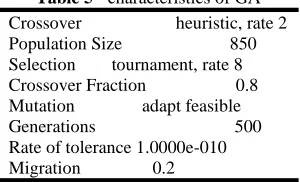
The ranking which is obtained in Table 4 by Norm 2, is acceptable, credible and consistent with decision maker’s opinion. The proposed model is so interesting. GA is used for solving it as the first time in AHP to derive the true weights from pairwise comparison matrix. Based on this model and GA, alternatives are also ranked. As it is claimed, the GA is applied as the solver. The characteristics of the applied GA are as following.
The size of population can be changed to get exact or almost true solutions.
5.
Comparison to previous models in literatures
Choosing the most suitable method for deriving priorities from pairwise comparison matrices has been an important research topic in AHP. Different methods have been extensively introduced and deriving priorities for alternatives has been investigated. In previous methods in AHP, adding the decision-maker’s favorites in model is impossible. However, in our proposed model, it is possible to consider manager or expert’s justification in his/her favorite case. Most of the proposed models have many constraints and they are time-consuming in terms of obtaining the best local weights for pairwise comparison matrices. This is solved in model (2), which not only obtains logical and true weights in a reasonable period of time but also can manage problems with large size of data.
6.
Conclusions
Diverse methods and models are introduced for deriving the local weights for pairwise comparisons matrices in AHP. A new model with one constraint is proposed. GA, which is a random algorithm for obtaining the optimal solutions of problems, is used to solve the model. The proposed model contributes to problems with large volume of data in AHP for determining the priorities. It has managerial and rational justification because of common weights. By using norm 1 in objective function of the proposed model, the alternative solutions are obtained.
It is for the first time that GA is used for deriving the true weights from pairwise comparison matrices in AHP.
References
[1] Adler, N., Friedman, L., Stern, Z. S., Review of ranking methods in data envelopment analysis context. European Journal of Operational Research. 140, 249–265.
18
[2] Charnes. A., Cooper. W. W., Rhodes. E., 1978. Measuring the efficiency of decision making units, EuropeanJournal of Operational Research 2 (6), (2002) , 428–444.
[3] Crawford, G.B., The geometric mean procedure for estimating the scale of a judgment matrix, Applied Mathematical Modelling 9, ( 1987) , 327–334.
[4] Chu, A.T.W., Kalaba, R.E., Spingarn, K., 1979. A comparison of two methods for determining the weights of belonging to fuzzy sets, Journal of Optimization Theory and Applications 27 , 4, (2002) , 531–538. [5] Cogger, K.O., and Yu, P.L., Eigenweight vectors and least-distance approximation for revealed preference in
pairwise weight ratios, Journal of Optimization Theory and Applications 46, (1985)483–491.
[6] Davis, L., Genetic Algorithms and simulated Annealing, Morgan Kaufmann Publishers, San Mateo, CA. (1987)
[7] Golden, B., Wasil, E., Harker, P. The analytic hierarchy process: applications and studies. Berlin, Springer.( 1989).
[8] Hwang, C.L., and Yoon, K Multiple Attribute Decision Making: Methods and Applications, Springer-Verlag, Berlin. .(1981).
[9] Holland, J.H., Adaptation in Natural and Artificial Systems, University of Michigan Press, Ann Arbor(1975). [10]Islei, G., and Lockett, A.G., Judgmental modeling based on geometric least square, European Journal of
Operational Research 36, (1988) 27–35.
[11]Keane, A., Genetic Algorithms Digest, 1994. Thursday, May 19, Volume 8, Issue 16.
[12]Mikhailov, L., A fuzzy programming method for deriving priorities in the analytic hierarchy process, Journal of the Operational Research Society 51, (2000) 341–349.
[13]Ramanathan, R., Data envelopment analysis for weight derivation and aggregation in the analytic hierarchy process, Computers and Operations Research 33, (2006)1289–1307.
[14]Saaty, T.L., The Analytic Hierarchy Process: Planning, Priority Setting, Resource Allocation, McGraw-Hill, Proposed York(1980). .
[15]Saaty, T.L., Fundamentals of Decision Making and Priority Theory with the Analytic Hierarchy Process, RWS Publications, Pittsburgh.
[16]Wasil, E., and Golden, B., 2003. Celebrating 25 years of AHP-based decision making. Computers and Operations Research; 30,( 2000.)1419–20.