Library Reports
University Library
1-2014
Data Management Brownbag Evaluation Summary
Megan N. O'Donnell
Iowa State University, [email protected]
Bonnie S. Bowen
Iowa State University, [email protected]
Follow this and additional works at:
http://lib.dr.iastate.edu/libreports
Part of the
Data Storage Systems Commons, and the
Library and Information Science Commons
This Report is brought to you for free and open access by the University Library at Iowa State University Digital Repository. It has been accepted for inclusion in Library Reports by an authorized administrator of Iowa State University Digital Repository. For more information, please contact [email protected].
Recommended Citation
Data Management Brownbag Evaluation Summary
Abstract
Data management and sharing became a national research concern when the National Science Foundation (NSF) began requiring Data Management Plans (DMPs) as part of their grant proposal process in January of 2011. While NSF is not the only funding agency requiring DMPs they are one of the largest and most diverse. As competition for grant funding has become more competitive, what were once considered sideshow documents to the main proposal may now factor into proposal acceptance or rejection. In 2013, Iowa State University received over 38 million dollars in sponsored funding from the National Science Foundation. In order to maintain this level of research investment Iowa State researchers need to be able to write and implement effective data management plans which meet funder requirements. The Data Management Brownbag/Seminar held on Nov. 5, 2013 was organized by the University Library, the Office of the Vice President for Research, and SP@ISU (Strengthening the Professoriate). It was the first university-wide presentation to address data management on the ISU campus.
Disciplines
Data Storage Systems | Library and Information Science
Data Management Brownbag Evaluation Summary
Megan N. O’Donnell
University Library, Iowa State University
Bonnie S. Bowen
Department of Ecology, Evolution & Organismal Biology and SP@ISU, Iowa State University
Background
Data management and sharing became a national research concern when the National Science Foundation (NSF) began requiring Data Management Plans (DMPs) as part of their grant proposal process in January of 2011. While NSF is not the only funding agency requiring DMPs they are one of the largest and most diverse. As competition for grant funding has become more competitive, what were once considered sideshow documents to the main proposal may now factor into proposal acceptance or rejection. In 2013, Iowa State University received over 38 million dollars in sponsored funding from the National Science Foundation.1 In order to maintain this level of research investment Iowa State
researchers need to be able to write and implement effective data management plans which meet funder requirements. The Data Management Brownbag/Seminar held on Nov. 5, 2013 was organized by the University Library, the Office of the Vice President for Research, and SP@ISU (Strengthening the Professoriate). It was the first university-wide presentation to address data management on the ISU campus.
Methods
The brownbag was split into two sections. The first section gave an overview of the reasons for data management (including current problems and issues) and shared a humorous video which highlighted what we called “worst practices.” The second part of the presentation revolved around tools that are available for data management including the new University Library Data Management Guide
(http://instr.iastate.libguides.com/DMP) and data management checklists (hosted on the guide) which were created to accompany the workshop and as stand-alone resources. Lastly, a review of Iowa State University resources for data management was followed by a question and answer session after the conclusion of the presentation. Participants were then invited to fill out an evaluation. Based on the number of empty chairs during the presentation we believe there were at least 40 attendees though only thirty-one filled out the evaluation.
The evaluation had four distinct parts. First, participants were asked to identify their position at the university as Faculty, Staff, Postdoc, or Student. The second section contained three questions intended to gauge the effectiveness of the presentation. These questions used a five point scale where the lowest score of 1 was “strongly disagree” and the highest score of 5 was “strongly agree.” The third section
1 See FY 2013 Sponsored Funding Awards – FY 2013 Total by Source at
http://www.vpresearch.iastate.edu/documents/filelibrary/for_researchers/sponsored_funding_awards_data/Spo nsored_Funding_FY04FY13_BD6C75BBCC550.pdf
asked if the participant had ever written a data management plan, what agency they had written it for, which resources they had used to write the DMP, and what they considered to be the hardest part of the process. There was an additional question in the third section asking if they had ever deposited data with a repository, archive, or with a publisher and if so, the name of the service used. The fourth and final section contained three open-ended short answer questions asking participants what they thought were the most and least useful parts of the presentation and what topics they would like to see
addressed in future workshops.
Results
Participants
Of the 31 participants who filled out the evaluation and indicated their position at the University (24), the majority were faculty (14) the remaining were 6 staff, 4 postdocs, 1 student and 1 “visiting scholar.”
Data Management Plan Questions
All thirty one participants answered the question “Have you ever written a Data Management Plan?” Surprisingly there were more who had not written a DMP (n=17) than those who had (n=14). Of those who said that they had written a DMP, 12 indicated that they had written one as part of an NSF grant proposal, 1 was for NASA, and 1 was left blank. This indicates that the majority of data management plans are prepared by those submitting grant proposals to the NSF to meet the requirements
implemented in 2011. Half of those who had written DMPs and indicated a funding agency were faculty (n=7) and there was one of each staff, student and post-doc. Four who had written DMPs left their status blank.
There were thirteen responses to the multiple choice question “What resources did you use [to write your DMP]?” Two choices: “funding agency website” (n=10) and “colleague” (n=9) were used by the majority of the participants. The remaining two choices, “OSPA” (Office of Sponsored Programs) Administration) and “other” were only used occasionally or not at all (see Table 1).
Table 1. Resources used to write DMP (n=13)
Choices Number Percent
Funding agency website 10 77%
Colleague 9 69%
OSPA 0 0%
Other 4 31%
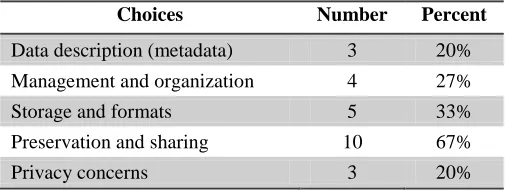
Table 2. What is the hardest part of developing a DMP? (n=15)
Choices Number Percent
Data description (metadata) 3 20%
Management and organization 4 27%
Storage and formats 5 33%
Preservation and sharing 10 67%
Privacy concerns 3 20%
The last question about data management plans asked researchers if they had ever deposited their data with a repository, archive, or publisher and if so, the name of the service they used. Twenty-nine participants answered this question. Sixteen participants said they did not deposit data, 11 said they did, and two said they did deposit but it wasn’t data. One of the two who indicated that they had deposited “not data” clarified that they deposited to a text repository but did not provide the name of the
repository. The other “not data” response provided no clarification of what they had deposited or where it went. Of those who deposited data (n=16), 10 provided the name of the service or location where the data was deposited. The locations for deposit varied widely. Very few specific repositories were given. ArXiv, GenBank, NCBI/GET2, and GBIF (Global Biodiversity Information Facility) were the only ones listed by name. One participant listed government agencies (DOE and OSTI) and two publishers were named (AMC and Elsevier). Two cloud storage services, Drop Box and Microsoft Sky Drive, were also named as places for data “deposit.” There was one participant wrote “ISU Repository.” There currently is no service on campus with this name but it could be a reference to ISU’s Institutional Repository, Digital Repository @ Iowa State University, which does not take data at this time but does host manuscripts. It could also be in reference to a local storage solution which is locally referred to as a “repository.”
Response to the Presentation
Overall the response to the presentation was positive. The lower score for question #2 is not entirely surprising as we decided to focus on general data management planning (based mostly off of the National Science Foundation requirements) and not the specific requirements of each funding body or NSF’s directorate guidelines. This was done because we wanted to reach a broad audience and not restrict the presentation to only one discipline or group.
Table 3. Questions used to gauge the effectiveness of the presentation and the average response (out of 5).
Number Question Response
1 My understanding of data management planning increased and will help with my research 4.2
2 My understanding of data management plans required by funding agencies increased 3.8
3 I will recommend this workshop to colleagues and students if it is offered again 4.3
Responses to the three open-ended questions where categorized based on common themes. (see Table 3 for categories). Responses often covered multiple themes. Each response was assigned at least one category and at most three categories. The first two questions were:
“Which components of this session were most useful to you and why?” (28 answers) “Which components of this session were least useful to you and why?” (11 answers)
Table 4: Responses to questions about most useful and least useful aspects of the workshop
Data
Repos. Video Intro
ISU
resources Guide Checklists Overall Help Most
Useful 5 4 2 8 6 6 2 2
Data
Repos. Video
Too general
Why
Important None
Least
Useful 2 2 1 2 3
The third and last open-ended question asked “What topics would you like to see addressed at a future workshop?” received 18 responses. There were two requests for workshops on agency specific
guidelines, two requests for workshops on writing data management plans, and three requests for sample data management plans. Other responses addressed broad topics, some of which were not related to data management such as: long-term preservation, securing and storing data, EndNote, and information on reference librarians, and requests to offer the workshop again.
Conclusion
Based on the number of attendees and the responses we gained from the evaluation it is clear that data management is an area of interest on the Iowa State University campus. The overall positive reception of the presentation indicates that it was effective in explaining data management planning and provided useful resources for researchers. The responses show that while all parts of data management are important to ISU researchers, data sharing and preservation are considered the most difficult parts of the data management planning process. These responses may indicate that there is not only a knowledge gap but also a resource gap on the Iowa State campus pertaining to data sharing and preservation. Additional presentations or workshops on data management should try to focus on these areas in more detail. The challenge in doing so is that ISU has no campus-wide resources devoted to data preservation and sharing so researchers must rely on outside institutions and services, many of which are discipline-driven. If future presentations or workshops are targeted at specific departments or colleges this is easily done, but it is not an appropriate solution for presentations aimed at a diverse audience.
maintained and updated regularly for them to retain their usefulness. Any changes or additions to campus-wide resources will also need to be integrated into the guide and future presentations.