Rochester Institute of Technology
RIT Scholar Works
Theses
Thesis/Dissertation Collections
3-18-2015
Run-time Ink Stability in Pneumatic Aerosol Jet
Printing Using a Split Stream Solvent Add Back
System
Arjun Wadhwa
Follow this and additional works at:
http://scholarworks.rit.edu/theses
This Thesis is brought to you for free and open access by the Thesis/Dissertation Collections at RIT Scholar Works. It has been accepted for inclusion in Theses by an authorized administrator of RIT Scholar Works. For more information, please [email protected].
Recommended Citation
R.I.T
Run-time Ink Stability in Pneumatic Aerosol Jet Printing Using a Split
Stream Solvent Add Back System
by
Arjun Wadhwa
A Thesis Submitted in Partial Fulfilment of the Requirements for the Degree of Masters in
Science in Industrial and Systems Engineering
Department of Industrial and Systems Engineering
Kate Gleason College of Engineering
Rochester Institute of Technology
Rochester, NY
Run-time Ink Stability in Pneumatic Aerosol Jet Printing Using a Split
Stream Solvent Add back System
Submitted by:
Arjun Wadhwa
A Thesis Submitted in Partial Fulfilment of the Requirements for the Degree of Masters in
Science in Industrial and Systems Engineering
Approved by:
Dr. Denis Cormier
________________________
(Department of Industrial and Systems Engineering)
(Advisor)
Dr. Scott Williams
_________________________
(School of Chemistry and Materials Science) (Committee Member)
Dr. Marcos Esterman
_________________________
i
Abstract
Aerosol Jet printing is a non-contact process capable of printing nano–ink patterns on conformal and
flexible surfaces. Aqueous or solvent nano–inks are pneumatically atomized by the flow of nitrogen gas.
The flow of atomizing gas into and out of the cup leads to evaporation and removal of volatile solvent(s).
As the solid loading fraction of the ink increases, the rheological changes eventually lead to instabilities
in print output. A potential solution to this problem is to moisten the atomizing ink by running it through
a bubbler. In this study, neat co-solvent solutions of ethanol and ethylene glycol at 85: 15 and 30:70
mixing ratios were atomized using nitrogen flow rates ranging from 600 to 1000 ccm. It was observed
that ethanol, being the more volatile solvent, was depleted from the neat solution. When using a bubbler
solvent add-back system, an excessive amount of ethanol was returned to the neat solution. The rate of
solvent loss from an ethanol rich neat solution (80%) was higher compared to an ethylene glycol rich neat
solution. A mixture of dry and wet (ethanol moistened) nitrogen gas was used to equalize the rate of
ethanol evaporation. Ethanol equilibrium in neat solutions with higher ethylene glycol loading (70%) was
achieved with a 40-60% wet nitrogen component while neat solutions with higher ethanol loading (85%)
were stable with 85 -90% wet nitrogen gas. The results were validated with copper nano ink with similar
co-solvent ratios. The solid content of the ink remained constant over four hours of printing when the
optimal dry: wet nitrogen gas ratios were used. Copper ink with 85% ethanol being atomized at 1000 ccm
ii
TABLE OF CONTENTS
List of Figures ... iii
List of Tables ... iv
List of Equations ... v
1. INTRODUCTION ... 1
2. LITERATURE REVIEW ... 3
2.1 Classification of Printing Technologies ... 3
2.2 Direct Write Printing ... 4
2.2.1 Ink Jet Printing ... 6
2.2.2 Laser Direct Write Printing ... 8
2.2.3 Flow Based Direct Write Printing ... 9
2.3 Overview of Aerosol Jet Deposition Process ... 9
2.3.1 Process Description ... 11
2.4 Real World Applications of AJ Printing ... 19
2.5 Process Parameter Characterization ... 21
2.7 Current Challenges ... 24
2.6 Research Scope ... 28
3. EXPERIMENTAL METHODOLOGY ... 29
3.1 Research Objective ... 29
3.2 Materials ... 29
3.3 Proposed Approach ... 29
3.4 Tools Used ... 32
4. EXPERIMENTAL RESULTS AND DISCUSSIONS ... 33
4.1 Ethanol Add-Back Simulation ... 33
4.2 Baseline Solvent Loss Rate Without Solvent Add-Back ... 34
4.3 Solvent Add-Back Rate Using A Bubbler ... 36
4.4 Split Stream Solvent Add-Back ... 41
4.5 Validation with Copper Nano-Inks ... 45
5. CONCLUSIONS AND FUTURE WORK ... 48
iii
List of Figures
Figure 1: Classification of Printing Technologies ... 3
Figure 2: Classification of Direct Write Printing Processes. ... 5
Figure 3: Classification of Ink Jet Printing Technology. ... 6
Figure 4: Continuous Ink Jet Printing ... 7
Figure 5: Drop on Demand Ink Jet Printing ... 8
Figure 6: Optomec Aerosol Jet System at the Brinkman Machine Tools and Manufacturing Lab, Rochester Institute of Technology ... 11
Figure 7: Sectional View of the Pneumatic Atomization Unit ... 13
Figure 8: Pneumatic Atomization Head ... 14
Figure 9: Sectional View of the Bubbler Solvent Add-Back System ... 15
Figure 10: Sectional View of the Virtual Impactor Assembly ... 16
Figure 11: Sectional View of the Deposition head and catcher assembly ... 17
Figure 12: 200 micron ceramic nozzle ... 17
Figure 13 Aerosol Jet Printing Process Schematic ... 18
Figure 14: AJP process flowchart ... 18
Figure 15: Representation of Solvent Evaporation During Atomization ... 26
Figure 16: Clogging In Atomization Cup. ... 26
Figure 17: Clogging In Virtual Impactor ... 27
Figure 18: Clogging In the Deposition Nozzle ... 27
Figure 19. Ethanol Flow Rate Versus Temperature Curve at Different Atomization Flow Rates ... 34
Figure 20. Weight Percent of Ethanol Versus Time Plot for Atomization of a 30% ethanol 70% Ethylene Glycol Co-Solvent Mixture Without Bubbler Add-Back ... 35
Figure 21. Weight Percent of Ethanol Versus Time Plot for Atomization of a 85% ethanol 15% Ethylene Glycol Co-Solvent Mixture Without Bubbler Add-Back ... 36
Figure 22. Weight Percent of Ethanol Versus Time for Atomization of 30% Ethanol 70% Ethylene Glycol Co-Solvent Mixture With Solvent Add-Back ... 37
Figure 23. Weight Percent of Ethanol Versus Time for Atomization of 85% Ethanol 15% Ethylene Glycol Co-Solvent Mixture With Solvent Add-Back ... 37
Figure 24. Bubble Formation At (a) 600 ccm and (b) 1000 ccm Nitrogen Flow Rates ... 40
Figure 25: Split Stream Bubbler Assembly. ... 41
Figure 26: Weight Percent of Ethanol Versus Time Plot for Atomization of a 30% Ethanol 70% Ethylene Glycol Co-Solvent Mixture Atomized at 600 ccm With Different Wet: Dry Bubbler Combinations. ... 42
Figure 27: Weight Percent of Ethanol Versus Time Plot for Atomization of a 30% Ethanol 70% Ethylene Glycol Co-Solvent Mixture Atomized at 600 ccm With Different Wet: Dry Bubbler Combinations. ... 42
Figure 28: RMS – Ethanol Wt.% (Time =0) Versus %Wet Nitrogen Gas for the 30% Ethanol 70% Ethylene Glycol Co-Solvent Mixture ... 43
Figure 29: Weight Percent of Ethanol Versus Time Plot for Atomization of 85% Ethanol 15% Ethylene Glycol Co-Solvent Mixture Atomized at 600 ccm ... 44
Figure 30: Weight Percent of Ethanol Versus Time Plot for Atomization of 85% Ethanol 15% Ethylene Glycol Co-Solvent Mixture Atomized at 1000 ccm ... 44
Figure 31: RMS – Ethanol Wt.% (Time =0) Versus %Wet Nitrogen Gas for the 85% Ethanol 15% Ethylene Glycol Co-Solvent Mixture ... 45
iv
List of Tables
Table 1: Summary of Contact Printing Processes. ... 4
Table 2: Comparision Between Inkjet and Aersosol Jet Printing Processes ... 10
Table 3: Aerosol Jet Printing Process Parameters... 11
Table 4: Comparision between Pneumatic and Ultrasonic Atomizers. ... 12
Table 5: Summary of application of Aerosol Jet Printing... 19
Table 6: Results obtained by C. Goth et al ... 22
Table 7: Classification of Solvents as Per Volatility ... 25
Table 8: Wet: Dry Nitrogen Gas Ratio Summary Table ... 31
Table 9: Antoine’s Equation Constant Values ... 33
Table 10: Refractive Index and Weight Percent of Ethanol for a 30% Ethanol 70% Ethylene Glycol Co-Solvent Mixture Atomized at 600 ccm Flow Rate Without Bubbler Add-Back ... 35
Table 11: Optimal wet: dry nitrogen gas ratios for atomizing the neat solutions. ... 45
Table 12: Copper Ink Formulations ... 46
v
List of Equations
Equation 1: Converting refractive index to ethanol wt.% ... 30
Equation 2: Determining Mass Flow Rate of Ethanol at a Particular Atomization Flow Rate. ... 33
Equation 3: Antoine’s Equation ... 33
1
1. INTRODUCTION
Functional printing of devices directly onto flexible and conformal substrates is rapidly gaining
importance in several industries. For example, aerospace components can be made lightweight by printing
interconnecting wires directly onto the circuit boards. Smart packaging can include spoilage sensors,
displays, and inductive power coils [1]. Printed nano-materials can improve functionality, reduce weight
and reduce material costs. Although plating and etching techniques used in conventional circuit board
production are widely used, the choice of substrate materials is limited, and there is great interest in
development of more environmentally friendly processing approaches. Rather than plating copper and
then selectively etching it away, an alternate approach is to print conducting materials (e.g. copper or
silver nano-inks) directly onto the substrate only where it is needed in order to eliminate plating, masking,
acid etching, and hazardous waste disposal completely. These printed electronic devices meet essential
requirements such as high chemical stability, low hysteresis, low temperature processing, and high
resolution [2]. Printed electronics have already found a number of industrial applications. For instance,
the packaging industry uses printed electronics for making level detectors, temperature and pH sensors,
and printed RFID tags [3] [4].
Direct-write printing has been employed to place functional devices directly onto conformal surfaces to
reduce material costs and weight. For instance, Yang et al.[5] ink-jet printed electronic circuits onto
flexible substrates and then molded the resulting films around 3D surfaces. This approach allows flexible
sheets to be molded onto 3D geometries with a single axis of curvature, such as cylinders. Greater
challenges occur when surface curvatures are more complex, such as saddle shapes that would result in
wrinkles in the film.
Another approach is to add electronic circuitry onto thermoplastic devices during the injection molding
process. This is known as the Molded Interconnect Device (MID) approach that can be done in one of two
ways. In the first approach, two types of thermoplastics are molded together, one of which is modified
such that it can be plated [6]. The second approach uses Laser Direct Structuring (LDS) of a metal-doped
thermoplastic. A laser first etches the required circuit pattern on the formed plastic part. The laser-scribed
regions are activated such that copper can be selectively plated in a subsequent processing step. The LDS
process is effective, although it is limited for use with special thermoplastic formulations and platable
2
Solid Oxide Fuel Cells (SOFC’s) are used in the generation of clean energy from a variety of fuels. SOFC’s can be fabricated into portable devices for providing power. They can also be used in integrated
hybrid systems for heat and power generation. Direct-write printing of conductive nano-materials
(electrodes) and ceramic nano-materials (as the electrolytes) plays an essential role in the fabrication of SOFC’s [7]. There are several researchers who have investigated printing technologies for SOFC’s that
are cited in Section 2.4 of this document.
There arises a need for a system that can effectively print nano-inks onto non-planar conformal surfaces
with any composition or geometry. Aerosol Jet Printing (AJP) is a mask-less, non-contact direct-write
printing technique that can deposit nano-material patterns onto conformal surfaces. This thesis focuses on
the study of long-term solvent loss from a nano-ink during the AJP process. Solvent loss leads to changes in the ink’s physical properties and degradation of print quality that is highly undesirable in a high
volume production environment. This thesis uses an experimental approach to quantify the rate of solvent
loss in the AJP process. and equalize the rate of solvent add-back to maintain solvent equilibrium in the
3
2. LITERATURE REVIEW
2.1 Classification of Printing Technologies
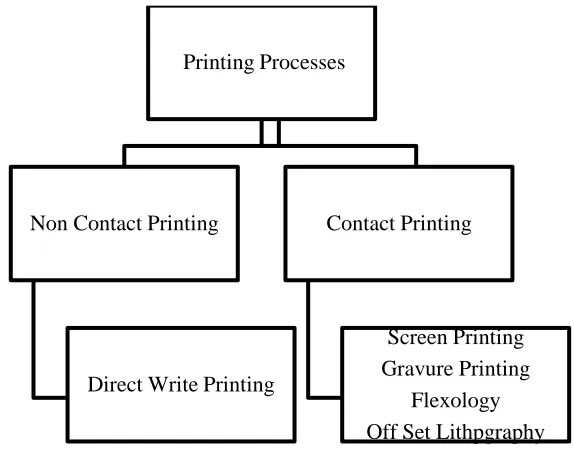
Printing technologies can be categorized into two groups based on the method of delivery of ink onto the
[image:11.612.179.466.196.422.2]substrate, which are as follows:
Figure 1: Classification of Printing Technologies
While contact printing processes are fast and efficient in their output, they pose the following
disadvantages that make them impractical for printing micro scale electronic devices and features:
Lack of resolution: Printing fine pitch electronics required high feature resolution, which can be
difficult to achieve by contact printing processes.
Conformal printing: Contact printing processes are limited to two axes translation and are not
suitable for three-dimensional material deposition. However, direct write processes such as
Aerosol Jet and micro-dispensing have Z-axis translation capabilities.
Non-contact Direct Write printing technologies may be used for printing electronic devices, and the
advantages and functionality of the same is explained in Section 2.2.
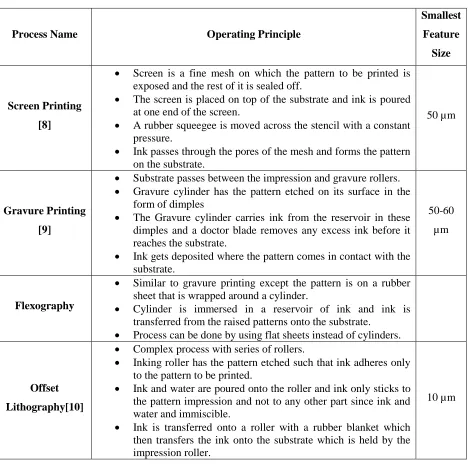
A summary of the operating principles for contact printing processes is summarized as follows: Printing Processes
Non Contact Printing
Direct Write Printing
Contact Printing
Screen Printing Gravure Printing
4
Table 1: Summary of Contact Printing Processes.
Process Name Operating Principle
Smallest
Feature
Size
Screen Printing
[8]
Screen is a fine mesh on which the pattern to be printed is exposed and the rest of it is sealed off.
The screen is placed on top of the substrate and ink is poured at one end of the screen.
A rubber squeegee is moved across the stencil with a constant pressure.
Ink passes through the pores of the mesh and forms the pattern on the substrate.
50 µm
Gravure Printing
[9]
Substrate passes between the impression and gravure rollers.
Gravure cylinder has the pattern etched on its surface in the form of dimples
The Gravure cylinder carries ink from the reservoir in these dimples and a doctor blade removes any excess ink before it reaches the substrate.
Ink gets deposited where the pattern comes in contact with the substrate.
50-60
µm
Flexography
Similar to gravure printing except the pattern is on a rubber sheet that is wrapped around a cylinder.
Cylinder is immersed in a reservoir of ink and ink is transferred from the raised patterns onto the substrate.
Process can be done by using flat sheets instead of cylinders.
Offset
Lithography[10]
Complex process with series of rollers.
Inking roller has the pattern etched such that ink adheres only to the pattern to be printed.
Ink and water are poured onto the roller and ink only sticks to the pattern impression and not to any other part since ink and water and immiscible.
Ink is transferred onto a roller with a rubber blanket which then transfers the ink onto the substrate which is held by the impression roller.
10 µm
2.2 Direct Write Printing
In order to print conductive inks directly onto thin flexible and / or conformal surfaces, there is a need for
non-contact multi axis processes that are broadly classified into Direct Write (DW) Printing.
DW printing is a fast and reproducible technology in which the material is deposited onto a substrate
5
There are several definitions of these processes, which are listed as follows:
Any technique or process capable of depositing, dispensing or processing different types of
materials over various surfaces following a preset pattern or layout [11].
A range of technologies, possibly in reconfigurable short production runs, of two- or
three-dimensional functional structures using processes that are compatible with being carried out
directly onto potentially large complex shapes [12].
Fabrication methods that employ a computer-controlled translation stage, which moves a
pattern-generating device, e.g. ink deposition nozzle or laser writing optics, to create materials with
controlled architecture and composition [13].
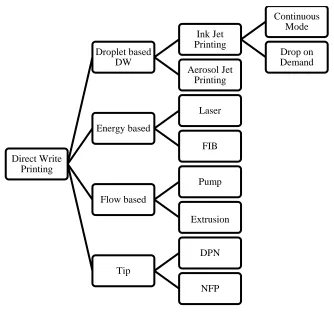
Direct write printing has been classified as follows [14]:
[image:13.612.127.461.277.591.2]
Figure 2: Classification of Direct Write Printing Processes.
Salient features of these processes are:
Feature widths achieved range from sub-microns to a few millimeters.
Direct Write Printing
Droplet based DW
Ink Jet Printing
Continuous Mode Drop on Demand Aerosol Jet
Printing
Energy based
Laser
FIB
Flow based
Pump
Extrusion
Tip
DPN
6
Direct write processes are capable of using inks with a wide range of viscosities, surface energies
and particle sizes.
These processes can deposit a variety of materials such as metals, ceramics, polymers and living
tissues in chemically dissolved or dispersion form.
2.2.1 Ink Jet Printing
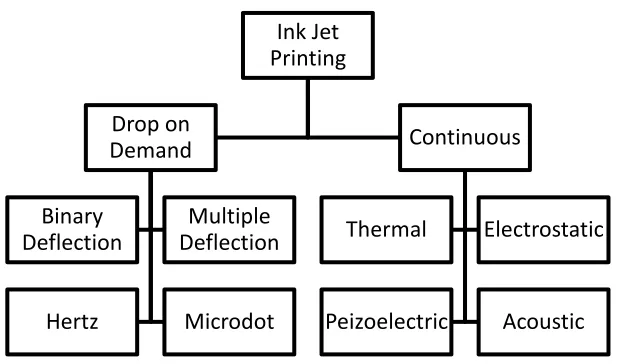
Ink Jet printing is one of the most widely used digital printing methods for commercial printing and
printed electronics. The process can be divided into two modes [11]:
[image:14.612.147.456.253.435.2]
Figure 3: Classification of Ink Jet Printing Technology.
Inkjet printing involves the formation and deposition of a sequence of drops of ink onto a substrate. The
droplets then dry or solidify by means of heating, evaporation of solvent or a chemical reaction.
In continuous inkjet printing, a jet of ink is generated by pumping the ink into a chamber where a
modulating disturbance, such as piezoelectric force, is applied through a transducer, which breaks up the
stream into droplets that then exit the nozzle. A charging electrode surrounds the liquid stream and
includes an electric charge on every drop. Drops then pass through a continuous field where they are
deflected sideways. Charge can be varied on each drop, and this determines the amount of deflection they
undergo in the steady field. Undeflected drops go into the catcher (and are recycled) and deflected drops
fall onto the substrate.
Ink Jet
Printing
Drop on
Demand
Binary
Deflection
Multiple
Deflection
Hertz
Microdot
Continuous
Thermal
Electrostatic
7
Figure 4: Continuous Ink Jet Printing
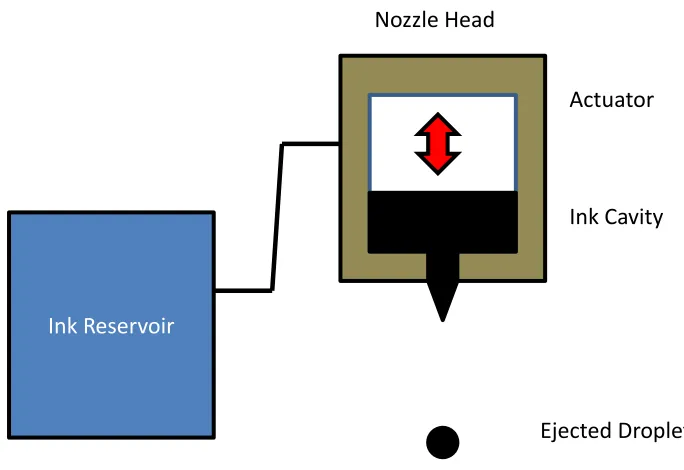
In drop-on-demand inkjet printing, a droplet is ejected only when needed (avoiding recycle) by means of
a trigger signal. Thermal Ink Jet printing employs a small electric heater that is capable of rapid transient
heating. This creates a small bubble of vapor in the ink reservoir pushing the ink into the nozzle. Once the
bubble collapses, it draws ink into the cavity, and the process is repeated.
Piezoelectric inkjet printing changes the volume of the ink cavity to generate pressure waves that eject
droplets of ink out of the nozzle. Releasing the pressure causes ink to be drawn into the cavity, and the
process is repeated.
While inkjet printing generally has much higher printing throughput/speed than single nozzle direct-write
printing technologies, its primary limitations are:
Ink Reservoir
Ink Cavity
Catcher
Piezoelectric Transducer
Nozzle Head
Charging
Electrodes
Field (deflection)
plates
8
It is limited to extremely low viscosity inks, which limits the solid loading fractions and amount
of material that can be deposited per pass.
[image:16.612.109.451.152.387.2] Inkjet printing is generally limited to use with planar or nearly planar substrates.
Figure 5: Drop on Demand Ink Jet Printing
2.2.2 Laser Direct Write Printing
Laser DW printing is the process of laser induced deposition of materials such as metals, ceramics, or
polymers without the use of lithography or masking processes. This process finds its application in the
biomedical field, as well as photonic crystal and MEMS fabrication. Laser DW printing can be carried out
in the following ways:
Laser chemical vapor deposition
Laser etching electroless plating
Laser enhanced or activated electroplating
Laser consolidation of thin solid films
Laser induced forward transfer
Matrix assisted pulsed laser direct write
Laser induced backward transfer
Multi-photon polymerization
Laser contact free trapping and transferring of particles in solution
Ink Reservoir
Actuator
Nozzle Head
Ink Cavity
9
2.2.3 Flow Based Direct Write Printing
Flow based DW printing makes use of positive pressure from either compressed gas or a positive
displacement pump to achieve high precision micro-dispensing of ink through a syringe. Flow based
systems provide a continuous output of material when actuated, whereas inkjet systems dispense ink in
droplet form. The two most established systems for this process are sold by nScrypt® and MicroPen®.
Salient features of the nScrypt® systems are:
The nScrypt system allows multi-material mixing and dispensing from the nozzle. Mixing is done
before extrusion in this case.
The syringe is the ink reservoir, and positive air pressure is applied from behind. Accurately
controlled air pressure, a precise needle valve opening, and high stage motor resolution leads to
precision dispensing of material onto the substrate achieving trace thicknesses from
approximately 25 microns to 3 millimeters depending on ink formulation and processing
conditions.
A suction system pulls back residual ink from the nozzle tip during non-printing moves to prevent
unwanted dispensing.
The system is capable of processing inks with viscosities as high as 1,000,000 cP and dispensing
volumes as small as 20 pL.
The gap between the nozzle and substrate plays a major role in the dispensing of the ink and thus
the final line width and thickness. For this purpose, a laser profilometer may be used to profile the
contours of the substrate accurately.
Similarly, translation speed also influences line geometry and can range from approximately 0.1 –
300 mm/s.
Material selection is important since the line geometry is determined by the physical properties of
the ink (slurry) used.
Flow-based direct-printing is very attractive in the sense that it can be used with perhaps the widest range
of printable materials among all printing processes. The print feature sizes are typically larger than those
achievable with other dispensing techniques, and the process is very sensitive to the gap distance between
the nozzle and substrate.
2.3 Overview of Aerosol Jet Deposition Process
For applications that require fine pitch and high resolution printing of nano materials, Aerosol Jet printing
10
printing process for printing fine pitch structures with the capability to process various inks (conducting
and non-conducting) containing nano-particles with sizes ranging from 10 – 700 nm and with a viscosity
range from 0.7 – 2500 cP [15].
Salient features of this technology are:
The deposition nozzle is generally kept at a distance of 3 to 5 millimeters from the substrate,
hence the process is not particularly sensitive to the gap distance.
The process employs room temperature operations that give flexibility in choice of substrates.
Features can be produced with width ranging from 20 to 200 microns.
The process can be used to print on conformal 3D surfaces as per the CAD geometry assigned.
Inks used in the system can have a wide range of viscosities from 0.7 – 1000 cP.
A comparison of this process versus traditional ink jet printing is stated in Table 2: [16]
Table 2: Comparision Between Inkjet and Aersosol Jet Printing Processes
Properties Ink Jet Aerosol Jet
Nozzle Diameter (microns) 10 – 50 100 – 300
Drop Volume (pico liters) 1 – 8 0.001 – 0.005
Line Width (microns) 20 – 200 5 – 30
11
Figure 6: Optomec Aerosol Jet System at the Brinkman Machine Tools and Manufacturing Lab,
Rochester Institute of Technology
2.3.1 Process Description
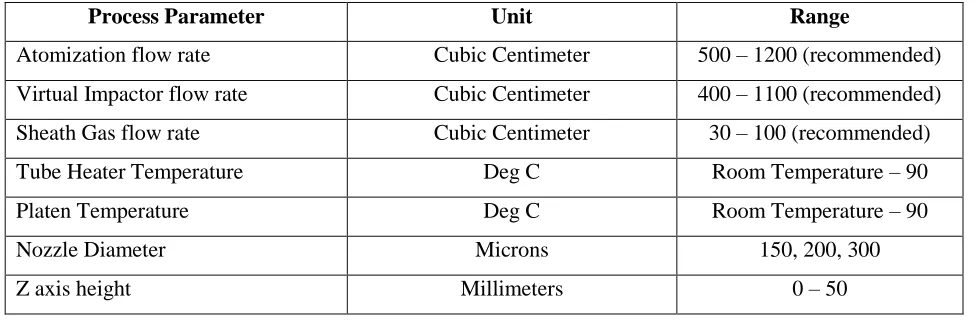
The following process parameters contribute to the aerosol stream formation:
Table 3: Aerosol Jet Printing Process Parameters
Process Parameter Unit Range
Atomization flow rate Cubic Centimeter 500 – 1200 (recommended)
Virtual Impactor flow rate Cubic Centimeter 400 – 1100 (recommended)
Sheath Gas flow rate Cubic Centimeter 30 – 100 (recommended)
Tube Heater Temperature Deg C Room Temperature – 90
Platen Temperature Deg C Room Temperature – 90
Nozzle Diameter Microns 150, 200, 300
Z axis height Millimeters 0 – 50
Atomization:
Atomization is the process of forming an aerosol stream from the ink reservoir in the atomization cup. An
[image:19.612.64.551.439.600.2]12
droplets have higher moments of inertia, they are not carried out of the atomization cup with the exhaust
stream of nitrogen gas. The exhaust stream carries out the small and medium sized droplets.
Two different atomization technologies are commercially available with the Aerosol Jet process
1. Pneumatic Atomization: In this process, the aerosol stream is formed by sheering away the ink
from a small orifice by a stream of nitrogen gas flowing perpendicular to the ink level. The
amount of incoming nitrogen gas is controlled by a mass flow controller, and hence the amount of
ink atomized is controlled. Kumar et al [17] studied the effect of the physical properties of the ink
such as viscosity, liquid surface tension, liquid flow rate and air velocity on the droplet size range
that was formed.
2. Ultrasonic Atomization: The process of disintegrating a liquid sheet into fine droplets on a
vibrating surface (having frequency (> 20 kHz) is known as ultrasonic atomization. The size of
the droplets formed is controlled by the atomization frequency.
Table 4 compares the salient features of the pneumatic and ultrasonic atomization processes [18]:
Table 4: Comparision between Pneumatic and Ultrasonic Atomizers.
Pneumatic Atomization Ultrasonic Atomization
Works well wwith ink systems having low vapor pressure (≤ 0.1 mmHg) and high boiling point
(>180 deg C) solvents
Works well with inks having high vapor pressure
and low boiling point solvents (volatile solvents)
System can handle high viscosity inks ranging
from 0.7 – 1000 cP
System can handle low viscosity ranges from 0.5 – 15 cP
Particle size can be large (> 50 nm) Particle size should be small (< 50 nm)
Examples of materials that can be used:
Metal inks (>55% SLF by weight)
UV curable epoxies
Carbon resistor paste
Examples of materials that can be used:
Metal inks (<40% SLF by weight)
Aqueous inks
13
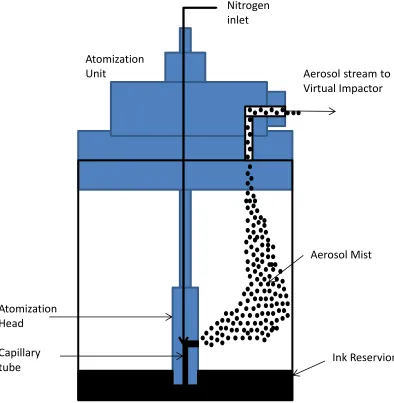
The Optomec Aerosol Jet system available in the Earl W. Brinkman laboratory (in the Kate Gleason
College of Engineering at the Rochester Institute of Technology) has dual pneumatic atomizers that were
[image:21.612.108.502.145.548.2]used for this study. This process is depicted in Figure 7:
Figure 7: Sectional View of the Pneumatic Atomization Unit
Nitrogen
inlet
Aerosol stream to
Virtual Impactor
Atomization
Unit
Atomization
Head
Aerosol Mist
Ink Reservior
Capillary
14
Figure 8: Pneumatic Atomization Head
Bubbler Assembly:
Continuous flow of nitrogen gas over the ink surface in the atomization cup leads to solvent evaporation,
degrading the ink, which affects the print quality. In order to maintain constant solvent content in the ink,
solvent loss can be mitigated by passing the nitrogen gas through a bubbler system prior to its
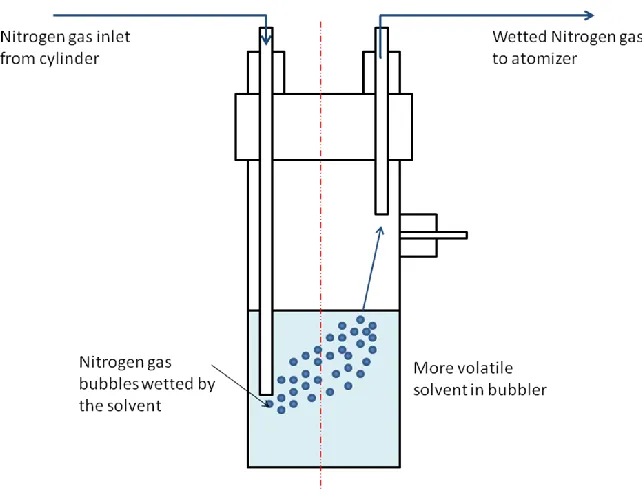
introduction to the atomizing cup. The bubbler contains the solvent present in the ink (generally the more
volatile solvent). Dry nitrogen gas enters a sponge-like sparger beneath the surface of the liquid solvent.
As the gas bubbles out of the sparger and through the solvent, the solvent wets the gas and moves into the
vapor phase. This moist nitrogen gas stream then exits the bubbler and is carried to the atomization unit.
The intent is for the solvent vapor that is transferred from the bubbler to the atomization cup to replenish
the solvent that is lost from the atomizer during operation of the system.
As of yet, there have been no studies to quantify the amount of solvent that a particular ink loses at a
particular process parameter setting. The purpose of this study is to quantify the rate at which solvent is
lost from ink during atomization. With that basic understanding, one can then attempt to determine how
15
Figure 9: Sectional View of the Bubbler Solvent Add-Back System
Virtual Impactor:
The aerosol stream that exits from the atomization cup contains a very high quantity of ink droplets that
would immediately clog the nozzle. Moreover the mass flow of ink is too high for producing
high-resolution traces. A virtual impactor (VI) is located just after the atomization unit. The VI has a vacuum
inlet that draws away a large part of the aerosol stream. As illustrated in Figure 10, vacuum is applied
perpendicular to the direction of flow. The fine droplets with low moment of inertia are carried away win
the nitrogen gas stream to an activated carbon filter. The medium size droplets that are too large to be
diverted through the VI continue downstream to the deposition nozzle. The removal of fine droplets
helps reduce over-spray and satellite formation in the printed lines. The vacuum applied is controlled by
means of a mass flow controller on the system’s user interface. The difference between the atomization
flow rate and virtual impactor flow rate is the amount of ink that makes it to the deposition nozzle. This is
16
Figure 10: Sectional View of the Virtual Impactor Assembly
In-flight Tube Heater:
The Aerosol Jet system is capable of processing nano-inks with different viscosities. Lower viscosity inks
can flow out on the substrate and distorting the feature being printed. An in-flight tube heater is located
before the deposition head. This heats up the droplets in-flight, thus promoting evaporation of some of the
solvent content of the ink. The tube temperature is an important process parameter and its effect on line
quality will be studied.
Deposition Head:
The aerosol stream is carried from the VI to the ceramic deposition nozzle through polypropylene or
polyethylene tubing with an internal diameter of 1/8 of an inch. The deposition head has a sheath gas of
nitrogen which pinches, or aerodynamically focuses, the aerosol stream as it enters the ceramic nozzle.
The sheath gas flow rate can be controlled through an independent mass flow controller (unit: ccm). The
nozzles typically used have internal diameters of 150, 200 or 300 microns. The formation of the aerosol
stream is a continuous process. To make complex patterns that require breaks or step overs, a mechanical
shutter attached to a stepper motor (known as the drip catcher system) obstructs the flow of the aerosol
stream to the substrate when deposition needs to be stopped. This is illustrated in Figure 11.
Aerosol from
atomizer
Reduced
aerosol
to
deposition
head
Exhaust
aerosol
to filter
Splitting of aerosol
stream
17
Figure 11: Sectional View of the Deposition head and catcher assembly
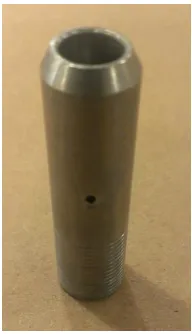
Figure 12: 200 micron ceramic nozzle
Heated Platen:
The moving substrate platen is capable of translation in the X and Y directions. The substrate is secured
onto the platen by means of vacuum. The X and Y translation motors have a step resolution of 1/4000 of
an inch that allows the system to have high precision motion control while printing micro-features. The Z
height of the nozzle is adjusted relative to the platen. The nozzle is generally placed 3 – 5 millimeters
above the substrate upon which ink is printed. The platen is equipped with a heater system that maintains
the substrate at an elevated temperature to facilitate the drying of ink.
Incoming
Aerosol
Stream
Sheath Nitrogen Gas
inlet
Focusing of Aerosol
stream
3 – 5 mm Z height
Ceramic Nozzle
Substrate
Stepper Motor
[image:25.612.230.383.383.536.2]18
[image:26.612.81.526.108.359.2]The operation of the AJP system can be summarized as follows:
[image:26.612.71.545.120.632.2]Figure 13 Aerosol Jet Printing Process Schematic
Figure 14: AJP process flowchart Atomization of Ink Extraction of exhaust aerosol stream Transfer of aerosol into deposition head Inflight heating of aerosol stream Aerodynami c focusing of stream by
sheath gas deposition of stream onto substrate through nozzle
Sheath
19
2.4 Real World Applications of AJ Printing
Several researchers have used the AJP system to fabricate devices such as solid oxide fuel cells,
conducting pads, fine pitch electronics etc. The literature describing some of these applications is
summarized in the Table 5.
Table 5: Summary of application of Aerosol Jet Printing
Author Objective Results
Rui Liu et al. [19]
Carbon based Field Effect Transistors were printed
High and low concentration Graphite Oxide (GO) inks were used and a layer of soluble MWNT was printed to form a conducting film.
AJP was used to print the source and drain electrodes.
Samples were reduced with hydriodic acid for 10 min at 100 deg C
Sheet Resistance obtained was in the range of 600 – 800 Ω m-1
Surface coverage and flatness obtained was good.
Feature resolution of 40 – 80 microns was obtained
Field Effect mobility of the FET was recorded to be ~350 cm2 (V . s)-1
A. Mette et al. [20]
Process was used to print the first layer for a contact structure on a silicon solar cell.
Modified screen printing organic metal ink was used for this application
Fine lines of 14 micron width were obtained.
Energy conversion efficiency of 17.8% was obtained.
Palvi Kopola et al. [21]
Indium Tin Oxide is replaced with a PEDOT: PSS layer in combination with a silver grid by means of AJP.
Optimizing the printing parameters helps determine the coverage and effective sheet resistance.
For a single pass, coverage of 5.8 – 11.9% was obtained with sheet resistance of 8.9 – 1.5 Ω.
Mary Sukeshini et al. [22]
Printing of Anode supported layer of SOFC using AJP
Dual pneumatic atomization system was used to make a graded layer or YSZ and NiO
Material Deposition rate (mg / min) for both materials with different combinations of atomization and VI flow rates were examined.
The cells had stable voltages around 1.2 V with a maximum power density of 200 mW / cm2.
Although performance was low, obtaining functional grading and reproducibility make AJP a viable option for this technology.
Chunhe Yang et al. [23]
Preparation of active layers of polymer solar cells by AJP of organic inks.
Different solvents and additives
Optimal results were obtained by using poly (3 – hexythiophene) and a C60 providing coverage of
20 were tested while preparing the organic inks
Effect of surface treatment by heat and solvent vapor annealing were also studied.
efficiency of 2.53% without surface treatment.
Also, using PCBTDPP and C70
devices provided 3.92% power conversion efficiency for 0.03 cm2 and 3.14% for 1 cm2.
Rui Liu, Haiyan Ding et al. [16]
Platinum decorated Single walled carbon nano tubes (SWCNT’s) are prepared using the AJP process.
Low material consumption, and application of nano particles makes AJP a feasible and reproducible process for printing SWCNT’s
Stable aqueous solutions of the SWCNT’s are printed onto the substrate with various passes.
It was observed that the density of the SWCNT’s networks increased with increasing the number of passes.
Controlling the number of layers controlled the electrical properties and homogenous nature of the layers.
J. Hoerber and C. Goth et al. [2]
Aerosol Jet Printing is an interesting approach to apply circuit tracks on three-dimensional thermoplastic circuit carriers used for Molded Interconnect Devices.
Four thermoplastics were used as substrates (PA6.6, spec PA6, PA6, PBT/ASA) having different surface roughness.
Silver nano-inks were used for the printing process (Bay Ink TP S 50 and Cabot CSD 66)
Three samples of each substrate were created by grinding, milling and polishing the samples.
Eight trace lines were printed on the surfaces of the plastics and the effect of the surface roughness on the pitch of the printed lines and the resistance obtained was studied after sintering at 80 deg C for 240 min.
50 and 100 micron pitch lines produced the lowest resistance while 300 micron pitch produces pinholes in the printed lines.
Thermal shock treatment (at 0, 250, 500, 750 and 1000 deg C) resulted in no change in resistance for 0, 50 and 100 micron pitch printed lines while there is a marginal increase in resistance for 300 micron pitch lines.
Exposure to humidity heat loading had little effect on the electrical conductivity of all the samples.
Sintering and thermal shock treatment improved the adhesion to the substrate and humidity heat loading has little to no effect. Andreas
Lesch, Dmitry Momotenko
Soft linear gold microelectrode arrays for high throughput scanning electrochemical microscopy (SECM) imaging were fabricated
21 et al. [24] using the AJP process.
Nano-particulate gold ink was printed on polyimide Kapton HN® thin films and coated with Parylene C and sintered at 200 deg C.
The linear gold microelectrode array can be scanned in contact mode while maintaining an almost constant working distance making possible the investigation of tilted or bended surfaces.
AJP provides is a simpler and reproducible process for preparation of soft probes for SECM and also enables the preparation of probes with different electrode materials. Da Zhao,
Tao Liu et al. [25]
Silver nano with carbon nano-tubes were printed to improve conductivity of the printed lines.
It was observed that the CNTs bridged the defects in some printed silver lines, thereby lowering the electrical resistivity by 38%.
Concentration of CNT’s beyond 0.5 – 1% by weight increased the resistivity due to aggregation of CNTs and the Schottky-barrier effect caused by the contact resistance at junctions of
semiconducting CNTs and silver. S.
Stoukatch, P. Laurent et al. [26]
Evaluation of printability of Silver nano-inks on various organic substrates.
The connectability of the printed silver lines to Gold and Aluminum was studied.
Cabot CSD-32 ink was used.
Bondability of silver lines was limited.
Conducting lines have resistivity of 16 µΩ.cm that is 10 times the resistivity of bulk silver.
2.5 Process Parameter Characterization
Aerosol Jet printing technology is a relatively new and novel technology for making high precision
printed electronic devices on two-dimensional and conformal surfaces. Several researchers have put this
technology to use as illustrated in Table 5. The process of ink atomization and deposition onto a substrate
is a complex process with several process parameters as well as ink properties that determine the quality
of the printed lines. Process characterization is determining best-fit process parameter settings for a
particular application.
22
Printed electronic features onto a 3D printed object (termed as 3D-MID prototyping). The part
was first manufactured using Stereolithography, and the fine pitch electronic components were
printed by Aerosol Jet Printing.
Studied the effect of AJP process parameters and sintering parameters on the line width,
thickness, resistivity and adhesion to substrate.
Used Cabot CSD-32, Bay Ink TP S 50, MicroCat conductive inks.
Worked with Somos Nanotool, Accura Bluestone, PPS-GF40, and PBT-PET substrates.
The PCM process parameters for the Optomec system were varied, and their effect on the line width and
thickness were studied.
Line width increased with increase in atomization and sheath flow rates (keeping a constant Delta
P of 20 ccm) and increasing the sheath pressure.
Line width and height increased with increasing the number of passes.
Line width decreased with increasing the translating speed.
Results for each ink used are summarized in Table 6.
Table 6: Results obtained by C. Goth et al
Ink Used Results
MicroCat Trace width: 90 -130 microns depending on the substrate used and 200 microns after plasma treatment.
Feature thickness: 0.2-0.4 microns
Resistivity: 4 – 4.5 µΩcm depending on the substrate.
Bay Ink TP S 50 Trace width: 62 – 68 microns depending on the substrate and up to 87 microns after plasma treatment.
Feature thickness: 1.1 – 2.1 microns and 1 – 1.5 microns after plasma treatment
Resistivity: 5.75 µΩcm.
Cabot CSD-32 The ink de-wetted the substrates by forming droplets and flakes.
After plasma treatment trace width ranged from 67- 110 microns with no change for Accura Bluestone.
Feature thickness: 0.8 – 1.4 microns before plasma treatment and 0.3 – 0.7 microns after.
Resistivity: 27 µΩcm.
M. Sukeshini et al. [27] investigated the use of AJP for printing solid oxide fuel cell layers. The cathode
and electrolyte layers of Solid Oxide Fuel Cells were printed using Aerosol Jet Printing. A composite of
YSZ (Yttrium Stabilized Zirconia) and LSM (Strontium doped lanthanum manganate) was used for
printing the cathode and electrolyte interlayers on standard anode supported substrates by means of a dual
23 Process parameters used were:
Atomization flow rate: 1500 ccm
Virtual Impactor flow rate: 1350 ccm
Sheath gas flow rate: 3000 ccm
Number of passes: 20
1:1 mixing ratio of both materials.
The effect of changing Z height (distance between the substrate and deposition nozzle) and Delta P
(difference in flow rate of nitrogen gas between the atomizer and virtual impactor by keeping atomization
constant) on the amount of material deposited was studied.
The Z height was varied from 5 to 12 mm, and the results were illustrated by means of Scanning
Electron Microscopy images for each sample.
For YSZ, it was observed that as Delta P increased, the amount of material deposited increased to
a maximum and then decreased because the density of droplets having the optimum size and
momentum decreased.
For LSM, the deposition rate was sluggish, and a definite maximum could not be determined.
This preliminary study indicated that the rate of material deposition could be controlled by means of
controlling the process parameters for AJP. The AJP cathode and electrolyte interlayers provided a stable
voltage of 1.16 – 1.20 Volts at 700 – 850 Deg C.
Verheecke et al [28] studied the use of AJP to print silver interconnects for embedded electronic
applications. The objective of this research was to determine a process parameter window that influences
the geometry, electrical properties and adhesion of printed silver lines. The researchers found that:
Controlling process parameters and ink formulation helped control the printed line quality and
minimize over spray. Also, surface preparation and cleanliness prevented contamination and
helped reduce the formation of over sprays.
Cabot CSD-32 silver nano-ink was used for printing the conducting lines. The process parameters
used were:
Atomization flow rate range: 550 – 800 ccm
Delta P range: 20 – 40 ccm
24
Nozzle Diameter: 150 microns
Z height: 3 mm
Platen Temperature: 80 Deg C
Ink Temperature: 22 – 37 deg C
Tube heater Temperature: 22 – 37 deg C
Translation speed: 1 – 5 – 10 mm/ sec
The quality of the printed lines was rated on a scale of 1 – 10 based on visual inspection, and a
model for determining the rough line quality was developed.
Line width and edge smoothness were used as the parameters in determining a 3D scatter plot to
estimate the optimum process window to obtain the desired line quality.
Optimization of Aerosol Jet Printing for High Resolution, High Aspect ratio Silver lines.
Mahajan et al [28] specifically studied AJP of high aspect ratio conductive silver lines. UTDAg40X (UT
Dots Inc.) silver nano-ink was ultrasonically atomized, and the effect of process parameters on the line
quality (thickness and width) was studied.
Process parameters considered were:
Focusing ratio (Sheath gas flow rate / carrier gas flow rate)
Nozzle diameter
Translation speed
Carrier gas flow rate
The effect of varying each process parameter on the width and thickness of the printed line and the
resistance per unit length was plotted. A rough process window (of carrier gas flow rate, focusing ratio
and stage speed) with the least over-spray and good line quality was determined from the previous plots.
It was observed that line width decreased with an increase in the focusing ratio and stage speed. Line
thickness increased with increase in the focusing ratio, but it decreased with increasing stage speed.
2.7 Current Challenges
In a production environment, nano-ink printing systems must be capable of consistently printing with
known and stable process parameter values to maintain repeatability and high quality standards. Most
nano-inks are colloidal dispersions in a solvent (single solvent or co-solvent). Surfactants are optionally
included to lower the surface tension of the ink, and dispersants are often used to prevent particular
25
for. For example, in order to achieve small feature sizes (20 microns or below) nano-inks contain a high
percentage of the high volatility solvent; this promotes fast drying of the aerosol droplets in flight leading
to narrower width of ink deposition. Conversely, for coating and low porosity applications, the low
volatility solvent is in higher percentage; leading to slower drying of the ink on the substrate, facilitating
uniform ink spread.
Barnes et al [29] classified commonly used solvents by ink manufacturers into two categories (High and
Low volatility) depending on their rate of evaporation.
Table 7: Classification of Solvents as Per Volatility
Material Vapor pressure @ 20 C,
mmHg
Evaporation rate @ 40 C, % mass loss per min
GROUP 1: High Volatility Solvents
Isopropyl Alcohol 32.40 1.85
DI water 17.54 0.39
Amyl Acetate 4.00 0.85
GROUP 2: Low Volatility Solvents
NMP 0.3 0.036
DEGMEA 0.1 0.018
Ethylene Glycol 0.06 0.01
Terpineol 0.06 0.01
DEGBE 0.01 0.008
Texanol 0.01 0.004
Long term nano-ink stability within the Aerosol Jet atomization cup while printing is strongly affected by
solvent evaporation. When a nano–ink is atomized, the flow of nitrogen gas over the ink surface in the
atomizing cup causes a loss of solvent through evaporation. Additionally, during atomization the larger
droplets have a higher moment of inertia and hence fall back into the ink reservoir; since droplets have a
very large surface area to volume ratio, solvent evaporation is further increased. This is depicted in Figure
26
Figure 15: Representation of Solvent Evaporation During Atomization
As solvent is lost over time, the physical properties of the ink such as viscosity and solid loading fraction
change. Prolonged solvent evaporation eventually leads to ink that is so dry that further printing is
difficult. Sludge formation at the bottom of the atomization cup and ink sludge deposition on the inside
walls of the virtual impactor assembly, deposition head and nozzles as depicted in Figures 16, 17 and 18
can occur if excessive ink drying is not prevented.
Figure 16: Clogging In Atomization Cup.
Figure 16 shows silver ink sediments at the bottom of the atomization cup on the left and copper ink
27
Figure 17: Clogging In Virtual Impactor
Figure 17, shows clogging in the exit point of the virtual impactor on the left and copper ink deposition
on the internal components of the virtual impactor on the right.
Figure 18: Clogging In the Deposition Nozzle
Figure 18, shows balling up of copper ink on the tip of the nozzle, which disrupts the aerosol flow. The
right image shows an internal view of a nozzle with ink deposits on the inside walls. This causes
turbulence in the aerosol stream as it passes through the nozzle leading to over spray formation. The
effect of clogging is also reflected in the quality of the printed feature, which is depicted in Figure 19.
Periodic pulsing in the aerosol stream can be caused by a number of different factors, one of which is
nitrogen streaming that dislodges the accumulated ink in the tubing system. This sudden change in feature
28
Figure 19: Print Quality Degradation Due to Pulsing In Aerosol Stream
One proposed method to compensate for the loss of solvent from the atomization cup is through wetting
of the incoming nitrogen gas with solvent vapors in a bubbler add-back system prior to the atomization
cup as previously described. The idea is that moist atomizing gas will "add back" solvent into the
atomizing cup in an attempt to compensate for the solvent loss due to atomization. To date, the
effectiveness of this solvent add-back approach has not been quantitatively assessed. The aim of this
thesis is to study the impact of the solvent add-back approach on ink stability, and to then make
recommendations on further process enhancements.
2.6 Research Scope
The recent work that has been summarized in this chapter illustrates the evaluation of a process parameter
window for optimal quality of printed features specific to the conductive ink(s), substrates, or application
being studied. However, variability in the ink properties over print time has a severe effect on the desired
output. Industrial applications require repeatability of printing, which is not yet well established with the
Aerosol Jet printing process.
The bubbler system replenishes the solvent in the ink system, but the rate of solvent loss and the rate of
feedback has not yet been quantified. The purpose of this study is to quantify the rate of loss and feedback
of the more volatile solvent, and to attempt to establish equilibrium between the two to maintain a
29
3.
EXPERIMENTAL METHODOLOGY
3.1 Research Objective
The purpose of this study is to quantify the rate of solvent loss from a co-solvent neat solution system
during Aerosol Jet printing. We will also quantify the rate of solvent add-back achieved when nitrogen
atomizing gas is passed through a bubbler. The ultimate research objective is to equalize the rate of
solvent loss and add-back, and to experimentally verify the best parameter settings to maintain co-solvent
equilibrium in the atomization cup.
3.2 Materials
Commercial ink manufacturers generally keep their formulations a trade secret. Moreover it is difficult to
accurately quantify the change in solid loading fractions of ink over time. In this research, a “neat solution” (e.g. pure co-solvent ink without any nanoparticles) is therefore used whose composition is
known and whose index of refraction can be quickly and accurately be measured when subjected to
various process parameter settings. It is assumed here that the nano-particles, surfactants and dispersants
that are present in a nano-ink have relatively low effect on the evaporation rate of solvents in the inks.
Hence a stripped down version of a conventional nano-ink is used for ease of experimental quantification.
In order to study Aerosol Jet ink stability as a function of process parameter values, two types of neat
co-solvent solutions of ethylene glycol (lower vapor pressure) and ethanol (higher vapor pressure) were
prepared. This co-solvent blend is used in a number of commercial nano-inks. The low volatility neat
solution consisted of 30 wt.% ethanol and 70 wt.% ethylene glycol. The high volatility neat solution
consisted of 85 wt.% ethanol and 15 wt.% ethylene glycol.
For validation purposes; commercially made copper nano inks (prepared by Intrinsiq Materials,
Rochester, NY) using ethylene glycol and ethanol as the co-solvents were prepared. Two inks were
prepared including a more volatile ink with approximately 80 wt.% ethanol and 20 wt.% ethylene glycol,
and a less volatile ink with approximately 20 wt.% ethanol and 80 wt.% ethylene glycol to establish
solvent equilibrium over both extremes of ink volatilities.
3.3 Proposed Approach
The experimental approach was divided into two stages.
30
2. Testing solvent equilibrium for the copper inks using optimized process parameters from Part 1.
Stage 1: Experiments with Neat Solutions
A. Solvent Loss
1. Co-solvent mixtures of ethylene glycol and ethanol were prepared as described in Section 3.2.
2. The neat solution was atomized in the pneumatic atomizer with a nitrogen flow rate of 600 ccm
and the virtual impactor set to 575 ccm nitrogen flow to maintain a constant Delta P of 25 ccm for
210 minutes (8 data points).
3. Approximately 0.5 ml of neat ink solution was withdrawn directly from the atomization cup at
30-minute intervals using a 6 inch long, 0.125 inch diameter stainless steel needle through an
inlet port sealed with a septa.
4. An Abbe refractometer was used to measure the refractive index of the sample. Three repeats per
sample were measured and the average values were reported.
5. It is assumed that the neat solution follows the rule of mixtures (i.e. the refractive index of the
neat solution is proportional to the mixing ratio of the two solvents).
6. The refractive index of the sample was converted to ethanol wt.% by:
%𝑬𝒕𝒉𝒂𝒏𝒐𝒍 = 𝑹𝑰𝑬𝑮− 𝑹𝑰𝑺 𝑹𝑰𝑬𝑮− 𝑹𝑰𝑬𝒕𝒉
Equation 1: Converting refractive index to ethanol wt.%
Where,
𝑅𝐼𝐸𝐺= refractive index of ethylene glycol (=1.4293)
𝑅𝐼𝑆= refractive index of ink sample extracted from cup at any given time interval 𝑅𝐼𝐸𝑡ℎ= refractive index of ethanol (=1.3616)
7. The average refractive index was plotted against time to observe the change in solvent content
with time.
8. Steps 1-5 were repeated again with 700, 800, 900 and 1000 ccm nitrogen atomization flow rates
31
B. Solvent Add Back
9. The bubbler system was connected between the nitrogen source and atomization cup such that the
incoming nitrogen gas would be wetted by ethanol vapors.
10. Steps 1-6 were repeated for 600 and 1000 ccm atomization flow rates, this time with the bubbler
in place.
11. Results from parts A and B for 600 ccm and 1000 ccm were plotted and compared.
C. Bubbler Optimization
During experimentation, it was found that a 100% bubbler system actually added too much ethanol into
the atomization cup under certain conditions. It was determined that a method was needed to reduce the
ethanol vapor content coming in. The solution was to use two incoming nitrogen gas streams – one moist
from a bubbler, and one dry. These two streams were merged into a single nitrogen gas stream by means
of a Y connector and static mixer. By independently controlling the mass flow rates of the wet and dry
nitrogen streams, it become possible to regulate the overall ethanol content in the nitrogen gas. The
following steps were followed to determine the optimal wet: dry ratio of nitrogen gas.
12. Both the low volatility neat solution (30 wt.% ethanol and 70 wt.% ethylene glycol) and the high
volatility neat solution (85 wt.% ethanol and 15 wt.% ethylene glycol) were atomized at 600 and
1000 ccm atomization flow rates at various wet: dry nitrogen ratios as listed in Table 8.
Table 8: Wet: Dry Nitrogen Gas Ratio Summary Table
Combination No % wet nitrogen gas % dry nitrogen gas
1 80 20
2 60 40
3 50 50
4 40 60
5 20 80
13. Ethanol wt.% graphs were plotted for both the high and low volatility neat solutions being
atomized at 600 and 1000 ccm.
32
15. For each experimental run, RMS – average ethanol wt.% (at time = 0) versus % wet nitrogen gas
were plotted.
16. The % wet nitrogen value at which the RMS – average ethanol wt.% (at time = 0) values closest
to zero were selected as the optimal values for each experimental run. Simply put, this was the %
wet nitrogen value that gave a stable ink whose ethanol content remained steady.
Stage 2: Validation with Copper Nano Ink
17. Copper nano-inks fabricated by Intrinsiq Materials as mentioned in Section 3.2 were printed
using optimum results obtained from the Stage 1 bubbler optimization trials.
18. Approximately, 0.5 ml of ink was withdrawn from the atomization cup at 30 minute intervals for
4 hours, and the solid loading fraction of each sample was measured using a TA Q2050
rheometer.
19. Solid loading fraction was plotted against time to determine change from original loading fraction
at time = 0.
3.4 Tools Used
Hardware:
Optomec® Aerosol Jet Deposition System.
Fisher Scientific 60 Sonic Dismemberator (Ultrasonic mixer).
Branson 5510 Ultrasonic Cleaner
T.A Q2050 Rheometer
Bausch and Lomb Abbe Refractometer
Nano Inks: Intrinsiq Materials Copper nano-inks.
33
4.
EXPERIMENTAL RESULTS AND DISCUSSIONS
4.1 Ethanol Add-Back Simulation
Using ethanol as a representative solvent with an atomizing cup pressure of approximately 10 psi (69
kPa), Figure 19 illustrates the loss of ethanol from the atomizing cup via evaporation at different nitrogen
flow rates and temperatures. This is obtained by using a mass flow estimation Equation 2:
QE = QN2 * (PE / (PT – PE))
Equation 2: Determining Mass Flow Rate of Ethanol at a Particular Atomization Flow Rate.
Where,
QE = mass flow rate of solvent vapors (ccm)
QN2 = mass flow rate of atomizing gas (ccm)
PT = total pressure (kPa)
PE = vapor pressure of ethanol (kPa)
The vapor pressure of ethanol is dependent on temperature. Since all experiments were run at room
temperature, PE has been calculated at 25 0
C for all cases. The vapor pressure is calculated using Antoine’s equation (Equation 3):
PE = 10
(A (-B / (C + T)))
Equation 3: Antoine’s Equation
Where,
PE = vapor pressure of ethanol (kPa)
A, B, C = Antoine’s constants dependent on temperature determined from Table 9. T = process temperature in °C
Table 9: Antoine’s Equation Constant Values
No. A B C Tmin [°C] Tmax [°C]
1 8.20417 1642.89 230.3 -57 80
34
Since the vapor pressure of ethylene glycol is significantly lower than that of ethanol, the rate of ethylene
glycol loss during atomization is approximately 1% of that of ethanol. In this study, it was therefore
assumed that the rate of ethylene glycol loss was not significant. In co-solvent inks with both low and
high vapor pressure constituents, one can effectively concentrate on the high vapor pressure solvents
[image:42.612.105.508.174.427.2]when trying to control ink stability.
Figure 19. Ethanol Flow Rate Versus Temperature Curve at Different Atomization Flow Rates
4.2 Baseline Solvent Loss Rate Without Solvent Add-Back
The rate of solvent loss for each solution was first determined by atomizing the neat solution at different
atomization flow rates (600 – 1000 ccm) without the bubbler add-back system (i.e. with dry nitrogen).
The refractive index of the neat solution was measured at 30 minute intervals for 3 hours and 30 minutes
in order to determine the weight percentage of ethanol remaining. Refractive index values measured while
atomizing at 600 ccm are shown in Table 10. As expected, the neat solution loses ethanol, and hence the
ethanol wt.% reduces. The same experiments were repeated at 600 – 1000 ccm atomization flow rates for
both low and high volatility inks. Figure 20 shows results of experiments for the low volatility and high
35
Table 10: Refractive Index and Weight Percent of Ethanol for a 30% Ethanol 70% Ethylene Glycol Co-Solvent
Mixture Atomized at 600 ccm Flow Rate Without Bubbler Add-Back
TIME (min)
REFRACTIVE INDEX ETHANOL
wt.%
R1 R2 R3
[image:43.612.139.475.318.566.2]0 1.4165484 1.4165483 1.4164810 1.4165259 30 1.4175488 1.417549 1.4175488 1.4175489 60 1.419495 1.419495 1.4164960 1.4184953 90 1.420501 1.4205000 1.420500 1.4205003 120 1.421506 1.4215507 1.4215506 1.4215358 150 1.422514 1.4225512 1.4225513 1.4225388 180 1.424518 1.424519 1.424520 1.4245190 210 1.4255224 1.425523 1.425220 1.4254218
36
Figure 21. Weight Percent of Ethanol Versus Time Plot for Atomization of a 85% ethanol 15% Ethylene Glycol Co-Solvent Mixture Without Bubbler Add-Back
Figures 21 and 22 plainly demonstrate that atomization with dry nitrogen led to substantial ethanol loss in
a relatively short amount of time (3½ hours). For the 30% ethanol ink, nearly half of the ethanol was lost.
In practice, Aerosol Jet printed nanoparticle inks include blends of low and high vapor pressure
co-solvents. The high vapor pressure solvents (e.g. ethanol) allow droplets of ink to dry rapidly on the
substrate. As the high vapor pressure co-solvent is depleted in the ink, the drying speed and surface
energy of the ink changes – sometimes dramatically. Practically speaking, this means that the quality of
the printed lines, as indicated by line width, thickness, and over-spray, will change as the high vapor
pressure solvent is depleted. Figures 21 and 22 point towards a strong need for an alternative approach to
atomization with high vapor pressure co-solvent blends. The aforementioned solvent add-back system is a
relatively simple approach.
4.3 Solvent Add-Back Rate Using A Bubbler
In order to quantitatively assess effectiveness of the solvent add-back system on ink stability, the next set
of experiments were run using the solvent add-back system to determine the effectiveness of this
technique at maintaining a constant volume percentage of ethanol in the neat solution. The bubbler
37
is substantially lower than that of ethanol. The rate of solvent loss for each solution was determined by
atomizing the neat solution at different atomization flow rates (600 – 1000 ccm) using the bubbler
add-back system (i.e. saturated nitrogen gas). The refractive index of the neat solution in the atomizing cup
was measured at 30 minute intervals for 3 hours and 30 minutes in order to determine the weight
percentage of ethanol remaining. Figures 23 and 24 show results of experiments for the 30% and 85%
ethanol inks respectively at 600 (low flow) and 1000 (high flow) ccm nitrogen atomization flow rates
[image:45.612.103.512.451.663.2]respectively. The dry nitrogen (no solvent add-back) results are also plotted for comparison.
Figure 22. Weight Percent of Ethanol Versus Time for Atomization of 30% Ethanol 70% Ethylene Glycol
Co-Solvent Mixture With Solvent Add-Back
Figure 23. Weight Percent of Ethanol Versus Time for Atomization of 85% Ethanol 15% Ethylene Glycol
38
Figure 23 shows the ethanol concentration for the low ethanol (30 wt.%) solution. The ideal outcome is
obviously a horizontal line indicating that the ethanol concentration remains constant over the 3½ hours
of atomization. At relatively low ethanol concentrations shown in Figure 23, the rate of ethanol loss
without solvent add-back was essentially the same at both low (600 ccm) and high (1000 ccm) nitrogen
atomization flow rates. When the nitrogen gas was passed through the bubbler on its way to the atomizing
cup, Figure 23 illustrates that the ethanol concentration actually increased. Under these experimental
conditions, more ethanol was transferred to the atomizing cup than was lost during atomization.
Figure 24 plots the same information for the high (85%) ethanol ink solution. When the ink consists
primarily of a high boilin