City, University of London Institutional Repository
Citation
:
Kim, Hyung Whan (2019). Media convergence: concept, discourse and influence. (Unpublished Doctoral thesis, City, University of London)This is the accepted version of the paper.
This version of the publication may differ from the final published
version.
Permanent repository link: http://openaccess.city.ac.uk/22232/
Link to published version
:
Copyright and reuse:
City Research Online aims to make research
outputs of City, University of London available to a wider audience.
Copyright and Moral Rights remain with the author(s) and/or copyright
holders. URLs from City Research Online may be freely distributed and
linked to.
City Research Online: http://openaccess.city.ac.uk/ [email protected]
Media Convergence: Concept, Discourse and Influence
Hyung Whan Kim
Thesis Submitted in Fulfilment of the Requirements for the Degree of Doctor of Philosophy
City, University of London
School of Arts and Social Sciences
Table of Content
LIST OF TABLES AND FIGURES
7
ACKNOWLEDGEMENTS
9
DECLARATION
10
ABSTRACT
11
ABBREVIATION
12
PART I
1. INTRODUCTION
13
1.1. Research gaps ...14
1.2. Purpose, research question and methodology ...15
1.3. Results of research ...16
1.4. Contribution of research ...18
1.5. Thesis overview ...19
2. LITERATURE REVIEW
22
2.1. Studies on the concept of media convergence ...222.2. Studies on media convergence discourse ...24
2.2.1. Convergence discourse 1: A predetermined future? ...26
Convergence Hype Cycle ...28
2.2.2. Convergence discourse 2: Deregulate, reform and compete ...29
Neoliberalism, information society and media convergence ...29
Media convergence and cross-ownership deregulation ...31
A rhetoric for reform ...31
Rise of competition law ...32
2.3. Studies on the influence of media convergence ...34
2.3.1. Technological convergence ...34
2.3.2. Industrial convergence ...35
2.3.3. Market convergence ...36
2.3.4. Policy convergence ...36
Clarification of terms: Policy convergence and regulatory convergence ...36
How policy convergence is made ...38
Trends in regulatory convergence ...40
Power issues...41
National Cases ...42
2.3.5. Conclusion ...48
2.4. Conclusion ...48
3. METHODOLOGY
50
3.1. Methods used in previous studies ...503.1.1. Qualitative text analysis ...50
Pros and cons of qualitative text analysis as a methodology ...51
Studies used qualitative text analysis ...51
3.1.2. Interview ...52
Pros and cons of interview as a methodology ...53
Studies used interview as a methodology ...54
3.2. Methods used in this thesis...55
3.2.1. Qualitative text analysis (critical discourse analysis) ...57
Critical discourse analysis ...58
3.2.2. Semi-structured interview ...60
The Interviewees ...61
Interview questions ...63
Research ethics ...64
3.2.3. Quantitative approach ...65
PART II
4. THE CONCEPT OF MEDIA CONVERGENCE AND ITS PROBLEMS
67
4.1. Development of digital and transmission technologies...67
4.2. The earliest concept of media convergence ...68
4.3. Four problems of the concept ...71
4.3.1. Broadness ...72
Media convergence in value chain...72
4.3.2. Overlaps ...75
4.3.3. Presumption ...77
4.3.4. Paradox ...78
4.4. Conclusion ...79
5. THE EMERGENCE OF CONVERGENCE DISCOURSE
81
5.1. Policy convergence debate in Korea...815.2. Convergence Committee’s white paper ...82
5.2.1. Recognition of differences between broadcasting and telecommunication...83
5.2.2. Convergence discourse 1: Technology changes everything?...84
5.2.3. Convergence discourse 2: Deregulate, reform and compete ...85
The economics of media convergence ...85
For global media conglomerate ...87
5.3.4. Marginalisation of public interest and PSB ...88
5.3. Convergence discourse and KCC ...89
5.3.1. KCC in 2008-2013: A follower of convergence discourse ...90
5.3.2. KCC in 2013-2017: Emergence of public interest discourse ...93
5.4. Conclusion ...96
6. THE IMPACT OF MEDIA CONVERGENCE ON BROADCASTING AND
TELECOMMUNICATION MARKETS
99
6.1. Network convergence ...1006.1.1. Cable TV’s landline telephone ...101
6.1.3. Telecommunication’s IPTV ...103
6.1.4. Bundle service ...106
6.1.5. M&A between leading companies ...108
6.1.6. DMB: Mobile TV ...109
6.1.7. Video on Demand (VOD) ... 112
6.1.8. DATA PP ... 113
6.2. Device convergence ... 114
Convergence or divergence? ... 115
6.3. The impact of media convergence on markets ... 117
6.3.1. The impact of media convergence on broadcasting market... 118
6.3.2. The impact of media convergence on telecommunication market ... 119
6.4. Conclusion ...120
7. THE INFLUENCE OF POLICY CONVERGENCE ON MEDIA POLICY
GOVERNANCE
123
7.1 Turf war between agencies ...1237.1.1. Dispute over IPTV ...123
7.1.2. Comparison of the reform plans of KBC, MIC and MCT ...125
Expanding the scope of authority ...127
7.1.3. Convergence Committee’s contradictory settlement ...128
7.2. KCC’s governance system and independence ...130
7.2.1. How KCC was established ...130
7.2.2. PSB’s political independence ...134
7.2.3. How political independence is made ...137
7.3. Hegemony struggle between KBC and MIC ...138
7.4. Conclusion ...139
8. CHANGES AND CONTINUITIES IN POLICIES AFTER POLICY
CONVERGENCE
141
8.1. Legal and jurisdictional systems ...1418.2. KCC’s policies in 2008-2017 ...145
8.3.1. Entry regulation ...149
8.3.2. Ownership regulation...152
Ownership regulations in newspaper ...152
Deregulation trend in telecommunication and broadcasting ...153
Result of ownership deregulation in broadcasting...155
Ownership regulations in telecommunication ...158
Ownership regulations in broadcasting ...159
8.3.3. Competition regulation ...161
8.3.4. Content regulation ...163
8.4. Conclusion ...165
9. CONCLUSION
166
9.1. The problem of concept of media convergence ...1669.2. The emergence of convergence discourse ...167
9.3. Influence on market ...168
9.4. Influence on governance...169
9.4.1. Turf war between agencies ...169
9.4.2. Political independence issues ...170
9.4.3. Hegemony struggle ...171
9.5. Influence on policies ...172
9.5.1. Systematic changes in laws and authorities ...172
9.5.2. Competition-centred policies ...173
The value conflict in media policy ...173
Why competition law is not sufficient? ...174
9.5.3. Correlation between system and policy ...177
9.5.4. Inertia of sector-specific regulations...178
9.6. Conclusion ...178
List of Tables and Figures
TABLE 1 REGULATORY ASYMMETRY ACROSS THE COMMUNICATIONS INDUSTRY 39 TABLE 2 CATEGORIES OF TEXT FOR ANALYSIS 58
TABLE 3 LIST OF INTERVIEWEES 62
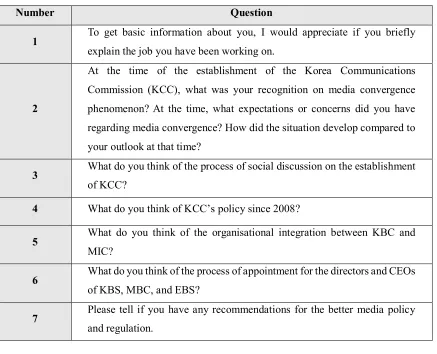
TABLE 4 LIST OF INTERVIEW QUESTIONS 64
TABLE 5 POLICY CONVERGENCE CASES 87
TABLE 6 REGULATORY PARADIGM SHIFT IN BROADCASTING AND
TELECOMMUNICATION 91
TABLE 7 KCC'S WORK PLANS IN 2013-2017 95
TABLE 8 CATEGORIES OF MEDIA CONVERGENCE IN PRACTICE 100 TABLE 9 CONFLICT AREAS CAUSED BY MEDIA CONVERGENCE 123 TABLE 10 THE HISTORY OF DISPUTE BETWEEN KBC AND MIC OVER IPTV 124 TABLE 11 REFORM PLANS SUGGESTED BY KBC, MIC AND MCT 125 TABLE 12 BROADCASTING AND TELECOMMUNICATION LAWS AND
JURISDICTIONS IN 2007 142
TABLE 13 BROADCASTING AND TELECOMMUNICATION LAWS AND
JURISDICTIONS IN 2008-2017 143
TABLE 14 KCC'S POLICY ACHIEVEMENTS IN 2008-2017 145 TABLE 15 ENTRY REGULATIONS FOR NEWSPAPER, TELECOM AND
BROADCASTING 150
TABLE 16 OWNERSHIP REGULATIONS IN NEWSPAPER 152 TABLE 17 DEREGULATION OF OWNERSHIP RULES SINCE 1990 153 TABLE 18 OWNERSHIP REGULATIONS IN TELECOMMUNICATION 158 TABLE 19 OWNERSHIP REGULATIONS IN BROADCASTING (%) 160 TABLE 20 COMPETITION REGULATIONS IN NEWSPAPER, TELECOM AND
BROADCASTING 162
TABLE 21 CONTENT REGULATION IN NEWSPAPER, TELECOM AND
BROADCASTING 163
FIGURE 1 CONVERGENCE HYPE CYCLE 29
FIGURE 2 TRADITIONAL ONE-TO-ONE COMMUNICATION 69 FIGURE 3 DE SOLA POOL'S DESCRIPTION OF MEDIA CONVERGENCE 70 FIGURE 4 LANDLINE TELEPHONE MARKET TREND IN 2005-2015 (BY SUBSCRIBER,
000S) 101
FIGURE 6 PAY TV MARKET TREND IN 2003-2015 (BY SUBSCRIBER) 104 FIGURE 7 PAY TV MARKET TREND IN 2009-2015 (BY REVENUE, KRW, MILLIONS) 104 FIGURE 8 NUMBER OF BUNDLE SERVICE USERS IN 2007-2015 (0,000S) 106 FIGURE 9 SATELLITE DMB'S REVENUE IN 2005-2012 (KRW, MILLIONS) 110 FIGURE 10 TERRESTRIAL DMB'S REVENUE IN 2008-2015 (KRW, MILLIONS) 111 FIGURE 11 VIDEO-ON-DEMAND (VOD) REVENUE IN 2012-2015 (KRW, MILLIONS) 112 FIGURE 12 VIDEO-ON-DEMAND (VOD) REVENUE SHARE BY GENRE IN 2015 113 FIGURE 13 DATA PP'S REVENUE IN 2008-2015 (KRW, MILLIONS) 114 FIGURE 14 PC AND SMART DEVICE PENETRATION IN 2011-2016 116 FIGURE 15 BROADCASTING MARKET SHARE IN 2015 (BY REVENUE) 118 FIGURE 16 LANDLINE TELEPHONE AND INTERNET BROADBAND MARKET IN 2015
(BY REVENUE) 120
FIGURE 17 KCC'S GOVERNANCE SYSTEM 131
FIGURE 18 KCSC'S GOVERNANCE SYSTEM 132
FIGURE 19 GOVERNANCE SYSTEM OF KOREAN PSB 134 FIGURE 20 RATING SHARE OF MAIN BROADCASTERS IN 2010-2015 156 FIGURE 21 HERFINDAHL-HIRSCHMAN INDEX (HHI) OF RATING SHARES IN
Acknowledgements
Declaration
I hereby declare that the work presented in this thesis is my own and has been developed under the joint supervision of both Professor Petros Iosifidis and Professor Jean Chalaby and any other assistance as stated and referenced in the thesis accordingly.
Abstract
Abbreviation
CJHV: CJ Hello Vision CP: Content Provider
DMB: Digital Multimedia Broadcasting DPS: Double Play Service
FTC: Fair Trade Commission IPTV: Internet Protocol Television
KCC: Korea Communications Commission
KCSC: Korea Communications Standards Commission KCT: Korea Cable Telecom
KISDI: Korea Information Society Development Institute KOCCA: Korea Creative Content Agency
KPF: Korea Press Foundation KT: Korea Telecom
MCT: Ministry of Culture and Tourism
MIC: Ministry of Information and Communication MPP: Multiple Programme Provider
MSIP: Ministry of Science, ICT and Future Planning MSIT: Ministry of Science and ICT
MSO: Multiple System Operator
MSP: Multiple System Operator and Programme Provider OTT: Over the Top
PP: Programme Provider QPS: Quadruple Play Service SKT:SK Telecom
TPS: Triple Play Service VOD: Video-on-Demand
Part I
1. Introduction
Digitalisation and the development of transmission technologies brought considerable changes in media technologies. Digitalisation meant that the data process technology in media could be simplified. As analogue signals could be translated into digital signals, traditional media such as newspaper, film, radio and television could be handled in a single digital format. This meant that any kind of digital media contents could be seen in any digital device, technically. For example, the introduction of smart digital media such as smart phone changed the way people communicate and use media contents. By using the smart device, which can be described as a connected mobile computer, people can make a phone call, browse the internet, buy something and enjoy loads of media contents in their hands. Moreover, by using smart device, people can participate in group video chatting and meetings, and can produce audiovisual contents and share them online with others. Therefore, digitalisation technology simplified traditional methods of media production and consumption. When it comes to the matter of transmission, the development of transmission technology increased the speed and scale of data transmission. This enabled digitalised media contents to be transmitted in any single digital network. Compared to analogue system where different media had to use different modes of transmission, it meant a significant degree of simplification in media network. Consequently, the development of digitalisation and transmission technology brought more simplified environment in media. This meant that the technological difference between analogue media became less significant than before.
1.1. Research gaps
There are at least three research gaps in the field of media policy studies regarding media convergence. Firstly, there have been little interest in the concept of media convergence. Most of relevant studies focused on governance reform issues and converged regulator’s policy styles. However, the more fundamental analysis can be made by examining the relationship between its concept and practical results of media convergence. Indeed, as shown in Frank Webster (2014)’s Theories of the Information Society, a concept in communications policy can lead to considerable changes in actual media policies. Particularly, as will be discussed in Chapter 4, the concept of media convergence has not been defined clearly, and this might have caused the confusions in understanding the phenomenon. Therefore, this thesis tries to fill the conceptual gaps in media policy studies, by examining and clarifying the concept of media convergence.
Secondly, the studies on the ideological aspect of media convergence was not followed up well so far. Some studies pointed out the ideological aspects of the concept and relevant discourses by examining some Western countries’ cases. But those were mostly relevant to the early stages of discussion on media convergence in around the early 2000s. But the changes in those discourses after this period was not examined well. Furthermore, those studies were mostly related to Western countries including the US, the UK and some European nations. Thus, it could be meaningful, especially for comparative media policy studies, if the scope of examinations on convergence discourse can be expanded by examining another national case. Therefore, this thesis introduces Korean case on the convergence discourse, to generate more empirical evidence in the field of media policy studies.
A Korean case study on media convergence
As noted above, this thesis is a case study on media convergence in South Korea. Case study is “an empirical inquiry that closely examines a contemporary phenomenon (the case) within its real-world context” (Yin, 2015:194). Case study aims for “analytic generalisation” of knowledge
(ibid.,200). However, this is not about generalising a specific case (sample) to population. If
knowledge from a case study can be generalised to population level, there needs lots of more cases. Instead, case study normally aims to “analytic generalization which consists of a substantive proposition or other principle or set of principles, derived from a case study’s findings and then claimed to be applicable to other situations.” (ibid.) In other words, the case study involves “the detailed examination of an aspect of a historical episode to develop or test historical explanations that may be generalizable to other events” (George and Bennett, 2004:5).
Therefore, in general, this thesis aims to practically examine how and to what extend the media convergence happened in Korea. In so doing, this study tries to find a general tendency shown in the process of media convergence. Particularly, as said, this research focuses on the influence of media convergence on media markets and policies. Accordingly, it aims to draw a general principle that shows correlation between media convergence and media market and policy, putting more weight on media policy field. Thus, what is basically assumed in the thesis is that the study of Korean case could be worth examining for other countries that are considering media policy reform in reaction to the media convergence. Indeed, the following examinations of this study seems to reveal many useful points that are worth thinking about before the reform of media policy systems. Korea experienced some valuable trials and errors in the course of media policy system reform which was caused by media convergence development. Having said that, the findings of this research seems to be helpful for other post-war new democracies in Asia, such as Japan, Taiwan and Indonesia, as they share political and cultural similarities to Korea in modern politics and media system (Gilley, 2014). Moreover, when it comes to academic area, the findings of this thesis would be helpful in understanding how and to what extent a new technology can affect media markets and policies.
1.2. Purpose, research question and methodology
second purpose is to analyse the ideological aspects of media convergence and the meaning of discourses shown in policy discussions. Accordingly, the following research questions can be asked: ‘What was the ideological character of the concept of media convergence?’, and ‘what convergence discourses were there in the process of media convergence development in Korea?’ The third purpose is the investigation of actual influences of media convergence on the market, governance system, and policies. Thus, it can be asked, ‘to what extent the broadcasting and telecommunication markets and policy structures were changed due to the introduction of convergent media?’ and, ‘to what extent media convergence brought the changes in actual media policies?’ In so doing, the thesis will examine the practical influences of media convergence on media market and policy.
In terms of methodology, this thesis implements qualitative textual analysis as a main method. This is to investigate the meaning of concept and discourse of media convergence. Accordingly, a range of documents including white paper, media agencies’ reports and work plans, and previous literatures will be examined in the following chapters. Furthermore, to get more specific and informal information on each subject of the thesis, semi-structured face-to-face interview was conducted. By doing so, some informal and in-depth information regarding the issue could be learned. Furthermore, as the thesis aims to see the degree of influence, it used quantitative approaches too, by referring to media market reports published in recent years in Korea. More details will be discussed in Chapter 3.
1.3. Results of research
The results of this research can be presented under three categories, as set in the purposes of this research: Concept, discourse and influence. The followings will briefly show the summaries of findings from main chapters.
Secondly, this thesis confirmed that the discourse of media convergence affected the policy discussion in Korea. As in other countries who adopted policy convergence, there was similar convergence discourses in the policymaking process of Korea. There were two kinds of convergence discourses. The first discourse was the social belief that the media convergence is expanding so quickly. And the second was that because of the rapid expansion of media convergence, there needs a policy system reform as well as more flexible regulations in media. Particularly, the second type of convergence discourse seemed to be related to liberal politico-economic ideology, as it consequently made competition law to be at the centre of the media policies, while sector-specific principles were marginalised. However, in Korea, there was rather dramatic changes of discourse after a reorganisation of policy system and authorities. More details will be discussed in Chapter 5. Therefore, in terms of convergence discourse, this thesis would contribute to the abundancy of empirical evidence, by presenting Korean case. As the part is linked to what was found in some Western cases, such as the US, the UK, and some European countries, it can be said that the research has provided new knowledge in comparative media policy studies.
Thirdly, this research examined the degree of influence of media convergence on media markets, governance and actual policies, respectively in different chapters from Chapter 6 to 8. As noted earlier, despite of interests in the impact of media convergence, the actual impact of media convergence seems little examined in academia so far. But studying the practical impact of a phenomenon can significantly extend the scope and scale of knowledge on the phenomenon. This was why the thesis investigated the actual influence of media convergence on markets, governance and policies.
When it comes to the influence on media markets, the results showed that there were some significant convergent media such as IPTV, bundle service and smart phone, but in the perspective of whole broadcasting and telecommunication, the impacts were limited. This was true, especially when compared to what expected by the concept itself as well as the convergence discourse. The concept and discourse of media convergence presumed that the blurring between analogue media would be expanded very rapidly. However, it has been more than 30 years since the concept was first introduced, but there were no remarkable examples regarding the convergence in content and platform levels in media. But on the other hand, it was confirmed that in network and device levels, there were some practical models of media convergence. Chapter 6 will discuss it in more details by examining Korean broadcasting and telecommunication markets.
conflict between broadcasting and telecommunication sectors, which continued almost a decade. Even after the integration of those two organisations, the conflict was not reconciled. However, the telecommunication side grabbed the hegemony within the converged institution. Meanwhile, policy convergence caused the decrease of political independence in Korean PSBs. But civil societies including Korean PSB workers successfully managed to raise the issue of political independence to the political discussion and the public. This resulted in actual changes in media governance and policy. When it comes to the structure of media policy system, Korea tried to merge everything in a single institution as it adopted policy convergence, but they had to distinguish regulatory policies and promotional policies afterwards. Accordingly, it seems that the differences between the principles and the forms of media agencies are crucial, so that there can be a strong resistance while merging those two different media agencies. Chapter 7 discusses the governance issues in more details.
Lastly, this thesis examined the influence of media convergence on actual media policies. The result showed that the media convergence caused convergence as well as divergence in overall legal system and agencies’ authorities. Also, it was found that the converged agencies’ policies were highly influenced by media convergence particularly in its early days of establishment, but the influence diminished due to the organisational changes of the agency. In terms of sector-specific regulations in Korean broadcasting, telecommunication and newspaper, those regulations were generally maintained in the last decade, despite of the apparent deregulation trends. In addition, it was found that broadcasting regulation has always been more restricted than that of newspapers and telecommunications. More details will be discussed in Chapter 8. Some practical recommendations for media policy, which are based on all of those examinations above, are presented in Conclusion chapters.
1.4. Contribution of research
With those examinations above, it is believed that the thesis contributes to the studies of media business, media governance and media regulation. At least three points can be presented. Firstly, it clarified the concept of media convergence, and it contributes to the conceptual understandings of media convergence. Moreover, it also reminded the importance of clarification of a concept in media, for it can hugely affect media policy practice as well as the way of studying media phenomena.
war between media policy institutions, and the creation of iron cage (from capture theory) by showing the coalition between policy agencies and media industries. Furthermore, in examining the policy convergence in Korea, the thesis was able to spot that the elite theory and the theory of regulatory state can be applied to the case, as the power of government was generally maintained throughout the reform process. Moreover, it introduced the detailed media regulations of South Korea by examining its newspaper, telecommunication and broadcasting regulations. It seems rare to see a study which investigated sector-specific regulations of Korean media, with its overall trends in the last decade.
Thirdly, as will be discussed more specifically in Conclusion chapter, the thesis suggested some useful recommendations for better practice in media policy. For example, it emphasised the significance of media-related concepts, for this can affect many following results in media business and policies. Indeed, the clarification of concept cannot be over-emphasised, for when it is loosely examined and defined, it can be easily manipulated as a social discourse by politico-economic ideologies that are prevalent in that time. Furthermore, it was suggested that the promotional and regulatory policies are better to be divided into separated policy agencies, for these principles are incompatible. Therefore, it would be better to establish a dedicated regulator for media regulation, while allocating promotional authorities to government-related agencies. Korean case showed that the regulatory principles were better achieved by dedicated regulator, not by a converged one, while promotional policies can be best achieved by government department. Furthermore, it was recommended that PSB can better serve its role and public interest when it is specifically legislated in relevant Act. That is, as in the case of Korea, when PSB is not clearly defined in the law, its values and policy principles can be marginalised in the process of social discussion such as Convergence Committee. Therefore, if a society wants a desirable PSB system, it may need to establish a good legal foundation for the institution. The legislation could include which broadcasters are the PSBs, and what is their remits and responsibilities. Also, when it comes to the political independence of PSB, it would be helpful to make special measures to inspect the informal interruption from the government to PSB. This is because the informal aspects can be more crucial than formal aspects regarding the actual degree of political independence.
1.5. Thesis overview
gaps are discussed. More specifically, the chapter reviews previous studies regarding media convergence’s concept, discourse and influence. Those three subjects make the explanatory framework of this thesis, so the rest of thesis will be examined by each subject of the framework. Chapter 3 discusses the methodology of this thesis. Before introducing this thesis’ methodologies, the chapter examines the methodologies of previous studies presented in Chapter 2, to find the best combination of methodologies for this thesis by reviewing theirs.
Part II discusses specific subjects by using the framework and methodologies established in Part I. Precisely, Part II consists of Chapter 4 to 9, including Conclusion as the last chapter of this thesis. Part II generally examines Korean cases regarding media convergence’s concept, discourse and influences. Particularly, Chapter 4 examines the concept of media convergence. By examining previous studies, reports, and other relevant documents in the UK, EU, the US and Korea, the chapter discusses the definition of concept and addresses some problems regarding the concept. Furthermore, on the basis of the discussion, it presents more specific and clarified definition of the concept. In Chapter 5, the discourses found in the process of policy convergence in Korea will be examined. The Convergence Committee’s white paper and KCC’s work plan will be analysed, to see whether similar discourses, which were found in other national cases, existed in Korea too. In addition to this, some peculiar points from Korean case will be presented as well.
regulations including entry, ownership, competition and content regulations are examined, to see the influence of media convergence on those sector-specific regulations.
2. Literature review
This chapter reviews three groups of literatures that are relevant to media convergence. The three groups of literatures are categorised according to the three purposes of this thesis, as presented in the Introduction chapter. Therefore, firstly, it examines the studies on the concept of media convergence. Secondly, it reviews the discourses related to media convergence. Thirdly, it reads the studies relevant to actual influence of media convergence on media market, governance and regulation. In examining those group of literatures, this chapter provides the landscape of media convergence studies since 1970s. In so doing, the research gaps that this thesis is to fill in will be presented.
2.1. Studies on the concept of media convergence
With the developments of digital and transmission technologies in media, the concept of media convergence was firstly presented by De Sola Pool in 1983 (Jenkins, 2006). The concept was welcomed by media industries, policies and academic fields, and it became “the catchword of the 1990s” (Vick, 2006:26). Indeed, there were many studies which dealt with media convergence, particularly between in the 1990s and 2000s (e.g. Blackman, 1998; Dwyer, 2010; European Commission, 1997; Fielden, 2012; Gibbons, 2005; House of Lords, 2013; Iosifidis, 2002; 2011; ITU, 1997; Jenkins, 2006; Latzer, 2009; Lunt and Livingstone, 2012; Michalis, 1999; Noll, 2003; OECD, 2004; 2013; 2016; Starks, 2014; Van Cuilenburg and McQuail, 2003; Vick, 2006; World Bank, 2007). Most of these studies are conducted in European background, and in many cases, these are relevant to the regulatory reforms including changes in media governance structures and content regulations. Particularly, in 2002, JMM (The International Journal of Media Management) published a special edition that is dedicated to the discussion of the future of media convergence. In this edition, the concept and impact of media convergence were discussed.
Most studies above presented the definition of media convergence on their own. But those definitions were quite different to each other, and it makes difficult to understand the term in comprehensive manner. And sometimes it overlaps with existing concepts, and sometimes it was presented in a paradoxical context. The term itself also contained ambiguity, for the term is quite relevant to a presumption of the future. Accordingly, there are four problems which makes it difficult in understanding the term comprehensively and clearly. In the following part, these problems will be briefly discussed, and Chapter 4 will discuss them further in detail.
general phenomenon in overall media sectors. But in most cases, sectional approaches were taken in the explanation of concept. That is, as many described the concept in regard to the different parts of media, the definition tended to be different from one to another. Precisely, the concept of media convergence was addressed as the blurring phenomenon which makes some lines between different media to be meaningless. But the problem is that there are so many different ‘lines’ within different ‘levels’ of media value chain. However, as the concept describes that any lines in general media would be blurred because of media convergence, it becomes difficult to capture what it exactly describes. For example, if one defines the concept mainly in the perspective of media provider, s/he tends to focus on what happens in a provider’s side in the name of media convergence. On the contrary, if another describes the phenomenon in an audience’s perspective, the definition tends to be more related the convergence of media device and usage. In addition, as the term was used to describe convergences in various sectors in media, including technology, industry, market and policy sectors, it could be even harder to catch the clear meaning of the term. Indeed, the convergence happened in industry has to be different to one that happened in policy area. All these complexities in media attributes to the difficulties in understanding media convergence. Therefore, as Garnham (1996:106) argued, the use of a big terminology such as ‘multimedia’ or ‘media convergence’ can make it difficult to give necessary attention to the various results that would result from digital technology. In line with this, Blackman (1998) also mentioned that, although the use of big concept can make it easier to understand a certain media phenomenon, there can be disadvantages of using the shorthand concept such as ‘media convergence’, because the concept describes too many things at once.
The second problem of this concept is its overlapping character with other existing concepts. As the term illustrates the phenomena that shows a merging between different things in media, it can overlap with the existing terms that are used to demonstrate something that is merging with another. For example, the concept overlaps with vertical and horizontal integrations, as well as merger and acquisition (M&A) between media firms, when it is used in relation to the industrial sector within media. Furthermore, the concept has quite similar notion with that of telematics or mediamatics, as the term describes similar phenomenon that those concepts bring in. Thus, the lack of originality in its concept seems contributing to the difficulties in identifying the concept correctly.
be clearly recognised by its readers. As will be examined later in Chapter 4 and 5, this character of the concept contributed to the emergence of certain social discourse.
Last but not least, the fourth problem of this concept is that the concept is frequently presented in paradoxical contexts. That is, the term is used in describing diverging trend as well as converging trend. For example, when a broadcasting network and a telecommunication network are converging into a single digital network, this can be called as convergence, for this demonstrates two different networks are being integrated into a single network. But in many cases, the term media convergence was also used to describe what is actually divergence, such as multiplatform, OSMU (One Source Multi Use) and contents spin-offs. For example, it is often exemplified that if a broadcaster offers online VoD (Video-on-Demand) service (which is an interactive data service) or newspaper-like articles on their website, then it can be called as an example of media convergence phenomena. However, these particular cases are showing something diversified rather than converged. That is, if something is converged, then it should mean that some separated things have been integrated and accordingly the number of relevant objects has to be reduced. When it comes to the broadcaster’s example above, their contents are provided in different platforms and styles due to the development of digital and transmission technologies. But in many cases, this diverging trend was also depicted as media convergence. This paradoxical presentation of the concept seems to obstruct clear understanding of the concept.
As briefly examined above, there have been some problems regarding the concept of media convergence, due to its broadness, overlapping character, presumption and paradoxical presentation. Yet, there has been little effort for the discussion on these problems in the concept of media convergence. But after almost twenty years of its popularity in media studies, now it might be able to establish more clarified version of it. The newly updated concept needs to be based on the examination of previous studies, as well as what has actually happened in media during last twenty years. In Chapter 4, the concept of media convergence will be investigated more thoroughly. The chapter will examine how the concept was presented in previous studies and relevant policy documents, and then it will present more clarified concept of media convergence. The chapter uses the framework of ‘media value chain’ to understand the concept more specifically and more comprehensively. The next part will examine studies that analysed social discourses that emerged in the process of policy discussions regarding media convergence.
2.2. Studies on media convergence discourse
naturally in social relations (Chalaby, 1996). According to Deacon et al (2007:152), ‘discourse’ is “speech or writing seen from the point of view of the beliefs, values and categories which it embodies; these beliefs constitute a way of looking at the world, an organisation or representation of experience – ‘ideology’ in the neutral, non-pejorative sense.” Thus, there are two dimensions of discourse: “language in social life” and “relationship between language and social structure” (ibid.
151). By examining these together, it enables us to understand what ‘ideological’ aspect is represented in a language form. Moreover, Deacon et al (2007:151) argued, “most significantly it enables us to focus not only on the actual uses of language as a form of social interaction in particular situations and contexts but also on forms of representation in which different social categories, practices and relations are constructed from and in the interest of particular point of view, a particular conception of social reality”.
According to some studies focused on the discourse made within the context of media convergence, there can be two discourses. The first discourse was that media convergence is developing rapidly, and it will be expanded throughout the media. As examined above, the term itself is ambiguous, for it is not a concept which is based on what exactly happened in the name of media convergence. Rather, it focused on the possible changes in the future. In other words, the concept contains a strong characteristic of projection, which predicts what might happen in the future. But for some reasons, a social consensus has been formed that media convergence would only develop further and further and there might be no boundaries for its development. Some studies captured this point, arguing that this is not a scientific reasoning, so we need to be cautious about this discourse on media convergence.
parts review these two types of convergence discourses that were appeared in previous studies on media convergence.
2.2.1. Convergence discourse 1: A predetermined future?
As Fagerjord and Storsul (2007:28) argued, “in policy documents and business plans, and to a large extent in academic writings, the convergent development has been seen as predetermined. The question of whether or not convergence will take place has not been posed, instead the conclusion that digitalisation will cause convergence on all the dimensions […] has been taken for granted”. For example, international organisations such as Office for Economic Co-operations and Development (OECD), International Telecommunications Union (ITU), and European Commission (EC), saw technological convergence as a rapidly-growing phenomenon that requires an urgent response. Those organisations were active players who disseminated ‘convergence discourse’. As noted above, convergence discourse means that ‘media convergence is bringing big and rapid changes in the media environment, and therefore we must actively respond to convergence quickly’.
and view audiovisual content. […] Convergence has added further uncertainty to business planning […] Technological evolution and the emergence of new products and services have rendered media markets more competitive” (OECD, 2013:5-6).
However, as time passes, the attitude of OECD towards technological aspects of media convergence was changed to be more realistic than before. Rather than disseminating the ‘fast change in media’ discourse, they narrowed down their focus to the ‘network level’ of media convergence. In one of the most recent papers on media convergence, they specified that: “The primary purpose of this report is to examine the effects of network convergence and its policy implications” (OECD, 2016:5). Moreover, their definition of digital convergence has changed to be more explicitly than in the past: “Digital convergence in this report refers to ‘the shift towards IP-based networks, the diffusion of high-speed broadband access, and the availability of multi-media communication and computing devices” (ibid.)
In the meantime, this type of ‘convergence discourse’ can be easily found in European Commission’s Green Papers as well. For example, in Convergence Green Paper published in 1997, they mentioned that: “Convergence is not just about technology. It is about services and about new ways of doing business and of interacting with society. The changes described in this Green Paper have the potential to substantially improve the quality of life for Europe’s citizens; to better integrate Europe’s regions into the heart of the European economy, and to make businesses more effective and competitive on global and national markets” (European Commission, 1997:ii). Later, they published another Green Paper, which was named as ‘Preparing for a Fully Converged Audiovisual World (2013)’. In the Green Paper they said: “Lines are blurring quickly between the familiar twentieth-century consumption patterns of linear broadcasting received by TV sets versus on-demand services delivered to computers. Moreover, with every smartphone enabling converged production as well as consumption, there might be a future shift from ‘lean-back’ consumption to active participation […] As convergence will become gradually more tangible over the next decade, it may have an impact on future legal instruments including Audiovisual Media Services Directive (AVMSD)” (European Commission, 2013:4). Therefore, it can be said that OECD and EC were institutions that promoted the recognition of a fast-changing media environment that is caused by media convergence.
the future of media and information technology, both in general and in specific areas, is neither certain nor predictable. We also know that technological change is neither determined in its development nor determining in its use [...] We know that human beings, social beings, have the capacity to engage with the products and services of electronic media and information technology in multiple ways: rejecting, accepting, transforming, moderating both the meaning of objects and supposedly objective meanings according to need, resource and circumstance” (Silverstone, 1995:11). In line with this, Noll (2003) also argued that it had been hard to judge whether the prediction is worth accepting. He said: “We were urged to join in the high-tech multimedia-mania, or risk being left behind in a cloud of semiconductor dust as the broadband wagon rushed down the communication superhighway. Yet all the hype was confusing and separating the sense from the nonsense was a mighty struggle” (Noll, 2003:12).
Convergence Hype Cycle
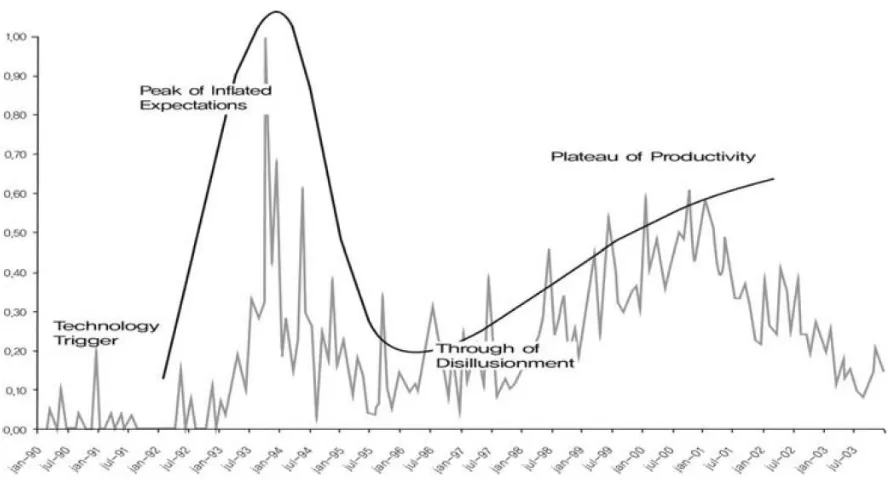
In addition, Lind (2004, cited in KISDI, 2008) studied the stages of socio-cultural development of the concept of media convergence. He argued that the socio-cultural development stage of convergence is divided into four stages. He examined lots of articles related to media convergence from Reuters and Dow Jones magazines between 1990 and 2003. Based on the number of articles related to media convergence, he found that the popularity of media convergence has dramatically changed as time passes. According to him, the first stage can be called as ‘technology introduction period’ (1970-1991). In this period, people are interested in new technologies and try to understand what the technology is. The second stage refers to the ‘excessive expectation’ period. It is the period when the boom is first made with great expectation and imagination (1992-1995). In this period, governments and corporations have a fantasy about convergence and actively promote the convergence between media. The third stage is called as ‘overcoming fantasy’ (1996-1997) period. It is a time of disappointment and scepticism because the previously elevated illusion is not realised in practice. The fourth stage is ‘productivity improvement’ period (1998-2003). This is due to the emergence of the Internet, which leads to a second convergence development but to a more gradual and sustained growth than in the first boom.
Figure 1 Convergence Hype Cycle
Source: Lind (2004:11, cited in KISDI (2008:34))
2.2.2. Convergence discourse 2: Deregulate, reform and compete
As examined above, media convergence was seen as a predetermined future. Therefore, media convergence became one of the key themes in media business, media policy and the media studies between the 1990s and the 2000s, (see George, 2010; Vick, 2006; see also Marsden and Verhulst, 1999; Levy, 1999). Yet, at the same time, a group of liberal ideologies was emerged as another key themes in media too. They were a group of liberal thoughts, namely, neoliberalism, marketisation, privatisation, etc. Media convergence was in the middle of those politico-economic ideologies which emerged in 1980s and 1990s. In this environment, media convergence was frequently quoted within the context of liberal ideology. Thus, as Fagerjord and Storsul (2007:28) argued, "strong economic and political interests" brought media convergence into an important position in media policy decision-making. More precisely, media convergence was often presented as a fairly good reason to liberalise media market and to remove old traditional regulations in media.
Neoliberalism, information society and media convergence
ideologies in cultural policy. Marketisation, according to Hesmondhalgh (2013:127), refers to “the permeation of market exchange as a social principle”. And neo-liberalism can be defined as “the view that human needs are best served by an unregulated free market” (ibid. 99). Therefore, marketisation and neoliberalism have similar goal, which is to adopt free market principle into media policy. As both marketisation and neo-liberalism pursues vibrant market and unfettered competition, it highlights ‘privatisation’ and ‘de- or re-regulation’ of media. Privatisation means the transfer from public company/institution to private company/institution. Deregulation means the removal or reduction of existing rules. Re-regulation has almost same meaning with deregulation, but it highlights “the introduction of new legislation and regulation which favoured the interests of large, private corporations” (ibid. 127).
Meanwhile, David Harvey (2005) argued that neo-liberalism and the information society were closely related. ‘Information society’ discourse was emerged since the 1970s. Many countries tried to establish an information network society, because it was believed that the ‘information’ would be the next currency within global network infrastructure. This prediction formed ‘the vision of information society’ and affected cultural policymaking, despite of the ambiguity of its concept (Webster, 2014). Meanwhile, he argued that the success of neo-liberalism depends on ‘information’, for sufficient information is essential in maintaining competitive market. He said, “neoliberalism requires technologies of information creation and capacities to accumulate, store, transfer, analyse, and use massive databases to guide decisions in the global marketplace” (Harvey, 2005:3). Furthermore, according to him, followers of information society also wanted neo-liberalistic free market approach in media policy, as they worried about that regulations could be the barriers for the development of information society. On the basis of this relationship between neo-liberalism and information society, Harvey (2005) argued that this is why most of policies relevant to information society resulted in deregulation and marketisation of media, while promoting the growth of IT companies.
Media convergence and cross-ownership deregulation
Furthermore, the tight relationship between media convergence and deregulation was frequently addressed in relevant studies. Precisely, it was argued that there was convergence discourse that promoted deregulation in cross-media ownership. In other words, they saw media convergence was used as a rhetoric for market consolidation. So, they argued that there was convergence discourse in media policymaking process, and the discourse encouraged vertical integrations between media companies and the overall concentration in media markets. Furthermore, some theorists argued that there was a social discourse that justified the consolidation in media markets. According to Silverstone (1995), “technological convergence, it is presumed and argued, requires industrial convergence and without the coming together of telephony, video and computing no economically successful future can be guaranteed” (Silverstone, 1995:11). Furthermore, Dwyer (2010) argued that the process of media convergence has a correlation with the consolidation in the media industry. He said: “the process of media convergence is inevitably tied to relentless industry consolidation and sectoral cross-ownership, and to the prevailing ideological and policy framings that underwrite it. There is abundant evidence that convergence discourses are continuing to play a strongly legitimating role in relation to media industry consolidation as much at the level of common-sense ideologies as in policy-making contexts”. In a similar vein, Blackman (1998) also argued that “convergence is promoting a trend towards vertically integrated companies and alliances.” Furthermore, Tim Dwyer (2010) also argued that there is a tight relationship between media convergence and consolidated ownership:
“Convergence is a new media ideology too: that is, a way of thinking that facilitates the operation of neoliberal global markets. Media owners in the twenty-first century strive to continuously expand their output across media platforms. In this sense, the economic and ideological dimensions of media convergence work together in the interests of a further consolidated ownership base (Dwyer, 2010:2-3)”.
In addition, Noll (2003:13) also mentioned that “companies have merged and acquired one another in the name of convergence and the supposed synergies that would result.” However, he showed the case of M&A between America Online (AOL) (a telecommunication firm), and Time Warner (a broadcasting and film conglomerate), and he argued that such an industrial convergence was not always successful as expected.
A rhetoric for reform
Iosifidis, 2002; ITU, 1997; Latzer, 2009; OECD, 2004, 2013, 2016; Van Cuilenburg and McQuail, 2003; Vick, 2006). Particularly, Fagerjord and Storsul (2007) argued that the term media convergence was used as a rhetoric by people who wanted to change media policy system. They said:
“In order to inform people, politicians, and practitioners about the relevance and impact of media change, it is useful to have metaphors and pictures that are easy to communicate. Convergence has served as such a simplifying metaphor […] convergence is used as a rhetorical tool in order to facilitate reform. The concept communicates a media landscape undergoing significant change. This has been instrumental in convincing politicians, regulators, investors and other market players that their strategies need to adapt” (Fagerjord and Storsul, 2007:28).
Therefore, it seems that convergence discourse propelled the advent of policy convergence and systematic reforms in media policy. Accordingly, it can be said that policy convergence was not the natural result that was caused by market convergence, but it could have been the result of the convergence discourse. However, as Garcia-Murillo and MacInnes (2002:58) argued, “it is important to clarify that agency and regulatory convergence are not a precondition for taking advantage of the opportunities provided by convergence.” In this context, Van Cuilenburg and McQuail (2003:202) also argued that, “there are reasons for redrawing boundaries, but no necessity to have only one regime for different kinds of service”. Bearing these in mind, Chapter 5 will examine whether the convergence discourse was formed in the process of policy convergence in Korea.
Rise of competition law
extent the competition law actually replaced existing sector-specific law afterwards. Therefore, it can be said that there is an academic gap between those concerns and the examination of actual results. Thus, to fill the gap, the thesis will examine the actual changes in media policy system and policies, in Chapter 8.
2.2.3. Conclusion
This part examined literatures relevant to convergence discourse. From this, it was possible to expand the understandings on media convergence. The thesis categorised convergence discourses into two groups. The first convergence discourse was formed because of high expectation that media convergence will progress fast. And the second convergence discourse was related to deregulation and market concentration. Moreover, it was shown that the discourse was affected by the predominant politico-economic ideology in that period, which was neoliberalism. Some studies found the strong link between liberal ideas and media convergence. That is, in many cases it was found that the concept of media convergence was used to promote neoliberalism and deregulation. And some argued that it was due to the prevalence of neoliberalism ideology in the period of time, particularly in 1980s and 90s. Indeed, neoliberalism was so powerful in that time in some developed Western countries. Therefore, it is agreeable that media convergence formed a ‘convergence discourse' in conjunction with some politico-economic ideologies such as marketisation, privatisation, and neo-liberalism that significantly affected the world of media since the 1980s. However, as Weiss (2012) argued, it would be difficult to make a desirable analysis of what is specifically happening in society, when adopting grand theories such as neoliberalism. Of course, it is true that grand theories such as neoliberalism and globalisation are good theoretical tools to facilitate the interpretation of social phenomena on a broad and long-term basis. However, in order to understand the social phenomenon related to media convergence more specifically, it is necessary to pay attention not only to the grand theories but also to the ‘small but important’ changes and continuities that actually happens in the media market and policy area. Therefore, the thesis has put its focus on both grand theory and small details of the phenomenon as well.
could be guessed that a concept could be ‘emerged’ when it has a good link to the predominant ideology. That is, because the concept could support the prevalent ideology in some social dimensions, it could be widely acknowledged in that time. But no matter which point of view is correct, it can be argued that the clear definition of a media concept is quite important, so that the concept is not misled in the society.
The discussion of convergence discourse has given a good framework for the analyses in this thesis. This increased the scope of analysis in this thesis. Accordingly, in Chapter 5, the thesis analyses what kinds of convergence discourses were shaped in Korea, and how they can be compared to the cases examined above.
2.3. Studies on the influence of media convergence
Some studies examined how media convergence influenced on different levels of media. There has been a good consensus among studies about the process of development of media convergence. According to them, media convergence develops through four steps (see Iosifidis, 2002; ITU, 1997; Jenkins, 2006; Latzer, 2009; Michalis, 1999; van Cuilenburg and McQuail, 2003; Singh and Raja, 2010). These four steps are technology convergence, industrial convergence, market convergence, and policy convergence. These steps are usually developed from technology to policy convergence, like a chain reaction. That is, technological convergence leads to industrial convergence, and then industrial convergence brings about market convergence, and then market convergence causes policy convergence. Therefore, it could be said that policy convergence can be regarded as the most advanced level in the process of media convergence development. In this part, we will examine some actual examples of media convergence in these four levels of development.
2.3.1. Technological convergence
2.3.2. Industrial convergence
Secondly, as technological convergence proceeds, industrial convergence is occurred. Industrial convergence can be understood in following two categories: Vertical integration and horizontal integration. Due to the emergence of digital technology, the way of production, storage and distribution of media content has been simplified, compared to the analogue era. Digitalisation has enabled the production, storage and distribution to be done in a single digital mode. Therefore, now a media company or even an individual who has a capacity to make and distribute digital contents, he can technically run various media businesses which were quite difficult to manage together in the analogue era. In other words, in a digitalised world, a media company can easily manage different media businesses than before, and this makes them more converged than the past.
Meanwhile, vertical integration means the integration between different media firms that operate within a media value chain. Vertical integration is a frequently used strategy to reduce transaction cost in a media value chain and obtain know-hows from an existing company (Albarran 2013). For instance, a media company that produces audio-visual content may want to reduce transaction cost and increase their control on how their contents are shown to the audience. As a result, they may want to buy an existing distribution industry by merger and acquisition (M&A). Perhaps, they may want to just establish an additional distribution company by and for themselves, but it would cost them a lot more, compared to M&A. Likewise, a distribution company may want to have a production company, for they want to reduce cost and to have right contents their customers want to watch. If they establish an affiliated production company or do an M&A with a production company, they will find it much easier to secure audio-visual contents they want to distribute. Furthermore, vertical integration is relevant to ‘economies of scope’, as the expansion of the company’s scope over multiple industries brings economic advantage in such as production, distribution, marketing and branding (Picard 2011b:78).
consolidation in a media market (Picard, 2011b:79). Like vertical integration, the horizontal integration has been a common practice in media markets.
2.3.3. Market convergence
Thirdly, market convergence is occurred, as industrial convergence makes the boundaries between existing markets blurred. A typical example of market convergence is bundle service market. For example, telecommunication companies can provide broadcasting as well as telecom services to customers by combining such as landline telephone, mobile phone, internet broadband, and broadcasting services. This is called ‘Quadruple Play Service (QPS)’, as it combines four different media and communication services. And if three different services are combined, it is called ‘Triple Play Service (TPS)’. And if two different services are integrated into a single service product, it is called ‘Double Play Service (DPS)’. For example, a Pay TV broadcasting company such as a cable television can provide TPS service, by offering telecommunication services such as the Internet broadband and VoIP (Voice over Internet Protocol) telephone service in addition to their existing broadcasting service. Therefore, a combined telecom-broadcasting market can be made, as there is virtually no difference between those services. In other words, the barriers between existing two markets have been disappeared, as a result of industrial convergence. Therefore, market convergence can be understood as the immediate result of industrial convergence. Therefore, two media that operated in two separated markets now should compete in the same market, and it can be called as market convergence.
2.3.4. Policy convergence
Finally, the changes in market prompts policy convergence. In general, policy convergence stands for the organisational integration of traditionally different media policy agencies (Garcia-Murillo and MacInnes, 2002:58). This could be exemplified as the integration between a government ministry and an independent media regulator. The most typical policy convergence occurs between broadcasting and telecom agencies. Furthermore, broadly speaking, policy convergence can also include the integration of traditionally different media-related laws (e.g. broadcasting law and telecommunication law) (ibid.).
Clarification of terms: Policy convergence and regulatory convergence
Promotional policy includes such as the research and development (R&D), the education for media workers, and the financial support for media companies, etc. More precisely, promotional policy includes conducting government-supported researches on specific media technologies and services. Furthermore, it can also include supporting the penetration of newly adopted media devices and services such as digital TV and 4K TV, and the export of media contents, and so on. As these examples show, promotional policy aims for the development of a whole, or a specific part of the media industry. Those activities are usually supported by government spending. Therefore, this policy activities are led by a government agency which is relevant to media industries.
On the other hand, regulatory policy includes permissions and impositions of the rules, such as the limitation of the consolidation level regarding media ownership. In other words, regulatory policy is aimed at restricting excessive expansion of private interests and promoting public interests (Napoli, 2001). Thus, it can be said that regulation generally means mainly imposing specific restrictions on operators. Typically, there are four regulations in media. Those are entry regulation, ownership regulation, competition regulation and content regulation. First, the entry regulation allows entry only to operators with the ability and responsibility by setting the conditions for entry into the media market. Second, ownership regulation is used to limit the excessive market concentration by setting ownership limits. In other words, it is a tool to secure sufficient diversity such as the diversity of public opinions in the market. In addition, ownership regulation sets regional boundaries in which a company can operate or, it sets the upper limit of revenue share or rating share in a certain media market. Third, competition regulation is applied to ensure fair competition among business operators by imposing rules that restricts anti-competitive behaviour. Lastly, Content regulation is a policy to secure diversity of contents and to prevent distribution of socially undesirable or harmful contents. For example, public service broadcasting is a medium where the strictest content regulation is imposed. For instance, the limit of times on a specific TV genre that a channel can air is predetermined every year. This is to prevent an excessive provision of a popular genre such as drama and entertainment, as well as to meet the remit the channel is given (Hanretty, 2012).
the UK, it only involves the convergence between regulatory agencies, as its government makes promotional policies. Therefore, the cases like Ofcom can be more specifically called as ‘regulatory convergence.’ Most of cases in European countries that adopted media convergence in policy level are relevant to regulatory convergence. The reason is that the integration between broadcasting and telecommunication often involves regulatory organisations only. Therefore, in many cases, relevant European studies use the term ‘regulatory convergence’, instead of ‘policy convergence’ (see Latzer, 2009). Indeed, in some European countries, regulatory convergence is a more common case than policy convergence. Therefore, most European studies related to this policy convergence category have been approached from the perspective of regulatory convergence rather than policy convergence (see Iosifidis, 2011; Vick, 2006; Latzer, 2009). Thus, in European background, the word 'regulatory convergence' may be more familiar than 'policy convergence'.
However, there are many cases that can be more adequately categorised as ‘policy convergence’. For example, Federal Communications Commission (FCC) in USA and Ministry of Internal Affairs and Communications (MIC) in Japan are media agencies that oversee both promotional policy and regulatory policy (World Bank, 2007). As its name hints, Korean KCC is quite similar to American FCC. KCC was a policy convergence case, as it was set to conduct both promotional function and regulatory function. However, Interestingly, both policy convergence and regulatory convergence can be observed in Korean case, as the country changed the areas of responsibility of old KCC, by reducing the authorities that was given to the KCC when it was first established in 2008. The first KCC was a policy convergence case that integrated the promotional and regulatory policies of the broadcasting and telecommunications sector. It literally had all responsibilities and authorities in media. However, since 2013, KCC has been reformed to be an organisation that controls only the regulatory domain of broadcasting and telecommunications. Therefore, now KCC can be understood as an example of regulatory convergence, rather than policy convergence. More details of how this happened in Korea will be examined in Chapter 7.
How policy convergence is made
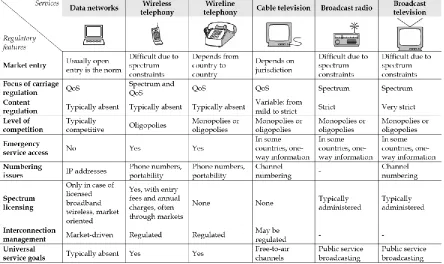
disappear because of media convergence. Therefore, it was argued that an integrated media regulator would be needed in preparation of media convergence era (World Bank, 2007).
Table 1 Regulatory Asymmetry across the Communications Industry
Source: The World Bank (2007:37) * QoS: Quality of Service
Furthermore, with the advent of digital media, a new kind of service can emerge. This causes policy vacuum, as there is no specific rule for the new service. For example, the internet broadcasting provided by newspaper company does not fit existing media regulation framework. Accordingly, the need for a more comprehensive media regulator is addressed, so that a new service can be regulated. In conclusion, the main purpose of policy convergence is to overcome policy duplication and policy vacuum.