Analysis of Errors Reported By
Surgeons at Three Teaching Hospitals
The Harvard community has made this
article openly available.
Please share
how
this access benefits you. Your story matters
Citation
Gawande, Atul A., Michael J. Zinner, David M. Studdert, and Troyen
A. Brennan. 2003. “Analysis of Errors Reported by Surgeons
at Three Teaching Hospitals.” Surgery 133 (6): 614–21. https://
doi.org/10.1067/msy.2003.169.
Citable link
http://nrs.harvard.edu/urn-3:HUL.InstRepos:38846188
Terms of Use
This article was downloaded from Harvard University’s DASH
614 SURGERY
STUDIES HAVE ESTIMATEDthat one half to two thirds of hospital adverse events are attributable to surgi-cal care.1-3 More than half of these events appear preventable.3-5 However, little is known about the human and systems factors that underlie such errors in surgery.
The surgical management of disease is complex and difficult. Observers describe a large variety of organizational and human factors that contribute to poor surgical outcomes, including surgeon inex-perience,6-8low hospital volume for an operation, 9-11 excessive workload,12 fatigue,13 poor technology,14insufficient supervision of trainees,15
inadequate hospital systems,16 poor communica-tion among staff,17time of day,14and bureaucracy or administrative failures.18To target interventions and policies, clinicians, administrators, and regula-tors have sought to identify which of these facregula-tors are implicated most frequently in surgical error.
However, determining the relative importance of the various factors has proven extremely diffi-cult. Chart review and observational studies have not revealed sufficiently detailed information about a large enough number of events to discern the underlying patterns.3,19-22 By contrast, in-depth investigations of incidents involving error have allowed identification of “root causes” in individual cases,23 but have been too time and labor intensive to replicate on a larger scale. Recently, policymakers in the United States and elsewhere have advocated both mandatory and voluntary error reporting systems to collect the desired information.22 These reporting systems face significant operational challenges, particular-ly in obtaining more than sporadic participation by clinicians.
at three teaching hospitals
Atul A. Gawande, MD, MPH, Michael J. Zinner, MD, David M. Studdert, LLB, ScD, MPH, and
Troyen A. Brennan, MD, JD, MPH,Boston, Mass
Background. Little is known of the factors that underlie surgical errors. Incident reporting has been pro-posed as a method of obtaining information about medical errors to help identify such factors.
Methods. Between November 1, 2000, and March 15, 2001, we conducted confidential interviews with randomly selected surgeons from three Massachusetts teaching hospitals to elicit detailed reports on surgi-cal adverse events resulting from errors in management (“incidents”). Data on the characteristics of the incidents and the factors that surgeons reported to have contributed to the errors were recorded and ana-lyzed.
Results. Among 45 surgeons approached for interviews, 38 (84%) agreed to participate and provided reports on 146 incidents. Thirty-three percent of incidents resulted in permanent disability and 13% in patient death. Seventy-seven percent involved injuries related to an operation or other invasive interven-tion (visceral injuries, bleeding, and wound infecinterven-tion/dehiscence were the most common subtypes), 13% involved unnecessary or inappropriate procedures, and 10% involved unnecessary advancement of dis-ease. Two thirds of the incidents involved errors during the intraoperative phase of surgical care, 27% during preoperative management, and 22% during postoperative management. Two or more clinicians were cited as substantially contributing to errors in 70% of the incidents. The most commonly cited sys-tems factors contributing to errors were inexperience/lack of competence in a surgical task (53% of inci-dents), communication breakdowns among personnel (43%), and fatigue or excessive workload (33%). Surgeons reported significantly more systems failures in incidents involving emergency surgical care than those involving nonemergency care (P<.001).
Conclusions. Subjective incident reports gathered through interviews allow identification of characteris-tics of surgical errors and their leading contributing factors, which may help target research and inter-ventions to reduce such errors. (Surgery 2003;133:614-21.)
From Brigham and Women’s Hospital and Harvard School of Public Health, Boston, Mass
Accepted for publication March 7, 2003.
Funding provided by the Warren Whitman Richardson Fund at Harvard Medical School
Reprint Requests: Atul A. Gawande, MD, MPH, Brigham and Women’s Hospital, 75 Francis Street, Boston, MA 02155. Surgery 2003;133:614-21.
© 2003 Mosby, Inc. All rights reserved. 0039-6060/2003/$30.00 + 0
Confidential interviews designed to collect inci-dent reports from single participants in mishaps is one relatively simple approach that has been suc-cessful in anesthesia and other fields in allowing identification of patterns in causation.24,25 To test the feasibility and usefulness of this method in the field of surgery, we undertook a study to gather and analyze reports on adverse events resulting from errors in surgical care through interviews with sur-geons at three hospitals.
METHODS
Overview and definitions. Interviews lasting approximately 1 hour were conducted with attend-ing surgeons, senior surgical residents, and surgical fellows at three Massachusetts teaching hospitals. We used the interviews to elicit reports on any of the interviewees’ cases in which: (1) an adverse event occurred, meaning an injury involving dis-ability (temporary or permanent) or death that resulted from medical management, as opposed to disease;26(2) the surgeon was personally aware of the circumstances that led to the adverse event; and (3) the surgeon judged the adverse event to be partly or wholly the result of an error in manage-ment. Following previous literature, we defined an error as a mistake: either a failure of a planned action to be completed as intended (ie, an error of execution), or the use of a wrong plan to achieve an aim (ie, an error of planning).27Events meeting all three criteria for inclusion were termed “inci-dents.”
Identification of interviewees and incidents. We sought 100 incident reports for analysis and antici-pated two to three error reports per interviewee. We randomly selected 45 surgeons from a list of all senior surgical trainees and clinically active sur-geons (in cardiac, general, thoracic, transplant, trauma, and vascular surgery) at three Massachu-setts teaching hospitals (n = 75). Thirty-two selected surgeons were faculty and 13 were fellows or resi-dents in the final 2 years of training. Interviews were conducted by a single surgeon-interviewer (AAG) between November 1, 2000, and March 15, 2001.
We ensured the confidentiality of the intervie-wees and the information they conveyed by main-taining the anonymity of the surgeon, colleagues, patients, and facilities in all records and by obtain-ing a federal certificate of confidentiality. All inter-viewees provided signed informed consent to participate. The study was approved by the institu-tional review board at the Brigham and Women’s Hospital.
We identified incidents in two ways. First, we reviewed with surgeons all their cases reported for
weekly morbidity and mortality (M&M) confer-ences during the previous 6 months. At two of the three institutions, M&M cases were reported by res-idents alone. One of the three institutions also gathered cases using administrative data. Only cases that met the three inclusion criteria were retained in our sample. Second, because only a subset of adverse events involving error are report-ed at M&M conferences,28,29 we included any reports of other adverse events volunteered by the interviewees that met the inclusion criteria.
We anticipated that a single incident could involve multiple errors. If multiple errors occurred in the care of one patient and involved separate cir-cumstances with separate adverse outcomes, they were analyzed as separate incidents. Also, several incidents were reported by more than one surgeon. To have comparable data from each case, only the data reported by the first surgeon interviewed were included in the analysis. However, data provided by subsequent surgeons were used to test agreement among interviewees’ reports.
Incident analysis. The interviews were then structured to gather detailed information on each incident following critical incident methods established for analyzing military, airline, and other disasters,30and previously used in studying critical medical incidents.25,31Surgeons were asked to pro-vide an open-ended description of each incident, and the factors they recalled that contributed to the errors in care associated with the incident. The interviewer and surgeon then reviewed the recounted events in detail, refining the description of the circumstances involved. Finally, the inter-viewer queried the surgeons about the role of 15 possible contributing factors.
To identify these contributing factors, we fol-lowed the error analysis framework of Vincent et al,32 refining our categories based on interviews with, and reviews by, surgeons and surgical nurses.32 The final 15 categories of factors were: (1) interrup-tion/distraction; (2) ergonomic problems (such as lighting, space, noise); (3) technology failure; (4) fatigue (from the length or lateness of duty); (5) excessive workload/inadequate staffing (for the tasks required at a given time); (6) breakdown in accurate transmission of necessary information (communication) between personnel; (7) inappro-priate protocols; (8) lack of supervision of trainees; (9) lack of experience with or competence at a task; (10) administrative complexity/bureaucracy; (11) emergent versus elective setting; (12) time of day; (13) failure of vigilance; (14) failure of memory; and (15) error in judgment. In addition, for errors that occurred in the operating room, the time of the
Surgery Gawande et al 615
incident was confirmed by checking the operative schedule. Length of time on duty was also con-firmed by checking with the surgeon’s operative and call schedules.
The interviewer recorded the information reported on each incident on a worksheet during the interview24and subsequently completed three comprehensive data forms: one recording the details of the injury itself; one the clinical circum-stances of the incident (including location, timing, and who was involved); and one the human and systems factors that contributed to the error. The surgeon’s judgment of whether a given factor (eg, excessive workload/inadequate staffing) con-tributed to error was recorded on a five-point Lik-ert scale (ranging from “highly unlikely” to “somewhat likely” to “highly likely”).
Data analyses. The surgeons’ judgments about contributing factors were analyzed as binary vari-ables. Factors judged at least “somewhat likely” to have contributed to error were coded as 1, and the rest were coded as 0. Length of time on duty was recorded as a categorical variable: less than 8 hours, 8 to 24 hours, and more than 24 hours.
We hypothesized that the setting of care could affect the factors contributing to error. We there-fore tested for differences in reported contributing factors between emergent and nonemergent cases, and between incidents involving an intraoperative error and other incidents, using chi-squared analy-sis. We also examined whether the most commonly reported factors identified in our descriptive analy-sis had significant interrelationships using chi-square analysis.
To investigate whether reports occurring fewer than 6 months after the incident or based on M&M review differed in important respects from other incidents, we tested for differences in severity of injury and incidence of common contributing fac-tors using chi-square analysis. Finally, using the sub-set of incidents that were reported by more than one surgeon, we tested agreement among sur-geons’ judgments by calculating kappa scores for their reports of leading contributory factors. Analy-ses were performed using SAS Version 8 (SAS Insti-tute, Cary, NC).
RESULTS
Thirty-eight of the 45 surgeons we approached agreed to participate in the study (participation rate = 84%). In interviews, these surgeons reported one to eight incidents each (mean 4, standard devi-ation 1.9), providing a total of 146 different inci-dents for analysis. Fourteen inciinci-dents were reported by more than one surgeon.
Fifty-five percent of incidents came from review of interviewees’ complications reported at M&M conference during the previous 6 months; of 235 M&M cases reviewed, 34% met the criteria for inclusion. The remaining 45% were independently volunteered.
Table I shows the incidents’ clinical characteris-tics. Two thirds involved events occurring fewer than 6 months before the interview. Sixty percent of incidents occurred in the operating room, 12% in an intensive care unit, and 16% on a noninten-sive care hospital floor. Three quarters involved nonemergent care. Most incidents occurred dur-ing daytime hours, but 40% occurred after hours. In the 94 incidents (64%) in which information was available on how long the principal clinician had been on duty at the time, 37% had been work-ing (in the hospital or office) for more than 8 hours and 16% for more than 24 hours.
The outcomes were serious: 33% of incidents resulted in permanent disability and 13% resulted in a patient’s death. The injuries were diverse: 77% involved injuries directly related to an operation or other procedure, with the three most common sub-types being a visceral injury (eg, a bowel or ureter-al laceration), bleeding, and wound infection or dehiscence; 13% involved an unnecessary or inap-propriately chosen procedure; 10% involved unnecessary advancement of disease (eg, missed diagnosis of breast cancer due to an incomplete workup).
The reported errors occurred in all phases of surgical care. Most commonly, they occurred dur-ing the intraoperative phase of surgical care (66%). In one quarter of the incidents, errors occurred during preoperative management, and in another quarter, during postoperative manage-ment. (Percentages sum to more than 100% because, in one in five incidents, surgeons report-ed a chain of events that spannreport-ed more than one phase of care.) Two or more clinicians substantial-ly contributed to error in 70% of the reported inci-dents, and three or more clinicians contributed in 18%.
trau-ma patient with a strangulated incisional hernia shortly after open-technique diagnostic peritoneal lavage. Abdominal exploration revealed infarcted bowel and inadequate fascial closure (sutures were not through fascia). A resident had performed the procedure, and the attending cited lack of supervi-sion and inexperience as contributing factors. Dur-ing review of other potential factors, the attendDur-ing also reported that interruptions and workload like-ly contributed (he was called away to another patient), as did fatigue (the resident was on duty more than 24 hours), ergonomics (the bay’s over-head lighting was not working), and miscommuni-cation (the attending only learned afterward that the resident had never done the procedure before).
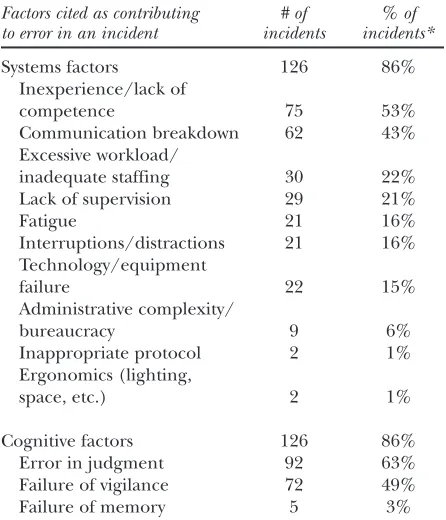
Inexperience or lack of competence with a par-ticular surgical task was the most commonly cited factor, reported in 53% of incidents. Communica-tion breakdowns were reported to contribute in 43%. Excessive workload, fatigue, or both were fac-tors specified in 33%: 22% of incidents involved excessive workload/inadequate staffing, 16% involved fatigue, and 5% involved both. One or more of this group of factors contributed to error in 83% of all incidents. Individual cognitive factors
Surgery Gawande et al 617
[image:5.585.304.527.97.357.2]Volume 133, Number 6
Table II. Incidents, by contributing factor
Factors cited as contributing # of % of to error in an incident incidents incidents*
Systems factors 126 86%
Inexperience/lack of
competence 75 53%
Communication breakdown 62 43%
Excessive workload/
inadequate staffing 30 22%
Lack of supervision 29 21%
Fatigue 21 16%
Interruptions/distractions 21 16%
Technology/equipment
failure 22 15%
Administrative complexity/
bureaucracy 9 6%
Inappropriate protocol 2 1%
Ergonomics (lighting,
space, etc.) 2 1%
Cognitive factors 126 86%
Error in judgment 92 63%
Failure of vigilance 72 49%
Failure of memory 5 3%
[image:5.585.59.276.112.743.2]*Percentages are calculated for non-missing data. Three incidents were missing data on inexperience, 11 on workload/staffing, 6 on lack of supervision, 14 on interruptions, and 1 each on technology failure, administration, and ergonomics. No incidents were missing data on the cognitive factors, communication breakdown, or use of an inappropri-ate protocol.
Table I. Clinical characteristics of the incidents (N = 146)
# of % of Characteristic incidents incidents
Time between incident and report
Less than 1 week 1 1%
Less than 1 month 24 16%
Less than 6 months 101 69%
Less than 2 years 119 82%
Location of the adverse event
Operating room 87 60%
Hospital room (non-ICU) 23 16%
Intensive care unit 17 12%
Physician’s office 4 7%
Emergency room 10 3%
Other 5 2%
Clinical circumstances
Emergency care 34 23%
Nonemergency care 112 77%
After hours (5 pm to 7 am) 59 40%
During daytime hours
(7 am to 5 pm) 87 60%
Number of clinicians contributing to error
Two or more clinicians 103 70%
Three or more clinicians 26 18%
Phase of care in which error contributed to injury
Preoperative management 39 27%
Intraoperative management 96 66%
Postoperative management 32 22%
Severity of injury
Temporary disability 79 54%
Permanent disability 48 33%
Death 19 13%
Type of injury
Unnecessary advancement
of disease 14 10%
Unnecessary/incorrect
invasive procedure 18 13%
Injury from appropriate
procedure: 114 77%
Bowel, bladder, other
visceral injury 31 27%
Bleeding 26 23%
Wound infection/dehiscence 14 12%
Myocardial infarction/CVA 7 8%
Operative failure 4 4%
Pneumonia 4 4%
Musculoskeletal injury 6 2%
also were commonly cited (86% of incidents), with surgeons citing failures of judgment and vigilance in the majority of incidents.
Several systems factors were significantly more commonly reported in emergency cases, includ-ing inexperience, miscommunication, lack of supervision, and fatigue (Table III). Acuity made no difference in the likelihood that judgment, vig-ilance, or memory failure were reported as con-tributors.
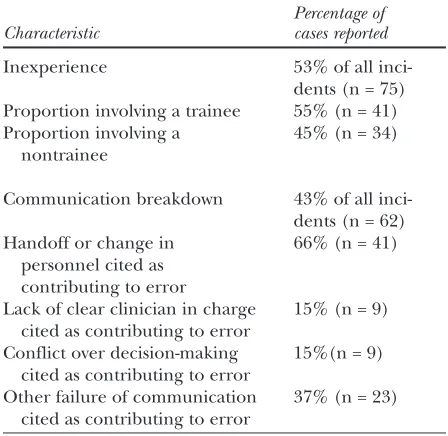
In approximately half the 75 cases in which inex-perience played a role, the inexinex-perience was that of a trainee (Table IV). Surgeons reported a lack of adequate supervision as a contributing factor in 55% of such incidents. In the other half of the inci-dents involving inexperience, the inexperienced participant was an attending staff member (or equivalent). Such lack of expertise may occur because a procedure is new to medicine or simply new to an individual. It appeared, however, that the latter was the more common situation. In 70% of these nontrainee cases, others with greater exper-tise at the same task were available to the clinician at the same institution.
Among cases involving communication break-down, two thirds involved an inadequate handoff of information or a change in the personnel pro-viding a patient’s care. Difficulties in ascertaining responsibility also were implicated (Table IV), whether because of a lack of a clear clinician in charge of a particular aspect of care or conflict among clinicians making decisions. Other prob-lems included communication failures between residents and attending surgeons, and between nurses and physicians.
We tested all possible relationships among the most common systems factors (inexperience/lack of competence, communication breakdown, work-load, fatigue, lack of supervision), and the two most common cognitive factors (misjudgment, lack of vigilance), and we found several strong and signifi-cant associations. Failure of judgment was directly associated with reports of inadequate supervision (odds ratio [OR] = 3.4; 95% confidence interval [CI] = 1.2-9.6), whereas failure of vigilance was inversely associated with inexperience as a report-ed contributing factor (OR = 0.51; 95% CI = 0.3-1.0). The likelihood that miscommunication was cited doubled when surgeons reported excessive workload to be contributory in a given case (OR = 2.3; 95% CI = 1.6-3.3]). The likelihood that fatigue was a cited factor doubled when surgeons reported excessive workload to be contributory (RR = 2.3, 95% CI = 1.0-5.0]).
[image:6.585.61.528.94.304.2]We also found inconsistencies in recall of events. Incidents occurring more than 6 months before the interview were more likely to involve perma-nent injury (42% vs 22%, P = .008) and visceral injury (48% vs 19%, P = .002) than those occurring within 6 months of the interview. Surgeons also were less likely to report fatigue as a contributing factor (0% vs 35%, P = .001). (No other factors were reported significantly more or less often based on time.) There was no significant difference in severity of injury or contributing factors between incidents identified in review of M&M reports and those that were independently volunteered. In the 14 incidents that were reported by more than one surgeon, we also found good agreement among surgeons about the role of leading contributing Table III. Incidents involving emergency versus nonemergency care, by contributing factor
Factors cited as contributing to error Emergency care Nonemergency care
in an incident (n = 34) (n = 112) P value
Systems factors
Inexperience/lack of competence 74% (25/34) 53% (57/108) .03
Communication breakdown 59% (20/34) 38% (42/112) .03
Excessive workload/inadequate staffing 29% (9/31) 20% (21/104) .30
Lack of supervision 42% (14/33) 14% (15/107) < .001
Fatigue 27% (9/33) 12% (12/101) .03
Interruptions/distractions 16% (5/31) 16% (16/101) .97
Technology/equipment failure 24% (8/34) 13% (14/111) .12
Administrative complexity/bureaucracy 3% (1/34) 6% (8/111) .37
Inappropriate protocol 18% (6/34) 8% (9/111) .11
Ergonomics (lighting, space, etc.) 6% (2/33) 0% (0/112) .009
Cognitive factors
Error in judgment 41% (14/34) 52% (58/112) .28
Failure of vigilance 68% (23/34) 62% (69/112) .52
factors. Comparing surgeons’ judgments about whether inexperience played a contributing role in a given incident, the kappa statistic was 0.7; for judgments about whether communication played such a role, the kappa statistic was 0.8. (Too few of these 14 cases involved fatigue or excessive work-load to permit accurate calculation of kappa statis-tics for these factors.)
DISCUSSION
We found that confidential interviews with sur-geons successfully elicited detailed reports on a large number of surgical adverse events resulting from errors in care. The incidents reported were serious, with one third resulting in permanent dis-ability and 13% in death, and we were able to iden-tify important underlying patterns in the errors.
Contrary to the premises of malpractice law, the vast majority of errors did not appear to be solely the result of individual failure.33We found that the vast majority of surgical errors reported involved contri-butions from more than one clinician and, fre-quently, a chain of events spanning more than one phase of care. Surgeons reported that cognitive fail-ures (eg, of judgment or vigilance) played a role in more than half the incidents; they also reported that systems factors contributed in 84% of these cases. Furthermore, we found that errors in judgment were strongly associated with reports of inadequate supervision, indicating that systems failures con-tributed to at least a subset of the cognitive errors.
We identified several leading underlying vulner-abilities. Emergency surgical care, in particular, appeared to pose special risks for patients in our study hospitals. Incidents involving emergency care were associated with significantly more systems fail-ures than others and were more likely to involve problems of inexperience, communication break-down, supervision, and fatigue. This makes some sense. Emergency care has been associated with increased risk of surgical error in other studies and often increases organizational and team difficulties.34
Nonetheless, only one quarter of the incidents involved emergency care. Most involved elective care. However, regardless of the setting, inexperi-ence, communication breakdown, fatigue, and excessive workload were the most common con-tributing systems factors identified. Factors of orga-nization, planning, and interaction among team members appeared to play a critical and underap-preciated role.
Our findings suggest new directions for remedies and research. Gaining understanding of how the organization of emergency surgical care contributes
to error and how it could be improved appears to be a critical next step in error research. Regarding errors in which inexperience played a role, we found that inadequate supervision was a frequently cited factor when trainees were involved. We also found that the majority of attending staff who erred while performing tasks that were new to them, or that they were inexpert with, reported having col-leagues on staff with greater expertise. Thus, as has been recognized in other settings, improving super-vision and formalizing skills training could be important directions for intervention and future study.25
Breakdowns in the accurate transfer of informa-tion, in particular during “handoffs” between per-sonnel, were the second most common factor reported to contribute to error. This is similar to findings in internal medicine,35 anesthesiology,36 and other specialties.37 Standardization of hand-offs has been shown to reduce these types of errors and deserves strong consideration for wider use in surgery.38
Surgeons also reported heavy workloads and fatigue as frequent (and related) contributors to error. This was consistent with our findings that 37% of the 94 incidents in which surgeons’ sched-ules were available to us involved a surgeon who had been on duty for more than 8 hours at the time of error (16%, more than 24 hours). The correla-tion we identified between workload and miscom-munication raises the possibility that heavy workloads may actually produce miscommunica-tion in the generamiscommunica-tion of errors. We must also
con-Surgery Gawande et al 619
[image:7.585.303.527.109.327.2]Volume 133, Number 6
Table IV. Incidents involving inexperience or communication breakdown, by subcharacteristic
Percentage of Characteristic cases reported
Inexperience 53% of all
inci-dents (n = 75) Proportion involving a trainee 55% (n = 41)
Proportion involving a 45% (n = 34)
nontrainee
Communication breakdown 43% of all
inci-dents (n = 62)
Handoff or change in 66% (n = 41)
personnel cited as contributing to error
Lack of clear clinician in charge 15% (n = 9) cited as contributing to error
Conflict over decision-making 15%(n = 9) cited as contributing to error
sider, however, the reverse effect. Strategies that are now being introduced to reduce workload and fatigue commonly involve increasing the number of personnel providing care, which in turn increas-es the number of handoffs. Unlincreas-ess measurincreas-es mini-mize errors from handoffs, the net result could be a paradoxical increase in adverse events.35
Several cautions in interpreting our results are warranted. First, it is unclear how representative the incidents reported by interviewees are of all the incidents that occur. Incident reporting is volun-tary, and comes from the perspective of only one participant. Although 6 months of M&M cases were reviewed and discussed, many relevant incidents are not reported to M&M conferences. Inevitably, only a subset of complications resulting from error are identified. Errors resulting in visceral injuries, for example, appeared to be more readily recalled in older cases, and errors of omission appear to be less easily remembered or recognized than errors of commission. Of note, the characteristics of the inci-dents identified in our study were similar in several important respects to those identified through chart reviews of 15,000 hospital admissions in a pre-vious study of preventable surgical adverse events.3 In both studies, visceral injury, bleeding, and wound complications were the three most common types of injuries reported (accounting for 62% of injuries in the present study and 50% in the previous study). Also, the setting for the majority of incidents in both studies was the operating room (60% versus 66%). The broad similarity between the types of incidents that we identified and those incidents found using different methods suggests that the incidents reported here are reasonably similar, at least in general typology, to those detected in other, larger scale epidemiologic investigations.
A second concern is that incident reports can-not be expected to gather perfectly accurate infor-mation about events, depending as they do on a clinician’s recall. Medicine has no universal flight data recorder as yet. Interviews did allow us to gath-er fingath-er, more intimate detail about the causes of events than other methods of error analysis have to date, but memory for events is known to be fallible, and we did find inconsistencies between reports on newer versus older events.39 People appear to be particularly prone to underestimating the influ-ence of factors such as fatigue and interruptions. Third, because we did not have multiple interview-ers, the possibility of bias in data gathering must also be considered.
Finally, findings from three teaching hospitals may not be generalizable to other hospitals, partic-ularly nonteaching ones. Previous studies have
found that nonteaching hospitals do not have sig-nificantly different rates of preventable adverse events.40 However, the causative nature of events can undoubtedly vary by setting.
Nonetheless, incident reports appear to be a useful and important source of information regard-ing the nature of surgical errors, and interviews appear to be an efficient, effective way of eliciting these reports. Previous analyses of incident reports gathered through formal, confidential interview methods like those we used have proved remark-ably valuable in other fields, both inside and out-side of medicine. Most prominently, Cooper et al’s 1978 interview study of anesthesia mishaps identi-fied several leading causal factors, including poor anesthesia equipment design, inadequate monitor-ing, and handoffs.25This work provoked a series of targeted interventions that greatly reduced mortal-ity from general anesthesia.41,42Use of these meth-ods to examine other aspects of surgical care could well achieve similar results.
Critical elements in the success of interviews are their confidentiality, the limited time commitment required for interviewees, their interactive nature, and a belief that participating will result in informa-tion that is both valuable and nonpunitive. Inter-views need not be the only effective method of gathering useful incident reports. Reporting that relies on Internet technology, e-mail, or other inter-active, structured forms of information gathering may be able to reproduce our success on a larger scale. Based on our experiences, however, we believe that making such reporting mandatory would likely undermine the level of candor and detail about the nature of errors that clinicians provide.
Chart review studies have found that 50% to 67% of surgical adverse events are preventable. Similarly, in this study, surgeons acknowledged that more than one third of their M&M cases resulted from error. Research and innovation on error reduction must be a central component of efforts to improve surgical outcomes. Carefully elicited, voluntary incident reports were found to be a sim-ple, unique, and rich source of specific informa-tion about how errors occur and how to reduce them.
The authors have no known financial or other con-flicts of interest in conducting or reporting this work.
REFERENCES
Surgery Gawande et al 621
Volume 133, Number 6
2. Thomas EJ, Studdert DM, Burstin HR, Orav EJ, Zeena T, Williams EJ, et al. Incidence and types of adverse events and negligent care in Utah and Colorado. Med Care 2000;38:247-9.
3. Gawande AA, Thomas EJ, Zinner MJ. The incidence and nature of surgical adverse events in Colorado and Utah in 1992. Surgery 1999;126:66-75.
4. Thomas EJ, Studdert DM, Newhouse JP, et al. Costs of medical injuries in Utah and Colorado. Inquiry 1999;36:255-64.
5. Couch NP, Tilney NL, Rayner AA, Moore FD. The high cost of low-frequency events: the anatomy and economics of sur-gical mishaps. N Engl J Med 1981;304:634-7.
6. Hannan EL, Siu AL, Kumar D, Chassin MR, et al. The decline of coronary artery bypass graft surgery mortality in New York State. The role of surgeon volume. JAMA 1995;273:209-13.
7. Sosa JA, Bowman HM, Tielsch JM, Powe NR, Gordon TA, Udelsman R, et al. The importance of surgeon experience for clinical and economic outcomes from thyroidectomy. Ann Surg 1998;228:320-30.
8. Ruby ST, Robinson D, Lynch JT, Mark H. Outcome analysis of carotid endarterectomy in Connecticut: the impact of volume and specialty. Ann Vasc Surg 1996;10:22-6. 9. Luft HS, Bunker JP, Enthoven AC. Should operations be
regionalized? The empirical relation between surgical vol-ume and mortality. N Engl J Med 1979;301:1364-9. 10. Hannah EL, O’Donnell JF, Kilburn H, et al. Investigation of
the relationship between volume and mortality for surgical procedures performed in New York state hospitals. JAMA 1989; 262:503-510.
11. Sosa JA, Bowman HM, Gordon TA, Bass EB, Yeo CJ, Lillemoe KD, et al. Importance of hospital volume in the overall man-agement of pancreatic cancer. Ann Surg 1998;228:428-38. 1 2. Sexton JB, Thomas EJ, Helmreich RL. Error, stress, and
teamwork in medicine and aviation: cross sectional surveys. BMJ 2000;320:745-9.
13. Taffinder NJ, McManus IC, Gul Y, Russell RC, Darzi A. Effect of sleep deprivation on surgeons’ dexterity on laparoscopy simulator. Lancet 1998;352:1191.
14. Lunn JN. The National Confidential Enquiry into Perioper-ative Deaths. J Clin Monitoring 1994;10:426-8.
15. Keyes C, Hammond J. Every defect is a treasure: supervision of junior staff. Intl J Qual Health Care 1997;9:391-2. 16. Leape LL. Error in medicine. JAMA 1994;272:1851-7. 17. Young GJ, Charns MP, Daley J, Forbes MG, Henderson W,
Khuri SF, et al. Best practices for managing surgical services: the role of coordination. Health Care Manage Rev 1997;22:72-81.
18. Pearse RM, Dana EC, Lanigan CJ, Pook JAR. Organisation-al failures in urgent and emergency surgery: a potentiOrganisation-al peri-operative risk factor. Anaesthesia 2001;56:670-89. 19. Couch NP, Tilney NL, Rayner AA, Moore FD. The high cost
of low-frequency events: the anatomy and economics of sur-gical mishaps. N Engl J Med 1981;304:634-7.
20. Andrews LB, Stocking C, Krizek T, Gottlieb L, Krizek C, Var-gish T, et al. An alternative strategy for studying adverse events in medical care. Lancet 1997;349:309-13.
21. Weingart SN, Wilson RM, Gibberd RW, Harrison B. Epi-demiology of medical error. BMJ 2000;320:774-7.
22. Kohn LT, Corrigan JM, Donaldson MS, eds. To err is human: building a safer health system. Washington, DC: National Academy Press; 2000.
23. Joint Commission on Accreditation of Health Care Organi-zations. Root cause analysis in health care: tools and tech-niques. Oakbrook Terrace, IL: Joint Commission on Accreditation of Health Care Organizations; 2000. 24. Klein GA, Calderwood R, MacGregor D. Critical decision
method for eliciting knowledge. IEEE Transactions on Sys-tems, Man, and Cybernetics 1989;19:462-72.
25. Cooper JB, Newbower RS, Long CD, McPeek B. Preventable anesthesia mishaps: a study of human factors. Anesthesiolo-gy 1978;49:399-406.
26. Brennan TA, Leape LL, Laird NM, Hebert L, Localio AR, Lawthers AG, et al. Incidence of adverse events and negli-gence in hospitalized patients: results of the Harvard Med-ical Practice Study I. N Engl J Med 1991;324:370-6. 27. Reason JT, Human error. Cambridge, MA: Cambridge
Uni-versity Press; 1990.
28. Feldman L, Barkun J, Barkun A, Sampalis J, Rosenberg L. Measuring postoperative complications in general surgery patients using an outcomes-based strategy: comparison with complications presented at morbidity and mortality rounds. Surgery 1997;122:711-9.
29. Brennan TA, Localio AR, Leape LL, Laird NM, Peterson L, Hiatt HH, et al. Identification of adverse events occurring during hospitalization: a cross-sectional study of litigation, quality assurance, and medical records at two teaching hos-pitals. Ann Intern Med 1990;112:221-6.
30. Flanagan JC. The critical incident technique. Psychological Bulletin 1954;51:327-58.
31. Crandall B, Getchell-Reiter K. Critical decision method: a technique for eliciting concrete assessment indicators from the “intuition” of NICU nurses. ANS Adv Nurs Sci 1993:16:42-51.
32. Vincent C, Taylor-Adams S, Stanhope N. Framework for analysing risk and safety in clinical medicine. BMJ 1998;316:1154-7.
33. Studdert DM, Brennan TA. No-fault compensation for med-ical injuries: the prospect for error prevention. JAMA 2001;286:217-23.
34. Gawande AA, Studdert DM, Orav EJ, Brennan TA, Zinner MJ. Risk factors for retained instruments and sponges after surgery. New Engl J Med 2003;348:229-35.
35. Petersen LA, Brennan TA, O’Neil AC, Cook EF, Lee TH. Does housestaff discontinuity of care increase the risk for pre-ventable adverse events? Ann Intern Med 1994;121:866-72. 36. Cooper JB, Long CD, Newbower RS, Philips JH. Critical
incidents associated with intraoperative exchanges of anes-thesia personnel. Anesthesiology 1982;56:456-61.
37. Neale G, Woloshynowych M, Vincent C. Exploring the causes of adverse events in NHS hospital practice. J R Soc Med 2001;94:322-30.
38. Petersen LA, Orav EJ, Teich JM, O’Neil AC, Brennan TA. Using a computerized sign-out program to improve conti-nuity of inpatient care and prevent adverse events. Jt Comm J Qual Improv 1998;24:77-87.
39. Loftus EF. Eyewitness testimony. 2nd Edition. Cambridge, MA: Harvard University Press; 1996.
40. Thomas EJ, Orav EJ, Brennan TA. Hospital ownership and preventable adverse events. J Gen Intern Med 2000;15:211-9. 41. Pierce EC. The 34th Rovenstine lecture. Anesthesiology
1996;84:965-75.