COMMISSION
OFTHE EUROPEAN
COMMUNITIES
JOINT RESEARCH CENTRE
Ispra Establishment
Italy
COMMUNICATiOl
Category 1.3
Nr 3716
■ M /
■-Lm
-.¿¿.J**-.^—;...¿i>*>n¿
« fi íuxa
EUR 7511
■ ■ ":..·-T'UTTr^-r——- -;■-.- v v ^ ^ v ^ n ^ ' ^ ^ S T T ? ? ?
Copy
fsjo
314
WARNING
The information contained in this document is
communicated confidentially by the Commission of the European Communities to Member States, persons and undertakings and should not be passed on to third parties.
(EuratomTreaty, Article 13, and Regulation (EEC) No. 2380/74 of the Council of Ministers).
Management
of Nuclear Materials and
Radioactive Waste
PROGRAMME PROGRESS REPORT
Programme Progress Report JRC Ispra July-December 1979
MANAGEMENT OF NUCLEAR MATERIALS AND RADIOACTIVE WASTE
Abstract
This document is the progress report of the programme Management of Nuclear Materials and Radioactive Waste of the Joint Research Centre for the period July -December 1979:
The programme consists of three projects.
The main achievements during the reporting period were the following :
Project 1 - Evaluation of the long-term hazard of radioactive waste disposal In the framework of a Risk Analysis Group the JRC is promoting contacts between people of the Community working in the area of risk assessment of geological disposal.
In the field of the long-term stability of conditioned waste, radiation damage studies and leaching experiments on vitrified and bituminized waste have been performed. Experiments have been carried out on the migration behaviour of actinides (Pu, Am and Np) leached from a glass matrix.
In the field of actinide monitoring the development of instruments and of interpretation models for non-destructive assay techniques has continued. The methodology developed by the JRC is being tested in nuclear plants.
Project 2- Chemical separation and nuclear transmutation of actinides In the field of chemical separation of actinides from HAW, solvent extraction techniques using HDEHP and TBP are investigated.
The assessment studies on nuclear transmutation of actinides include reactor physics calculations, fuel element design, evaluation of risk and of implications on the nuclear fuel cycle.
Project 3 - Decontamination of reactor components
The project includes studies on chemical decontamination and on physico-chemical structure of oxide layers.
JOINT RESEARCH CENTRE
Ispra Establishment
Italy
Management
of Nuclear Materials and
Radioactive Waste
PROGRAMME PROGRESS REPORT
BEMÆRK
Den viden, som rummes i dette dokument, meddeles som fortrolig fra Kommissionen for de europæiske Fællesskaber til Medlemsstater, per-soner og virksomheder og må ikke videreaives til trediemand. (Euratom-traktatens artikel 13 og Minersterrådetsforordning(EOF) N° 2380/74). Hverken Kommissionen for de Europæiske Fælleskaber eller nogen, som optræder på Kommissionens vegne er ansvarling for den eventuelle brug af information, som er indeholdt i det følgende.
ZUR BEACHTUNG
Die in diesem Dokument enthaltenen Kenntnisse werden von der Kom-mission der Europäischen Gemeinschaften den Mitgliedstaaten, Per-sonen und Unternehmen der Gemeinschaft vertraulich mitgeteilt und dürfen nicht an Dritte weitergegeben werden. (Euratom-Vertrag,
Arti-kel 13, und Beschluss des Ministerrates (EWG) Nr. 2380/74).
Weder die Kommission der Europäischen Gemeinschaften noch Perso-nen, die im Namen dieser Kommission handeln, sind für die etwaige Verwendung der nachstehenden Informationen verantwortlich.
NOTICE
The information contained in this document is communicated confi-dentially by the Commission of the European Communities to Member States, persons and undertakings and should not be passed on to third parties. (Euratom-Treaty, Article 13, and Regulation (EEC) No. 2380/74 of the Council of Ministers).
Neither the Commission of the European Communities nor any person acting on behalf of the Commission is responsible for the use which might be made of the following information.
AVERTISSEMENT
Les connaissances contenues dans le présent document sont communi-quées confidentiellement par la Commission des Communautées euro-péennes aux Etats membres, personnes et entreprises et ne peuvent être transmises à des tiers. (Traité Euratom, article 13, et règlement (CEE) N° 2380/74 du Conseil de Ministres).
Ni la Commission des Communautés européennes, ni aucune personne agissant au nom de la Commission, n'est responsable de l'usage qui pourrait être fait des informations ci-après.
AVVERTIMENTO
Le cognizioni contenute nel presente documento sono comunicate con-fidenzialmente dalla Commissione delle Comunità europee agli Stati membri, persone ed imprese e non debbono essere trasmesse a terzi. (Trattato Euratom, articolo 13, e regolamento (CCE) N° 2380/74 del Consiglio dei Ministri).
Né la Commissione delle Comunità europee, né alcuna persona che agisca per suo conto, è responsabile dell'uso che dovesse essere fatto delle informazioni che seguono.
OPMERKING
De kennis, die in dit document is vervat, wordt door de Commissie van de Europese Gemeenschappen vertrouwelijk aan de Lid-Staten, per-sonen en ondernemingen medegedeeld en mag niet aan derden worden doorgegeven. (Euratom-Verdrag, artikel 13, en het besluit van de Mi-nisterraad (EEG) No. 2380/74).
CONTENTS
1. Introduction 3
2. Projects 7
2.1 Evaluation of Long Term Hazard of
Radioactive Waste Disposal 7
Waste Hazard Analysis 7
Long Term Stability of Conditioned Waste 8
Interaction of Actinides with the Environment 10
Actinides Monitoring 12
2.2 Chemical Separation and Nuclear
Transmutation of Actinides 15
Chemical Separation of Actinides 15
Assessment Studies on Nuclear
Transmutation of Actinides. . . 19
Actinides Cross-Section Measurements 25
2.3 Decontamination of Reactor Components 27
3. Conclusions 31
1. INTRODUCTION
The safe and economic management of the radioactive waste, produced in the exploitation of nuclear
energy at an Industrial level, requires a considerable effort of R&D.
The Joint Research Centre (JRC) started work in the field of radioactive waste management in 1973.
This programme is part of the activity of the JRC in the field of Nuclear Safety which includes also the
programme Reactor Safety and the programme Plutonium Fuel and Actinide Reasearch. The staff
allocated to the programme for 1979 consists of 62 research men, corresponding to about 6% of the
total JRC-staff. The programme is carried out at the Ispra Establishment with a participation of the
Karlsruhe Establishment.
The JRC programme Management of Nuclear Materials and Radioactive Waste has been organized
into three projects:
Evaluation of Long-Term Hazard of Radioactive Waste Disposal
It comprises essentially the identification and the evaluation of the long-term hazard of the permanent
storage of radioactive waste in geological formations. This type of storage is considered at present to
be the most appropriate to solve the problem of radioactive waste.
Chemical Separation and Nuclear Transmutation of Actinides
The objective is to obtain a better appreciation of this advanced strategy for managing radioactive
waste by separating the actinides responsible for long-term risk from the bulk of the fission products
and by their transmutation in nuclear reactors.
Decontamination of Reactor Components
The objective Is to study the nature of the contaminated layers and the application of various
decontamination techniques in order to optimize the decontamination procedures required for the safe
operation and for the decommissioning of nuclear reactors.
The Commission of the European Communities started in 1975 an Indirect Action on Radioactive
Waste Management. In this Indirect Action, which is conducted by means of contracts with national
laboratories, various aspects of waste conditioning technologies are studied and a large coordinated
action for the study of waste disposal in various types of geological formations is established.
The two programmes complemented each other rather well and the coordination between them and
with national activities was assured by appointing one Advisory Committee for Programme
2. PROJECTS
2.1. Evaluation of Long Term Hazard of Radioactive Waste Disposal
The long-term hazard of radioactive waste disposal in geological formations, which is largely due to the presence of actinides, is studied by the barrier approach based on the evaluation of the barriers provided between the disposed waste and man.
The barriers considered are the following:
- Segregation provided by disposing the waste in a deep geological formation
- Long-term stability of the waste conditioned in glass and other matrices
- Retention of actinides by geological media - Environmental distribution pattern of actinides.
The evaluation of the long-term hazard requires the development and application of waste hazard analytical mo dels and experimental studies for the quantification of the values of the different barriers.
In the field of model development we are passing from generalized models in which the data are arbitrarily set on the basis of scientific considerations, to a more applied type of development in which the data are collected on specific experimental sites.
Concerning the experimental studies on the long-term stabi lity of the conditioned waste, both radiation damage studies on glasses and studies on the leaching of vitrified and bituminized waste are in progress.
Experimental studies on actinides distribution in the environment relate to the chemico-physical interactions be tween leached actinides and geological media. The inter actions between the actinides and the biosphere are studied essentially by means of theoretical models, taking ad vantage of the large amount of experimental data generated by the indirect action programme Radiation Protection.Joint actions have been set up to strengthen the links between the two programmes.
A study on actinide monitoring is also included in this project : this study is important both for safety reasons and for optimizing the waste management.
Waste Hazard Analysis
OBJECTIVES
Aim of the study is to develop a methodology for the assessment of the risk linked to the disposal of radioactive wastes into geological formations. Probabilistic and deterministic approaches are used, in function of the nature of the barriers considered. For the probabilistic approach the Fault Tree Analysis method is utilized; for the deterministic approach the potential levels of environmental radioactive pollution and the corresponding dose-rates to man are calculated, through the development of appropriate models.
For the second semester of 1979 the planned activities were:
A To describe in a comprehensive report the application of the probabilistic analysis to a specific clay site.
Β To publish as EUR report the results on risk analysis for different fuel cycle strategies, described in the previous Programme Progress Report1.
C To continue the collaboration with CEN/SCK, Mol, through the development of a «Consequence Analysis», related to the possible creation of a waste repository in the Belgian clay formation of Boom.
RESULTS
A The probabilistic safety analysis for a waste repository in a clay formation was completed during the first semester of 1979, and the main results were illustrated in the previous Programme Progress Report1.
A detailed report of that study has been prepared in a draft form and is now being revised.
Β The study of long-term risks linked to throwaway and plutonium recycle strategies (mentioned in the previous Programme Progress Report as Ref. 4) has been published with minor modifications as EUR report2.
C The deterministic section of our methodology is being applied to a specific site, to verify the applicability of that consequence analysis to a real site. The work is being performed in collaboration with the CEN/SCK of Mol, to assess the environmental consequences of an hypothetical radioactivity release from a repository mined into a clay formation. As a first step, the waste inventory is being defined.
D Collaboration with the Indirect Action Programme on Risk Analysis of Geological Disposal.
In order to improve contacts between the Risk Analysis Activity of the JRC and similar activities which have been initiated in the frame of the Activity Sheet 7 (Geological Disposal) of the Indirect Action Programme, a «Risk Analysis Subgroup» of the Activity Sheet 7, was formed two years ago. The group meets periodically to exchange ideas and experience, to discuss risk analysis approaches and to promote supporting experimental research. The JRC keeps the secretariat of the group.
In a meeting held in May 1979, it was decided to promote further contacts between scientists of the various disciplines contributing to Risk Assessments to improve the risk analysis data base. The contacts will take the form of joint meetings between people working in various activity sheets of the JRC and Indirect Action Programmes. Risk evaluators will present their models, discuss on the validity of the assumed data base and, possibly, originate the research which is necessary to decrease the uncertainties of the evaluation.
Interactions between specialists is particularly important at the present time when both the JRC and the Indirect Action Programme are preparing the activities of the next multiannual plan.
A meeting was held in November 19-21, to discuss risk modelling and experimental research in relation to geological disposal. Among the points discussed were: - Waste arising and waste conditioning data assumed in
different countries with geologic disposal programmes.
- The present state of development of risk analysis
activities.
- The properties of conditioned waste and their modelling.
- The disposal strategies in hard rock, clay and salt
formatios.
- The geological data base available and the present
knowledge of the evolution of the geological environment
of waste repositories.
The conclusions of the meeting are presently being
analysed with the purpose of incorporating the
recommendations of the meeting in the Community R and D
programmes.
A meeting of the Group with DG XII Radiation Protection is
foreseen in January 1980 to discuss environmental
modelling and risk evaluation criteria.
COLLABORATION WITH EXTERNAL ORGANIZATIONS
- Collaboration with the CEN/SCK, Mol for the application
of our methodology to a clay formation.
- Collaboration with DG XII Radiation Protection
Programme on the interaction of actinides with the
biosphere.
- Collaboration with various organizations of the
Community in the framework of the Risk Analysis Sub
group.
CONCLUSIONS
Although several problem areas do exist at present affecting
the accuracy of the evaluations, it is apparent both from
probabilistic and from deterministic studies that the
long-term disposal of radioactive waste presents a large margin
of safety; therefore it seems possible to conclude that the
problems linked with radioactive waste management,
although not completely solved, have not the potential to
hamper the development of nuclear energy.
PLANNED ACTIVITIES
Concerning the activity in 1980, it has to be remembered
that the JRC proposals for the 1980-1983 programme
foresee a considerable increase of effort in the field of risk
analysis.
In the first half of 1980, on the basis of the Council decision
expected for December 1979, the planning of the activity for
1980-1983 will be prepared in a detailed form, taking into
account possible activities of the Indirect Action
Programme in this area.
At present for the first semester of 1980 the following
activities are planned:
- Publication of a detailed description of the probabilistic
analysis performed on the clay formation of Boom.
- Development of the consequence analysis for the same
formation.
- Increase of the effort for the management of the Risk
Analysis Sub-group.
REFERENCES
1. Management of Nuclear Materials and Radioactive Waste
Programme Progress Report of the JRC. January-June 1979,.
No. 3659
2. F. GIRARDI, G. BERTOZZI, G. BIGNOLI: «Comparison of
long-term risks of alternative strategies for the nuclear fuel cycle and
of different waste categories», Report EUR 6569 (1979)
8
Long Term Stability of Conditioned Waste
OBJECTIVES
The aim of this study is to obtain information on long term
behaviour of conditioned high- and medium-level waste in
the framework of the studies of Waste Hazard Analysis.
The planned activities for the second semester of 1979 were
the following:
Radiation damage on glasses
- Irradiation of capsules (BONI III), containing borosilicate
glasses, in the HFR reactor at Petten.
- Measurements by means of optical and electron
microscopy techniques, of a series of heavy ions
irradiated Si02 samples with the following aims:
1. to study the annealing effect at different tempe
ratures
2. to study the distribution of the damage in the irra
diated area after irradiation and annealing (voids,
clusters, precipitates).
Leaching tests
- Termination of leaching tests on glasses with water
conditioned by clay.
- Continuation of leaching tests on bitumen conditioning
different materials.
RESULTS
Irradiation of capsules (BONI III), containing
borosilicate glasses, in the HFR reactor at Petten
The results obtained with the capsules BONI I and BONI II
have shown the validity of the damage simulation by fission
fragments. The highest dose received by the samples was
0.36 dpa corresponding to a damage period for vitrified
HAW of about 105 years.
It appeared convenient to use this simulation technique to
reach an equivalent time of the order of 1 million years.
Previous experiments have shown that a source of error
was the temperature distribution inside the cylindrical glass
sample. In fact, the glass cylinders (0 = 10 mm) with the
highest U-235 content (1.76 w%) had a surface temperature
of 50°C and a central temperature of about 75°C. In order to
reduce the inhomogeneity in temperature, annular samples
are used in the new irradiation experiments.
The capsules will be irradiated in the HFR reactor at Petten
for about 8 months. Irradiation started in September 1979.
Radiation damage experiments on silica
Table I. Typical values of defect centres produced by Irradiation at various doses
•~~^_^ ( P a r t i c l e s / c m ^ )
Heavy ions (Ni'l ß46.5MeV)
Electrons
χ 1015 .42 .85 4.2 8.5
χ 1016 .55 1.1 2.5 5.0 8.0 dpa 0.05 0.1 .5 1. χ IO"6
.25 .5 1.15 2.3 3.7 Β (cm·1)
x l 0 2 6.1 5.5 6.0 4.6
' Ν (cm"3) χ 1018 6.8 5.9 6.7 5.2 E (cm·') χ 102 3.8 3.3 3.8 2.6 χ 10 .5 .7 .9 1.1 1.2
Ν (cm*) x 1 0 ' 9 1.7 1.5 1.7 1.2
χ 1 0 " 2.3 3.2 4.1 5.0 5.5
bonds, as suggested in some theories1·2. The effects of the dose and temperature, during electron bombardment, on the growth of E', have also been studied.
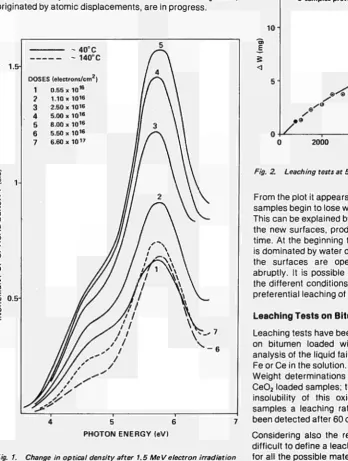
The results of experiments are summarized in Fig. 1 giving the absorption spectra obtained in different irradiation conditions. The intensity of the ΕΊ band at 140°C shows
saturated values that are much smaller than those obtained for comparable or smaller doses during irradiation at 40°C. At this lower temperature the dose dependence is non-linear with a tendency to saturation. Similar studies on B2 band,
originated by atomic displacements, are in progress.
1.5--2 1 >-co Ζ < Q. O LU E LU CC O 2 0.5
- 40° C - 140°C
DOSES (electrons/cm ) 0.55 χ 10
1 . 1 0 x 1 0 « 2.50 χ Ι Ο « 5.00 χ 1 01 6
8.00 χ 101 6
5.50 χ 1 01 6
6 . 6 0 x 1 0 "
Fig. 1.
4 5 6 7 PHOTON ENERGY (eV)
Change in optical density after 1.5 MeVelectron irradiation of S1O2 at different temperatures and doses
Leaching Tests on Glasses
In order to test glasses in water typical of a clay repository the extractor previously used for leaching tests with pure water was modified. The condensed water enters a vessel containing a clay suspension under agitation. Through a filter the water enters then into the vessel where the glass is located. The clay is changed every 2 weeks in order to have a constant water composition.
The test performed at 80°C for 10,000 h is terminated. The test at 50°C will be finished at the beginning of December. The analyses of the surface gel layer are in progress. In order to evaluate the effects of cracks which may be produced in the glass blocks during the initial cooling, glass samples were water quenched from the temperature of 550°C. After quenching of the samples a pattern of very small cracks was observed at the microscope on the surface of the samples.
The quenched samples were subjected to leaching tests up to 10,000 h with pure water. The results of the tests are compared in Fig. 2 with the results previously obtained on non-cracked samples. 15 10-E S <
© normal samples
• samples previously quenched
[image:15.595.280.550.294.507.2]0 2000 4000 6000 8000 10000 TIME (h)
Fig. 2. Leaching tests at 50°C inpure water
From the plot it appears that after about 8,000 h the cracked samples begin to lose weight more and more rapidly. This can be explained by the fact that the access of water to the new surfaces, produced by quenching, takes a certain time. At the beginning the corrosion of the internal surface is dominated by water diffusion and only after a certain time the surfaces are opened up and corrosion increases abruptly. It is possible also that the acceleration is due to the different conditions of pH existing in the cracks due to preferential leaching of Na.
Leaching Tests on Bitumen
Leaching tests have been performed for about three months on bitumen loaded with 20 w% Fe203 and Ce02. The
analysis of the liquid failed to show a measurable amount of Fe or Ce in the solution.
Weight determinations show a negligible variation for the Ce02 loaded samples; this is to be expected due to the high
insolubility of this oxide. In the case of Fe203 loaded
samples a leaching rate of the order of 10"5 g/cm2d has
been detected after 60 days.
Considering also the results previously obtained it seems difficult to define a leaching model of bitumen which is valid for all the possible materials. Water diffuses rather freely in the bitumen following a classical Fick law. If the compound
[image:15.595.46.395.327.789.2]which is dispersed in the bitumen has a high solubility and a diffusion lower than that of the water, around each grain drops of water are formed which can cause an extensive swelling. As a consequence the interface bitumen-water increases and also the diffusion coefficient increases. It does not seem possible to make a simple model of such a process.
In the case of low solubility or high diffusion no swelling occurs. It is possible then to set up a diffusion model. If we assume that the place of the dissolved grains is occupied by water, the model has to take into account that the water front is displaced as a function of time within the bitumen. Due to the fact that the stability of the bitumen as a conditioning system is strictly linked to the properties of the waste, it seems necessary to consider more deeply the problem of pretreatment of the waste before the conditioning operation.
COLLABORATION WITH EXTERNAL ORGANIZATIONS
Collaboration with AERE, Harwell, concerning irradiation experiments and theoretical investigations.
Collaboration with the University of Modena concerning examination by SEM (scanning electron microscope) of heavy ion irradiated samples.
Collaboration with CEA, Marcoule, on the leaching of glasses loaded with plutonium.
CONCLUSIONS AND PLANNED ACTIVITIES
Radiation damage on glasses
The investigations on radiation damage are being conducted by means of tests on borosilicate glasses and of more fundamental studies on silica.
In general the planning of the activity has been respected; however, the study of the distribution of the damage in the irradiated areas, planned for the reporting period, has been postponed in order to provide the suitable experimental tool (i.e. H.V. electron microscopy) to observe microstructural changes.
A contract with the Metallurgy Division of AERE, Harwell, for observation by H.V. microscopy is in preparation.
For the first semester of 1980 the following activities are planned:
- Completion of the irradiation of the borosilicate glasses in the HFR, Petten.
- Radiation damage on silica
1. Studies of annealing effects will be pursued by means of optical techniques
2. Preliminary assessments for observation of microstructural changes at the H.V. microscope will be performed. The observations may be completed by small angle X-ray scattering and structural measurements of X-ray diffraction in order to demonstrate eventual variation of density and short range order after heavy ions irradiation.
Leaching tests
For the first semester of 1980 the following activities are planned:
- Completion of the analysis of the results on glass leaching in water conditioned by clay
- Continuation of the tests on bitumen
- Leaching tests on borosilicate glasses loaded with Pu (provided by CEA, Marcoule) to verify a possible enrichment of Pu in the gel layer.
- Definition of a leaching test in a system with a restricted amount of water. Probably the case of a glass sample immersed in clay will be taken into consideration.
10
REFERENCES
1 A.R. RUFFA, Phys. Rev. Lett. 25 (1970) 650
2 G.M. GREAVES, Proc. Int. Conf. «The Physics of Si02 and its
interfaces», Ed. ST. Pantelides, Pergamon Press, 1978, p. 268
Interaction of Actinides with
the Environment
OBJECTIVES
The study aims at the development of experimental studies on the behaviour of transuranic nuclides in the environment in order to obtain a better understanding of their interaction with geological media and aquatic systems following an eventual release from a waste repository.
For the reporting period the planned activities were the following:
- continuation of column migration experiments with Pu-238, Am-241 and Np-237
- theoretical modeling study development
- investigation on the development of analytical techniques and valence state evolution of transuranic nuclides.
RESULTS
Experimental studies to investigate the migration behaviour of transuranic elements leached from a glass matrix, under conditions similar to those of natural groundwaters, are being developed in our laboratories. We assume that, as a consequence of a postulated accidental event, water penetrates the repository and partially dissolves the actinide bearing glass, moving afterwards through a surrounding porous formation.
In order to simulate the expected conditions of glass leaching and underground transport in the laboratory, a water pathway is established which flows over the actinide bearing glass and then through columns containing glauconite sand samples. Water fractions are continuously collected and analysed at the column outlet; the water velocity through the columns corresponds to a groundwater movement of about 25 m/yr. The experiments are carried out over periods of 1 to 6 months, and at the end the columns are cut into thin sections and the distribution profile of transuranic isotopes measured.
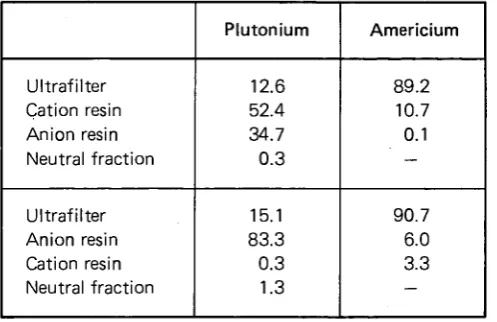
In Table I results are given on the percentage distribution of actinides leached from contaminated glass. The partitioning was obtained in an experiment over a six month period. As the operating conditions were identical for all three isotopes, the quantity retained by the filters inserted before the soil columns does not appear to depend upon the glass but on the characteristics of the leached radioelements.
Table I. Percentage distribution of actinides after six months of percolation
2 3 7NP
238p u 2 4 1 Am
10 Mm filter
The concentrations in the water directly after contact with the alphabearing glasses, for americium and plutonium are 109 M and for neptunium 3.7x10"8 M. At the outlet of the soil columns the concentration continually maintained a constant value of 2x10~13 M for americium and plutonium and 8x10"10 M for neptunium. Two ion exchange resin columns (BioRad AG 50Wx8 and AG 1, 200400 mesh) were placed in series with the soil column. It was found that all the plutonium and americium released from the soil columns were absorbed on the anion resins.
With the aim of determining the main processes which affect the distribution of activity, the leaching solution was passed through an analytical train made up of a membrane filter, two ¡on exchange columns and a fraction collector for neutral species.
In Table II are given the results of the distribution of plutonium and americium. These are based on the average of three experiments, each carried out over a 34 day period. Results are given for two cases where the cation and anion resins were inverted in order to determine the eventual filtration effects of the uncharged species on the first column. The soluble charged fraction is considered to be that found on the second column; 34.7% and 0.3% are negatively and positively charged respectively for plutonium. The percentage of uncharged actinide is obtained by substracting the soluble fraction from the total adsorbed on the corresponding initial column. The data show in fact that between 4852% of plutonium particles seems to be uncharged and fixed by filtration. The largest «soluble» fraction, however, behaves as an anionic species and only a negligible cationic fraction was detected.
Table II. Percent activity repartition in the analytical train
Ultrafilter Cation resin Anion resin Neutral fraction
Ultrafilter Anion resin Cation resin Neutral fraction
Plutonium 12.6 52.4 34.7 0.3 15.1 83.3 0.3 1.3 Americium 89.2 10.7 0.1 90.7 6.0 3.3
orders of magnitude lower than the Maximum Permissible Concentration for drinking water.
Work is underway in order to understand better the phenomena observed in these laboratory experiments and to develop models of underground migration. Nevertheless, these initial results already indicate that theoretical models of underground transport must take into consideration the filtering effect of porous media. This phenomenon in fact appears, at least for transuranic nuclides, to prevail during the dispersion of solutions leached from αbearing borosilicate glasses.
Parallel to this development a systematic study in order to determine the amount and kinetics of formation of soluble species is underway. A combination of techniques, as reported in the previous Programme Progress Report (Jan. June 1979), is being adopted at controlled environmental conditions of pH and Eh, and the distribution of Am241, Np 237 and Pu237 isotopes between particulate, cationic, anionic and neutral fractions is being measured at different concentrations of carbonate ions in solution.
COLLABORATION WITH EXTERNAL ORGANIZATIONS
In the framework of the collaboration between the JRC Waste Management Programme and the DG XII Radiation Protection Programme a number of contracts of particular interest for risk evaluation studies has been outlined. These contracts, carried out in various institutes of the Community, are expected to provide the necessary data to validate the environmental models used in longterm waste hazard evaluations.
On the other hand, the JRC's activity on the development of chemical speciation techniques for actinides, can give a basic contribution to studies carried out under contract. In the framework of this collaboration a graduate student from the Radiation Protection Programme is undertaking at Ispra her doctoral thesis on actinide bioavailability as a function of chemical form in selected fresh water systems.
A meeting with CEA scientists from Cadarache and FontenayauxRoses has been held at Ispra in October with a view to a possible collaboration in the field of actinides speciation and migration through sandy clay columns (artificial or natural barriers).
For americium it can be seen that the largest amounts of activity are retained on the membrane filter. Of the remaining, some 3% of the total appears to be soluble, having a positive charge, and the remaining 6% is retained by filtration of the resin. Negatively soluble charged forms account for less than 0.1 % of the total.
These initial results demonstrate that the soil matrix studied effectively retains the transuranic nuclides; however, the more effective processes seem not to be related to the high exchange capacity of clay minerals but rather due to the highly effective filtering ability of sandy clays. Further the data appears to show that both for plutonium and americium cationic species are only present at very low levels and negatively charged species appear, for plutonium at least to be the main mobile form.
For both plutonium and americium a soluble anionic form having a concentration of 10~13 M was detected which was not retained by the columns. Under the present experimental conditions, this concentration is about four
CONCLUSIONS AND PLANNED ACTIVITIES
The reported results have confirmed the complexity of the studies required for the description of the actinides migration in geological media and aquatic systems.
In the first half of 1980 the following activities are planned: filtration experiments with sand columns in parallel with
membrane ultrafiltration aiming to identify colloids in the leachate solution
washing of sandy clay columns after fixation of the leached activity in order to determine the elution behaviour
continuation of the studies on the physicochemical behaviour of actinides
initiation of a study on carbonate complex formation.
[image:17.595.43.292.411.572.2]Actinides Monitoring
OBJECTIVES
The objective of this study is to develop a methodology for monitoring plutonium contaminated waste streams. The activities are organized in the frame of an Advisory Laboratory.
For the reporting period the planned activities were the following:
A. Integral Experiment
Continuation of the benchmark and calibration measurements. Starting of measurements on real waste.
B. Passive Neutron Assay
Set-up and test of the upgraded signal processor unit. Optimization experiments for the upgraded detector unit. Theoretical investigations of the pulse to pulse time correlation analysis.
C. Passive Gamma Assay
Continuation of the experimental verification of the interpretation model.
D. Active Neutron Assay
Design paramater study of the Reference Monitor
E. Organization of the International Meeting on Monitoring of Pu-Contaminated Waste, JRC Ispra, 25-28 September, 1979.
RESULTS
A. The collaboration programme for an Integral Experiment with the plutonium waste management system of the Dounreay Nuclear Power Development Establishment (DNPDE) has been extended for a new period of twelve months. The final report of the foregoing year is in preparation; the results will be given in the next Programme Progress Report.
During the reporting period a considerable number (180) of synthetic waste items were measured with the NDA4 passive neutron monitor of the Dounreay plutonium waste measurement system. The existing interpretation model will be fitted to this waste problem and will be made available to Dounreay as a computer programme.
B. The development of both the signal processing unit and the detector system of the upgraded Reference Monitor for Passive Neutron Assay has been continued. The signal processing unit is in operation. During the next few months reliability tests will be carried out on the electronic circuits. The design of the detector unit is completed, all the components have been delivered and the unit is under construction in the workshop.
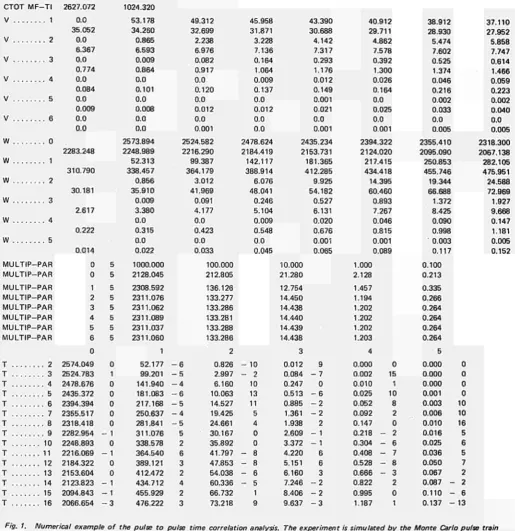
The theoretical investigation of the pulse to pulse time correlation analysis was completed. A computer code was elaborated to calculate the detected multiplicity parameters. Fig. 1 demonstrates such a calculation: the measured time distribution of two successive pulses of the first, second, ... order (V) are transformed into the time distributions of the zero, first, second,... order coincidences (W). The detected neutron multiplicity parameters are determined by a least square fit of the theoretical predictions to the measured time distributions using these parameters as variables. The calculated time distributions of the coincidences (T) are in good agreement with the measured distributions (W).
12
The pulse to pulse time correlation analysis, developed by the JRC, constitutes a major improvement in comparison with the systems like the VDC and Shift Register which are presently utilized. These systems have been introduced because of their electronic simplicity and ease of implementation rather than the fact that they represent a good algorithm for analysis.
The advent of microprocessors and low volume bulk storage means that a more sophisticated algorithm can be considered as suitable for operational implementation. C. During the reporting period the experimental verification of the interpretation model for passive gamma assay has been continued. In order to confirm the validity of the radiation transport model, over the whole γ-ray energy range and waste volume, experiments were performed with point sources, simulating a ring source located inside a polyethylene cylinder.
The theoretical predictions of the radiation transport model defined by the equation
1/4 πα2) exp i-μρΐ) S ( r , ø , ζ) dv
was evaluated numerically with the MERCURE-3 code. Calculations were performed with appropriate μ and ρ values and compared with experimental results.
The measured and calculated data are in good agreement with each other, thus indicating that the radiation transport model describes correctly the attenuated γ-radiation spectrum detected experimentally.
The planned continuation of this work will involve the elaboration of a mini-computer based program to evaluate numerically the above equation.
The work will be extended to take into account different corrections such as self-shielding, inhomogeneous waste matrices and the use of different 7-ray lines.
D. The layout of the Reference Monitor considered for active neutron assay is given in Fig. 2.
The Sb-Be neutron source (Thick Target) generates a Sub-MeV neutron interrogating flux in the sample. The flux distribution aroand the sample channel is measured by monitors. Fission neutron leakage from the Pb-pile is measured by 4He-counters. The sample is rotated and
moved along the channel (scanning). The interaction of the experimental results is based on heterogeneous diffusion theory (Nordheim-method). The apparatus is designed to measure prompt fission neutrons induced by photo-neutrons from an antimony-beryllium source. Owing to the energy spectrum of the (Sb-Be)-source neutrons primary induced fission occurs only with fissile isotopes such as U-235, Pu-239, Pu-241. This allows good discrimination of fertile materials such as U-238. Distinction between fissile plutonium and fissile uranium can be investigated measuring the delayed neutron fraction.
The actual and future problems of the Active Neutron Reference Monitor concern the heterogeneous parameters and the verification of the interpretation model.
EXPERIMENT 0.0000400 CTOT MF-TI 2627.072 V 1 0.0
35.052 V 2 0.0
6.367 V 3 0.0
0.774 V 4 0.0
0.084 V 5 0.0
0.009 V 6 0.0
[image:19.595.37.553.53.585.2]0.0 W 0 2283.248 W 1 310.790 W 2 30.181 W 3 2.617 W 4 0.222 W 5 0.014 MULTIP-PAR MULTIP-PAR MULTIP-PAR MULTIP-PAR MULTIP-PAR MULTIP-PAR MULTIP-PAR MULTIP-PAR T 2 T 3 T 4 T 5 T 6 T 7 T 8 T 9 T 10 T 11 T 12 T 13 T 14 T 15 T 16 0 0 1 2 3 4 5 6 2574.049 2524.783 2478.676 2435.372 2394.394 2355.517 2318.418 2282.954 2248.893 2216.069 2184.322 2153.604 2123.823 2094.843 2066.654 0.0000050 1024.320 53.178 34.260 0.865 6.593 0.009 0.864 0.0 0.101 0.0 0.008 0.0 0.0 2573.894 2248.989 52.313 338.457 0.856 35.910 0.009 3.380 0.0 0.315 0.0 0.022 1000.000 2128.045 2308.592 2311.076 2311.062 2311.089 2311.037 2311.060 1 52.177 99.201 141.940 181.083 217.168 250.637 281.841 311.076 338.578 364.540 389.121 412.472 434.712 455.929 476.222 1 16 49.312 32.699 2.238 6.976 0.082 0.917 0.0 0.120 0.0 0.012 0.0 0.001 2524.582 2216.290 99.387 364.179 3.012 41.969 0.091 4.177 0.0 0.423 0.0 0.033 100.000 212.805 136.126 133.277 133.286 133.281 133.288 133.286 2 0.826 2.997 6.160 10.063 14.527 19.425 24.661 30.167 35.892 41.797 47.853 54.038 60.336 66.732 73.218 45.958 31.871 3.228 7.136 0.164 1.064 0.009 0.137 0.0 0.012 0.0 0.0 2478.624 2184.419 142.117 388.914 6.076 48.041 0.246 5.104 0.009 0.548 0.0 0.045 10 2 10 13 11 5 4 0 0 8 8 6 5 1 9 43.390 30.688 4.142 7.317 0.293 1.176 0.012 0.149 0.001 0.021 0.0 0.001 2435.234 2153.731 181.365 412.285 9.925 54.182 0.527 6.131 0.020 0.676 0.001 0.065 10.000 21.280 12.754 14.450 14.438 14.440 14.439 14.438 3 0.012 0.084 0.247 0.513 0.885 1.361 1.938 2.609 3.372 4.220 5.151 6.160 7.246 8.406 9.637 9 - 7 0 - 6 - 2 - 2 2 - 1 - 1 6 6 3 - 2 - 2 - 3 40.912 29.711 4.862 7.578 0.392 1.300 0.026 0.164 0.0 0.025 0.0 0.001 2394.322 2124.020 217.415 434.418 14.395 60.460 0.893 7.267 0.046 0.815 0.001 0.089 1.000 2.128 1.457 1.194 1.202 1.202 1.202 1.203 0.000 0.002 0.010 0.025 0.052 0.092 0.147 0.218 0.304 0.408 0.528 0.666 0.822 0.995 1.187 0 15 1 10 8 2 0 2 6 7 8 3 2 0 1 38.912 28.930 5.474 7.602 0.525 1.374 0.046 0.216 0.002 0.033 0.0 0.005 2355.410 2095.090 250.853 455.746 19.344 66.688 1.372 8.425 0.090 0.998 0.003 0.117 0.100 0.213 0.335 0.266 0.264 0.264 0.264 0.264 0.000 0.000 0.000 0.001 0.003 0.006 0.010 0.016 0.025 0.036 0.050 0.067 0.087 0.110 - 6 0.137 - 1 3 0 0 0 0 10 10 16 5 6 5 7 2 - 2 37.110 27.952 5.858 7.747 0.614 1.466 0.059 0.223 0.002 0.040 0.0 0.005 2318.300 2067.138 282.105 475.951 24.588 72.969 1.927 9.668 0.147 1.181 0.005 0.152
Fig. 1. Numerical example of the pulse to pulse time correlation analysis. The experiment is simulated by the Monte Carlo pulse train generator.
(2500 SF/sec with V = 2.18; 10000 (Οί—η) neutrons/sec; the multiplication parameter k = 0.03;one fissionable isotope with V =
2.9 and a detector efficiency ofe= 15.2% (1/X = 40 ßsec; t# = 5ßsec; At = 5 ßsec; L = 15)
LONGITUDINAL - SECTION-VIEW CROSS-SECTION-VIEW
n-flux-monitors channel
Pb
Pb-plug |sb-B« | Pb-plug
Pb-plug
n-flux-monitors channel
Sample Pb-plug
Pb
Fig. 2. Lay-out of a reference monitor for active neutron assay
The construction of the apparatus and the experimental part
will be considered after the end of the first phase of
calculations thus permitting the assessment, within
approximatively one year, of the feasibility and the
sensitivity of this system.
E. Organization of the International Meeting on Monitoring
of Pu-Contaminated Waste.
The meeting was held at Ispra on 25-28 September 1979,
with the participation of 130 people from both within the
Community and outside. 38 papers were presented during 5
sessions:
- General Session
- Destructive Analysis and Reference Materials
- Instruments and Methods
- Theoretical Studies and Nuclear Data - Operational Experience.
Four working groups were organized in order to draw con-clusions. The findings of the working groups were presented and discussed in the final plenary session.
The papers presented and the conclusions of the working groups are being published in the proceedings of the meeting.
Five papers prepared by the JRC staff and by people working under JRC contracts were presented at the meeting1-5.
COLLABORATION WITH EXTERNAL ORGANIZATIONS
- Collaboration contract with the Dounreay Nuclear Power Development Establishment (DNPDE) on an Integral Experiment.
- Study contract with the Institut de Physique Nucléaire (University of Lyon) for design parameter study of the Reference Monitor for Active Neutron Assay.
- Collaboration contract in preparation with the Plutonium Fabrication Plant ALKEM (Hanau, F.R.G.) concerning test measurements of waste with equipment development at the JRC.
- Contacts with AERE-Harwell to develop a passive neutron assay system by means of the pulse to pulse time correlation analysis of the neutron pulse train. - Contacts with the Plutonium Fabrication Plant CNEN
(Casaccia, Italy) for setting-up a monitoring system of Pu contaminated solid waste streams.
CONCLUSIONS AND PLANNED ACTIVITIES
The development of the work has been carried out in agreement with the planning.
Concerning the activity in 1980, it has to be remembered that the JRC proposals for the 1980-83 programme, foresee a considerable increase of effort in the field of actinides monitoring.
In the first half of 1980, based on Council decisions, the planning of the activity for 1980-83 will be prepared in a detailed form.
For the first semester of 1980, the following activities are planned:
- Integral Experiment: continuation of real waste measurements
- Passive Neutron Assay: parametric study of the interpretation model for waste measurements with the EURATOM Time Correlation Analyser
- Active Neutron Assay: design parameter study of the Reference Monitor
- Technical Guide for Design and Analysis of Monitoring Systems6 : continuation of the revision work
- Consultation and calibration services in the frame of the EURATOM Advisory Laboratory: in particular, test measurements in the ALKEM plant.
REFERENCES
1) G. BIRKHOFF, J. DEPRAZ, J.P. DESCIEUX: «Interpretation of Active Neutron Measurements by Heterogeneous Theory», Paper presented at the International Meeting on Monitoring of Pu-Contaminated Waste, JRC-lspra, September 25-28,1979 2) J.P. DESCIEUX: «Analyse critique du rapport EURATOM sur
l'interprétation des mesures par la méthode neutron passive», ibidem
3) S. KUMPF: «Pulse to Digital Converter for the Time Correlation Analyser», ibidem
4) M. ASHGAR, L. BONDAR: «Passive 7-ray Monitoring of Plutonium Contaminated Waste», ibidem
5) L. BONDAR: «Time Correlation Analyser for Non-Destructive Plutonium Assay», ibidem
6) Monitoring of Plutonium Contaminated Solid Waste Streams. A Technical Guide for Design and Analysis of Monitoring Systems.
Chapter I:
G. BIRKHOFF, A. NOTEA: «Planning of Monitoring Systems» EUR 5635 (1977)
Chapter II:
G. BIRKHOFF, L. BONDAR, A. NOTEA : «Principles and Theory of Radiometric Assay» EUR 5636 (1977)
Chapter III :
G. BIRKHOFF, A. NOTEA : «Passive Gamma Assay» EUR 5637 (1977) Chapter IV:
G. BIRKHOFF, L. BONDAR : «Passive Neutron Assay» EUR 6027 (1978) Chapter V: G. BIRKHOFF: «Active Neutron Assay» (To be published in 1979)
2.2. Chemical Separation and Nuclear Transmutation of Actinides
If the separation of the actinides from fission products is demonstrated to be possible, it will open up a number of alternative waste management options in which the disposal of actinides, largely responsible for the long-term risk, and fission products can be considered separately. One option which would provide an ultimate solution for actinide wastes is the transmutation xo short-lived isotopes by neutron bombardment in reactors.
In the framework of the activity of the OECD Nuclear Energy Agency in the field of radioactive waste, the Commission has been chosen as leading organization for the studies on the chemical separation and nuclear transmutation of actinides.
The activity of the JRC in this field includes experiments on the chemical methods required for actinides separation from HAW and assessment studies on the possibility of actinides transmutation in nuclear reactors.
For the chemical separation of actinides from HAW, oxalate precipitation (OXAL Process) and solvent extraction by HDEHP and TBP are being investigated.
The assessment studies include, in addition to the reactor physics aspects, the implications of the nuclear transmutation on the nuclear fuel cycle (actinide fuel element design, modifications in the nuclear plants, increase of cost and risk).
In order to improve the accuracy of the reactor physics calculations a programme of neutron cross section measurements is carried out.
The JRC activities are planned in such a way as to have a maximum of information emerging in the second half of 1979. It is, in fact, intended to prepare for the beginning of 1980 a major report dealing with a critical evaluation of the feasibility of the chemical separation and nuclear transmutation of actinides.
Chemical Separation of Actinides
OBJECTIVES
The experimental studies on the feasibility of the HAW partitioning by OXAL, HDEHP and TBP processes are being concluded.
For the reporting period it was planned:
- to conclude HDEHP batch-extraction and denization tests on a fully active laboratory scale
- to conclude batch-countercurrent experiments on fully active HAW by HDEHP as well as on simulated HAW by TBP.
- to conclude engineering evaluation studies
- to start the preparation of the final report on the chemical and engineering feasibility of the HAW partitioning.
RESULTS
Denitration experiments
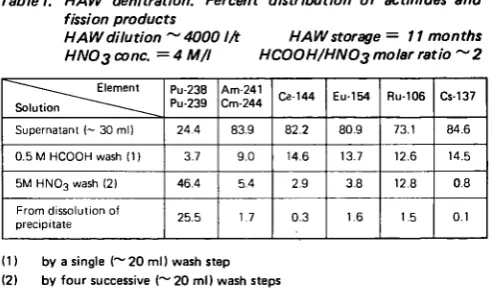
Fully active denitration experiments under the operating conditions foreseen by the HDEHP process flow-sheet has been concluded. A last denitration experiment was performed on the actual (4000 l/t) HAW solution prepared in Ispra hot cells1 and stored under acidic conditions (4.6 M
HNO3 ) during about 11 months. After a suitable clarification step this solution was denitrated by formic acid to a pH of about 2 and then filtered. The denitration precipitate was washed and redissolved by 70% HN03. The
[image:21.595.300.547.352.496.2]composition of the various liquid fractions was determined by alpha and gamma spectrometry. Process conditions and results are reported in Table I where the percent distribution values for each element refers to its total amount present in the initial HAW solution after clarification.
Table I. HAW denitration. Percent distribution of actinides and fission products
HAW dilution ~4000 l/t HAW storage = 11 months HNO3 cone. = 4 M71 HCOOH/HNO3 molar ratio ~2
~ . ^ ^ Element Solution ' -—^^^^ Supernatant (~ 30 ml) 0.5 M HCOOH wash (1) 5M HN03wash (2)
From dissolution of precipitate Pu-238 Pu-239 24.4 3.7 46.4 25.5 Am-241 Cm-244 83.9 9.0 5.4 1.7 Ce-144 82.2 14.6 2.9 0.3 Eu-154 80.9 13.7 3.8 1.6 Ru-106 73.1 12.6 12.8 1.5 Cs-137 84.6 14.5 0.8 0.1
I D by a single ( ~ 2 0 ml) wash step (2) by four successive ( ~ 20 ml) wash steps
Table I shows that Am behaves as observed in the preceding denitration tests, while a rather large fraction of the initial Pu amount remains in the denitration precipitate. This unexpected Pu behaviour could depend on the insufficient amount of noble metals acting as catalyst of the formic acid decomposition which in turn would be insufficient to promote an adequate Pu reduction. The lower degrees of the Pu retention in the denitration precipitate, separated after the preceding denitration processes, were in fact attributed to the reduction of Pu to its trivalent state. If during the denitration the Pu reduction is incomplete, Pu IV may in fact hydrolyse and coprecipitate with other hydrolysable ions (Zr, Mo).
Another possible effect could be the presence of phosphate ions generated by the radiolysis of TBP traces. No dodecane wash of the HAW raffinate was in fact performed at the end of Purex process operations so that non negligible traces of TBP, mechanically entrained in the HAW solution, may degrade by radiolysis up to phosphoric acid.
The precipitation of Zr phosphates and of hydrous zirconia could also explain the high Pu retention (18%) measured in the precipitate separated from the HAW solution after 9 months storage under acidic conditions. This possibility seems confirmed by the presence in the same precipitate of about 18% of the initial amount of Zr. More difficult to explain is the presence of a large portion of Pd (24%) that could, however, support the hypothesis above reported
(insufficient noble metal content) to explain the large fraction of Pu (25%) adsorbed on the denitration precipitate. On the basis of the above results it is evident that to minimize the presence of phosphate the HAW raffinate must be washed by the organic diluent just after being produced. As it is likely that also the ageing of the HAW raffinate could promote the formation of precipitate the storage of the HAW solutions has to be avoided as much as possible. The organic wash of the HAW solution is a plant operation normally accomplished without difficulties. On the contrary even if the HDEHP process does not include any storage step («direct partitioning») occasional HAW storage periods cannot be «a priori» excluded.
According to the TBP process flow-sheet (see solvent extraction experiments) a partial HAW denitration to 0.5-1.0 M HNO3 has to be carried out. Partial denitration experiments were performed using a synthetic concentrated (~ 13-fold) HAW solution containing phosphate-ions. The obtained results indicate that actinide content increases in the precipitate as the storage time of the concentrated HAW increases. After not more than three weeks of storage in fact the Pu content in the denitration precipitate increased from 1 to about 3% of its initial amount.
Also in this case the HAW storage in presence of phosphates appears to be an important factor in determining the actinide retention in the overall precipitate produced by the HAW concentration, storage and denitration steps.
Solvent extraction experiments
HDEHP Process
Batch extraction experiments on fully active laboratory scale carried out under acidic (4 M HN03) and low acidity
(pH 2) conditions have been described in the preceding progress report2. The set of experiments relating to the
HDEHP process has been concluded by testing on fully active laboratory scale the back-extraction of trivalent actinides from 0.3 M HDEHP - 0.2 M TBP in n-dodecane. The solvent was previously loaded by extracting trivalent actinides, Pu and RE from a 3500 l/t fully active HAW solution at pH - 2. The measured percent back-extraction yields are reported in Table II along with those obtained under similar conditions using a simulated 5000 l/t.
HDEHP Radiolysis
The efficiency of the HDEHP back-extraction could be negatively affected by the actinide and RE radiation effect on the solvent.
In order to determine the extent of this effect a fraction of HDEHP solvent (0.3 M HDEHP - 0.2 TBP in n-dodecane) containing actinides and RE previously extracted from a fully active HAW solution (3500 l/t) was stored during 5 months in a sealed tube (self-irradiation test). No formation of precipitates being observed at the end of the storage time, the loaded HDEHP was successively volume to volume back-extracted with the following aqueous solutions:
1. 0.05 M DTPA + 1 M glycolic acid at pH 3 for the selective stripping of Am and Cm
2. 5M HNO3 for the selective stripping of RE
3. 0.08 M H2C204 for the selective stripping of Pu and
4. 1 M Na2C03 at 60° for the solvent clean up (U)
The distribution coefficients (D0.,) measured for the various
elements seem to indicate a certain reduction of the back-extraction efficiency probably due to the self-irradiation effect. A factor 3 increase of the D0,, was in fact measured
for Am corresponding to a decrease of the Am percent back-extraction yield from 96 to about 88%.
As to the subsequent stripping steps mentioned at points 2 and 3, the back-extraction efficiency of RE and Pu remained practically unchanged. During the alkaline clean-up of the solvent (point 4) carried out at 60°C no emulsion or interfacial precipitate were observed.
After reconditioning to the acid form, the HDEHP concentration was determined by titration with tributylammonium hydroxide and sodium hydroxide. A reduction of about 10% of the initial HDEHP molarity was measured.
The extraction capacity of the regenerated solvent controlled under simulated condition did not show significant variation of the Am and RE distribution coefficients with respect to the expected values.
A set of more intensive irradiation tests were also performed using a Cobalt-60 source at a dose rate of 1 M rad/h. Different types of solution were irradiated at variable radiation exposures, namely:
Table II. Selective back-extraction of trivalent actinides from HDEHP loaded with synthetic and fully active HAW
Element Pu Am Eu Ce Solvent 0.3 M HDEHP 0.2 M TBP
in n-dodecane Strip Solut. 0,05 M DTPA 1M glycolic acid p H ~ 3 0 / A = 1
% Back-Extraction Synthetic HAW 29 97 38 20 Fully Active HAW 20 96 40 23
From the comparison of the results obtained from the two batch-experiments (Table II) it appears that the Am back-extraction efficiency does not show significant variations. Nearly the same percent back-extraction yields were obtained for Am using synthetic and fully active HAW solutions.
16
Pure solvent (0.3 M HDEHP-0.2 M TBP in n-dodecane) The purpose of this irradiation test was to determine whether radiolysis products having high extractive capacity for trivalent actinide could be produced during the irradiation and could thus prevent a complete actinide back-extraction. According to the results obtained with irradiated (120 Mrads) and unirradiated solvent fractions the above hypothesis can be excluded.
Loaded solvent
This irradiation test was aimed at determining to what extent the Am and RE back-extraction efficiency may be affected by irradiating the loaded HDEHP with an external beta-gamma radiation source.
The obtained results show that the Am and RE retention in the irradiated HDEHP show a certain tendency to increase as the radiation exposure increases. These results are therefore fairly consistent with those obtained by self-irradiation tests.
HCOOH and DTPA solutions
These irradiation tests were performed in order to investigate the possible formation of oxalic acid as well as the radiation stability of the DTPA solution in view of its possible recycling.
The obtained results indicate no formation of oxalic acid and an increase of the Am and RE retention in the solvent as the DTPA radiation exposure increases.
TBP Process
TBP batch-countercurrent experiments with the simulated HAW solution have been completed during the present reporting period. The option 1, previously proposed for TBP process3 was slightly modified according to the following
process sequence:
1. Partial denitration of 13-fold concentrated HAW and final adjustment to 1 M HN03.
2. Selective extraction of U, Pu at 1 M HN03 (instead of
extracting at 4-5 M HN03 before the denitration step as
originally proposed)
3. Final acidity adjustment (to - 0.2 M HN03) and salting
by addition of AI3+/AI(OH)2+ nitrates, NaN03 and NaOH in
amounts compatible with the vitrification (instead of the direct denitration to 0.2 M HN03 ).
4. TBP extraction and back-extraction of Am and RE. 5. HDEHP selective extraction of RE.
These process step modifications were aimed at achieving the following objectives:
- to attain the reduction of the HAW acidity by means of a procedure which is undoubtedly less critical for the remote acidity control than a specific denitration process.
- to promote favorable conditions for converting to an extractable form the Pu fraction coprecipitated during the HAW concentration and storage. The possibility of achieving this latter objective is however still to be demonstrated on fully active laboratory scale.
A simulated HAW solution, concentrated by a factor 13, partially denitrated and then adjusted to 1 M HN03 was
therefore used as initial feed. The operating conditions applied for the batch-countercurrent extraction and back-extraction steps are summarized in Table III.
Typical percent separation yields are reported in Table IV for Pu, Am, Eu, Ce and some FP. The obtained results are consistent with the results of batch experiments reported for Am in a preceding progress report 4 . They can be
summarized as follows:
- Pu, Am, Eu and Ce behave as expected in the varius TBP extraction and back-extraction steps. The actinide separation from the concentrated HAW is obtained with DF higher than 103 for Pu and 104 for Am.
- The separation Ce and Eu from actinides is also satisfactory; D F of about 2000 and 133 for Ce and Eu being measured respectively after their selective extraction by HDEHP.
Therefore this experiment leads to conclude that the TBP process is suitable to remove actinides from a concentrated synthetic HAW solution with quite satisfactory actinide separation efficiencies. Obviously the validity of this statement is presently still restricted to the employment of simulated conditions and needs to be demonstrated also for actual HAW solutions.
OXAL process experiments
They have been completed with the actinides/RE partitioning experiments on fully active laboratory scale illustrated in the preceding progress report2.
Process Engineering Assessment
The stage has been reached concerning the engineering assessment of actinide separation whereby the laboratory data collection is correlated and assessed in practical nuclear chemical engineering terms in order to establish the feasibility of a flow-sheet for the subsequent stage of a preliminary design.
Previous PPR's have indicated some significant factors concerning the proposed flow-sheets submitted for feasibility assessments. Generally these factors have been based on the following considerations:
I. solvent choice
II. HAW-concentrated or original III. «Direct» or «Delayed» partitioning
IV. Proven nuclear fuel reprocessing technology
V. The overall waste balance must be of the same order or at the most only fractionally greater than that for a comparable vitrification step alone
VI. Precipitates - solid formation
VII. Decontamination factors achieved, compared to requirements
VIII. Process safety - criticality, chemical and control IX. Corrosion
X. Cost estimate considerations
The above list is by no means exhaustive but it does illustrate simply the magnitude of the problem. It was foreseen that the actual conception and possible realization of a HAW partitioning plant would present a formidable task because of the function the plant is required to do in terms of performance and decontamination factors (DF's of the order 103, 104 compared to 200 for normal PUREX type
reprocessing).
In short the conception is of a highly advanced technology industry requiring very small limits of operational variation for successful «production» of a - free waste streams.
Integration with the PUREX reprocessing facility has always been considered an essential requisite and so compatibility has been a conditional criterion on which to base the processing sequence.
The necessary criteria originally envisaged of, 5 year cooled HAW produced from LWR fuel, must therefore be considered in a much broader context in terms of
1. storage time out of reactor prior to reprocessing 2. reprocessing itself
3. HAW treatment after reprocessing - «direct» or «delayed» which is dependent on (1 ) above
4. activity levels in the extraction and stripping sections. The considerations of these factors all influence in some way the choice of one of the proposed flow-sheets. For example the TBP solvent instead of the HDEHP solvent would be the preferred choice. However, in order to enhance the extraction of Am/Cm/RE's the TBP solvent requires addition of salting agents (nitrates of aluminium). Further the quantity of salting agent required would be considerable and totally unacceptable from the point of view of solified waste arisings if the unconcentrated HAW was considered. Consequently the TBP process can only be applied to the concentrated HAW since the salting agent requirements are then of an order of 10-15 less in quantity and at the same time amenable to the vitrification process.
Concentration of the HAW which is already a routine plant operation evidently means a large increase in the activity level per unit volume of the HAW. This could present serious problems particularly from Zr-Nb, Ru-Rh in high acidity exhaustive extraction steps and from the RE's mainly Ce-Pr 144, in the low acidity separation step. It is already known
Table III. Operating conditions applied to the various process steps of the TBP flow-sheet
^ ^ Process
^ v . steps
L. stream ^ ^ constituents ^ \ ^ TBP/n-dodecane
FEED : HNO3 (M/l) A l3 + (M/l)
Na+ (M/l)
NO3 (M/l)
SCRUB : HNO3 (M/l) STRIP : HNO3 (pH)
H D E H P/ A A
1 n-dodecane ΓΒΡ
FEED : HNO3 (pH) DTPA (M/l) Glycolic acid (M/l)
Na+ (M/l)
SCRUB: DTPA (M/l) Glycolic acid (M/l) pH U-Pu Select, extraction Compos. 30% 1 1 1 Stage No. 10 8 2 Relat* flow 770 385 385
Am, Eu, Ce Extraction Compos 30% 0.20 0.54 1.08 2.90 Stage No. 8 8 Relat* flow 1800 600
Am, Eu, Ce Stripping Compos. 1.5 Stage No. 3 3 Relat* flow 1800 900 Eu, Ce Select, extraction Compos. 0.3 M 0.2 M 3.0 0.05 1 X>.25 0.05 1.0 3.0 Stage No. 8 5 3 Relat* flow 4200 3500 700
( · ) R E L A T I V E FLOW : litres per metric ton of U
Table IV. TBP batch - counter-current experiments. Percent separation yields of actinides and some F Ρ obtained by operating the various process steps. Process conditions: see Table III
^ ^ ^ Process ^ \ s t e p s
Element ^ v . Pu Am Eu Ce Ru Rh Pd Zr DF
% Separation yields U, Pu
Select, extr. > 9 9 . 9 < 0 . 1 < 0 . 1 < 0 . 1 ~ 13 ~ 1 < 5 < 5
(Pu)= 103
Am, Eu, Ce Extraction
>
> 99.99
> 99.99 > 99.98 - 9 0 . 0
(Am) ~ 1 04
Am, Eu, Ce Stripping
> 99.97
> 99.97
> 99.97 - 2 6
Eu, Ce Select, extr.
~ 0.07 99.25
> 99.95
( E u ) » 133 (Ce) > 2000