European Investiti
][jû{f®[7[M](o]Î}D(ô)Dû^Î^x; P~p^
B a n k
^^CZ^^N^
Den europaeiske Investeringsbank
' ' * ^ j f ^ ' ^ \ Europäische Investitionsbank
• * ^ ^ )"* Banque Européenne d'Investissement
1 ^ Banca Europea per gli Investimenti
^ ^ y ^ < ^ Europese Investeringsbank
No 2 0 · February 1980
ISSN 0250-3891Including first loans from New Community Instrument resources
Financing operations up 40 o/o in 1979
to more than 3 billion u.a.
A rise in financing operations to a total of 3 071-1 million units of account (u.a.) Is shown in the figures for the European Investment Bank's activities in 1979.
This is 4 0 % up on the 2188-3 miiiion u.a. provided in 1978 and almost double the 1977 totai of 1 571 -5 miiiion.
Loans for industrial projects, energy and other infrastructure development in EEC Member Countries, or of direct interest to the Community, ac-counted for 2 558-2 miiiion u.a., roughly a third more than the 1966-5 miiiion ient in 1978; they were concentrated (over 90 %) in italy, the United Kingdom, ireland and France.
The majority — 2 281 · 2 million u.a. — came from the ElB's own resources (essentially borrowings which the Bank makes on capital markets). The remainder, 277 million u.a., was drawn from the resources of the New Community Instrument for Borrowing and Lending •— 'Ortoli Facility' ('), which became operational with the first loans made in September last year. The New Community Instrument is funded by borrowings made by the Commission of the European Communities in the name of the EEC. The Bank has the mandate to make the loans on the EEC's behalf for projects declared eligible by the Commission.
Another important development last year: under arrangements agreed when Ireland and Italy joined the
In this issue
operations up 40 % Financing
in 1979
— over 2-5 billion u.a. in the European Community
— more than 500 million u. a. in Mediterranean and Lomé Convention countries p. 1-6 Revue of trends on the inter-nationai capitai marltet in 1979
p. 6-12
European Monetary System {'), interest subsidies of 3 % are being applied to certain loans made in the two countries using funds set aside for this purpose in the Community budget for 1979.
This expansion of the Bank's operations in 1979 reflects the em-phasis put by the European Council (Community Heads of State or Government) on the importance of action in a number of key areas crucial to the EEC's future de-velopment: the need to stimulate investment and combat unem-ployment, to reduce disparities be-tween the performances of national economies, to tackle structural changes, in particular with the Community's enlargement in mind, and to reduce as far as possible the EEC's dependence upon oil imports, which severely threatens economic growth over the years ahead.
Outside the Community, the EIB provided 512-9 million u.a. (against 221-7 million u.a. in 1978) for development in 10 Mediterranean countries which have association or cooperation agreements with the Community and in 16 African and Caribbean countries which signed the first Lomé Convention.
Of this, 420-9 million u.a. was in the form of loans from the ElB's own re-sources (usually with interest subsidies paid by the Community)
F
ive years ago EIB-Information was launched as an effort to make better known, through concise, factual articles, the role and activities of the European Investment Bank.It is a fairly modest publication, and will remain so, although a more modern presentation has now been adopted, starting with this number. Distribution is free. There are four issues per year in the six official languages of the European Community (Danish, Dutch, English, French, German and Italian); Greek will be added from 1981, when Greece joins the Community.
Circulation has risen steadily. Requests for copies are received from a wide range of organi-sations, principally in industrial and financial circles and the media, but also from Government departments, public authorities, universities and others. Sug-gestions are always welcome
regarding distribution or other ways to render this publication as useful as possible.
We are pleased with the interest so far and look forward to an increasing circulation as the ElB's work develops in the BO's.
The years ahead may well present the European Community with tests of its strength greater than in the past.
This is not necessarily the cue for pessimism — challenges are often the spur to progress — but it does mean that very special responsibilities fall upon the Community institutions, in their respective fields of competence. The European Investment Bank has clearly defined tasks, first set out more than 20 years ago under the Treaty of Rome.
They were given added emphasis in March 1977 when the Community Heads of State or
and 92 million as finance on special conditions (particularly long-term loans at minimal interest rates and various kinds of risk capital o p -erations) provided from budgetary funds which the Bank manages on the Community's behalf.
To make possible the increase in Its lending activities, the EIB stepped up its b o r r o w i n g s in 1979 to a total of 2 481 -2 million u.a., mainly via public bond issues, approximately half on the international market and certain national markets outside the Community, half on domestic markets within the Community. This is 27 % up on the 1 949-7 million u.a. raised in 1978. Main currencies borrowed were US $ ( 4 0 - 5 % ) , DM ( 2 2 % ) , Guilders (11%), French francs ( 8 - 3 % ) , Yen ( 6 % ) , Swiss francs ( 4 - 5 % ) . The Bank also borrowed Belgian and Luxembourg francs, Austrian Schillings and £ sterling.
In t h e C o m m u n i t y
Priority t o regionai d e v e l o p m e n t and i m p r o v e d energy supplies Over two-thirds of lending within the Community went to investment in regions which are economically less developed or confronted with industri-al conversion problems.
Action was concentrated where these difficulties are most pro-nounced and unemployment the highest: in fact, 6 2 % of lending for regional development went to those
Unit of A c c o u n t
Below are the values in national currencies of the Unit of Account used by the Bank, as at 31 Decem-ber 1979; these rates are applied the present quarter in preparing f i -nancial statements and operatio-nal statistics of the Bank: DM 2-49057 Bfrs 40-3181 £ 0-646904 Lfrs 40-3181 Ffrs 5-79312 Dkr 7-71697 Lit 1 157-19 IRe 0-670579 Fl 2-74085 US-$ 1-43839 Statistics summarising Bank activi-ties in terms of Units of Account have been based on several diffe-rent conversion rates applied sin-ce 1958. This, coupled with the ef-fects of price trends, would sug-gest prudence in interpreting the significance of figures which relate to operations extending over many years.
The composition and hence value of the unit of account used by the EIB Is the same as that of the European Unit of A c c o u n t (EUA) and the European Currency Unit (ECU).
areas given top priority ' under Community regional policy: Ireland, the Italian Mezzogiorno, Northern Ire-land and GreenIre-land {').
This continued high level lending for regional development is in line with the Bank's main task under the Treaty of Rome and with one of the principal objectives of the Council of the European Communities in deciding upon the New Community Instrument.
A wide variety of industrial projects was supported, plus water supply, sewerage and irrigation schemes, improvements to telecommuni-cations, transport, electricity and gas supplies.
The EIB also increased operations under its other main role, that of financing projects of c o m m o n interest t o several Member Countries or the Community as a whole.
This includes support for industrial cooperation between enterprises from different countries, development of European capacities in high t e c h -nology fields, cross-frontier transport links, environmental protection and, most important of all, investment helping t o limit , t h e Community's dependence upon oil imports, for which a number of loans were also made from New Community In-strument resources.
iVIain s e c t o r s
Close t o 45 % of all lending in the Community in 1979 went to the energy sector. The total — 1 146-5 million u.a. (including 149-5 million from New Community Instrument funds) — was up nearly 60 % on the previous year (721 -3 million).
Water supplies, irrigation, drainage and sewerage works claimed 567-4 million (including 90-1 million from NCI resources) against 357 million in 1978 and communications projects 456-6 million (37-4 million from NCI resources) against 625-6 million in 1978.
Despite a difficult investment climate, and lack of demand for finance from several major public enterprises which had borrowed from the EIB in previous years, the Bank increased loans to other sectors, mainly manu-facturing industry; they rose to 377-6 million u.a., over 4 0 % up on 1978 (262-6 million) and went also t o a m u c h wider range of projects than in the previous year.
To be n o t e d : 137-3 million u.a. was in the f o r m of global loans t o regional or national financial institutions which use the funds to make sub-loans for small and m e d i u m s c a l e i n d u s t r i -al ventures chosen in agreement with the EIB (99-9 million in 1978).
During 1979 credit provided from these global loans, and others granted previously, totalled 131-4 million u.a. and helped to finance 415 ventures (72-2 million went to 155 ventures in 1978).
The Bank attaches particular value to global loans because the kind of investment which they go to sup-port tends to be relatively labour-intensive, all the more important in the present circumstances.
In addition, and for the first time, the Bank made a global loan (12 million u.a. in France) for financing small and medium-scale infrastructure works carried out by public authorities to improve conditions for regional development.
Country by c o u n t r y
In Italy, lending totalled 990-4 million u.a., w o r t h Lit 1 129 billion at exchange rates ruling at contract signatures (including 85 million u.a. — Lit 97 billion — from New Community Instrument resources). This represents an increase of about 24 % on the previous year (Lit 909 billion) and accounts for nearly 3 9 % of all operations in the Community last year. A r o u n d 70 % of the total went to investment in the Mezzogiorno.
Interest subsidies of 3 %, under the European Monetary System arrangements, are being paid on loans totalling 619-1 million u.a. (Lit 705 billion).
(') Ttie Commission of the European Communities has been authorised by the Council of the European Communities to borrow up to 1 billion units of account in the name of the EEC; these funds are deposited with the European Investment Bank which has the mandate to make loans on the Community's behalf for projects declared eligible by the Commission as conforming to priority objectives laid down by the Council; the first 500 million tranche has been reserved for infrastructure and energy projects. (') By decision of the Council of the Euro-pean Communities, 3 % interest subsidies may be applied to selected loans from the ElB's own resources and from those of the New Community Instrument which are made over a period of five years (1979-1983) in less prosperous countries fully participating in the European Monetary System (Ireland and Italy have been designated as such). These subsidised loans are to be concentrated on infra-structure projects which help to solve major structural problems in the countries concerned, reduce regional disparities and improve the employment situation. The Commission is responsible for deciding the eligibility of investment projects for a subsidy.
About a third of lending (349-9 million u.a) went towards investment in improved energy supplies. Loans were made for laying 470 km of the Algeria—Italy gasline in Sicily and Ca-labria, acquisition of high-technology equipment for laying this and other pipelines, construction of a hydro-electric and pumped storage power station in Piedmont, development of five oil and gas fields off the Adriatic coast and in the Po Valley, improvements to the national grid control system and extensions to the electricity distribution networks in Abruzzi, Molise, Calabria, Basilicata, Friuli and Venezia-Giulia. Finance was also provided for construction of geothermal power stations in Tus-cany and an energy-saving district heating system in Brescia.
Lending to manufacturing industry rose by over 80 % to 244 - 3 million u.a., of which 101-1 million in five global loans to assist small and medium-scale ventures in the Mezzogiorno and various regions confronted by difficult economic problems in the North and Centre of Italy. Larger-scale projects assisted by the Bank included construction of an Italo-French commercial vehicles factory In the Abruzzi, a gearbox plant in Molise, coachworks in Emilia Romagna, modernisation of tyre fac-tories in Latium and Sicily plus a diesel engine components plant in Apulia.
Other industrial projects were an electro-mechanical equipment fac-tory and installation of energy-saving facilities at a match factory (both in Lombardy), manufacture of solar energy panels and restructuring an ethylene/acetylene plant (both in Tus-cany), production of bio-medical equipment (mainly pacemakers) in Piedmont and extension of a frozen food factory in Latium.
A total of 279-1 million u.a. went to acqueduct construction and other works to improve water supplies in Apulia and Campania and irrigation of more than 50 000 hectares in Apulia and Molise. Loans totalling 54-4 million went to transport projects (final works on the France-Italy alpine road tunnel at Frejus, purchase of 8 European Airbus jetliners to strengthen the Alitalia fleet, con-struction of the Catania by-pass in Sicily) and 42-4 million to improved telecommunications (reinforcing trunk circuits between the Mezzogiorno and Northern Italy and abroad, extension to a ground station in Abruzzi for telecommunications satellites). A 17-5 million u.a. loan was made for road construction, flood prevention and other works In the Syracuse industrial zone, Sicily. A 2-6 million u.a. loan was made for housing linked to industrial development in Latium and Molise.
EIB lending in the Community last year, from the Bank's own resources, was well over double that in 1976. Virtually half the lending since the Bank began operations in 1958 has been carried out in the last three years alone.
This expansion, even allowing for the effects of inflation, shows the effort made by the EIB to meet the call which the European Council (EEC Heads of State or Government) made in March 1977 for mobilisation of a greater volume of Community finance to combat unemployment, sluggish investment and insufficient convergence of national economic performances.
The New Community Instrument for Borrowing and Lending, from which the first loans were made In September last year, was designed with the same aim in view, at the initiative of the Commission of the European Communities, to give additional financial support for investment.
There are different ways of evaluating the ElB's activities during the three years; much interest naturally focuses on employment and energy supplies.
The impact made on employment by the various projects which the EIB helped to finance can be estimated as follows:
— the direct creation of around 52 000 permanent jobs plus the safe-guarding of 23 500 more, principally in industry.
— the temporary, direct and indirect, effects on employment during construction periods (often lengthy) and also on employment involved in supply of necessary services and materials — this mainly concerns large-scale energy and infrastructure works; the total effect of projects financed for the first time in 1979 can be estimated at about 500 000 man-years of work, a figure roughly comparable to that for operations in each of the previous two years. This 500 000 corresponds to up to 145 000 jobs for a year in 1979 and 1980, progressively fewer thereafter. — the long-term effects of most infrastructure projects — water supplies and communications for example — which create few per-manent jobs directly but which are of fundamental importance for economic growth.
The Bank can also estimate the impact in potential oil import savings of the energy projects which It has helped to finance (38 % of total lending within the Community in the period concerns energy).
Loans went to a range of investment — hydro-electric/pumped storage, nuclear and geothermal power stations, oil and gas field development, electricity and gas transmission facilities, solid fuel extraction etc. Many of the schemes involve long construction periods and require phased financial support over a number of years.
Very approximately, and barring unforeseen circumstances, energy investment financed in 1977-1979 should, when completed, provide extra resources or enable economies equivalent in total to over 38 million tonnes of imported oil per year ( = ± 8 % of the Community's imports in 1979).
In the United Kingdom lending rose considerably to 844-3 million u.a. (£ 553-9 million) equivalent to 33% of all operations in the Community. This compares with £ 286-3 million in
1978, when operations had dropped from 1977's total of £ 320-8 million. Of the total lent in 1979, 105-3 million u.a. (£ 66-3 million) came from New Community Instrument funds.
Over half the lending in the UK — 471-5 million u.a. — went to improved energy supplies: con-struction of a pumped storage power station in Dinorwic, North Wales, nu-clear plant in the North of England, at
Hartlepool and Heysham, a thermal power station at Peterhead in Scotland, extension and moderni-sation of the electricity distribution networks in Wales and N.W. England and a new phase of development at the Sullom Voe oil port in Shetland which handles supplies from many North Sea fields. In Northern Ireland a loan was made for construction of a thermal power station at Kilroot — an interest subsidy of 3 % was granted from the European Regional Development Fund, the first ap-plication of this possibility.
sewerage schemes, largely to meet present or projected industrial needs: a total of 151-4 million u.a. was provided for works carried out in Tyneside, the North West, Yorkshire and Humberside, in Devon and in the Lothian region, Scotland.
Other infrastructure development assisted by the Bank: expansion of the telecommunications network in Wales (92-4 million), road con-struction in Northern Ireland (22-2 million), a number of local authority schemes (total 42-7 million) involving road construction, sewerage pro-vision and lay-out of industrial estates in Scotland (Glasgow, Livingstone, the Central Region and the Orkneys) and in Devon, where finance also went towards extension of Exeter airport.
Industry benefited from loans worth In total 64-2 million u.a. These went to a wide variety of projects through-out the country: in Scotland, extensions to a whisky bottling line in Dumbarton, printing works modernis-ation in Glasgow, re-equipment of a copper fittings factory and. con-struction facilities for North Sea oil
platform superstructures (both in Dundee), plus modernisation of an aluminium smelter at Fort William; in Wales, construction of two factories in Wrexham producing cans and packaging for the food and dhnks industry, a mineral wool factory in Bridgend and a plastic components factory in Blaenau Ffestiniog; in Northern England, construction of a pump factory in Leeds, new factories producing turbochargers for diesel engines and furniture as well as modernisation of a telecommuni-cations cables factory, all three in Merseyside, and expansion of a plastic pipe factory in Durham. In Northern Ireland, a loan was made for modernisation of tyre factories in Belfast and Ballymena.
Lending in Ireland almost tripled, reaching 339-6 million u.a. (IR£ 226-1 million against IR£ 78-5 million in 1978). Of this amount 86-7 million u.a. (IR£ 58 million) came from the resources of the New Community Instrument.
Interest subsidies of 3 %, under the European Monetary System arrange-ments, apply to loans totalling 259-3 million u.a. (IR£ 172-6 million). Again, a major share (103-9 million u.a.) went to improved energy supplies: construction of a thermal power station at Aghada, Co. Cork, and equipment of linked peak period generators (both to be fired by na-tural gas discovered off the Cork coast), extensions to the national grid and distribution system, and development of peat bogs to supply peat-burning power stations and
solid fuel for domestic heating instal-lations and open fires.
Water and sewerage schemes carried out in most parts of the coun-try accounted for 94-8 million, improvements to the telecommuni-cations system 45-3 million, road construction 35-8 million and land drainage and forestry development a further 33-4 million.
Three global loans totalling 26-3 million u.a. were made to help finance small and medium-scale industrial and agro-industrial ventures.
In France, lending totalled 222-7 million u.a. (Ffrs. 1302-1 million) of which 99-2 million went to tele-communications development in Lorraine and 98-9 million to energy projects — the EURODIF uranium enrichment plant (Tricastin, Drôme) and NERSA fast breeder reactor power station (Creys-Malville, Isère), both of which involve participation by a number of European countries, and equipment at the Franco-Belgian nuclear plant near Chooz (Cham-pagne-Ardennes).
Loans were also made for flood prevention works in the Loire valley, equipment at Brest in Britanny for treating ballast water discharged by oil tankers (it may also be used to clean oil-polluted sand) and for a fact-ory in the Auvergne producing mineral wool.
The Bank made a global loan to finance small and medium-scale infrastructure works carried out by public authorities in less-de-veloped or industrial conversion areas.
In Belgium, loans totalled 58-4 million u.a. (Bfrs 2 350 million), of which 49-7 million went towards construction of the Tihange nuclear
power station near Liège. The remain-der took the form of a global loan for small and medium-sized industrial ventures in less-favoured regions and a loan for an adhesive paper factory near Antwerp.
Lending in Germany totalled 47-8 million u.a. (DM 120 million). Most of this — 43-8 million u.a. — went towards construction of a gasline running across Germany from the Austrian and Czechoslovak frontiers to-the French frontier, designed to bring supplies from the USSR. A loan was also made for a factory in North Rhine-Westphalia which will produce equipment for uranium enrichment. Loans in Denmaric totalled 15-6 million u.a. (Dkr 112 million), of which the majority — 10-2 million — went to assist Greenland's development (construction of a power station on the West Coast and improvements to the telecommunications system). A global loan was made for small and medium-scale ventures in Denmark's development regions and a loan for extension of an agricultural chemicals plant on the Isle of Falster.
Last year the ElB's Board of Gover-nors authorised the Bank to support an energy project in Austria of direct interest to the Community; a loan of 39-4 million u.a. was made for a hydro-electric scheme in the Austrian Tyrol, half the output of which will be supplied to an electricity company in Germany.
Cooperation with EURATOIM
During the year EURATOM — the European Atomic Energy Community made nine loans worth 152-3 million u.a. for construction of the Doel (Bel-gium), NERSA (France), and Alto Lazio (Italy) nuclear power stations.
Tabte 1 : EIB financing operations In the Community Breakdown by project location
Belgium Denmark Germany France Ireland Italy
United Kingdom Other Countries (i)
Total
From EIB own resources million
u.a. 58-4 15-6 47-8 222-7 252-9 905-4 739-0 39-4
2281 -2
0/0
2-5 0-7 2-1 9-8 11-1 39-7 32-4 1-7
100
From NCI resources
million u.a.
—
—
—
86-7 8 5 0 105-3
~
277-0
1979 From EIB own and NCI resources million
u.a. 58-4 15-6 47-8 222-7 339-6 990-4 844-3 39-4
2558-2
0/0
2-3 0-6 1-9 8-7 13-3 38-7 33-0 1-5
100 million
u.a. 62-2 106-3 45-5 359-3 117-4 845-1 430-7
™
1966-5 1978
0/0
3-1 5 2 18 6 43 21 4 3 3 0 0 9
~
million u.a.
_
32-7 28-4 296-5 79-0 425-7 489-9 48-8
100 1401-3 1977
0/0
2-3 2 21 5 30 34 0 2 7 4 9 3-5
100
These operations were funded from resources borrowed by EURATOM on the capital markets and decided upon by the Commission, the Bank assuring the project appraisal and loan management. They are ac-counted for separately and not included here in the figures for the Bank's lending operations.
Table 2: EIB financing operations In the Community in 1979 Sectoral breakdown
From EIB own resources
million
u.a. 0/0
From NCI From EIB own and NCI
resources resources million
u.a.
million u.a.
Outside the Community Large increase in lending in the IVIediterranean region
With a total of 426-5 million u.a. lent for development in 10 countries, mainly for industrial, agricultural and energy investment, 1979 saw a major expansion in EIB activities in the Mediterranean region, outside the Community.
This lending, carried out under the terms of agreements negotiated between the countries concerned and the Community, included 78-8 million u.a. drawn from budgetary re-sources which are managed by the Bank on the EEC's behalf. Finance went towards the following:
Greece — 114 million u.a.: three global loans to help finance small and medium-scale industrial and agro-industrial ventures; irrigation in Crete and Thrace, forestry development in Macedonia and Thrace, construction of two hydro-electric power stations in Macedonia.
Portugal — 46 million u.a.: a global loan for small and medium-scale industrial and tourism ventures; electricity transmission lines; im-proved navigation equipment and other facilities at Funchal airport, Madeira.
Turkey — 82 million u.a.: two global loans for investment in small and me-dium-scale ventures in the private sector; wood and paper production plant in southern coastal areas and associated forestry development, the Keban hydro-electric scheme on the Euphrates.
Egypt — 65 million u.a.: a global loan for small and medium-scale industrial and tourism ventures; power station construction near Cairo and navi-gation improvements/maintenance facilities for the Suez Canal.
IVIorocco — 40 million u.a.: con-struction of a deep water port to. handle growing phosphate rock exports.
Tunisia — 24 million u.a.: a global loan for small and medium-scale industrial and tourism ventures; development of water resources in
the North of the country.
Syria — 19-2 million u.a.: con-struction of a main road linking
east-E n e r g y , c o m m u n i c a t i o n s a n d
other i n f r a s t r u c t u r e 1 9 0 3 - 6 8 3 - 4 2 7 7 - 0 1 0 0 - 0 2 1 8 0 - 6 8 5 - 2
Energy Production Nuclear
Thermal power stations Hydroelectric power stations Geothermal power stations and district heating plant
De veiopment of oil and natural gas deposits
Solid fuel extraction Supply systems Power lines
Gaslines and oii pipelines Communications
Transport Roads
Shipping and inland waterways Airlines
Telecommunications Water schemes
Agricultural development Water catchment, treatment and supply
Housing
Global loan (amount unailocated)(i)
997-0 686-9 301-6 116-4 221-7 11-3 24-2 11-7 310-1 185-2 124-9 419-2 153-9 99-6 28-7 25-6 265-3 477-3 160-1 317-2 2-6 7-5
43-7 30-1 13-2 5-1 9-7 0-5 1-1 0-5 13-6 8-1 5-5 18-4 6-8 4-4 1-3 1-1 11-6 20-9 7 0 13-9 0-1 0-3
149-5
24-7 114-3 10-5
37-4 19-4
18-0 90-1
90-1 54-0
8-9 41-3 3-8
13-5 7 0
6-5 32-5
1 146 836 3 0 1 141 3 3 6
2 1
2 4 11 310 185 124 456 173 119 2 8 2 5 283 567 160
407
2
I n d u s t r y , a g r i c u l t u r e a n d s e r v i c e s 377-6 16-6
Industry
Mining and quarrying Metal production and semi-processing Construction materials Woodworking Glass and ceramics Chemicals
Metalworking and mechanical engineering
Motor vehicles, transport equipment
Electrical engineering, electronics
Foodstuffs Textiles and leather Paper and pulp
Rubber and plastics processing Other
Building — civil engineering Agriculture, forestry, fishing Services
Tourism Other
Global loans (amount unallocated) (i)
343-4 5-9 4-3 16-2 17-4 4-7 22-6 55-2 108-6 11-3 29-8 9-8 24-9 26-6 5-6 0-6 25-8 2-6 1-6 1-0 5-8
7-5
377-6
T o t a l 2 2 8 1 - 2 100 2 7 7 - 0 100
44 32 11 5 13
0 0 12
7 4
17 6 4 1 1 11 22 6
15
0
0 - 3
1 4 - 8
I S O 0-3 0-2 0-7 0-8 0-2 1-0 2-4 4-7 0-5 1-3 0-4 1-1 1-2 0 2 M 0-2 0-1 0-1 0-3
2 5 5 8 - 2 100
ern farming regions with population centres in the West.
the Lebanon — 17 million u.a.: ad-ditional generating equipment for a power station near Beirut.
Jordan — 11-3 million u.a.: two global loans for small and medium-scale industrial and tourism ventures and for development of handicrafts; construction of an industrial zone on the outskirts of Amman.
IMalta — 8 million u.a.: expansion of the Valetta commercial port.
In the Lomé Convention countries
For the African, Caribbean and Pacific (ACP) countries, 1979 was marked by the signature of the second Lomé Convention on 31 October which will provide for a major increase in tfie amount of Community development finance in years ahead, a substantial sum to be made available by the EIB.
While this was being negotiated, the Bank carried on operations under the terms of the first Lomé Convention; it provided a total of 86-4 million u.a. for industrial, mining, energy and tourism investment in 16 countries. Of this amount, 13-2 million was
drawn from resources of the Euro-pean Development Fund managed by the Bank for risk capital operations. Finance was provided towards the following:
Mauritania — 25 million u.a.: mining of the Guelbs iron ore deposits plus enrichment plant.
Cameroon — 16-7 million u.a.: extension and modernisation of an aluminium plant*, increased capacity at clinker and cement works, con-struction of a textile mill for the local market.
Ivory Coast — 16-3 million u.a.: interconnection of the Ivory Coast and Ghana electricity grids, expansion of latex production, ex-tension to and restructuring of a ferti-lizer plant*.
Ghana — 6 million u.a.: inter-connection of electricity grid with the Ivory Coast.
Kenya — 5 million u.a.: a global loan to assist small and medium scale industrial ventures.
Niger — 4-5 million u.a.: con-struction of a hotel in the capital, Niamey.
Barbados — 2-5 million u.a.: a global loan for financing small and medium-scale industrial and tourism ventures.
Mali — 2-5 million u.a.: construction of two hotels plus equipment for setting up tourist circuits *.
the Gambia — 2-3 million u.a.: modernisation of groundnut pro-cessing plant *.
Madagascar — 2-3 million u.a.: con-struction of a pilot chrome ore dephosphorizing plant * ; studies on developing the country's bituminous deposits with a view to producing synthetic petroleum *.
Senegal — 1-5 million u.a.: con-struction of a workshop producing solar energy equipment * ; studies re-lating to development of iron ore deposits *.
Djibouti — 1 million u.a.: acquisition of electricity generating equipment and erection of power lines * necessary for industry.
Burundi — 0-5 million u.a.: feasibility studies * on potential industrial, mining and tourism projects.
A further 0-3 million u.a. was drawn from risk capital for studies relating to industrial projets In Swaziland, ship repair facilities in Cape Verde and development of tourist at-tractions in Jamaica.
* Denotes finance provided in whole or in part from risk capital resources.
The international capital market In 1979
Capital raised during 1979 against public Issues of eurobonds on the international market and foreign bonds on national markets and in the form of inter-nationally syndicated credits amounted to the eq-uivalent of 73 500 million European Units of Account (see Note on page 7) compared with 70 900 million EUA in 1978. The total of public bond issues was much the same in both years, if with a somewhat changed pattern; a fall in the amount raised on
national markets of about 1 500 miiiion EUA was off-set by an increase of similar extent In borrowing operations conducted on the international bond market. The whole of the increase in the amount of capital borrowed in 1979 can therefore be attributed to the growth in Internationally syndicated credits, though this in Itself was much less than the spectacu-lar bound forward of 20 000 million EUA achieved the previous year.
These comparisons should be made with cauLion, because of the substan-tial role, preponderant in bank credits, played by the US dollar which depreciated sharply against most other major currencies (and hence the EUA) during the latter part of 1978. The rate at which conversion of 1979 dollar amounts into EUA was carried out was accordingly 9 % less favourable to the dollar than that used for 1978.
For all these statistical imperfections it Is clear that in 1979 non-OPEC developing countries secured for themselves a much larger share of
finance raised internationally whether in absolute terms (33 000 million EUA compared with 22 000 million EUA in 1978) or in percentage terms which went up from 31 % to 45 %. This was mostly at the expense of developed countries whose share of the total declined from 50 % to 40 % but partly also at the expense of oil-exporting countries who claimed 8% in 1979 compared witfi 12 % a year earlier. It could thus be said that, from the point of view of evening out economic development, 1979 saw international finance moving broadly in the direction where it was most
needed.
The bond markets
A widespread tightening of conditions
When the year began a substantial flow of resources to capital markets ensured that the rhythm of issuing activity was sustained at a high level, even if most interest rates continued on a gentle uptrend that had orig-inated in 1978 (see chart). The establishment of the European Monetary System In March 1979 ush-ered in a period of comparative calm in foreign exchange markets during
which long-term yields in different sectors of the International capital market and in the main national markets tended to converge. Pres-sures were building up, however, internationally as well as within the domestic economies of industrialised countries, which soon brought the favourable developments on capital
markets to an end.
A rising tempo of business activity in a number of industrialised countries seemed to restimulate hitherto dor-mant inflationary threats. The danger of inflation was seriously aggravated by the increases in oil prices which were initiated at an OPEC meeting In June. Monetary authorities in one industrialised country after another felt obliged to tighten monetary policy as a means either of combatting inflation or of defending the exchange value of the currency in the face of interest rate increases In neighbouring markets.
Initially the stricter monetary policies had the effect of raising short-term interest rates and, with further tightening, a reverse yield gap developed in many markets as short-term interest rates rose above those on longer-term securities. Bond yields consequently began to be affected by the higher costs which market Intermediaries incurred in financing their security holdings as well as by investors' reluctance t o purchase securities which, because of rising rates of inflation, offered a minimal or perhaps a negative yield in real terms.
Rising yields began in turn t o induce potential borrowers to delay bond issues or to seek other methods of raising the capital they needed. This was particularly noticeable in the sector of the international market dealing In US dollar securities but the reluctance of borrowers to commit themselves to paying the high yields demanded by investors was also apparent in the foreign bond sector of the US domestic market and In the Swiss market. In the latter, borrowing costs of the order of 5 % or so were still comparatively low but the high revaluation potential of the currency had also to be taken Into account.
No issues of straight bonds appeared in the US dollar sector of the inter-national market between September and November 1979 but there was an ample supply of floating-rate note issues during this period. Because the interest paid on these floating-rate notes is set at a fixed margin, usually 0 - 2 5 % , above a short-term interest rate such as the 6 months' London interbank offered rate (LIBOR), they were able to attract investment demand. About two thirds
N o t e
Unless ottierwise stated, the statistics of bond issues in this article are those of public issues on the international market (of eurobonds) or of foreign public bond issues on national markets.
Eurobond Issues are those which are sold through International banking syndicates, usually in more than one market including markets outside Europe; they include all issues to which special monetary clauses are attached (EUA, EURCO, ECU, SDR and other multiple currency issues).
Foreign bond Issues are those which are sold on a single national market on behalf of non-resident borrowers by financial institutions of the country concerned. The distinction between eurobond and foreign bond issues is, however, becoming blurred.
Syndicated credits consist of loans granted by international banking syndicates as publicly reported; they are recorded at the time of signature and not of drawdown. The classification of developed and developing countries corresponds to that used by the World Bank, i.e. developing countries are mostly those which had an income per head in 1976 of less than $ 2 500 but they also include a number with a higher income per head such as Greece and Spain.
For the purpose of comparison, amounts in various currencies have been converted in the summary tables into the European Unit of Account (of which the abbrevi-ation is EUA) consisting of a basket of specific amounts of the currencies of EEC Member States. The rates applied in this article for converting the EUA into the main currencies in use on the international market are as follows:
US$ DM Sfrs Guilder (Fl)
Yen
1978 1979
1 EUA: 1 EUA:
1-261 1-380
2-564 2-511
2-287 2-250
2-765 2-742
269-00 291-27
of all dollar issues during the last quarter of 1979 were of floating-rate notes compared with a little more than one third in the first three quarters of the year and in 1978. While the high yields available on floating-rate issues clearly favoured investors, the issuers of the notes were just as clearly expecting the ref-erence interest rates to decline, hence reducing the cost of servicing their borrowings. A number of issues began last year to Incorporate devices aimed at holding down the interest charges. These include an offer to holders of the notes of conversion into fixed-interest securi-ties at a rate lower than those on current new issues of fixed-interest bonds but high enough from a histori-cal point of view to offer protection to investors from a possible sharp decline In yields. A device known as 'drop lock' goes further in stipulating that If the reference rate for an Issue of floating-rate notes were to fall below a certain level, the notes would automatically be converted into fixed-interest securities at a specified rate. The use of these hybrid securities has not as yet become widespread but they have nevertheless enabled a number of borrowers to tap the market under difficult circumstances.
The currencies
It was very largely because of the growth of floating-rate issues In the sector of the international market dealing in US dollars that the use of this currency in eurobond and foreign bond issues began to recover from the setback it underwent in 1978. The
EUA equivalent of US dollar issues on the international market rose from 4 698 million EUA in 1978 to 6 814 million EUA in 1979. During the same period, however, foreign bond issues on the US market declined from 3 446 million EUA to 2 619 million EUA, entirely because of a reduction in the offtake by Canadian borrowers. The 5 % increase in the EUA equivalent of non-Canadian issues on the so-called Yankee bond market in New York remained modest in comparison with a 45 % growth In EUA terms of dollar eurobond issues largely because, as might be expected, the tighter credit policies of the Federal reserve had a greater impact on the domestic market than on International transactions.
the US dollar during the third quar ter. By this time, however, potential borrowers had become anxious about the imminence of a revaluation of the Deutsche Mark; as a result new issues activity was sharply cur tailed during the third quarter and yields declined. A tightening of credit in the last quarter of 1979 with the aim of counteracting an increase in in flationary tendencies led to a re newed rise in interest rates during the greater part of the fourth quarter but towards the end of the year fore casts of slower growth in 1980 induced the belief that interest rates had passed their peak and rates indeed began to edge downward.
The rise in yields at issue of securities denominated in French francs was very marked. In February the Kingdom of Norway was able to launch a 5-year issue offering a yield of 9-5%, whereas in December IBM
France had to offer 12 %. In spite of these rising yields, the total of Euro-franc bond issues increased sharply by 242 % in 1979 to the equivalent of 270 million EUA. Foreign issues on the domestic bond market came down a little from the equivalent of 154 million EUA to 142 million EUA consisting of one issue each by the EIB and the ECSC.
The euro-sterling sector, after nearly a year of inactivity, re-opened in March with an issue by Finance for Industry. The continuing strength of the currency enabled three further issues, including one by the EIB and a second operation on behalf of Finance for Industry to be realised in the period to July. Subsequently a severe tightening of monetary policy raised interest rates to a point where they deterred potential borrowers. Similar considerations have delayed approaches by foreign borrowers to
the UK domestic market to which they were granted access by ' the lifting of Exchange Controls in October. Other bond issues denominated in the currencies of EEC countries were those in Belgian and Luxembourg francs — virtually unchanged at the equivalent of 215 million EUA — and those in Netherlands Guilders which fell by one third in 1979 to 149 million EUA.
Outside the Community a substantial fall in borrowings on the Japanese capital market more than offset a modest gain in those raised in Switzerland. Foreign bond issues on the Swiss market rose in 1979 by about 18-5% to the equivalent of 2 370 million EUA in spite of the tensions which caused yields at issue to rise from around 3-5 % in January to between 5 and 5 - 25 % by the end of the year and which led to the closure of the primary market
Average yields on new bond issues made in selected markets
%
12
I f
in
0
Q
7
c
4
-i
/
Κ
\
^.^
.^
/
/
•—
*..
—
^.,-,,-·
• ^-V
S
\
\
,--.
\
'"v/
/
,.*'*
'
Ν
s.
•
* * • .
'^-.^
\ .
f · ^
"·
**
^
-^ ,
'—.
'·>..
^,
y
'-'·«
r * ^
[ ^ '
"""
'—
-**,
"~-—^.
—
^v
-^.
^ ,
s^
'
^*-*
^ ^
s.
'--.
. ^
*"
'•^.
/ '
.-^
••
/
^-.
- • • '
, 4
y
,'
* " • •
:—---.
S
-^
^
,
-»..
,
^»-.• * •
' * v
"
J
/
^ N
^
Λ
/
\
,'
/
y
,·
/
,^'
\
'".
-/ '
/
, ^
/
—-,-^
y
y
—~
, -^
/
-'
Ν
/
1
/
/
1
*
E-»
\
^ ^
. ^
,'
/
y
^
.
•*
' \
<i
/
/
r "
\
\
— - J
/
/
- \
— · .
Ì
I
1
ί
1 '
r —
/
/
^,-·
^^
•J
- —
/
/
/
/
/ A
' /
•k
"·
.--%
12
10
J F M A M J J A S O N D J F M A M J J A S O N D J F M A M J J A S O N D
Euro-$ bond market Euro-DM bond market Swiss market in foreign issues Japanese market in foreign issues
US domestic market {long-term issues by Aa rated public utilities)
bonds with maturities
between 7 and 15 "^ears issued by first class borrowers Source: EIB
Source: Salomon Brothers
Table 1 : E u r o b o n d and f o r e i g n b o n d i s s u e s c l a s s i f i e d a c c o r d i n g t o c u r r e n c y (million EUA) Currencies US dollars Canadian dollars Deutsche Mark Pounds sterling Dutch guilders French francs Swiss francs Japanese Yen Other currencies Total 1st H. 2916
-2 087 226 5 -243 5 477 1978 2ndH. 1782 -1624 -6 79 -56 286 3 833 Eurobonds Total 4 698 -3711 226 11 79 -56 529 9 310I s t H . 3 438 248 1 641 138 38 160
-34 330 6 027 1979 2ndH. 3 376 62 786 46 7 110 -52 227 4 666 Total 6814 310 2 427 184 45 270 -86 557 10 693I s t H . 2 217
-234 -187 66 1036 1624 50 5 414 1978 2ndH. 1229 -312 -24 88 964 1 060 186 3 863 Foreign bonds Total 3 446 -546 -211 154 2 000 2 684 236 9 277I s t H . 1438
-40 -49 56 1261 645 89 3 578 1979 2ndH. 1 181 -1057 -55 86 1 113 498 194 4184 Total 2 619 -1 097 -104 142 2 374 1 143 283 7 762I s t H . 5 133
-2 3-21 226 192 66 1036 1624 293 10 891 1978 2ndH. 3011—
1936 -30 167 964 1 116 472 7 696 Total 8 144 -4 257 226 222 233 2 000 2 740 765 18 587 Total 0/0 43-8 -22-9 1-2 1-2 1-3 10-8 14-7 4-1 100-0I s t H . 4 876 248 1681 138 87 216 1261 679 419 9 605 1979 2ndH. 4 557 62 1 843 46 62 196 1 113 550 421 8 850 Total 9 433 310 3 524 184 149 412 2 374 1229 840 18 455 0/0 51 1 19 1 0 2 12 6 4 1 7 1 0 8 2 8 7 6 100-Ó
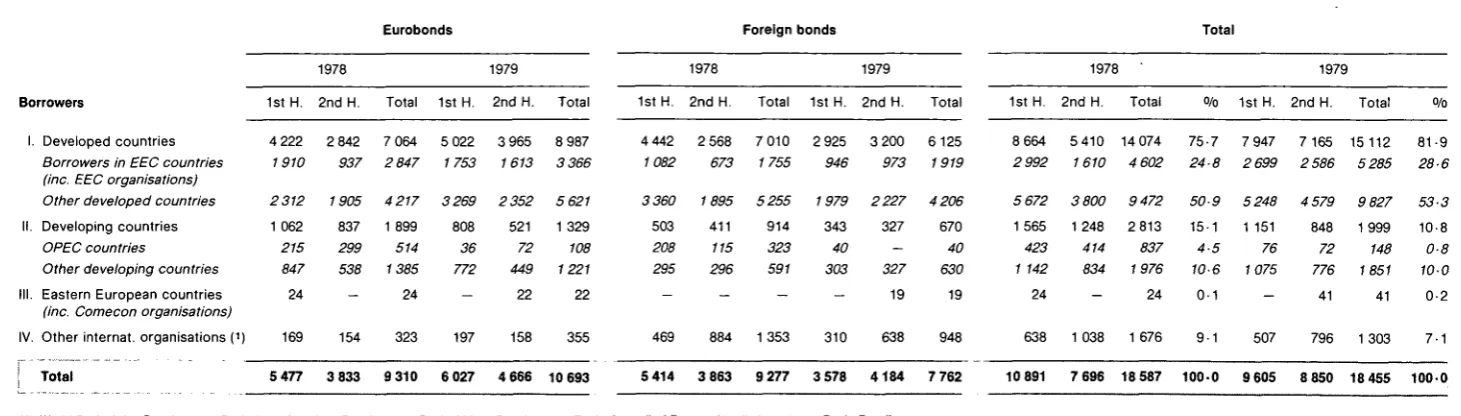
Table 2 : E u r o b o n d and foreign b o n d issues classified a c c o r d i n g t o borrower (million EUA)
Eurobonds
Borrowers
I. Developed countries Borrowers in EEC countries (inc. EEC organisations) Other developed countries li. Developing countries
OPEC countries
Other developing countries III. Eastern European countries
(inc. Comecon organisations) IV. Other internat, organisations (')
I Total
1978 1979
1st H. 2nd H. Total 1st H. 2nd H. Total
4 222 2 842 7 064 5 022 3 965 8 987 1910 937 2 8 4 7 1753 1613 3 3 6 6
2 3 1 2 1 062
215 847 24
169
1905 4 217 3 2 6 9 2 3 5 2 5 621 837 1 899 808 521 1 329 299 514 36 72 108 538 1385 772 449 1221
- 24 - 22 22
154 323 197 158 355
5 477 3 833 9 310 6 027 4 666 10 693
Foreign bonds Total 1978 1979
I s t H . 2nd H. Total 1st H. 2nd H. Total
4 442 1082
3 3 6 0 503 208 295
469
2 568 7 010 2 925 3 200 6125
673 1755 946 973 1919
1895 5 2 5 5
411 914
115 323 296 591
884 1 353
1979 2 2 2 7
343 327
40
303 327
19
310 638
4 2 0 6
670
40
630
19
948
5 414 3 863 9 277 3 578 4184 7 762
CD (i| World Bank, Asian Development Bank, Inter-American Development Bank, African Development Bank, Council of Europe, Nordic Investment Bank, Eurofima. Source; EIB
1978 1979
1st H. 2nd H. Total 0/0 1st H. 2nd H. Total
8 664 2 9 9 2
5 410 14 074 1 610 4 602
5 6 7 2 3 800 9 4 7 2 1 565 1 248 2 813
423 414 837 1 142 834 1976
24 - 24
638 1 038 1 676 75 24 50 15 4 10 0
7 7 947 7 165 15 112 8 2 6 9 9 2 5 8 6 5 2 8 5
9 5 2 4 8 4 5 7 9 9 827
1 1 151 848 1999
5 76 72 148
6 1075 776 1851
1 - 41 41
507 796 1 303
0/0 81-9 28-6 53-3 10-8 0-8 1 0 0 0-2
7-1
[image:9.833.57.788.302.510.2]between March and May. The year saw the lifting of two important limitations on the participation by non-residents in the Swiss capital market. The first of these was the lifting of the 50 % restriction on the proportion of new issues which could be bought by non-residents and the second was the phased elimination of the negative interest rate of 10% per quarter imposed on foreign-held bank deposits over Sfrs 100 000 which had been imposed since 1975. A similar lifting in May 1979 of the 25 % limitation in non-resident sub-scriptions to bond issues on the Ja-panese market, the so-called 'Sa-murai' Issues, was less successful in reviving foreign demand for these securities. Other measures that had been adopted earlier in the year by the Japanese of abolishing the 100 % reserve requirement against foreign-held bank deposits and the relaxation of rules governing the pur-chase of domestic Japanese bonds by non-residents had done little to strengthen the market which was having difficulty in absorbing a sub-stantial volume of Japanese Government securities. Foreign investors remained hesitant about purchasing Yen securities, largely because a deterioration in the exter-nal trade balance had led to a weakening of the exchange rate. As a result of the lack of investment demand, many potential borrowers postponed or withdrew their operations and the total raised in 1979 fell to the equivalent of 1 229 million EUA from 2 740 million the previous year. Included in these amounts are euro-yen issues which in 1979 came to 86 million EUA, consisting of one issue each by the EIB and Eurofirma.
The Canadian dollar sector of the eurobond market re-opened in May 1979 following upon a firming of the exchange rate for the currency. The latter feature combined with a higher structure of interest rates than avail-able in the US dollar sector helped to attract investors. New issues, all by Canadian entities, amounted to the equivalent of 310 million EUA before activity was halted in early October by a fresh weakening of the currency. Issues on behalf of Euro-fima, the EIB and the Inter-Ameri-can Development Bank during November and December 1979 ac-counted for the equivalent of 68 million EUA raised in the Austrian Schilling sector of the eurobond market.
[image:10.589.245.546.69.433.2]The main features of operations denominated in Kuwaiti dinars in 1979 were the widening of the range of investors to beyond those in Middle-Eastern countries and the Increased proportion of issues made by first-class names in industrial countries.
Table 3: Total International financing through public Issues of eurobonds, foreign bonds and syndicated credits, classified according to borrowers
(million EUA)
Eurobonds Foreign bonds Total bonds Syndicated credits TOTAL
BORROWERS Developed countries Borrowers in EEC countries
(incl. EEC organisations) Other developed countries
Developing countries OPEC countries Other developing countries Eastern European countries (incl. Comecon organisations)
Other international organisations Unallocated TOTAL
I s t H . 5 477 5414 10 891 23 772 34 663
18 114 6635
11479 14 215 4 625 9 590 1381
638 315 34 663
1978 2ndH.
3833 3 863 7 696 28 566 36 262
16 966 8 457
8 509 16 769 4111 12 658 1316
1 157 54 36 262
Total 9 310 9 277 18 587 52 338 70 925
35 080 15 092
19 988 30 984 8 736 22 248 2 697
1795 369 70 925
0/0
13-1 13-1 26-2 73-8 100-0
49-5 21-3
28-2 43-7 12-3 31-4 3-8
2-5 0-5 100-0
I s t H . 6 027 3 578 9 605 22 271 31876
13 452 6605
6 847 15 519 2644 12 875 2125
598 182 31876
1979 2ndH.
4 666 4184 8850 32 796 41646
15 694 7318
8 376 23 768 3 362 20406 1237
905 42 41646
Total 10 693
7 762 18 455 55 067 73 522
29146 13 923
15 223 39 287 6 006 33 281 3 362
1503 224 73 522
0/0
14-5 10-6 25-1 74-9 100-0
39-6 18-9
20-7 S3-4 8-1 45-3 4-6
2-1 0-3 100-0 Sources: see Tables 1. 2 and 4.
However, the sharp rise In short-term interest rates from early October onwards led to the suspension of issuing activity and as a result new Issues In 1979 reached no more than the equivalent of 294 million EUA compared with 333 million EUA in 1978. <·
Among unit of account operations, two Issues by the Nordic Investment Bank, the capital and accounts of which are denominated in Special Drawing Rights, and one by Finland were made in SDR. A modest but steady flow of finance continued to be provided by the sector operating in European Units of Account (not the currency basket EUA in which the statistics in this article are presented but a unit which provides exchange options in Community currencies). The c o u n t r i e s of b o r r o w e r s
In the uncertain conditions which pre-vailed for a large part of 1979 investors turned increasingly towards securities issued by first-class names. This tendency inevitably fa-voured borrowers located In developed countries more than
others. The percentage of public issues of eurobonds and foreign bonds accounted for by borrowers in developed countries, which had
re-mained more or less stable at 76 % during 1977 and 1978, rose to nearly 82% in 1979. Within this group, issu-ers within the EEC moved up from 24-7 % in 1978 to 28-6 % in 1979, or rather faster than the rest. Otherwise US borrowers increased their share, partly because of the launching of the 'Carter bond' issues on the German domestic market.
Public bond issues by non-OPEC developing countries declined moderately last year by 125 million EUA to 1 851 million. Nearly half the funds raised were on behalf of only four countries, Argentina, Brazil, Israel and the Philippines, thus illus-trating the narrowness of the range of developing countries that have access to bond markets.
On the other hand, OPEC countries which had more than doubled their offtake from capital markets to 837 million EUA in 1978 reduced their borrowings to only 148 million EUA last year. As the only OPEC countries which borrow regularly on bond markets, Venezuela and Algeria, had benefited substantially from the rises in petroleum prices, their borrowing needs were much reduced.
International organisations other than those of the EEC borrowed the
equivalent of 1 303 million EUA in 1979 by means of public bond issues or 373 million less than in the prev-ious year.
Syndicated loans
A slight firming in the terms of borrowing towards end-year
At the beginning of 1979 the ample liquidity in the hands of international banks ensured that borrowers who approached International banking syndicates for roll-over credits continued to be offered terms that were easy in relation to their credit standing. Not only were Japanese banks very active lenders during the first half of the year but US banks which, during the latter part of 1978, had been reluctant to countenance the further narrowing of margins in loans to borrowers in developed countries, returned to the market in 1979 in order, so it would seem, to protect their share of the market from erosion.
By the third quarter of the year, however, a number of the smaller banks began to feel themselves
seriously squeezed by the narrowing of margins, particularly on loans granted to borrowers in developing countries which carried a higher risk. At the end of 1978 margins on loans to borrowers in industrialised coun-tries had ranged between 0 - 5 % and 0-625% but these fell by about 0-125 % during the first nine months of 1979. During the same period, margins on loans granted to bor-rowers in developing countries were reduced even further and as a result the gradation of margins according to risk became harder to establish. Greek and Spanish borrowers, for example, were charged a margin of 0 - 5 % on ten-year loans while a twelve-year loan to the Malaysian Government also bore a margin of 0-5 % for its first ten years, although for the final two years the margin rose to 0-625%.
It was also during the third quarter that interest rates on short-term euro-dollar deposits began to rise steeply under the influence of a tightening of monetary policy in the USA and a corresponding reduction of liquidity in the international market. Under these conditions multiple-tier inter-bank interest rates began to develop and the smaller members of internati-onal banking syndicates found it In-creasingly difficult to secure the re-sources needed at a cost which enabled them to associate with larger banks in granting credits.
In October, at more or less the same time that smaller banks began to withdraw from the market in
syndicated loans, the Japanese auth-orities found themselves obliged by a serious deterioration in the country's balance of payments to restrict more severely the participation of Ja-panese banks in such loans. The existing practice of imposing a limit of 25 % on the participation of Ja-panese banks in internationally syndicated loans was replaced by a requirement that the banks seek the Minister of Finance's approval for each operation. As such approval tended to be given only where the loans contained an element of buyer credit tied to Japanese exports, the banks found themselves mostly barred from participating in what had become a normal line of business. These developments tended to halt the shrinking of interest margins which had continued virtually without interruption since early 1977. On the other hand, there has been no clear indication that margins are about to widen again; but there has been a tendency for the term to final re-payment of international credits to shorten by perhaps an average of two years.
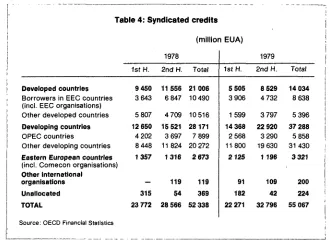
The countries of the borrowers The greatest growth in internationally syndicated credits in 1979 was, encouragingly, in lending to non-OPEC developing countries. The in-crease in such lending, from the equivalent of 20 272 million EUA in 1978 to 31 430 million EUA in 1979, was mostly attributable to higher borrowing by Mexico, China and Turkey. Mexico raised the equivalent of 7 375 million EUA in 1979, 2 868 million more than in the previous year; although not a member of OPEC, Mexico is an oil-exporting country and the external borrowing
was mostly on behalf of the national oil enterprise, Pemex. China resorted to borrowing on euromarkets for the first time in 1979 and the equivalent of 2 500 million EUA that it secured more than covered its external trade deficit. Turkey Increased its borrowing from the equivalent of 200 million EUA in 1978 to 2 300 million in 1979 largely in connection with the refinancing of the country's short-term external debt over seven years. The only other group of countries to increase its borrowing in 1979 was that of Eastern Europe. However, difficulties In obtaining the favourable terms to which they were ac-customed tended to dampen the demand for credit and loans obtained rose in 1979 by about a quarter or the equivalent of 648 million EUA. Borrowing by international organ-isations outside the EEC rather less than doubled to the equivalent of 200 million EUA which consisted of two loans obtained by the African Development Bank, a regular bor-rower in this market since 1975. The OPEC countries, as a group, re-duced their borrowing in the form of syndicated credits in 1979 by the equivalent of about 2 000 million EUA to 5 860 million. The current account surpluses of OPEC countries have risen dramatically with the rise in the price of oil but some of them such as Algeria, Indonesia, Nigeria and Venezuela continued to rely heavily on external finance for their national development programmes.
[image:11.584.195.524.530.780.2]The biggest reduction, however, was in borrowing by industrialised coun-tries, with the UK and Canada (both oil producers) accounting for nine tenths of the total fall of nearly 7 000 million EUA. France, Italy and Ireland
Table 4: Syndicated credits (million EUA)
Developed countries Borrowers in EEC countries (incl. EEC organisations) Other developed countries Developing countries OPEC countries
Other developing countries Eastern European countries (incl. Comecon organisations) Other international
organisations Unallocated TOTAL
1st H. 9 450 3 643 5 807 12 650 4 202 8 448 1357
315 23 772
1978 2ndH. 11556 6 847 4 709 IS 521 3 697 11824 1316
119 54 28 566
Total 21006 10490 10 516 28 171 7 899 20 272 2 673
119 369 52 338
IstH.
5 505 3 906 1599 14 368 2568 11800 2125
91 182 22 271
1979 2ndH.
8 529 4 732 3 797 22 920 3 290 19 630 1 196
109 42 32 796
Total 14 034
8638 5 396 37 288 5 858 31430 3321
200 224 55 067
on the other hand resorted to borrowing on an increased scale; and Belgium which borrowed very little In 1978 secured the equivalent of 725
million EUA by means of an eight-year loan agreement concluded by
the Government in December 1979.
(Continued from page 1 )
Government, meeting In Rome as the European Council, called for mobilisation of greater Community financial resources to combat
unemployment and counter sluggish investment and lack of convergence in national economic performances. Roughly half the total of Bank lending within the Community, since it began ope-rations in 1958, has been carried out in these last three years (see page 3).
If anything, the ElB's tasks will become even more important over the next decade.
Regional development: since 1958 the EIB has given constant priority to helping development of the less-advanced regions of the Community. This work has been complicated by the recession and abrupt structural changes which have underlined the fragility of some of the gains made during past years (unemployment being only one indicator) and put at risk the economies of certain regions considered hitherto as pros-perous. Enlargements to the Community will introduce many less developed areas and widen the disparities between the Community's richest and poorest regions.
Common interest: the ElB's second major task — financing investment of common interest to several Member Countries or the Community as a whole — centres at present on energy, i. e. helping
to finance a wide range of projects which help to cut dependence upon oil imports, but under the same 'common interest' heading the Bank will seek to increase support for industrial cooperation between enterprises from different Mem-ber Countries, for development of European capacities in high technology fields, improved com-munications and environmental protection.
Industrial modernisation and conversion: re-equipment and higher productivity represent the only path forward for a number of basic industries which have seen brutal changes In their market prospects.
Outside the Community, the EIB will be called upon to continue expanding development finance in countries which have negotiated cooperation agreements with the EEC: 58 African, Caribbean and Pacific states under the second Lomé Convention and most of the countries surrounding the Med; iterranean.
In presenting these activities In future issues, we hope that EIB-Information will continue to make a useful contribution to under-standing of the life and activities of the European Community. Articles, or extracts, may be reproduced at any time, although the Bank appreciates an ack-nowledgement.
Personalia
On 1 February 1980, Mr. Eugenio GREPPI succeeded Mr. Henri LENAERT as .Secretary-General of the European Investment Bank.
Mr. LENAERT, who was born in Louvain on 3 January 1915, has now reached retirement age, but is to remain with the Bank for the time being as a Special Adviser to the Management Committee. It was In September 1962 that he joined the Bank as Manager of the General Administration Department, serving in both this capacity and that of Secretary-General. He began his pro-fessional career in Belgium with the Banking Commission, working between 1942 and 1946 with the Bank Examiners Depaftment, before becoming a Bank Auditor (1946—1950) and subsequently serving the Banque Centrale du Congo Belge et du Ruanda-Urundi (1950—1960) as Manager, later taking charge of its winding-up. Mr. Lenaert is also a special Director of Studies at the Catholic University of Louvain.
Mr. GREPPI, born in Milan on 23 August 1931, holds a Doctor's Degree in Law from the University of Florence and a Diploma in Advanced European Studies from the College of Europe in Bruges. He joined the staff of the EIB shortly after its foundation in 1958, serving in the Legal Department for the first ten years. In 1969, Mr. Greppi was appointed Deputy Manager of the Department for Operations outside the Community, with special responsibility for Bank activity In the Mediterranean countries. He was appointed Deputy Secretary-General in 1978.
The international capital market as described In this article experienced a check to its growth in 1979. For this the successive Increases in petroleum prices which followed from the OPEC meeting In June and re-awakened fears that very high rates of inflation might again develop must bear a large share of the responsibility. The counter-measure against inflation adopted by most national authorities of tightening monetary policy had a dampening if not restrictive effect upon borrowing operations generally through the steep uptrend in interest rates which developed from mid-year onwards. At one time interest rates were rising so rapidly that even floating-rate securities fell to discounts on the secondary market because of the three or six months' Interval between interest rate revisions. Certainly new issues for the conversion of older, high-yielding fixed-interest securities which were a feature of 1978 virtually disappeared last year.
It was evident from the failure of bond markets to expand and the modest increase in internationally syndicated credits that the higher current ac-count surpluses of oil exporting coun-tries (which according to some pre-liminary estimates may have been seven times higher In 1979 than in the previous year) were by no means all finding their way back to active employment on capital markets. The main Indication of an underlying change In the position of OPEC coun-tries was a reduction in their bond issues and in their borrowing from international banking syndicates.
EIB-INFORMATION Is published perio-dically by the European Investment Bank In six different languages (Da-nish, Dutch, English, French, German and Italian.)
Material whicti appears in EIB-INFOR-MATION may be freely reproduced; an acknowledgement would be apprecia-ted and also a clipping of any article pu-blished.
2, Place de Metz — Boite postale 2005 Luxembourg
tel. 4350 11 — telex 3530 bankeu lu Department for Italy: 38, Via Sardegna, 00187 Rome tel· 483651 — tetex 611130 bankeu i
Representative Office in Brussels: 227, Rue de la Loi
B-1040 Brussels
tel· 73521 38 — telex 21721 bankeu b Liaison Office forthe United Kingdom:
23, Queen Anne 's Gate, Westminster, London SWIH 9BU
tel. 222 2933 —- telex 919159 bankeu g
Printed In Germany by Saarbrücker Zeltung, Druckerei und Verlag GmbH, GutenbergstraBe 1 1 - 2 3 , 6600 Saarbrücken