TISSUE MOBILIZATION OF HAMSTRING FLEXIBILITY IN
HEALTHY SUBJECT
A Dissertation Submitted to
THE TAMILNADU Dr. M.G.R. MEDICAL UNIVERSITY
CHENNAI
in partial fulfillment of the requirements for the award of the
MASTER OF PHYSIOTHERAPY
(ADVANCED PHYSIOTHERAPY IN ORTHOPAEDICS)
DEGREE
Submitted by
Reg. No.27102002
NANDHA COLLEGE OF PHYSIOTHERAPY
ERODE-638052
The dissertation entitled
“A STUDY TO DETERMINE THE EFFECT OF DYNAMIC SOFT
TISSUE MOBILIZATION OF HAMSTRING FLEXIBILITY IN
HEALTHY SUBJECT”
Submitted by
Reg.No.27102002
Under the Guidance of
Prof.V.MANIVANNAN,M.P.T(Ortho)
A Dissertation submitted to
THE TAMILNADU M.G.R.MEDICAL UNIVERSITY
CHENNAI
Dissertation evaluated on ---
CERTIFICATE BY THE HEAD OF THE INSTITUTION
This is certify that the dissertation entitled
“A STUDY TODETERMINE THE EFFECT OF DYNAMIC SOFT TISSUE
MOBILIZATION OF HAMSTRING FLEXIBILITY IN
HEALTHY SUBJECT
” is a bonafide compiled work, carried out by Register No. 27102002, Nandha College of Physiotherapy Erode – 638 052,in partial fulfillment for the award of Degree in Master of Physiotherapy as
per the doctrines of requirements for the degree of the TAMILNADU
DR.M.G.R. MEDICAL UNIVERSITY CHENNAI – 32. This work was
guided and supervised by Prof.V.MANIVANNAN M.P.T (ORTHO)
PRINCIPAL
NANDHA COLLEGE OF PHYSIOTHERAPY
CERTIFICATE BY THE GUIDE
This is to certify that the dissertation entitled “A STUDY TO
DETERMINE THE EFFECT OF DYNAMIC SOFT TISSUE
MOBILIZATION OF HAMSTRING FLEXIBILITY IN
HEALTHY SUBJECT
” submitted by (Reg No. 27102002) is a record of original and independent work done by the candidate during the period ofstudy under my supervision and guidance. The dissertation represents
entirely an independent work on the part of the candidate but for the general
guidance by me.
Guide
Prof.V.MANIVANNAN, M.P.T(Ortho) The Principal,
Nandha College of Physiotherapy
Erode-638052
I thank GOD almighty who laid the foundation for knowledge and
wisdom and who has always been in his source of strength and inspiration
and who guide me throughout.
I am grateful to our principal Prof.V.MANIVANNAN, M.P.T.,
M.I.A.P., for granting me permission to do this dissertation in our
institution.
I extend my sense of gratitude to my guide Prof.V.MANIVANNAN
M.P.T., M.I.A.P., Nandha College of Physiotherapy for his valuable
suggestion, exquisite guidance and constant encouragement throughout the
duration of my dissertation.
I also extend my sincere thanks to our my staffs Prof. R.
Manikandan, MPT(Sports)., Prof. Sirvanan, MPT(Cardio)., Dr.Sabiya.,
MPT(Neuro) who sowed the seed of interest in me to complete this project.
I am also thankful to my biostatistics lecturer Mr.K.DHANAPAL
M.Sc, who helped me a lot in the field of research methodology.
I am also thankful to my friends and colleagues for their cooperation
and suggestions even in between their busy schedule.
Last but not least I thank all the subjects participated in this study for
CHAPTER-I TITLE PAGE NO.
INTRODUCTION 1
Introduction
Operational definitions
Need for the study
Statement of problem
Objectives of the study
Hypothesis
- Null Hypothesis
- Alternate Hypothesis
Assumption
CHAPTER-II REVIEW OF LITERATURE 5
CHAPTER-III MATERIALS AND METHODOLOGY 9
Study Design
Study Setting
Criteria for selection of samples
Materials
Parameters
Variables
Procedures
Statistical analysis
CHAPTER IV DATA PRESENTATION 16
CHAPTER V DATA ANALYSIS AND
INTERPRETATION
21
CHAPTER VI RESULTS 23
CHAPTER VII DISCUSSION 24
CHAPTER VIII LIMITATION 27
CHAPTER IX RECOMMENDATION 28
CHAPTER X CONCLUSION 29
REFERENCES 31
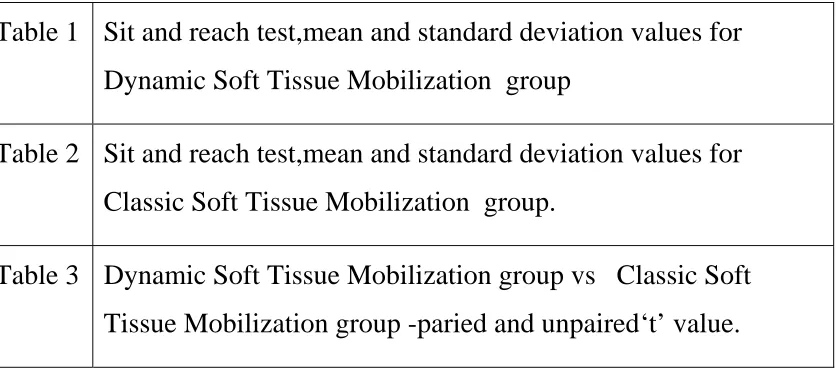
LIST OF TABLES
Table 1 Sit and reach test,mean and standard deviation values for
Dynamic Soft Tissue Mobilization group
Table 2 Sit and reach test,mean and standard deviation values for
Classic Soft Tissue Mobilization group.
Table 3 Dynamic Soft Tissue Mobilization group vs Classic Soft
[image:8.612.94.512.209.394.2]LIST OF GRAPHICAL PRESENTATION
GRAPH.NO LIST OF GRAPHICAL PRESENTATION PAGE.NO.
Graph 1
Graphical presentation of mean of Dynamic
Soft Tissue Mobilization and Classic Soft
Tissue Mobilization.
18
Graph 2
Graphical presentation of Standard deviation
values of Dynamic Soft Tissue Mobilization
and Classic Soft Tissue Mobilization.
19
Graph 3
Graphical presentation of Paired and
unpaired‘t’ test values of Dynamic Soft Tissue
Mobilization and Classic Soft Tissue
Mobilization.
I. INTRODUCTION
Physical therapists all over the world have been conducting newer
trials and have used many different methods to increase joint range of
motion and maintain it.
Techniques commonly used by to increase flexibility include static
and ballistic stretching as well as PNF. Recent literatures have indicated that
stretching does not provide significant benefits.
The effectiveness of massage on resting muscle flexibility has not
been extensively researched. However several studies investigated use of
massage as treatment of delayed onset of muscles soreness
A dynamic deep muscle tissue model was developed to treat patient
with muscle tightness and associated soft tissue problems. The dynamic deep
muscle tissue technique consists of series of progression from traditional to
dynamic techniques which concentrated on one specific area of muscle
tightness. Clinical experiences suggest that dynamic deep muscle tissue
model is an efficient pain free intervention that appears to have an
1. OPERATIONAL DEFINITION
1. DYNAMIC SOFT TISSUE MOBILIZATION
Dynamic Soft Tissue Mobilization is a relatively recent development
in manual therapy in which if combines with therapist delivered manual
treatment a number of different features such as joint, soft tissue positioning
and movements involving either concentric or eccentric movement.
2. HAMSTRING MUSCLE
Of is a knee flexor and a hip extensor which appears as a bulk of
muscle in the back of the thigh.
It consist of
1. Biceps femoris
2. Semitendinous
3. semimembranous
3. FLEXIBILITY AND FLEXIBILITY TRAINING PROGRAME
Flexibility is defined as the ability of a muscle to elongate. Flexibility
training is generally acceptable as important aspect of individual
2. NEED FOR THE STUDY
Flexibility is important not only for successful physical performance
but also in prevention of injuries. In many situation a muscle is forced to
stretch beyond its normal active limits. If the muscle does not have enough
elasticity to compensate for this additional stretch the musculo-tendonous
units may be injured. The physical therapist have used many different
therapeutic methods to maintain and increase joint range of motion by
altering the extensibility of musculo-tendonous units that produce movement
in a joint and to prevent deformities and dysfunction resulting from injuries.
In order to find the effect of dynamic soft tissue mobilization in
increasing hamstring flexibility and its effects compared with classic soft
tissue mobilization this study was conducted.
3. STATEMENT OF PROBLEM
“Effect of dynamic soft tissue mobilization on hamstring flexibility in
healthy subjects”.
4. OBJECTIVES OF THE STUDY
To increase hamstring flexibility by means of
1. Dynamic soft tissue mobilization technique
5. HYPOTHESIS
1. Null hypothesis
There is no significant different between the effect of dynamic soft
tissue mobilization technique verus classic soft tissue mobilization technique
to improve hamstring flexibility in healthy subject.
2. Alternate hypothesis
There is significant different between the effect of dynamic soft tissue
mobilization technique verus classic soft tissue mobilization technique to
improve hamstring flexibility in healthy subject.
6. ASSUMPTION
The study had been conducted assuming both dynamic soft tissue
mobilization and classical soft tissue mobilization technique will have an
II. REVIEW OF LITERATURE
1. Diana Hopper et al [2003] conducted a study on evaluation of effect of
two massage technique on exercising hamstring muscle length. She
concluded that dynamic soft tissue mobilization had an immediate
significant effect on hamstring muscle length in competitive female field
hockey players.
2. D. Hopper. S Deacon concluded that dynamic soft tissue mobilization
increase hamstring flexibility. Journal of sport medicine [2005]
Volume : 39, issue : 9 page 594-598
3. Alison Ruston, Simon Spencer concluded effect of dynamic soft tissue
mobilization on flexibility and passive resistant in the hamstring muscle.
Published online 03 Nov [2010].
4. Barlow A, Clarke R, Johnson, effect on massage of the hamstring
muscle group on performance of the sit and reach test Br J sport medicine
5. Elizabeth Quinn, concluded that sit and reach is a simple measure of
lower back and hamstring flexibility Nov 20, [2008] all about.com.health
(medical review board @.about.com)
6. J.Brummit concluded that dynamic soft tissue mobilization increase
hamstring flexibility sports phys the V.3 (1) Feb : [2008]
7. C.J. Jones. RE Rikli, J Max [1998] sit and reach test as a measure of
hamstring flexibility in older adults. www.ncbi.nlm.nih.gov pub med.
98 64752
8. PL. Rodrigvaz [2008] conducted a study on hamstring muscle
performance and concluded hamstring flexibility was evaluated through the
sit and reach test.
9. Brandy W D and Irion [1977] examined that 30 and 60 seconds of static
stretching on hamstring flexibility is more effective.
10. Bennel et al [1998] stated that in untrained or weak hamstring muscle
May pre dispose the athlete to injury as this muscle is less able to withstand
11. Clin J Sports medicine [1997] stated that hamstring injury is most
common in football players.
12. Charles Ecodrin [1997] stated that adequate flexibility may help to
prevent muscle strain and such orthopedic problems such as backache and
they also stated that good flexibility may bring about improved athletes
performance.
13. Dr. Ben Kim concluded in his study that chronic low back pain can
improve and end fully heal their back by release hamstring tightness on by
doing stretching their hamstring muscle.
14. Godess JJ et al [2003] concluded that soft tissue mobilization and PNF
was effective for providing immediate improvements in gleno-humeral
internal rotation and reach in patients in shoulder disorders.
15. PoPe R P et al [2000] concluded that a typical muscle stretching
protocol performed during pre exercise warm up does not produce clinically
meaningful reduction of exercise related injury in army recruits.
16. Youdas JW et al [2005] stated that hamstrings flexibility was not
influenced by age. They found that hamstrings length significantly in
17. Worell Jwet et al [1994] conclude that hamstring muscle flexibility was
an effective method for increasing hamstring performance as selective
Isokinetic condition.
18. Rob D Hebert et al [2002] concluded that stretching before or after
exercise does not confer protection from muscle soreness and stretching
before exercise does not seem to confer a practically useful reduction in risk
of injury.
19. D Scott Davis et al [2005] stated that these stretching techniques on
improving hamstring flexibility during a 4 week training program. Here
effectiveness of three stretches using consistent parameters.
20. Erik Witvrouw P T PhD et al [2003] concluded that soccer players
with an increased tightness of hamstrings or quadriceps muscles have a
stretching higher risk for a subsequent musculo skeletal lesion. Hence
increased tightness of hamstrings muscle leads to a risk for a muscle strain
III. MATERIALS AND METHOLOGY
1. STUDY DESIGN
Quasi experimental design study
CONTROL GROUP
This group consist of 15 subject to asses the effectiveness of classic
soft tissue mobilization technique in increasing hamstring flexibility in
healthy subject.
EXPERIMENTAL GROUP
This group consist of 15 subject to asses the effectiveness of dynamic
soft tissue mobilization technique in increasing hamstring flexibility in
healthy subject.
2. STUDY SETTING
1. Nandha College of Physiotherapy
2. Nandha Arts and Science College
3. SELECTION OF SAMPLES
All the students studying in Nandha College was included in this
study. Only 30 student were considered for this study. All the subject were
divided into 2 group of 15 each using convenience sampling
4. STUDY DURATION
2 Months
5 CRITERIA FOR SELECTION OF SAMPLES
1. INCLUSIVE CRITERIA
¾ Hamstring muscle tightness
¾ Sit and reach test positive
¾ Medically stable
¾ Male and females
2. EXCLUSIVE CRITERIA
¾ Recent hamstring injury.
¾ Musculoskeletal and neurological dysfunction.
6. MATERIALS
1. Inch tape and yardstick
2. Sit and reach box
3. Stop Watch
4. Powder
5. Towel
7. PARAMETERS
Sit and reach test
Table interest
8. VARIABLES
Independent variables
In this study the independent variable consists of dynamic soft tissue
mobilization and classical soft tissue mobilization.
Dependent variable
Hamstrings muscle flexibility measured by sit and reach test is
9. PROCEDURES
1. CLASSIC SOFT TISSUE MOBILIZATION
All subjects were positioned with hip and knee in neutral relaxed
position. Each subject received a massage based on traditional Swedish
technique on hamstring muscle group. The specific technique included
effleurage kneading. Picking up and shaking.
The total massage counted of 5 strokes of each of these techniques
and was completed in 5 minutes.
2. DYNAMIC SOFT TISSUE MOBILISATION
Before dynamic intervention subjects received some classic massage
technique with same tissue frame of 5 minutes.
The dynamic intervention was divided into hierarchical progression
which involved assessment and identification of specific area of hamstrings
tightness, the application of reassessment after each technique.
To asses hamstrings muscle group subjects remained in prone position
To execute dynamic intervention subjects was moved into supine with
hip and knee flexed in 90 degrees. In this position all dynamic techniques
worked hamstrings muscle length from 3 quarters to eng range of motion.
Deep longitudinal stokes were applied to proximal directions in the area of
hamstring tightness when the leg was passively moved to hamstrings
lengthened positions. Five stroked were applied and 20 seconds of shaking
was performed at the completion of these technique. The specific area of
hamstring tightness was not reduced the treatment was stopped.
The same sequence was implemented for the most dynamic technique.
During this technique the subject was required to actively extend their leg in
order to achieve reciprocal inhibition of hamstrings. In the final technique
the subject was required to work the hamstring muscle group eccentrically
by creating tension in the therapist hands as muscle was elongated to end
range of motion. During this movement therapist performed 5 distal to
proximal longitudinal strokes over the hamstring area of muscle tightness.
Overall time to complete the combination of both classic and dynamic
10.
STATISTICAL ANALYSIS
To compare the effect of hamstring flexibility student ‘t’ test for
paired value.
d t = N
S
d = Mean
S = Standard deviation (S.D)
N = Number of observation
To compare the effects between two groups. Student ‘t’ test for
unpaired values .
x1 - x2
t =
s 1 1 n1 + n2
(n1 - 1) S1 2
+ (n2 - 1) S2 2
Where S =
n1 + n2 - 2
x1 = Means of dynamic soft tissue mobilization group
s2 = Standard deviation of classic soft tissue mobilization group
n1 = Number of observation dynamic soft tissue mobilization
group
IV. DATA PRESENTATION
1. TABULATION
SIT AND REACH TEST
TABLE – I
DYNAMIC SOFT TISSUE MOBILIZATION GROUP
S.No Pre – Test Post – Test
1 .5 12
2 1.3 10
3 1 15
4 2 20
5 1.5 18
6 2.3 20
7 3.7 25
8 4.3 21
9 3.6 22
10 1.5 19
11 1.2 16
12 0.9 9
13 3.7 27
14 2.1 20
TABLE – II
CLASSIC SOFT TISSUE MOBILIZATION GROUP
S.No Pre – Test Post – Test
1 1.8 7.8
2 1 10
3 2 15
4 1.6 18
5 1.2 16
6 3.9 20.4
7 2.6 12
8 2.1 16
9 3.5 24
10 3.5 19.5
11 0.8 10
12 2.4 13
13 1.3 10.5
14 2.8 21
15 2.5 15.2
Table I Table II
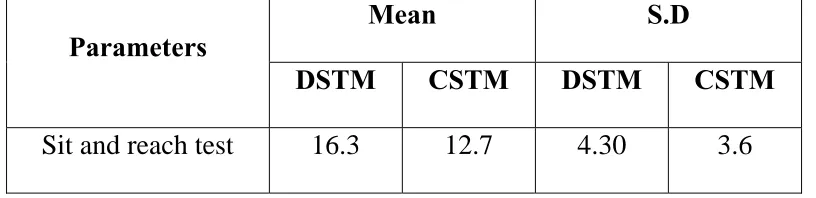
Mean = 16.3 Mean = 12.7
S.D = 4.30 S.D = 3.6
Paired t test value = 14.4 Paired t test value = 13.4
GRAPHICAL PRESENTATION OF MEAN
OF DSTM OF CSTM
16.3
12.7
0 2 4 6 8 10 12 14 16 18 20
GRAPHICAL PRESENTATION OF S.D OF DSTM AND CSTM
4.30
3.6
0 1 2 3 4 5 6 7
GRAPHICAL PRESENTATION OF PAIRED AND
UNPAIRED T VALUE OF DSTM AND CSTM
14.4
2.57 13.4
0 0
2 4 6 8 10 12 14 16
Paired t unpaired t
DSTM
V. DATA ANALYSIS AND INTERPRETATION
This chapter deals with the analysis and interpretation of data in
collected from the group dynamic soft tissue mobilization and classic soft
tissue mobilization to compare their effectiveness in improving hamstring
[image:30.612.104.512.336.435.2]flexibility collected data were analyzed and tabulated below.
TABLE I
DSTM VS CSTM MEAN AND STANDARD DEVIATION VALUES
Parameters
Mean S.D
DSTM CSTM DSTM CSTM
Sit and reach test 16.3 12.7 4.30 3.6
TABLE II
DSTM VS CSTM PAIRED AND UNPAIRED T VALUE
Parameters
Paired t value
Unpaired t value DSTM CSTM
The table shows the value of paired and unpaired t value of the
parameters that was used to assess the hamstring flexibility calculated ‘t’
VI. RESULTS
¾ The results obtained from statistical analysis indicate that there was an
improvement in dynamic soft tissue mobilization in hamstring flexibility.
¾
The increase hamstring flexibility was seem in all subject receiveddynamic soft tissue mobilization group and classic soft tissue
mobilization.
¾
By analyzing the mean values, the results showed the subjects whoreceived dynamic soft tissue mobilization are found to be more effective
in improving the hamstring flexibility then classic soft tissue
mobilization
¾
By analyzing the value of standard deviation the result showed asignificant increase in the subject received dynamic soft tissue
mobilization than those who received classic soft tissue mobilization.
¾
The student t test results shown that dynamic soft tissue mobilization inmore reliable than classic soft tissue mobilization in improving the
VII. DISCUSSION
This project is the documentation of the effect of Dynamic soft tissue
mobilization on hamstring flexibility in healthy subjects.
A total of 30 students were selected for this study, each using
convenience sampling techniques. All the 2 groups were identical before the
application of the selected experimental treatments since the obtained t -
values are statistically insignificant
During this study, dynamic soft tissue mobilization technique to
group-I and classic soft tissue mobilization technique to group-II with an
expectation to see whether there is any difference in the outcome measures.
In this study compared the pre-treatment and pos-treatment values of
group-I, the results indicated that there is a significant difference in the sit
and reach test in the treatment outcome as shown by the t - value. This
Further, when comparing the pre-treatment and post-treatment values
of group-II, there is a significant difference in the Hamstring flexibility
which is measured by sit and reach test as shown by obtained t-value. This
result consistent with the previous studies by Hooper D. et al (2005)
When comparing the post treatment values of group-I and group-II,
subjects in group-I showed significant improvement in the Hamstring
flexibility which is measured by sit and reach test as shown by obtained
t-values (table-IV) this result is consistent with the previous studies done by
Hooper D et al (2005).
This study found that subject who received dynamic soft tissue
mobilization achieved significantly greater increase in hamstring flexibility
than subject who received only classic soft tissue mobilization.
This study demonstrated that a significant increase in hamstring
length could be achieved by identifying a specific area of tightness and
The significant improvement in hamstring flexibility in the subjects
who received dynamic soft tissue mobilization technique may be due to
1. The dynamic soft tissue moblilzation was 3 minutes longer in duration
than the other two interventions. The extra 3 minutes of massage may
have influence the results.
2. In the dynamic soft tissue moblilzation compound the hamstring
muscle growth receives progressive dynamic techniques that work in
synchrony as the muscle moves to the end ROM. The dynamic soft
tissue moblilzation technique eccentrically works the muscle at its
functional lengths with the result that hamstring flexibility is
optimized.
3. Dynamic STM is a specific structured technique in which the therapist
identifies a target area of muscle tightness and focuses the treatment
on that specific area while moving it longitudinally under the different
VIII. LIMITATION
¾ This study is a small sample study confined to a small number of patient
which limits generalization.
¾ The study in conducted over a shorter period of time. The duration of the
study was only 2 months.
¾ This study demonstrated a significant short term effect on hamstring
muscle flexibility but longer term effect need to be established over
IX. RECOMMENDATION
¾
A similar study can be performed on patient population¾
A similar study can be performed with large sample size¾
A similar study can be performed for the large duration with follow up¾
A similar study can be performed to other muscle groups too.¾
For hamstring flexibility in healthy subject. Dynamic soft tissuemobilization can be used as an effective technique to improve muscle
X. CONCLUSION
Massage in often viewed as a time consuming and a non specific
treatment option in clinical practice. The improvements in hamstring
flexibility in response to dynamic soft tissue mobilization were achieved
with every little additional treatment time compared to classic soft tissue
mobilization.
The positive outcome of this study in consisted with anaedotal reports
on the benefits of dynamic soft tissue mobilization in clinical setting. The
unpaired ‘t’ test was used to compare the effectiveness of treatment between
two groups.
Based on the statistical analysis there was significant difference in the
treatment efficacy in dynamic soft tissue mobilization than Classic soft
tissue mobilization.
We here reject the null hypothesis and accepting the alternate
by the treatment technique between dynamic soft tissue mobilization and
classic soft tissue mobilizationgroup.
So it was concluded that dynamic soft tissue mobilization technique in
more effective in improving the hamstring flexibility than classic soft tissue
REFERENCES
1. GLEIM GW, MS HUGH MP,flexibility and its effect on sports
injury and performance – sports medicine 1997.
2. MEMMINGS B physiological, psychological and performance effect
of massage therapy in sports – physical therapeutic sports 2001.
3. HUNTER G. specific soft tissue mobilization in management of soft
tissues dysfunction.
4. BARLOW A. effect of massage on hamstring muscle group on
performance of sit and reach test – physical therapeutic sports 2004.
5. ROBERTSON A. effect of leg massage in recovery from high
intensity cycling exercise – physical therapeutic 2004.
6. WILSON G. The relation between stiffness of musculature and static
flexibility.
7. TIDUS P.Manual massage and recovery of muscle function following
exercise; J Orthopetic sports physical therapeutic medicine.
8. HOPPER et al.,concluded significant increase in hamstring flexibility after performing the dynamic soft tissue mobilization program when
APPENDIX
MEN WOMEN
cm Inches cm inches
SUPER > + 27 > + 10.5 > + 30 > + 11.5
EXCELLENT +17 to + 27 + 6.5 to + 10.5 + 21 to + 30 + 8.0 to 11.5
GOOD + 6 to + 16 + 2.5 to + 6.0 + 11 to + 20 + 4.5 to7.5
AVERAGE 0 to + 5 0 to 2.0 -1 to + 10 + 0.5 to + 4.0
FAIR -8 to -1 -3.0 to – 0.5 -7 to 0 -2.5 to 0
POOR -20 to -9 -7.5 to 3.5 -15 to 8 - 6.0 to -3.0
SIT AND REACH TEST
SIT AND REACH BOX
ASSESSMENT CHART
SUBJECTIVE ASSESSMENT
Name :
Age :
Sex :
Occupation :
Chief complaint:
Present medical history:
Past medical history:
Family history:
Personal history:
Socioeconomic status:
Psychological history:
Associated medical problem:
History of pain:
Onset :
Duration :
Nature of pain :
Aggravation factors :
Relieving factor :
Side :
Site :
INTENSITY OF PAIN BY VAS
0 1 2 3 4 5 6 7 8 9 10
↓ ↓ ↓ ↓ ↓ No pain Moderate pain Severe pain
VITAL SIGNS
BP :
HR :
RR :
T0 :
ON OBSERVATION
Built :
Swelling :
Gait :
ON PALPITATION
Tenderness :
Spasm :
Muscle wasting :
Warmth :
ON EXAMINATION
Muscle tone :
ROM :
Muscle power :
INVESTIGATION
PROVISIONAL DIAGNOSIS
PT MANAGEMENT