JOURNALOFVIROLOGY, Dec. 1993,p.7215-7222 0022-538X/93/127215-08$02.00/0
CopyrightX) 1993,AmericanSociety for Microbiology
Three Different Cellular Proteins Bind
to
Complementary Sites
on
the 5'-End-Positive
and
3'-End-Negative Strands
of
Mouse Hepatitis Virus
RNA
TETSUYA FURUYA1 ANDMICHAELM. C. LAII,2*
HowardHughesMedical Institute2 and Department of Microbiology,'*School ofMedicine,
University
of Southern California,
LosAngeles, California
90033-1054Received 4 June1993/Accepted 10 September 1993
The termini of viral genomic RNA and its
complementary
strandareimportantinthe initiation of viral RNA replication, which probablyinvolvesbothviral andcellularproteins. Todetect the possiblecellularproteinsinvolved in the replication ofmouse hepatitis virus RNA, we performed RNA-protein binding studies with RNAs representingboth the5' and 3' ends ofthe viral genomicRNAand the3' end ofthe negative-strand complementaryRNA.Gel-retardationassaysshowedthatboth the5'-end-positive- and 3'-end-negative-strand
RNA formed an RNA-protein complex with cellular proteins from the uninfected cells. UV cross-linking experiments furtheridentifieda55-kDa protein boundtothe5'endofthepositive-strand viral genomicRNA and twoproteins 35 and 38 kDa insize boundtothe3' end ofthe negative-strand cRNA. The results of the
competitionassayconfirmed the
specificity
of thisRNA-protein binding.Noproteinswerefoundtobindtothe3'end of the viralgenomicRNAunder thesameconditions.Thebindingsite of the 55-kDaproteinwasmapped withinthe56-nucleotideregionfromnucleotides 56to112 fromthe 5' end of thepositive-strand RNA, andthe 35- and 38-kDaproteins boundtothe
complementary
regiononthenegative-strandRNA.The38-kDaprotein wasdetectedonlyinDBTcells butwasnotdetectedinHeLaorCOScells, while the 35-kDa proteinwasfoundinall three celltypes.Thejuxtaposition ofthedifferentcellular proteinsonthecomplementarysitesnearthe
ends of thepositive- and negative-strandRNAs suggests that theseproteinsmayinteract witheach other and
playarole in mousehepatitisvirus RNAreplication.
Mouse hepatitis virus (MHV), a coronavirus prototype,
contains apositive-sense single-stranded RNAgenome31 kb
in size (16, 23). In infected cells, the viral genomic RNA is
transcribed into negative-strand RNA (25), which in turn is usedtotranscribeseventoeight mRNAs. These mRNAs have a nested-set 3'-coterminal structure, and the 5' end of each
mRNAcontains a 60- to 70-nucleotide (nt) leadersequence,
which is identical among all the mRNAs andgenomic RNA
(14, 15, 31). It has been shown that the leader RNA is
important for the regulation and initiationoftranscription of
subgenomicmRNAs(2, 14, 30).
The RNAsequencesrequired for the transcriptionof MHV
subgenomicmRNAs include both the5' end of the genomic
RNA(i.e.,theregion containingthe leadersequence)and the
intergenic sequences (i.e., the transcription initiation sites of subgenomicmRNAs[14]).The latterregion requiresasfewas
8 core nt (11, 19), but the sequence in the former region requiredfortranscriptionhasnotbeenprecisely characterized.
The sequence required for the replication of the full-length genomicRNAhas also beenpartiallycharacterized;atleast for
a defective interfering RNA, morethan 800 ntof the 5'-end sequence and400 nt of the 3'-end sequence of the genomic
RNA are required for RNA replication (17). However, the
protein compositionof thetranscriptionorreplication
machin-eries for viral RNAsynthesisislargelyunknown.Presumably, virus-specificRNApolymerase,whichis encodedbygene1 of the MHVgenome(14),isresponsiblefor both the replication
andtranscriptionof MHV RNA. Becauseanantibody specific
for the viralnucleocapsid proteininhibited RNAsynthesis (4),
*Corresponding author.
the nucleocapsid protein may also be a component of the
transcriptionorreplicationmachinery.In viewof themultiple
functions required for viral RNA synthesis, it would not be
surprising that some host cellular factors also participate in
MHV RNAsynthesis.
Studies with other positive-stranded RNA viruses indeed
suggested the possibleinvolvement of host cellular factors in
viralRNAreplication.Forexample, deletionmutantsin the5'
end ofSindbis virus RNA often have different levels of viral RNAreplicationinchicken andmosquito cells, suggestingthat
hostfactors interact with this RNAregionandaffect viral RNA
replicationin different cells(22).Several cellularproteinshave been foundtobindtothe 3' end of thenegative-strandRNA of the Sindbis virus genome(24). TheRNA-protein complex
formed between cellular proteins and a mutant viral RNA which contains a lethal mutation had a longerhalf-life than
that of the wild-type RNA-protein complex (24), suggesting
the functional significanceof the RNA-protein binding. Also,
in poliovirus, a cellular protein was found to bind to a
cloverleafstructure,whichisrequiredfor RNAreplication,at the 5' end of RNA(1).Thesequenceorstructureof the5' end of viralgenomicRNAisprobablydirectlyinvolved inthe RNA synthesis of mostof the positive-stranded RNAviruses. For
example, sequences similar to the internal control regions 1 and 2 of tRNAgenesarefound in the 5' end of thegenomic
RNAs of brome mosaic virus and otherplantviruses(26).The internal control region 2-likesequenceinbrome mosaic virus RNA forms a stem-loop structure. Most surprisingly,
muta-tions which disrupt this structure in the positive-strand RNA reduced positive-strand RNAsynthesis dramatically,but
mu-tations which disrupt only negative-strand structure did not 7215
Vol. 67, No. 12
on November 9, 2019 by guest
http://jvi.asm.org/
7216 FURUYA AND LAI
A.
HIindlll
DE25
Nar Xba
poly A
B . 182(+) 5'
112(+)5'-)
- 56(+) 5' >
HindIll DraI Bst NI Notl
pNXI
~~~~~~~~~~~182
< 1 82(-) 3' 126(-)3'
< 70(-) 3'
C. 90(+)3' >
Xba
poly A
pHN2
90 1
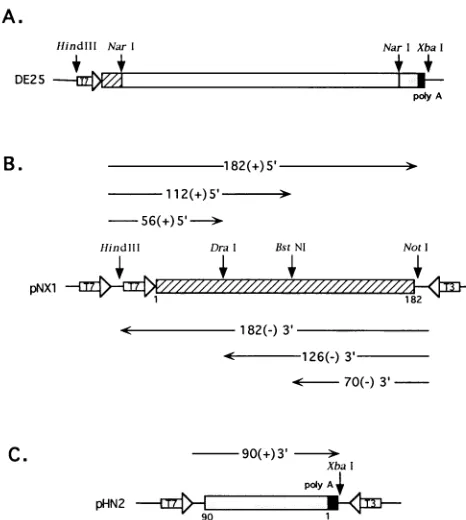
FIG. 1. Schematic diagrams of the structures ofplasmids used in this study. Only the relevant sequences, including the MHV-specific
sequences (in boxes) and T7 and T3 RNA polymerase promoters
(largeopenarrows)areshown. pNX1(B) andpHN2 (C)werederived
from DE25 (A) (see Materials and Methods). Hatched boxes
repre-sent cDNA of 5'-end MHV RNA inserted into pNX1 (A and B). Shaded and solid boxes represent cDNAof 3'-end MHV RNA and poly(A) inserted intopHN2 (AandC).The numbersunder the boxes denote nucleotide numbers in the MHV RNAsequence from the 5' end(B) and the 3' end (C), respectively (21).
significantly affect RNA synthesis (26), suggesting that the stem-loop structure at the 5'-end-positive-strand RNA is a
promoter for genomic positive-strand RNA synthesis. All of thesefindingssuggestpotential roles in RNAreplication of the 5'-end-positive- and 3'-end-negative-strand RNAs and of cel-lularproteins interacting with these regions.
Inthisstudy,wefound that severaldifferentcellular proteins bindspecificallytothecomplementary sitesonthepositive and
negative strands of the 5'-end untranslated region (UTR) of MHV RNA. Some of the proteins are conserved among
different cell lines. Thepossible roles of theseproteins in viral RNAreplication are discussed.
MATERALS AND METHODS
Construction ofplasmids. Plasmids pNX and pHN2were
used throughout this study to generate various RNA
tran-scripts in vitro. These plasmids were derived from DE25/
BSSK, which contained the complete cDNA sequence of
DIssERNA(21) in BluescriptSK(+)vector(Stratagene). The DE25/BSSK plasmidwasmade by releasing theDIssE cDNA from DE25 plasmid (20) by digestion with Hind!l! and XbaI andinserting the DIssEsequenceintoBluescript SK(+)vector at the corresponding sites. DE25/BSSK was digested with
Narl-XbaI or NarI-HindIII to remove most of the DIssE cDNA sequence (Fig. IA), and the remaining sequence was
blunt ended with T4 DNA polymerase and self-ligated to obtain pNXI and pHN2, respectively. pNX1 contains 182 nt
from the 5' end ofDIssE cDNA, which is flanked by two T7 promoters at the 5' end and a T3 promoter at the 3' end (Fig.
IB). It has 46 nt between the two T7 promoters and 43 nt of vector sequence downstream of the T3 promoter. Only thefirst T7 promoter was active in in vitro transcription reactions with T7 RNA polymerase (data not shown). pHN2 contains 90 nt from the 3' end of DIssE cDNA, which is flanked by T7 promoter and 46 nt of vector sequence at the 5' end, and a T3promoterand40 ntofvector sequence atthe3' end(Fig.
IC).
In vitro RNA transcription. pNXIwas linearized withDral,
BstNI, andNotI and transcribed with T7 RNA polymerase to yield 56(+)5', 112(+)5', and 182(+)5' RNA, respectively,
which represent the 5' end UTR of MHV genomic RNA (Fig. lB). For the synthesis of negative-strand RNA, pNXI was linearized with BstNI, DraI, andHindllland transcribed with T3 RNA polymerase to generate 70(-)3', 126(-)3', and 182(-)3' RNA, respectively, which represent the 3' end of negative-strand RNA
complementary
to the 5' end of MHV genomic RNA (Fig. IB). For synthesis of the 3' end ofpositive-strand RNA, pHN2 was linearized with XbaI and transcribed with T7 RNA polymerase to yield 90(+)3', which represents the 3' end of MHV genomic RNA including
poly(A) (Fig. 1C). For synthesis of a nonspecific competitor, plasmid pTZ18U (U.S. Biochemicals) was linearized with PvuII and transcribed with T7 RNA polymerase to generate a 149-nt RNA, which represents cloning sites and internal sequences of the vector. In vitrotranscriptions were performed under the previouslydescribed conditions (33) at 37°C for I h.
32P-labeled RNAs were obtained by transcription in the pres-ence of 75 P,Ci of[ct-32P]UTP (3,000 Ci/mmol [ICN Biomedi-cals]), 12.5 F.MUTP, and 500F.M (each) ATP, GTP, and CTP. Unlabeled RNAs were transcribed in the presence of 500 p.M (each) ATP, GTP, CTP, and UTP. The transcribed RNAs were purified with a Sephadex G25 column equilibrated in STE buffer (10 mM Tris-HCl, 1 mM EDTA, 0.1 M NaCl [pH 7.5]) to remove unincorporated ribonucleotides.
Preparation of cytoplasmic extracts. DBT (9), COS-7 (8), and HeLa cells were grown in 15-cm-diameter dishes to confluence. Cells were washed with cold phosphate-buffered saline(PBS), scraped off the plates, and centrifuged at 1,500 x gfor 10 min at 4°C. The cell pellets were resuspended in cold PBS (4.0 x 10⁷cells per ml), stored at - 80'C, and thawed just before the experiments. Cytoplasmic extracts were prepared by a previously described method (29) with slight
modifica-tions. Briefly, 2.0 x
107
cells in an Eppendorf tube werepelletedbyspinning for 15 s in a microcentrifuge. Cell pellets were resuspended in 400
pl
of the extraction buffer (10 mM HEPES [N-2-hydroxyethylpiperazine-N'-2-ethanesulfonic acid, pH 7.9], 10 mMKCl,0.1 mM EDTA, 1 mMdithiothreitol, 0.5 mM phenylmethylsulfonyl fluoride) at 4°C by gentle pipetting.Cellswereallowed to swell on ice for 15 min. After addition of 25
p.l
of 10% Nonidet P-40, the mixture was vortexed vigor-ously for 10 s and centrifuged for 30 s in a microcentrifuge. The supernatant was collected, and the total protein concentration wasdetermined with the Bio-Rad protein assay kit (Bio-Rad). Gel-retardation assay of RNA-protein binding. The gel-retardation assay was carried out essentially as described previously (12) with slight modifications. Briefly, 39P-labeledRNA (approximately 105 cpm, specific activity 2.5 x
10'
cpm/pLg)
was mixed with differentamounts of cellular extractsin 20
.I1
of the binding buffer (25 mMKCl,5 mM HEPES [pH7.5], 2 mM MgCl2, 0.1 mM EDTA, 3.8% glycerol, 2 mM dithiothreitol). In competition assays, different amounts of
unlabeled RNAs were lyophilized in Eppendorf tubes, resus-pended together with a fixed amount of cellular extracts in the J.VlIRC)L.
on November 9, 2019 by guest
http://jvi.asm.org/
[image:2.612.62.295.73.333.2]MHV RNA-PROTEIN BINDING 7217
binding buffer, and incubated at 30)C for it) min prior to the addition of
32P-labeled
RNA. In all reaction mixtures, approx-imately40 pg of32P-labeled RNA was used. The RNA-cellular extractmixture was incubated at 30(C for 10min, followed bytheaddition ofheparin to a final concentration of 1 mg/ml, and
further incubated for 10 min. The reaction mixture was then
mixed with one-fifth volume of S x loading buffer (50%7c glycerol, 0.05% bromophenol blue, 0.05% xylene cyanol) and separated byelectrophoresison a4% polyacrylamidegel made in0.5 x TBE (45 mMTris-borate, 1 mMEDTA)-5%/a glycerol. The polyacrylamide gels had been preelectrophoresed at 200 V for 30 min prior to the loading of samples, and
electrophoresiswas performed at 200 V at room temperature
until xylene cyanol reached a point one-third from the top of
the gel.
UV cross-linking of protein complexes. The
RNA-protein binding reaction was first carried out as described for
the gel-retardation assay, except that the cell extracts were preincubated with yeast tRNA. Briefly, the cytoplasmic ex-tractsfromdifferent cells were mixed with 10 pg of yeast tRNA
and unlabeled competitor RNAs, if
needed,
in 20[I
of thebindingbuffer and incubated at 30°C for 10 min. Subsequently. 100 pgof
329P-labeled
RNA wasadded and the reaction mixture was incubated for an additional 10 min. The reaction mixture was then irradiated with UV light (254 nm [UV Stratalinker2400; Stratagene])on ice at a 14-cmdistance for 10min. After
irradiation, RNase A was added to a final concentration of I mg/ml, and the mixture was incubated for 30 min at 37°C,
boiled for 3 min in the sample buffer (10% glycerol. 5%
P-mercaptoethanol,
3Cc sodium dodecyl sulfate [SDS], 62.5mM Tris-HCI [pH 6.8]), and electrophoresed on a 12.5% polyacrylamide gel containing0.1% SDS (13).
RESULTS
Binding ofcellular proteins to MHV UTR RNA detected by
gel-retardation assay. To determine whether any cellular
proteins bind to the UTR of MHV RNA, we initially carried out gel-retardation assays of RNA-protein binding, using the
cytoplasmic extracts from DBT cells and RNAs representing the 5' end ofpositive-strandviralgenomic RNA,the 3' end of negative-strand cRNA, and the 3' end ofpositive-strand viral
genomicRNA. Thesizes of RNAs usedranged from 90 to 182 nt plus various lengths of the vector sequence (see Materials and Methods). The 5' end of negative-strand cRNA was not examined because of technical difficulty in plasmid construc-tionand also because the 5' end of negative-strand RNA is not
expected to play a significant role in viral RNA synthesis (see
Discussion). The results showed that a distinct RNA-protein
complex of slower electrophoretic mobility was formed be-tween the DBT cellular extract and both the 182(+)5' and
182(-)3' RNAs (Fig. 2). The amounts of the RNA-protein
complexes increased when increasing amounts of the cellular extracts were used; correspondingly, the amounts of the free RNA probes decreased. In contrast, incubation of 90(+)3' RNA with cellular extracts yielded only diffuse radioactivity, butnodistinct RNA-protein complexes were detected (Fig. 2). The lack of protein binding to the 90(+)3' RNA was
con-firmed by UV cross-linking studies (described below). Both 182(-)3' and90(+)3' RNApreparations consisted of several RNAbands in the absence of the cellular extracts. They most
likely represented different conformers or multimers of the
same RNA,
because
only a single specieswasdetected whenthe RNA transcript was examined by electrophoresis in aga-rosegels containing6M urea (data notshown). The 182(+)5' RNAalsoconsistedof a diffuse RNAband.This waslikely also
D v2,.
I....
a
A-
-ID,.
..4 W~.,...:
E.4-182(+)5' 182(-)3' 90(+)3'
FIG. 2. Gel-retardation assay of RNA-protein complexes. 32P-labeled 182(+)5', 182(-)3',and 9()(+)3' RNAs wereeach mixedwith
1,5, and 10,ugofcytoplasmicextracts from DBT cells. Thearrowhcads
show protein-RNA complexes. In ( -) lanes, no cellular extract was added. The RNA-protcincomplexes were separated in4%k polyacryl-amide gels.
caused by RNA secondary structure, because it yielded a distinct band when analyzed by denaturing agarose gel
elec-trophoresis (data not shown). Heparin, a negatively charged polymer, which had been reported to reduce nonspecific binding of proteins to RNA (5), was included in all of the RNA-protein binding assays. It did not affect the formation of the RNA-protein complex observed in this study.
Toexamine thespecificity ofbinding of the cellular proteins to UTR MHV RNAs, unlabeled specific and nonspecific RNAs were used as competitors for protein binding (Fig. 3). The results showed that, when increasing amounts of the unlabeled 182(+)5' or 182(-)3' RNAs were incubated with the cellular extracts prior to the addition of the
232P-labeled
respective RNAs, the RNA-protein complexes formed by both 182(+)5' and 182(-)3' RNAs proportionally decreased; in contrast, the comparable amounts of tRNA or vector RNA did not reduce the amounts of the RNA-protein complexes formed (Fig. 3).These results demonstrated that the binding of the cellular proteins to 182(+)5' and 182(-)3' RNAs was specific.
Identification of the bound cellular proteins by UV cross-linking. To identify the proteins which bound to the MHV UTR RNAs,
32P-labeled
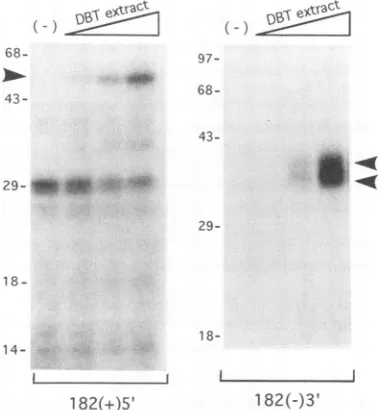
RNAs were cross-linked to cellular proteins by UVirradiation and digested with RNase, and then the proteins were identified by SDS-polyacrylamide gel elec-trophoresis (PAGE). As shown in Fig. 4. 182(+)5' RNA cross-linked to a proteinapproximately 55 kDa in size (arrow-head), whichincreased in amount when increasing amounts of cellularextracts were used. The 29-kDa band wasprobablyan RNA fragment resistant to RNase, because this band was present even in the sample without cellular extract, and its amount decreased with increasing amounts of cellular extract. By comparison, 182(-)3' RNA bound to two proteins of 35 and 38 kDa in size (Fig. 4, arrowheads). Insome gels, a faint bandapproximately 90 kDa in size could also be detected, and its binding was specifically inhibited by the unlabeled homol-ogous RNA(data not shown). The 90-kDa protein may be anVoi.. 67. 1993
10-
on November 9, 2019 by guest
http://jvi.asm.org/
[image:3.612.327.543.82.283.2]7218 FURUYA AND LAI
(A)
competitor
CI
.b P
P (-) IBO
68-
43-
97-68
-
43-S..'
2918
-
14- 18-1 8
182(+)5'
(B)
Competitor P (-)
.,
10 ..
[image:4.612.345.535.81.286.2]182(-)3'
FIG. 3. Competition assays of RNA-protein binding. Approxi-mately5,ugof cellularextractswasincubated withvariousamountsof unlabeled RNAs for 10 min and then was incubated with the 32p_
labeled homologous RNAs. The unlabeled RNAs used represented 80-, 160-,and 320-foldexcess over the labeled RNA.Corresponding
amounts of unlabeled yeast tRNA or plasmid pTZ18U RNA were
usedasnonspecific competitors.Thearrowsshow free RNAs(F)and RNA-protein complexes (C). P,nocellularextract;(-),nounlabeled competitors.
unstable protein, because it was detected only with fresh
cellular extracts. Similar UV cross-linking studies were
per-formed with 90(+)3' RNA; no proteins were detected (data
not shown). This finding is consistent with the results of the gel-retardation assay(Fig. 2).
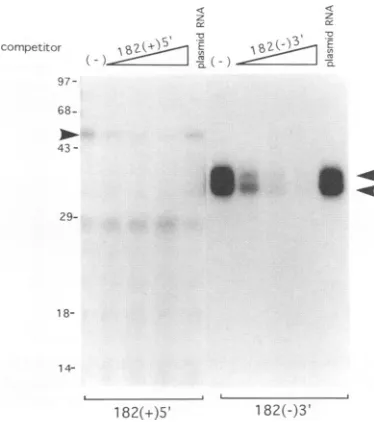
To examinethespecificity of UV cross-linking reactions, the unlabeled homologous RNAs were used as specific competi-tors,and RNAtranscribedfromplasmidpTZ18Uwas usedas anonspecific competitor. As shown in Fig. 5, when increasing
amountsof thespecific competitorswereused, theamountsof the55-, 35-, and 38-kDa proteins cross-linked toboth RNAs
182(+)5'
82(-)3
FIG. 4. UV cross-linking of RNA-protein complexes. 32P-labeled 182(+)5' RNAmixed with 2.2, 5.0, or 7.2 ,ug of cellular extracts and 182(-)3' RNA mixed with 1.0, 3.0, or 6.0
pig
of cellularextracts were UVirradiated, digested with RNase, and separated by SDS-PAGEon 12.5% polyacrylamide gels. Arrowheads indicate the 55-kDa and 35-and 38-kDaproteins which cross-linked to the 182(+)5' and 182(-)3'RNAs, respectively.In(-)lanes, no cellular extracts wereadded. The numbers on the left side show the sizes (in kilodaltons) of standard protein markers.
decreased proportionally; in contrast,comparable amountsof the vectorpTZl8U RNAdid not reduce the amountsof the
cross-linked proteins (Fig. 5). These data showed that the
binding of 182(+)5' and 182(-)3' RNAs to these cellular
proteins was specific. In contrast, the amount of the 29-kDa
band was not reduced by either the specific or nonspecific competitor RNAs.
Mapping of the protein-binding sites on 182(+)5' and
182(-)3' RNAs. To localize the binding sites of the cellular
proteinsonthe MHV UTRRNAs,truncatedRNAsof
differ-ent sizeswere transcribed from the different DNAtemplates which had been digested at different restriction sites (Fig. 1). The transcribed RNAs were cross-linked to the cellular
pro-teins by UV irradiation and digestedwith RNase. As shown in Fig. 6A, roughly the same amounts ofthe 55-kDaprotein
were cross-linked to both 112(+)5' and 182(+)5' RNAs; in contrast, 56(+)5' RNA was not cross-linked to the protein. These results indicated that the 56-nt region between nt 56 and 112from the 5' endofthe
genomic
RNAwascrucialforthe binding of the 55-kDa
protein
or was the actualprot-ein-binding site. It is notable that UV irradiation of these
RNAs,particularly 112(+)5' RNA,in the absenceofcellular extracts generated multiple RNA bands which decreased in
amount when cellular extracts were added. These multiple
bands probably represent RNase-resistant RNA fragments formedbyUVcross-linking of secondarystructures,becausea
single RNA band was detected when RNA transcripts with-out UV irradiation were analyzed by denaturing agarose gel electrophoresis (data not shown). The use of both RNase A and RNase Ti for this experiment did not alter the RNA patterns.
The mapping experiments with the 3' end of the
negative-strand RNA showed that the 35- and 38-kDa proteins were
cross-linkedtothe 126(-)3' RNA moreefficientlythantothe
J VIROL..
L_
:i
F*
i,i
t..1
A, .n.
.7.1
A. iie.
on November 9, 2019 by guest
http://jvi.asm.org/
[image:4.612.88.277.82.509.2]MHV RNA-PROTEIN BINDING 7219
Z rs
competitor B
97-
68-43
-c.a'
S-
29-1
8-
14-182(+)5' 182(-)3'
FIG. 5. Competition assays of UV cross-linking. Cellular extracts were first incubated with various amounts of unlabeled 182(+)5' or 182(-)3' RNAs or plasmidpTZ18URNAs for 10 min and then were incubated with therespective32P-labeledRNAs. The unlabeled RNAs used represented 80-, 160-, or 320-fold excess of the same labeled RNAs,while plasmid RNA represented160-foldmolar excess. Arrow-heads show the 55-kDa and 35- and 38-kDaproteins cross-linked to 182(+)5' and 182(-)3' RNAs,respectively. In (-) lanes,no compet-itorRNAwasadded. The sizes (in kilodaltons) of the standard protein markersareindicatedon theleft side.
182(-)3' RNA; in contrast, 70(-)3' was not cross-linked to those proteins (Fig. 6B). These results indicated that the
binding site of the 35- and 38-kDa proteins on the
3-end-negative-strand RNA areinthe56-nt region between nt 56 and 112 from the 3' end of the negative-strand RNA. This region represents the complementary region of the 55-kDa
protein-binding site on the positive-strand RNA (see Fig. 1). These RNAs also generated multiple RNase-resistant RNA
frag-A
56(+)5' 112(+)5' 182(+ 5'
M I-)
--ments in the absence of cellular extracts; their amounts
decreased when increasing amounts ofcellular extracts were
added. Thus, they are likely derived from the cross-linked
RNA secondary structures. The results of UV cross-linking
studies on both positive- and negative-strand RNAs thus
indicated that atleastthreecellularproteinsbind to the same site on the complementary strands near the 5' end of MHV
genomic RNA.
Binding ofthe 55-kDa protein to longer RNA transcripts. Because the RNA transcripts used in the experiments
de-scribed above contained vector sequences and represented
only a small fraction of the full-length MHV viral genomic
RNA, it is possible that the conformation of these RNA transcripts is different from that of the full-length RNA
molecules. Therefore, the RNA-binding proteins described abovemaynotbindtothenatural viral RNAs. Toruleoutthis possibility, we used 681-nt and 1,182-nt transcripts of DE25
plasmid (20), which contain onlyone extra G residucatthe 5'
end of the positive-strand RNA transcripts, for UV
cross-linking studies. Figure 7 shows that the 55-kDa protein was
cross-linked to both RNAs. We conclude that this protein
likelybinds tothenatural MHVviralRNAand that the vector sequencesdid not contributeto the protein binding. Further-more, noother proteins werecross-linked tothesetwo RNAs.
Thus, within the nearly 1.2 kb of the 5' end ofpositive-strand
RNA, only the 5'-end UTR is capable of binding cellular proteins.
UV cross-linking studies of 182(-)3' RNA with cellular extracts from different cell lines. For the binding studies described above, the cellular extracts from DBT cells were
used, because these cells were highly susceptible to MHV
infection (9). To determine whether the proteins bound to MHV UTR RNAs are conserved among different cell lines,
182(-)3' RNA was also cross-linked to the cellular extracts
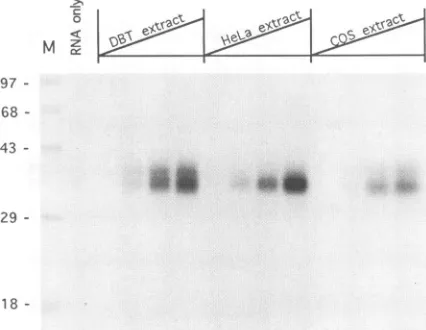
derived from HeLa cellsand COS-7 cells. As shown inFig. 8, the 35-kDaproteinwasdetected in all threecell lines,whereas
the 38-kDa protein was barely detectable in HeLa or COS-7
cell extracts. This result shows that the 38-kDa protein isnot
expressed, orisexpressed in verysmall amounts, in these two
celllines,while the 35-kDaproteinisexpressedin all of the cell
lines.
B
70(-)3' 126(-)3' 1 82(-)3'
M. ( )
1t~
) ( ) -Y- elI
68-MO .4 43- wm.*
23-
29-
18-
14-FIG. 6. Mapping of the binding sites of cellularproteinson5'-end-positive-strand (A) and 3-end-negative-strand (B) MHV RNAs. Various
amounts(0).7 to7.2 p.g inpanelAand (1.9to7.2 ,ugin panel B)of thecellularextractswere mixed with 32P-labeled RNAs and UV irradiated.
Arrowheads show the 55-kDaprotein (A)andthe 35- and 38-kDaproteins(B).In(-)lanes,nocellularcxtractswereadded. M. molecularmass
standards (inkilodaltons).
4._'-
43-
29-
18-
14-V()L.67, 1993
on November 9, 2019 by guest
http://jvi.asm.org/
[image:5.612.79.266.73.284.2] [image:5.612.68.545.515.683.2]7220 FURUYA AND LAI
M (-) i1)
200 92.4 -68.0
-4 3.0 - *-I
97
-68 -43
-29 -29.0-
-18 -18.4
-IL
DE25(+681) DE25(+1 182)
FIG. 7. UVcross-linking studies of long RNA transcripts. DE25 plasmid(20)wasdigested withEagI andAflIlandtranscribed withT7 RNApolymerasetoyield 681- and 1,182-ntRNAs, respectively, which represent 5'-end-positive-strand RNA fragments with only 1 extra
nucleotide. UVcross-linking studies wereperformedwith 3.5, 5.8,or
11.5 jigof DBTcellularextracts.In(- )lanes,nocellularextractswere
added. The arrow indicates the 55-kDa band. M, molecular mass
standards(in kilodaltons).
DISCUSSION
Inthisreport,wehave shown that several cellularproteins of
different sizes bindtothedifferent strands of MHV RNAs in the region corresponding to the 5' end of positive-strand genomic RNA and the 3' end of negative-strand cRNAs. Interestingly, these proteins bindtothecomplementary sites of the same 56-nt region near the ends of both positive- and negative-strand RNAs. The nature and functions of these cellular proteins are still not clear; however, the fact that the binding sites of these proteins arelocated nearthe end ofthe
viralgenomic and cRNAssuggeststhattheymaybeinvolved in RNA replicationortranscription, because RNA replication is
expectedto startfrom theends of viralRNA, and the5'-leader RNA has been shown to be involved in subgenomic mRNA transcription (14). These cellular proteins on both genomic
and complementary strands of viral RNA can potentially
interact with virus-encoded RNApolymerase toform a
repli-cationortranscription complex. Suchacomplexisexpectedto
cover the end of the positive- or negative-stranded RNAs,
inasmuchasthe Escherichia coli RNApolymerase,which hasa
molecular size close to the expected coding capacity of the MHV polymerase gene (14, 16), has been shown to cover
approximately 75 bp of templateDNA(6, 32).Thefinding that the55-kDaprotein is the only cellular protein boundtoMHV RNA within thefirst 1.2 kb from the 5' end further suggests that these proteins are involved in the initiation of RNA
synthesis. Because the binding sites of the cellular proteins on
the positive- and negative-strand RNAsarecomplementary, it
ispossible that these proteins might interact with each other during certainstagesofviral RNAsynthesis. Potentially, these cellular proteins are all part of the RNA replication or
transcription complexes.
Itisinteresting thatnocellularproteinswerefoundtobind
to the 3' end of positive-strand genomic RNA. In MHV-infectedcells, the incoming viralgenomic RNA is expected to be replicated from the 3' end of positive-strand RNA into
FIG. 8. UV cross-linking of 182(-)3' RNA to cellular extracts from different cell lines. Approximately 1, 3, 6, and 12
jLg
of cellular extracts from the different cell lines were used. M, molecularmass standards(in kilodaltons).negative-strandRNAbyvirus-specificRNApolymerase. Thus, single-stranded, positive-sense genomic RNA likely serves
directly as the template for the synthesis of negative-strand
RNA. Thesimplicity of this template mayminimize theneed for cellular factorstoparticipate in RNA replication.
Several cellularproteins have been reportedtobind to RNA
fragments representing UTR RNA or its complementary strand fromother RNAviruses.Forexample,the 3' end ofthe Sindbisvirus negative-strand RNA, which is thought to be a promoter for RNA replication, was cross-linked to cellular proteins 42, 44, and52 kDainsize byUVirradiation (24). The 5'-UTR RNAofpolioviruswas reportedtobe cross-linkedto a54-kDacellularprotein, whichmaybe a commontranslation
factor for viral and nonviral mRNAs (7). Other cellular proteins with sizes of48 and38 kDa were alsocross-linked to other sites on the 5'-UTR RNA and maybe associated with specific poliovirus translation (7). A 57-kDa cellular protein
wasfound tocross-link to two sites in the internal ribosomal
entry site on the 5'-UTR of foot-and-mouth-disease virus
RNA (18). Whether the 54- and 57-kDa cellular proteins, which bind to poliovirus and foot-and-mouth disease virus
RNA,arerelated to the 55-kDaprotein,whichbindstoMHV
positive-strand
RNA, is an interesting issue.Itislikelythat thebinding regionsof the cellularproteinson MHV RNA (nt 56 to 112 from the 5' end) overlap the
consensusUCUAA repeats(14, 15)atthe 3' end oftheleader
sequence(nt70 to80).Because the UCUAArepeats arealso
present at the intergenic sites preceding the open reading
frames of each subgenomic mRNA, these proteins may also
bindtotheintergenic regions,which serve as thetranscription initiation sites. Preliminarydata indeedindicatethatthis isthe
case
(35).
Thus, these proteinsmayplaysomerolesnotonly inthereplication of viral genomic RNA,but also in the
transcrip-tion of subgenomic mRNAs. In addition, the 55-kDa protein
bound to the viral genomic RNA may also play a role in translational regulation, because itsbinding site precedes the
first open reading frame in the viralgenome.
Allof the RNAtranscriptsused in this study contain some vector sequences, and some of them contain an extra T7 promoter sequence. However, among the
5'-end-positive-strand RNAfragments used, 56(+)5' RNA did not cross-link tothe 55-kDaprotein, althoughitcontainsthe same vectorand
c
0 e*.q C:. t
< s e
M z
loiql
J.VlIROL.
on November 9, 2019 by guest
http://jvi.asm.org/
[image:6.612.69.301.76.273.2] [image:6.612.335.548.78.243.2]MHV RNA-PROTEIN BINDING 7221
extra T7 promoter sequence as those in 112(+)5' and 182(+)5'. Furthermore, a long (1.2-kb) RNA fragment with-out the vector sequence bound the same 55-kDa protein. Similarly, among the 3'-end-negative-strand RNA fragments used, 70(-)3' RNA did not cross-link to the 35- and 38-kDa proteins although it contains the same vector sequences as thosein 126(-)3' and 182(-)3'RNAs. Therefore, these extra sequences were not responsible for the specific bindings ob-served between the MHV UTR RNAs and the cellular pro-teins, and these cellular proteins likely bind to the full-length viral RNAs in the virus-infected cells.
The 35-kDa protein, which bound to the 3' end of negative-strand RNA,is present in all three of the cell lines studied. It hasbeen shown that MHV can replicate in COS-7 cells after transfection of MHVgenomic RNA, even though COS-7 cells are not naturallysusceptible to MHV infection because of the lack of an MHV receptor (34). Thus, COS-7 cells should contain factors needed for MHV replication, and the 35-kDa protein may be one of these factors. In contrast, the 38-kDa protein was not detected in either COS-7 or HeLa cells; it may havearoledifferent from that of the 35-kDa protein and is not necessary for viral RNA replication. Therelationship between the 35- and 38-kDa proteins is not clear. The 38-kDa protein may represent the posttranslational modification product of the 35-kDa protein.
The UV cross-linkingstudies, especially those with 112(+)5' and 56(+)5' RNAs, detected several RNase-resistant RNA
bands, which decreased in amount upon the addition of cellular extracts (Fig. 6A). These bands likely represent RNA
fragments with strong secondary structures. Thus, these find-ings suggest that cellular extracts contain some enzymatic activities, such asRNAhelicases,which reduced the secondary
structures of RNAs and rendered them sensitive to RNase digestion. RNA helicase activities in some proteins, such as eukaryotic initiation factor4A
(eIF-4A)
(27, 28), human p68 protein (10), and RNA helicases from HeLa cell nuclearextracts (3), have previously been detected. Whether the proteins detected in this study have RNA helicase activitieswill
require additional studies.
REFERENCES
1. Andino, R., G. E.Rieckhof, and D. Baltimore. 1990. Afunctional ribonucleoprotein complex forms around the 5' end of poliovirus RNA. Cell 63:369-380.
2. Baric,R.S., S.A. Stohiman, and M.M.C. Lai. 1983. Character-ization ofreplicative intermediate RNA ofmouse hepatitis virus: presence of leader RNA sequenceson nascent chains. J. Virol.
48:633-640.
3. Claude, A., J. Arenas, and J. Hurwitz. 1991. The isolation and characterization of an RNA helicase from nuclear extracts of HeLacells. J. Biol. Chem. 266:10358-10367.
4. Compton, S. R., D. B. Rogers, K. V. Holmes, D. Fertsch, J. Remenick, and J. J. McGowan. 1987. In vitroreplication ofmouse
hepatitisvirusstrain A59. J. Virol. 61:1814-1820.
5. Dildine, S. L., and B. L. Semler. 1992. Conservation of RNA-proteininteractions amongpicornaviruses.J.Virol. 66:4364-4376. 6. Galas,D.J.,and A.Schmitz.1978. DNasefootprinting: asimple method for the detection of protein-DNA binding specificity. Nucleic Acids Res. 5:3157-3170.
7. Gebhard, J. R., and E. Ehrenfeld. 1992. Specific interactions of HeLa cell proteins with proposed translation domains of the poliovirus5'noncoding region.J.Virol.66:3101-3109.
8. Gluzman, Y. 1981. SV40-transformed simian cells support the replicationofearly SV40mutants.Cell23:175-182.
9. Hirano, N., K. Fujiwara, S. Hino, and M. Matumoto. 1974. Replication and plaque formation of mouse hepatitis virus (MHV-2) inmousecellline DBT culture. Arch. Gesamte
Virus-forsch. 44:298-302.
10. Hirling, H., M. Scheffner, T. Restle, and H. Stahl. 1989. RNA helicase activity associated with the human p68 protein. Nature (London) 339:562-564.
11. Joo, M., and S. Makino. 1992. Mutagenic analysis of the corona-virusintergenic consensus sequence. J. Virol. 66:6330-6337. 12. Konarska, M. M., and P. A. Sharp. 1986.Electrophoretic
separa-tion of complexes involved in the splicing of precursors to mRNA. Cell 46:845-855.
13. Laemmli, U. K. 1970. Cleavage of structural proteins during the assembly of the head of bacteriophage T4. Nature (London) 227:680-685.
14. Lai, M. M. C. 1990. Coronavirus: organization, replication and expression of genome. Annu. Rev. Microbiol. 44:303-333. 15. Lai, M. M. C., C. D. Patton, R. S.Baric, and S. A. Stohlman. 1983.
Presence of leader sequences in the mRNA of mouse hepatitis virus. J.Virol. 46:1027-1033.
16. Lee, H.-J., C.-K. Shieh, A. E. Gorbalenya, E. V. Koonin, N. La Monica, J.Tuler, A. Bagdzhadzhyan, and M. M. C. Lai. 1991. The complete sequence (22 kilobases) of murine coronavirus gene 1 encoding the putative proteases andRNA polymerase. Virology 180:567-582.
17. Lin, Y.-J.,and M.M. C. Lai. 1993. Deletionmapping ofamouse hepatitis virus defectiveinterferingRNAreveals therequirement ofaninternal and discontiguous sequence forreplication.J.Virol. 67:6110-6118.
18. Luz, N., andE.Beck. 1991. Interaction ofacellular 57-kilodalton protein with the internal translation initiation site of foot-and-mouth disease virus. J.Virol.65:6486-6494.
19. Makino, S., and M. Joo. 1993. Effect of intergenic consensus sequence flanking sequences oncoronavirus transcription.J. Vi-rol. 67:3304-3311.
20. Makino, S., and M. M. C. Lai. 1989. High-frequency leader sequenceswitching duringcoronavirusdefectiveinterferingRNA replication. J. Virol. 63:5285-5292.
21. Makino, S., C.-K. Shieh,L.H.Soe, S. C. Baker,andM.M.C. Lai. 1988. Primarystructureand translation ofadefective interfering RNAofmurine coronavirus.Virology 166:550-560.
22. Niesters,H.G. M., andJ. H. Strauss. 1990.Defined mutations in the 5' nontranslated sequence of Sindbis virus RNA. J. Virol.
64:4162-4168.
23. Pachuck, C. J., P. J. Bredenbeek, P. W.Zoltick,W.J.M.Spaan, and S.R.Weiss. 1989.Molecularcloningof the geneencodingthe putative polymerase ofmouse hepatitis coronavirus, strain A59. Virology 171:141-148.
24. Pardigon, N.,andJ.H.Strauss.1992. Cellularproteins bind to the 3' endof Sindbis virus minus-strand RNA. J. Virol. 66:1007-1015. 25. Perlman, S.,D.Ries, E. Bolger,L.J.Chang, andC.M.Stoltzfus. 1986. MHV nucleocapsidsynthesis in the presence of cyclohexi-mide andaccumulation ofnegative strand MHV RNA. Virus Res. 6:261-272.
26. Pogue, G. P., and T. C. Hall. 1992. The requirement for a 5' stem-loop structure inbrome mosaic virusreplication supportsa new model for viral positive-strand RNA initiation. J. Virol. 66:674-684.
27. Ray, B. K., T. G. Lawson, J. C. Kramer, M. H.Cladaras, J. A. Grifo,R. D.Abramson, W. C. Merrick, and R. E. Thach. 1985. ATP-dependent unwindingof messenger RNA structure by
eu-karyoticinitiation factors. J. Biol. Chem. 260:7651-7658. 28. Rozen, F.,I.Edery,K.Meerovitch, T.E.Dever,W.C.Merrick,and
N.Sonenberg. 1990. Bidirectional RNAhelicaseactivity of
euca-ryotic translation initiation factors 4A and 4F. Mol. Cell. Biol. 10:1134-1144.
29. Schreiber, E.,P.Matthias,M.M.Muller,and W. Schaffner. 1989.
Rapiddetectionofoctamerbindingproteinswith 'mini-extracts', prepared from a small number of cells. Nucleic Acids Res. 17:6419.
30. Shieh, C.-K.,L. H.Soe,S.Makino, M.F.Chang,S. A.Stohlman,
and M. M. C. Lai. 1987. The 5'-end sequence of the murine coronavirus genome: implications for multiple fusion sites in leaderprimedtranscription. Virology 156:321-330.
31. Spaan, W., H. Delius, M. Skinner, J. Armstrong, P. Rottier, S. Smeekens, B. A. M. van der Zeijst, and S. G. Siddell. 1983. VOL. 67? 1993
on November 9, 2019 by guest
http://jvi.asm.org/
7222 FURUYA AND LAI
Coronavirus mRNA synthesis involves fusion of noncontiguous
sequences. EMBO J. 2:1839-1844.
32. vonHippel, P. H., D.G. Bear, W. D. Morgan, and J. A. McSwiggen.
1984. Protein-nucleic acid interactions in transcription:a
molecu-laranalysis. Annu.Rev. Biochem. 53:389-446.
33. Yokomori, K., L. R. Banner, and M. M. C. Lai. 1991.
Heteroge-neity of gene expression of the hemagglutinin-esterase (HE)
proteinofmurinecoronaviruses. Virology 183:647-657. 34. Yokomori, K., and M. M. C. Lai. 1992. Mouse hepatitis virus
utilizes twocarcinoembryonic antigensasalternativereceptors.J. Virol. 66:6194-6199.
35. Zhang, X.-M.,and M. M. C. Lai. 1992.Unpublished observation.
J.VoR)l.