This is a repository copy of Conceptions about teaching and learning of expressivity in music among Higher Education teachers and students.
White Rose Research Online URL for this paper: http://eprints.whiterose.ac.uk/119228/
Version: Accepted Version
Article:
Bonastre, C., Muñoz, E. and Timmers, R. (2017) Conceptions about teaching and learning of expressivity in music among Higher Education teachers and students. British Journal of Music Education. ISSN 0265-0517
https://doi.org/10.1017/S0265051716000462
[email protected] https://eprints.whiterose.ac.uk/ Reuse
Unless indicated otherwise, fulltext items are protected by copyright with all rights reserved. The copyright exception in section 29 of the Copyright, Designs and Patents Act 1988 allows the making of a single copy solely for the purpose of non-commercial research or private study within the limits of fair dealing. The publisher or other rights-holder may allow further reproduction and re-use of this version - refer to the White Rose Research Online record for this item. Where records identify the publisher as the copyright holder, users can verify any specific terms of use on the publisher’s website.
Takedown
If you consider content in White Rose Research Online to be in breach of UK law, please notify us by
1
Title: Conceptions about teaching and learning of expressivity in music among Higher
Education teachers and students.
Running Head: Conceptions about expressivity in music in HE teachers and students.
Acknowledgements
The preparation of this article was supported in part by a grant to the first author from the Universidad Autónoma de Madrid (UAM) for a research stay in the University of Sheffield. We would like to thanks the Conservatorio Superior de Música de Madrid and the UAM for its collaboration.
Abstract
This work aimed to analyse factors related to conceptions and beliefs about expressivity in music among students and teachers. A questionnaire with 11 Likert-type items was developed covering the main factors included in the literature of teaching-learning of expressivity and emotion in music. Through exploratory factor analysis three factors were identified: expressive technique (ET), emotional expression (EE), and self-learning of expressivity (SLE). Comparisons between teachers and students showed that teachers had significant higher scores in EE with no differences in ET or SLE, although the effect size for SLE was high. The three factors are proposed as a tool for the assessment of conceptions of expressivity and its learning in both teachers and advanced students of music for teaching and research objectives.
Keywords: Expression; Music performance; Teaching-learning; Assessment.
2
Introduction
Music psychological literature has only recently started to consider the teaching and learning of expressiveness in music performance through empirical and detailed
analyses. There is empirical evidence that searching to communicate emotions through music is common at any level of learning (e.g., Juslin & Laukka, 2004), that the
intention of professional musicians is often to express emotions (Lindström, Bresin, Juslin, & Williamon, 2003), and that expert musicians are able to express specific emotions through the manipulation of music elements such as tempo, articulation,
dynamics and timbre (Juslin, Karlsson, Lindström, Friberg, & Schoonderwaldt, 2006; Viellard, Roy, & Perets, 2012; Timmers & Sadakata, 2014). As stated by Berman
(2006), ‘the pianist needs to know what physical actions influence sound and in what way’, as he thinks that every musician, in general should know what sounds are linked with specific emotions.
The ability of communicating emotions, as well as other forms of
expressiveness, in music performance is sometimes wrongly assumed as natural and not
susceptible to be improved with training (Broomhead, 2006; Lindström, Juslin, Bresin, & Williamon, 2003; Williamon, 2014). This assumption may be related to the implicit nature of emotional communication, which complicates its transmission or training
3 used, favouring aspects such as recall of information, attention to stimuli or production of responses, also congruent with the active mood. Likewise, according to Bower
(1981), easiness to activate a concrete emotion (e.g., fear) would depend on the type and
amount of concepts related with that emotion in long term memory and on the strength of the connection between those concepts. Thus, emotions involved in music are
strongly determined by our previous learning, and appear automatically, and information related to emotional content is more easily stored and less likely to be forgotten (Talmi, Schimmack, Paterson, & Moscovitch, 2007). As stated by Chaffin,
Logan, and Begosh (2009), this involves that
the performer’s visceral response to the music contributes to musical memory.
We have observed that musicians find it difficult to play from memory when asked to perform without expression and surmise that playing without
expression eliminates emotional cues that normally contributes to the retrieval of the music from memory (p.356).
This line of reasoning suggests that when expressiveness is taught to arise ‘from within’ the efficacy of a performer’s expression is determined by the play of emotional
4 idea, Minassian, Gayford, and Sloboda (2003) found that up to 60% of public
performances of a group of young high level musicians were considered as inadequate by themselves, despite of very high pre- and post- expectations according to their
preparation. And Van Zijl and Sloboda (2011) found that the role of emotions of performers changed when they achieve an expressive performance, ‘the conveyance of
the previously constructed interpretation towards an audience seemed to take centre stage -rather than the performer’s own emotional experience’. Likewise, the verbal and nonverbal behaviours of both students and teachers play a relevant role in their personal
interactions and in the pedagogical outcomes of music learning (Zhukov, 2012; Ivaldi, 2014). Explicit consideration of affect and emotion questions could therefore facilitate
general learning, not only expressivity skills. This is for example evident in the effect of drama training programmes, where explicit consideration is given to emotion and effect in communicative expression in public (e.g., Nicholson, 2000). Notably, training in
acting techniques and collaborating with actors improved self-confidence, creativity and presence in the performance of musicians (Rea, 2015).
In music curricula, a systematic approach to the teaching and learning of expressivity seems lacking, and consequently its training depends on conceptions, beliefs or opinions about its relevance and the best way to train it of each professor
5 knowledge rather than on a promotion of musical understanding and expressiveness using a constructivist approach (López, Pozo, & de Dios, 2013). Even when the curricula are based on constructivist principles, like in the UK, in practice, a
behaviourist approach is still often employed (Garnett, 2013). Teaching in music classes seems to be mostly focused on learning specific skills instead of on constructing
concepts and developing understanding (Ofsted, 2009). Investigations related to the teaching of expressivity similarly suggest that a behavioural approach is the dominant practice (Karlsson & Juslin, 2008). In a small sample study, Meissner (in press) found a
variety of approaches, including auditory modelling, the use of metaphors, movements and gestures, and teacher’s enquiry and discussion. What teaching approach is
employed, and its success may depend on the conceptions and beliefs about
expressiveness that of professors and students of music have. In that sense, knowing the conceptions of expressiveness is a first step in developing and enhancing a teaching
method. Little empirical work is available that has analysed this issue.
Currently, expression is understood as a multidimensional construct including
emotional communication, but, as well stylishness, quality and expressiveness in particular musical parameters (Schubert & Fabian, 2014). As defined in the Grove Music Online (Kovalef Baker, Paddison, & Scruton, 2016): ‘In its simplest sense, the term ‘expression’ is applied to those elements of a musical performance that depend on
6 hereafter, the main focus will be on emotional expression, the way in which music communicates emotions to listeners.
Different factors have been considered in the literature as potentially affecting
expressivity in music and its teaching and learning. For the goals of the present work, we will be focused on those in which there is no consensus, where a heterogeneity of
responses as well as differences between teachers and students can be expected. Thus, there is still some controversy regarding to what extent (emotional) expressivity can be learned, depends on innate talent, and can or cannot be explicitly addressed in class.
Whereas music achievement and talent for music have been considered to partially depend on genetic and epigenetic factors (Chaffin, & Lemieux, 2004), it is clear that
early experiences, preferences, opportunities, habits, training, and practice are
paramount for musical development (Howe, Davidson, & Sloboda, 1998). Developing musical expressivity is not an exception, given the evidence that indicates that explicit
instruction improves expressivity (Juslin et al., 2006; Woody, 1999, Meissner, in press; in preparation), but it seems that this is not a generally shared belief. Other factors
relevant to the teaching-learning of expression in music include the idea that a)
expression in music is just or mainly a matter of technique (Karlsson & Juslin, 2008), b) musical elements (tempo, timbre, etc.) are associated in specific ways or not with the
7 expressive elements, and a specific piece should be studied according to that (e.g., Daynes, 2010); d) the age of the student affects the way of expressively studying a piece and language for expressive terms should be adapted (Tan et al. , 2010); e) and playing
by memory affects the expression achieved (Chaffin, Logan, & Begosh, 2009).
In her review of the consideration of emotion in music education, Susan Hallam
(2010) highlighted the lack of research in this field and suggested several lines for further research in order to fulfil that gap, including pupil’s and teacher’s perceptions. As stated by Casa-Mas, Pozo and Montero (2014), investigating the beliefs and
conceptions of the different agents of musical education should be a central goal for research, which has not been the case yet for expressiveness. To address this gap, this
work aimed to analyse the extent to which certain beliefs and concepts of expressivity were held by music performers and to explore sub-groupings of these beliefs and conceptions. Additionally, the aim was to compare these conceptions between students
and professors participating in advanced instrumental courses in a conservatory. With this goal in mind, a questionnaire was developed consisting of questions related to
potential beliefs of musicians about factors affecting expressiveness. Given the lack of previous studies comparing these groups the study has an exploratory character, and no hypothesis were formulated a priori.
8 Sample
Participants were students and professors of advanced courses of instrumental
music in the Higher Music Conservatory of Madrid, Spain. The final sample comprised 69 participants. 53 were students, 50.9% women (M age = 22.73, SD = 3.01, range:
17-29) and 49.1% men (M age = 22.73, SD = 3.01, range 18-28). 16 participants were professors, 68.8 % women (M age = 40.92, SD = 7.87, range: 30-55) and 31.2 % men (M age = 42.80, SD. = 12.19, range: 32-58). All students were involved in
complementary piano lessons (piano as second instrument). Main instruments included 37.7% strings, 26.4% woodwind, 18.9% brass, and 17.0% keyboard instruments.
Distribution of the main instrumental subjects for the teachers sample was: 37.5% piano complementary, 12.5% accompanying piano, 31.3% string, 12.5% woodwind, and 6.3% brass.
Measures
A questionnaire was developed in order to collect the relevant conceptions about the teaching-learning of emotional expression in music. Relevant dimensions were discussed among the investigators and a first version composed of 20 questions was
9 questions were considered as not relevant or redundant and were omitted. The final version of the questionnaire included 11 Likert-type items with four alternatives of response indicating the degree of agreement with each statement, ranging from ‘1’, Not
at all to ‘4’, Very much’. The questionnaire used is presented in Appendix 1. No specific instructions or additional explanations were provided. A verbal informed
consent was obtained from the participants and total confidentiality and anonymity of the responses was guaranteed.
Statistical analyses
First, descriptive analyses (mean and standard deviation) were performed for all
items in each group (students and teachers), and means were compared through
independent-samples t-tests. Additionally, the effect size (Hedges’ g) was estimated for each comparison; g is an unbiased version of the known Cohen’s d, and the usual
guidelines for d (Cohen, 1988) were followed: lower than .20 is an irrelevant effect; between .20 and .50 a small effect, between .50 and .80 a medium effect, and over .80 a
high effect.
Then the structure of the questionnaire was analysed with exploratory factor analysis techniques. A principal component factor analysis (PCA), as method for factor
10 the internal consistency for the total of scales. Despite of the small sample size, the degree of over-determination of the model (11 variables and 3 factors) and the moderate-to-high communalities of the variables indicate that the sample size was
adequate according to theoretical and empirical (with Monte Carlo simulation)
suggestions by MacCallum, Widaman, Zhang, and Hong (1999) and Arrindel and Van
der Ende (1985).
Finally, total scores for subscales were calculated adding scores for items associated with each factor. Items with negative loadings were reversed. t-tests were
then performed comparing scores for each subscale between teachers and students, and effect sizes for each comparison were estimated. In order to control for family-wise type
I errors, a multiple analysis of variance with covariates (MANCOVA) was run with scores in the previously constructed subscales as dependent variables, group and gender as independent variables, and age as covariate. Depending on the presence of omnibus
statistically significant effects, post-hoc comparisons for group, age and gender, as well as for interactions, were performed. Box’s M test was used as a way to test the adequacy
of data for this type of analyses; effect sizes (square root of partial eta squared, which can be considered equivalent to r were calculated for each main effect (Rosenthal, Rosnow, & Rubin (2000); .24 is considered a medium effect for r and .37 a large effect;
11 the same for both groups in that variable); Games-Howell tests were used when equality of variances could not be assumed.
Statistical analyses were performed with the software SPSS for Windows,
version 19.0.
Results
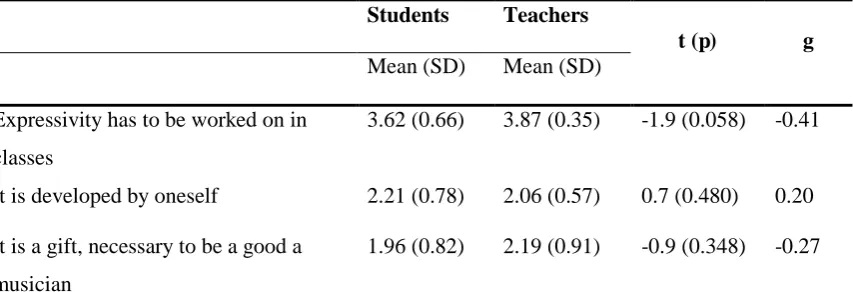
Descriptive analyses for each item in both groups are shown in Table 1.
[image:12.595.89.516.522.668.2]Comparisons between groups showed statistically significant differences (p<.05) for four items, and effect sizes were in general medium.
Table 1.Means and standard deviations of responses from students and teachers per item
and comparison between the responses using an independent samples T-test. t values in
bold indicate responses that are significantly different.
Students Teachers
t (p) g Mean (SD) Mean (SD)
Expressivity has to be worked on in
classes
3.62 (0.66) 3.87 (0.35) -1.9 (0.058) -0.41
It is developed by oneself 2.21 (0.78) 2.06 (0.57) 0.7 (0.480) 0.20
It is a gift, necessary to be a good a
musician
12 Students Teachers
t (p) g Mean (SD) Mean (SD)
It is part of music technique 3.04 (0.91) 3.44 (0.89) -1.5 (0.127) -0.44
There is specific musical elements
associated with concrete emotions
3.35 (0.79) 3.44 (0.73) -0.4 (0.682) -0.11
According to the stylistic period,
changes the manner of expressively
studying a piece
3.37 (0.63) 2.94 (1.00) 2.1 (0.044) 0.58
Each historical period is linked to
concrete expressive elements
3.25 (0.74) 2.73 (0.70) 2.4 (0.019) 0.70
I should know what musical elements
influence expressivity and how
3.40 (0.57) 3.63 (0.62) -1.3 (0.188) -0.39
Expressive elements should be
explicitly included in programs
(curriculum).
3.10 (0.78) 3.53 (0.52) -2.0 (0.047) -0.58
Expression changes when playing from
memory
2.98 (0.95) 3.47 (0.64) -1.9 (0.068) -0.54
According to the age of the student a
different language should be used for
expressivity
2.66 (0.83) 3.50 (0.63) -3.7 (<.001) -1.05
13 Chronbach’s alpha for the whole scale was low (.515), indicating lack of
unidimensionality. The determinant of the matrix was .01, KMO test had a value of 0.5, and Bartlett's statistic was 91.2 (df = 55; p = .002). Based on these results an exploratory
factor analysis for the total sample was undertaken. According with the K-1 rule and the scree-test, three components were retained explaining 48.96% of variance. Distribution
[image:14.595.121.407.357.586.2]of eigenvalues is shown in Figure 1.
Figure 1.Scree-test for the questionnaire about conceptions on expressivity.
Therefore, a three factors solution was retained (eigenvalues: 2.32, 1.63, and
14 rotation. Correlations between latent factors were low and non-significant (ranging between .03 and .14).
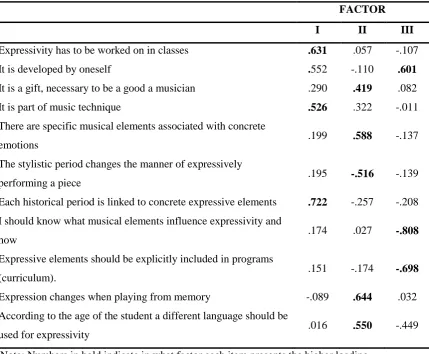
Table 2. Factor structure of items on conceptions about expressivity. Configuration matrix
(direct oblimin rotation)
FACTOR
I II III
Expressivity has to be worked on in classes .631 .057 -.107
It is developed by oneself .552 -.110 .601
It is a gift, necessary to be a good a musician .290 .419 .082
It is part of music technique .526 .322 -.011
There are specific musical elements associated with concrete
emotions .199 .588 -.137
The stylistic period changes the manner of expressively
performing a piece .195 -.516 -.139
Each historical period is linked to concrete expressive elements .722 -.257 -.208
I should know what musical elements influence expressivity and
how .174 .027 -.808
Expressive elements should be explicitly included in programs
(curriculum). .151 -.174 -.698
Expression changes when playing from memory -.089 .644 .032
According to the age of the student a different language should be
used for expressivity .016 .550 -.449
15 For Factor 1, items 1, 4, and 7 had high regression weights. These items include questions related to the idea that expressivity should be worked on in the classroom and is part of the musical technique. Additionally, it associated with the idea that expressive
elements are linked to specific stylistic periods. Seemingly contrasting, item 2 (‘expressivity is developed by oneself’) also had a high loading on this factor (.552),
although its highest loading was on Factor 3. This suggests that participants believe that while expressivity should be worked on in class and is part of musical technique, it also develops by itself. We’ll see that this contrasts with Factor 3 which primarily
emphasises that expressivity cannot be taught. We have labelled Factor 1 as ‘expressive technique’ (hereafter, ET).
The second factor had high factor loadings for items 3, 5, 6, 10, and 11. These items are associated with the factor either positively or negatively (item 6). These items include the ideas that expressivity is affected by playing by memory, concrete emotions
are associated with specific music elements, teaching of expressivity has to be adapted to the age of the student, the expressive performance of a piece is not affected by
16 ‘expressive talent’, or ‘expressive development’. We have labelled this second factor as ‘emotional expression’ (hereafter, EE).
Factor 3 includes high loadings of items 2, 8, and 9. Those items are associated
with the idea that expressivity can be developed by oneself. Unlike the weight of item 2 on Factor 1, its combination with negative weights for items 8 and 9 indicate that
participants belief that expressivity training does not need to be explicit - they do not need to be explicitly included in teaching programs (item 9), and previous knowledge of what (and how) musical elements influence expressivity is not needed (item 8). Given
the positive loading of item 2 and the negative loadings for items 8 and 9, this factor could be labelled as ‘self-learning of expressivity’ (hereafter, SLE).
Subscales total scores were then calculated adding scores of the items representing each of the three retained factors (scores for items with negative factor loadings were reversed). Differences between students and professors in these three
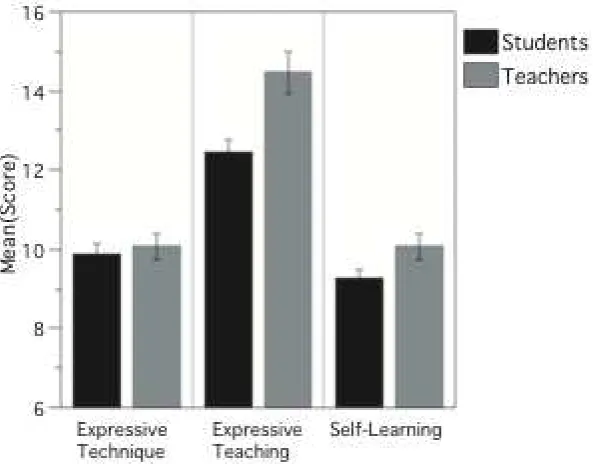
scores were tested using t-tests for independent samples. Statistically significant differences were found for EE (t(67)=3.03; p=.004; g=0.88), with a higher score for
professors (M=14.5; SD=2.1) than for students (M=12.5; SD=2.2). Likewise, there was a trend for higher scores of professors in SLE (t(67)=1.81; p=.075; g=0.53). Finally, there was no significant difference between students and professors for ET (t(67)=0.34;
17 Figure 2.Mean scores for students and teachers in the three factors of conceptions about
expressivity education.
More restrictive analyses, statistically controlling for gender and age, produced
similar results. Thus, in a MANCOVA 2x2 (group and gender) with age as a covariate and each composed subscale as dependent variables1 there was no significant effect in the omnibus analyses for gender (Wilk’s lambda =0.960, F(3,54)=0.75; p=.526;
r=.200), or age (Wilk’s lambda =0.950, F(3,54)=0.96; p=.420; r =.224) or for the
interaction gender*group (Wilk’s lambda =0.929, F(3,54)=1.38; p=.258; r =.266), or for
1The Box’s M value was statistically not significant (M=21.4; F(18,1029.3)=0.96; p=.500). This tests the
18 any interaction with age, but the effect of group was statistically significant (Wilk’s lambda =0.841, F(3,54)=3.39; p=.024; r =.399). When performing univariate analyses, it was found that differences between student and professors were only significant for
Factor EE in the same direction that the previous reported t-tests showed (higher scores for teachers): F(1,56)=6.15; p=.016; r =.315.
Summary and Discussion
This work aimed to analyse conceptions of music teachers and advanced students regarding factors associated with expressive performance and its teaching and
learning. A questionnaire was developed including factors suggested in the literature as potentially affecting these processes and for which some lack of consensus was shown to exist, and heterogeneity in responses could be expected. The questionnaire including
11 items presented an acceptable factor structure with three components explaining around 49% of variance, which we named expressive technique (ET), emotional
expression (EE) and self-learning of expressivity (SLE). Differences between teachers and students were only found for EE in univariate and multivariate analyses (controlling for gender and age), with significantly higher scores for teachers and a large effect size.
19 period, and that historical periods are linked to concrete expressive elements, whereas, teachers had higher scores on items that indicated that expressive elements should be explicitly included in the curriculum, and the age of the student influences what
language should be used for expressivity.
Regarding the factor structure, there was a cross-loading in the results of the
factor analysis, as item 2 (‘It is developed by oneself’) had high loadings in Factors 1 and 3. Further cross-validation of the questionnaire with larger samples of teachers and students should clarify the precise structure of the scale. The ambiguity of classification
of item 2 contributing to two factors with contrasting meanings at the same time (i.e, susceptible to be taught or trained vs. developed by oneself) is a limitation of the
present work. On the other hand, it highlights that it is possible to think at the same time and to different degrees that expressivity is developed by oneself and that it can be trained or taught, at least in the context of individual instrumental lessons.
Likewise, the difference in factor loadings between items 6 and 7 is of interest. They are similar in content and could be expected to have similar factor loadings.
However a subtle difference in the content of the items could explain the difference. Item 7 includes the idea that concrete expressive elements differ with stylistic period, which is congruent with the first factor: expressivity is a matter of technique. Item 6 on
20 negatively correlated with Factor 2, Emotional Expression. Participants either
emphasise emotional or stylistic expression.
Interestingly there were no differences according to gender or interactions with
gender, even when women have been traditionally thought to give more relevance to expression of emotions in music. Our results are in line with recent results that indicated
no systematic differences in gender in the ability to classify musical emotions (e.g, Mohn, Argstatter, & Wilhelm-Wilker, 2010). Men and women seem to share similar conceptions of expressivity. Age, or age*group interaction, were neither significantly
related with any of the conceptions: differences between teachers and students seem related to their different roles in the teaching-learning processes rather than to age.
Regarding the questionnaire, given the lack of standardized measures for these purposes, it is proposed as a tool for assessing conceptions about expressivity both in educational and research settings. Development of items for each of the three factors
can be used to validate the proposed dimensions. More research on its psychometric properties is clearly needed.
Differences between teachers and students in specific items, and in the different subscales deserve more attention. Whereas there is not clear consensus about the optimal way of improving expressivity, there is increasing evidence suggesting that
21 gives relevant information, as they are directly relevant for the process of learning, and we should know how they differently cope with the question of expressivity in music. Particularly, results of this work suggest that teachers think more that expressivity can
be explicitly trained and worked on, and is dependent on age and performing context, results for which empirical evidence has been previously found (How et al., 1998; Juslin
et al, 1996; Tan et al., 2010). Students in contrast see expressivity more as dependent on a stylistic context, possibly reflecting a greater sense of historical performance practice among students. More explicit conceptions would be expected for teachers, and this
idea is in agreement with the empirical evidence. The important point is that disparity in beliefs should be considered as well as their effects on teaching and learning, and
possible implications for the curriculum, regardless the mere adequacy of the conceptions maintained for ones or others.
A clear limitation of this work is the small sample size, which could preclude
obtaining statistically significant effects, even when effect sizes in some cases suggest that such effects could be present and be very relevant. Particularly, the sample of
teachers was small affecting statistical power, although the participating teachers can be considered representative of their educational context. Besides, for the exploratory factor analysis the whole sample was included and, as indicated before, the sample size
22 Attitudes towards expressivity and its learning can be worked on and discussed in class, furthering students’ knowledge about how to develop expressivity in music performance. As Hallam (2010) pointed out, direct support of professors is needed in
order to develop adequate skills for practicing, particularly in middle and higher educational levels, and a gap has been reported between the extent to which teachers
think that they are really teaching adequate strategies, and negative reports from the students (Jørgensen, 2000). Thus, although teachers in the present study were convinced that expressivity should be worked on in class and included in the syllabus, students did
not recognize to the same extent the relevance of explicit work. Such a gap could be a barrier in the teaching of expressivity. Similarly, differences in beliefs and concepts of
expressivity among students and teachers could be a source of miscommunication and frustration in teaching situations affecting the effectiveness of teaching (Madsen & Geringer, 2014). On the other hand, it is also likely that beliefs and concepts are
transferred between teachers and students or that teachers are sensitive to and respond to students’ conceptions. More focused research is warranted here.
It is noteworthy that even in items in which there were statistically significant differences between teachers and students (e.g., ‘Expressive elements should be explicitly included in programs (curriculum)’), mean scores for both groups were quite
23 expressivity is considered in the contents, objectives and assessment criteria of
education. Likewise, it is not clear what specific activities are developed for improving expressivity. The scant available evidence in previous research suggested a large variety
of approaches and a lack of specific formal guides (Broomhead, 2006; Meissner, in press). Besides, discrepancies have been found between teachers’ intentions and
pedagogical practice as well as between teachers’ practices and students’ expectations (Carey & Grant, 2015). Results of the present work suggest that both teachers and students think that expressivity is a relevant issue that should be explicitly considered in
the syllabus. More research is needed on this topic, and music curricula could be critically considered taking into account varying beliefs and approaches towards
24
References
ARRINDELL, W. A. & VAN DER ENDE. J. (1985) An empirical test of the utility of the observations-to-variables ratio in factor and components analysis. Applied
Psychological Measurement, 9, 165-178.
BERMAN, B. (2000) Sound and Touch. In B. Berman (Eds), Notes from the Pianist’s
Bench (pp. 3-24). New Haven: Yale University Press.
BOWER, G. (1981) Mood and memory. American Psychologist, 36, 129-148.
BOX, G. E. P. (1949) A general distribution theory for a class of likelihood criteria.
Biometrika, 36, 317–346.
BROOMHEAD, P. (2006) A Study of Instructional Strategies for Teaching Expressive
Performance in the Choral Rehearsal. Bulletin of the Council for Research in Music Education, 167, 7-20.
CAREY, G. & GRANT, C. (2015). Teacher and student perspectives on-to-one
pedagogy: practices and possibilities. British Journal of Music Education, 32, 5-22.
25 CHAFFIN, R., & LEMIEUX, A. F. (2004) General perspective on achieving musical excellence. In A. Williamon, Musical excellence: strategies and technique to enhance performance (pp.19-40). Oxford: Oxford University Press.
CHAFFIN, R., LOGAN, T. F. & BEGOSH, K. T. (2009) Performing from memory. In S. Hallam, I. Cross & M. Thaut (Eds), The Oxford Handbook of Music
Psychology (pp. 352-364). New York: Oxford University Press.
COHEN, J. (1988) Statistical power analysis for the behavioral sciences. Hillsdale, N. J.: Erlbaum (2nd Ed).
DAYNES, H. (2010) Listener’s perceptual and emotional responses to tonal and atonal music. Psychology of Music, 39, 468-502.
DE LÓPEZ-ÍÑIGUEZ, G., POZO J. I. & DE DIOS M. J. (2013) The older, the wiser? Profiles of string instrument teachers with different experience according to their conceptions of teaching, learning, and evaluation. Psychology of Music, 41,
1-20.
FABIAN, D., TIMMERS, R. & SCHUBERT, E. (2014) Expressiveness in music
performance. Empirical approaches across styles and cultures. Oxford: Oxford University Press.
FOA, E. & KOZAK, M. (1986) Emotional processing of fear: Exposure to corrective
26 GARNETT, J. (2013) Beyond a constructivist curriculum: a critique of competing paradigms in music education. British Journal of Music Education, 30, 161-175. HALLAM, S. (2010) Music education. The role of affect. In P. N. Juslin & J. A.
Sloboda (Eds), Handbook of Music and Emotion: Theory, Research, Applications (pp. 791-817). Oxford: Oxford University Press.
HOWE, M. J. A., DAVIDSON, J. W. & SLOBODA, J. A. (1998) Innate talents: reality or myth? Brain and Behavioral Sciences, 21, 399-407.
IVALDI, A. (in press) Students’ and teachers’ orientation to learning and performing in
music conservatoire lesson interactions. Psychology of Music.
JUSLIN, P. N., KARLSSON, J., LINDSTRÖM, E. F., FRIBERG, A. &
SCHOONDERWALDT, E. (2006) Play it again with feeling: Computer feedback in musical communication of emotions. Journal of Experimental Psychology: Applied, 12, 79-95.
JUSLIN, P. N. & LAUKKA, P. (2003) Communication of emotions in vocal expression and music performance. Different channels, same code? Psychological Bulletin,
129, 770-814.
JUSLIN, P. N. & LAUKKA, P. (2004) Expression, perception, and induction of musical emotions: A review and a questionnaire study of everyday listening. Journal of
27 JUSLIN, P. N. & TIMMERS, R. (2010) Expression and communication of emotion in music performance. In P. N. Juslin & J. A. Sloboda (Eds), Handbook of Music and Emotion: Theory, Research, Applications (pp. 457-490). Oxford: Oxford
University Press.
KARLSSON, J. & JUSLIN, P. N. (2008) Musical expression: An observational study of
instrumental teaching. Psychology of Music, 36 , 309-334.
KOVALEF BAKER, N., PADDISON, M. & SCRUTON, R. (2016). Grove Music
Online, Oxford University Press.
http://www.oxfordmusiconline.com/public/;jsessionid=2EEA9843CB0E4A45D
AEBD9F566CB673C. Accessed: 05/08/2016.
LINDSTRÖM, E., JUSLIN, P. N., BRESSIN, R. & WILLIAMON, A. (2003) Expressivity comes from within your soul: A questionnaire study of music students’ perspectives on expressivity. Research Studies in Music Education, 20,
23-47.
MACCALLUM, R. C, WIDAMAN, K. F., ZHANG, S. & HONG, S. (1999) Sample
size in factor analysis. Psychological Methods, 4, 84-99.
MADSEN, C.K. & Geringer, J.M. (2014). The relationship between teacher preparation and long-term teaching effectiveness. Proceedings of the 25th
28 2014) (pp., 229-241);
http://issuu.com/official_isme/docs/2014_11_10_isme_rc_ebook_final_pp37/1). Accesed: 05/07/16.
MEISSNER, H (in press). Instrumental teachers’ instructional strategies for facilitating children’s learning of expressive music performance: An exploratory study.
International Journal of Music Education, doi: 10.1177/0255761416643850 MINASSIAN, C., GAYFORD, C. & SLOBODA, J. A. (2003) Optimal experience in
musical performance: a survey of young musicians. Communication presented at
the Meeting of the Society for Education, Music and Psychology Research, London.
NICHOLSON, H. (2000) Introduction: Dramatic practices and pedagogic principles, In H. Nicholson (Eds), Teaching Drama 11-18 (pp.1-12). London: Continuum Group.
OFSTED (2009). Making More of Music: An Evaluation of Music in Schools 2005– 2008. London: Ofsted. Available at
http://www.kulturskoleradet.no/upload/bruker/dokumenter/Dokumentarkiv/11_I nternasjonalt_og_nordisk/2008_Making_more_of_music_-_Ofsted.pdf
(Accessed 05/7/16).
29 integrate in a drama training environment. British Journal of Music Education, 32, 295-310.
ROSENTHAL, R., ROSNOW, R. L. & RUBIN, D. D. (2000) Contrasts and Effect
Sizes in Behavioral Research: A Correlational Approach. Cambridge: Cambridge University Press.
SCHUBERT, E. & FABIAN, D. (2014). A taxonomy of listeners’ judgements of
expressiveness in music performance. In D. Fabian, R. Timmers, & E. Schubert (Eds.), Expressiveness in music performance. Empirical approaches across
styles and cultures (pp. 283-303). Oxford: Oxford University Press. SLOBODA, J. A. (1996) The Acquisition of Musical Performance Expertise:
Deconstructing the ‘Talent’ Account of Individual Differences in Musical Expressivity. En K. A. Ericsson (Ed.) The Road to Excellence: The Acquisition of Expert Performance in the Arts and Sciences, Sports, and Games (pp. 107–
26). Mahwah, NJ: Erlbaum.
TALMI, D., SCHIMMACK, U., PATERSON, T. & MOSCOVITCH, M. (2007) The
role of attention and relatedness in emotionally enhanced memory. Emotion, 7, 89–102.
TAN, S.- L., PFORDRESHER, P. & HARRÉ, R. (2010) Development, learning, and
30 TIMMERS, R. & SADAKATA, M. (2014) Training expressive performance by means
of visual feedback: existing and potential applications of performance measure techniques. In D. Fabian, R. Timmers, & E. Schubert (Eds), Expressiveness in
music performance. Empirical approaches across styles and cultures (pp. 304-322). Oxford: Oxford University Press.
VAN ZIJL, A. G. W. & SLOBODA J. (2010) Performer’s experienced emotions in the construction of expressive performance: an exploratory investigation.
Psychology of Music, 39, 196-219.
VIELLARD, S., ROY, M & PERETZ, I. (2012) Expressiveness in musical emotions. Psychological Research, 76, 641-653.
WOODY, R. H. (1999) The Relationship between Explicit Planning and Expressive Performance of Dynamic Variations in an Aural Modeling Task’, Journal of Research in Music Education, 47, 331–42.
WILLIAMSON, A. (2014) Implications of education. In D. Fabian, R. Timmers & E. Schubert (Eds), Expressiveness in music performance. Empirical approaches
across styles and cultures (pp. 348-351). Oxford: Oxford University Press. ZHUKOV, K. (2012) Interpersonal interactions in instrumental lessons: teacher/ student
31
APPENDIX 1.
Questionnaire of lay-conceptions about expressivity in music used in this study, including instructions and other general data.
- Gender: Man Woman
- Year of birth: _________________________________________________________ - Specialisation: ________________________________________________________ - Musical instrument: ____________________________________________________ -Next, you will find several considerations about music expressivity. Please read each question carefully and mark to what extent you agree with them, (1, not at all; 2 somewhat; 3, quite a bit; 4, very much). At the end you can add any clarification or observation related to these assertions.
Do you agree that expressivity has to be worked on in classes, and be part of the
teaching-learning process?
1 2 3 4
Do you agree that expressivity is something that you develop by yourself,
instead of learning it from others?
1 2 3 4
Do you agree that expressivity is a gift, and if you don’t have it one will never
become a good musician?
1 2 3 4
Do you agree that expressivity in music belongs to musical technique? 1 2 3 4
Do you agree that some musical elements (tempo, tonality…) are associated
with concrete emotions, such as feelings of sadness or happiness?
1 2 3 4
Do you agree that the stylistic period changes the manner of expressively
performing a piece?
1 2 3 4
Do you agree that each historical period is linked to concrete expressive
elements?
1 2 3 4
A musician should know how to interpret musical elements to play correctly
from a stylistic view; do you agree that (s)he should also know what concrete
musical elements influence expressivity and how?
32 Do you agree that expressive issues should be explicitly considered in the usual
syllabus of music classes, such as stylistic aspects?
1 2 3 4
Do you agree that music expressivity changes when playing from memory? 1 2 3 4
Do you agree that according to the age of the learner a different language has to
be used to talk about expressivity?