This is a repository copy of
Mirror and triplet displacement energies within nuclear DFT: :
numerical stability
.
White Rose Research Online URL for this paper:
http://eprints.whiterose.ac.uk/111953/
Version: Accepted Version
Article:
Baczyk, Pawel, Dobaczewski, Jacek Jan orcid.org/0000-0002-4158-3770, Konieczka,
Maciej et al. (3 more authors) (2017) Mirror and triplet displacement energies within
nuclear DFT: : numerical stability. Acta Physica Polonica B. pp. 259-264. ISSN 0587-4254
https://doi.org/10.5506/APhysPolB.48.259
[email protected] https://eprints.whiterose.ac.uk/
Reuse
This article is distributed under the terms of the Creative Commons Attribution (CC BY) licence. This licence allows you to distribute, remix, tweak, and build upon the work, even commercially, as long as you credit the authors for the original work. More information and the full terms of the licence here:
https://creativecommons.org/licenses/
Takedown
If you consider content in White Rose Research Online to be in breach of UK law, please notify us by
P. Baczyk֒ 1, J. Dobaczewski1,2,3,4, M. Konieczka1,
T. Nakatsukasa5,6, K. Sato7, W. Satu la1,4
1Faculty of Physics, University of Warsaw, Pasteura 5, PL-02-093 Warsaw, Poland 2Department of Physics, University of York, Heslington, York YO10 5DD, UK 3Department of Physics, P.O. Box 35 (YFL), FI-40014 University of Jyv¨askyl¨a,
Finland
4Helsinki Institute of Physics, P.O. Box 64, FI-00014 University of Helsinki, Finland
5Center for Computational Sciences, University of Tsukuba, Tsukuba 305-8577, Japan
6 RIKEN Nishina Center, Wako 351-0198, Japan
7 Department of Physics, Osaka City University, Osaka 558-8585, Japan
Isospin-symmetry-violating class II and III contact terms are introduced into the Skyrme energy density functional to account for charge dependence of the strong nuclear interaction. The two new coupling constants are adjusted to available experimental data on triplet and mirror displacement energies, respectively. We present preliminary results of the fit, focusing on its numerical stability with respect to the basis size.
PACS numbers: 21.10.Hw, 21.60.Jz, 21.30.Fe, 21.10.Dr
1. Introduction
An accurate description of atomic nucleus, a system of protons and neu-trons interacting with electromagnetic and strong forces, is a difficult task. It can be simplified considerably by introducing the concept of isospin sym-metry [1] that relies on charge independence, that is, on equality of nucleon-nucleon (NN) forces Vpp=Vpn=Vnn in the same space-spin channel. The
NN scattering experiments indicate, however, that the strong interaction depends slightly on a pair of nucleons involved in the process [2]. On a fundamental level, violation of the isospin symmetry is due to the mass
∗Presented at the Zakopane Conference on Nuclear Physics Extremes of the Nuclear
Landscape, Zakopane, Poland, August 28 September 4, 2016
2 Baczyk˙v03 printed on November 3, 2016
splitting and different charges of theupanddownquarks and the difference in quark composition of proton and neutron.
In atomic nuclei, the main source of isospin-symmetry breaking (ISB) is the Coulomb force, which shifts binding energies of nuclei forming a multi-plet of a given isospin T. This property is used to construct various mass indicators which are sensitive to the ISB effects. The most common among such indicators are the mirror (MDE) and triplet (TDE) displacement en-ergies involving data on isospin doublets (T = 1
2) and triplets (T = 1). It turns out, however, that the Coulomb interaction alone is not sufficient to fully explain neither the MDEs nor the TDEs and the additional ISB mechanism due to the strong nuclear force is needed [3, 4].
Contemporary ab initio models are able to account for ISB effects in both NN scattering data and light nuclei [5, 6, 7]. However, they are still not suitable for describing heavier systems which is a domain of mean-field (MF) or density functional theory (DFT). These approaches are excellent tools to study bulk properties (masses, radii or quadrupole moments) in atomic nuclei regardless of their mass and parity of proton and neutron numbers, see [9] and refs. cited therein. Among different variants of MF or DFT approaches the models based on the Skyrme interaction [8] are the most efficient computationally and fairly well describe nuclear binding en-ergies. However, the isospin invariant Skyrme energy density functionals (S-EDF), which are typically used in practical applications, systematically fail to reproduce the experimental data on MDEs and TDEs. In our re-cent work [10] we introduced two new ISB terms into the S-EDF. The first calculations performed with these modifications proved the ability of the ex-tended model to correctly grasp the missing ISB effects in both the MDEs and TDEs, however, a systematic fitting of the new coupling constants tII0 and tIII0 is necessary.
In this paper we present a discussion on the numerical stability of MDEs and TDEs with respect to the choice of the basis size. The study allows us to estimate a theoretical uncertainty associated with a given basis cut-off. The discussion is followed by a presentation of preliminary results of the fitting procedure performed with a certain basis cut-off.
2. Numerical stability
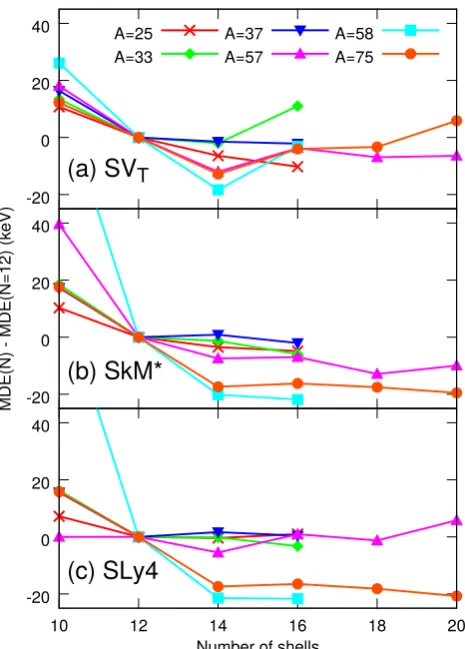
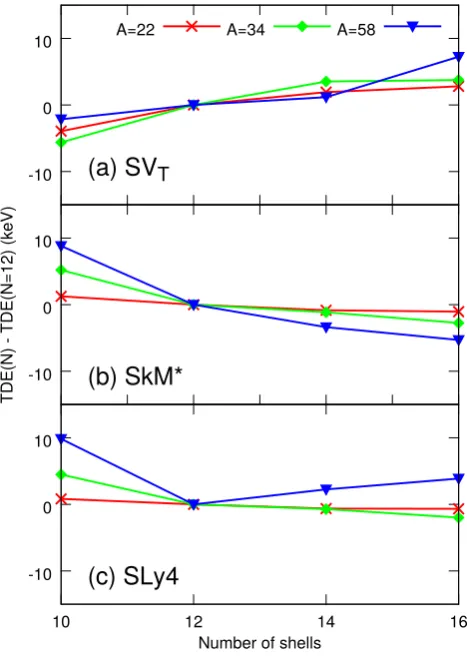
between computation time and expected precision of the calculations. To evaluate theoretical uncertainty of the calculated MDEs and TDEs due to the basis size we have performed test calculations forT = 12 doublets with A=25, 33, 37, 57, and 75 and for T = 1 triplets with A = 22, 34, and 58. Calculations have been performed using the spherical HO bases consisting of N = 10, 12, 14, and 16 shells. For the heaviest doublets and triplets with A = 57, 58, and 75, we have extended the test by including the bases consisting ofN=18 and 20 shells. In each case we have computed both the MDEs and TDEs using three different S-EDF parametrizations, including the density-independent SVT S-EDF of Refs. [12, 13] and two popular density-dependent S-EDFs SkM∗ [14] and SLy4 [15]. Results are collected in Figs. 1 and 2.
The basis-size-dependence tests suggest that the optimal strategy re-garding both efficiency and accuracy of the calculations is to compute light (A= 10−30?), medium-mass nuclei (A= 31?−56), and heavy (A ≥57) nuclei using bases consisting of N=10, 12, and 14 spherical HO shells, re-spectively. Both for the MDEs and TDEs, this strategy would result in the basis-size related uncertainty not exceeding ∆basis ≈ ±15 keV. As we show in Sect. 3, the basis-size uncertainty is relatively small as compared to the uncertainty resulting from the fitting procedure, which may justify using even smaller bases.
3. Fitting results
As stated in Sec. 2, the optimum choice of the number of spherical HO shells implies dividing the mass region of interest into the three subsets. In the present preliminary study, we use N=10 shells for all nuclei having masses A = 10−56 and 58, and we use N = 14 shells only for the heavi-est systems. This choice almost doubles the basis-size related uncertainty of the calculated MDEs to ∆basis ≈ ±30 keV without much affecting the uncertainty of the calculated TDEs. A smaller computational time allows us to explore the richness of experimental data available for ISB effects in the A = 10−58 nuclei. In future, it may allow us to perform calcula-tions of mirror (MED) and triplet (TED) energy differences in rotational bands or the ISB effects in electromagnetic and β decays using the recently developed no-core configuration-interaction (NCCI) formalism [16], which involves CPU time demanding isospin and angular momentum projections and configuration mixing.
With the less strict choice of the basis size, the two new coupling con-stants (see Ref. [10]) were adjusted to all available data on MDEs (A = 10−75) and TDEs (A = 10−58). The fitting procedure has been real-ized independently fortII
0 andt III
4 Baczyk˙v03 printed on November 3, 2016
-20 0 20 40
(a) SV
T A=25 A=33A=37 A=57
A=58 A=75
-20 0 20 40
M
D
E(N
) - M
D
E(N
=
12) (k
e
V)
(b) SkM*
-20 0 20 40
10 12 14 16 18 20
Number of shells
(c) SLy4
Fig. 1. (Color online) Values of MDEs in function of the number of spherical HO shells used in the basis, plotted with respect to that obtained forN = 12. Results for multiplets with different values of A are labelled with different symbols, as shown in the legend. Panels (a), (b), and (c) show values obtained using SVT, SkM*, and SLy4 S-EDFs, respectively.
and following the guidelines from Ref. [17] and will be described in details in our forthcoming publication. The fitting results as well as the standard deviations from the experimental data points are presented in Table 1.
As it turns out, the uncertainty resulting from the choice of the basis cut-off, ∆basis, is small with respect to the values of standard deviations, σfit, given in Table 1. Hence, in the total uncertainty, ∆T =
q
[image:5.595.180.413.157.482.2]-10 0 10
(a) SV
TA=22 A=34 A=58
-10 0 10
T
D
E(N
) - T
D
E(N
=
12) (k
eV
)
(b) SkM*
-10 0 10
10 12 14 16
Number of shells
(c) SLy4
[image:6.595.179.413.159.488.2]Fig. 2. (Color online) Same as in Fig. 1, but for the TDEs.
Table 1. Values of thetII
0 andtIII0 parameters with uncertainty and standard devia-tions for MDE and TDE,σfit, resulting from the fit to all available data on isospin doublets and triplets. The calculations has been done for three different S-EDFs considered in this work.
Interaction SV SkM* SLy4 tII0 (MeV fm
3
) 17±5 24±8 22±7 σfit (keV) 100 110 100 tIII
0 (MeV fm 3
) −7.3±1.9 −5.5±1.3 −5.5±1.1 σfit (keV) 190 150 120
4. Summary
[image:6.595.162.434.573.649.2]6 Baczyk˙v03 printed on November 3, 2016
to the basis size. It turned out that the optimum choice of the number of spherical HO shells,N, which defines the basis size, isN = 10 for light nuclei (A= 10−30?),N = 12 for medium-mass nuclei (A= 31?−56) andN = 14 for heavy nuclei (A≥57). It is shown, that the corresponding uncertainty, ∆basis ≈ 15 ˙keV is small as compared to the uncertainty coming from the fitting procedure. This allows us to compute light and medium-mass nuclei using the basis consisting only ofN = 10 HO shells without loosing much of the precision. Smaller basis, in turn, will be beneficial regarding efficiency of the planned NCCI calculations. Finally, the two new coupling constants were adjusted to all available experimental data. The details of the fitting procedure will be presented in the forthcoming publications.
This work has been supported by the Polish National Science Centre under the contract 2015/17/N/ST2/04025 and by the Academy of Finland and University of Jyv¨askyl¨a within the FIDIPRO program. Advanced com-putational resources were provided by the ´Swierk Computing Centre (CIS) at the National Centre for Nuclear Research (NCBJ).
REFERENCES
[1] E. Wigner, Phys. Rev.51, 106 (1937).
[2] G.A. Miller, B.M.K. Nefkens, and I. ˇSlaus, Phys. Rep. 194, 1 (1990). [3] J.A. Nolen and J.P. Schiffer, Ann. Rev. Nuc. Sci.19, 471 (1969).
[4] W. Satu la, J. Dobaczewski, M. Konieczka, and W. Nazarewicz, Acta Phys. Polon. B45, 167 (2014).
[5] R. B. Wiringa, V. G. J. Stoks, and R. Schiavilla, Phys. Rev. C51, 38 (1995). [6] R. Machleidt, Phys. Rev. C63, 024001 (2001).
[7] R.B. Wiringaet al., Phys. Rev. C88, 044333 (2013). [8] T.H.R. Skyrme, Nucl. Phys.9, 615 (1959).
[9] M. Bender, P.-H. Heenen, and P.-G. Reinhard, Rev. Mod. Phys. 75, 121 (2003).
[10] P. Baczyk, J. Dobaczewski, M. Konieczka, and W. Satu la, Acta Phys. Pol. B֒ Proc. Suppl.8, 539 (2015).
[11] N. Schuncket al., Comput. Phys. Commun.183, 166 (2012).
[12] M. Beiner, H. Flocard, N. Van Giai, and P. Quentin, Nucl. Phys. A 238, 29 (1975).
[13] W. Satu la, J. Dobaczewski, W. Nazarewicz, and M. Rafalski, Phys. Rev. Lett. 106, 132502 (2011).
[14] J. Bartel, P. Quentin, M. Brack, C. Guet, and H.B. H˚akansson, Nucl. Phys. A386, 79 (1982).
[16] W. Satu la, P. Baczyk, J. Dobaczewski, and M. Konieczka, Phys. Rev. C֒ 94, 024306 (2016).