Full Terms & Conditions of access and use can be found at
http://www.tandfonline.com/action/journalInformation?journalCode=rhpb20
Download by: [University of Leeds] Date: 30 October 2017, At: 05:29
An Open Access Journal
ISSN: (Print) 2164-2850 (Online) Journal homepage: http://www.tandfonline.com/loi/rhpb20
Testing message framing to increase physical
activity among British South Asians
A. K. Daffu-O’Reilly, D. B. O’Connor & R. J. Lawton
To cite this article: A. K. Daffu-O’Reilly, D. B. O’Connor & R. J. Lawton (2017) Testing message framing to increase physical activity among British South Asians, Health Psychology and Behavioral Medicine, 5:1, 372-389, DOI: 10.1080/21642850.2017.1377617
To link to this article: http://dx.doi.org/10.1080/21642850.2017.1377617
© 2017 The Author(s). Published by Informa UK Limited, trading as Taylor & Francis Group
Published online: 17 Oct 2017.
Submit your article to this journal
Article views: 140
View related articles
Testing message framing to increase physical activity among
British South Asians
A. K. Daffu-O’Reilly a, D. B. O’Connorband R. J. Lawtonb
a
School of Healthcare, University of Leeds, Leeds, UK;bInstitute of Psychological Sciences, University of Leeds, Leeds, UK
ABSTRACT
Objective:British South Asians (BSAs) experience a higher incidence of coronary heart disease (CHD) which is not declining in line with the UK national average. Low physical activity levels are likely to contribute to this elevated risk. This study investigated the effectiveness of message framing, cultural sensitivity and their interaction on promoting physical activity among BSAs.
Design:One hundred and seventy-nine participants (70 males and 109 females) were randomly allocated to watch one of four films in a 2 (loss vs. gain) × 2 (culturally sensitive vs. non-culturally sensitive) design.
Main outcome measures: Measures of self-reported physical activity and behavioural intention were completed at baseline and two-month follow-up.
Results:The analysis revealed no main effects for message framing, cultural sensitivity or for the interaction between these factors for self-reported physical activity and behavioural intention.
Conclusions: Healthy BSAs appear not to respond to health promotion messages which have been manipulated by message framing or cultural sensitivity. Possible explanations are that despite an increased risk of developing CHD, healthy BSAs may be unwilling to engage in immediate action for a potential future health problem and cultural sensitivity may be irrelevant to a
‘Westernised’ sample. Nevertheless, future research ought to investigate variations of the current intervention by using a larger sample size, targeting a more sedentary population, varying the length and exposure to the intervention in less assimilated groups, clinically symptomatic populations or those at high risk of CHD.
ARTICLE HISTORY Received 16 November 2016 Accepted 18 June 2017
KEYWORDS
British South Asian; coronary heart disease; message framing; prevention; behaviour change
Introduction
British South Asians and coronary heart disease
British South Asians (BSAs) are people of Indian, Pakistani or Bangladeshi origin resid-ing in the UK. Cardiovascular diseases are more prevalent among BSAs compared to the national average (British Heart Foundation, 2010, 2012). Genetic and
© 2017 The Author(s). Published by Informa UK Limited, trading as Taylor & Francis Group
This is an Open Access article distributed under the terms of the Creative Commons Attribution License (http://creativecommons.org/ licenses/by/4.0/), which permits unrestricted use, distribution, and reproduction in any medium, provided the original work is properly cited.
CONTACTA. K. Daffu-O’Reilly [email protected] School of Healthcare, University of Leeds, Leeds LS2 9JT, UK
https://doi.org/10.1080/21642850.2017.1377617
environmental factors (e.g. Vitamin D deficiency, increased incidence of diabetes, greater social deprivation) have been suggested for this higher prevalence (Barnett et al.,2006; Nazroo, 2001). However, the fact that South Asians in Britain and other European countries present with myocardial infarction up to 10 years earlier compared to their White/European counterparts (Yusuf et al.,2005) suggests that lifestyle may be an important modifiable risk factor and of equal significance as genetic causes. Cardi-ovascular diseases, in particular diabetes and coronary heart disease (CHD), are at epi-demic levels in India and Pakistan with similar causal factors to that of BSAs in the UK, namely unhealthy diets and sedentary lifestyles (Gupta, Mohan, & Narula, 2016). In India, CHD was responsible for 26% of adult deaths between 2001 and 2003, rising to 32% between 2010 and 2013 (Gupta et al.,2016). World Health Organization data states that 19% of all deaths in Pakistan were due to cardiovascular diseases, with no defined strategies to arrest this problem (World Health Organization, 2014). It seems, therefore, that the lifestyle of South Asians residing both in the UK and in indi-genous countries is similar as well as equally problematic. The National Service Frame-work for South Asians and Coronary Heart Disease (Fox, 2004) describes physical activity as a ‘major independent protective factor against CHD’(p. 41). Studies show that high and moderate levels of physical activity provide significant protection against CHD (Sofi, Capalbo, Cesari, Abbate, & Gensini, 2008). However, Health Survey for England 2008data (BHF,2012) report that for Pakistani and Bangladeshi men, only 28% and 26%, respectively, met the recommended physical activity target. Only 14% of Pakistani women and 11% of Bangladeshi women met the target, mainly from housework. Thirty per cent of Indian men and 23% of Indian women met the recommended physical activity target. Research consistently shows that Indian men and women are the most physically active out of the three main South Asian groups, but physical activity levels are still low when compared to Whites (Bhat-nagar, Townsend, Shaw, & Foster,2015). Low physical activity levels and gender differ-ences are well documented (Fischbacher, Hunt, & Alexander, 2004) as well as sub-group differences; Muslims are identified as more sedentary compared to Sikhs and Hindus and CHD-related mortality occurs more among Pakistani and Bangladeshi groups (Williams, Nazroo, Kooner, & Steptoe,2010; Williams, Stamatakis, Chandola, & Hamer, 2011). Barriers to physical activity among BSAs vary and include lack of time, insensitivity towards faith in gyms, cost, lack of motivation, lack of an‘exercise companion’ and gender expectations (Farooqi, Nagra, Edgar, & Khunti, 2000; Jepson et al.,2008; Sriskantharajah & Kai,2006). Therefore, BSAs would benefit from interven-tions promoting greater participation in physical activity.
Reducing CHD risk through physical activity among BSAs
The research on interventions to increase physical activity among BSAs is limited. One community programme, Khush Dil (Mathews, Alexander, Rahemtulla, & Bhopal,2007) identified ‘at risk’ individuals and offered culturally appropriate support, such as cookery and smoking cessation workshops. Fifty-three per cent of participants increased moderate exercise and statistically significant improvements to weight, body mass index (BMI), blood pressure and cholesterol were observed. However, identifying the‘effective’ component of the programme was difficult due to a lack of control group; a common
problem applicable to other interventions. Coe and Boardman (2008) undertook a lifestyle intervention at a UK Sikh Temple to encourage behaviour change and improve lifestyle; however, there were no quantitative outcome measures. A recent review assessing the effectiveness of physical activity and dietary interventions (both randomised controlled trials and non-randomised controlled trials) for South Asians identified just four studies, including the aforementioned Mathews et al. (2007) study (Chapman, Qureshi, & Kai,2013). Three studies were based in the UK and one in New Zealand. Only one study (Mathews et al.,2007) included self-reported changes to dietary and physical activity behaviours. It was not possible to undertake meta-analyses with the studies due to lack of control groups, inconsistencies in measures and poor quality outcome data. Other pro-blems include a lack of statistical significance testing, lack of validated tools for measuring outcomes and no use of theoretical frameworks to inform interventions. Therefore, the need for theoretically informed and robustly designed behavioural interventions for the BSA population is great. Other studies for BSAs focus on reducing CHD risk and not phys-ical activity, per se (Akhtar, Feather, & Summerscales,2001; Farooqi & Bhavsar,2001).
Message framing and health behaviours
Prospect theory is a widely applied framework informing behaviour change interventions (e.g. Abhyankar, O’Connor, & Lawton,2008; Kahneman & Tversky,1979). Traditionally, prospect theory predicts patterns of decision-making under risk, such that individuals will respond differently to risky information depending on how the risk is presented. Gener-ally, people avoid risks when considering gains but are risk-seeking when considering losses. Based upon prospect theory, Rothman and Salovey (1997) argue that message framing can inform health behaviour change interventions because, broadly speaking, health behaviours fall into two categories, those that may be perceived as risky and those that are not. Prevention behaviours (e.g. physical exercise) present little risk to the individual and are more likely to result in certain outcomes, whereas detection beha-viours (e.g. health screening) are perceived riskier because of the potential detection of an abnormality and the outcomes may be less certain. To this end, Rothman and Salovey (1997) propose that gain frames are more effective when promoting the performance of prevention behaviours (because of the low risk) and loss frames are more effective when promoting the performance of detection behaviours (because of a potentially risky outcome) (Covey, 2014; Gallagher & Updegraff, 2012; O’Keefe & Jensen, 2009; Uskul, Sherman, & Fitzgibbon,2009). Additionally, Levin, Schneider, and Gaeth (1998) describe a framing typology to distinguish between the different types of framing effects; risky choice framing (based upon the tenets of prospect theory), attribute framing (involving evaluation of an object or an event) and goal framing, which manip-ulates the persuasiveness of messages/information. The current study, along with many other framing studies, employs the use of goal framing, which manipulates the persuasive-ness and appeal of a health communication through the use of positive and negative wording.
Regarding physical activity interventions employing message framing, the research findings are mixed; some have demonstrated message framing effects on physical activity behaviours (Latimer et al., 2008), whereas others have not (Jones, Sinclair, Rhodes, & Courneya, 2004). Generally, main effects of message framing on physical activity are
sparse and any observed effects usually coincide with interaction/moderation effects (e.g. Kalichman & Coley, 1995). Providing a conclusive statement about the direction of the effects of message framing on physical activity is, therefore, difficult. However, Gallagher and Updegraff’s (2012) meta-analytic review of framing effects on attitudes, intentions and behaviour found that the effect of gain framed messages on actual physical activity beha-viours was significantly different to loss framed messages. In additional to physical activity, gain framing was found to be particularly effective for skin cancer prevention, smoking cessation and safe sex. Such findings support Rothman and Salovey’s (1997) pre-dictions and thereby justify further research into the effects of framing on illness preven-tion behaviours.
Cultural sensitivity
The current study tested a novel variable–cultural sensitivity–in response to calls for more culturally tailored/appropriate behaviour change research (Netto, Bhopal, Lederle, Khatoon, & Jackson,2010). Incorporating personally relevant cultural nuances (i.e. experi-ences, history, social norms) into interventions can increase receptivity, importance and acceptance (Resnicow, Baronowski, Ahluwalia, & Braithwaite,1999). Cultural sensitivity has been manipulated in studies involving non-BSA minority ethnic groups with favour-able outcomes for diabetes management (Brown & Harris,1995) and HIV testing (e.g. Apa-novitch, McCarthy & Salovey,2003) for example. Specific to BSAs, O’Hare et al. (2004) have demonstrated how a tailored diabetes care programme brought about decreases in blood pressure and cholesterol, but studies nevertheless remain limited for BSAs.
Therefore, taken together, the aim of this study was to investigate the effectiveness of message framing, cultural sensitivity and their interaction on promoting physical activity among BSAs.
Method
Participants
Three hundred and fifty-five participants responded to the recruitment campaign which involved advertising the study through local community centres, places of worship, Inter-net, local radio and email. Fliers and participant information leaflets were provided. Fifty-six participants were recruited by visiting local community centres.
Participants were included if they were over 18 years, of South Asian origin, able to read English, residing in the UK and not experiencing a recent acute (e.g. myocardial infarc-tion) or uncontrolled illness (e.g. uncontrolled high blood pressure). Pregnant women were excluded. Participants completed the Physical Activity Readiness Questionnaire (Thomas, Reading, & Shephard, 1992) with additional questions relating to acute and uncontrolled illness.
Participant flow
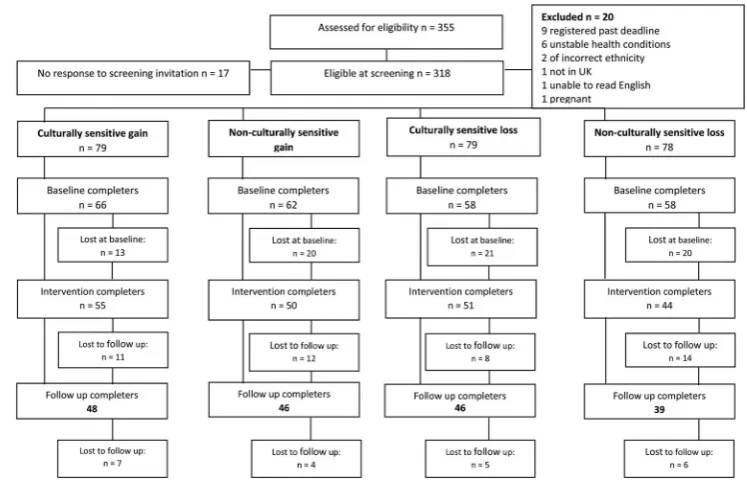
A flow diagram (Figure 1) shows that 355 individuals were assessed for eligibility and 179 individuals completed the study.
Demographics
[image:6.493.56.430.52.294.2]One hundred and seventy-nine participants completed all three parts of the study. There were 109 females and 70 males. The mean age was 42.8 years (SD = 12.8). Sixty-four per cent held a university degree or higher. This is quite a high percentage, in comparison to national statistics, where a lower number of people of South Asian origin are degree qua-lified. Census data from 2011 show that 42% of Indians, 25% of Pakistanis, 20% of Ban-gladeshis and 35% of‘other Asians’ have degree level qualifications (Lymperopoulou & Parameshwaran,2014). The mean BMI was 24.3 (SD = 6.6) (a BMI of >25 is overweight). Eighty-seven per cent held a British passport and 40% were born in England. Other countries of birth were India (24%), East Africa (18%) and Pakistan (12%) (East Africans were included because many Hindu, Sikh and Muslims in the UK come from East Africa from the time of the Indian diaspora in the nineteenth century to Southeast Africa to work as labourers on the Kenya–Uganda railway or as traders, whilst having their ancestral roots in indigenous countries. In 1972, General Idi Amin ordered the expulsion of Ugan-dans of Asian descent, resulting in 30,000 Ugandan Asians moving to Britain and now identify themselves as East African in origin (BBC News, 2012)). Fifty-one per cent cited India as their country of origin followed by Pakistan (39%). Fifty-four per cent cited English as their first language. The sample generally reflects the distribution of Asians and British Asians in the UK, where the number of people of Indian origin exceeds that of people of Pakistani origin (Office of National Statistics, 2011). Across the entire sample, 48% were Muslim, 7.8% Sikhs, 25.7% Hindus, 8% Jains and 2% Chris-tian. Individuals considered themselves to be in reasonable health, with a mean score of 4.5 (SD = 1.3) (on a scale of 1 (very much) to 7 (not at all)). There was a strong desire to be healthier, with a mean score of 2.4 (SD = 1.8) (on a scale of 1 (very much) to 7 (not at all)).
Figure 1.CONSORTflow chart.
Most (74%) participants reported not having any health conditions. However, 6% had controlled high blood pressure, 6% had stable diabetes, 5% asthma, 5% CHD and 4% reported having both high blood pressure and diabetes.
Design
A 2 (framing: gain vs. loss) × 2 (cultural sensitivity: culturally sensitive vs. non-culturally sensitive) mixed design was utilised. Data were collected at two time points–baseline and follow-up (2 months after intervention). The estimated sample size to detect a small differ-ence (0.2) with 80% power and alpha of 0.05 was 174 participants for this 2 × 2 design (G*Power; Faul, Erdfelder, Lang, & Buchner,2007).
Procedure
Ethical approval was obtained from the Institute of Psychological Sciences Ethics Commit-tee, University of Leeds. Interested potential participants contacted the researcher for a screening appointment. Confidentiality, data protection, anonymity and right of withdra-wal were explained. The three stages of the study were clarified. Baseline–first question-naire (consent, demographics, International Physical Activity Questionquestion-naire (IPAQ)). Intervention–second questionnaire (DVD and DVD feedback, where participants were asked to view and record their views and feelings on the DVD, both positive and negative). Follow-up–third questionnaire (identical IPAQ to first questionnaire) at 2 months post intervention. This study was completed by post with pre-paid envelopes with the consent form included with the baseline questionnaire. Participants were allocated to the four con-ditions using a random number generator (www.random.org).
Randomisation and allocation concealment
After a successful screening, participants were allocated to one of the four experimental film conditions using a random allocation sequence. Participants from the same house-hold received the same treatment. All participants were blind to condition and were informed that they would receiveaDVD film after completing and returning the baseline questionnaire. Participants were fully debriefed after completion of the study.
DVD film development
A small body of research evidence shows that individuals from minority ethnic back-grounds prefer videos/DVD films as a method of receiving information compared to other media, such as leaflets (e.g. Geana, Kimminau, & Greiner,2011; Gettleman & Wink-leby,2009). The production of the films began with script writing, informed by three prin-cipal sources of information/theory – the findings from previous qualitative interviews conducted specifically to identify culturally and non-culturally specific barriers and facil-itators to healthy living (Daffu-O’Reilly,2011), factual health information resources (e.g. UK Department of Health) and the theory of planned behaviour (TPB; Ajzen,1988,1991). Based on the TPB model and the antecedents of intention formation, the barriers and facilitators identified from the interviews were mapped onto the TPB constructs of atti-tude, subjective norm and perceived behavioural control and these constructs were
targeted within the films. In line with previous message framing studies 26% of the script was framed (e.g. Apanovitch et al.,2003). There were three distinct sections in the DVD– factual information about CHD (explanation of disease, symptoms, facts and figures, pre-ventability), diet (dangers of consuming too much saturated fat, the difference between saturated and unsaturated fats, suggestions to reduce fat intake–using non-stick cook-ware, grilling and baking foods and decreasing portion sizes) and physical activity (national guidance of 30 minutes of physical activity on five or more days of the week, explanation of moderate physical activity, difficulties of maintaining exercise routines, costly gym memberships, low cost/free alternatives–brisk walking, gardening, cleaning, DIY, active play with children, dancing, yoga, playing games in local park). Whilst the DVD also covered diet and knowledge about CHD, this paper reports physical activity outcomes only. Examples of framed messages included in the films are:
Gain frame: Doing physical activity could help reduce your risk of heart disease, diabetes and blood pressure and will benefit your general well-being and self-esteem. By doing enough physical activity, you can feel confident that you are taking positive steps to looking after your long term health.
Loss frame:If you don’t do physical activity you could increase your risk of heart disease, diabetes, blood pressure and you won’t benefit your general well-being and self-esteem. By not doing enough physical activity, you will miss out on the chance of feeling confident that you are taking positive steps to looking after your long term health.
Cultural sensitivity was achieved by implementingsurface structureanddeep structure
dimensions outlined by Resnicow et al. (1999). Examples of surface structure character-istics are familiar people, places, food, music and locations, all of which were included. Deeper structure characteristics reflect a more comprehensive understanding of the target audience, pertaining to‘how ethnic, cultural, social, environmental and historical factors may influence specific health behaviours’(p. 12). To achieve this, qualitative inter-views were completed with 20 BSAs investigating health behaviour decision-making (diet and physical activity). Findings relating to cultural and social factors were described in the films. For the non-culturally sensitive films, specific references, for both script and sup-porting visuals, were replaced with generic wording. Examples of the culturally and non-culturally sensitive messages included are:
Cultural script:Heart disease is actually 50% more common among Asian people compared to the White British population putting us at an increased risk.
Non cultural script: Heart disease is the UK’s biggest killer and claims around 100,000 lives every year.
The scripts were storyboarded prior to filming. Filming took place at locations around the North of England area and comprised of a presenter narrating the script with accom-panying visuals for added interest and appeal, resulting in four films–culturally sensitive gain frame, culturally sensitive loss frame, non-culturally sensitive gain frame, non-cultu-rally sensitive loss frame. A BSA female presenter narrated the cultunon-cultu-rally sensitive films and a White British female presenter narrated the non-culturally sensitive films. The cul-turally sensitive films included South Asian actors and families, included footage of foods from Asian supermarkets, Asian sweet confectionary, vegetables widely used in Asian cooking, preparation of Asian food (e.g. chapatti, kebab), Asian actors engaging in
physical activity (running/brisk walking, sweeping/gardening, cleaning, vacuuming, playing, doing yoga). The non-culturally sensitive films included people/actors/families involved in similar scenes, but acted with people from different minority ethnic groups. The culturally sensitive films aimed to be as representative as possible of the South Asian culture. Apart from cultural sensitivity, the films were as similar as possible in terms of wording, visual content, target behaviours and length (12 minutes). The films were produced by the principal author with an independent camera man. The acceptabil-ity of the films was tested with 80 participants, revealing that they were understood, well received and described as informative and interesting. Alterations were not required.
Main outcome measures
Demographics–age, gender, qualifications, BMI, citizenship, country of birth, country of origin, first language, religion, self-reported health status, desire to be healthy and CHD family history were assessed using single item measures.
Physical activity measures–physical activity was measured in two ways. First, inten-tions to engage in physical activity were measured using three items on a Likert type scale ranging from 1 (strongly agree) to 7 (strongly disagree): ‘I intend/want/expect to increase my physical activity in the next 2 weeks’(Conner & Norman,2005). The Cron-bach’s alpha coefficient (α) for these items was .85. Second, physical activity was measured by the short form of the IPAQ (Craig et al.,2003). This tool was chosen because it is the most widely used questionnaire to measure physical activity and is quick and easy to com-plete (Lee, Macfarlane, Lam, & Stewart,2011). The IPAQ has also been demonstrated to be a valid and reliable measurement of self-reported physical activity, both on paper, compu-terised versions as well as in different languages (Craig et al.,2003; Vandelanotte, De Bour-deaudhui, Philippaerts, Sjöström, & Sallis, 2005). Total activity comprised of a combination of vigorous, moderate and walking activity. Physical activity was measured at baseline and follow-up (2 months after viewing the DVD film). Data for total activity in the last 7 days were collected. IPAQ scores were expressed as metabolic equivalent task (MET) values with high scores indicating greater physical exertion. Data are pre-sented for follow-up total IPAQ score, using baseline data as the covariate. Data are reported for all participants and separate analyses are reported for inactive participants (described as ‘insufficiently active’), minimally active participants (‘those achieving more than the minimum level of activity recommended for adults in current health rec-ommendations, but is not enough for“total PA”when all domains are considered’) and high exercisers (for people who exceed the minimum public health physical activity rec-ommendations and are accumulating enough activity for a healthy lifestyle (at least 1.5–2 hours per day’)), as defined by the IPAQ short form scoring protocol (p3; The IPAQ Group,2004) to determine any differences in these groups.
Statistical methods
Statistical Package for the Social Sciences version 23 was used for data analysis. A 2 (con-dition: loss vs. gain) × 2 (cultural sensitivity: culturally sensitive vs. non-culturally sensi-tive) analysis of covariance (ANCOVA) tested the main and interaction effects on intentions and behaviour. Analysis of variance (ANOVA) was conducted to detect
differences in intention. Baseline intention scores and baseline IPAQ scores were included as covariates in the analyses. Intention to treat analysis was also conducted.
Results
Randomisation checks
Randomisation checks were performed to ensure participants in the four groups were similar with respect to baseline MET scores (METS), age, gender and BMI. No statistically significant differences were found for baseline METS, age or BMI. A chi-square test indicated that there were statistically significant differences in the proportion of males and females,χ²(1,n= 178) = 8.99,p= .003. The gain frame culturally sensitive condition consisted of 19 males and 29 females, the loss frame culturally sensitive condition consisted of 11 males and 35 females, the gain frame non-culturally sensitive condition consisted of 21 males and 24 females and the loss frame non-culturally sensitive condition consisted of 18 males and 21 females.
There were 48 participants identified as inactive, 76 as minimally active and 30 as highly active.
Drop-out analysis
There were no statistically significant differences between the participants who did and did not complete the study in terms of age, gender, BMI or baseline physical activity levels.
Descriptive statistics for intention scores
The baseline and follow-up scores for intention are presented inTable 1. The scores did not differ greatly across the two time-points.
Descriptive statistics for the IPAQ
The baseline and follow-up data for the IPAQ for total physical activity in MET values are presented inTable 2. Broadly speaking, the means were quite high for males and females across each of the conditions.
The effects of framing and cultural sensitivity on behavioural intentions to increase physical activity and self-reported physical activity for all participants
[image:10.493.59.434.580.627.2]An ANOVA did not reveal any statistically significant differences in the means across the four conditions for intention scores. There were no significant effects of framing
Table 1. Descriptive statistics for baseline and follow-up intention scores (means and standard deviations).
Framinga Gain frame Loss frame
Cultural sensitivityb Culturally sensitive Non-culturally sensitive Culturally sensitive Non-culturally sensitive
Total Baseline 8.19 (3.90) 9.09 (3.44) 7.04 (3.73) 9.38 (4.24) Follow-up± 8.19 (3.40) 9.07 (4.60) 8.0 (4.25) 9.23 (4.56)
a
Main effect of frame,F(1, 165) = 0.13,p= .71.
bMain effect of cultural sensitivity,F(1, 165) = 0.10,p=.74; ±frame × cultural sensitivity,F(1, 165) = 0.12,p= .72.
(F(1, 165) = 0.13,p= .71, partial eta squared = .00), cultural sensitivity (F(1, 165) = 0.10,p
= .74, partial eta squared = .00) or for the frame by cultural sensitivity interaction (F(1, 165) = 0.12, p= .72, partial eta squared = .00) on intentions to increase physical activity. See Table 1 for intention scores across the four conditions. The means for baseline and follow-up across all four conditions were 8.4 (SD = 3.9) and 8.6 (SD = 4.2), respectively. An ANCOVA for intention scores, controlling for baseline intention scores, revealed no effects of framing, cultural sensitivity or the framing by cultural sensitivity interaction.
Similarly, a 2 (framing: gain vs. loss) × 2 (cultural sensitivity: culturally sensitive vs. non-culturally sensitive) ANCOVA controlling for baseline total physical activity scores, found no effects of framing (F(1, 148) = 0.11,p= .73, partial eta squared = .00), cul-tural sensitivity (F(1, 148) = 0.26, p= .61, partial eta squared = .00) or of the framing by cultural sensitivity interaction (F(1, 148) = .03,p= .85, partial eta squared = .01). There were no statistically significant effects of framing, cultural sensitivity or the framing by cul-tural sensitivity interaction on any of the individual components of the IPAQ–vigorous, moderate or walking activity.
The means for total activity for baseline and follow-up across all four conditions were 1522.23 METS (SD = 1361.38) and 1575.45 METS (SD = 1443.63), respectively. SeeTable 2for condition-specific scores.
The effects of framing and cultural sensitivity on behavioural intentions to increase physical activity and self-reported physical activity among‘inactive’ participants
For post intervention physical activity behaviour intentions, an ANOVA revealed no statistically significant differences across the four conditions for inactive participants. An ANCOVA for intention scores, controlling for baseline intention scores, revealed no effects of framing, cultural sensitivity or the framing by cultural sensitivity interaction.
An ANCOVA for self-reported physical activity behaviour controlling for baseline total activity scores for inactive participants found no significant effects for framing (F(1, 47) = 0.17,p= .68, partial eta squared = .00), cultural sensitivity (F(1, 47) = 1.65,p= .20, partial eta squared = .00), or for the framing by cultural sensitivity interaction, (F(1, 47 = 0.01,
[image:11.493.63.434.74.139.2]p= .92, partial eta squared = .00). There were no statistically significant effects of framing, cultural sensitivity or the framing by cultural sensitivity interaction on any of the individual components of the IPAQ–vigorous, moderate or walking activity.
Table 2.Descriptive statistics for baseline and follow-up METS for the IPAQ (means and standard deviations).
Framinga Gain frame Loss frame
Cultural sensitivityb Culturally sensitive Non-culturally sensitive Culturally sensitive Non-culturally sensitive
Total Baseline 1169.24 (1202.84) 1573.36 (1447.42) 1569.36 (1386.78) 1787.31 (1377.90) Follow-up± 1451.80 (1338.29) 1556.04 (1335.21) 1619.05 (1569.31) 1676.35 (1559.16)
Males 14 18 10 18
Females 27 24 33 21
aMain effect of frame,F(1, 148) = 0.11,p= .73. b
Main effect of cultural sensitivity,F(1, 148) = 0.26,p=.61; ±frame × cultural sensitivity,F(1, 148) = 0.03,p= .85.
The effects of framing and cultural sensitivity on behavioural intentions to increase physical activity and self-reported physical activity among‘minimally active exercisers’
For post intervention physical activity behaviour intentions, an ANOVA revealed no stat-istically significant differences across the four conditions for minimally active participants. An ANCOVA for intention scores, controlling for baseline intention scores, revealed no effects of framing, cultural sensitivity or the framing by cultural sensitivity interaction.
An ANCOVA for self-reported physical activity behaviour controlling for baseline total activity scores for minimally active exercisers found no significant effects for framing (F(1, 74) = 0.85, p= .36 partial eta squared = .01), cultural sensitivity (F(1, 74) = 0.26, p= .60, partial eta squared = .00), or for the framing by cultural sensitivity interaction (F(1, 74) = 0.73 p= .39, partial eta squared = .01). There was a statistically significant effect of framing on moderate activity (F(1, 74) = 3.90,p= .05 partial eta squared = .05). Partici-pants in the gain framing conditions reported higher moderate activity scores compared to participants in the loss framing conditions (411.42 vs. 214.44). There were no statisti-cally significant effects of cultural sensitivity or the framing by cultural sensitivity inter-action on vigorous or walking activity.
The effects of framing and cultural sensitivity on behavioural intentions to increase physical activity and self-reported physical activity among‘high exercisers’
For post intervention physical activity behaviour intentions, an ANOVA revealed no stat-istically significant differences across the four conditions for high exercisers. An ANCOVA for intention scores, controlling for baseline intention scores, revealed no effects of framing, cultural sensitivity or the framing by cultural sensitivity interaction.
An ANCOVA for self-reported physical activity behaviour controlling for baseline total activity scores for high exercisers, found no effects of framing (F(1, 27) = 0.43,
p= .51 partial eta squared = .01), cultural sensitivity (F(1, 27) = 0.06, p= .80, partial eta squared = .00), or for the framing by cultural sensitivity interaction (F(1, 27) = 1.32, p= .26, partial eta squared = .05). There were no statistically significant effects of framing, cultural sensitivity or the framing by cultural sensitivity interaction on any of the individual components of the IPAQ – vigorous, moderate or walking activity.
DVD feedback
Forty-nine participants in Condition 1 (gain frame culturally sensitive) provided feedback on the DVD. Similarly, 42 participants in Condition 2 (gain frame non-culturally sensi-tive), 48 participants in Condition 3 (loss frame culturally sensitive) and 43 participants in Condition 4 (loss frame non-culturally sensitive) provided written feedback on the DVD in the booklet provided. In general, the feedback was positive, however, some par-ticipants described it as boring, too long and lacking in new and insightful information. It was noted by participants in the non-culturally sensitive condition that the DVD was not sensitive to the Asian culture. Examples of feedback are provided below:
This is a very good video to make people understand that the food, physical activity is very important for our Asian people. (Participant from gain frame culturally sensitive condition)
Excellent. Initially everyone looked fairly slim and White. I think you need more culture specific role models of activities –dancing tough for many (funding etc.) –many Asian women like to exercise, dance etc., so need to know this is possible for THEM. (Participant from gain frame non-culturally sensitive condition)
I think the DVD is great and is very much needed for the South Asian people here in the UK. It should encourage people to look after their health. (Participant from loss frame culturally sensitive condition)
Informative, but too basic. Too much information in a 12 minute video. Need for detailed information. For South Asian people, South Asian food and cooking should be in the video. To me, our Asian cooking and food habits especially Bangladeshis living in London are not very healthy. We do not have very active lifestyles. Statistical data and information needed to show how South Asians are at risk of heart attack. (Participant from loss frame non-culturally sensitive condition)
Intention to treat analysis
Intention to treat analysis was performed on all participants who completed at least the baseline questionnaire by entering baseline IPAQ scores as follow-up scores. Using ANCOVA the intention to treat analysis did not reveal any significant effects of the inter-vention, thereby, confirming the earlier null effects.
Discussion
The aim of the current research was to investigate the effectiveness of message framing, cultural sensitivity and their interaction on promoting physical activity among BSAs. The results revealed that neither the manipulation of message framing nor cultural sensi-tivity altered intentions to engage in more physical acsensi-tivity across the sample. Also, neither message framing nor cultural sensitivity influenced total physical activity behaviour at the two-month follow-up. There are a number of possible explanations for these null findings. First, it is possible that the sample simply did not respond to the manipulation of wording in the health promotion materials; a suggestion appearing in other null effect studies (O’Connor,2008). Also, the participants may have had negative attitudes towards physical activity. In the persuasion literature, Krosnick and Petty (1995) have suggested that atti-tudes influence information-processing and judgments. Individuals who hold a negative attitude are more likely to deflect the message frame when it is presented and therefore process the information less adequately, compared with individuals with a positive attitude (see Krosnick & Petty,1995; Meyers-Levy & Maheswaran,2004).
Second, the characteristics of the cohort may provide some more clues as to the inef-fectiveness of the intervention–they were young, generally healthy with no serious health concerns. The DVDs described CHD as a condition that may occur in the future–the individuals in this study may not have considered CHD as an immediate concern and regarded it as a disease which may or may not even occur in the future. Put simply, neither immediate consideration nor behavioural action was required. Very few of the par-ticipants exhibited health concerns which would be amenable to the development of CHD
in the immediate future. For future research, it would be useful to explore whether con-sideration of future consequences (CFC; Strathman, Gleicher, Boninger, & Edwards, 1994) moderates the effectiveness of a message framing intervention in this context. For example, O’Connor, Warttig, Conner, & Lawton (2009) showed that message framing effects are influenced by individual differences in CFC. Given the characteristics of the sample, the development of CHD simply may not have been personally relevant, in turn, resulting in no action or changes in behavioural intention (O’Connor et al.,2009). There may be some benefit in conducting research with BSAs with established clinical hypertension (or similar) to assess the efficacy of messages in a more immediate and press-ing context.
Cultural sensitivity has not been widely researched in the message framing field and it is difficult to suggest why this was also an ineffective means of persuasion. A handful of message framing studies have demonstrated varying levels of ‘ethnicity’ effects, but the number of studies is low and generalisability is limited (Apanovitch et al.,2003; Conse-dine, Horton, Magai, & Kukafka, 2007; Kalichman & Coley, 1995; Lauver & Rubin, 1990; Rivers, Salovey, Pizzaro, Pizzaro, & Schneider,2005; Schneider et al.,2001; Uskul et al.,2009). However, a number of factors may explain the lack of ethnicity effects in the current study. Importantly, the majority of participants were British born and there-fore may have a higher level of integration and assimilation with the British culture. A small body of research suggests that higher levels of acculturation are synonymous with the increased adoption of ‘British’ behaviours, such as high levels of bottle-feeding among infants (Choudhry & Wallace, 2012), the adoption of a more Western diet (Jamal, 1998) and taking up more ‘formal’ exercise at gyms and purposeful venues, especially among BSA women (Carroll, Ali, & Azam,2002), for example.
Whilst high levels of acculturation may explain the lack of effects with the culturally sensitive DVDs, it fails to explain the lack of success with the non-culturally sensitive DVDs on self-reported physical activity, which should have been more appealing given the aforementioned explanations. There is also small body of research which suggests that BSA males demonstrate a stronger preference (compared to BSA females) to preserve South Asian culture through the maintenance of customs and traditions, especially relat-ing to dietary intake (Daffu-O’Reilly,2011; Wyke & Landman,1997) with less willingness amongst males to explore other cuisines (Jamal,1998). Whilst the latter research relates to dietary intake, future research should take into consideration the potential differences among BSA males and females relating to the preservation of culture, suggesting that cul-tural sensitivity may indeed play an important role when conveying health messages to specific genders, rather than BSAs per se. The differences in attitudes towards culture may warrant an entirely different and more tailored approach which is gender specific. Furthermore, whilst the different South Asian groups share many similarities, there are also many cultural and religious differences which the current research perhaps did not take fully into consideration. Approaching the different South Asian groups individually may be the way forward. This technique, however, could prove expensive, on the one hand, but could pay dividends on the other. The lack of behaviour change research among BSAs creates a sparse platform of knowledge on which to build. It is widely known that it is difficult to encourage behaviour change among older BSAs (Lawton, Ahmad, Hanna, Douglas, & Hallowell, 2005); however, very little is known about
younger BSAs and what methods are conducive to changing their behaviours. Neverthe-less, this research provides some insight in what methods may not be useful.
We recognise that the current study has a number of shortcomings and limitations that require further comment. The participants in the study, in general, were well educated and affluent; the generalisability of these findings to BSAs of lower socio-economic and edu-cation status or to older, first-generation, non-English speaking BSAs is limited. Most of the sample was also reasonably physically active at baseline; it is possible that the true potential effects of this intervention were not achieved due to an already active sample. We may have had greater success with a more sedentary sample. The number of females outweighed the males and therefore firm conclusions relating to gender differ-ences cannot be made. A non-BSA control group may have enabled a greater understand-ing of ethnic differences that may have occurred as a result of this study, although control groups are seldom used in framing research–gain vs. loss designs are typical. Alternative types of framing could also be explored (Levin et al.,1998). An imbalance in religious rep-resentation is acknowledged. The attrition in the study is also considered as a further limit-ation. Previous research has documented the difficulty of recruiting BSAs onto studies and trials (Hussain-Gambles, Atkin, & Leese,2004). Finally, it is difficult to monitor if the films were actually viewed or viewed in their entirety. Whilst a section in the booklet was pro-vided for feedback and a high volume of feedback was propro-vided, this does not guarantee viewing and may have impacted the effectiveness of the intervention. However, it is worth noting that we received similar levels of feedback across each of the conditions, therefore, reducing the likelihood that this factor accounted for the null findings. Nevertheless, future research ought to try to ensure that participants view interventions. Shorter inter-ventions would also be a recommendation for the future as this, too, may have also con-tributed to the lack of effects. Nevertheless, the length of the DVDs in this intervention was not dissimilar to another framing study utilising this type of media to convey healthy living messages (Apanovitch et al.,2003). There is therefore, significant scope to test vari-ations of the current intervention–larger sample size, targeting a more sedentary popu-lation, varying the length of the intervention, repeated exposure to the intervention verses a single dose of intervention. The need for further research, however, either by varying the current intervention or testing new, theoretically informed interventions is evidently clear and in urgent need.
We also acknowledge limitations relating to the use of the IPAQ as a stand-alone measure of reported physical activity. Nevertheless, previous studies have demonstrated the reliability and validity of the IPAQ for use in different countries, digitised forms, in different languages and shows high concurrence between reported physical activity and objectively recorded physical activity (Craig et al., 2003; Vandelanotte et al., 2005), demonstrating that the IPAQ is a reliable stand-alone measure of physical activity data collection. An objective measure, such as a pedometer, would, nevertheless, be desirable for future studies to corroborate self-reported data.
Conclusion
Behaviour change research among BSAs is still in its infancy and challenging to conduct. The findings of the current study provisionally suggest that producing positively or nega-tively worded health information or manipulating cultural sensitivity may not be
persuasive enough to encourage the development of strong intentions to change behaviours or to actually change behaviours. Nevertheless, before ruling out message framing as a means of persuasion for this group, it is important to consider the characteristics of the sample and how these factors may have influenced the outcomes of the study. Further research is needed on different BSA populations, for example, less assimilated groups, clini-cally symptomatic populations or those at high risk of CHD. Integrating other theories and models of persuasion when designing and conducting behaviour change research with BSAs is advisable to widen the scope of knowledge for this population.
Disclosure statement
No potential conflict of interest was reported by the authors.
Funding
The authors would like to thank the Economic and Social Research Council and Heart Research UK for funding this work [grant number ES/1902988/1].
ORCID
A. K. Daffu-O’Reilly http://orcid.org/0000-0002-3022-4596
References
Abhyankar, P., O’Connor, D. B., & Lawton, R. J. (2008). The role of message framing in promoting MMR vaccination: Evidence of a loss-frame advantage.Psychology, Health & Medicine,13, 1–16.
doi:10.1080/13548500701235732
Ajzen, I. (1988).Attitudes, personality and behavior. Milton Keynes: Open University Press. Ajzen, I. (1991). The theory of planned behaviour.Organisational Behaviour and Human Decision
Processes,50, 179–211.doi:10.1016/0749-5978(91)90020-T
Akhtar, S., Feather, C., & Summerscales, N. (2001). Interventions to improve heart health in the Asian community.Community Nurse,7, 13–14.
Apanovitch, A. M., McCarthy, D., & Salovey, P. (2003). Using message framing to motivate HIV testing among low-income ethnic minority women.Health Psychology,22, 60–67.doi:10.1037/ 0278-6133.22.1.60
Barnett, A. H., Dixon, A. N., Bellary, S., Hanif, M. W., O’Hare, J. P., Raymond, N. T., & Kumar, S. (2006). Type 2 diabetes and cardiovascular risk in the UK South Asian community.Diabetologia,
49, 2234–2246.doi:10.1007/s00125-006-0325-1
BBC News. (2012).Ugandan Asians: Life 40 years on. Retrieved fromhttp://www.bbc.co.uk/news/ world-africa-19066465
Bhatnagar, P., Townsend, N., Shaw, A., & Foster, C. (2015). The physical activity profiles of South Asian ethnic groups in England. Journal of Epidemiology and Community Health. Advance online publication.doi:10.1136/jech-2015-206455
British Heart Foundation. (2010).Your ethnicity and heart disease. Retrieved fromhttps://www.bhf. org.uk/heart-health/preventing-heart-disease/your-ethnicity-and-heart-disease
British Heart Foundation. (2012).Physical activity statistics 2012. Retrieved fromhttps://www.bhf. org.uk/publications/statistics/physical-activity-statistics-2012
Brown, S., & Hanis, C. L. (1995). A community based, culturally sensitive education and group support intervention for Mexican Americans with NIDDM: A pilot study for efficacy.
American Journal of Public Health,85, 817–822.doi:10.2105/AJPH.85.6.817
Carroll, R., Ali, A., & Azam, N. (2002). Promoting physical activity in South Asian Muslim women through‘exercise on prescription’.Health Technology Assessment,6, 8.doi:10.3310/hta6080
Chapman, J., Qureshi, N., & Kai, J. (2013). Effectiveness of physical activity and dietary interven-tions in South Asian populainterven-tions: A systematic review.British Journal of General Practice.doi:10. 3399/bjgp 13X663064
Choudhry, K., & Wallace, L. M. (2012).‘Breast is not always best’: South Asian women’s experi-ences of infant feeding in the UK within an acculturation framework. Maternal and Child Nutrition,8, 72–87.doi:10.1111/j.1740-8709.2010.00253.x
Coe, C. J., & Boardman, S. (2008). From temple to table: An innovative community health and life-style intervention aimed at a South Asian community.Ethnicity and Inequalities in Health and Social Care,1, 44–51.doi:10.1108/17570980200800020
Conner, M., & Norman, P. (Eds.). (2005).Predicting health behaviour: Research and practice with social cognition models(2nd ed., pp. 1–27). Buckingham: Open University Press.
Consedine, N. S., Horton, D., Magai, C., & Kukafka, R. (2007). Breast screening in response to gain, loss and empowerment framed message among diverse, low-income women. Journal of Healthcare for the Poor and Underserved,18, 550–566.doi:10.1353/hpu.2007.0057
Covey, J. (2014). The role of dispositional factors in moderating message framing effects.Health Psychology,33, 52–65.doi:10.1037/a0029305
Craig, C. L., Marshall, A. L., Sjostrom, M., Bauman, A. E., Booth, M. L., Ainsworth, B. E.,…Oja, P. (2003). International physical activity questionnaire: 12-country reliability and validity.Medicine and Science in Sports and Exercise,35, 1381–1395.doi:10.1249/01.MSS.0000078924.61453.FB
Daffu-O’Reilly, A. K. (2011).Promoting healthy hearts among British South Asians: The effects of message framing and cultural sensitivity on health behaviour(Unpublished thesis). University of Leeds. Farooqi, A., & Bhavsar, M. (2001). Project Dil: A co-ordinated primary care and community health
promotion programme for reducing risk factors of coronary heart disease amongst the South Asian community of Leicester – experiences and evaluations of the project. Ethnicity and Health,6, 265–275.doi:10.1080/13557850120078170
Farooqi, A., Nagra, D., Edgar, T., & Khunti, K. (2000). Attitudes to lifestyle risk factors for coronary heart disease amongst South Asians in Leicester: A focus group study.Family Practice,17, 293–
297.doi:10.1093/fampra/17.4.293
Faul, F., Erdfelder, E., Lang, A. G., & Buchner, A. (2007). G*Power 3: A flexible statistical power analysis program for the social, behavioral, and biomedical sciences. Behavior Research Methods,39, 175–191.doi:10.3758/BF03193146
Fischbacher, C., Hunt, S., & Alexander, L. (2004). How physically active are South Asians in the United Kingdom? A literature review. Journal of Public Health, 26, 250–258. doi:10.1093/ pubmed/fdh158
Fox, C. (2004).Heart disease and South Asians: Delivering the national service framework for cor-onary heart disease. Retrieved fromhttp://webarchive.nationalarchives.gov.uk/20130107105354/ http://www.dh.gov.uk/en/Publicationsandstatistics/Publications/PublicationsPolicyAndGuidanc e/DH_4098586
Gallagher, K., & Updegraff, J. A. (2012). Health message framing effects on attitudes, intentions, and behaviour: A meta-analytic review. Annals of Behavioral Medicine, 43, 101–116. doi:10. 1007/s12160-011-9308-7
Geana, M., Kimminau, K., & Greiner, K. A. (2011). Sources of health information in a multiethnic, underserved urban community: Does ethnicity matter?Journal of Health Communication,16,
583–594.doi:10.1080/10810730.2011.551992
Gettleman, L., & Winkleby, M. A. (2009). Using focus groups to develop a heart disease prevention program for ethnically diverse, low-income women.Journal of Community Health,26, 439–453.
doi:10.1023/A:1005155329922
Gupta, R., Mohan, I., & Narula, J. (2016). Trends in coronary heart disease epidemiology in India.
Annals of Global Health,82, 307–315.doi:10.1016/j.aogh.2016.04.002
Hussain-Gambles, M., Atkin, K., & Leese, B. (2004). Why ethnic minority groups are under-rep-resented in clinical trials: A review of the literature. Health and Social Care in the Community,12, 382–388.doi:10.1111/j.1365-2524.2004.00507.x
Jamal, A. (1998). Food consumption among ethnic minorities: The case of British- Pakistanis in Bradford, UK.British Food Journal,100, 221–227.doi:10.1108/00070709810221436
Jepson, R., Avan, G., Bowes, A., Harris, F., Robertson, R., & Sheikh, A. (2008).Physical activity and black and minority ethnic groups: A qualitative study of South Asian people living in Scotland. Edinburgh: NHS Scotland.
Jones, L. W., Sinclair, R. C., Rhodes, R. E., & Courneya, K. S. (2004). Promoting exercise behaviour: An integration of persuasion theories and the theory of planned behaviour.British Journal of Health Psychology,9, 505–521.doi:10.1348/1359107042304605
Kahneman, D., & Tversky, A. (1979). Prospect theory: An analysis of decision under risk.
Econometrica,47, 263–291.doi:10.2307/1914185
Kalichman, S. C., & Coley, B. (1995). Context framing to enhance HIV-antibody testing messages tar-geted to African American women.Health Psychology,14, 247–225.doi:10.1037/0278-6133.14.3.247
Krosnick, J. A., & Petty, R. E. (1995). Attitude strength: An overview. In R. E. Petty, & J. A. Krosnick (Eds.),Attitude strength: Antecedents and consequences(pp. 1–24). Mahwah, NJ: Erlbaum. Latimer, A. E., Rench, T. A., Rivers, S. E., Katulak, N. A., Materese, S. A., Cadmus, L.,…Salovey, P.
(2008). Promoting participation in physical activity using framed messages: An application of pro-spect theory.British Journal of Health Psychology,13, 659–681.doi:10.1348/135910707X246186
Lauver, D., & Rubin, M. (1990). Message framing, dispositional optimism and follow up for abnormal papanicolaou tests.Research in Nursing and Health,13, 199–207.doi:10.1002/nur.4770130309
Lawton, J., Ahmad, N., Hanna, L., Douglas, M., & Hallowell, N. (2005).‘I can’t do any serious exer-cise’: Barriers to physical activity amongst people of Pakistani and Indian origin with Type 2 dia-betes.Health Education Research,21, 43–54.doi:10.1093/her/cyh042
Lee, P. H., Macfarlane, D. J., Lam, T., & Stewart, S. M. (2011). Validity of the international physical activity questionnaire short form (IPAQ-SF): A systematic review. International Journal of Behavioral Nutrition and Physical Activity,8, 115.doi:10.1186/1479-5868-8-115
Levin, I. P., Schneider, S. L., & Gaeth, G. J. (1998). All frames are not created equal: A typology and critical analysis of framing effects.Organizational Behavior and Human Decision Processes,76,
149–188.doi:10.1006/obhd.1998.2804
Lymperopoulou, K., & Parameshwaran, M. (2014).How are ethnic inequalities in education chan-ging?(The dynamics of diversity: Evidence from the 2011 Census). Manchester: ESRC Centre on Dynamics of Ethnicity. Retrieved January 12, 2017, from http://www.ethnicity.ac.uk/ medialibrary/briefingsupdated/how-are-ethnic-inequalities-in-education-changing.pdf
Mathews, G., Alexander, J., Rahemtulla, T., & Bhopal, R. (2007). Impact of a cardiovascular risk control project for South Asians (Khush Dil) on motivation, behaviour, obesity, blood pressure and lipids.Journal of Public Health,29, 388–397.doi:10.1093/pubmed/fdm044
Meyers-Levy, J., & Maheswaran, D. (2004). Exploring message framing outcomes when systematic, heuristic, or both types of processing occur.Journal of Consumer Psychology,14, 159–167.doi:10. 1207/s15327663jcp1401&2_18
Nazroo, J. (2001). South Asian people and heart disease: An assessment of the importance of socio-economic position.Ethnicity and Disease,11, 401–411.
Netto, G., Bhopal, R., Lederle, N., Khatoon, J., & Jackson, A. (2010). How can health promotion interventions be adapted for minority ethnic communities? Five principles for guiding the devel-opment of behavioural interventions.Health Promotion International,25, 248–257.doi:10.1093/ heapro/daq012
O’Connor, D. B. (2008). Message framing and health-related cognitions and behaviours. In Alexandra M. Columbus (Ed.), Advances in psychology research (Vols. 58, pp. 129–144). New York, NY: Nova Science Publishers. ISBN 978-1-60456-910-0.
O’Connor, D. B., Warttig, S., Conner, M., & Lawton, R. J. (2009). Raising awareness of hypertension risk through a web-based framing intervention: Does consideration of future consequences make a difference?Psychology, Health & Medicine,14, 213–219.doi:10.1080/13548500802291618
Office of National Statistics. (2011).2011 Census analysis: Immigration patterns of non-UK born populations in England and Wales 2011. Retrieved from https://www.ons.gov.uk/ peoplepopulationandcommunity/populationandmigration/internationalmigration/articles/ immigrationpatternsofnonukbornpopulationsinenglandandwalesin2011/2013-12-17
O’Hare, J. P., Raymond, N. T., Mughal, S., Dodd, L., Hanif, W., Ahmad, Y.,…Barnett, A. H. (2004). Evaluation of delivery of enhanced diabetes care to patients of South Asian ethnicity: The United Kingdom Asian diabetes study (UKADS).Diabetic Medicine,21, 1357–1365. doi:10.1111/j.1464-5491.2004.01373.x
O’Keefe, D. J., & Jensen, J. D. (2009). The relative persuasiveness of gain-framed and loss-loss-framed messages for encouraging disease detection behaviors: A meta-analytic review.Journal of Communication,59, 296–316.doi:10.1111/j.1460-2466.2009.01417.x
Resnicow, K., Baronowski, T., Ahluwalia, J. S., & Braithwaite, R. L. (1999). Cultural sensitivity in public health: Defined and demystified.Ethnicity and Disease,9, 10–21.
Health Survey For England. (2008). Retrieved from http://www.hscic.gov.uk/pubs/ hse08physicalactivity
Rivers, S., Salovey, P., Pizzaro, D., Pizzaro, J., & Schneider, T. R. (2005). Message framing and Pap test utilization among women attending a community health clinic.Journal of Health Psychology,
10, 65–77.doi:10.1177/1359105305048556
Rothman, A. J., & Salovey, P. (1997). Shaping perceptions to motivate healthy behaviour: The role of message framing.Psychological Bulletin,121, 3–19.doi:10.1037/0033-2909.121.1.3
Schneider, T. R., Salovey, P., Apanovitch, A. M., Pizarro, J., McCarthy, D., Zullo, J., & Rothman, A. J. (2001). The effects of message framing and ethnic targeting on mammography use among low income women.Health Psychology,20, 256–266.doi:10.1037/0278-6133.20.4.256
Sofi, F., Capalbo, A., Cesari, F., Abbate, R., & Gensini, G. F. (2008). Physical activity during leisure time and primary prevention of coronary heart disease: An updated meta-analysis of cohort studies. European Journal of Preventive Cardiology, 15, 247–257. doi:10.1097/HJR. 0b013e3282f232ac
Sriskantharajah, J., & Kai, J. (2006). Promoting physical activity among South Asian women with coronary heart disease and diabetes: What might help?Family Practice,24, 71–76.doi:10.1093/ fampra/cml066
Strathman, A., Gleicher, F., Boninger, D. S., & Edwards, C. S. (1994). The consideration of future consequences: Weighing immediate and distant outcomes of behaviour.Journal of Personality and Social Psychology,66, 742–752.doi:10.1037/0022-3514.66.4.742
The IPAQ Group. (2004).IPAQ Scoring Protocol. Retrieved fromhttp://www.institutferran.org/ documentos/scoring_short_ipaq_april04.pdf
Thomas, S., Reading, J., & Shephard, R. J. (1992). Revision of the physical activity readiness ques-tionnaire (PAR-Q).Canadian Journal of Sport Sciences,17, 338–345.
Uskul, A. K., Sherman, D. K., & Fitzgibbon, J. (2009). The cultural congruency effect: Culture, regu-latory focus and the effectiveness of gain- vs. loss-framed health messages. Journal of Experimental Social Psychology,45, 535–541.doi:10.1016/j.jesp.2008.12.005
Vandelanotte, C., De Bourdeaudhui, I., Philippaerts, R., Sjöström, M., & Sallis, J. (2005). Reliability and validity of a computerized and Dutch version of the international physical activity question-naire (IPAQ).Journal of Physical Activity and Health,2, 63–75.doi:10.1123/jpah.2.1.63
Williams, E. D., Nazroo, J. Y., Kooner, J. S., & Steptoe, A. (2010). Subgroup differences in psycho-social factors relating to coronary heart disease in the UK South Asian population.Journal of Psychosomatic Research,69, 379–387.doi:10.1016/j.jpsychores.2010.03.015
Williams, E. D., Stamatakis, E., Chandola, T., & Hamer, M. (2011). Physical activity behaviour and coronary heart disease mortality among South Asian people in the UK: An observational longi-tudinal study.Heart,97, 655–659.doi:10.1136/hrt.2010.201012
World Health Organization. (2014).Pakistan. Retrieved fromhttp://www.who.int/nmh/countries/ pak_en.pdf
Wyke, S., & Landman, J. (1997). Healthy eating? Diet and cuisine amongst Scottish South Asian people.British Food Journal,99, 27–34.doi:10.1108/00070709710158852
Yusuf, S., Hawken, S., Ounpuu, S., Dans, T., Avezum, A., Lanas, F.,…Lisheng, L. (2004). Effect of potentially modifiable risk factors associated with myocardial infarction in 52 countries (the INTERHEART study): A case-control study. The Lancet, 364, 937–952. doi:10.1016/S0140-6736(04)17018-9