www.ijseat.com
Page 768
Energy-Efficient Real-Time Tasks Scheduling in Cloud Data
Centers
Debendra Maharana, Dr. Bibhudatta Sahoo, Dr. Srinivas Sethi
Department of Computer Science and Application, Rourkela Institute of Management Studies (RIMS), Rourkela, India Department of Computer Science & Engineering, National Institute of Technology (NIT), Rourkela, India
Department of Computer Science & Engineering(IGIT), Saranga, Dhenkanal,India
[email protected],[email protected], [email protected]
Abstract—Reducing energy consumption in cloud computing systems has been a major concern among the researchers because it not only reduce the operational cost but also increase the system reliability, and efficient scheduling approach is a promising way to achieve this goal. But unfortunately, existing energy-aware scheduling approaches are
inadequate for real-time tasks running in cloud
environment because they assumes that cloud
computing environment are deterministic and pre-computed schedule decisions are followed during the execution. The above issues are addressed in this paper by considering the number of energy-efficiency factors such as energy cost, CPU power efficiency, carbon emission rate, and workload, and near-optimal energy efficient scheduling policies are proposed for cloud
data center for scheduling real-time, aperiodic,
independent tasks that can reduce operational cost and provide Quality of Service (QoS).
Keywords—cloud computing; energy efficiency; real-time, scheduling;
I. INTRODUCTION
Cloud computing has emerged as a revolutionary paradigm for enabling ubiquitous, convenient, on-demand network access to a shared pool of configurable computing resources(e.g., networks,
servers, storage, applications, and services) for
customers based on a “pay-as-you-go” model[2]. Nowadays, an increasing number of enterprises and
governments have deployed their applications
including commercial business and scientific research in clouds. To meet such a huge demand of computing
power, many industries are rapidly deploying
distributed data centers containing large number of
computing nodes in different locations around the
world .
Data center industry has been growing rapidly in the last five years and reducing the energy consumption of
data centers has been a challenging issue because the data needed for computing are growing so quickly that increasingly larger servers and disks are needed to process them fast enough within the required time period.
According to Forrester research ,India will be the third largest internet user by 2015, with China and the US taking the first two spots respectively. The internet population is expected to grow by 10-20% annually for the next two years. With a growing internet population, the data to be handled is expected to grow exponentially. Infrastructure needs to support this kind of growth is also expected to grow leaving a strong forecast for the data center market.
With the rapid increase of the data centers, energy consumptions in data centers is also increasing at very rapid pace. Increasing energy cost imposes tremendous pressure on the developers to design energy efficient data centers. As per the Energy insights report-2015 by Govt of India, in business area and Industry part, the utilization of power has expanded at a much speedier pace contrasted with different segments amid 2005-06 to 2013-14 . Of the aggregate utilization of power in 2013-14, industry division represented the biggest share (43.83%), trailed by agribusiness (18.03%), and business parts (8.72%) .According to Industry Outlook 2014 , server farms devour up to 3% of all worldwide power creation, while producing more than 200 million metric huge amounts of CO2 [16]. The most part of power consumption in data centers comes from
computation processing, disk storage, network, and
cooling systems. Beside the operating cost, huge consumption of energy in data centers result in low reliability of the system since the hosts failure rate
doubles for every 10-degree increase in
temperature[1].Therefore, reducing energy
In addition, the real-time task has been a primary fraction of computing applications in cloud data centers. For reducing energy consumption in real time system, two most widely used techniques are DVFS(Dynamic voltage and Frequency Scaling) and
DPM(Dynamic Power Management).DVFS
approaches reduce energy while improving
performance by decreasing the voltage and the frequency of the CPU, but reducing the frequency increases the task execution time which cause a great challenge for scheduling real-time tasks efficiently in cloud system, because it need to derive maximum
processor speed to meet the timing
requirements/deadline of task while minimizing the energy consumption
Remainder of this paper is organized as follows. Section II presents the related work in the literature. Section III presents problem formulation includes the System , task and energy consumption model. The energy-efficient scheduling algorithm for real-time tasks is introduced in Section IV. Section V evaluated the performance of proposed algorithm by performing extensive experiments to comparing it with existing algorithms. The future work and the summary of conclusion is presented in Section VI.
II. RELATED WORK
In recent years, high energy consumption in cloud data centers has been a great challenges among the researchers, To address this issues, a large number of
energy-aware scheduling approaches have been
developed. Such as DVFS, DPM, machine
virtualization etc. Among them, the DVFS technique
has been widely used for reducing the power
consumption of cloud data centers. For example, In [3], Kyong Hoon Kim et al. have proposed several job scheduling methods for DVS-enabled cluster systems. The proposed policies consider the deadlines of tasks to regulate their execution speeds. In [11] Rodrigo N et al. proposed an approach for reducing the power required to execute urgent, CPU-intensive Bag-of-Tasks applications on cloud infrastructures. It exploits intelligent scheduling combined with the Dynamic Voltage and Frequency Scaling (DVFS) capability of modern CPU processors to keep the CPU operating at the minimum voltage level (and
consequently minimum frequency and power
consumption) that enables the application to complete before a user-defined deadline. . In [7], Anton Beloglazov et al. surveyed and classified various approaches to control the power consumption by a system from the OS level applying DVFS and other power saving techniques and algorithms.
However, the above studies show mild improvements on total energy consumptions of a data-center under their allocating policies.
In the global task scheduling aspect, several studies have focused on resource provisioning for the initial time. For this, bin packing heuristics have been proposed. for example,
In [4], Bo Li et al. uses an energy-aware First Fit bin packing-based algorithm. The migration frequency in the proposed method is sensitive to the mean arrival
rate of tasks.In [5], Rajkumar Buyya et al.
implemented an energy-aware VM manager that guides the reallocation of VMs according to current resource requirements and states of physical nodes . It uses modified Best fit decreasing (MBFD) bin packing -based algorithm which sort all VMs in decreasing order of current utilization and allocate each VM to a host that provides the least increase of power consumption due to this allocation.
In [6], Anton Beloglazov et al. proposed local scheduling policies typically have defined a number of thresholds for CPU utilization. In other words, they bound CPU utilizations of hosts not to be lowered than a minimum threshold nor exceed a maximum threshold In [9] Shailesh S. Deore et al. proposed a scheduling scheme for virtual machine called EESS(Energy-Efficient Scheduling Scheme) for reducing energy consumption by distributing maximum workload on minimum number of virtual machines. In [10]
Xiaomin Zhu et al. used a rolling-horizon policy
presented for enhancing the system’s schedulability
and presented an energy-aware scheduling algorithm EARH for real-time tasks. In [13] Seyedmehdi Hosseinimotlagh et al. proposed a cooperative two-tier task scheduling approach to benefit both cloud
providers and their customers. It regulates the
execution speeds of real-time tasks in a way that a host reaches the optimum level of utilization instead of migrating its tasks to other hosts. In [16] Tudor cioara et al. proposes a methodology for energy aware management of virtualized data centers (DC) based on dynamically adapting and scaling the computing capacity to the characteristics of the workload.
But unfortunately, to the best of our knowledge, few work considers the issue of dynamic energy-efficient real-time tasks scheduling in clouds environment.
III. PROBLEM FORMULATION
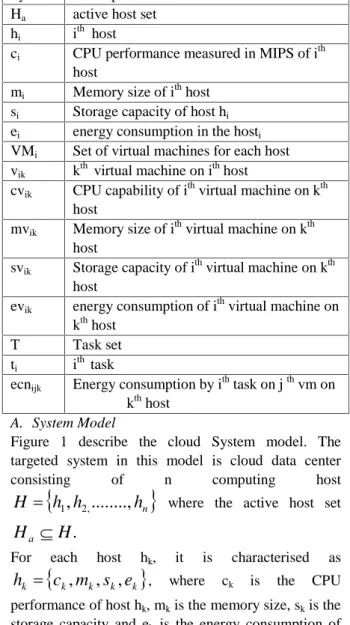
In this section, we will introduce the models, notions, and terminology used in this paper. Table 1 describes the different parameter used in the models.
www.ijseat.com
Page 770
Symbol Description
Ha active host set
hi ith host
ci CPU performance measured in MIPS of ith
host
mi Memory size of ithhost
si Storage capacity of host hi
ei energy consumption in the hosti
VMi Set of virtual machines for each host
vik kth virtual machine on ithhost
cvik CPU capability of i
th
virtual machine on kth host
mvik Memory size of ithvirtual machine on kth
host
svik Storage capacity of ithvirtual machine on kth
host
evik energy consumption of ithvirtual machine on
kthhost
T Task set
ti ithtask
ecnijk Energy consumption by ithtask on jthvm on
kthhost
A. System Model
Figure 1 describe the cloud System model. The targeted system in this model is cloud data center
consisting of n computing host
h
h
h
n
H
1,
2,...,
where the active host set.
H
H
a
For each host hk, it is characterised as
k k k k
k
c
m
s
e
h
,
,
,
, where ck is the CPUperformance of host hk, mkis the memory size, skis the
storage capacity and ek is the energy consumption of
host hk. For each host hk, a set of virtual machine VMk
is denoted by
VM
K
v
1k,
v
2k,...
v
nk
, where vikisthe ithvirtual machine of host hk.
B. Task Model
In this model, it is considered the independent,
real-time, aperiodic task denoted by
t
t
t
m
T
1,
2,....,
.Where,t
i
T
is the tasksubmitted by the user and is modelled as
i i i i
i
a
d
l
f
t
,
,
,
, wherea
i,
d
i,
l
i,
f
i represent thetask arrival time, deadline, length of task and task finish time tirespectively. The execution time of task ti
on virtual machine vijis defined as
...(
1
)
jk i ijk
cv
l
et
,where, li is the length of task and cvjk is the CPU
capability of jthvirtual machine on kthhost.
C. Energy Consumption Model
In a cloud data center , since CPU consume the main part of energy, consumed by a host, so the energy consumption by CPU is considered in this paper. Further, the consumption of energy in cloud data center is classified into static energy consumption and
dynamic energy consumption[10], and since static
energy consumption is having less dominant than dynamic energy consumption, In this model, focus is made on the dynamic energy consumption.
Let the task ti running on VM vjk has consume the
energy ecnijk., and let ecrjkbe the energy consumption
rate of the VM vjk. The energy consumption ecnijkcan
be
)
2
,...(
.
ijk jk ijkecr
et
ecn
Since in a cloud data center the energy consumption is incurred when the VM is executing task and when VM is sitting idle, so the total energy E consumed by a host
can be
E
ecn
exec
ecn
idle,...(
3
)
.Hence, the total energy consumed when VM executing all the
tasks is:
Ha k k VM j T i ijk ijk exececn
x
ecn
1 1 1
.
)
4
,...(
.
.
1 1 1
ijk H k VM j T i jk ijk
ecr
et
x
a k
Where xijkrepresents tasks mapping to VM at different
hosts in cloud data center, where xijkis “1” if task tiis
allocated to VM vjkat host hkand is “0”, otherwise.
Similarly, when all the VMs in a host are sitting idle, by DVFS technology the host can be set to a lower
energy consumption rate
ecr
jklowof virtual machineVM vjk. In a host hk, if the idle time is idtkwhen all the
VMs are idel, the energy consumption can be written as:
)
5
...(
.
.
1 1
Ha k k VM j k low jk idleidt
ecr
ecn
IV. ENERGY-EFFICIENT SCHEDULING ALGORITHM
In the energy-efficient scheduling algorithm, the start time of task tion VM vjkis represented as stijkand
the ready time of VM vjkis represented as rtjk.if a new
task tnis allocated to VM,the new ready time on vjkis,
)
6
...(
njk njk jk
st
et
rt
www.ijseat.com
Page 771
__
Algorithm1: pseudo code of scheduling algorithm _________________________________________ __
1:
flag
FALSE
;
VM
avail
NULL
;
2: for each VM vjkin the host do
3: Calculate the execution time etijlusing Eq(1);
4: if stijk+ etijk≤ dithen
5:
flag
TRUE
;
6: Calculate ecnijkusing Eq.(3);
7: end if
8: end for
9: If
flag
TRUE
then10: Select vskwith minimum energy consumption
to execute ti;
sk;
ijk
1
;
avail
x
v
VM
else11:
0
;
ijk
x
12: end if
13: Update the scheduling decision of tiand
remove it from queue;
_________________________________________ __
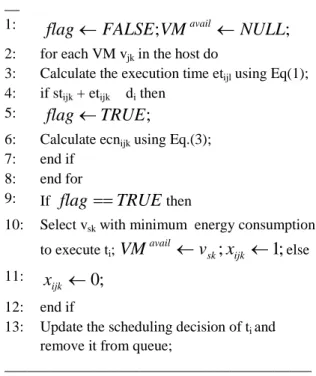
In the above scheduling algorithm, each task ti is
allocated to a VM, to meet their deadline, while minimizing the energy consumption. It first calculates
the start time and execution time of task tion each VM
before allocating it to VM.if it satisfy it’s deadline then the task is allocated to VM and then algorithm select the VM that consume the less energy to execute the task ti, otherwise the task is rejected by the algorithm.
Figure 1. System Model
V.
V. PERFORMANCE EVALUATION
The performance of the aforementioned algorithm is
evaluated by using CloudSim toolkit[17] as a
simulation platform. To evaluate its performance it is compared with three existing algorithms- EDF (Earliest Deadline First), FCFS (First Come First Serve) and EARH (Energy Aware Rolling-Horizon). The brief descriptions of these algorithms are as below.
FCFS: It assign the new task as soon as it arrives to any available Cloud Resource.
EDF: Tasks are assigned to VM by their deadline in a non-decreasing order by guaranteeing the deadline of the task.
EARH: This algorithm employs the Rolling-Horizon Optimization scheme and Virtualization technique for scheduling the Real-Time task in Cloud.
The performance metrics, parameters and the detailed setting for conducting experiment are as given below.
Simulation parameters and detailed setting:
The CPU performance of each host with one CPU core is 500 MIPS, 1,000 MIPS, and 1,500 MIPS. Energy consumption rate of three different kinds of hosts are 250 W, 300W, or 400W. The task arrival rate is in Poisson distribution, and the parameter intval is used to determine the time interval between two consecutive tasks. The start-up time of a host is 60 s and the creation time of a VM is 10 s.
Performance Metrics:
The various performance metrics used for evaluating system performance are,
ECPT (Energy consumption per task) =Total energy consumption/Task size.
GR(Guarantee Ratio)=Number of tasks guaranteed to meet their deadline/ Task size.
TEC (Total energy consumption) =Total energy consumed/Host
Different experimental results are presented below to observe the performance comparison of the algorithm in term of no of task executed.
Resource Manager Scheduler
Rejected task
Waiting Queue New task
Host
11
Host2...
...
Host n
---v
m
v
m
v
m
v
m
v
m
www.ijseat.com
Page 772
(a)
(b)
(c)
From the Fig. a, it is observed that, the proposed algorithm EDVS has low energy consumption compared with others. When the task size is increased, the running VM can be consolidated to provide room for the new VM by avoiding energy consumption caused by the new active host. Further, the idle host can be shut down to reduce the energy consumption.
From Fig. b, it is observed that, energy consumption of EARH has slightly increased with increase of task size, whereas other three algorithms maintain stable energy consumption with increase of task size. This experimental result can be explained as, when task size increased, active VMs are consolidated to make room
for executing new tasks by reducing energy consumption of adding new tasks.
From Fig. c, it reveals that, all the algorithm maintain stable guarantee ratio regardless of increase in task size. This is because of the infinite resources in the cloud and new host and VM can be started with increase of task size. However, some task cannot finish execution successfully, because starting new host or adding new VM incur addition time cost, as a result some real-time task with tight deadline cannot complete their execution with the given time constraints.
VI. CONCLUSION
In this paper, energy-efficient scheduling problem for real-time independent aperiodic task in Cloud environment is investigated. The objectives of the scheduling of real-time independent tasks in Cloud computing system are to save energy consumption in the cloud data centers and to improve the system performance. To achieve the objectives, near-optimal energy efficient task scheduling policies are proposed for cloud data centers. The results of the experiment indicate the effectiveness of the proposed EDVS algorithm compared to related algorithm in cloud environment. In future research, it is planned to work on improving the execution time of real time task in the cloud environment.
REFERENCES
[1] Kirk W. Cameron, Rong Ge,Xizhou Feng, “
High-performance, power- aware distributed computing for scientific applications”,vol. 38, Issue. 11, pp. 40-47, 2005.
[2] R. Buyya, C.S. Yeo, S. Venugopal, J. Broberg,
and I. Brandic, “Cloud Computing and Emerging
IT Platforms: Vision, Hype, and Reality for
Delivering Computing as the Fifth Utility”, Future
Generation Computer Systems, vol. 25, no. 6, ELSEVIER,pp- 599-616, 2009.
[3] Kyong Hoon Kim, Anton Beloglazov,Rajkumar
Buyya, “Power –aware provisioning of Cloud
Resources for Real-time Services” ACM
978-1-60558-847-6/09/11, pp. 1-6, 2009.
[4] Bo Li, Jianxin Li, Jinpeng Huai, Tianyu Wo, Qin
Li, Liang Zhong, “EnaCloud: An Energy-saving
Application live placement approach for Cloud
Computing Environments”, IEEE International Conference on Cloud Computing, DOI 10.1109, pp. 17-24, 2009.
[5] Rajkumar Buyya, Anton Beliglazov, Jemal
architectural elements and open challenges”,
Cloud Computing and Distributed
Systems(CLOUDS) laboratory, the university of Melbourne,Australia, pp. 1-12, 2010.
[6] Anton Beloglazov, Rajkumar Buyya, “Energy
efficient resource management in virtualized
Cloud data centers”, 10th IEEE/ACM International Conference on Cluster, Cloud and Grid Computing, DOI 10.1109/CCGRID.2010.46, pp. 826-831, 2010.
[7] Anton Beloglazov, Rajkumar Buyya, Young
Choon lee, Albert Zomaya, “A Taxonomy and
survey of energy-efficient data centers and Cloud
computing Systems”, ELSEVIER, advances in computers, vol. 82, pp. 47-111, 2011.
[8] Toni Masteli, Ivona Brandi, “ Recent Trends in
Energy Efficient Cloud Computing”, Journal of Latex Class Files, vol. 11, no. 4, pp. 1-6, 2012.
[9] Shailesh S. Deore, Ashok Narayan Patil, “
Energy-Efficient Scheduling Scheme for Virtual
Machines in Cloud Computing”, International
Journal of Computer Application (0975-8887), vol. 56, no. 10, pp. 1-7, 2012.
[10] Xiaomin Zhu, Laurence T. Yang, Huangke Chen,
Ji Wang, Shu Yin, Xiaocheng Liu, “Real-Time
Tasks Oriented Energy-Aware Scheduling in
Virtualized Cloud”, IEEE Transactions on Cloud
Computing, vol 2, no. 2, pp. 168-180, 2014.
[11] Rodrigo N. Calheiros , Rajkumar Buyya, “
Energy-Efficient Scheduling of Urgent
Bag-of-Tasks applications in Clouds through DVFS”,
IEEE 6th International Conference on Cloud
Computing Technology and Science, DOI
10.1109/CloudCom.2014.20, pp. 342-349, 2014.
[12] Seyedmehdi Hosseinimotlagh, Farshad Khunjush,
Seyedmahyar Hosseinimotlagh, “A Cooperative
Two-Tier Energy-Aware Scheduling for
Real-Time Tasks in Computing Clouds”, IEEE 22nd
Euromicro International Conference on Parallel, Distributed, and Network-Based Processing, DOI 10.1109/PDP.2014.91, pp. 178-182, 2014.
[13] Tarandeep Kaur, Inderveer Chana, “Energy Efficiency Techniques in Cloud Computing: A
Survey and Taxonomy”, ACM Computing
Surveys, Vol. 48, No. 2, Article 22, pp. 1-46, 2015.
[14] Pragya, Manjeet Gupta, “ Analysis of Energy
Efficient Scheduling Algorithms in Green Cloud
Computing”, International Journal of Advanced Research in Computer Engineering & Technology (IJARCET), vol. 4 ,Issue 5, pp. 2413-2416, 2015.
[15] Altaf Ur Rahman, Fiaz Gul Khan, Waqas
Jadoon,” Energy Efficiency techniques in cloud computing”, International Journal of Computer
Science and Information Security (IJCSIS), Vol. 14, No. 6, pp. 317-323, 2016.
[16] Tudor Cioara , Ionut Anghel , Ioan Salomie, “
Methodology for energy aware adaptive
managementof virtualized data centers”, Springer
Science, DOI 10.1007/s12053-016-9467-2, pp. 1-24, 2016.
[17] R.N. Calheiros, R. Ranjan, A. Beloglazov,
C.A.F.D. Rose, and R.Buyya, “CloudSim: A
Toolkit for Modeling and Simulation of Cloud Computing Environments and Evaluation of
Resource Provisioning Algorithms,” Software:
Practice and Experience, vol. 41,no. 1, pp. 23-50, 2011.
[18] J.O. Gutierrez and K.M. Sim, “A Family of
Heuristics for Agent- Based Elastic Cloud
Bag-of-Tasks Concurrent Scheduling,” Future Generation