Activity and Learning Agreement
Pilots
Programme Theory Evaluation
Working Paper 3
Activity Agreement Provision
Research Report DCSF-RR097
Research Report No
DCSF-RR097
Activity and Learning Agreement Pilots
Programme Theory Evaluation
Working Paper 3 - Activity Agreement Provision
Becci Newton, Claire Johnson and Harriet Fearn
Institute for Employment Studies
The views expressed in this report are the authors’ and do not necessarily reflect those of the Department for Children, Schools and Families.
© Institute for Employment Studies 2009
Acknowledgements
The authors would like to thank the staff of the three Connexions Partnership areas who agreed to participate in this study and helped to provide the sample of young people. We would also like to thank Susanna Greenwood (DCSF) and Professor Ray Pawson (University of Leeds) for their advice, support and helpful comments throughout the project. Joy Oakley at IES led the review of data from the process evaluation and we are grateful for her
perseverance and accuracy in revisiting the many transcripts involved. Gerry Lyons showed persistence and dedication in the interview recruitment for the sample of young people. Gill Brown, James Walker-Hebborn, Karen Patient and Denise Hassany at IES all provided administrative and secretarial support. Gill and James also provided invaluable support as ‘researcher safety buddies’ during pilot and main-stage fieldwork.
Contents
EXECUTIVE SUMMARY 1
1 INTRODUCTION 5
1.1 What is ‘programme theory evaluation’? 5
1.2 Background 6
1.3 Hypothesis and research aims 6
1.4 Methodology 7
1.5 Structure of the Working Paper 8
2 YOUNG PEOPLE’S CONTEXTS AND AA STARTING POINTS 9
2.1 Experiences prior to AA and why young people signed up 9 2.2 The framework of provision for Activity Agreements 10
2.3 AA Adviser roles and team structures 12
3 THE ‘MENU OF CHOICE’ THEORY 13
3.1 Is there a ‘menu of choice’? 13
3.2 Is the menu flexible enough? 22
3.3 How do activities ‘fit together’? 30
3.4 Conclusions 31
4 THE ‘ADVISER DISCRETIONARY FUND’ THEORY 33
4.1 What is the discretionary fund? 33
4.2 Using the DF to pay for bespoke provision 33
4.3 Using the DF to remove immediate practical barriers 36
4.4 Young people’s recognition of the DF 38
4.5 Identifying barriers through regular Adviser meetings 38
4.6 Conclusions 40
5 THE ‘BROKER’ THEORY 41
5.1 Staying informed about provision and activities 41 5.2 Enablers and constraints to sourcing tailored, ‘off–menu’ provision 42
5.3 Establishing young people’s needs 44
5.4 Importance of regular Adviser meetings 47
5.5 Persuading young people of the benefits of activities 51
5.6 The process of brokering agreements 54
5.7 Outcomes perceived by Advisers and young people 56
5.8 Conclusions 58
6 LINKING THE PROVISION THEORIES 60
6.1 How the theories relate 60
6.2 How the theories relate for different types of young people 61
7 REFERENCES 65
Executive Summary
Introduction and research aims
The Activity and Learning Agreements (ALA) Pilots were launched in 12 areas of England in April 2006. Activity Agreements (AA) operated in eight of the 12 areas and were designed for young people aged 16 or 17 who are not in employment, education or training (NEET). Young people had to be NEET for 20 weeks to be eligible. They received a weekly allowance (three variants of which were tested in different pilot areas) and continuous support, and in return agreed to take part in tailored activities designed to help them progress towards an employment or education and training outcome. Learning Agreements (LA) were aimed at 16 to 17 year olds in jobs without training (JWT) and also operated in 8 of the 12 pilot areas. Under a Learning Agreement, young people took part in agreed activities, which included undertaking a designated course.
This paper is part of the programme theory strand of the ALA Pilots evaluation. This is a realist evaluation method which focuses on identifying and testing some of the key ‘theories’ that underlie the ALA policy to explore which components of the policy work (or don’t), how, for whom, why, and in what circumstances.
This is the third paper resulting from the ‘focused studies’ element within the programme theory evaluation and explores the theories related to provision and brokerage. It is based on research undertaken among a sample of young people in three Connexions Partnership areas who signed up to the AA between December 2007 and April 2008. The aim of this particular study was to gather evidence in relation to three theories:
Theory 14 (the ‘menu of choice’ theory): If the policy provides a ‘menu of choice’ to the young person then there is a greater likelihood of being able to provide them with activities they need and want in order to progress. This assumes the ‘menu of choice’ is varied enough to appeal to young people with different interests and aspirations and has the capacity to be tailored to what the young person wants to do and when they want to do it. Conversely, constraints on the ‘menu of choice’ may have a negative effect and may lead to disengagement by the young person, unless they can be overcome OR negotiated around to achieve an agreed alternative. The fit between activities is also important to ensure there is some form of development between them - although the need for this may be a constraint, from the perspective of the young person.
Theory 15 (the ‘discretionary fund’ theory): By giving Connexions staff access to a
discretionary fund for each young person, they will be able to use it to lift specific or immediate barriers preventing the young person from progressing.
Methodology
The study was qualitative in approach and a matched-case method was used. The first stage of this was a series of in-depth interviews with 45 young people who had signed up to the AA. As part of these interviews the research team asked young people for permission to contact their Advisers (to provide the matched-case). The target of matched Adviser interviews for 30 young people was achieved. In addition to the interviews, an analysis of data from the process evaluation was conducted to gather further information about provision across the three Connexions areas in the study.
Key Findings
The ‘menu of choice’ theory
In practice, a mix of menu-centred and young person-centred approaches was used. Advisers in Areas 1 and 2 tended to use a list, calendar or diary of activities with young people to prompt their choices, however they would try to source off-menu provision if the young person wanted it. Advisers in Area 3 did not use a list directly with young people although they sometimes used a training directory to provide information on work-based training or course options.
The ‘menu of choice’ appeared to be varied enough across all of the three Connexions areas, despite the difference in approaches they used to setting out the ‘menu’ to young people. There were few examples where young people had not been able to do something which they really wanted to do, and many examples where young people had been able to take part in a wide and varied range of activities (in particular those who did not have a clear idea about their future goals, who could try out various different areas of work or learning through taster-style
provision).
Some provision gaps were identified. The most consistent gap across all the three areas was a lack of work experience placements. This was a particular issue for work-focused young people (in particular if they wanted to do some work-based training).
A few young people had missed activities because they felt they had not particularly wanted to do them, or had felt uncomfortable about saying ‘no’. This was generally in cases where there had been a more menu-led approach.
A key aspect of the Adviser’s broker role was about negotiating constraints: however, some constraints or barriers were difficult to overcome purely via more flexible provision because they were associated with issues centred within the young person, such as severe lack of confidence in group situations or health barriers. In these cases referrals to specialist support services was needed. Some Advisers felt that the 20 week AA period was not long enough to achieve outcomes with young people in these situations, especially if the main problem did not become apparent until several weeks into the AA.
The ‘fit’ between activities and how they were sequenced was important to build progression into the AA and to ensure that young people recognised the benefits of each activity they had done. Activities did not necessarily have to be incremental - there was a role for trying things out and changing track if the young person found they did not want to pursue a particular course of action. Having a broad enough menu of choice to provide the flexibility for young people to do this was crucial, so that they did not feel ‘boxed in’ to a particular pathway.
Overall, the AA was generally flexible enough to be tailored to what young people wanted to do and when they wanted to do it, although this was inter-dependent on the other provision theories. Use of the Discretionary Fund and brokerage from the Advisers were crucial components of whether the menu could be tailored to individual needs and could provide timely provision.
The Discretionary Fund (DF) theory
The DF was seen as an extremely useful tool by both young people and the Advisers. Advisers appreciated the flexibility it gave to the programme and felt it allowed them to be more person-focused when exploring possible courses or equipment the young person needed. Young people in turn appreciated that they could get help with work or course-related equipment they may need. Overall young people had a sound, if not detailed, understanding of DF.
The DF was seldom used to buy in bespoke provision or courses for an individual young person, but was more often used to create new, tailored provision that could benefit a number of young people with similar needs. This new tailored provision helped to build a more comprehensive ‘menu of choice’ in all three regions. All Advisers felt that the DF was an important part of the programme as it allowed young people with very specific or unusual career goals to benefit from the AA.
Some Advisers felt that there could be more flexibility in the ceiling of DF as some young people did not need any money spent either on bespoke courses or equipment. Their ‘budget’ could be used to offset equipment or provision for young people who needed more financial support1.
Spending the DF was not taken lightly by either young people or Advisers. Advisers expected the young people to prove that they deserved the money spent on them and young people were aware that there were limitations to what could be spent.
There was little difference between the two urban areas in their approach to using DF for bespoke provision and equipment. The rural area spent less on bespoke provision for individuals due to the increased costs of travel. They worked extremely hard to make up for the lack of funds by spending the DF on tailored courses or opening out provision explored for one individual to a wider range of young people.
Overall the results of the study indicated that the DF helped to remove specific or immediate barriers for the young people so they could progress. This supports the theory regarding DF that was identified during the programme theory process. The study also found that having the DF helped to broaden the ‘menu of choice’ available to young people, and assisted the brokerage role by involving young people in decisions about how the DF might be used.
The brokerage theory
Brokerage was a key element of the AA for young people and their Advisers. It offered a link between available activities and meeting the needs and aspirations of young people. All young people valued the support from their Advisers and the option of negotiating activities rather than being told what they would do.
1
Advisers’ experience of researching and sourcing activities in addition to those available through the menu led to broader views of available provision which could then be ‘sold’ to young people. Important to this were formal and informal mechanisms for Advisers to share their experiences with others.
However, examples from one of the urban areas particularly demonstrated that certain young people could be encouraged to research the specialist provision they wanted. This process was felt to deliver benefits to the young person in terms of study skills but also in
encouraging them to find out more about their chosen option to help clarify its appropriateness.
All Advisers emphasised the need to set out the benefits of provision to ensure young people were involved in activities that would meet their needs. With some young people, the process of getting them signed up to provision that was peripheral to their core goal was sometimes lengthy and this demonstrated the role for the regular review meetings. These established a supportive working relationship through which Advisers could raise opportunities and
challenge perceptions. However, some young people needed little, if any, persuasion to engage in provision and, in these cases, the negotiation might focus more on establishing a learning or work path, best suited to the individual, so that activities could build towards this.
There was little evidence that a delay to an activity caused particular difficulties to individuals. The reason for this was the Advisers’ skills in setting expectations appropriately: if young people could see that provision that met their core goal was scheduled, they could be persuaded to participate in peripheral and contributory activities in the interim. In this way, activities could be used as an incentive to help sustain engagement in the AA.
There was evidence that provision could come too soon for certain young people whose underlying barriers did not become evident until they tried to engage, or later in the programme. Advisers recognised the potential danger in this: if a young person tried to engage, but failed, it could have a negative effect on their confidence and self-esteem which in turn could impact on their outcomes at the end of the Agreement.
A final point is that some Advisers noted that the AA is not appropriate for some young people, for instance those with significant personal or contextual barriers to engagement (such as health / mental health problems or insurmountable problems in the home
1 Introduction
The Activity and Learning Agreement (ALA) Pilots were launched in 12 areas of England in April 2006. Activity Agreements (AA) were designed for young people (aged 16 or 17) not in employment, education or training (NEET) and operated in eight of the 12 areas. Young people had to be NEET for 20 weeks to be eligible. They received an allowance (three variants of which were tested in different pilot areas) and continuous support, and in return agreed to take part in tailored activities designed to help them progress towards an
employment or education and training outcome. Learning Agreements (LA) were aimed at 16 to 17 year olds in jobs without training (JWT) and also operated in eight of the 12 pilots areas (ie both pilots operated in four areas and they each operated separately in four others). Under a LA, young people took part in agreed activities, which included undertaking a designated course. If successful, young people may receive a monetary bonus (and in two areas their employers received wage compensation).
The evaluation has three main strands:
■ a quantitative element, using surveys of young people to measure the impact of the pilots in comparison to a number of control areas
■ a programme theory element, focusing on testing some key aspects of the policy to identify what works or doesn’t and why
■ a process evaluation, examining how the pilots have been set up and delivered, and the main implementation issues.
1.1 What is ‘programme theory evaluation’?
Programme theory evaluation is considered a useful tool for conceptualising programmes, guiding evaluations, planning empirical research, and analysing why programmes are successful (or not). It seeks to identify the ‘theory of change’ that lies behind an intervention and assess to what extent, why and how this change has occurred. In doing so, any
unintended as well as intended outcomes are considered. The results of this type of evaluation are explanatory rather than providing a clear-cut answer on whether a policy ‘works’, and can be fed back into the policy design in order to make improvements.
The guiding principle of this approach is that policy interventions are originally underpinned by theories. Pawson et al. (2004) sum up the basic ‘if-then’ logic of this as follows:
‘If we deliver a programme in this way or we manage services like so, then this will bring about some improved outcome.’
The outcome is not to provide an unequivocal answer about whether the ALAs ‘work’, but rather to highlight the components that inform the successful operation of the policy (as well as ones that hinder it). This will help to refine the theories implicit within the policy design to better articulate what works, for whom, how and in what circumstances, so that this learning can be embedded into any subsequent revision of the policy, or nationwide roll-out.
The programme theory approach to evaluation adopted by this study has two main elements. The first is to identify, assess and refine the theories that underpin the ALA policy (the ‘theory elicitation’ stage). The second is to then test these theories via empirical research, of which this study forms a part.
1.2 Background
The theory elicitation stage presented 25 different theories and sub-theories which were formulated based on a review of related research and in-depth interviews with a number of key policy architects and stakeholders. These theories and sub-theories were collated under different elements of the ALA policy: financial incentives, agreements, personalised support, flexible options, brokerage, and progression. Earlier focused studies concentrated on the role of the financial incentives in participation in the AA and the role of personalised support in participation in the LA. Focused Studies 3 (Activity Agreement) and 4 (Learning Agreement) consider flexible options and brokerage.
1.3 Hypothesis and research aims
This paper is based on research undertaken among a sample of young people in three Connexions Partnership areas who signed up to an AA between December 2007 and April 2008. The aim of this particular focused study was to gather evidence in relation to the following theories:
Theory 14 (the ‘menu of choice’ theory): If the policy provides a ‘menu of choice’ to the young person then there is a greater likelihood of being able to provide them with activities they need and want in order to progress. This assumes the ‘menu of choice’ is varied enough to appeal to young people with different interests and aspirations and has the capacity to be tailored to what the young person wants to do and when they want to do it. Conversely, constraints on the ‘menu of choice’ may have a negative effect and may lead to dis-engagement by the young person, unless they can be overcome OR negotiated around to achieve an agreed alternative. The fit between activities is also important to ensure there is some form of development between them - although the need for this may be a constraint, from the perspective of the young person.
Theory 15 (the ‘discretionary fund’ theory): By giving Connexions staff access to a
discretionary fund for each young person, they will be able to use it to lift specific or immediate barriers preventing the young person from progressing.
The overarching aims of the project are to:
■ Explore the extent and impact of choice of provision on young people’s progress - do they really get a ‘menu of choice’ and what happens when they want to do things which are ‘off-menu’? In what circumstances does this occur, and among which types of young people?
■ Examine what constraints on choice exist - from the perspectives of the young person and
their Adviser.
■ Explore whether and how such constraints are overcome - and the impact when they cannot be overcome. What impact do such constraints have on the Adviser / client relationship and on the young person’s engagement? Is this different under different circumstances and for different young people?
■ Investigate how choices are negotiated between the young person and their Personal Adviser (PA) or project worker. What happens when there is a gap between what the young person wants to do and what the Adviser a) deems appropriate and b) can actually offer? In what circumstances can such gaps be hurdled, and for which young people?
1.4 Methodology
1.4.1
Research designThe methodology was based on a qualitative, young person-centred case study approach. Our strategy was to interview the young person, and then ask for permission to approach their Adviser for interview. In addition, data from the process evaluation was reviewed. The research design comprised:
■ 45 in-depth qualitative interviews with young people currently or previously participating on the AA
■ 30 in-depth qualitative matched interviews with young people’s Advisers
■ a review of interview data from the process evaluation focusing on provision, including material on providers’ views of the AA.
1.4.2
Area selectionUnlike the earlier study into the financial incentive (Johnson et al., 2008) the particular variant of AA on offer was not integral to the research since provision was unlikely to differ by
variant. However, the process evaluation had shown that Connexions Partnerships differ in terms of range and accessibility of provision. Depending on the set-up and size of the Connexions Partnership there can also be differences within areas, for example between local authorities. Our priority was to ensure coverage of different contexts and that the areas covered by the research included urban, suburban and rural settings.
1.4.3
Generating the sampleDue to data protection restrictions, it was necessary to liaise with each Connexions
During the opt-out period, only a small number of young people said they did not wish to have their details provided to IES. Once this period was over, the remaining contact details were supplied to IES and stored securely in line with data protection regulations.
1.4.4
FieldworkRecruitment for the study was conducted by telephone. A small-scale pilot was undertaken in mid-April in order to test the research instruments and the approach to fieldwork. Six face-to-face interviews with young people were booked for the pilot, of which four were conducted (one cancelled and one was a ‘no-show’). All four young people who were interviewed at this stage gave permission for their Adviser to be contacted. The Advisers working with three of the four ‘pilot’ young people were then interviewed. After the pilot, only minor revisions were made to the topic guides.
Main-stage fieldwork took place between mid-April and the end of May 2008. All interviews were undertaken by Criminal Records Bureau (CRB) - checked researchers from IES. An incentive of a £20 High Street voucher was offered to young people to take part in an interview. The aim was to conduct 45 interviews with young people who had signed up to the AA and 30 interviews with their Advisers. Some Advisers were interviewed about two different young people. Although scheduling of the Adviser interviews took longer than anticipated, the method was otherwise unproblematic and the target numbers of interviews for young people and Advisers were both met. There were a small number of no-shows and cancellations among young people but replacement appointments could be found. Almost all of the
interviews with young people were undertaken face-to-face, with a small number of ‘mop-up’ interviews carried out by telephone towards the end of the project. Around half of the Adviser interviews were conducted by telephone.
It should be noted that this study was qualitative in design and therefore, although designed to map the various types of pathways that young people followed through the AA, it is not possible to assign quantitative measures to these.
All the young people’s names have been changed in this report to protect their identities.
1.5 Structure of the Working Paper
The remainder of this Working Paper is structured as follows:
■ Section 2 explores young people’s contexts and their initial plans when they joined the Activity Agreement
■ Section 3 investigates the ‘menu of choice’ theory
■ Section 4 examines the ‘Adviser discretionary fund’ theory; and
■ Section 5 assesses the ‘broker theory’.
2 Young People’s Contexts and AA Starting Points
In this section we explore young people’s educational and employment contexts prior to joining the AA. We then outline the broad types of activity envisaged on the AA and fit this into a framework linked to young people’s contexts and aspirations.
2.1 Experiences prior to AA and why young people signed up
Young people’s experiences at school varied: some had quite enjoyed it and got on
reasonably well, others liked the social aspect although did not get on well academically. A few had been bullied and were relieved for school to come to an end. Some young people had experienced significant difficulties that led to a withdrawal or exclusion from school and attended either a pupil referral unit or college to complete their compulsory education. A couple mentioned home-schooling (one as a result of school exclusion, the other had been withdrawn from school by their parent because of concerns about bullying). Another couple of the young people in the study sample had stopped attending school at around the age of 14 and had seemingly fallen through the education net and started work instead.
Most of the young people had left school without any qualifications or with qualifications at very low GCSEs (grade Ds and below). Many of these young people had problems with literacy, numeracy, or both. A handful of young people in the sample had achieved quite high GCSE grades including a sprinkling of As and Bs.
The majority of the sample had become Not in Education, Employment or Training (NEET) following school. Many of them just wanted to work but had not been able to find or hold down a job. Some had been considering college but were thwarted by their own lack of motivation to submit an application in time, or because their qualification grades were inadequate. In one case, a young person had to leave the family home before her GCSE results arrived and she had been unable to start college because she did not know her grades.
A few of the sample had found work on leaving school although for most this had not lasted long and they had subsequently become NEET. A smaller number had entered college although most of these had ‘dropped out’ in the early stages as it did not meet their
expectations. Some young people had attended one year programmes and achieved a Level 1 or in some cases a Level 2 qualification.
When asked about their reasons for joining the AA, most young people said it had been because they wanted help. While the incentive payment might have been a linked factor in their decision, help to improve their chances of employment, or to gain a college place, was far more frequently mentioned as the main reason. Only a small group mentioned that the money had been the main motivator (see Johnson et al., 20081 which shows that the incentive alone is not the attraction of the AA. For many, the decision to join the AA was motivated by the incentive linked to the one-to-one support, activities, meeting new people or relieving boredom).
1
2.2 The framework of provision for Activity Agreements
[image:15.595.76.522.398.694.2]The Activity Agreement is designed to be a personally negotiated action plan between a Connexions Personal Adviser (PA) and the young person, identifying specific steps they should take to move into education, training or employment (preferably with learning) in return for access to financial support. The AA itself can last up to 20 weeks and, within this time, the policy envisages that young people will require a range of activities to enable them to progress. The amount of time spent on activities per week can be built up over the 20-week period, at the discretion of the Adviser and depending on the needs and progress of the young person.
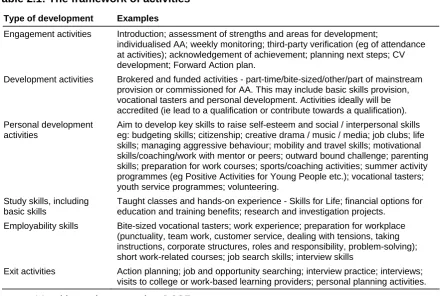
Table 2.1 shows the broad types of activities that can be done as part of the AA and these can be seen as ‘journey-based’ in concept1:
■ Engagement at the outset (with reviews throughout) focusing on assessing the aspirations and needs of young people. This type of activity enables barriers to be identified and where possible overcome through the other types of provision.
■ Development and personal development help to break down immediate barriers to enable young people to interact with longer term study and vocational options as well as gain valuable skills and certificates.
■ Exit activities at the end of the AA aim to ensure young people have goals and plans to sustain their engagement.
Table 2.1: The framework of activities
Type of development Examples
Engagement activities Introduction; assessment of strengths and areas for development;
individualised AA; weekly monitoring; third-party verification (eg of attendance at activities); acknowledgement of achievement; planning next steps; CV development; Forward Action plan.
Development activities Brokered and funded activities - part-time/bite-sized/other/part of mainstream provision or commissioned for AA. This may include basic skills provision, vocational tasters and personal development. Activities ideally will be accredited (ie lead to a qualification or contribute towards a qualification). Personal development
activities
Aim to develop key skills to raise self-esteem and social / interpersonal skills eg: budgeting skills; citizenship; creative drama / music / media; job clubs; life skills; managing aggressive behaviour; mobility and travel skills; motivational skills/coaching/work with mentor or peers; outward bound challenge; parenting skills; preparation for work courses; sports/coaching activities; summer activity programmes (eg Positive Activities for Young People etc.); vocational tasters; youth service programmes; volunteering.
Study skills, including basic skills
Taught classes and hands-on experience - Skills for Life; financial options for education and training benefits; research and investigation projects.
Employability skills Bite-sized vocational tasters; work experience; preparation for workplace (punctuality, team work, customer service, dealing with tensions, taking instructions, corporate structures, roles and responsibility, problem-solving); short work-related courses; job search skills; interview skills
Exit activities Action planning; job and opportunity searching; interview practice; interviews; visits to college or work-based learning providers; personal planning activities.
Source: AA guidance documentation, DCSF
1
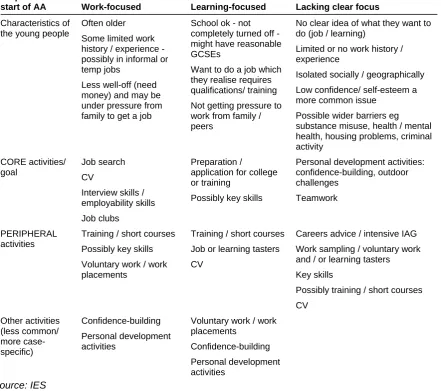
This provided a useful framework against which to review the activity programmes of the young people involved in this study. These programmes necessarily varied and a key factor in this was the young person’s focus at the outset and how this developed as the AA
progressed. We have conceptualised the types of activities and ‘journeys’ in which young people might engage in Table 2.2.
This framework is simplistic and some cases do not sit as easily in the categories as others, but it is useful as a starting point. Some young people, for instance, might have a very fixed idea of what sort of job they wanted at the outset of their agreement, while others who wanted to work may not have clear ideas of the career they would pursue, or alternatively, a clear idea of what was required to enter their selected career path. In other cases, there might be personal or contextual barriers which meant that while they might have a particular work or learning focus, the barriers were so great that they might have a long way to travel before they were ready to achieve it.
We test this framework in our assessment of each of the theories and explore the
[image:16.595.78.520.359.750.2]circumstances in which they influence activity programmes. A key factor was that the young people’s starting points developed over the course of the AA and some changed altogether: provision needed to be flexible enough to cater for this.
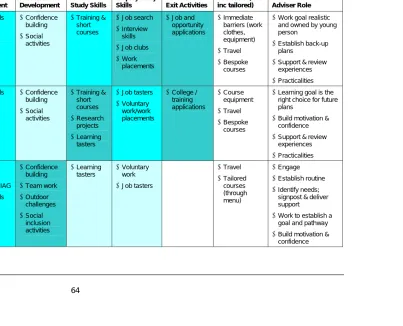
Table 2.2: Ideas for framework on different ‘types’ of young person case
YP priorities at
start of AA Work-focused Learning-focused Lacking clear focus
Characteristics of the young people
Often older Some limited work history / experience - possibly in informal or temp jobs
Less well-off (need money) and may be under pressure from family to get a job
School ok - not completely turned off - might have reasonable GCSEs
Want to do a job which they realise requires qualifications/ training Not getting pressure to work from family / peers
No clear idea of what they want to do (job / learning)
Limited or no work history / experience
Isolated socially / geographically Low confidence/ self-esteem a more common issue
Possible wider barriers eg substance misuse, health / mental health, housing problems, criminal activity
CORE activities/ goal
Job search CV
Interview skills / employability skills Job clubs
Preparation /
application for college or training
Possibly key skills
Personal development activities: confidence-building, outdoor challenges
Teamwork
PERIPHERAL activities
Training / short courses Possibly key skills Voluntary work / work placements
Training / short courses Job or learning tasters CV
Careers advice / intensive IAG Work sampling / voluntary work and / or learning tasters Key skills
Possibly training / short courses CV Other activities (less common/ more case-specific) Confidence-building Personal development activities
Voluntary work / work placements
Confidence-building Personal development activities
2.3 AA Adviser roles and team structures
The majority of Advisers interviewed in this study had worked on the AA for at least a year, and many since its implementation. In all areas, Advisers had a significant career history in working with young people. Many had a previous role in the Positive Activities for Young People programme (PAYP) or as a school-based or hub-based Personal Adviser for Connexions.
Advisers fulfilled a multiple role including recruiting young people to the AA, sustaining engagement, carrying out weekly review meetings, sourcing and brokering provision, and planning for exit activities. Caseloads varied, and Advisers working solely on the AA were usually dealing with between 16 and 20 young people at any one time.
The structure of teams and types of roles that Advisers were involved in varied between the case study areas:
■ Area 1 - Large urban area: While Advisers were structured into teams which covered specific localities, a lot of training provision was delivered directly by Connexions. In addition, young people could access a Connexions Access Point away from their home locality. Where bespoke provision was required, most often the brokerage and contract arrangements were led through the pilot manager, although Advisers could also source provision themselves and get it approved centrally.
■ Area 2 - Mainly rural: Advisers worked in teams to cover specific and quite large areas. The team in each locality sourced and brokered provision, although contracting
arrangements were managed centrally. Advisers had a role in tailoring provision to meet the needs of AA participants, but they tended to allow young people to choose from a set list for ease of planning in such a large and rural area.
3 The ‘Menu of Choice’ Theory
This section focuses on the ‘menu of choice’ theory:
Theory 14 (the ‘menu of choice’ theory): If the policy provides a ‘menu of choice’ to the young person then there is a greater likelihood of being able to provide them with activities they need and want in order to progress.
In the rest of this section we break down this theory into its component parts and address each in turn:
■ Is there a ‘set menu’ of activities or is it a ‘menu of choice’ - that is, to what extent is the AA led by what is available, or how far is it young-person centred?
■ How important is choice to the young person? Do they feel comfortable about turning activities down - and what happens when they do not?
■ The ‘menu of choice’ needs to be varied enough to appeal to young people with different interests and aspirations and have the capacity to be tailored to what the young person wants to do, and when they want to do it. To what extent is this the case? What happens when provision is not available or is not sufficiently tailored?
■ Constraints on the ‘menu of choice’ may lead to disengagement by the young person, unless they can be overcome or negotiated around to achieve an agreed alternative. How is this done, and what happens when it is not possible?
■ The fit between activities is important to ensure there is some form of development
between them. How far do Advisers plan this and how far do young people recognise that they have had some progression?
Evidence is drawn predominantly from the young person and Adviser interviews, and is presented in a ‘case-study’ style format wherever possible.
3.1 Is there a ‘menu of choice’?
3.1.1
Getting started on the AAYoung people tended to enter the AA with a view to finding a job, and less commonly, aiming to find a course. Some young people were lacking in any real focus about what they wanted to do in the future (see Section 2.1).
Almost all of the young people described how their initial meeting was a ‘getting to know you’ session. The Adviser would tell them a bit about the AA but spend more time talking about them - their background, their interests, what had held them back in the past, and what they hoped for the future.
There is flexibility for the engagement phase to be tailored to the young person
Harry (Area 2) joined the AA because he wanted help to find work. He had a vague interest in doing an Apprenticeship in construction, but his GCSEs were very low. He also wanted to meet new people as he was quite isolated both socially and geographically. He was keen to start on an activity from the first day that he met with his Adviser, and signed up to take part in a 2-hour team building, problem solving and confidence workshop that very afternoon:
‘When I went to my Adviser she was like, “Oh normally it’s like one or two weeks before you want to start” and she was like, “How soon do you want to start?” and I was like, “As soon as I can”. So she was just like … someone wanted to drop out of a session so she was like, “If you want you can go along today”, and so I was proper wanting to get involved and everything.’
The workshop ran regularly every week and therefore when someone dropped out at short notice it was relatively easy for his Adviser to offer him the place. His Adviser felt that a more challenging, motivational approach suited some young people:
‘Technically on the AA we start the young person with a few hours and work them up to 16. I would start mine on 16, and again with Harry I would say, “Look, look at you, you’re capable, you say you have a problem with strangers but you sat in a room with me. You’re making eye contact. You’re talking to me, you’re being coherent …. Do you want to go straight in there or you can start with a little, but I don’t think you need to”. And they always go, “OK I’ll do it”. It’s about positive support and positive motivational skills I think.’
In contrast, for others it took a much longer series of meetings with their Adviser before they even started to talk about potential activities, much less sign up to do any. This was
particularly the case where young people had no real focus about their future career plans, very low self-confidence, and/or multiple barriers which could often take several weeks to fully emerge, such as health or family problems.
Jackie (Area 1) had started the AA to get some help with finding a course. She had no prior qualifications and had attended specialist provision because of bullying at school. She was
vaguely interested in doing a Hair and Beauty course but had not pursued it due to her severe lack of confidence and lack of entry qualifications. At the time of the interview she had been on the AA for approximately 6 weeks and had not yet started any activities. She described how her Adviser meetings were mainly focused on how she felt about herself, and identifying her interests, leading on to discussions about what sorts of activity she would like to do:
‘I have done stuff, there is a thing about how you feel that you are and that, and they build it up and I really enjoyed it. So you know what you feel like and you tell them what you think you are now and things like that …. It’s to see how I feel about myself because sometimes I am
embarrassed and I won’t go. If I didn’t know you and you were in a big room with lots of people I will sit there and be embarrassed to see how I feel. If I was here now with you and I did it and I said “Look I feel okay”, so it [confidence rating] would be like 5.’
Time invested in the engagement phase could eat into the rest of the 20 weeks
Advisers appreciated the flexibility they had to tailor this engagement phase to the needs of each young person, although some pointed out that there was a balance to be struck
‘I picked up from another of my colleagues who went off sick, so the first few weeks we took time to just know each other - it takes time to actually know what they are, where they are coming from and what has happened in the past. Now the database we have doesn’t talk much of these sort of things - personal relationships and all that kind of thing - so this lad, I think 15th or 16th week, finally I had to draw a line and say that ”Ok now, we have known each other for a pretty long time, we’ve been talking of doing things but we haven’t done anything and four weeks down the line you will be off the project”.’
Adviser, Area 3
The length of time required by some young people before they were in a position to start more formal activities such as work/college preparation or vocational skills development was cited by some Advisers as impacting on how well subsequent activities could be fitted within their remaining time on the AA. This impacted on the extent to which (hard) outcomes could consequently be achieved. Advisers felt that working with those young people who required extensive support and personal development work before they could fully engage in some of the more work or learning-focused activities, meant that the 20 week period was not long enough for some of the hardest to help.
3.1.2
How are activities presented?Young person-centred or menu-based approaches
Young people were asked how they found out about what activities they could do on the AA, and their responses varied somewhat by Connexions Partnership area. Some Advisers described how they might use a list or timetable, especially if the young person was very unclear about their interests or future goals, when it could provide a useful ‘prompt’ to motivate them into trying out a few things as a starting point. In general, young people who were lacking in any initial focus tended to start off with a more menu-based approach, whereas the approach for those who had a clearer idea about their work or learning goals tended to be more young-person centred.
In Area 3 in particular, almost all of the young people described how they had spent varying amounts of time talking to their Adviser about their current situation and future goals, before identifying an activity or activities that they wanted to do.
‘I never say, “That’s what we’ve got, have a look through, see what you think.” The ball is firmly in their court. Most people do have a good idea of what they want to do. And if they don’t then there are services or facilities or other things we can call upon to help generate ideas and ways forward. So there’s never an offer of, let’s say, “This is what we’ve got”.’
Adviser, Area 3
Advisers in Area 3 did not appear to use a list or timetable of activities directly with young people, although they clearly knew which provision was available locally and what had been used successfully before. They also had a training directory, and other material such as case studies, to provide examples of the range of activities available and to help stimulate ideas among those young people who lacked a clear focus about what they wanted.
‘With regards to training opportunities we have a directory which young people can browse to help generate ideas. We also have case studies and examples of activities that other young people have done to spark a bit of interest and to make young people aware of the diverse range of opportunities that we’ve got to offer.’
In other areas the situation appeared to be slightly more mixed. Some young people had discussed activities with their Adviser in an individual-centred way, whereas others had been shown a list or timetable of activities that were available and this had formed the basis of the discussion.
‘She got this little thing out - this little chart - and it had the activities on and said, “Well this is happening on Wednesday, it’s blah blah. If you want I can take you”.’
Suzanne, Area 1
‘Well, they give you a list of activities and it’s things like sport or going to the gym - ridiculous things like going to the zoo. Things that aren’t really that productive but then again they have got me into [literacy and numeracy] which was good, and they gave me guitar lessons twice a week, which I love doing.’
Tom, Area 2
The menu is useful where it is difficult to arrange individualised provision
The other main example of where a list or timetable of provision was used was generally where provision was more limited, in terms of availability or accessibility. In Area 2 it was generally more difficult than in the other areas to source individualised provision, due to the large geographical coverage and rurality of some locations. This meant that a varied ‘menu’ of provision had been drawn up and was run on a calendar basis so that young people could benefit from a ‘carousel’ of different activities run at regular intervals:
‘We kind of plan. The rock climbing and high rope work we have to book quite far in advance. We have a diary, we would try and book four months [ahead]. So a lot of the provision we already had, but because we’re focusing on key skills it’s appropriate to most of the young people we get on the AA.’
Adviser, Area 2
Most young people felt that the activities on the list were appropriate and interesting enough for them to be able to choose activities they wanted from within it.
Rob (Area 2) left school at 16 without any GCSEs as he had been put down a year, and therefore was able to leave before his examinations year. After school, he had not found any work or training. While he did not have clear plans when he left school, by the time he joined the AA he had aspirations to get work in construction or farming. He was impressed by the range of activities available as there were plenty of certificated courses that would help him find work and make up for his lack of qualifications.
‘I’ve got one [menu] here somewhere … it says like - it says at the top “Activity Agreement” and underneath it’s got four headings and underneath there you’ve got lists of what comes underneath your headings: First Aid, Health and Safety, Driving Theory, Quads, Dumpers, Diggers. [It has all] the courses I want for tickets and that is Fork Lift, Dumper and Digger, and Tractor. I’m going to see if I can add quad biking to that, or paint balling, and I’ve also done my English and Maths.’
‘Basically he showed me the calendar and the training that was going on and there was business, youth, babysitting courses and he said it was up to me, that no one was going to tell me what to do and that I choose. I have always wanted to do health studies or something to do with children and childcare was obviously there, so I was alright’.
However, the drawback of this approach, in the view of a minority of young people, was that it could become ‘boring’ after a while, if they got into a pattern of doing the same activities without any sense of challenge or progression.
Shelly (Area 2) had joined the AA after completing a year of college and a short period working, before she became NEET. She mentioned she had ADHD and anger management issues. She left the AA towards the end, partly because her Adviser changed and partly because she had become ‘bored’ with the activities on offer.
‘A big list and I chose a few things. I chose quad biking and horse riding and water sports, but they didn’t do watersports in the end because they didn’t have enough time in the week. Because you have to do like [driving] theory and [literacy and numeracy], which you have to do …. It was all the same apart from week [xx], then on that Monday it was quad biking for one day. Then it was the same again after that, apart from week [xx] when my Adviser changed.’
Some activities are seen as ‘part of the deal’
The other issue was that some activities within the menu were seen to be a standard part of the AA and to some extent treated by young people as ‘compulsory’. This tended to be mainly in Area 2, where several young people mentioned being ‘told’ to do various activities such as completing an online careers assessment programme, literacy and numeracy
courses, or weekly group discussions with other young people, in addition to their one-to-one Adviser meetings.
‘It [literacy and numeracy] was something I was told to do …. It was all right at first.’
Shelley, Area 2
‘Connexions just told me to turn up that day [for an online careers assessment] …. If I’d had a choice then I would rather not but perhaps it’s necessary for Connexions’ records.’
Robin, Area 2
It should be noted that almost all of the young people who mentioned these types of activity as being ‘part of the deal’ were not necessarily talking about them in a negative way, but rather flagging up that they were Adviser-driven rather than being done out of choice.
Some young people need more upfront information about their activities
Robin (Area 2) had been home-schooled and wanted support to do numeracy and literacy
qualifications, improve his employability skills and improve his self-confidence. He had been given a list of activities to choose from and had found most of what he was looking for on the list. However, he seemed unclear about some of the courses he had selected, on social skills and managing money:
‘Now I think about it social skills might be more to do with managing anger and people who have quite serious social problems perhaps - I don’t know exactly what that course is about … I think I just saw it on the list and thought I need to get a bit more confidence when dealing with people, so I signed up for that one but that might be for - I don’t know what sort of people - it might be
intended for disruptive teenagers for all I know.’
‘I’m not exactly sure I want to do that one [managing money] because I don’t know exactly what it involves. I did pick it out of the list just like social skills but - actually, yes I think I would like to take this course because I’m not too sure about money.’
3.1.3
Having a choice about what to do on the AA was part of its appealAll the young people in the study felt that having an element of choice about what they did on the AA was essential. For many, part of their very reasoning for signing up to the AA was that they felt they would not feel ‘forced’ into participating in certain activities.
‘It was that [a college course] or the Activity Agreement and the Activity Agreement seemed - it suited me better so I decided to go along with that …. The course was … I think it was based on Art or something, but on the Activity Agreement I could choose between anything and that seemed better.’
Kerry, Area 3
‘I don’t think I would have signed up on the AA if they’d just said, “It consists of Maths, English, Science, Construction work and First Aid - if you take the AA you will take these things”.’
Robin, Area 2
Young people recognised that choice was an important aspect of being treated like an adult:
‘I don’t think you should be made to have to do something, especially if you don’t want to do it. It’s not like you’re in school or anything.’
Harry, Area 2
Advisers themselves felt that it was important for young people to have some ‘ownership’ over their choices and to make an informed choice1. They employed various ‘tactics’ to encourage this, including:
■ Giving young people information about a particular activity or course but then allowing them to decide for themselves whether they did it or not.
1
‘Everything is left up to the young person. All I do is signpost and offer advice and options. I would say I’m fairly relaxed about it, maybe differing from some of the other PAs, but one of the things I always say to them is that, “I couldn’t care less if you want to do it or not. It’s your decision. As long as I make you aware of the consequences of your decision, then that’s my job done. So if you want it, great, I’ll support you 100%, if not well you’re nearly 18 years of age now. You’re not a kid any more”.’
Adviser, Area 3
■ Talking young people through the potential problems or pitfalls to test how committed they were to the activity they wanted.
‘If you’re just going through the positives you’re not actually being honest with them - they’ve got this picture in their heads it’s so great but they actually have to travel two hours to get there, then they get lost, then they’re not going to return the next day. So it’s trying to make them look at it from a different way.’
Adviser, Area 1
■ Asking young people to research options themselves. This was particularly the case either among young people who were unsure of what they wanted to do, to try to encourage them to find out more about their options, or when young people wanted to do something that was not in the ordinary range of provision.
‘We would work really hard to make sure they could do what they wanted to do. But that doesn’t involve, it’s not just about me going, “Darling, you just stay there, I’ll go off and get hold of them”. They were involved in every step.’
Adviser, Area 2
‘I will always give it to them to do, so that they know how much it costs and how much they are wasting if they don’t turn up, and I like them to be able to have the skills to find things out for themselves.’
Adviser, Area 3
Some Advisers spoke of striking a balance between offering young people choices and helping them to make decisions. Some young people - particularly those who were unfocused about their future work or learning - could almost have too much choice and needed a firmer steer about what activities they could do.
Karen (Area 3) had no clear focus when she started the AA and was considering various college courses or work-based training options. Her Adviser encouraged her to try out different personal development and training courses but she felt that she had had enough of trying things out and wanted to make a commitment. It was only when a different youth worker intervened that she made a firm decision about what she really wanted to do: training related to Hair or Beauty.
‘She [Adviser] just wants me to try out different things but like I don’t want to feel stupid because she’ll say, “Do you want to try this?” and I’ll feel stupid saying, “No I don’t want to do that, I want to do that” but [other youth worker] just pushes you.’
3.1.4
Do young people feel they have enough choice?Most young people are happy with the choices available
The majority of young people felt that they did have enough choice on the AA, in terms of both whether or not to do certain activities, and the range of activities that was available. This applied across all three of the Connexions areas, including those where a more menu-based approach was taken to planning activities.
‘It was different from being sat down, fill that in and send that in, it was like, “What do you want to do?”, not “There’s a job - phone for them, fill that in”.’
John, Area 3
‘I was expecting it to be more of a set thing, like they set you things which you do but it’s completely your own choice and as long as you are doing something that is okay, I mean within the boundaries obviously.’
Tom, Area 2
Limited or no perceived choice equates to non-attendance or gradualdisengagement
Some young people reflected that occasionally they had felt somewhat pressured into doing certain activities because they were available rather than because they wanted to do them. Others reported occasional examples of courses being booked without their full commitment. This often translated into non-attendance, even if this meant missing out on a weekly
payment.
Tom (Area 2) felt that he had experienced a couple of instances of provision being booked up without his agreement: ‘They have arranged odd things that I haven’t gone to because I haven’t had the inclination to do it. These are things which they arrange which I have no say in so it isn’t really an agreement. Once they arranged a whole day at [name of town] doing a First Aid course and I decided not to go.’
His Adviser reflected on the same course: ‘We were just running those group sessions and he was
offered the opportunity to join in the group and said, “Oh well, I guess so. I might as well - it will look good on my CV”, and then decided on the day not to go along.’
Around the same time, Tom was undergoing some personal problems and his Adviser felt this had been a factor in his non-attendance. Over the course of his AA he had missed payments two or three times.
Occasionally young people reflected that they had not had a broad enough choice, and this was generally when they had suggested an activity they would like to do and been turned down without a full explanation from their Adviser. The Adviser themselves may have had a good reason for this but it was imperative that this was explained and understood by the young person otherwise it could lead to resentment and a feeling of not being listened to.
Suzanne (Area 1) was interested in doing a childcare course but also lacked self-confidence and did not have the requisite entry qualifications. She did not want to travel outside her local area because of fears about crime combined with her lack of confidence.
‘She said that she doesn’t think that going in and working for an hour earns £30 - I have to make the effort. I said to her if it was closer I would make the effort but I ain’t going all the way up to [name of town] just to do a course and have to come home again. I didn’t think that was fair.’
Most young people are confident enough to say no if they have to
Where the Adviser was suggesting activities rather than this being led by the young person, most of the young people were confident enough to tell their Adviser if they did not want to do something. Indeed, many felt that this was essential, because otherwise they might just not turn up for that activity. It was generally the more self-assured young people, or those who had the clearest focus about what they wanted to do, who felt most comfortable about saying ‘no’ to things their Adviser suggested.
‘I can say if I don’t want to do things. There’s no point being pressured into something you don’t really want to do, I would end up not doing it.’
Paul, Area 3
Other young people were not necessarily self-confident but they were self-aware and wanted to ‘manage’ the volume of their activities so they did not feel they were taking too much on. Here, being able to exercise choice over which activities to do, and how many, equated to a sense of control over the scale of their commitments on the AA compared with other issues that might be going on in their personal or family life.
Debbie (Area 1) was in Week 8 at the time of her interview. Eighteen later this year, she had not attended mainstream school since the age of 14 or 15 and had not achieved any qualifications. She was very clearly focused on using the AA to access accredited courses and work experience, with a view to finding work as a receptionist in an office.
‘He [Adviser] has offered me to do a few activities like going on the music project and whatnot, but he knows that I don’t want to do that. I feel it’s my decision but sometimes I do feel like I don’t want to say no but I have to because I know for a fact I’m not going to go do it.’
‘I don’t want to sound rude or anything but I’m not in it for the activities and stuff − I’m just in it for like getting my qualifications and [to] get out and working …. If you get everything chucked at you, well it’s just about what you can take on − you know what you can take on and you don’t like want too much. I know for a fact if I was to try to take on more than two things at once then there’s no way I could do it.’
But some did find saying ‘no’ difficult
It was generally young people who had very low confidence or self-esteem who were more reticent about declining activities, and a few even felt that they were being ‘pushed’ into agreeing to take part in some things. When this occurred the Adviser usually had a strong reason for trying to encourage the young person to do that activity, for example because it would help them to develop more self-confidence. The young person may even have been persuaded of the benefits of doing the activity, but other barriers such as extreme lack of self-confidence, fear of meeting new people or fear of travelling to new places proved too large a barrier to overcome.
Caroline (Area 1) had not turned up or had backed out of doing activities a few times due to her lack of confidence in a group and fear of travelling outside the local area. She initially agreed to attend a first aid course, and her Adviser supported her by offering to meet her there and attend the first session. But she admitted she was very nervous about it and had stayed up drinking until 5am the night before, consequently being too hungover to attend. Her allowance was stopped for that week. Her Adviser then suggested she take part in a NHS workshop which was an
introduction to NHS careers, but she missed that activity as well. Having her allowance stopped for the week was not a big disincentive for her, compared with her anxiety issues. She felt she had learned from this experience though, and the next time it was suggested she declined the offer as she felt she would still not turn up.
‘Well I’m squeamish for a start so I didn’t think I would like it. But I don’t like saying no to people so I said yes and then backed out at the last minute. She left it for a couple of weeks and then asked me again but this time I’d learned from before and said no to it straight away.’
Debbie’s Adviser felt that some young people, in particular those who have had a lot of prior contact with Connexions or similar ‘authorities’, such as looked-after children, find it more difficult to make independent choices and say no to things than others:
‘There are some young people anything to do with any organisation, any profession -- they’ve trained themselves what to say, so it’s just breaking that barrier. This is not about you just saying yes.’
Adviser, Area 1
3.2 Is the menu flexible enough?
3.2.1
Extent and range of provisionEvidence from both the young people and the Adviser interviews portrayed an extensive range of activities across all three of the case study areas. The activity maps below have been selected to be ‘typical’ examples of the types of activity undertaken by young people with a work focus, a learning focus, or no clear focus, from across all three of the Connexions areas.
Work-focused young people
Paul already had relatively good qualifications, with 9 GCSEs (including 2 C grades) and a GNVQ in IT (with four B grades). He considered college on leaving school but decided he wanted to work instead. He originally went to Connexions for help to find a job working with motor vehicles and remained work-focused, although his focus had developed somewhat as he had done several work-related qualifications with a view to gaining an Apprenticeship as a mechanic. At the time of the interview he was waiting to find out if his application for a Motor Vehicle Apprenticeship had been successful. His Adviser later confirmed that it had been, and he was now applying for placements with garages:
‘Hopefully with the qualifications that he’s got anyway he will be a good asset for any sort of garage really for his age, because he’s going to have good skills behind him.’
Adviser, Area 3
Activity Map - Paul, Area 3
Paul left school at 16 with relatively good qualifications. He had considered college at 16 but wanted to look for a job instead to get money. Prior to joining the AA he had worked in a shop but this job had not lasted. His decision to join the AA was motivated by the incentive payment.
Started Activity Agreement
Activity Agreement
x
x
x
x
x
1
Weekly meetings
x
x
x
Applied to Motor Vehicle Studies NVQ level
2
Now
2 3 4 5 7
Information on AA. Met adviser discussed interests
Planned goal - find employment in a garage. Discussed ways to find vacancies
& what qualifications needed
NVQ Level 1 fast-track qualification @ Training Centre
Working on CV for application to Motor Vehicle
Studies course
6 8 9 10
Work experience in a garage full week (5 days) bodywork – not exactly
what he wanted
Level 2 short course 1 day/week Motor Vehicle Studies
Started Activity Agreement Activity Agreement Started Activity Agreement Activity Agreement
x
x
x
x
x
1
Weekly meetings
x
x
x
Applied to Motor Vehicle Studies NVQ level
2
Now
2 3 4 5 7
Information on AA. Met adviser discussed interests
Planned goal - find employment in a garage. Discussed ways to find vacancies
& what qualifications needed
NVQ Level 1 fast-track qualification @ Training Centre
Working on CV for application to Motor Vehicle
Studies course
6 8 9 10
Work experience in a garage full week (5 days) bodywork – not exactly
what he wanted
Level 2 short course 1 day/week Motor Vehicle Studies
IES, 2008
Learning-focused young people
Young people who were learning-focused generally wanted to go to college to do vocational qualifications in areas such as childcare. Some of them wanted to find a job rather than go to college, but realised they needed to improve their qualifications first. Many of these wanted to improve their literacy and numeracy.
‘She [Adviser] said, “Would you be interested?” I said, “Not really. I just want to get my ICT and I need to do my Maths and English again.” She said, “That’s fine.” She was trying to make me do something fun as well but I didn’t fancy it.’
Emma, Area 2
At the time of the interview she was waiting to start a group work placement in
administration, which her Adviser had suggested. According to her Adviser, her attendance at some of the activities was problematic as she needed to build more of a routine.
Activity Map - Emma, Area 2
Emma left school at 15 with no qualifications and few ideas about her future. She was in contact with Connexions prior to joining the AA since she realised she needed to find a way to gain qualifications. She saw the AA as a second chance and was highly focused on
certified courses (rather than personal development activities). As a result of being involved in the AA she made a decision that she would like to work in administration and was seeking a work placement as the next stage of the AA.
x
x
x
x
x
x
Started Activity Agreement Activity Agreement 1 2Adviser meetings
x
x
x
x
x
x
x
x
3 4 5 6 7 8 9 10
Now
Taster session - CLAIT introduction
Maths & English - 3 days a week for 20
weeks (looking to boost Lit)
Admin work placement - starts this week/next week
x
x
x
x
x
x
CLAIT- 3 hrs 1 day a week for 20 weeks approx
Confidence building - taster session to be
organised
x
x
x
x
x
x
x
x
x
x
x
x
Started Activity Agreement Activity Agreement 1 2Adviser meetings
x
x
x
x
x
x
x
x
x
x
x
x
x
x
x
x
3 4 5 6 7 8 9 10
Now
Taster session - CLAIT introduction
Maths & English - 3 days a week for 20
weeks (looking to boost Lit)
Admin work placement - starts this week/next week
x
x
x
x
x
x
x
x
x
x
x
x
CLAIT- 3 hrs 1 day a week for 20 weeks approx
Confidence building - taster session to be
organised
IES, 2008
Young people lacking clear focus
Many young people who were unsure of what to do needed to try out different pathways before they found something they enjoyed or could develop a firmer goal. In the following example, Robin started the AA for help to get a job, under some pressure f