International Journal of Innovative Technology and Exploring Engineering (IJITEE) ISSN: 2278-3075, Volume-8 Issue-8, June, 2019
ABSTRACT: This experimental study describe the combined effect of polypropylene fiber and ceramic tile waste on different strength properties of M40 grade concrete. Conventional concrete have different problems as cracks, voids, bleeding and plastic shrinkage that occurs in concrete specimen. Recent studies shows that polypropylene fiber reduces the effects bleeding and plastic shrinkage and increases the homogeneity of concrete mix. Present investigation is focused on the replacement of natural coarse aggregates with ceramic tile waste at various percentages (10%,15%,20%,25%) .Polypropylene fiber is added at proportions of 1% by weight of cement to concrete mix. A number of beams, cubes and cylinders are casted to conducted the compressive strength, flexural strength, split tensile strength test at 7 ,14 and 28 days. Two non destructive tests also carried out as rebound hammer and ultra pulse velocity test on cubes. For concrete mix, ordinary portland cement grade 43 and water cementitious ratio has taken 0.4. After the result analysis ,the optimum value obtained at 20% replacement of coarse aggregate with ceramic tile waste. Ultra pulse velocity test also reveal that the homogeneity of the design concrete mix is higher than conventional concrete. It makes the concrete more versatile in the construction industry.
Keywords: polypropylene fiber, ceramic tile waste, flexural strength test ,ultra pulse velocity test, rebound hammer test, split tensile strength.
I. INTRODUCTION
Concrete is made of three major ingredients cement, natural aggregates and water. In most construction works, portland cement is used .Concrete is weak in tension zone due to its brittle nature. Generally bleeding ,plastic shrinkage, cracks occur in pain concrete. To overcome these deficiencies, fibers introduce to the concrete .There are different fibers used in the construction industry steel fiber ,polypropylene fiber, polyethylene fiber ,glass fiber ,carbon fiber , plastic fiber ,asbestos fiber ,organic fiber .In this investigation we are using polypropylene fiber in concrete mix .Polypropylene fiber is a type of synthetic and byproduct of petroleum .Generally monofilament and fibrillated types PP fibers are
Revised Manuscript Received on June 07, 2019.
Avneet Saini: Student of M.E, Structural Engineering, Chandigarh University, Punjab, India
Vikram Singh: Assistant Professor, Department of Civil Engineering, Chandigarh University, Punjab, India
used in construction technology. Monofilament fiber of 6mm size is used. Polypropylene water absorption capacity is nil due to its hydrophobic properties. It enhances the homogeneity and strength properties of concrete .Polypropylene fiber reduces the bleeding rate in concrete. Presently construction industry is facing shortage of natural aggregates due to its regular exploitation and uses .To explore potential alternative materials in construction , natural aggregates are being partially replaced by crushed ceramic tiles to minimize the uses of natural aggregates. Combination of sand ,natural clay and water are used to form ceramic tiles .ceramic tile waste are the crushed broken tiles which can be collected from the tile industry waste and construction sites. It has lighter weight ,cost effective ,higher long term strength compare to the natural aggregates. In this experimental program ,ceramic tiles and polypropylene fiber used with different percentage to enhances the long term mechanical properties and homogeneity of concrete.
II. LITERATURE REVIEW
Milind V. Mohod (2015),studied about polypropylene fiber concrete. This research paper was carried out on M30 and M40 mix with different percentage of fiber 0%,0.5%,1% & 2% .This paper concluded that fiber used up to 0.5% give optimum strength .For flexural, compressive and split tensile strength .Harjeet Singh .Dr. Hemant Sood(2017)In this paper different proportion of granite powder as 10%,20%,30% & 0.25% polypropylene fiber by weight of cement was added to M45 concrete mix. The researcher concluded that 20% replacement of sand with the granite powder gives the optimum value of compressive strength .Chaitra Patil(2017),In this experimental program,
researcher used 1% PP fiber and different
proportions(0%,20%,40%,60%,80% & 100%) of
manufacturers sand as partial replacement for fine aggregate. The experiment were conducted on M30 concrete mix and concluded that use of 1% polypropylene fiber and 20% proportion of manufacturer sand give the optimum value of flexural strength, compressive strength and split tensile strength.
An Experimental Research on the Polypropylene
Fiber Concrete using Ceramic Tile Waste as
Partial Replacement for Coarse Aggregate
Satish T .Rathod (June 2018) In this investigation ,various proportion of fiber 0.5%,1%,1.5%& 2% by weight of cement were added into concrete mix .The study shows that M40 design concrete mix gets higher value than the conventional concrete. Polypropylene used up to 5% give the optimum value for compressive strength, split tensile strength and flexural strength. Hanish Dhiman (2018),According to this experimental study, various percentage of marble dust powder 0%,5%,10% & 15% were used. PP fiber 0%,0.5%,1% & 1.5% added to M30 concrete mix. The result shows that optimum value of flexural strength, compressive strength and split tensile strength are obtained at 0.5% PP fiber and 10% of marble dust powder. Tamanna (2018) In this research paper ,ceramic waste tile were used as coarse aggregate OPC 43 grade cement was used .Coarse aggregate were replaced at 10%,20%,30% & 40% with ceramic waste tile .Sikka Plast(SP430)is used as admixture (water reducing agent in concrete mix).The experiment perform for compressive strength, split tensile strength and flexural strength at 7 days,14 days and 28 days, the result shows that up to 20% of the ceramic tile waste as coarse aggregate gives the optimum strength for M40 concrete mix . Md Daniyal (2015)In this study ceramic tile waste with 10%,20%,30% ,40% and 50% were used as coarse aggregate in concrete mix .waste/cement ratio was taken 0.5%.This paper concluded that optimum value of concrete strength was determined at 30% replacement of ceramic tile waste as coarse aggregate. The flexural and compressive strength was found 32.2% and 5.43% higher than the conventional concrete . Rinu Isha RJ (2017), In this experimental study different proportion(0%,10%,20%,30%,40% and 50%) of ceramic tile waste were replaced as coarse aggregate and 20% of acrylic polymer added in M30 concrete mix. This research paper concluded that 20% replacement of ceramic tile waste as coarse aggregate gives optimum results than the conventional concrete for compressive strength, flexural strength and split tensile strength at 28 days .Jeniba .A (2016) This investigation focused on utilizing the ceramic tile waste as coarse aggregate .In this paper M20 concrete mix was used with different proportion of ceramic tile waste (20%,40%,60%,80%) as coarse aggregate .Split tensile strength ,compressive strength and flexural strength tests were performed at 28 days,54 days and 90 days for M20 grade concrete mix .The result shows that optimum value of different strength parameters were obtained at 20% replacement of ceramic tile waste as coarse aggregate .Skhaviy (2017) studied about the waste ceramic tile used in concrete industry .In this investigation ,natural aggregates were partially replaced by waste ceramic tiles with different proportion of 25%,30%,35% for concrete mix .The study concluded that value of compressive strength ,split tensile strength were higher than the conventional concrete at 30%replacement of ceramic waste as natural aggregate.
III. MATERIAL AND COLLECTION 3.1 Cement :
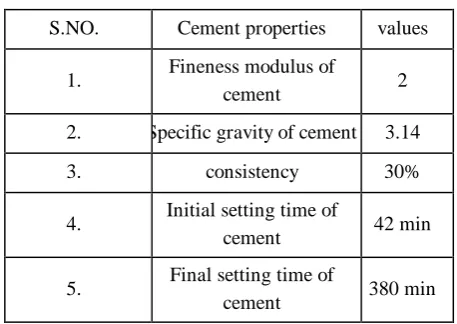
[image:2.595.312.541.142.304.2]As per guidelines of IS:8112-1989 ,the Ordinary portland cement grade 43 is used .Cement collected from S.G. Agencies ,kharar-Punjab
Table no.1 Cement properties.
S.NO. Cement properties values
1. Fineness modulus of
cement 2
2. Specific gravity of cement 3.14
3. consistency 30%
4. Initial setting time of
cement 42 min
5. Final setting time of
cement 380 min
3.2 Coarse aggregate:
20mm size coarse aggregates is used and collected from quarry plant ,kharar ,Punjab.
S.NO. Coarse aggregate properties Values
1. Fineness modulus of coarse aggregate 4.74
2. Specific gravity of coarse aggregate 2.74
3. Water absorption of coarse aggregate 0.5
Table no.2 Coarse aggregate properties.
3.3 Fine aggregate :
As per Indian Standard IS 383-1970 fine aggregate passes through the 4.75 mm size sieve are used.
S.NO. Fine aggregate properties values
1. Fineness modulus of fine aggregate 2.46
2. Specific gravity of fine aggregate 2.57
3. Water absorption of fine aggregate 2
Table no.3 Fine aggregate properties.
3.4 Polypropylene fiber :
6mm size monofilament type PP fiber used polypropylene fiber collected from A.B Enterprises ,Chandigarh.
S.NO. Polypropylene fiber properties values
1. Unit Wt. of P.P fiber 0.91g/cm3
2. Specific gravity of P.P fiber 0.91
3. Water absorption of P.P fiber Nil
4. Length of P.P fiber 6mm
International Journal of Innovative Technology and Exploring Engineering (IJITEE) ISSN: 2278-3075, Volume-8 Issue-8, June, 2019
3.5 Ceramic tile aggregate :
20mm crushed ceramic tile waste aggregates are used.
S.NO. ceramic tiles properties values
1. Fineness modulus of ceramic tiles 3.92
2. Specific gravity of ceramic tiles 2.68
[image:3.595.47.542.55.842.2]3. Water absorption of ceramic tiles 0.8
Table no. 5 Ceramic tile properties
IV. METHODOLOGY
1. Collection and procurement of material 1. Concrete mix prepared as per Indian
Specification IS 10262 (2009) for M40 grade concrete with water cement ratio of 0.4 1. Castings and curing of Cubes, beams and
cylinders specimen for 7 days, 14 days and 28 days
1. Testing of specimens at 7 days, 14 days and 28 days.
1. Collection of the results and interpretation. 1. Comparison of test results with conventional
and other concrete mix.
V. EXPERIMENTAL RESULTS AND ANALYSIS 5.1 Compressive strength
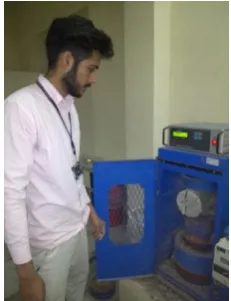
45 cubes were casted in specimen size of 150mm x 150mm x 150mm at room temperature. After 24 hours ,specimen demolded and cube samples cured for 28 days. Cube samples were tested in universal testing machines at 7 days ,14 days and 28 days
Figure 1 compressive strength test.
Trial mix
Polypropyl ene fiber
(%)
Ceramic tile waste(%)
7 Days (MPa)
14 Days (MPa)
28 Days (MPa)
Trial mix 1 0% 0% 27.17 31.14 39.27
Trial mix 2 1% 10% 29.94 33.38 40.75
Trial mix 3 1% 15% 30.85 34.08 42.92
Trial mix 4 1% 20% 31.67 37.46 46.12
Trial mix 5 1% 25% 29.51 34.19 43.54
Table no. 6 Compressive strength test
Figure 2 Results of compressive strength test
5.2 Split tensile strength test :
45 cylinder were casted in specimen size of 150mm x 300mm at room temperature. After 24 hours ,specimen demolded and cylinder samples cured for 28 days. cylinder samples were tested in universal testing machines at 7 days ,14 days and 28 days.
[image:3.595.57.552.64.235.2]
Figure 3 split tensile strength test
Trial mix Polypropyl ene fiber (%)
Ceramic tile waste(%)
7 Days (MPa)
14 Days (MPa)
28 Days (MPa)
Trial mix 1 0% 0% 2.23 2.71 3.93
Trial mix 2 1% 10% 2.47 3.25 4.81
Trial mix 3 1% 15% 3.10 3.82 5.24
Trial mix 4 1% 20% 3.89 4.70 6.32
Trial mix 5 1% 25% 3.54 4.15 5.69
[image:3.595.368.484.342.493.2]
Figure 4 Results of split tensile strength
5.3 Flexural strength test :
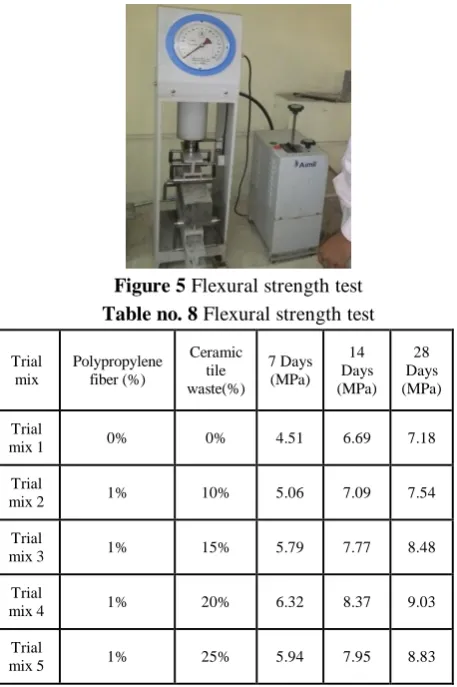
45 beams were casted in specimen size of 100mm x 100mm x 150mm at room temperature. After 24 hours ,specimen demolded and beam samples cured for 28 days. beam samples were tested in flexural testing machines at 7 days ,14 days and 28 days.
[image:4.595.303.546.49.232.2]
Figure 5 Flexural strength test
Table no. 8 Flexural strength test Trial
mix
Polypropylene fiber (%)
Ceramic tile waste(%)
7 Days (MPa)
14 Days (MPa)
28 Days (MPa)
Trial
mix 1 0% 0% 4.51 6.69 7.18
Trial
mix 2 1% 10% 5.06 7.09 7.54
Trial
mix 3 1% 15% 5.79 7.77 8.48
Trial
mix 4 1% 20% 6.32 8.37 9.03
Trial
mix 5 1% 25% 5.94 7.95 8.83
Figure 6 Result of flexural strength test
5.4 Rebound hammer test :
[image:4.595.49.278.332.676.2]As per Indian code IS 13311-2(1992) ,rebound hammer test is used for assessing the quality and uniformity of the concrete. 9 reading were taken by schmidt hammer device at 7 days ,14 days ,28 days and average values calculated for each cube sample.
Table no. 9 Rebound hammer test
Tria l mix
Polypropyl ene fiber
(%)
Ceramic tile waste(%
)
Avg.value
at Avg.value at Avg. value at
7 Days (MPa)
14 Days (MPa)
28 Days (MPa ) Tria
l mix
1
0% 0% 25.05 27.19 30.39
Tria l mix
2
1% 10% 26.1 29.09 32.35
Tria l mix
3
1% 15% 28.56 30.08 38.44
Tria l mix
4
1% 20% 29.45 35.1 40.97
Tria l mix
5
1% 25% 27.1 34.17 39.8
5.5 Ultra pulse velocity test :
[image:4.595.305.547.341.619.2]International Journal of Innovative Technology and Exploring Engineering (IJITEE) ISSN: 2278-3075, Volume-8 Issue-8, June, 2019
Author-1 Photo
[image:5.595.43.303.47.476.2]Author-2 Photo
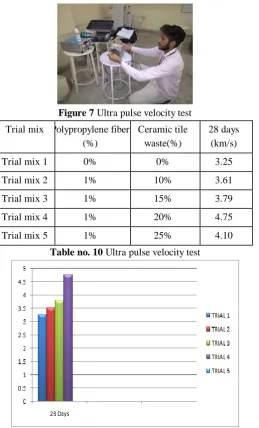
Figure 7 Ultra pulse velocity test Trial mix Polypropylene fiber
(%)
Ceramic tile waste(%)
28 days (km/s)
Trial mix 1 0% 0% 3.25
Trial mix 2 1% 10% 3.61
Trial mix 3 1% 15% 3.79
Trial mix 4 1% 20% 4.75
Trial mix 5 1% 25% 4.10
Table no. 10 Ultra pulse velocity test
Figure 8 Results of ultra pulse velocity test
VI. CONCLUSION
1. compressive strength value obtained at 20% replacement of the natural coarse aggregates with ceramic tile waste is higher than the conventional concrete at 7 days 14 days and 28 days.
1. Optimum value of Split tensile strength obtained at 20% replacement with ceramic tile waste at 7 days,14 days ,and 28 days ,after that value decreases.
1. Flexural strength test results shows that 20% replacement with ceramic tile waste, values of beam specimen is 25.7% higher than the conventional concrete mix at 28 days.
1. Rebound hammer test reveal that optimum value of rebound number is achieved at 20% replacement with ceramic tile waste at 7 days ,14 days,28 days.
1. Ultra pulse velocity test shows that homogeneity of concrete increases and reduces the cracks in cube specimen .Maximum value of ultra pulse velocity is obtained 4.75 km/s after adding 1% polypropylene fiber and 20% replacement with ceramic tile waste.
1. All results shows that addition of the 1% polypropylene enhances the homogeneity and strength properties of concrete mix and optimum values is achieved at 20% replacement of coarse aggregate with ceramic tile waste
REFERENCES
1. Milind V.Mohod ,“Performance of polypropylene fiber reinforced concrete” IOSR Journal Mechanical and Civil Engineering (Jan-Feb 2015).
2. Harjeet Singh ,DR.Hemant Sood ,”Effect of granite powder and polypropylene fiber on compressive split tensile and flexural strength of concrete at high temperature”.(2017)
3. Chaitra Patel ,Kavita Patole , “Experimental study on polypropylene reinforced concrete using manufactured sand as fine aggregate”.(IRJET) e-ISSN-2395-0056,P-ISSN; 2395-0072(April 2017)
4. Satish T Rathod ,shubham Patil “Experimental investigation on polypropylene fiber reinforced concrete for M40 ”.International Research Journal of Engineering And Technology (IRJET) e-ISSN 2395-0056.Volume -5 issue-6 P-ISSN:2395-0075(June 2018). 5. Hanish Dhiman ,Shivani Bhardwaj, “Partial replacement of cement with
marble dust powder and addition of polypropylene fibers ”.International Journal of Engineering and Technology (IRJET)Volume -05 issue -11(Nov 2018).
6. Tamana ,Puneet Sharma, “An experimental work of using crushed ceramic waste tile by coarse aggregate in concrete mix ”.International Journal of Civil Engineering and Technology(IJCIET) Volume-9 issue-7(July 2018).
7. Md Daniyal ,Shakeel Ahmad, “Application of waste ceramic tile aggregate in concrete ”.International Journal of Innovative Research in Science Engineering and Technology (IRJET) Volume 4,issue 12(Dec 2015).
8. Rinu Isah RJ, “Experimental Investigation on concrete tile waste as replacement of coarse aggregate in concrete using Acrylic polymer as an admixture” .International Research Journal of Engineering and Technology(IRJET) Volume-64 issue 10 (Oct-2017).
9. Jeniba.A ,“Experimental studies on ceramic tile used for concrete” .International Journal of Engineering research and technology(IRJET) issue 2016.
10.Skhaviya ,“Experimental study on Partial Replacement of waste ceramic tiles used as an alternative coarse aggregate in concrete” .International Journal of Modern Trends in Engineering and research(ISSN) 2349-9745.
AUTHORS PROFILE
AVNEET SAINI, Student of Master of Engineering in Structural Engineering in department of Civil Engineering, Chandigarh university, Punjab, India. Completed B.E. in Civil Engineering from Chandigarh University , Punjab , India. Completed secondary education from S.G.N Khalsa sr. secondary school, Hanumangarh , Rajasthan, India. Not having any type of membership in any journal.