S T U D Y P R O T O C O L
Open Access
People-centered tuberculosis care versus
standard directly observed therapy: study
protocol for a cluster randomized
controlled trial
Vahe Khachadourian
1, Nune Truzyan
1, Arusyak Harutyunyan
1, Michael E. Thompson
2, Tsovinar Harutyunyan
1and Varduhi Petrosyan
1*Abstract
Background:Tuberculosis is a major public health concern resulting in high rates of morbidity and mortality worldwide, particularly in low- and middle-income countries. Tuberculosis requires a long and intensive course of treatment. Thus, various approaches, including patient empowerment, education and counselling sessions, and involvement of family members and community workers, have been suggested for improving treatment adherence and outcome. The current randomized controlled trial aims to evaluate the effectiveness over usual care of an innovative multicomponent people-centered tuberculosis-care strategy in Armenia.
Methods/design:Innovative Approach to Tuberculosis care in Armenia is an open-label, stratified cluster randomized controlled trial with two parallel arms. Tuberculosis outpatient centers are the clusters assigned to intervention and control arms. Drug-sensitive tuberculosis patients in the continuation phase of treatment in the intervention arm and their family members participate in a short educational and counselling session to raise their knowledge, decrease tuberculosis-related stigma, and enhance treatment adherence. Patients receive the required medications for one week during the weekly visits to the tuberculosis outpatient centers. Additionally, patients receive daily Short Message Service (SMS) reminders to take their medications and daily phone calls to assure adherence and monitoring of treatment potential side effects. Control-arm patients follow the World Health Organization - recommended directly observed treatment strategy, including daily visits to tuberculosis outpatient centers for drug-intake. The primary outcome is physician-reported treatment outcome. Patients’knowledge, depression, quality of life, within-family tuberculosis-related stigma, family social support, and self-reported adherence to tuberculosis treatment are secondary outcomes.
Discussion:Improved adherence and tuberculosis treatment outcomes can strengthen tuberculosis control and thereby forestall tuberculosis and multidrug resistant tuberculosis epidemics. Positive findings on effectiveness of this innovative tuberculosis treatment people-centered approach will support its adoption in countries with similar healthcare and economic profiles.
Trial registration:ClinicalTrials.gov registration number: NCT02082340. Date of registration: 4 March 2014.
Keywords:tuberculosis, treatment adherence, innovative care, family support, psychological counseling, SMS reminder, cluster randomized trial
* Correspondence:[email protected]
1
School of Public Health, American University of Armenia, 40 Marshal Baghramyan Ave, Yerevan 0019, Armenia
Full list of author information is available at the end of the article
Background
Tuberculosis (TB) is an airborne infectious disease transmitted from person to person, and is a major pub-lic health concern [1]. In 2012, TB affected more than 8.6 million people worldwide and resulted in 1.3 million deaths, which made it second only to HIV among lead-ing causes of infectious disease-related deaths [1]. More than 80 % of active TB cases in the world are concen-trated in 22 low- and middle-income countries [2], where 95 % of all TB deaths occur [3]. Moreover, TB is the leading cause of death among HIV patients, ac-counting for 20 % of all causes of deaths among HIV-infected people [2].
Drug-sensitive strains of TB are treated with four stand-ard first-line anti-TB drugs. Non-compliance to treatment, misuse, or mismanagement of medications may lead to relapse, development of drug-resistant (DR) TB (which re-quires a more expensive and intensive treatment course), and even death [4, 5]. According to the 2013 World Health Organization (WHO) progress report [1], each year an estimated 450,000 cases and 150,000 deaths occur globally due to multidrug-resistant TB (MDR-TB). Ac-cording to 2012 WHO data, 3.6 % of all new TB cases were MDR-TB, while the rates among previously treated patients reached 20 % [6]. Among those with MDR-TB, approximately 9.6 % suffer from extensively drug-resistant (XDR) strains. In addition to these adverse health conse-quences, TB places a tremendous economic burden on in-dividuals and societies [7].
Current treatment approaches and alternative strategies Currently, WHO recommends directly observed therapy (DOT) to monitor patients’ adherence to the treatment regimen, with an optimal dosing frequency of 6 days per week for new TB patients. In DOT, patients take their medications while being observed by a healthcare worker, usually a physician or a nurse [8]. DOT prevents patients from missing their treatment and thus reduces the devel-opment of resistance. The outpatient phase of DOT, re-quiring near daily visits to the health facility, introduces significant financial and time-related costs to patients [9], particularly in areas with poor access to health services [10]. Given such limitations, researchers have implemented and evaluated various modified or alternative strategies to improve patients’adherence to TB treatment [5, 11–14]. A systematic review of randomized controlled trials did not suggest enough evidence that DOT compared to self-administered treatment leads to better treatment outcomes in people receiving treatment in low-, middle-, and high-income countries [5].
Empowering patients is recommended as one of key components of TB treatment [15]. Although several au-thors have documented the effectiveness of patient em-powerment in TB treatment [16–19], as identified in a
review by Macqet al.in 2007 [20], people-centered so-lutions have received less attention globally. In low-resource countries, as an alternative to traditional DOT, researchers have recruited family members to observe pa-tients’medication intake, making treatment easier and less expensive [10, 21]. Family members are interested in iden-tifying noncompliance and motivated to encourage and promote treatment adherence. Several studies [10, 21, 22] have documented the effectiveness of involving family members in TB treatment. Some patients value family in-volvement, especially if the observer is a family decision maker or is highly respected in the family [23]. Moreover, WHO has encouraged the development of innovative people-centered care strategies that, where medically ap-propriate, enable patient self-management and commu-nity engagement to improve health outcomes [24, 25].
In recent years, the widespread availability of mobile phones [26] has spawned numerous health communica-tions intervencommunica-tions [27–29]. The Short Message Service (SMS) has been widely used as a reminder for patients to take their medications and improve treatment adher-ence [27–29]. Although, SMS reminders have shown sig-nificant improvement in medication adherence among patients with HIV [27], asthma [30], and other condi-tions, a recent review paper evaluating the effectiveness of SMS reminders for treatment adherence among TB patient was inconclusive, identifying methodological lim-itations of prior studies and suggesting further con-trolled trials evaluating the role of SMS reminders for TB adherence [31].
Patient counseling and education have been found to improve treatment adherence among TB patients [11, 32], which in turn, results in better treatment outcomes and improvement in the patients’quality of life [33].
Treatment adherence has been associated with many different factors [9], including social support, healthcare satisfaction, and disease-related knowledge. Multicompo-nent interventions were found to improve treatment adher-ence [34]. Hadher-ence, our team developed a multicomponent innovative approach to TB care to enable self-administered drug intake by empowered TB patients - supervised by a trained family member and supported by patient and family counseling and reminders - to improve treatment adher-ence and outcome, and thereby forestall TB and multidrug resistant TB epidemics. The innovative treatment approach integrates several educational, technological, and social evidence-based components.
Aims and objectives
drug-intake supervised by a trained family member, 3) daily SMS reminders to TB patients, and 4) daily phone calls to supporting family members. The research team is measuring if this alternative TB care strategy offers advantages over the regular DOT in terms of treatment outcomes, patients’and family members’knowledge about TB, patients’ depression status and quality of life, TB-related stigma, family social support, and self-reported ad-herence to TB treatment.
Methods/design
Trial design
This is an open-label, stratified cluster randomized con-trolled superiority trial with two parallel equal arms (intervention and control) conducted in Armenia. TB outpatient centers defined the clusters, with equal num-bers of clusters assigned to intervention and control arms. We performed a cluster-level random assignment of drug sensitive TB patients to intervention and control arms to mitigate potential contamination of participants in the control arm.
Study setting and eligibility criteria for clusters
The intervention takes place during the continuation phase of TB treatment and is implemented through Armenia’s TB outpatient centers. TB centers having a minimum patient load of five drug-sensitive TB patients in 2012 were included to ensure that centers with very small patient loads did not decrease the study’s power. Out of 60 TB outpatient centers in Armenia, 52 met the inclusion criterion.
Eligibility criteria for individual tuberculosis patients Study participants are patients starting their continu-ation phase of TB treatment in selected outpatient TB care centers. The patient eligibility criteria are as follows:
1. Having a diagnosis of drug sensitive pulmonary TB, 2. Starting the continuation phase of TB treatment
between March and-December 2014,
3. Being at least 18 years old at the time of enrolment, and
4. The ability to communicate in Armenian.
The eligibility status of each patient is subject to verifi-cation by the corresponding TB outpatient center phys-ician and the psychologist of the National Tuberculosis Control Center (NTC).
Assignment of intervention/randomization
We stratified the TB outpatient centers (clusters) based on their drug-sensitive patient load in 2012 and their treat-ment outcomes (performance). We classified TB out-patient centers as small, average, or large, and performance
outcomes as below average, average, or above average, yielding nine distinctive cluster categories. We applied computer-assisted block randomization to assure rela-tively equal number of cluster representatives from each of these nine categories in the intervention and control arms. The process yielded 26 centers in each arm.
Cluster level interventions
TB physicians in both intervention and control clusters are instructed and requested to inform the study team whenever they have a patient who meets the inclusion criteria. In addition, all TB physicians and nurses in the intervention clusters are trained on the study protocols and procedures. They are instructed to closely follow the study protocols and perform study-related paper work, including the distribution and collection of weekly side effect and medication intake forms (applicable only to intervention clusters). Physicians in the intervention clusters also are trained to provide patients with a one-week supply (6 days of pills) of TB medications using the designated pillboxes.
Individual level interventions
Patients in the intervention arm are asked to identify a family member to provide support during the course of treatment. The patients, their supportive family member, and other interested family members, as permitted by the patient, participate in TB educational and psycho-logical counseling session provided by a team of a psych-ologist and a nurse (interventionists).
The interventionists participated in a training-of-trainers course before starting fieldwork. The interactive TB educational and psychological counseling session covers various topics, including TB symptoms, TB route of transmission, TB treatment strategies, importance of treatment adherence, prevention and infection control, handling side effects, addressing TB-related stigma and common myths. Average duration of each session is ap-proximately 90 minutes. The primary objective is to em-power TB patients and their family members to take responsibility for the treatment.
After the educational and counseling session, patients visit their physicians weekly in the TB outpatient centers for a medical check-up and to receive the prescribed TB medication for that week. The supportive family mem-bers are responsible for following the TB patients and supporting their adherence to the treatment regimen. The supportive family members also are responsible for completing a form each week documenting medication intake and observed side effects. Patients return the completed form to the TB physician during the next week’s visit.
weekly SMS messages reminding them to visit their TB physician for their weekly supply. The supportive family members receive daily phone calls from the research team each evening to inquire about side effects related to TB medication and to inquire if the patients are tak-ing their TB medications on a timely basis. Durtak-ing these calls, patients and family members also are offered add-itional psychological advice and support if needed.
Patients in the intervention arm who lack a supporting family member also assume all the responsibilities de-fined for the supportive family member.
Patients in the control arm follow the regular DOT strategy for continuation phase, in line with the guide-lines of Armenia’s Ministry of Health and WHO recom-mendations: it includes taking prescribed TB medication 6 days per week while being observed by a health-care provider. The patients in this group do not receive any additional intervention.
Outcomes and additional measurements
The primary outcome of this controlled trial is TB treat-ment outcome according to WHO definitions as re-corded in the medical file and reported to the NTC. Treatment outcomes are classified as follows: cured, completed treatment, dead, failed, defaulted, and trans-ferred [35]. A patient is considered to be successfully treated if he/she has a cured or completed treatment outcome. All other categories are considered as an un-successful treatment outcome.
Secondary outcome measures include patients’ know-ledge, depression status, quality of life, within-family TB-related stigma, family social support, and self-reported adherence to TB treatment. In addition, we measure fam-ily members’knowledge, depression status, social support
toward TB patient, and TB-related stigma. All the second-ary outcomes other than self-reported treatment adher-ence are measured at T0 (baseline) and T1 (follow-up). Self-reported treatment adherence is assessed only at T1. The knowledge variable is constructed from correct responses to five items adapted from previous work [36–38]. Depression is assessed using a modified ver-sion of the Center for Epidemiological Studies Depres-sion (CES-D) scale [39]; the Armenian translation is validated and the negatively formulated 16 items show high diagnostic accuracy and good factorial structure [40, 41]. We have used a modified version of a validated scale to measure within-family TB related stigma [42] and the Berlin social support scale [43] to measure so-cial support of family members toward TB patients. We have applied EQ-5D to obtain data on quality of life of patients [44].
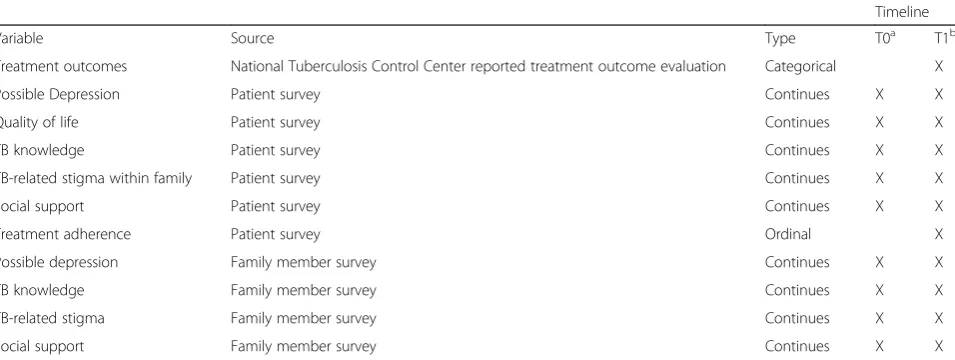
Measurements on sociodemographic characteristics including age, gender, socioeconomic status, education, marital status, and health behavior (smoking and drink-ing) are obtained to verify the validity of randomization and, if necessary, to control for the potentially con-founding effects of these variables on the primary and secondary outcomes. Table 1 summarizes the study out-comes and presents the frequency of data collection.
[image:4.595.60.538.527.707.2]Baseline and follow-up surveys are interviewer-admin-istered. Given the characteristics of the intervention protocol, blinding interviewers assessing secondary out-comes (knowledge about TB, depression, quality of life, within-family TB-related stigma, and family social sup-port) at baseline is not possible. However, interviewers are blinded for the assessment of secondary outcomes at follow-up. The treatment outcome (primary outcome variable of interest) is assessed and reported by the
Table 1Outcome variables
Timeline
Variable Source Type T0a T1b
Treatment outcomes National Tuberculosis Control Center reported treatment outcome evaluation Categorical X
Possible Depression Patient survey Continues X X
Quality of life Patient survey Continues X X
TB knowledge Patient survey Continues X X
TB-related stigma within family Patient survey Continues X X
Social support Patient survey Continues X X
Treatment adherence Patient survey Ordinal X
Possible depression Family member survey Continues X X
TB knowledge Family member survey Continues X X
TB-related stigma Family member survey Continues X X
Social support Family member survey Continues X X
a
At the beginning of continuation phase of treatment/before intervention b
After completion of continuation phase of TB treatment
corresponding TB outpatient center physician as part of regular reporting to the NTC; this process is completely independent of the research team.
Recruitment
The NTC informed physicians and nurses in all 52 eligible TB outpatient centers (clusters) of the study and invited them to be involved in the trial. All agreed to participate. Health-care workers in the intervention and control clus-ters are instructed and requested to report on all new and previously treated drug sensitive TB patients who start their continuation phase of TB treatment in the selected TB outpatient centers. The NTC psychologist, who had special training on the protocols and procedures of this study, makes the initial contact with the eligible patients following these steps: 1) the TB physicians report eligible patients to NTC, 2) the NTC psychologist contacts eli-gible patients over the phone, 3) the NTC psychologist verifies patients’ eligibility, 4) the NTC psychologist pre-sents the study information briefly in a phone call and gets the patients’ consent to share their contact information with the research team, and 5) the NTC psychologist schedules a face-to-face meeting between the TB patient and the research team members.
The NTC psychologist also asks patients about house-hold size and the number of family members aware of the TB diagnosis. If it becomes evident that all members of the patient’s family know about his/her disease and if the patient expresses desire for family members to receive TB counseling, then the NTC psychologist arranges an appro-priate place (usually home of the patient), date and time for the counseling session. We ask the patients to identify potential supporters from their family members who par-ticipate in the counseling session to support them during their treatment period. If the patient lives alone or is un-willing for any family member to support him/her during the treatment and to participate in the counseling session, we set a convenient place (usually TB outpatient center), date and time for the TB patient’s counseling session.
Patients are enrolled within 15 days from the start of their continuation phase of treatment. The average duration of the continuation phase for the drug sensitive TB treat-ment is about four months. We anticipate completion of recruitment and data collection within 12 months from the start of the field work.
Sample size
We based sample size calculations for this study on the treatment outcome as the main variable of interest. In 2012, 1,200 drug sensitive TB patients received the con-tinuation phase of their treatment in TB outpatient cen-ters. Utilizing the 2012 data on the number of patients and outcomes at each TB outpatient center, we identified 52 eligible clusters from the 60 centers. We calculated
the intracluster correlation to be 0.04 and estimated the design effect as 1.6 [45]. The initial sample size calcula-tion used a 10 % difference in the primary outcome [38], an alpha of 0.05 and power of 80 % and yielded a sample size of 95. Considering the potential for losses to follow-up taking a more conservative approach, we used a design effect of two; thus, the required sample size was calculated to be 190 in each arm.
Data collection
We utilize interviewer-administered face-to-face surveys to collect data on secondary outcomes. All patients and their family supporters (if any) in the intervention and control arms are asked to complete an interviewer-administered questionnaire at baseline (T0) and after completion of their TB treatment (T1, follow-up).
Data management
All the completed survey questionnaires are reviewed by a research team member for missing data and unusual responses. Data are double entered into an SPSS (version 21.0) database; after completing entry, the two databases will be reconciled to minimize data entry related errors.
The research team directly enters the data collected during daily calls made to the supporting family mem-bers of patients in the intervention arm into an Epi-info database.
The complete de-identified dataset of the trial will be publicly available when finalized.
Statistical analyses
Statistical analyses will follow the intention-to-treat principle [46]. We will assess randomization across the two arms by comparing sociodemographic characteris-tics and other potential confounding variables using chi-square for binary and categorical variables, t-test, or other equivalent nonparametric tests, as appropriate, for continuous variables.
secondary outcome model also will include its baseline assessment as a covariate.
We will report all the descriptive and inferential statis-tics results with their 95 % confidence intervals.
Patient safety and monitoring of adverse events
TB patients included in this trial are drug-sensitive and have completed their intensive treatment phase. We take special efforts to minimize potential adverse events. All patients in the intervention arm undergo routine med-ical check-ups during weekly visits to TB outpatient cen-ters. Moreover, the side effect report form is completed daily and reported by telephone to the research team, allowing the research team to quickly report concerns to the corresponding TB physician for follow-up. Side ef-fects among those patients in the control arm are taken care during their regular daily visits to TB outpatient centers.
Research ethics
The American University of Armenia Institutional Review Board (IRB) reviewed and approved the study protocol (# AUA-2014-020). Study-related activities started only after receiving IRB approval.
In this multicomponent intervention, we randomized at the TB outpatient center (cluster) level. Individual pa-tient assignments therefore are determined by their geo-graphically assigned TB outpatient center. Patients (and their family members) can only participate in the inter-vention arm after reading and signing a written consent form. Patients opting out of their assignment and those in the control arm receive traditional DOT for the con-tinuous phase of TB treatment.
Data safety
All patients are assigned a unique ID. The question-naires and other data collection forms contain no identi-fiable information. Hardcopy questionnaires are stored in a locked safe in the research center at the American University of Armenia School of Public Health and will be archived for at least three years. Electronic databases are password protected and select members of the re-search team have access to the databases. No identifiable information is provided to persons outside the research team.
Discussion
TB poses a major burden on populations, particularly among those living in low- and middle- income coun-tries. Any improvement in TB treatment strategies can have a significant public health and economic import-ance. Improved control and management of TB can lead to better treatment outcomes, thereby decreasing health inequalities, morbidity, mortality, and economic costs
associated with the disease. Rigorously evaluated alterna-tive people-centered strategies, if successful, can be im-plemented in countries with similar healthcare and economic profiles and help to forestall TB and multidrug-resistant TB epidemics.
Trial status
At the time of submission of this manuscript, the trial is ongoing; it began enrolment in March 2014.
Abbreviations
CES-D:Center for Epidemiological Studies Depression; DOT: directly observed therapy; DR: drug resistant; IRB: institutional review board; MDR-TB: multi-drug resistant TB; NTC: National Tuberculosis Control Center; SMS: short message service; TB: tuberculosis; WHO: World Health Organization; XDR: extensively drug-resistant.
Competing interests
The authors declare that they have no competing interests.
Authors’contribution
VK drafted the manuscript. VK, NT, AH, MET, TH and VP contributed to the study conception and design, and critically revised the manuscript for important intellectual content. VK, NT, and AH contribute to the study implementation and coordinate acquisition of data. All authors read and approved the final manuscript.
Acknowledgments
Grand Challenges Canada, funded by the Government of Canada, awarded the seed grant (Grant number S5 0399-01) for this project. The authors thank Dr. Ruzanna Grigoryan for her input in developing the innovative idea for this study and Dr. Steven Piantadosi for his advice on the study design. Authors also express their gratitude to the Ministry of Health of the Republic of Armenia and the National Tuberculosis Control Center, particularly Dr. Armen Hayrapetyan and Dr. Karapet Davtyan, for their unconditional support and contribution to implementing this project.
Author details
1School of Public Health, American University of Armenia, 40 Marshal
Baghramyan Ave, Yerevan 0019, Armenia.2Department of Public Health
Sciences, College of Health and Human Services, University of North Carolina at Charlotte, 9201 University City Boulevard, CHHS 427D, Charlotte, NC 28223-0001, USA.
Received: 15 October 2014 Accepted: 8 June 2015
References
1. World Health Organization. Global Tuberculosis Report 2013. Geneva: WHO; 2013.
2. Lawn SD, Zumla AI. Tuberculosis. Lancet. 2011;378:57–72. 3. World Health Organization: Factsheet N 104. http://www.who.int/
mediacentre/factsheets/fs104/en/. Accessed 1 August 2014.
4. World Health Organization. Basic Facts on Tuberculosis (TB) in the WHO European Region. http://www.euro.who.int/en/health-topics/communicable-diseases/tuberculosis/data-and-statistics. Accessed 20 July 2014.
5. Volmink J, Garner P. Directly observed therapy for treating tuberculosis. Cochrane Database Syst Rev. 2007;4, CD003343.
6. World Health Organization. Multidrug-resistant tuberculosis (MDR-TB) 2013 update. http://www.who.int/tb/challenges/mdr/MDR_TB_FactSheet.pdf. Accessed 3 June 2014.
7. Laxminarayan R, Klein E, Dye C, Floyd K, Darley S, Olusoji A. Economic Benefit of Tuberculosis Control. Washington, DC: World Bank; 2007. 8. World Health Organization. Treatment of Tuberculosis Guidelines. 4th ed.
Geneva: WHO; 2010.
9. Barnhoorn F, Adriaanse H. In search of factors responsible for
10. Newell JN, Baral SC, Pande SB, Bam DS, Malla P. Family-member DOTS and community DOTS for tuberculosis control in Nepal: cluster-randomised controlled trial. Lancet. 2006;367:903–9.
11. M’imunya JM, Kredo T, Volmink J. Patient education and counselling for promoting adherence to treatment for tuberculosis. Cochrane Database Syst Rev. 2012;5:CD006591.
12. Liu Q, Abba K, Alejandria MM, Balanag VM, Berba RP, Lansang MAD. Reminder systems and late patient tracers in the diagnosis and management of tuberculosis. Cochrane Database Syst Rev. 2008;4:CD006594.
13. Lutge EE, Wiysonge CS, Knight SE, Volmink J. Material incentives and enablers in the management of tuberculosis. Cochrane Database Syst Rev. 2012;1:CD007952.
14. Bosch-Capblanch X, Abba K, Prictor M, Garner P. Contracts between patients and healthcare practitioners for improving patients’adherence to treatment, prevention and health promotion activities. Cochrane Database Syst Rev. 2007;2:CD004808.
15. Stop TB Partnership, World Health Organization (WHO). Global Plan to Stop TB 2006–2015. Geneva: WHO; 2006.
16. Wandwalo E, Makundi E, Hasler T, Morkve O. Acceptability of community and health facility-based directly observed treatment of tuberculosis in Tanzanian urban setting. Health Policy. 2006;78:284–94.
17. Wandwalo E, Kapalata N, Egwaga S, Morkve O. Effectiveness of community-based directly observed treatment for tuberculosis in an urban setting in Tanzania: a randomised controlled trial. Int J Tuberc Lung Dis. 2004;8:1248–54.
18. Morisky DE, Malotte CK, Ebin V, Davidson P, Cabrera D, Trout PT, et al. Behavioral interventions for the control of tuberculosis among adolescents. Public Health Rep. 2001;116:568–74.
19. Cass AD, Talavera GA, Gresham LS, Moser KS, Joy W. Structured behavioral intervention to increase children’s adherence to treatment for latent tuberculosis infection. Int J Tuberc Lung Dis. 2005;9:415–20.
20. Macq J, Torfoss T, Getahun H. Patient empowerment in tuberculosis control: reflecting on past documented experiences. Trop Med Int Health. 2007;12:873–85.
21. Wright J, Walley J, Philip A, Pushpananthan S, Dlamini E, Newell J, et al. Direct observation of treatment for tuberculosis: a randomized controlled trial of community health workers versus family members. Trop Med Int Health. 2004;9:559–65.
22. Kamolratanakul P, Sawert H, Lertmaharit S, Kasetjaroen Y, Akksilp S, Tulaporn C, et al. Randomized controlled trial of directly observed treatment (DOT) for patients with pulmonary tuberculosis in Thailand. Trans R Soc Trop Med Hyg. 1999;93:552–7.
23. Munro SA, Lewin SA, Smith HJ, Engel ME, Fretheim A, Volmink J. Patient adherence to tuberculosis treatment: a systematic review of qualitative research. PLoS Med. 2007;4:e238.
24. World Health Organization. Towards People-Centred Health Systems: An Innovative Approach for Better Health Outcomes. Copenhagen: WHO; 2013. 25. World Health Organization. Global Strategy and Targets for Tuberculosis
Prevention, Care and Control after 2015. Geneva: WHO; 2014.
26. International Telecommunication Union. The World in 2014-ICT Facts and Figures. 2014. https://www.itu.int/en/ITU-D/Statistics/Documents/facts/ ICTFactsFigures2014-e.pdf. Accessed 1 August 2014.
27. Pop-Eleches C, Thirumurthy H, Habyarimana JP, Zivin JG, Goldstein MP, de Walque D, et al. Mobile phone technologies improve adherence to antiretroviral treatment in a resource-limited setting: a randomized controlled trial of text message reminders. AIDS. 2011;25:825–34. 28. Broomhead S, Mars M. Retrospective return on investment analysis of an
electronic treatment adherence device piloted in the Northern Cape Province. Telemed J E Health. 2012;18:24–31.
29. Iribarren S. TextTB: A parallel design randomized control pilot study to evaluate acceptance and feasibility of a patient-driven mobile phone based intervention to support adherence to TB treatment. J Mob Technol Med. 2012;1:23–4.
30. Strandbygaard U, Thomsen SF, Backer V. A daily SMS reminder increases adherence to asthma treatment: a three-month follow-up study. Respir Med. 2010;104:166–71.
31. Nglazi MD, Bekker L-G, Wood R, Hussey GD, Wiysonge CS. Mobile phone text messaging for promoting adherence to anti-tuberculosis treatment: a systematic review. BMC Infect Dis. 2013;13:566.
32. Morisky DE, Malotte CK, Choi P, Davidson P, Rigler S, Sugland B, et al. A patient education program to improve adherence rates with antituberculosis drug regimens. Health Educ Q. 1990;17:253–67. 33. Guo N, Marra F, Marra CA. Measuring health-related quality of life in
tuberculosis: a systematic review. Health Qual Life Outcomes. 2009;7:14. 34. Roter DL, Hall JA, Merisca R, Nordstrom B, Cretin D, Svarstad B. Effectiveness
of interventions to improve patient compliance: a meta-analysis. Med Care. 1998;36:1138–61.
35. World Health Organization. Definitions and reporting framework for tuberculosis
–2013 revision. apps.who.int/iris/bitstream/10665/79199/1/9789241505345_ eng.pdf. Accessed 22 June 2015.
36. Stop TB Partnership, World Health Organization (WHO). Advocacy, Communication and Social Mobilization for TB Control: A Guide to Developing Knowledge, Attitude and Practice Surveys. Geneva: WHO; 2008. 37. Yousif K, Khayat M, Salman H. Survey of knowledge, attitudes and practices:
Enhanced response to TB ACSM. Iraq MEJFM. 2009;7:23–38.
38. Truzyan N, Harutyunyan T, Koshkakaryan M, Grigoryan R, Tadevosyan M, Martirosyan H, et al. Household TB Infection Control Pilot Project: Counseling for TB Patients and Their Family Members. Yerevan, Armenia: American University of Armenia School of Public Health; 2013.
39. Radloff LS. The CES-D Scale: A Self-Report Depression Scale for Research in the General Population. Appl Psychol Meas. 1977;1:385–401.
40. Movsisyan A. Diagnostic Accuracy of Post-traumatic Stress Disorder Checklist - Civilian Version and Modified Versions of Center for Epidemiologic Studies Depression Scale among 1988 Spitak Earthquake Survivors. Yerevan, Armenia: American University of Armenia School of Public Health; 2013.
41. Demirchyan A, Petrosyan V, Thompson ME. Psychometric value of the Center for Epidemiologic Studies Depression (CES-D) scale for screening of depressive symptoms in Armenian population. J Affect Disord.
2011;133:489–98.
42. Van Rie A, Sengupta S, Pungrassami P, Balthip Q, Choonuan S, Kasetjaroen Y, et al. Measuring stigma associated with tuberculosis and HIV/AIDS in southern Thailand: exploratory and confirmatory factor analyses of two new scales. Trop Med Int Health. 2008;13:21–30.
43. Schulz U, Schwarzer R. Soziale Unterstützung bei der Krankheitsbewältigung: Die Berliner Social Support Skalen (BSSS). Diagnostica. 2003;49:73–82. 44. Group EQ. EuroQol–a new facility for the measurement of health-related
quality of life. Health Policy. 1990;16:199–208.
45. Eldridge S, Kerry S. A Practical Guide to Cluster Randomised Trials in Health Services Research. Chichester, UK: John Wiley & Sons; 2012.
46. Herman A, Botser IB, Tenenbaum S, Chechick A. Intention-to-treat analysis and accounting for missing data in orthopaedic randomized clinical trials. J Bone Joint Surg Am. 2009;91:2137–43.
47. McCulloch CE, Searle SR, Neuhaus JM. Generalized, Linear, and Mixed Models. 2nd ed. New York: John Wiley and Sons; 2008.
Submit your next manuscript to BioMed Central and take full advantage of:
• Convenient online submission
• Thorough peer review
• No space constraints or color figure charges
• Immediate publication on acceptance
• Inclusion in PubMed, CAS, Scopus and Google Scholar
• Research which is freely available for redistribution