International Journal of Innovative Technology and Exploring Engineering (IJITEE) ISSN: 2278-3075,Volume-8 Issue-3C, January 2019
Abstract: Background/Objectives: The purpose of this study was to identify type of subjectivity onandropause among middle-aged men using Q methodology. Methods/Statistical analysis: For the Q population, an indepth interview and literature review were used to select 32 Q samples for Q-sort. P-sample was made with 29 middle-aged men and Q-sort was performed on a 9-point scale according to their subjective agreement. The analysis is performed by PC-QUNAL program.
Findings: Four types of andropause in middle-aged men were identified: overcome hard type, a sense of futility and depressed type, health and sexual function-centered type, and support-centered type. Improvements/Applications: As the result of this study suggests, based on classification of andropause in middle-aged men, intervention program for middle-aged men will need to be developed and different, individualized intervention strategies provided.
Keywords: Subjectivity, Andropause, middle-age, men, Q methodology.
I. INTRODUCTION
Andropause is generally known to be relevant with the disappearance of reproductive function due to women’s menopause. In fact, women might have various physical and psychological symptoms because of hormonal changes by menopause. They normally have menopause between their forties and fifties, so the term ‘menopause’ is generalized for middle aged women. While men do not show hormonal changes noticeably, the male sex hormone testosterone has been tended to reduce gradually since their forties[1]. Andropause is slower hence it seems that some men themselves may not recognize climacteric symptoms. According to the guidance of the Endocrine Society in the U.S. andropause is defined as the status of absolutely low male hormones followed by its symptoms and signs[2]. In other words, being aged it refers to typical symptoms such as impotency, hyposexuality, passivity and osteoporosis and clinical, biochemical syndromes accompanied by deficiency of testosterone in serum[1].Middle-aged men shows a lot of stresses and high fatigue degree and cause physical, psychological and social risks, which relate to the decline of male hormone[3]. In addition, there is a report that the decline of males hormone relates to metabolic syndrome[4], resulting in lowering life satisfaction and affecting the quality of life in old age and health[5]. Neither because all men have marked symptoms nor because all men show climacteric symptoms, most men either overlook or accept them as aging
Revised Manuscript Received on January 03, 2019.
Hye-Won Jeon, Department of Nursing, Kkottongnae University, South Korea
Mi-Young Chon, Corresponding author, Department of Nursing, Konkuk University, South Korea
symptoms[6]. Therefore, we need to apprehend subjective male perception of the andropause and understand andropause. However quantitative and qualitative research on andropause have mainly been done, there were no intervention researches by types which categorize similar qualities. It is therefore necessary to analyze systematically and grasp its type by using Q methodology that can recognize individual experience and perception differently. This study aims to provide theoretical bases for nursing intervention strategy development to improve men’s life quality by using Q methodology, categorizing andropause and verifying qualities by types.
II. MATERIALSANDMETHODS
2.1 Research design
Q methodology is designed to measure subjective ego, individual’s potential behaviors and understand each type’s characteristic depending on subjective structure of humans[7]. Hence this study used and applied Q methodology to investigate subjectivity on andropause for middle aged men.
2.2 Concourse(Q population) and Q sample
Literatures related to andropause were examined in this study[1-6], and in depth interviews were conducted for the subject of middle-aged men until statements data were overflown. The in depth interview was conducted on what the biggest problem was in life, what physical change I felt, which behavior I have done to keep in health, and so forth. It was aimed at the age between forties and sixties, took 1-2 hours per interviewee and recorded to prevent omission receiving consent. Through this procedure, 120 Q populations were extracted in total. These statements by Q methodology were discussed by experiences nursing professors who wrote several thesis rearranged and finalized 32 Q samples.
2.3 P sample
Since Q methodology is dealt not interindividual difference but intraindividual difference in significance, the number of P sample is enough to create factors and compare to between factors.[7] The P sample in this study was targeted 29 middle-aged men received written consent.
2.4 Q sorting
After reading 32 cards written statements, the participants were made normally to distribute from the most negative(-4), neutral(0) to the most positive(+4) on a nine-point scale according to their own opinion and the degree of agreement[Figure 1].
Subjectivity on Andropause among Middle-aged
Men using Q Methodology
1
Q sort was done by reading Q samples and dividing largely into three stacks which are positive, neutral and negative. Then among positive statements, the most positive one was selected in order classifying from the outside to the inside and completed in the neutral. At this point, the statements at the end sides(+4, -4) were required to write down the reasons for choosing. This is utilized as useful data to interpret each Q factor later[8].
2.5 Data Analysis
Collected data were analyzed factors using PC QUANL program by beginning from 1 point for the most negative statement(-4) to 9 points for the most positive statement(+4) in Q sample statements. For deciding idealistic number of factors, the number of factors were entered variously on the basis of the eigen value over 1.0. Considering output results and total description variables, four types were eventually selected which judged as having larger conceptual meaning per types and being rational.
[image:2.595.60.277.277.389.2]Note.aRaw scores; bNumber of cards; cTransformed scores.
Figure 1. Forced distribution on Q samples
III. RESULTSANDDISCUSSION 3.1 Formation of the types
Four types for andropause were shown through Q factors
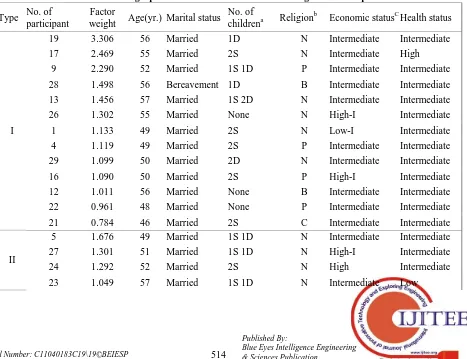
analysis. As a result of analyzing factor weight and variables per type, four types were explaining about 55.3% of the total variables. The descriptive power per each type was 28.3 for the type 1, 12.5% for the type 2, 7.7.% for the type 3, 6.8% for the type 4[Table 1]. Medium correlations were found among the four types[Table 2]. In 29 of the participants of the P sample, there were four types: 13 participants were grouped into Type 1, 6 participants were grouped into Type 2, 4 participants were grouped into Type 3, and 6 participants were grouped into Type 4. Demographical characteristic and factor weight for the participants belonged each type were shown in the Table 3. The higher factor weight the participants in each type has, the more typical characteristic he seems. It means that the subject represents a corresponding type.
Table 1. Eigen value, Variances, and Cumulative percentage
Variables Type Ⅰ Type Ⅱ Type Ⅲ Type Ⅳ Eigen value
Variance (%) Cumulative percentage
8.195 .283 .283
3.626 .125 .408
2.232 .077 .485
1.974 .068 .553
Table 2. Correlation Matrix between Types Variables Type Ⅰ Type Ⅱ Type Ⅲ
Type Ⅱ Type Ⅲ Type Ⅳ
.050 .264 .484
-.146
[image:2.595.79.546.470.829.2].300 .220
Table 3. Demographic Characteristics and Factor Weight for P sample
Type No. of participant
Factor
weight Age(yr.) Marital status No. of
childrena Religion
b Economic statusC Health status
I
19 3.306 56 Married 1D N Intermediate Intermediate
17 2.469 55 Married 2S N Intermediate High
9 2.290 52 Married 1S 1D P Intermediate Intermediate 28 1.498 56 Bereavement 1D B Intermediate Intermediate 13 1.456 57 Married 1S 2D N Intermediate Intermediate
26 1.302 55 Married None N High-I Intermediate
1 1.133 49 Married 2S N Low-I Intermediate
4 1.119 49 Married 2S P Intermediate Intermediate
29 1.099 50 Married 2D N Intermediate Intermediate
16 1.090 50 Married 2S P High-I Intermediate
12 1.011 56 Married None B Intermediate Intermediate 22 0.961 48 Married None P Intermediate Intermediate 21 0.784 46 Married 2S C Intermediate Intermediate
II
5 1.676 49 Married 1S 1D N Intermediate Intermediate
27 1.301 51 Married 1S 1D N High-I Intermediate
24 1.292 52 Married 2S N High Intermediate
International Journal of Innovative Technology and Exploring Engineering (IJITEE) ISSN: 2278-3075,Volume-8 Issue-3C, January 2019
14 1.042 49 Unmarried None B High-I Low
6 0.552 53 Married 2S N Low-I Intermediate
III
10 1.225 65 Married 2S B High-I Intermediate
2 1.152 49 Married 1S 1D N Low-I High
25 0.963 52 Married 1D N High-I Intermediate
18 0.702 56 Married 1S 2D C High-I Intermediate
IV
20 1.042 47 Married 1S 1D N Intermediate Intermediate
7 0.928 49 Married 1S N Intermediate Intermediate
11 0.862 49 Married 1D N Low-I Intermediate
3 0.799 50 Married 1S 1D N Intermediate Intermediate
15 0.598 49 Married 2S N Low-I Intermediate
8 0.299 59 Married 1S 1D N Intermediate Intermediate Note. aS=son, D=daughter, bN=None, P=Protestant, C=Catholic, B=Buddhist, CI=Intermediate
3.2 Characteristics by types
To analyze characteristics by types on andropause, types’
characteristics were depicted centered on the most positive statement(Z≥+1.0) and the most negative statement(Z≤-1.0) among 32 statements[Table 4].
Table 4. Q statements and typal array of Z-scores
Q Statement
Z-score Type 1
(n=13)
Type 2 (n=6)
Type 3 (n=4)
Type 4 (n=6)
Q1 I got more stresses -0.1 1.8 0.9 0.7
Q2 I failed to control anger -0.9 0.9 0.2 -1.3
Q3 I felt a sense of futility and depressed -1.1 1.3 -1.1 0.2 Q4 I am no longer a man due to a decline in sexual function -1.6 -1.6 -0.3 -2.0 Q5 It is stressful to adapt a new place and meet new people 0.1 -0.1 -2.2 -0.5
Q6 I got more tears 0.9 -0.1 -0.8 0.3
Q7 I became serious because I thought one more time before I told 1.4 -0.0 1.4 0.2 Q8 I felt being old when I felt less passionate than I used to be 0.8 1.9 0.7 0.6 Q9 I don’t feel sad thinking it maturing process 0.7 -1.1 0.1 0.2 Q10 I am worried about my health the most 0.2 0.6 1.6 0.9 Q11 Everything has been bothering me lately -0.7 1.7 -1.4 -0.1 Q12 I just want to enjoy myself and be alone -0.2 1.0 -0.1 0.7 Q13 Feeling useless in life, I don't envy the world -0.6 0.7 -0.7 -1.3 Q14 I think it's a good medicine and I do what I like 1.2 -0.4 -0.2 -0.1
Q15 I never do anything bad 0.1 -1.5 -0.3 -0.7
Q16 I hate looking at myself in the mirror because I look old all of a
sudden -0.7 0.3 -1.2 -0.6
Q17 I think my whole body feels weak and different from the old days 0.2 0.3 1.3 1.1 Q18 I had a symptom that my face got hot and sweaty suddenly -1.2 0.2 -1.6 0.1 Q19 My pride is hurt because I don't get along well with my sex -1.3 -1.2 1.2 -0.1 Q20 I'm concerned that I don't have anything to collect as a head of
household 0.2 -0.9 0.2 1.6
Q21 I feel sorry for my family for not knowing as much as I did* 0.1 0.1 -0.7 0.1 Q22 It is comforting that family members including spouse and children
listen and encourage well 0.8 -0.9 0.7 1.6
Q25 I try to give up my greed and live a pleasant life 2.0 0.7 -0.3 1.7 Q26 I am able to get over the andropause if I live hard 1.6 -0.6 1.4 0.1 Q27 I take care of myself by non-smoking, non-drinking, and exercising 1.0 -1.8 0.1 -2.4
Q28 Well, I am just going to die -0.2 0.9 -1.2 -0.8
Q29 I am apt to eat health tonic -1.0 -0.7 1.1 -1.1
Q30 I feel impatient and nervous -0.6 0.6 -0.0 -0.1
Q31I use medicines(vigra, blood circulation promoter, etc.) to enhance
sexual function -1.9 -1.5 0.8 -0.9
Q32 I think there is a need for active treatment(doctor counseling,
hormone therapy, etc.) -1.4 -0.9 -0.9 -0.2
Note. *Consensus item
3.2.1 Type 1: Overcome hard type
The most strongly agreed statements in the type 1 were ‘I try to give up my greed and live a pleasant life(Z=2.04)’, ‘I am able to get over the andropause if I live hard(Z=1.55)’, ‘I became serious because I thought one more time before I told(Z=1.38)’. While in the most negatively agreed statements were ‘I use medicines(vigra, blood circulation promoter, etc.) to enhance sexual function(Z=-1.93)’, ‘I am no longer a man due to a decline in sexual function(Z=-1.56)’, ‘I think there is a need for active treatment(doctor counselling, hormone therapy, etc.)(Z=-1.43)’, ‘My pride is hurt because I don't get along well with my sex(Z=-1.27)’. In addition, the more strongly agreed statements which showed over +1.00 on standard score in the type 1 compared other types were ‘I take care of myself by non-smoking, non-drinking, and exercising’, ‘I try to give up my greed and live a pleasant life’, ‘I am able to get over the andropause if I live hard’ in oder and the more strongly negative statements which showed over –1.00 were ‘I use medicines(vigra, blood circulation promoter, etc.) to enhance sexual function’, ‘My pride is hurt because I don't get along well with my sex’, ‘I got more stresses’ in order. 13 participants out of 29 in total belonged to the type 1, they tried to live merrily and could overcome andropause. In the research on andropause for middle-aged men, overcoming andropause by continuos keeping in health is reported to be a subcategory[9]. It is consistent with the results of the type 1. The participants who belonged to the type 1 are trying their best to keep in their health through healthy behaviors. That’s why we may call this type “overcome hard type”.
3.2.2 Type 2: A sense of futility and depressed type The most strongly agreed statements in the type 2 were ‘I felt being old when I felt less passionate than I used to be(Z=1.87)’, ‘I got more stresses(Z=1.81)’, ‘Everything has been bothering me lately(Z=1.67)’, ‘I felt a sense of futility and depressed(Z=1.32)’. While in the most negatively agreed statements were ‘I take care of myself by non-smoking, non-drinking, and exercising(Z=-1.78)’, ‘I am no longer a man due to a decline in sexual function(Z=-1.55)’, ‘I never do anything bad(Z=-1.49)’, ‘I use medicines(vigra, blood circulation promoter, etc.) to enhance sexual function(Z=-1.48)’ in order. In addition, the more strongly agreed statements which showed over +1.00 on standard score in the type 2 compared other types were ‘Everything has
depressed’, ‘Well, I am just going to die’, ‘Feeling useless in life, I don't envy the world’, ‘I failed to control anger’ in order and the more strongly negative statements which showed over –1.00 were ‘It is comforting that family members including spouse and children listen and encourage well’, ‘I am able to get over the andropause if I live hard’, ‘I'm concerned that I don't have anything to collect as a head of household’ ‘I don’t feel sad thinking it maturing process’ in order. 6 participants out of 29 in total belonged to the type 2, they felt that they feel old, stressed a lot, everything bothering and a sense of futility and depressed. A preceding study on andropause, they felt a sense of futility about the present life[10], as time passes by they are experiencing lack of confidence and psychological symptoms such as anxiety and depression. These feelings were reported to affect quality of their lives negatively[11,12], and it is consistent with the characteristics of the type 2. They do not do healthy behaviors for keeping in their health and receive their family’s support. It differs from the type 1 in that they do not feel they can overcome andropause with their intension. That’s why we may call this type “a sense of futility and depressed type”.
International Journal of Innovative Technology and Exploring Engineering (IJITEE) ISSN: 2278-3075,Volume-8 Issue-3C, January 2019
hurt due to decline in sexual function, and tend to eat health tonic. It contrasts to the type 2 in that they are not depressed. In a preceding study, the symptoms related to the decline in sexual function are reported to be a factor to feel that I am under andropause[9]. Through characteristics above mentioned, we may call the type 3 as "health and sexual function-centered type".
3.2.4 Type 4: Support-centered type
The most strongly agreed statements in the type 4 were ‘It is less difficult to have friends who make good conversation(Z=1.74)’, ‘I try to give up my greed and live a pleasant life(Z=1.69)’, ‘I'm concerned that I don't have anything to collect as a head of household(Z=1.64)’, ‘It is comforting that family members including spouse and children listen and encourage well(Z=1.64).’ While in the most negatively agreed statements were ‘I take care of myself by non-smoking, non-drinking, and exercising(Z=-2.36)’, ‘I am no longer a man due to a decline in sexual function(Z=-1.99)’, ‘Feeling useless in life, I don't envy the world(Z=-1.33)’ In addition, the more strongly agreed statements which showed over +1.00 on standard score in the type 4 compared other types were ‘I'm concerned that I don't have anything to collect as a head of household’, ‘It is less difficult to have friends who make good conversation’, ‘It is comforting that family members including spouse and children listen and encourage well’ in order and the more strongly negative statements which showed over –1.00 were ‘I take care of myself by non-smoking, non-drinking, and exercising’, ‘I failed to control anger’, ‘Feeling useless in life, I don't envy the world’ 6 participants out of 29 in total belonged to the type 4, they are worried about their responsibilities as a head of a household, however they feel that it is less difficult to have supporters like family or friends. In a preceding study, family function like emotional support by family can be an more important factor in that the center of life moved from the society or job place to family[13]. Moreover, smooth communication is suggested as an important factor to satisfy own life quality for middle-aged men[14]. There is no problems in sexual function and they do not keep in their health. This type may be a "support-centered type".
3.2.5 Consensus perspectives among types
In consensus perspective among types, ‘I feel sorry for my family for not knowing as much as I did(Average Z=-.09)’ was shown that they were not generally sorry for their family. On the whole they do not feel sorry for their family.
IV. CONCLUSION
The subjectivity on andropause was able to be seen 4 types among middle-aged men. Based on these, mediation is needed suitable for each type in implementing educational and counseling program for overcoming andropause. Since middle-aged life is directly related to old life, it is considered to develop an integrated program on physical, psychological and emotional aspects and apply for systematical program in order to enhance their health.
REFERENCES
1. Kim KM. Late Onset Hypogonadism. Korean Journal of Family Practice. 2013 Sep;3(3):245-254. Available from: http://www.kjfp.or.kr/journal/view.html?uid=86&vmd=Full
2. Nieschlag E, Swerdloff R, Behre HM, Gooren LJ, Kaufman JM, Legros JJ, et al. Investigation, Treatment, and Monitoring of Late-Onset Hypogonadism in Males: ISA, ISSAM, and EAU Recommendations. J Androl. 2006 Mar-Apr;27(2):135-137. DOI: 10.2164/jandrol.05047 3. Kim DS. Effects of Body Mass Index on Late-onset Male Climacteric
Symptoms, Serum Total Testosterone Level, Neural Transmitter and Metabolic Syndrome Risk Factor in Middle Aged Males. [master’s theses]. Seoul: Korea University; 2017. Available from: http://www.riss.kr/link?id=T14549453
4. Laughlin GA, Barrett-Connor E, Bergstrom J. Low Serum Testosterone and Mortality in Older Men. The Journal of Clinical Endocrinology & Metabolism. 2008 Jan;93(1):68-75. DOI: 10.1210/jc.2007-1792 5. Lee MW, Park H. A Study on Late-onset of Hypogonadism, Erectile
Dysfunction, Depression, and Quality of Life among Middle-aged Male Worker. Korean Journal of Adult Nursing. 2013 Oct;25(5):483-493. https://doi.org/10.7475/kjan.2013.25.5.483
Kim NK. Related factors and the Symptoms and Menopause in Male Workers. Korean Journal of Health Education and Promotion. 2008
Dec;25(4):29-42. Available from:
http://www.dbpia.co.kr/Article/NODE01146912
6. Kim HG. Q-methodology. Seoul: Communication books. 2008. 7. Kim HG. Agreement between the Q block and the Q tool. Journal of
Korean Society for the Scientific Study for Subjectivity. 2008;16:5-16. 8. Jeon HW, Kim SA. A Phenomenological Convergence Study on the Experience of Middle-aged Men Menopause. Journal of the Korea Convergence Society. 2017 Sep;8(9):217-229. DOI : 10.15207/JKCS.2017.8.9.217
9. Kwon IY, Kim CY, Kim HJ, Shin YJ, Lee DK, Jang HH, et al. The Experience of Andropause. Ewha nursing, 2018;52:27-43. Available from: http://www.riss.kr/link?id=A105428071
10. Baek SS, Yeoum SG, Cho JY. The Causal Relationship between Andropause Symptoms, Depression, and Suicidal Ideation in Middle-aged Men. Journal of the Korean data Analysis Society, 2014 Oct;16(5):2739-2755. Available from: http://www.riss.kr/link?id=A101599602
11. Han KL, Chung YK, Lee JO. A Study on the Relationship between Stress and Climacteric Symptoms of Midlife Men. The Journal of Korean Community Nursing. 2002;13(3):513-522. Available from: http://www.riss.kr/link?id=A60122896
12. Kim YM, Han SH. The Effect of Family Functioning and Family Values on Life Satisfaction among Middle-aged Men and Women. Chungnam National University Journal of Educational Studies.
2014;35(2):70-100. Available from:
http://www.riss.kr/link?id=A100137033