Abstract: Today wireless Sensor Networks is new research area for researchers in wireless technology. There is two type of wireless network one is infrastructure and second is infrastructure less .WSN is an example of infrastructure less network which have low cost and dynamic topology and use multi hopes in communication. It is designed with small and energy constraint wireless sensing devices distributed over geographical area. Mobile Agent is latest technology which is used to increase the efficiency of network . Mobile Agents are used to aggregate data efficiently in WSN. In this research paper we discuss about node deployment, Clustering technique, and deployment of mobile agent in WSN for efficient data aggregation. We simulate our proposed work in NS2 simulator. Our simulated result shows that embedding mobile agent in wireless sensor network give efficient data aggregation in term of time delay, throughput, packet loss as compare to without MA Wireless Sensor Networks.
Keywords: Wireless sensor network (WSN), Mobile Agent (MA), Cluster Head (CH), Local Nearest First (LNF) and Global Nearest First (GNF)
I. INTRODUCTION
WSN consists thousand of wireless sensor nodes and single central node (called sink node), all wireless sensor nodes collect information and send collected data to sink node for further processing. If all nodes send sensed data directly to sink node, it reduces the overall performance of network like nodes having limited battery died quickly, sink node have redundant data, traffic load increase and collision may occur. for scalable and energy-efficient data aggregation [9] . The Mobile Agent (MA) is software code that migrating from node to node in the network and performs data processing itself. Many applications are based on mobile agent technology such as Google search engine. It has also proved that mobile agent technology may save up to 80 percent of data transfer time.
Revised Manuscript Received on May 28, 2019.
Kamal deep,Electronics & Communication deptt., Mewar University ,Chittorgarh ,India
Dr. S.Niranjan ,Electronics & Communication deptt., Mewar University ,Chittorgarh ,India
Fig.1. Classification of wireless Networks
II. RELATED WORK
Authors purpose [1] two bio motivated techniques that is ABC and PSO to enhancement energy in wireless sensor networks. Here Sink Mobility in WSN is compared with the ABC approach and find that the Sink Mobility scheme is effective in term of average packet time delay and increase the life of the network. In [2] Energy-saving Topology Control Algorithm is proposed to enhance the lifetime of the network with concept of mobile sink. This paper proposes a heuristic topography control rule with time complexness O (n(m+n) logn) by making use of greedy policy. Cluster based protocols [3] consist of five categories : clustering approach, Rendezvous Node(RN) selection , Cluster Head (CHs) selection and connectivity with RNs, Data aggregation and forwarding to the RNs and Communication between RNs nodes with Mobile Sinks. Mobile Agent Based Wireless Sensor Network (MAWSN) architecture is proposed [4] by author to remove data redundancy and represent data aggregation scheme for planar network. The performances of Mobile agent based wireless sensor network is better than the client/server-based approach in terms of data packet transmission ratio, end-to-end delay, power loss . Mobile agent technology used to reduce the transmission cost and utilize network bandwidth efficiently.
Mobile Agent Embedding in Cluster based
Wireless sensor network Environment
III. PROBLEM FORMULATIONS
WSN consists of thousands of sensor nodes and single central node (called sink node). All the sensor nodes collect the sensed information and send the collected data to the sink node for further processing. If all the nodes send the sensed data directly to sink node, it reduces the overall performance of network like nodes having limited battery dead quickly. So, sink node have redundant data, increases traffic load and collision occurs. Some other problems are formulated from the various works like node deployment, clustering strategy, data aggregation, lifetime of network, energy consumption, communication cost, bandwidth, MA routing strategy, load balancing etc. The main focus of proposed work is to achieve increase lifetime of the network, to reduce the communication cost, proper bandwidth utilization, efficient data aggregation technique and mobile agent communication strategy.
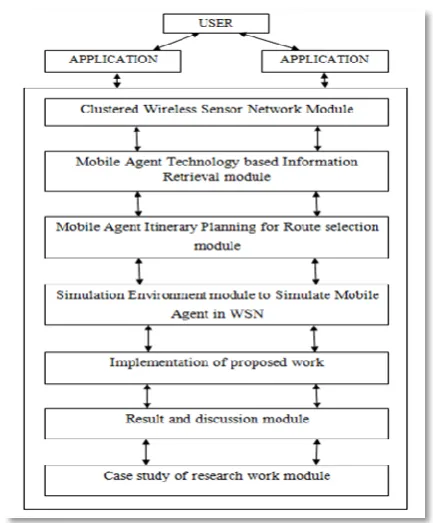
IV. MODULES FOR PROPOSED WORK: MOBILE AGENT EMBEDDING IN CLUSTER BASED WIRELESS SENSOR NETWORK
In our proposed work mobile agent technology is used in cluster based wireless sensor network .
Fig. 2.Proposed Mobile Agent Embedding In Cluster Based WSN
A. An Effective Clustering Algorithm for Wireless Sensor Network
Clustering is a mechanism that divides the network into number of groups. Each group assigned with coordinator node called cluster head (CH). The coordinator node of the cluster is responsible for collecting, processing and transmitting of the sensed data to the base station .Other nodes of cluster are member nodes which sense and forward the sensed data to the CH. Cluster head is selected using T(n) in
LEACH[5]. We modify the function T(n) using our proposed progressive approach to increase the probability of cluster head selection for other nodes. The modified T (n) is:
(1)
G is group of nodes, p is the probability of cluster head selection; r the number of rounds of selection and k is the number of nodes that are not included in the cluster head selection
.
B. Mobile Agent Technology for Information Retrieval in Wireless Sensor Network
It will become important to retrieve information efficiently and rapidly from distributed network. A mobile agent is software code capable of moving across the whole network. Mobile agents move into a network either on a predetermined path by sink node, or the agents itself determine path dynamically. In mobile agent-based
wireless sensor network sink node sends a query to mobile agent for data collection in the target region then MA visit the network, move to each CHs one by one.
.
Fig.3. Client Server vs. Mobile Intelligent Agents
In traditional client server model all data stored at server, clients can access data from server only. So client1 cannot transmit data to client2 directly without server. This will create a serious problem if we increase client server model. But using mobile agent data can be shared between client machines. Mobile agent approach reduce traffic load over network as well as use low bandwidth. In multiple criteria Clustering of Mobile Agents (MCCMA) Mobile Agents are divided into clusters based [5].
C. Mobile Agent Itinerary Planning for Route selection module
Mobile agent-based applications for data gathering is very important and main aim is to find out the route planning for mobile agent. An itinerary means information about routes which the agent will follow
to get information from the network with low resource
[image:2.595.60.277.376.638.2] [image:2.595.304.539.394.511.2]topology itineraries would be either static or dynamic and according to uses in network MA is single agent or multiple agents [7]. Static itineraries are calculated at the sink node before the MA is dispatched while in dynamic itineraries mobile agent itself determines the source nodes to be visited. In our approach [8], two approaches are used: Local Nearest First (LNF) and Global Nearest First (GNF). In LNF, the MA visit the next node having the minimum distance from the current node and in Global Nearest First (GNF), MA searches for the next node having the smallest distance from the processing node.
D. Research Methodology
Research methodology is used to solve a problem systematically. It provides a framework to conduct various experiments, tests and survey on which the whole work can be carried out.
Fig.4. Proposed Research Methodology
The research work is done in four phase: First is initialization phase that explain the node deployment strategy, second phase is setup phase in which cluster formation and cluster head selection is carried out, third transmission phase explain inter-cluster (within cluster) and intra-cluster (outside the clusters) communication and in last data aggregation phase mobile agent is embedded in WSN that will collect data from CHs and sent it to the Base Station. The performance of MA based WSN is compared with traditional WSN in term of average throughput, average packet loss and average end to end delay.
E Simulation Environment to Simulate Mobile Agent in Wireless sensor network
There are various type of Simulaters are used in wireless sensor network ,Simulater provides result analyses of our work .We simulate our work using NS-2. It is composed with two languages: Object-oriented Tool Command Language
(OTcl) & C++ Library for simulator. To setup and run a simulation, the source code is written in OTcl then OTcl-interpreter will interpret the programme using C++ library. When the simulation is finished, the simulation results are stored in form of text-based in specified output files that contain detailed simulation data, which can be used to analyze directly in term of X graph or can be visualize in graphical user interface using “Network Animator (NAM)”.
V. IMPLEMENTATION AND RESULT
DISCUSSION
The results of our proposed work are divided into two parts. a) Performance evaluation of WSN model without mobile agent
b) Performance evaluation of WSN model after embedding mobile agent
A. Simulation Setup
Performance of mobile agent based WSN is evaluated and compare it with the traditional WSN having no MA. Simulation of proposed work is based on following steps: Step 1: Node Deployment : Random deployment
Step 2: Clustering Algorithm in WSN :- Location Based clustering algorithm
Step 3: Embedding Mobile agent in clustered WSN :- Single Mobile Agent
Step 4: Define Itinerary planning of MA :- Static Itinerary Planning
Step 5: Defining simulation environment for MA based WSN :- NS-2 Simulator
Step 6: Simulation and Performance evaluation: GUI based NAM Animator
B. Simulation parameters
Table I Node parameters
Table II. Physical parameters
C WSN without Mobile Agent:
Step1: Random Node Deployment : Random deployment
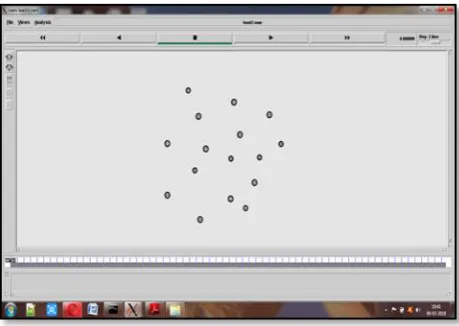
The first scenario show cluster based wireless sensor network where sensors are randomly deployed. In this scenario host/sink node directly send the query to each CH and in response each CHs collect data from their member nodes and transmit it to Host/Sink node.
Fig.5. Deployment of sensor nodes.
Here figure shows random scattering of sensor nodes in target field.
[image:4.595.48.274.302.450.2]Step 2: Clustering Algorithm in WSN :- Location Based clustering algorithm
Fig .6. Clustered WSN without MA
Location base clustering algorithm is applied here to create clusters and cluster head selection is done using above mentioned T(n) formula. Figure 6 shows clustering and Host/sink node send a query to the CHs.
Fig .7. Inter-Cluster communication
Step 6: Simulation and Performance evaluation without mobile agent: Using GUI based NAM Animator .
Average Throughput: Average throughput is calculated by starting form first packet to the last packet divided by the total time.
Average Throughput = Total number of packet transferred over period of time.
The following lines are used to calculate throughput of cluster heads in NS-2.35 :
set bw0 [$sink4 set bytes_] Here sink4 is cluster head of first
cluster and store packet in bw0 file in form of bytes.
puts $f0 "$now [expr
(($bw0+$holdrate0)*8)/(2*$time*1000000)]" this will
[image:4.595.304.533.337.433.2] [image:4.595.49.279.585.748.2]Fig.8. Average throughput of WSN without MA
Figure.8 represents average throughput of three cluster heads in the network. Here X axis represents the time duration and Y-axis represents throughput of three cluster heads. As we can see that the first data flow peak of CH-2 is at0.4Mbit/s, CH3 is at 2.7 Mbit/s and CH1 is at 0.8 Mbit/s.
Average Packet Loss: Averagepacket loss occurs when one or more packets of data travelling across a computer network fail to reach their destination in a period of time.
Average packet loss= Total number of packet lost/ time
Average Packet loss is calculated using the following formula:
set bw3 [$sink4 set nlost_] total number of lost packets at
sink4 is stored in bw3 file in order to calculate the average packet loss.
puts $f1 "$now [expr $bw3/$time]" calculate the
average packet loss.
Fig.9. Average packet Loss
Figure9 is showing the average packet Loss Analysis over the network of three clusters. Here X axis represents the time and y axis represents the packet loss over the network. Red line represents the Packet loss in cluster 1, green line for cluster 2 and blue line for packet loss in cluster 3. At time 10 sec maximum loss occur in cluster 3 but at time 80 maximum loss occur in cluster 1.
Average End to End delivery Time
Delay[i] = receiving_time[i] – sending_time[i] Here the time delay is recorded into a file using formula:
set bw6 [$sink4 set lastPktTime
_]
puts $f2 "$now [expr ($bw6 - $holdtime0)/($bw9 - $holdseq0).
Here bw6 hold receiving time, holdtime0 represent sending time and bw9 represent total number of packets.
Fig.10. Average End to End delivery Time
Delay measures time to send and receive a uncast packet from one node to another .Figure10 is showing the Average End to End delivery Time over the network of three clusters. Maximum delay 12.5 occurs in cluster 3 and in cluster 2 delays is 5.4 sec.
D. WSN with Mobile Agent:
In above scenario, if all cluster head send aggregated data at same time then packet loss and bandwidth problem may occur. It may be redundant data at sink node. Mobile Agent technology removes these problems. Sink node sends a query to mobile agent, and mobile agent move in wireless sensor network. MA will collect the sensed data from clusterheads, data is processed by MA itself and then it transmitted to sink node.
Fig.11. Sink send query to MA
Step 4: Define Itinerary planning of MA :- Static Itinerary Planning
Fig.12.Mobile Agent migration to CHs
Here fig.12 shows that Mobile agent migrate to the cluster heads according to static Itinerary planning decided by sink node.
Step 6: Simulation and Performance evaluation with Mobile Agent: GUI based NAM Animator
Average Throughput:
These lines are used to calculate average throughput in NS-2.35.
set bw0 [$sink22 set bytes_] where sink 22 is receiver which
store the whole packets in bw0 file in term of bytes
puts $f0 "$now
[expr(($bw0+$holdrate0)*8)/(2*$time*1000000)]" is
formula to compute average throughput in term of bits/sec
Fig.13. Average Throughput with mobile agent
Figure13 shows the average throughput of mobile agent based Wireless sensor network.
Average Packet loss:
set bw1 [$sink22 set nlost_]
total packet lost at sink22
node are stored in bw1 file in order to compute the
average packet loss.
puts $f1 "$now [expr $bw1/$time]"
this will calculate
the average packet loss over a period of time.
Fig.14. Average packet loss
Here in this figure green line shows expected packet delivery, red line shows no. Of packet transmitted and blue line shows packet loss.
Average Packet delay
The following lines calculate the average delay time:
set bw2 [$sink22 set lastPktTime_] set bw3 [$sink22 set npkts_]
if { $bw3 > $holdseq0 } {
puts $f2 "$now [expr ($bw2 - $holdtime0)/($bw3 - $holdseq0)]"
}
time of a session and bw9 represent time for total number of packets.
Fig.15. Packet Delay
VI. CONCLUSION
There are some problems in traditional wireless sensor network such as bandwidth constraints, energy constraints, packet loss, data redundancy, lifetime of network, data security etc. MA technology improve the performance of WSN .Instead of collecting data from CHs ,Host send MA in the network to collect data from each CHs.MA is a software code which migrate in the network from node to node according to predefined static itinerary planning . Static itinerary planning is decided by sink node. Before transmitting data to sink node, it is pre-processed by Mobile Agent, it removes unnecessary or duplicate data and then transmits it to Host. Mobile agent deployed in such a way that the impact on the energy of the WSN is minimized and it provides a high degree of flexibility, robustness, and load balancing. The performance of mobile agent based wireless sensor network depends on various network parameters like network coverage, bandwidth, network security, energy utilization, as well as agent parameters like agent’s code size and data size, execution environment etc.
The analysis of our propose work shows that the mobile agent based wireless sensor network provides performance benefits over without mobile agent wireless sensor networks in term of throughput, packet loss, end to end delay. Our simulation result shows that mobile agent technology improves band width utilization, decrease the chance of packet loss and reduce end to end time delay
VII. FUTURE WORK
In future, we can enhance our work using other clustering algorithm. Today Mobile agent is broadly deployed in real-world applications like railway reservation, Hotel Booking ,e-Trading etc. The mobile agent model implemented here simulates the most basic behaviour of agent technology. We implement static itinerary planning for mobile agent also use single mobile agent .In future work ,we enhance our work with dynamic itinerary planning with multiple mobile agent technique for data aggregation.
Multi-mobile agent technologies improve the life time of network, save energy consumption and reduce task duration due to parallel computing.
Reference
1. Jose, Deepa V., and Sadashivappa.G: A novel scheme for energy enhancement in wireless sensor networks. Computation of Power, Energy Information and Communication (ICCPEIC), International Conference on, pp. 0104-0109. IEEE, 2015.
2. Zhao, Huan, SongtaoGuo, Xiaojian Wang, and Fei Wang.: Energy-efficient Topology Control Algorithm for Maximizing Network Lifetime in Wireless Sensor Networks with Mobile Sink. Applied Soft Computing 2015
3. Konstantopoulos, C.; Pantziou,: A Rendezvous-Based Approach Enabling Energy-Efficient Sensory Data Collection with Mobile Sinks. IEEE Transactions on Parallel and Distributed Systems, vol.23, no.5, pp.809-817, 2012
4. Min Chen, Taekyoung Kwon*, Yong Yuan :Mobile Agent Based Wireless Sensor Networks. Journal Of Computers, Vol. 1, April 2006. 5. Kamal Deep, S Niranjan, Yashpal Singh.: Effective Clustering Algorithm
of Wireless sensor network through clustered Mobile agents”, Journal of Computer Sciences and Applications, Vol. 3, No. 6,154-161, 2015 6. Yashpal Singh, Kamal Deep, S.Niranjan. Clustering Approach in Route
Selection Using Mobile Agent in Mobile Ad-Hoc Network. International Journal of Engineering Research and Development, Volume 5, Issue 11, PP. 68-73 2013.
7. Divya Lohani, Shirshu Varma.: Dynamic Mobile Agent Itinerary Planning for Collaborative Processing in Wireless Sensor Networks. IEEE INDICON 2015
8. Huthiafa Q Qadori, Zuriati A Zulkarnain.: Multi-mobile agent itinerary planning algorithms for data gathering in wireless sensor networks: A review paper. International Journal of Distributed Sensor Networks Vol. 13(2)2017
9. Yashpal Singh ,Kamal Deep and S Niranjan.: Multiple Criteria Clustering of Mobile Agents.in WSN International Journal of Wireless & Mobile Networks (IJWMN) Vol. 4, No. 3 2012
AUTHORSPROFILE
Dr.S Niranjan was born on 4th April 1955 in India. Graduated from University College of Engineering, Sambalpur University in 1978 in Electronics & Telecommunication Engineering, worked as asst Engineer under State Govt and Ex. Engineer under State Electricity Board working for Power line Carrier Communication Systems, Protective relaying, telemetry and LFC Systems. Master’s Degree from IIT Kharagpur in 1987 in Computer Engineering. Worked in the areas of Parallel Processing. Performance characterization of parallel Programs under variable and uniprocessor environments, worked towards the development of a machine and hand printed Oriya Character Recognition System. Ph.D . from Utkal University. Area of work is Study and issues of mobile Computing Algorithms. He has also worked in the areas of Load Frequency Control in deregulated Scenarios and study of various non linear models of interconnected power Systems including GRC and other stochastic conditions. His current research areas include ECC based cryptographic applications, mobile ad-hoc sensor networks.