International Journal of Innovative Technology and Exploring Engineering (IJITEE) ISSN: 2278-3075, Volume-8 Issue-7, May, 2019
Parametric Estimation of Various Protocols for
Routing In Manets
Sanam Nagendram, K. Ramchand H Rao
Abstract -In Wireless communications, recent advances for MANETs (Mobile Ad-Hoc Networks) are rapidly growing which are widely used in several areas such as military, disaster recovery process etc. MANETs are the combination of nodes that moves from one place to other place. In MANETs, Routing protocols are classified into different types; they are unicasting and multicasting routing. In general protocols are defined as the step by step procedure used to find the correct path. Protocols for routing play a vital role in preventing routing attacks. This paper presents the parametric estimation of various protocols that are used for routing such as AODV (Ad-hoc On-demand Distance Vector), DSR (Dynamic Source Routing), and DSDV (Destination Sequence Distance Vector) protocols in MANETs. Further various optimization techniques can help us to find the shortest path.
Keywords- AODV, DSR, DSDV, MANETs
I. INTRODUCTION
The development of wireless communications had brought many changes in the way the people live, as the growth of wireless Communication increases, people across the world wants to move without having proper infrastructure. This provides a great demand for MANETs. Every network other than MANET possess fixed infrastructure. In general nodes in MANETs can also acts as sender
One of the major functions in this network is route discovery process [2].To develop any ad-hoc network, routing protocols plays major role. There are different types of Routing protocols, they are proactive, reactive and hybrid [3]. In other ways Reactive routing protocol is also Known as on-demand routing protocol i.e. it helps to find the routes on demand and Proactive routing protocol in other ways known as table driven routing protocol [4].
Revised Manuscript Received on May 07, 2019.
Sanam Nagendram, Asst.Prof,, KLEF and Research scholar, Department of Computer science and Engineering, ANU, Guntur, Ap., India.
Dr. K. Ramchand H Rao,Prof, Computer Science and Engineering,
A.S.N College of Engineering and Technology, Tenali, Ap., India.
[1]. There are several applications for MANETs which include communication in military, disaster recovery process, search and rescue operations, seminar halls or conference rooms, also used in the places where meeting is going to happen. Similar to applications they also face some challenges and these challenges occur because they are infrastructure-less and also the topologies in this networks change frequently.
B. Reactive Protocol for Routing
[image:1.595.305.537.462.607.2]This protocol is also known as on-demand routing protocol. Unlike proactive it does not update the routing information regularly. At times it searches for the route whenever it is required and for this reason it is called as reactive routing protocol. Example of this category is AODV (Ad hoc on-demand distance vector), DSR (Dynamic source routing).
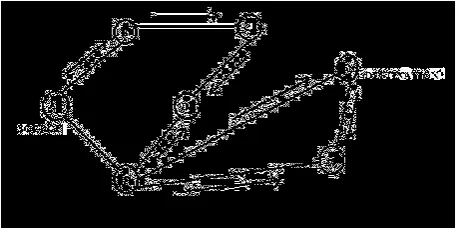
Fig 1: Structure of MANETs.
II. MANET ROUTING PROTOCOLS
A. Proactive Protocol For Routing in MANETs
[image:2.595.297.527.52.166.2]In Table driven routing protocol the nodes consists of tables that contain entire routing information. Information that is entering into the table needs to be updated regularly. Due to this reason it causes some problems. In this protocol nodes can maintain more than one table. DSDV (Destination sequenced distance vector) is one of the examples [6-7].
[image:2.595.47.275.180.304.2]Fig 2: Position and topology based routing protocol
Fig 3: Classification of MANET protocols for routing.
III. VARIOUS MANET PROTOCOLS FOR ROUTING
A. AODV Routing Protocol
AODV is one of the reactive routing protocols for MANETs. The main objective of the reactive routing protocol is that routing overhead can be reduced. This type routing protocol always finds the routes on-demand i.e. whenever it is required it overflows the network with route request (RREQ). In AODV whenever a node wants to transmit some information to other node which is having no route then it generates a message called route request (RREQ) message and that will be overflowed to other nodes [8].
Fig 4: Process of requesting for route in AODV
Fig 5: Route reply process in AODV
B. DSR Routing Protocol
Unlike AODV, DSR is another important routing protocol for MANETs. It also comes under reactive routing protocol i.e. the routes will be formed when the transmitting node requests for route. The name itself indicates that it utilizes a technique called source routing [8]. Now let us consider two nodes A and B, whenever node A has to send a data packet to node B, but node A doesn’t know route to B then node A initiates a process called route discovery process. And source node A overflows route request (RREQ) [9-10]. Every route request has set of information that consists of senders and receivers address and a unique id that is determined by sender. By simply receiving the route in route request we can obtain route reply. If node B already knows a route to node a then route discovery is not needed.
[image:2.595.312.532.202.308.2] [image:2.595.314.534.559.665.2]International Journal of Innovative Technology and Exploring Engineering (IJITEE) ISSN: 2278-3075, Volume-8 Issue-7, May, 2019
Fig 7: Route Reply process In DSR.
C. DSDV Routing Protocol
DSDV is one among the protocols of proactive routing which is also called as table driven routing for mobile ad-hoc networks. It is based on the algorithm called bell-Mann ford algorithm. The main objective of this algorithm is to solve the loop problem that occurs while routing takes place. This protocol consists of routing table at every entry the routing table consist of sequence numbers, destination address, next hop address and this seq. no can be even or odd [11-12].
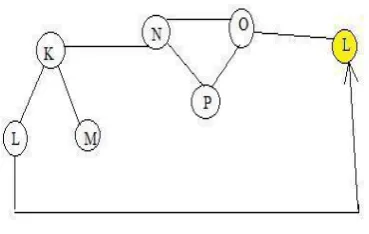
Above example shows how information is transmitted from source node to destination node. Two tables show the information at node K before and after updating. Table consists of several information such as destination, next hop address, metric and seq. no. Tables show the movement of nodes.
[image:3.595.295.517.88.213.2]Example of DSDV:
Table I. Table at Node K before updating
Destination Next Hop Metric Seq. No
K K 0 S206_K
L L 1 S335_L
M M 1 S199_M
N N 1 S568_N
O N 2 S768_O
P N 2 S47_P
Table II. Table at Node K after updatig
Destination Next Hop Metric Seq. No
K K 0 S305_K
L N 3 S425_L
M M 1 S298_M
N N 1 S688_N
O N 2 S869_O
P N 2 S165_P
IV. RESULTS AND DISCUSSION
The objective of this paper is to estimate the various parameters of routing protocols for MANETs. The performance of routing protocols can be estimated by the following parameters such as overhead, packet delivery ratio, delay and packet drop etc. performance of the various routing protocols can be estimated by this parameters and these parameters are implemented by using the simulator tool NS2(Network simulator) .
A.Parametric Analysis a.
Overhead
In general routing overhead occurs due to the sharing of same amount of bandwidth between the routes and the data packets. For a protocol in order to maintain best performance it should not be over headed.
Routing Overhead = Routing Packets.
b. Packet Delivery Ratio
We can estimate the performance of different protocols using parameter called packet delivery ratio.
Packet delivery ratio = the total no of data packets that are successfully received / total no of data packets that are transmitted
c. Delay
Delay is one of the important parameter in wireless communication. It is measured in terms of seconds. It is generally defined as the time taken by the node to reach the destination node. Delays are again classified into different types.
[image:3.595.60.245.443.560.2]d. Packet Drop
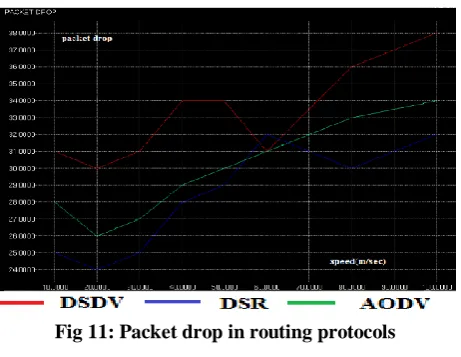
Packet drop is usually defined as packet loss, when one of the packets which are travelling from source node to destination node and in that process if any node failure occurs then packet loss takes place. Packet drop = no of packets send-no of packets received
Below figures shows the comparison of three different routing protocols in MANETs such as AODV, DSR, DSDV.
S. No Parameter Value
1. Simulator NS2
2. Routing protocol AODV, DSR,
DSDV
3. Model of Antenna Omni
4. MAC type 802_11
5. Simulation start 10
Time
6. Simulation end 250
[image:4.595.307.537.79.268.2]Time
[image:4.595.306.537.331.473.2]Table III. Simulation Metrics
Fig 8: Overhead in routing protocols for MANETs
[image:4.595.48.278.369.568.2]The overhead performance comparison of AODV, DSR, DSDV routing protocols is shown in the above figure. From this we can conclude that DSDV protocol is having more overhead compared to other protocols, since it is be updated at each and every stage.
Fig 9: Packet delivery ratio
Above figure shows the estimation of AODV, DSR, DSDV protocols based on packet delivery ratio parameter. We can conclude that the packet delivery ratio of DSR is more compared to the other routing protocols.
Fig 10: Delay in routing protocols for MANETs
Above figure shows the estimation of protocols based on the delay parameter. From this we can conclude that the delay factor is more in DSDV compared to other two protocols. After DSDV delay is more for AODV followed by DSR.
[image:4.595.308.539.554.732.2]International Journal of Innovative Technology and Exploring Engineering (IJITEE) ISSN: 2278-3075, Volume-8 Issue-7, May, 2019
Above figure shows the estimation of various protocols based on packet drop parameter. From this we can conclude that the packet drop is more in DSDV compared to other two protocols.
V. FUTURESCOPE
This paper can be extended further by applying various optimization techniques such as ant colony optimization, bee colony optimization etc. optimization techniques can helps us to find the best path.
VI. CONCLUSION
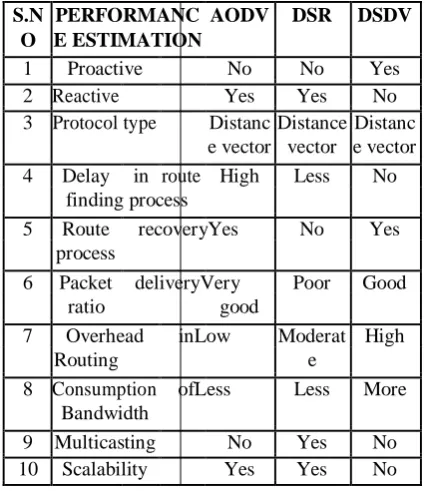
In this paper we have presented various parametric measures by varying the number of nodes for various protocols for routing such as AODV, DSR and DSDV. Parametric estimation of various routing protocols are presented using NS2 simulator. By this we can say that the performance of AODV is best in maintaining connection between nodes and DSR performance is better in short range cases and DSDV performance is not up to that extent compared to other two protocols. Below table shows the comparison of three protocols using different parameters.
S.N PERFORMANC AODV DSR DSDV
O E ESTIMATION
1 Proactive No No Yes
2 Reactive Yes Yes No
3 Protocol type Distanc Distance Distanc e vector vector e vector
4 Delay in route High Less No
finding process
5 Route recoveryYes No Yes
process
6 Packet deliveryVery Poor Good
ratio good
7 Overhead inLow Moderat High
Routing e
8 Consumption ofLess Less More
Bandwidth
9 Multicasting No Yes No
[image:5.595.57.270.362.608.2]10 Scalability Yes Yes No
Table IV. Parametric estimation of various protocols
REFERENCES
1. Aditya Bakshi, A. K. Sharma, Atul Mishra. ― “Significance of
Mobile AD-HOC Networks (MANETS)” International Journal of Innovative Technology and Exploring Engineering Volume-2, Issue-4, March 2013.
2. Arpitha C N, Dr. Arun Biradar ―”Survey on Proactive and
Reactive Protocols in MANETs”,
3. International Journal of Scientific & EngineeringResearch,
Volume 5, Issue 4, April-2014 318.
4. Basu Dev Shivahare, Charu Wahi, Shalini
5. Shivhare ―”Comparison Of Proactive And
6. Reactive Routing Protocols In Mobile Adhoc Network Using
Routing Protocol Property”:
7. International Journal of Emerging Technology and Advanced
Engineering Volume 2, Issue 3, March 2012.
8. Royer, Elizabeth M., and Chai-KeongToh. "A review of current routing
protocols for ad hoc mobile wireless networks." IEEE personal communications 6.2 (1999): 46-55.
9. Abdur Rashid Sangi, Jianwei Liu, Zhiping Liu. “Performance Comparison
of Single and Multi-Path Routing Protocol in MANET with Selfish Behaviors World Academy of Science, Engineering and Technology”. International Journal of
10.Electrical, Computer, Energetic, Electronic and Communication
Engineering Vol: 4, No: 5, 2010.
11. Avinash giri, Jitendra Prithviraj & Ashok Verma. Analysis of unipath
and multipath routing protocols in mobile adhoc networks by Avinash giri, International Journal of Smart Sensors and Ad Hoc Networks, Vol2, Iss- 1, 2, 2012.
12. Sangeeta Singh, Swati Atri. ”Analyzing Multipath Routing Protocol in
AdHoc Networks”.
13.International Journal of Advanced Research in Computer and
Communication Engineering Vol. 5, Issue 4, April 2016.
14.Dr. S. S. Dhenakaran, A. Parvathavarthini. “An
15.Overview of Routing Protocols in Mobile Ad-Hoc
16.Network”. International Journal of Advanced
17.Research in Computer Science and Software Engineering Volume 3,
Issue 2, February 2013.
18.Shruti Singhroy, P. L. Zade & Nilima bodhya.
19.―Comparative Analysis of AOMDV, AODV,
20.DSR AND DSDV Routing Protocols for Cognitive Radio International
Journal of Electronics, Communication & Instrumentation Engineering
21.Research and Development‖ Vol. 3, Issue 2, Jun
22.2013, 1-6.
23. Delfín Rupérez Cañas · Luis Javier García, Villalba Ana Lucila,
Sandoval Orozco, Tai- Hoon
24.Kim. ―”Adaptive routing protocol for mobile ad hoc networks”
Springer 2014.
25. K. Ramesh Reddy, S. Venkata Raju, N. Venkatadri Reactive, Proactive