International Journal of Innovative Technology and Exploring Engineering (IJITEE) ISSN: 2278-3075, Volume-8 Issue-9, July 2019
Abstract The identification of a person through images has been on cards for a long while but identification/recognition through video is not so common that is what we have tried to explain by the use of some classifiers like HAAR, Local Binary Pattern (LBP) and Local Binary Pattern Histogram (LBPH). These all classifiers are used for facial detection & recognition respectively. For the Facial Detection, HAAR Classifier is used while for Facial Recognition Local Binary Pattern Histogram is used.
IndexTerms : Classifiers, Facial Detection, Facial Recognition, Local Binary Pattern Histogram (LBPH), Local Binary Pattern (LBP), HAAR.
I. INTRODUCTION
Facial Detection is a technology falling in category of Machine Learning whose main work or which is mainly used for detecting faces in a digital image. It works on a simple algorithm [1]. The basic way Facial Detection work is as follows:
1. The detect Multi Scale function is a general function that detects objects. Since we are calling it on the face cascade, that’s what it detects.
2. The 1st thing is the conversion to gray-scale picture. 3. The 2nd is the scale-Factor. Because few face closer to
camera, may appear big others in back might appear small. 4. The detection algorithm uses a moving window to detect objects min-neighbours-defines how much objects get detected in the current one as soon as it says the faces found [2].
While Facial Recognition with all due respect is a different cup of tea and is indeed a bit tough task but can be achieved with ease if done right. The phenomenon is basically defined as a verification of the face of an individual from a digital picture or a video using a particular algorithm and by training the machine. The basic stages/ways Facial Recognition work is as follows [3]:
1. First , collect image ids.
2. Second, extract unique features, classify them & store in XML files. The features are stored in XML because XML files are easy to extract & use .
3. Third match feature of input image with the feature of input image with the feature of saved XML files & predict identity [4-5].
Revised Manuscript Received on July 05, 2019.
[image:1.595.325.537.141.528.2]Mohd.Altamash, Dept. of CSE, Amity University, Noida, India Avinashwar, Dept. of CSE, Amity University, Noida, India Neetu Faujdar, Dept. of CSE, Amity University, Noida, India Shipra Saraswat, Dept. of CSE, Amity University, Noida, India
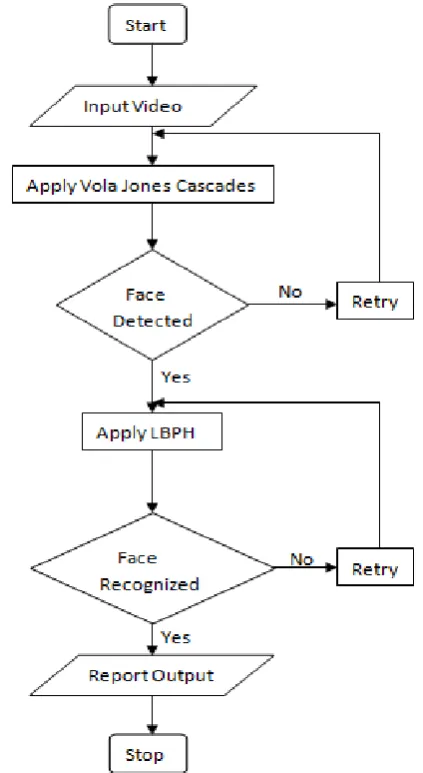
Fig. 1. Flowchart on Face Detection & Recognition II. RELATEDWORK
Facial Detection & Recognition was first introduced to the world in year 1977 by Kanade using a human face vector [6]. Kirby and Sirovich in 1983 introduced the principal component analysis (PCA) for complete feature extraction [7]. Local Binary Pattern analysis for texture recognition came into light in 1994 and later for better performance integrated with histogram [8].Viola and Jones introduced algorithm which uses HAAR cascades and AdaBoost for facial detection [9]. In this project, HAAR cascades are used for facial detection and the Local Binary Pattern Histogram for facial recognition.
III. METHODOLOGY
Video Based Facial Detection & Recognition
In order to accomplish this task, we first with the help of cascades we able to teach the computer how a face looks like then the video is read in terms of frames then the image is changed into gray scale after that by the help of classifiers like HAAR and LBP (or you can make your own classifiers) and the Face Detection is complete. Further for Recognition, the detected faces are verified with the Database & if verification results in “yes”, the name below the detected face in the box appears and if the result is “no”, the detected face in the box is shown as it is.
There are majorly two classifiers which does the face detection task by dividing the face into small tasks and then passing more than 30 stages. These two classifiers are called HAAR and LBP respectively.
A. HAAR Classifier:
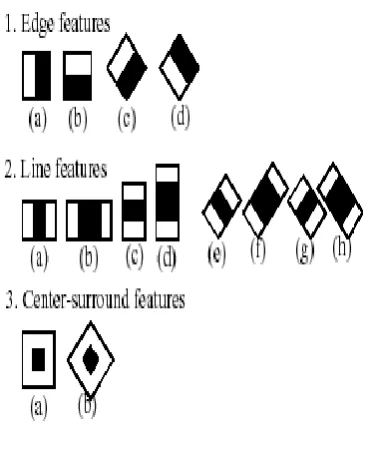
[image:2.595.322.530.50.223.2]This is used for detecting faces in any kind of digital image or videos. This is an algorithm which was developed by Paul Viola and Michael Jones but it is often called as Voila Jones Algorithm. HAAR is predominantly used and the accuracy is improved by Ada-boost, which is a training module for face detection which selects those features that improve accuracy. The Fig 2 below shows how the features from an Image frame are extracted and processed [10]:
Fig. 2. HAAR Cascade
Every window displayed above is placed gently on the face in image or face in video to obtain individual feature value. This subtracts the total pixels of the light share after the total pixels beneath the dark portion. This is mostly used in recognizing the lighter and darker area. While Ada-boost is used to remove the irrelevant values [11].
[image:2.595.68.253.334.559.2]The Fig 3 below shows how in general the HAAR classifier works on a given image (explained above):
Fig. 3. HAAR Cascade
Algorithm (Approach):
1. Select a pixel location of the image from the video. 2. Let’s crop a sub-image with the picked pixel being the
centre of the source image with the same size as the convolution kernel.
3. Mathematically do calculations of an element-wise product set in-between the values of the kernel and sub images.
4. Adding the result of the product set.
5. Add and place the final result value in the newest image at the same position where you selected the pixels location.
B. LBP Classifier:
LBP is Local Binary Pattern, it is a cascade or classifier which is used for facial detection. This is developed by Dong Chen. It is simple but very efficient, which classifies the pixel of photos through thresholding the adjacent pixel and obtains result as a binary value [12].
The Fig 4 below shows the calculation done after a particular portion of the image is analyzed:
Fig. 4. LBP Cascade
C. HAAR vs LBP Classifier:
Comparing both the classifiers isn’t easy because they almost work in the same fashion but with a slight difference that the LBP chooses a particular portion of face and finds its binary value.
[image:2.595.317.538.473.631.2]International Journal of Innovative Technology and Exploring Engineering (IJITEE) ISSN: 2278-3075, Volume-8 Issue-9, July 2019
D. Module Training (LBPH) for Facial Recognition:
We can do this task of recognize faces very easily but at the same time this task is quite difficult for machines. So, we now have to train these machines such that these should be able to recognize a face in a video. In order to accomplish that we first have to tell the machines how face looks like so that it can at-least detect a face in a video [13].
In order to train a machine how, a face looks like, we have to make cascades in XML language which has addresses of thousands of images of different faces which will be used to train the machines.
So, with the help of these cascades the machine would know what to detect which are faces of people in this case [14]. How LBPH works?
This algorithm is pretty accurate in recognizing faces as the parameters it uses are very reliable and doesn’t vary much from time to time.
Some of the parameters that this uses are as follows:- 1. Number of neighbors- We can select the number of
neighbors in order to build the binary pattern. The more it is the more accurate it will be. But we don’t need it to be too high as it would make the computational cost high. 2.
Radius- Used to select the number of pixels around the
radius of the central pixel.
3.
Grid X- As the name suggests it is the number of pixels in the horizontal directions.
4. Grid Y- the number of pixels in the vertical direction.
Algorithm(Approach):
First and foremost, we need some images of the people we need to recognize. We also need to give each of them an ID which will reflect under their face. The ID can be their names. With this dataset we will train our algorithm (Recognition):
From the video our algorithm extracts a region of interest which is the face of the person whom it has detected in the video. It then extracts every pixel from the image and gives it a unique (kind of) number.
How you may ask, well it first selects the all the pixels around it whom it is sharing the borders. It then gives value of RGB to each of the pixels.
In the next step it checks that if the threshold value (the value of the center pixel) is greater than or smaller than all of its neighbors.
If it is greater then, it gives the value of 1 to the neighbor and if it less than the threshold value then the neighbor is given a value of 0.
In the next step we make a binary number by starting from the top left side of the matrix and moving towards the right row by row.
The binary value which we get is taken as the threshold value which is the value of the center pixel.
This way we get a value of every pixel and we make a histogram out of it.
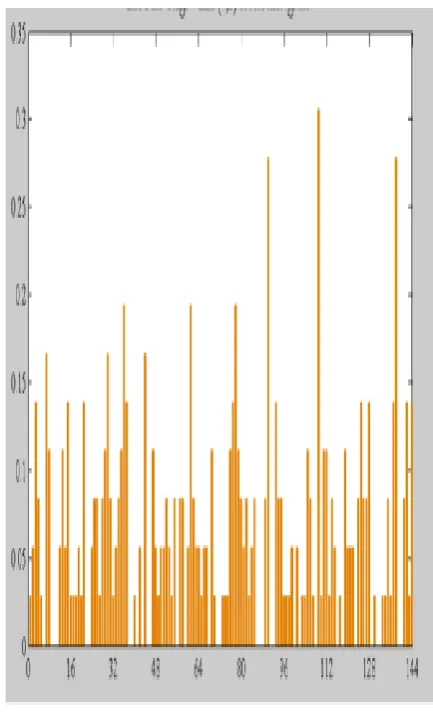
[image:3.595.313.536.52.244.2] When we want a face to be recognized then the same procedure is followed as above and we make a histogram of the face we want to be recognized. Then we find he difference between the histograms and the closest match is the result.
Fig. 5. This is illustration how LBPH Works
[image:3.595.317.534.286.643.2]IV. RESULT
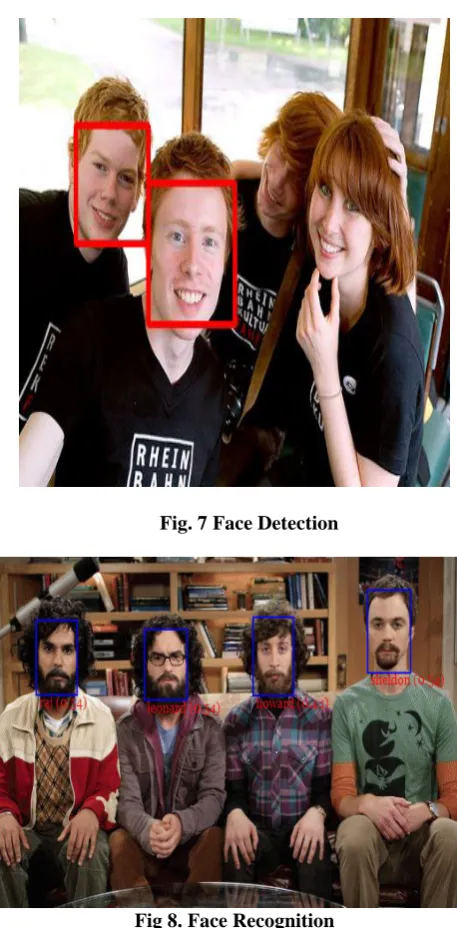
We are able to alter the frame rate in the video to our specified frame rate and then detect the faces in the video by using our own datasets, further for comparison the detected facial expressions in the video to the store, further at last we are able to identify the face of the individual in the video. The face of our group members are able to get recognized by the tool. We are satisfied by the results and the system is working efficiently with both Facial Detection and Recognition properly which is shown in Fig 7 & 8.
[image:4.595.51.280.294.759.2]The Facial Detection is first done, and the images are stored then the trained machine matches the stored image with the sample or probable image and if matched then displays the image with name and box around the face else it displays only the image with box around the face. We are able to reach a success rate of more than 90% with this project. Though system has some small errors, but we are rectifying them. The small errors which we encountered are just related to some hardware issues like memory and some specifications otherwise there are no flaws in the actual software system.
Fig. 7 Face Detection
Fig 8. Face Recognition
V. CONCLUSION &FUTURE PLANS
The main aim is achieved in the first place i.e. detect and recognizes faces in a video and are able to recognize the faces of our group members using this algorithm. And now, we are working to implement this in some real-life scenarios like in CCTV-footages.
The plans for the future with the finding are pretty clear. Our project and findings are most likely to be acknowledged at both Industrial and Academics level as it can be used in security management of organizations plus at academic level it can be used for security and fake attendance marking check for both students and teachers. Another future prospect is to integrate this algorithm with an Android Application for better accessibility, but these Applications can be used only by the organizations or institutions which have larger databases of photos.
REFERENCES
1. Suneetha, J. "A survey on video-based face recognition approaches.” International Journal of Application or Innovation in Engineering And Management (IJAIEM) 3.2, 2014.
2. Patil, S., and D. Deore. “Video-based face recognition: a survey.” World Journal of Science and Technology 2.4, pp. 136-139, 2012.
3. Turk, M. A., & Pentland, A. P, “Face recognition using eigen faces”. In proceedings IEEE Computer Society Conference on Computer Vision and Pattern Recognition, pp. 586-591, 1991.
4. Kshirsagar, V. P., Baviskar, M. R., & Gaikwad, M. E., “Face recognition using Eigenfaces” In 3rd International Conference on Computer Research and Development, pp. 302-306, 2011.
5. Gunturk, B. K., Batur, A. U., Altunbasak, Y., Hayes, M. H., and Mersereau, R. M, “Eigen face-domain super-resolution for face recognition” IEEE transactions on image processing, 12(5), pp. 597-606, 2011.
6. Viola, Paul, and Michael Jones. "Rapid object detection using a boosted cascade of simple features.” CVPR, (1)1, pp. 511-518, 2001.
7. Bartlett, M. S., Movellan, J. R., & Sejnowski, T. J., “Face recognition by independent component analysis” IEEE Transactions on neural networks, 13(6), pp. 1450-1464, 2002.
8. Huang, H., He, H., Fan, X., & Zhang, J., “Super-resolutionof human face image using canonical correlation analysis” Pattern Recognition, 43(7), pp. 2532-2543, 2010.
9. Sirovich, Lawrence, and Michael Kirby. "Low-dimensional procedure for the characterization of human faces." Josaa, 4.3, pp. 519-524, 1987.
10. He, Dong-Chen, and Li Wang. “Texture unit, texture spectrum, textureanalysis. “IEEE transactions on Geoscience and Remote Sensing, 28.4, pp. 509-512, 1990.
11. Faujdar Neetu and SP Ghrera, “Modified Levels of Parallel Odd-Even Transposition Sorting Network (OETSN) with GPU Computing using CUDA,” Pertanika J. Sci. and Technology, pp. 331-350, 2016. 12. Neetu Faujdar, Yashita Verma, Akash Punhani “Effective utilization
and delimiting energy consumption based on IoT”, International
Journal of Innovative Technology and Exploring Engineering, 8(6), pp.
1499-1504, 2019.
13. Akash Punhani, Neetu Faujdar, Sunil Kumar, “Design and evaluation
of cubic torus Network-on-Chip Architecture”, International Journal of
Innovative Technology and Exploring Engineering, 8(6), pp.
1672-1676, 2019.
International Journal of Innovative Technology and Exploring Engineering (IJITEE) ISSN: 2278-3075, Volume-8 Issue-9, July 2019
oto
AUTHORSPROFILE
First Author Mohd. Altamash is currently doing B-tech in CSE from Amity School of Engineering and Technology, Amity University, Noida. He is certified in Ethical Hacking form the prestigious institute named Lucideus and worked under the guidance of Founder of Lucideus Technology. Apart from this he has done multiple Machine Learning courses from different sources as from coursera and from some prestigious institutes. He has done his internship from DRDO.
Second Author Avinashwar is currently doing B-tech in CSE from Amity School of Engineering and Technology, Amity University, Noida. He has done his internship from DRDO.
Third Author Dr. Neetu Faujdar is currently working as an Assistant Professor in Amity School of Engineering and Technology, Amity University, Noida. She has completed her Ph.D. from Jaypee University of Information Technology, Solan, H.P. from July 2013 - Feb 2017 on the topic "Performance Analysis of Sorting Algorithms uses GPU Computing with CUDA Hardware". She has Completed her M.Tech (Computer Science Engineering) in 2013 from Invertis University Bareilly and B.Tech (Information Technology) in 2011 from VTU University Belgaum. She has been the member of IAENG since 2015. She has published 3 book chapters and more than 20 research papers publications in different International Journals and in Proceedings of International Conferences of repute. She has 6 years of teaching and research experience with leading institutions. Her area of interest includes Algorithms, High Performance Computing Architecture, and GPU Computing.