International Journal of Innovative Technology and Exploring Engineering (IJITEE) ISSN: 2278-3075,Volume-8, Issue-11, September 2019
Abstract: In this paper a new genetic algorithm is developed for solving capacitated vehicle routing problem (CVRP) in situations where demand is unknown till the beginning of the trip. In these situations it is not possible normal metaheuristics due to time constraints. The new method proposed uses a new genetic algorithm based on modified sweep algorithm that produces a solution with the least number of vehicles, in a relatively short amount of time. The objective of having least number of vehicles is achieved by loading the vehicles nearly to their full capacity, by skipping some of the customers. The reduction in processing time is achieved by restricting the number of chromosomes to just one. This method is tested on 3 sets of standard benchmark instances (A, M, and G) found in the literature. The results are compared with the results from normal metaheuristic method which produces reasonably accurate results. The results indicate that whenever the number of customers and number of vehicles are large the new genetic algorithm provides a much better solution in terms of the CPU time without much increase in total distance traveled. If time permits the output from this method can be further improved by using normal established metaheuristics to get better solution
Keywords : CVRP, Genetic algorithm, modified sweep algorithm, dynamic demand, Minimum no of Vehicles.
.
I. INTRODUCTION
Transportation is one of the important cost of logistics cost. Vehicle routing problem (VRP) is one of the interesting optimization problem. VRP was first proposed by Dantzig and Ramser [1] and has been proved to be an NP-complete problem. Its purpose is to design the least costly routes for a fleet to serve geographically scattered customers. According to different applications and restrictions, many extended VRP types are classified. The Capacitated Vehicle Routing Problem (CVRP) is known as the basic extension, in which the total demand of any vehicle cannot exceed a preset capacity value. Since VRP is a NP-hard problem CVRP is also a NP-hard problem. Since the first VRP was presented, many algorithms have been proposed for solving either the classical VRP or its variants. At present, those algorithms can be divided into three main groups: exact algorithms,
Revised Manuscript Received on September2, 2019.
Vangipurapu Bapi Raju, Dept. of Mechanical Engg, V.R. Siddhartha Engineering College, Vijayawada, 520007, India Email: [email protected]
Govada Rambabu , Dept. of Mechanical Engg, Andhra University, Visakhapatnam, 530003, AP, India, Email: [email protected]
Kandukuri Narayana Rao, Dept. of Mechanical Engg, Government Polytechnic College, AP, India, Email: [email protected]
heuristics, and metaheuristics. Paolo Toth and Daniele Vigo [2] have given a detailed description of these methods. An exact algorithm is an algorithm that solves a problem to optimality. This category includes branch and bound approach, cutting planes, network flow, dynamic programming approach and so on. G. Laporte (1992) [3] and C.Y.Liong et.al [4] gave an overview of these methods. Exact methods are suitable for small instances only as complexity increases rapidly with increase in the number of customers, making these methods unsuitable in those cases. So, numerous studies have concentrated on developing heuristics to obtain near-optimal solutions. Classical heuristics refer to use the experience based inductive reasoning and the experimental analysis to solve a problem. They include mathematical programming method, improvement or exchanges methods, saving or insertion methods, cluster first route second and route first cluster second and so on. Classical heuristics for CVRP have been surveyed by G. Laporte and F. Semet [5] and G. Laporte and M. Gendreau [6]. Christofides Nicos [7] has categorized and discussed both exact and approximate methods for solving VRPs. The classical heuristic approaches can find one feasible solution quickly, but this feasible solution may have a large disparity compared with the best solution. In recent years, based on biology, physics, and artificial intelligence, metaheuristics were developed. Metaheuristics have been applied for various fields due to its efficient optimization performance. In most works of literature printed, most of the CVRP are tackled by metaheuristics, such as Tabu Search, Simulated Annealing (SA), Immune Algorithm, Genetic Algorithms (GA), Particle Swarm Optimization (PSO), and Ant Colony Optimization etc. Genetic algorithm is one of the important metaheuristic which is used to solve the vehicle routing problems. Although metaheuristics are effective and efficient they consume a lot of CPU time to arrive at the solution. This is because they have no specific stopping criterion. Longer the computing time the higher is the probability of finding global optimum. Hence they are generally allowed to run for long time. For example, a typical genetic algorithm runs for more than 100 iterations to solve even medium sized vehicle routing problem consuming a lot of computational time in the process. Secondly, metaheuristics often suffer from parameter optimization. A thorough knowledge of the problem structure or a lengthy trial-and-error process is needed to select the parameter set carefully.
Development Of A New Genetic Algorithm For
Solving Capacitated Vehicle Routing Problem In
Short Time
The best parameter set is usually re determined for the each of the problem instances considering the application area, size or input data of the problem. Adenso-Diaz and Laguna [8] state that during development of a heuristic of CVRP about 10% of the total time is dedicated to designing and testing of a new heuristic is spent for development, and the remaining 90% is consumed in tuning of parameters. Lastly the quality of initial solution can impact the performance of the metaheuristics. These problems can be overcome to a certain extent if we have a good initial solution, reduced objectives, simplified problem.
In many of the VRP problems demand is assumed to be constant before the beginning of each trip. In reality the demand changes before the beginning of the each trip. This is because there can be changes in the demand of the existing customers, there can be addition of the new customers or there can be deletion of the customers etc. Hence there is a necessity to determine the best solution before the beginning of the every trip. This makes it necessary to use an algorithm which produces the solution within short amount of time providing reasonably accurate solutions. Metaheuristics normally give best results but they consume excessive amount of CPU time and resources resulting in delay of generation of output. Thus there is a necessity of developing a metaheuristic which produces the output in relatively short amount of time without deviating much from the best results.
Minimizing the number of vehicles and minimizing total distance are two main objectives which are considered by many researchers in CVRP. Many a time it is seen hiring/maintaining a new vehicle is costlier than using existing vehicles for longer distances. Hence most heuristics use hierarchical objectives, which consider minimizing the number of vehicles used as the primary objective and minimizing the total distance as a secondary objective. That is because a solution with less number of vehicles is treated as a better one than the solution with more number of vehicles even when the total distance traveled in the latter case is less. Most of the time these two objectives are conflicting meaning when the number of vehicles is less the distance traveled is more and vice versa. Hence an attempt should be made to first get a solution satisfying the primary objective of minimizing the number of vehicles and later if time permits this initial solution can be improvised to reduce the total distance travelled without increasing the number of vehicles.
II. LITERATURESURVEY
Genetic algorithm (GA), proposed by Holland [9], has been widely applied to solve hard combinatorial problems and it is an effective search and optimization method that simulates the process of natural selection or survival of the fittest. GA starts with generating random population of chromosomes. The chromosomes evolve through a series of iterations, called generations. During each generation, the fitness of each chromosome in population is evaluated. According to their fitness measure, two parent chromosomes are selected which can be crossed over by exchanging pieces with each other and/or mutated randomly or transferred unaltered to the next generation; this process is repeated until a termination sequence (such as convergence) is reached.
Thangiah [10] has used GA to determine clusters of customers during the clustering phase of the two phase strategy.Van Breedam [11] measured the impact of various parameters of a GA on the final solution value of VRP. Prins [12] developed a more efficient genetic algorithm which can compete with tabu search method for solving VRP, Hiassat et al[13] developed genetic algorithm approach for location-inventory-routing problem with perishable products Gillett and Miller [14] developed the sweep algorithm that applies to planar instances of VRP. Feasible routes are created by rotating a ray centered at the depot and gradually including customers in a vehicle route until the capacity or route length constraint is attained. A new route is then initiated and the process is repeated until the entire plane has been swept. In each solution, the routes are optimized for by moving and exchanging the customers between the routes. The authors have shown that the processing time increases quadratically as the average number of locations per route increases keeping the total number of customers constant , but when the total number of customers is increased keeping the average number of customers in each route constant the processing time increases only linearly. This indicates that real processing time is consumed only by the improvement phase and not by the formation of routes. M. M. A. Aziz et al [15] developed a Hybrid Heuristic Algorithm for solving CVRP. His method consists of using the sweep algorithm and the Nearest Neighbor algorithm. Sena Kir et al [16] developed a new heuristic algorithm for CVRP based on adaptive large neighborhood search (ALNS). Bapi raju et al [17] have developed a heuristic to achieve this objective of minimizing the number of vehicles. Their heuristic is based on two propositions. First one is that sweeping should start from a node whose angular distance from the next consecutive node w.r.t depot is very large. This prevents customers who are very far being in the same vehicle and subsequently increasing the traveled distance. In other words, this would ensure routes are densely packed with customers and would reduce the total distance traveled. The second proposition is that vehicles can be loaded nearly to their full capacity if some of the customers can be skipped during sweeping. This would result in less number of vehicles. In order to achieve this objective the authors have used the technique of skipping some of the customers in order to load the vehicles to its full capacity. In this paper a new genetic algorithm, is developed to solve CVRP problems. The output from this algorithm has the least number of vehicles, in the solution, even when the tightness (total demand / total capacity) is equal to 1. This method is tested on 3 sets of (A, M and G) of benchmark instances found in literature. The output is compared with the output of similar methods.
International Journal of Innovative Technology and Exploring Engineering (IJITEE) ISSN: 2278-3075,Volume-8, Issue-11, September 2019
III. ANEWGENETICALGORITHMFORSOLVING
VEHICLEROUTINGPROBLEM
A new simple genetic algorithm is developed to solve CVRP. In the following subsections, the adaptation of the GA to this model, and its elements, such as chromosome representation are described.
Chromosome representation
Chromosome representation can be done by permutation representation, direct path representation, binary representation. In this algorithm direct representation is used. A single variable Db which is a measure of distance from the depot is used as a chromosome. It represents the cutoff distance for rearranging the customers as mentioned below in the fitness function.
Fitness function
Total travelled distance is the used as fitness measure. It is determined as follows.
1)Customers are arranged in the order of the angular distance.
2)Nodes which are at distance less than Db from Depot are separated. They are added at the end of the list 3)The modified sweep algorithm developed by Bapi raju
et. al [17] is used to calculate total travelled distance. This algorithm automatically ensures minimum number of vehicles are used.
Parameters of GA
The parameters of the genetic algorithm is set as follows. Number of generations is restricted to 1. This would ensure results are obtained very quickly. Upper boundary of the Db is set to median of all the distances of customers from depot. Lower boundary is set to ‘0’. Also Db is restricted to integer values. Initial population is taken as those 10 values which divide the distance between lower boundary and upper boundary in to equal parts (rounded to nearest integer). Other parameters like, cross over parameters, Mutation parameters etc. are set to default values by MATLAB® which is used to solve the problem
IV. EXPERIMENTALTESTS
The proposed algorithm is tested on three (A, M, and G) sets of benchmark instances, which are found in the literature [18]. Matlab software is used to solve the problem. The experiments have been done on a PC (Intel Core i7-8550U CPU @ 1.80 GHzCPU, 8GB RAM) with Windows 10 OS.
V. RESULTANDDISCUSSION
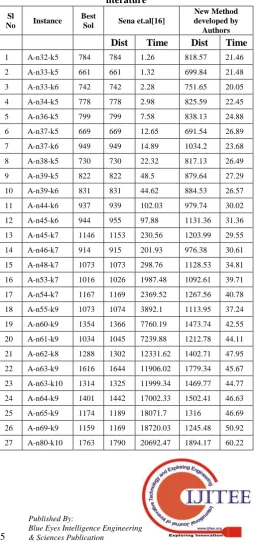
The results are compared with the results of Kır, S., Yazgan et al [16]. The results are presented in Table 1. It can be seen that the proposed algorithm produces reasonably good results within short amount of CPU time. Although this algorithm fails to compete with regular metaheuristics whenever the number of customers and number of vehicles are less, it outperforms them, in terms of speed, whenever the number of customers and number of vehicles are large. However this speed in computation is achieved by some reduction in the quality of the solution measured in terms of
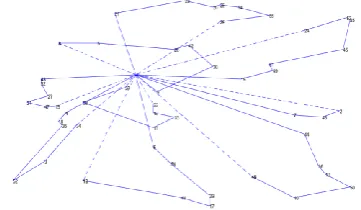
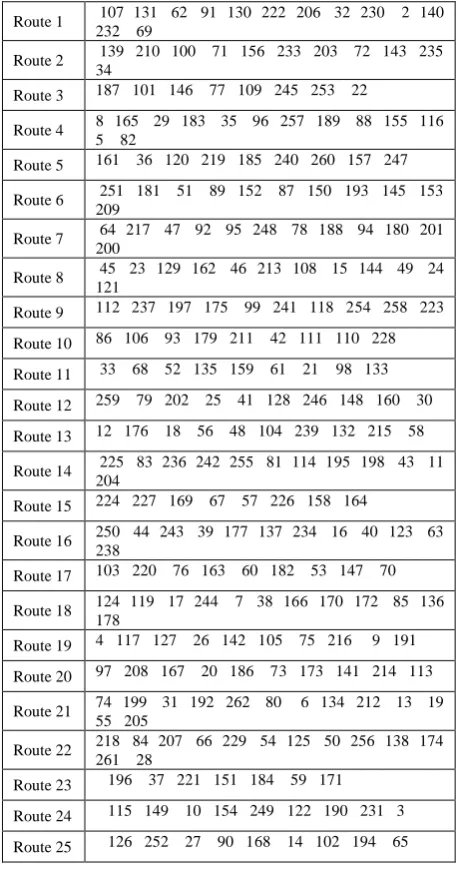
[image:3.595.300.556.291.835.2]total distance travelled. The total distances of output from new algorithm are only about 7% more compared to one best solution from metaheuristics found in literature, but there is a reduction of about 99% in CPU time(for larger problems). It is to be noted that for the test instance M-n200-k17 the new algorithm produces solution with one vehicle less (i.e. only 16 vehicles). Hence the solution from the new method is assumed to be superior in this case and further comparison is not made for this instance. Hence this method can be used generate reasonably good solution quickly for larger problems with more number of vehicles and more number of customers. If time available is more this solution can further be improved, by normal meta heuristics. The solutions to the problem instances A-n55-k9, M-n200-k17, G-n262-k25 and are presented in the Appendix in Table 2, Table 3and Table 4. The corresponding figures are Figure 1, Figure 2 and Figure 3 respectively.
Table 1 Comparison of output results with results from literature
Sl
No Instance Best
Sol Sena et.al[16]
New Method developed by
Authors
Dist Time Dist Time
1 A-n32-k5 784 784 1.26 818.57 21.46
2 A-n33-k5 661 661 1.32 699.84 21.48
3 A-n33-k6 742 742 2.28 751.65 20.05
4 A-n34-k5 778 778 2.98 825.59 22.45
5 A-n36-k5 799 799 7.58 838.13 24.88
6 A-n37-k5 669 669 12.65 691.54 26.89
7 A-n37-k6 949 949 14.89 1034.2 23.68
8 A-n38-k5 730 730 22.32 817.13 26.49
9 A-n39-k5 822 822 48.5 879.64 27.29
10 A-n39-k6 831 831 44.62 884.53 26.57
11 A-n44-k6 937 939 102.03 979.74 30.02
12 A-n45-k6 944 955 97.88 1131.36 31.36
13 A-n45-k7 1146 1153 230.56 1203.99 29.55
14 A-n46-k7 914 915 201.93 976.38 30.61
15 A-n48-k7 1073 1073 298.76 1128.53 34.81
16 A-n53-k7 1016 1026 1987.48 1092.61 39.71
17 A-n54-k7 1167 1169 2369.52 1267.56 40.78
18 A-n55-k9 1073 1074 3892.1 1113.95 37.24
19 A-n60-k9 1354 1366 7760.19 1473.74 42.55
20 A-n61-k9 1034 1045 7239.88 1212.78 44.11
21 A-n62-k8 1288 1302 12331.62 1402.71 47.95
22 A-n63-k9 1616 1644 11906.02 1779.34 45.67
23 A-n63-k10 1314 1325 11999.34 1469.77 44.77
24 A-n64-k9 1401 1442 17002.33 1502.41 46.63
25 A-n65-k9 1174 1189 18071.7 1316 46.69
26 A-n69-k9 1159 1169 18720.03 1245.48 50.92
28 M-n151-k1
2 1053 1048 37360.19 1107.73 147.7
29 *
M-n200-k1
7 1373 1331 42873.25 1525.2 201.7
30 G-n262-k25 6119 5875 45202.09 6237.52 240.1
Total* 35310 35264 217624.5 37776.6 1332.6
*The output from 29th instance is not added to the totals as the new algorithm took only 16 vehicles (one vehicle less) and therefore cannot be compared with the other method. The new algorithm is assumed to be superior.
VI. CONCLUSION
In this paper a new genetic algorithm for solving CVRP based on modified sweep is developed. The output from the algorithm always results in least number of vehicles. The processing time of the algorithm is very less compared to other metaheuristics although this objective is achieved by compromising with the other objective of total distance travelled. This is to be applied in situations where the demand is known only at the beginning of the trips and the number of customers and vehicles are large. In this type of scenarios metaheuristics, which normally provide reasonably accurate solutions, cannot be applied due to time constraints. Hence this method should be used so as to generate reasonably good solutions within short duration. More over if time permits, this output can be improved by normal metaheuristics. The limitation of this method is that it cannot perform well whenever the number of customers and number of vehicles are low. This is because the normal metaheuristics provide better results taking more or less same time as the new method.
APPENDIX
Table 2 Solution for Problem Instance A-n55-k9
Route 1 43 32 27 21 47 15
Route 2 4 18 35 52 3 34
Route 3 6 54 39 17 41 12 16
Route 4 48 40 50 10 36 44
Route 5 7 46 2
Route 6 19 49 51 45 25 53 24
Route 7 29 55 14 28 20 23 31
Route 8 8 5 26 42 30 9
[image:4.595.41.298.50.120.2]Route 9 37 38 11 33 13 22
[image:4.595.338.519.61.166.2]Figure 1: Solution for Problem Instance A-n55-k9 Table 3 Solution for Problem Instance M-n200-k17
Route 1 53 154 83 125 37 144 48 169 49 195 107 103
Route 2 89 149 63 108 176 12 65 50 20 124 183 8 147
Route 3 28 168 32 11 190 109 91 64 127 160 191
Route 4 133 70 2 102 71 31 21 129 161 132 182 33 163 128
Route 5 177 52 189 67 66 137 72 162 104 10 51
Route 6 112 158 4 186 34 82 165 35 36 136 121 123
Route 7 29 185 77 197 117 78 159 80 130 170 30 122 13
Route 8 155 139 110 178 55 131 135 25 164 151 69
Route 9 27 150 196 180 199 111 5 156 140 188 171 56 166 81
Route 10 179 198 57 187 24 68 40 26 181 106
Route 11 59 138 146 172 23 134 76 75 73 74 22 41 54
Route 12 153 3 116 42 16 44 15 143 43 173 58 145 88 98 118 14
Route 13 96 93 152 38 101 120 39 141 45 92 194 99 95 113
Route 14 184 60 94 86 193 192 142 126
Route 15 148 6 174 18 114 87 17 62 100 105 97 7 157
Route 16 19 84 200 115 9 175 47 46 85 119 61 167 90
[image:4.595.312.541.220.674.2] [image:4.595.68.271.486.628.2]International Journal of Innovative Technology and Exploring Engineering (IJITEE) ISSN: 2278-3075,Volume-8, Issue-11, September 2019
Table 4 Solution for Problem Instance G-n262-k25
Route 1 107 131 62 91 130 222 206 32 230 2 140 232 69
Route 2 139 210 100 71 156 233 203 72 143 235 34
Route 3 187 101 146 77 109 245 253 22
Route 4 8 165 29 183 35 96 257 189 88 155 116 5 82
Route 5 161 36 120 219 185 240 260 157 247
Route 6 251 181 51 89 152 87 150 193 145 153 209
Route 7 64 217 47 92 95 248 78 188 94 180 201 200
Route 8 45 23 129 162 46 213 108 15 144 49 24 121
Route 9 112 237 197 175 99 241 118 254 258 223
Route 10 86 106 93 179 211 42 111 110 228
Route 11 33 68 52 135 159 61 21 98 133
Route 12 259 79 202 25 41 128 246 148 160 30
Route 13 12 176 18 56 48 104 239 132 215 58
Route 14 225 83 236 242 255 81 114 195 198 43 11 204
Route 15 224 227 169 67 57 226 158 164
Route 16 250 44 243 39 177 137 234 16 40 123 63 238
Route 17 103 220 76 163 60 182 53 147 70
Route 18 124 119 17 244 7 38 166 170 172 85 136 178
Route 19 4 117 127 26 142 105 75 216 9 191
Route 20 97 208 167 20 186 73 173 141 214 113
Route 21 74 199 31 192 262 80 6 134 212 13 19 55 205
Route 22 218 84 207 66 229 54 125 50 256 138 174 261 28
Route 23 196 37 221 151 184 59 171
Route 24 115 149 10 154 249 122 190 231 3
Route 25 126 252 27 90 168 14 102 194 65
Figure 3: Solution for Problem Instance G-n262-k25 REFERENCES
1. Dantzig, G. B., & Ramser, J. H. (1959). The truck dispatching problem. Management science, 6(1), 80-91.
2. Toth, P., & Vigo, D. (Eds.). (2002). The vehicle routing problem. Society for Industrial and Applied Mathematics.
3. Laporte, G. (1992). The vehicle routing problem: An overview of exact and approximate algorithms. European journal of operational research, 59(3), 345-358.
4. ZIROUR, M. (2008). Vehicle routing problem: models and solutions. Journal of Quality Measurement and Analysis JQMA, 4(1), 205-218. 5. Laporte, G., & Semet, F. (2002). Classical heuristics for the capacitated
VRP. In The vehicle routing problem (pp. 109-128). Society for Industrial and Applied Mathematics.
6. Laporte, G., Gendreau, M., Potvin, J. Y., & Semet, F. (2000). Classical and modern heuristics for the vehicle routing problem. International transactions in operational research, 7(4‐ 5), 285-300.
7. Christofides, N. (1976). The vehicle routing problem. Revue française d'automatique d'informatique et de recherche opérationnelle. Recherche opérationnelle, 10(1), 55-70.
8. Adenso-Diaz, B., & Laguna, M. (2006). Fine-tuning of algorithms using fractional experimental designs and local search. Operations research, 54(1), 99-114.
9. Holland, J. H. (1975). Adaptation in natural and artificial systems Ann Arbor. The University of Michigan Press, 1, 975.
10.Thangiah, S. R. (1993). Vehicle routing with time windows using genetic algorithms. Artificial Intelligence Lab., Slippery Rock Univ 11.Van Breedam, A. (1996). An analysis of the effect of local
improvement operators in genetic algorithms and simulated annealing for the vehicle routing problem. RUCA.
12.Prins, C. (2004). A simple and effective evolutionary algorithm for the vehicle routing problem. Computers & Operations Research, 31(12), 1985-2002.
13.Hiassat, A., Diabat, A., & Rahwan, I. (2017). A genetic algorithm approach for location-inventory-routing problem with perishable products. Journal of manufacturing systems, 42, 93-103.
14.Gillett, B. E., & Miller, L. R. (1974). A heuristic algorithm for the vehicle-dispatch problem. Operations research, 22(2), 340-349. 15.Abdelazziz, M. M., El-Ghareeb, H., & Ksasy, M. S. M. (2014). Hybrid
heuristic algorithm for solving capacitated vehicle routing problem. International Journal of Computers and Technology, 12(9), 3844-3851.
16.Kır, S., Yazgan, H. R., & Tüncel, E. (2017). A novel heuristic algorithm for capacitated vehicle routing problem. Journal of Industrial Engineering International, 13(3), 323-330.
17.V.Bapi Raju, Govada Rambabu, Kandukuri Narayana Rao, A Heuristic for Solving CVRP, ICRDME 2019, Journal of Advanced Engineering Research, in press
18.Test data source.\\url {http://neo.lcc.uma.es/vrp/vrp-instances}
AUTHORSPROFILE
Mr.V.Bapi Raju completed his Master’s degree from Indian Institute of Technology Chennai, in the area of Industrial Management. He has published more than 5 papers in reputed journals and conferences. His research interests include Inventory management, Optimization techniques, Supply chain management etc. Currently he is Working as Assistant Professor in the Department of Mechanical Engineering, V.R. Siddhartha Engineering College Vijayawada, AP, India
Dr. G. Rambabu completed his Doctoral degree from Andhra University, Visakhapatnam in the area of Industrial Engineering. He has published more than 10 papers in reputed journals and conferences. His research interests include Friction stir welding, Scheduling problems, Inventory management, Optimization techniques, Service quality, Supply chain management etc. He is currently working as Assistant Professor in the Department of Mechanical Engineering, Andhra University College of Engineering, Visakhapatnam, AP, India.
Dr Kandukuri Narayana Rao completed his Doctoral degree from JNTU, Hyderabad, in the area of Industrial Engineering. He has published more than 30 papers in reputed journals and conferences. His research interests include multi-criteria decision making, optimization, supply chain management and statistical applications in engineering etc. He is currently working as Principal (FAC), Government Polytechnic, Dept of Technical Education, A.P. India