COMMISSION OF
THE
EUROPEAN
COMMUNITIES
coii(TB)
:rS
fLnar/a.|'
!t'i
3russels,
12July
19?8,
i.
SMOIN ]fi.NCPEA}i
StrIAL
BIJ}GET(rgZo-rgao)
(submitted.
to
the
Co'*i:cilby
the
Corrimission)cc,i,i(?8)
:ig
iutal/A,
\
N
\\\
.\
coMMtssloN
oNtT coi{cEa$s rHn ENGII'ISH viEfftlot{'
gg!(?8) :' .a
ti,",...' i
,::l :;. : ,. ' .. .,
EUROP EAN:. COMMU
NITI
ES
,-"':.,.1,,,,,-'r,.
csu(ts) He
nnat/4,1!
$quq*e1e' 19,*yq,ryt
19?8 ,OF
TH;
.' . .: .- i
c0RRTGENDIJMJ CsApnm
v
(pages 8?-
93)i ,,,.
COMMIS$ION OF
THE
EUROPEAN
COMMUNITIES
ONtY CONCESI{S fITE ENGT,ISI{ 1TENSION
cou(?8)
ltl
ttrc-t/
ilz
Bnrssels,
f8
AWust f9?8coRRIGu$UMi ctlAPggn
V
(pages 8?-
93)tr#ffiffiffi$f
\'
SECOI{D EUROPEAI{ SOCI,AI SUDGEN O ;
'
(tgtr.;tgao)
(sutnittett
by
the
Conrnissionto
the
C-ouaoff)
'---l -^ r
(I)Ml .-.---\ rv .7xl I J-v al Q .oi - la/OLLn&L!
-*87-
v/tt+l/lt-xx
CHAPTER V
,ir -. !
CONCTUI)INC REI,'IRKS J lr
l?3.
--ftris
is
an opportrrne momentto recall that
the
second'',.t
.'
t
BuropeanSocial
Badgetconstitutes the
firs't
step
towardsthe
achievenentof
the
general aimsfixed,
for
the
operati'onas a shole,
whichrviLl
call
i;"-;-ei"taineA effort in
nanyfield.s
over a
to*,
period'
of
time
(l)'
An
effort is
macehero
to
arrswert$ti
sets
of
qrrestionsconcoming
the
limitations
and short-oorningsof
the
operation
and' howthey
might be overcorl€oI.
LnffrArro]is
oF' TiE-SECOND I]IJ--L0P3A]I-S9CLA!$ryCgr-ry
EEIE
!o[s!eP!c!s
LigllglioTs-3f
lhe
segondlt\rgpean
s99ia1*3,P1
I?4.
Follor+ingthe
gui.deLines adoptedby the Cowrcilr
thesecond. E\ropeas
Social
Bud.get vrasconfined
to
the,areas
coveredby
thepresent
Social
Accounts (seepoints 8-1O).
In
addition
to
sociaLprotection,
whichis
a
very
significant item,
social
policy
covers
manyother
fields :
vocational
training,
Low-costhousing, asset
forma'uion,education,
etc.
However, even thoughlimited.
to
social protectionr
theE\rropoan
Social
Erdget doesnot
inalud.ealL
categories
of
suchexpen-diture.
.r:....11 covers
current but
not
capi-tal
expenCiture
(in
ttre'forn
of
investnent) 1$irect
beneflts
(narnely,those
that
give
rise
to
financial flows),
but
not
ind"irect
benefits
in
the
form
of
tax
rebates.
In
this
corvrection,
it
m:st
be bornein
mindthat
social
protection
policy
ca.n be implemented.mainly
througtr palrrrentof
benefits
t+hich mayor
naynot
be accoppaniedby
tax
advantagesfor
certain
categories
:fanitri"es,
old. peopLe, the.unenpLoyed,,otc. in
sonecountries,
suchtax
advarrtegea canrepresent
a
significarrt
pelcentageof
benefits.
6
of
ChapterI
and AltnexII
point. 1,
2!o
(f)
seo'points
b-:.^:,r^- +tra f
i
hefieLd'
of
survey, there
1?5.
ldsides the
limits
fixed
to
t'
are
limits
on,ths
analysis
of
irends
in
social protection
sche:nes' AlthouShit-r,ay
le
pooliirL.
io
make an approxlmateestima'te
of
thero}ep)'ayedt,ytheoconomicenvironmentinthesetrends,thisisnot
tmo
as
""gu",i"
the other
faciore
rnakingfor
ehange
(l'ogisLationt
. regula.i".ron",
Ou*o#tpftio
factor=L:ryli{io
features
of
various
schemeeor
tlreir
r6g'r6ctive
degreeof
iniluenco).
Howevoriit
should'p.4otea
that,
e.sfor'-tax rebatos, the various
national reports
d'ocontain
infor-;aation,cln these
Points'
- vali.clitIjf
comqSlisog:il
the
9oci31p:g!'qctllgn
field
tl?6"
$incethe
second suropeansocial
Budgpt concentretvessolely
onsooial.protection, the
""ff"lifity
of
the
comparisons madej'n
this
'
area as rega::debeneiits
andreceipts
should'ba
exarnined'Various
iactors
play a
role
trers- i;
First).Xr
as rnentioned above,there are major lacwtae
in
a
.
'
ths
field
str:rveYed.ln
add,ition, there
are_differ€ncos
from
one eountlTrto
another
""
oug*"dsthe
criieria
used.for
the
subdivision
of
seetora
and'
breakd,owng
o:f-total
expondlture, despite
the
efforts in thie field
nade
by
the
$tatistieai offics
of -the E'ropean Coonrxrities'
-
The escondfactor'ls
differences
in
the
econornic andsocial stnrctursa
of
the
l,lemberStates. Thoir
sconomiostmctures
wete.brlefly
desorlbedin
chapter
IY;
with
respect
to
social
cond'itions, to
obtain a
realistic
idea
the
general
situalion
in
eachcountry
mrrst bethoroughly exarnined.,
particularly
as
regard'sworking
conditionst',
d.onogrlphic andfanily
stmctures,
inco*e
distribution,
and. bowtbe
'
different
eocial security
scheneeare
adapted..accord'ing1y'
,i-88-
'v/t343fi?-Et{
-
ThEthird
f,actor
ie
the projectious thenselves,
wbtohgive
rdee,to
several
oriticlEus
ta
1?7.
(")
(r)
(")
asstmptlons und.erlYing the
tine
taken
to
prepare
thelinited.
tine-spa,n
oovered-
projeotlons'
projeotionst
projootionst
by
the
-89-
v/\iqt/tt-ss
f
) .
Assgrntlionsunderlging
tbe
grojectiogs
/'uB.'Acomparison.oftheprojectionsreveals
significant
differenccs
as
to
how eachcountry
interprets
thair
nature
andsignificance'
IThe assumptions anC nrethods used
are
far
fromhomogeneous.
this
j.s
dueto
itre
conslderabredifficulty in
preciseiy
defining
whatis
meantin
eachcountry
by
the reLatively
vague conceptof
,,const"nt
f"gi"Iation",
andthe
grlater or
lesser extent
to
r"hich eachcount"y
1"i"" to
makerealistic
projections
co'sistent with
theecononic enlironment
as
regardsthe anarysis
of
behaviourpatterns.
L/
-
rhe_macro-ecg:gmig_:E1l-:l!91*"|sed
1:
descrile
glggll_gye r_the_perr. og r\!)-!
>2wI?9.
{tre
basis
is
the
fourth
revised
medium-term econonic progranme, which has been updated'to
a varying
extentdepending on
the country. foday,
view
of
the
developmentsthat
took
place
'n-f
9i&f
977it
lt_oks as though
the
prog'amme shouLd bereconside"*i
, thi" ."tt
be regard,ed from twoangles
:the
assumptions seemunrealistic
in
19?gto T
extent varying
from onecountry
to
anotherlthe
results
for
1976-1977 d'onot
cast
doubt
onthe!-yearprojectionsforeachcountryinthesarneway.
Conslguentfy,
iire
I'growthpaths'
observeclduring the
first
two
yearsshow
diverglnt
i""rri"
whicirare
reversedin
19?8-1980-
a
eituation
whic|hardlyetandsuptoh&Cfo-g0onornicanalysis...
'
Detailed information
onthis
point
is
given
in
ChapterI
(seePoints
2Oio
2J)'
Thus,
the
first
trap
to
be
avoid'ed vrouLdbe
to
invalidate the
Sqropean Socia1 Budgetprojeciiqrs
for
LgBO'since
they
based on noreor
less
soundt"croiconomic
assdmptions.
|
'"
I
,2
/
-
ffisff}i*#d#5s*tr#:##s**'
180.
:-
the.problem
here
is to
designa
mediurn-terro.
proJeatlonfor
eacb MemberState.
It
couldbe
donein
three
ways i-90-
vlrullrt-nu
!-i
(a)
rrgiectigng gt-cgngtgn!
$eerSretlon
(in
the
restrictec
sense/Projcctlons
at
constant
legislation
assunethat
no
changer+il}
oocurauring the
period" covered,as regards
scopea.ndmet}:.asorapp}ication,andthatarrychangginthe}3ve1of
benef1',
or
".ru.iii
(ittau*-iittt
ing
of
prices
or
rvagee)ealling
for
a,. legis
;ivo
d.elcisionis
excludeal
(Such conventions Leadto
extremel'yunr6a
-stic
er;tiroates and.-
particularly
in inflaticnary
period's
-'
eharply
curb 1;he upward,treni
of
benefits
at
constalt
prit"") '
''
(t)
lrgigcligns
:n99gperglirrs.*l.g
!"!?]?+:
IaliErgslog
3u!t!c-a.gt!1:,i3,iSs-qd'
botl
SiE"E
gf:i+}gsIlf i"
relation
to
theeconomic
situation
131.
This
t;pe
of
projection
calls for
a
fuII
analyois
of
the past
from whichstable
nrl"es
of
behaviour
nay.bpinferred
overtirne
(for
exanrplei
animplicit
assurancoregarding
the
progress.rrf
purehasing power) and.conseqrrentLy presupposesthe
useof
econonetri6tichnigues.
-5ueh techniques m&f,' however,be
inadecluateghera new problems
aiise
in
a situation
described
in
a
macro-economloprojection, I:r particu).ar,
rando,nelenents
becomesignificant if
lpe"ific
sooi;e} need.s connectedwith
grotrbh problemsdevelopr
for
texa*pl,e,the extent
that
u.nemplopnentprojections
point
to
hitherto
gnlceovnr-Ievs},s,
it
would beverydiffitult to
proposespecific
measuies€ogol lowerin,gi
the retirement
ageor
adjusting
ths
level of
unemploy-'
nent'iniurane,abenefits,
in
accordancewith
the
situation
(")
lrgjgcligng
inglgdlng
ge$i3mltgrg
.
..
,
Goyerngegt_oljgcliyeg182.
This option
is
the
last
stage
in
preparing
a
mediurn-termproj'ection
which seeksto
take
acoountof priority
lmprovenentein
rnediun-termsociai.
policy
andthe
implementation
of
noasures.noedod.
to
coper+ith problens
arising
in
tho
frameworkof
arsalistic
projection,
as
d.escribed'in
the previous
ca,se.The
dlfferent
countries
haveto
a varying
extont
ad.opted. assunptionsinvolving
a}l
three
conceptsr
whlchcompllcates comparisons
for 1980.
..r*91
-
vlt
yl/ll*!,N
Z)
.
Sitg
tg'kento
prepare-thg
projec'i;lonslB3.InClrapterlwenotodthattheEuropeanSocial
Suriget was prepared
over
4
+'1';Q-]rgafperiod'
Thsreis
therefors
aaangorl
in i
time
of
urcertain
ocononic doveloprnent,that
both
thep"ojeoitons
andthe
comparisons base{i on themat
Comnlrnitylove1
rnayi"pidly
rosoiituit reLevancsr
'3) .
Extending-thg
time-spen9f
lhe-projection
3y
lirniting
the
iime-span
of #e
pro3ection
to'th"
nocliuur-term, l.ong-torm
trencs
-
particularly
C'enographio,-
cannot betaken
lnto
consideration.
Tnus,by about
1985,there
is likely to
be
asubstantial
increase
in
the
numberof
oLd.-age pensionexs and anegually
eharpdecline
in
the
numberof
recipients
of
family
allorvances.II.
IRgrysll!
Io-rl:!PloIE:w-c9ir4All$!v-ol
!ry
tRgrEclrgN!
.a184.
ttre
proposalsbelou
follos
frornthe
foregoing
remarks o1 th9Iimitations
a:rd.1*cnrr".
in
the
second $rropeanSocial
Sudget,
andtheir
consoquencos
for
the
comparabili.tyof
the projections..
comments
wiII,
hovrever,be
confined.-to
the present fiel-d' of
sulvey
-
sociaLprotection
-
without attemptt""
*:
cover
the
ground. exhaustivoly.
3y
approvingthe
pgidelines
for
the
seoond Europeansocial
Br.rdget,the Clunclf also
agreedto
thq
extension
of
thb Social
Budgetto
other ieotors
of
soci.al
action
-
mosturgently
to
adult
vocational
training
andlou-cost
housing,
onnhich the
Comrnissionstaff
are
at'
present working.
185.
ltre
proposalsni1l
concentrate
onthe
three
foll"owing
subjects
l(a)
hp"ovementof
the social protection
accounti
by
includ.ing
tax
ai.vantagesrelating
to
the
sectors
.
cov6red, bytha
Dropean
Social
Budget t.i *ar
^ara.rs*
-
by
taking
into
accourrtcapital
expenditure
exptrioitly.
(t)
Bxpngloljrg-*?r:9ygg94
of
informe!1g1
(t)
v/tzEt/l?-E
{I
second Europban SociaL moro
detail
vrascalled.
fort
sourcos;
this
wasthe
case-92-.
IB5,
The analYses gi'venin
the Br:dget 5enera1ly concernaggregates'
l'lheninforrnation
hadto
beobtained from other
itr
ChaptcrIII
o. I,t
r*cu1dtherefore
be
desirable
(andthis
is.erpressly
.
prov,dedfor
in.the
objectives
of
the
guropeansocil],Budget)
for
tfrgbudgrt
to
contain nore items
of
inforr:ration
to facilitate
more deteiiled' ,*t"Iyt"",
uhich
coultl
irnproveeomparability'
1B?,
The searchfor
newitems
of
information
ehould.first
be directed.
to
a1I,or
somesectors or.t;ryes
of
benefits
(in
cashor
kind).
,Forexa:nple,overa}ld.ataonbenefitsinkind.in
gensral,
or
for
the
sickrresssector,
shouldbe systematically
accornpanied,
by
inforr:ration
on'their
conponents:
cost
of
hospitalization,
medicaL
fees,
pharnaceutical
costs,
etc'
I' In
the
caseof
unemployment,information
shoulC beprovid.ed on
the actual
numbersreceiving
compensation,the
average'
d,urationof
unernplolanent,the
averagea*ount
of
compensation and'ihe
distributiorr
of
the
benefit
payments.It
vrouldr moreover,be
d.esira'pleto
hnow.thisdistribution
for all
functionsl
.this
trould, makeit
possibl,e
to
thfor.rlight
onthe extent
of
reCistribution
phenomena
-iesulting
fr.on MemberSlatesf social
protection
po}icies.
Consequentlyt.
there
would. bea
need,to
d.istinguish
betweennet
andgross
benefitst
so
far
abeerrtfron
comniunitystatistical .comparisons.
'IBB.
The searchfor
neninformat:,on should
also
iouch
on
the'factors
deterrroining'theevolutj-on
of
social-
protection
systems,
either
endogenous
or
exogenous,overall
or
sectorial".
Thefirst
staS;e should'be
limited
t;ogeneral
legislative,
econoinic (pr5.ces and wages) and,demogiaphic (insured.
persons,
beneficiaries,
changesin
po.oulationtarget
groups)factors.
(Sornenational
reports already
contain'ihis
type
of
infornation).
!\rther,
inforrnation
of this
i;'p(i
has
aLreadgr bee::colLected
for
particular
studies
or
research
projects
(for
exampie 3nhealth),
o.rstatistics
concerningrecipients
of
.bonefits.
This wo:::':
/-./.
-93-
*. /.^,1 /--
5.-v/rJ+5ii{"xr\
shoul<i bo iontinued. and ex?anded,
if
not carried
out
ona
systematicbasis,
for
tho
purposesof
the
EuropoanSocial
Budget.(
"
)
IgelgJg!9lt_i"_llg_re
li
abi I
ily
of-plg
i ecggn:
This ca1ls
for efforts iir
two
d.irections
:, -.more
care
snould betaken
to
ensurethat
SociaLTU*a
projections are consistent
r.rith
the
econoudc environment,
-
the
concoptof
'rconstant
legislation",
with
all its
irnplications,
should, bedefined.,
in
particular
wherepaet
trend.eare
takeninto
considoration.
189.
The Corulission beLievesthat
this
set
of
proposalstwhich
represents
the
miniimrm neededto
reinforce the
si.gnificance'
and usefulnessof
the
EuropeanSocial
tsudgetthrough
improvingcomparability,
couLd.be
supplementedduring
the
forthcomingdiscussions
!,rith
the
national- experts
- at
rvhichtine
the
me'uhod,sto
be used should aLsobe
determined. Itowever,it
shouldbe
reaLlzedthat
impler,renting these proposale vrould.subsialltially
increase
the
work'
load reguired
to
producethe
Social
Budget,in.its
present fottr.
' It is
nevertheless
the
onlyof
the
EuropeanSocial
Sudget and nakeit
.:
raay
to
achievethe
objectives
even nore
useful.
CONTENTS
FCIREWORD
CHAPTER
I
:
INTRODUCTIONr.
COWIISSION CO},il,IUNICATION 1O TI{E COUNCILII.
PREPARATION OF Ti{E SCOND EUROPEAN SOCIAL SIJDGET ( rgzo-r9eo)CHAPTER
II
:
BASIC EESULTSI.
INTRODUCTIONII.
EXPEIi-'ITUREIII.
RECEIPTSIV.
SIZE OF THE EUROMAN SOCIAL BUDCETV.
AD}'IINISTRATIVE STRUCflIRECIIAPI'ER
]II
:
THE FUNCTIONS OF SOCIAL BENEFITS INTRODUCTIONI.
lmALTS{ BEI,IIFITSII.
OLD AGE, DEATI{ AND SURVIVORS BENEFITSI1I.
FAI{ILY SENEFITSIV.
EI/IPLonIENT BEIIEFITSSUPPI,EIIIEI{TART SECTI ON
CHAPTER
IV
: SOCIAL PROTECTION AND TIIE ECONOFIIC ENVIRONI',IENTPAGE NO
17
'lo
2l
zz
23
72 19
B2 26
)7
1n
44
62
I.
ECONOIIIIC ENVIROM'IENTII.
SOCIAL EXMND]TiJRE AND GROSSIIT.
RECEIPTS AND OROSS DOI\tsSTICDO}MSTIC PRODUCT PRODUCT
I
PAOE No
CHAPTIERV :
CONCLUDINCREMARKS1.
LTMITATIONS OI' TITE SECOND E\]NOFEAN SOCIALBIJNGET
87AND THEIR CONSNQIJENCES
rr.
moFosALS T0 rMpRolrE rHE coupARABrLlTy 0FTHE
gtPRO.IECTIONS
APPENDICES
I.
: A.
Social
expend.itureby
function
and. natureB.
Receipts by natureC.
Gross Domestic FroductD.
PopulationE,
Active
populationF.
Valueof
the
E.U.A.in
national
currencyG.
Conversionfactors
from cumentto
constantprices
H.
Tables(see separate
list at
beginningof
Appendix)II.
r 1.
Objectivesof
the
European Soci.al Bud.get2.
Nomenclatureof
the
institutions
andactivities,
andprincipal definitions
3.
Definitions
of
the
functions4.
Organi zationI-FORE1IORD
certain rierds
:1""*illT:,i:;'i:
il3il'.:"ilii":"'il#i:i:ll
lll,r.,o
and 1975.
The word. "Budgeltt should.
not
be understoodhere
in
theprecise
Bsnsein
drich
it is
usedin
public
fiha"nce,that is,
an actauthorising
expenditureor
receipts
for
the financing
of this
expendi-ture.
Theprojections
donot
representtargets
or
constraints,
atCommunity
or
national level.
The lgBO
figures,
based. onvarious
assumptions, d-o nottherefore
representnational
or
Communitypolitical
choices.
Theobjectives
of
suchprojections
&re explained.in
chapterI.
The
data,
comparative a.nalyses and accompanyingdescriptions
of legislative
background. arrdprojection
methodolory are,the fruit of
cooperation betweenthe national authorities
and theCoruni ssiorrr
s
servi ces.The European
Social
Bud,get forrnspart of
the
workof
theDirectorate-General
for
Employment and.Sooial
Affairs.
:L. CRIJNS
Director,
Generalsocial
policy
guidelinesR.
DRAPERIE Headof
Specialised Service,
European SocialBudget
P.
CALDERB.0,NKPrincipal
Ad.ministratorE. JOOSEN
AdministratorThe
following also
participated.
in
the
work :B.
EYQUEM Statistical
Office
of
the
European ComrnunitiesL.
SCHUBERT Directorate-Generalof
Economic and Financial-r-CHAPTER
INTROIII'CTION
I.
COl'frliISIIgN C9!N,IU1[IgA!I9N-T9 THE COIINCT!1.
TheCouncil,
at its
f92nd meetingheld
on 30April
L976, declaredits
agreementwith the
objectives
of
the
EuropeanSocial
Budget and the guid.elines for the
second Er:ropeanSocial
Budget,as
set out
in
the
Com-mission communication subrnittedto
the
Council on1!
Decemberi9?5
(1).
e)
lhere
are
two ob.iectives whichthe
E\rropean Sociat Bud.get should.neet
:a)
tne
Socia1 Bud.get should. bea
sourceof
quantitative
informa-tion
on medium-term trend.sin
expend.iturein
the
various
social
policy
sectors
and onthe
waythis
expenditureis
financed.The achieven:ent
of
anobjective
of this
kind
is
a
difficult
andlong-term
task
andinvolves
:(i)
cornpiling comparable d.ata ona
nurnberof
social fields
where
this
hasnot yet
been doneor
hasonly recently
commenced. I(ii)
tatcingcapital
expend"itureinto
consid.eratlon ;(:-ii.)
achievinggreater
conparability
anongnational
projections/\.
(iv)
analyzingthe
relative
influence
of
the
various
factorsaffecting
expenditure aridreceipts
so asto
pinpoint
the reasonsfor
convergingor
d.iverging trend"s.2.
?
4.
5.
-2-l)
ffre
Social
Budgetis
intend-edto
becorne anaid
to
deeision-naking
at
national
aswell
as CommunityIevel,
since
it
providesinforma-tion
whic.h can be used asa basis
for policies in
various
spheres :social protection
in particular,
public financer
employment,etc.
The comparisonof
forecasts
at
Community leve1is
usefuf
tonationaL d.elegations
in
several
ways, such asreciprocal
information'pooling
of
experience andthe
searchfor
commonsolutions
or
ways oftackling
problems.It is particularly
importantin
the
context
of
theconcertation
of
policies
in this field,,
set
in
motion bythe
Council Resolutionof
21 JanuaryI)l{
concerningthe social action
progratme(1).
B)
qgiqglines
for
the
secong-EgfgBege_Eggf3l_91is"!6.
The guid.elines d.efinethe
limits of
the
Er.rropeanSocial
Sudgetin
termsof
the
scope and period' covered.It
was specified.that
the field"
to
be covered bythe
SocialBud.get wouLcl be
the
sane asthat
covered. bythe
Social
Accounts-
nowlcrorrrn as
thertsocial protection
accounts"- whilst
the
period- covered would beten years
(r9?o-f98o).It
wasalso
ind.icatedthat efforts to
extendits
scope should bemade
at
the
sametime, with
a
viewto
including
other
areasof
socialpolicy
such asvocational
training for
ad.ults,
low-costs housing,etc.,
at
a
later
d.ate.r r
.
pnEpARArroI
eF_qp_sECoND guEoFAN-sqcLA! IUlqEr- (1916:1289 )
The preceding guid.elines were almost tvlo years.
The
first
stage concerned thethe
Commissionrs summaryreport
whichEuropean Socia} Budget exercise.
implemented.
in
twostages,
lasting
7.
nationa]
reports
andthe
second.tconstitutes
anoverafl
viewcf
theA)
F,irst
gtgsg
:
tlgp3lg!1on
9€-13!fggl-f9P9r!:
B.
Thereports
were prepared by Governmentexperts
fromthe
Member States on.the
basis
of criteria
andguidelines
adoptedin
close
coniunc-tion
with.the
Commissionrs departments.-3-L/ -
Tlne contextEstimates and retrospective
revenue were compiled.
following the
systemof
the
European Conmr:nitiesfor
the
social
2/ -
Subiectqattel
The Socia1 Budgetpend.iture,
but
only
expenditureof
whichsocial security
is
the mins t otfrn-dfrTTl6;-Accept
ed.taken
into
consid.erationrdata
concerning expend.iture andused by
the
Statistical
Officeprotection
accounts(1).
does
not
coverall
typesof
social
ex-incurred
in
respectof
social
protection,
chief
component.&rly
expend.iture confor-asthe basis
for
the
social
accountsis
9.
'rAny expend.iture involved.
in
meeting expenses by householdsincurred. as
a
resul-t
of
the materialization
or
existenceof
certain
risks
or
needs,insofar
asthis
expend.iture givesrise to
the intervention
of
a
I'third. partyfr,
narnel.ya
unit
other
thanthe
household.s themselves-
a public
or
private
administration
or
urd.ertaking-
without there
being anysimultanenous
equivalent
counterpart bythe
beneficiary.
trOnly
current
expend.itureis at
present includ.ed. (ttrus exclud.ingcapital
expend.iture, on whichstudies are
in
progress).Revenue used
to
fina^ncethe social
expenditurerefered
to
above
is
also
included.in
the
EuropeanSocial
Budget.ilxpenditure defined
in this
way coversthe following
risks
nn naorle
-
siclmess,-
old. age,death, survivors,
-
invalid.ityt
-
physical
and mentaldisability,
-
employ'nentinjury
and occupational d.isease,-
r:nemplo;rment t-
family benefits (including
maternity)^-
miscell&n€oos r(f)
nir:.sis
the
new designationof
the social
accounts.It is
planned.later
-4-10.
Expend.itureis
effected. and. financed. thror:ghinstitutions
administrative
bod.ies grouped. under(I)
:-
-bype A schemes(generall special,
statutory,
conplementary,rroluntary)
:
theseare
social_pgolegtlog gtheges ;-
l,ype B schemes (ernployerstvoluntary
benefits)
;-
type
c
schemes(benefits
for
victims
of political
events orrratural
disasters)
;-
1;ype D schemes(other social
measures: in
partj.cular,
social
vrelfare ).
3/ -
Pefiod coveredThe
projections
coverthe
period
L?76-L9BO; for
past
d.ata,the
period. usedis
1970-1975t
the link-year
being
Lg|r.
47l
-
Prepalation of_projections11.
The 1tB0projections given
in
the national reports
are basedon
a
numberof
assumptionsresulting
fromthe
Cor:ncil mand.ate and.specific
characteristics
of
national legislation.
. legigletive
assr:gptionsThe
projections
were mad.e onthe
assumptionof
trconstaptn orunchanged
regislation, that is to
say,
the
lawas
it
stood.at
a
givendate
- in this
caser 1 January L977-
taking
accountof aII
rel-evantprovisionsr
in
particular
indexation machinery.Irrespective
of
the
proce-dures used
-
whichd.iffer
from one countryto
another-
ind.exation has a,ni.mportant.part
to
play
as regard.s cashbenefits,
especiarry
long-termbenefits
(o1d. a,geor invalidity
pensions).A
list of
schemesState
is
'provicled covered.in
Append.ix bythe
ff.2.
D:.ropeanSocial
Bud.getin
each Member-5-The importance
of
certain
measures takenafter this
date,
and.during
L977t has led. sorne d.eregationsto
ad.opta
later
d-ateoLastlyt
some delegations have ertend.edthe
conceptof
consta.r,rtlegislation to
incorporate reforns
wherethe probability
ol their
beingrealized
or
ad.hered.to
seemed.very
greatl
This
is tnre, for
exarnple,for
rtaly
as regard.sthe introduction
of
the
national healih
schemen.
$egega! gcononic_agsurnptions_12.
Theseare
assumptions concerrring d.ernographic and. general econo-mic trend.s.a)
legega!
d.egogrg:hic assumptionsThe
latterr
whichare
obtained. fromnational
sourcesin
al1the
MemberStates,
concernoverall
andactive
population trend.s, whichare
shownin
the tabte
below(in
ttre
formof
ind.ices)
(f).
(f)
Oatain
absclute nunbersare given
in
Appendr;:f.-r
e*, E.}IOTE TO TI{E READER :
In
order
to
simplify the
presentationof
the tables
in
the
various
chaptersand. aruaexes
of
the overall
EuropeanSocial
Budgetreport,
the
Ivlember Stateswill
be d.enoted. bythe following
initials
:B =
Belgiurnr
DK=
Denmarkr
D=
The Fed.eral Republi.qof
Gerrnany,p=trarancel
IRL=Ireland-,
I=ItaIXr
L
= Luxembourg, N =Netherland.s,
IIK = United- Kingdom. Indiceslanrr-+-.'vvqrurJ
L975
(tglo
=
roo)(tgt>
rq80=
loo)t
-Total
ActivePopulation
I
PopulationTotal
I
ActivePopulation
I PooulationB DK D
F IRL
f
I
L
N UK
1nl q
102.4
101.1
104.3
106.0
104,0
105"1 1 o4.B
1 00.4
104,5 1 o4.o
98.5
1 04.1
1 02.0
101.5
111 .1
1 02.0
tuo.o
1 00,4
lur.)
gB.3102.4
10r.5
101.9
ooK
101.4
99.5
106. 3
141.' 99.1
104.tl
1^' 'l
103.1
96.7
1nl I
b)
Economic_assumptlons_13.
The assumptions ad.opted.in
the
European Socia1 Bud.get arethe
same a.s those und.erlyingthe
macro--economicprojections
contained.in
the
fourthr med.ium-term economic progra.nune (L976-L98O) updateiLat
Comnunitylevel in
Sipringt
1977.L4.
Events which have takenplace since
the publication
of
theseprojection.s have however caused some lillember
States
(netgir:rn, Francerluxem-bourg and.the
lfetherland-s)to
d.epart from them, asfar
asthe
projectionsfor
the
Eu.ropearrSocial
Budgetare
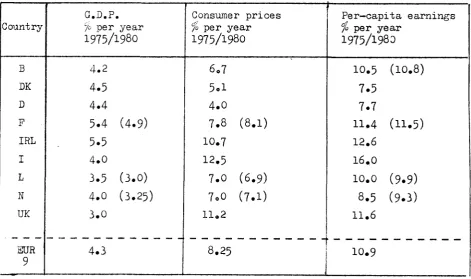
eoncerned.The macro-economic assumptions
of
the fourth
prograrnme-updated.
to
Spring 1977 and. usedin
the
Social
Bud.get-
&?€ shownin
thetable
below. llherethere
is
a
d.iscrepancy,the
figure
ad.opted. appearsin
brackets.Jountry
G.D. P.
tzl.
-o r aro. n
/' yv- Jvs^
L97r/1980
Consumer prices
fL per. year L97r/t93o
Per-capita
earnings/,
per
yearr975/r98r
B DK
D
F
IRL
I
L N UK
4..2 +.) 4.4
5.4
Q.g)
5.5 4.0
3.5
(l.
o;,4.0
(:.e5;
3.0Ool
5"r
4.o
?.8
(B.r)
I0.7
12.5
7.o
(6.g)700
(7.r)
11" 2
,;;
10.5
(rO.B) 7.57.7
11.4
(11.5) L2.615.0
10.o
(g.g)8.5
(g.r)
!rav
I0.9
EUR
9
[image:19.578.56.528.335.614.2]15.
[he table
below makesit
possible
to
comparerfor
the
sameparameters,
the
trend.sforecast
with the results
record.ed.for
the
period. I97q-L975, whichare reflected.
in
tlne L975Social
Budgetdatao
Neverthe-less, it
raust rememberedthat
there
wasa
breakin
the
trend. towards the end.of that
period..Per-capita earnings /o
per
yearLgTo-L97'
B DK n
F IRL
I
L
T\T II
UK
3.4 1o9 1.9 4.o J.1 2.3
4Q l au
3.4 1.8
9.4 9.3 6.3 8.7 1 3.3
14.2
7.2 9"2 1 3.0
L6.g 1 500 1 0,9 1 3.2 1g.B 26,7 12.O
13.9
15.5
Consumer prices
4
70 peT yeaT
L97o-t975
G.DrP.
fo
per
yearL97o-L975
The Community G.D.po growth
rate
was about( /"
per
year between 19it0 and L974;
however,in l)lJ it ferr
by
l.g
%r"'
against
the previous year.16.
Asfar
as unemploymentis
concerned., onthe basis
of
theTlsumntionsr-
(that
( Spring L977) on wirichthe
1976-1980'proj"ciiot"-""""
based 1s4.3
T"perJmrfor C.D.P, by volgrneed
3.8
/"
pu,year
for
producti-vity
per
personin
emploJnnent) the-unemploymentlevel for
the
Communlty wourdstirl.
behigh
in l!80 :
3.? /"
of
the
active
population
or
about{ million
Feople. Ass}rownin
the table
below, unemploy:nent would. beune-qua11y
distributed
amongthe
membercountries
:3DK
2.8
2.52.5 2.9
DFIRL
5.8-8-IL
3.65
o.o 1tNUK
JoI )c)
fn
somecountries a
return
to
much more acceptablelevels
is
anticipated.,while
in
others unemplo;rmentrtrill
continueto
beof
concern,L7.
These werethe rates
used.in
the national reports
as basisfor
the calculation
of
the cost
of
unemploJrmentin
1!BO.itre
only
excep_tion
was Fbance, wherea
higher
rate
(6.5
fl)was seleoted as beingprolally
morerealistic in
the
light of
present economic trend.s thanthat
shown above o18.
fhere are
ground.sfor
d.oubtingthe
reliability of
the
assump-tions
for
tlhevarious
economic parameters on whichthe
nurlpean Social Bud'get projr=ctions are based.,there
beinga
quite
consid.erable d.iscrepaJlcyover
the
courseof
the
last
fewyears
(tglS-tgl6-L977)
hetweenthe
actual trend.sforbhese
parameters and thoseforecast
(as
shown abovein
poini
14).
This
irnportantpoint
will
be d.iscussed.at
a
rater
stager,>/ Other assumptions
-9-5/
-
Ns!19le1_p'sJgs!tg$_Igr_129920.
Theprojections
for
lpBO givenin
the national
reports
arederived,
asindicated
above, froma set
of
assurnntions corresponding to a viewof
economictrends
asat
spring,
L977.F\rller details
havepreviously
been g:"ven(points
]l to 1l).
2r.
Changesin
the999!9119-!1!931r9!_3tg_!Ierr_rtPlr93lrgn_Igr
llg-prgrge!:en:
Dre
to
the deteriorating
economicoutlook
since thi_s time,the
assumptions on whichthe
second. EuropeanSocial
Budgetts 1!80pro-jections
were mod.elled may nolonger
berealistic for
a
numberof
countriesr
in particular
asfar
as growth and unemplo;rmentare
concerned.If this
d.eterioration
were takeninto
account now,it
would haveimpor-tant
implications
for
the
1!80pro;ections
asthey
appearin this
d.ocu-ments, asfollows.
mic si
tuar,"l"i"l"';:"T:;:,:fi"i:*"::
;n:n:"3::Hiffition
or
the
econo-22.
")
Iggg$-gcgngritggerelgpge$:
The annual
report
onthe
Corununityts
economicsj-tuation
andthe
guidelinee
for
economicpolicy
in ltl8
subrnittedin
octobergl7
Q),
highlight the
changesthat
have takenplace
in
the
economicsituation
:-nthe
last
few yearsas
seenin
termsof
certain significant
paraneters :gross d.omestic prod-uct,
priees,
earnings and unemplo;rment,a.
grgs:-4ggg"lrg-prggrg!
The
fluctuations
frorn oneyear
to
anotherfor
the
Cormu-nity
asa
whole were asfollows
: -
1.8
in
1975; +4.I in
f9?5;+
2.5
in l!l'f
.The comesponding trend_
for
eachof
the
Member Statesis
shovnn
in
the table
below :-to-Gross d.omestic
g:o9uct
br
Johune(/'
cnange)B DK
n
IJ
tr'
]RL
I
L
.I\T
UK
L97'
, 2.O
.11
. 2.60.1 o.4
.
3"5'
8.4.
'1.1
-
1.7r976 3.0 4.8
)rI
5'2
3.2)ro
2"74.4 1.6
r977
2
3/41 3
2
3/45 2
r1L4 2-b
,-.z
ruR9
-
1.8 4.72*
b.
Pricesces ( expressed
.:"o:f"ff*:-:ilil3:';"il*il3*;:;,**
ilH#:i
:ilil:'indi-considerable
disparitieso
gDK!E
1g?5
12.8 9.6 5.9
11.7Lg76 9.2 9.0 4.6
9.6t977
(r)
?.1
11.5 3.9
9.9(r)
cnange expressed(z)
ctrane'e expressedILT
17.0 10.8
9"9L6.7 9.8
8.918.6 6.1
6.9(9.r)
(2.4) (r.6)
over 12 months.
over
J
monthsr IRL20.9 17.9 13.5 \4e) )
annual rate
annual
rate
UK
EUR q24.2
L304L6.5
1r.0
L6.4 lI.5
(6.8)
(l.g)
as an
as an
Prices rose
quite
sharply
in
L975in all
the
Member States'but,
by
ccntrast, the
trend. lras Teversedfor
someof
themin
L976. However,11
-c.
Earnin€:s23.
Fbonnlpf4
tu
L977,the
role
of.increase
in
per-capitaremuneration
in
the
Communityfell
from 16.7 "/"in
t975 t,o L2.8 dlin
L)16
and IL.O/"
in
L977(year-to-year
changes),ind.icating
a
significa,ntshowlown, though ranging
in
ertent
from one countryto
another as thefoll-owing
table
shows :E pK !
g
rRr
I
!
I
uK
ruRgL975
r5.4 15.0 7.7 17.7 24.6 19"? r2.5 13.4 jo.B
L6.7Lg77
1Oo0 8.0 6.9 11.8 13.5 22.O 10.3
7"7
10.5
11.0(rylq-
or L)lJ
-
beingthe
year
in
whichthis
tendenc;r became e*pparent). d.. Unqgrployment_ln relation to
the
previousperiod
(19?0-1974), L975 marksa turning-point
from whichtime
the rate
of
unemplo;rment rosesteadily in
most MemberStates,
asis
shownin
the following
table(expressed. as
a
{"of
the
active
population)
:
(*)
nLs75
;5
Lg76
6.r
Lg77
6.9DKIg
5.0 4.r
4.O5.r 4.L
4.46.2 4.O
5.LIRL
7.9 $.6) o.2
4.o9.4 (l.g) o"4
4.39.6
(6
3/4) 0.5
4.3EU? 9
3.9
Q.+)5.2
(q.g)/r r\ )oY \)t) )
24.
The communicationof
the
Commissionto
the
Council concerning ad.aptationsin
guid,elinesfor
economiepolicy
in
t9?8(f)
shor^rsthat
thegross d.omestic product 61rew
in
L977by L.9
"/'ofor
the
Comnnrrnity asa
qrholeinstead.
of
the
2",
fLestinated
in
the
October 19??report
(mentionedin
$
ee)"(x)
fire
unemploymentrate
shownin
bracketsis that
obtained. by taking,for ltaly,
the
unemploymentfigures
record.edby
the
Departmentof
-tnpl'o;'-mentrather
than thoseof
ISTAT.b)
Tmplicationsof_the
egogomic changes_for
t3_e-}989 proiections25.
If
the
economic trend-s observedare
conparedwith the
assumptions ad,optedthe
EuropeanSocial
Sudget($$
tr-r7), it
of
several
cou.ntries they noare no longerlight of
the
communication rnentionedin
I
. -^6/ a.^nB /l'o . ..,\
Ln tylo-LY(
{
\,J!
zz
anc1tJ)
for
the
llBO projections
for
carr
be
seenthat in
the
caserealistic,
particrrleirly
in
the 24.-12-This
statement may beillustrated.
bythe following
tablerwhichshows
the
d.evelopments which would haveto
take place
overthe
remaind'erof
the
period
(f9?B-f980)for
the five-year
assumptionsto
be achieved. (1" change,yearly
average)Per
capita
earningsLastly, it is
clear
that, in
the prevailing
ecolomicconditions'
the
assump'tions concerningthe
unemploynentrate
in
19BO ($$ 15 and 1?)lose
nuchcf their
valid.ity
for
almostall
l{ember States.25.
Obviously such changes,if
applied.to
the
1980projections,
would impl.r mod.ifications as regardsboth
expend.iture and revenue.A comple
te
revisj.onof
the
projections
would. haveto
beunder-taken
in
o:rderto
quantify
these changeso To berealisticr
legislative
andother
neasures introducedsince
the
preparation
of
the
1p80projec-tions,
those appearingin
the
present Socia1 Budgetrwouldalso
to
be takeninto
account.0.D.P.
price
ind.exC.D.P. voLume
Assurnptions
Lg?r-8o Lg76-77'
\r/
Assumptions
L97 54o'L97 64 7' t97B-Bo
(r)
(2)197,
Assumptionsr975-Bo, :197 6-7
7
l97B-Bo(r
)
(a)rRLl
).5
N |
3.25uK
I
l.o
5.1
1
7.57.3
l
r.5
,., |
7.7/ , I i.
Oo4 i rr.)
3.9
|
JZ.5 ldaJo{ | O.O
la^
7o4 | ooY
| -r ? 4t4 i lr.o 2.9
2.9 4.4 4
4.r
4.r
2"0 3.4r.0
A'r
var
9.5 4.2 9.4 L5.5 rR n
8.4 8.2 15.3
7.L 2.9 3.9 6.6 B.g 9.0 9.7 5.7 9.2
1C.8 7.5 7.7 11.5 12.6 15.0 9.9 9.3 11.6
9.2
1C.79.8
6.07.,
7.813.2
10.417.1
9.72L.6
r2.4
1O.I
.9.89.2
9.4r2.7
10.9ACopted
i::
the
eachcountryrs
forecastsTrends wh:ich would have
to
emerge duringfive-year
assumptionsto
be achieved.-rl-However,
in
ad.d.itionto
the
fact that
the report
containsprojections
rather
tha.nforecasts, the
uncertainty
of
the
med.irr"ur-termd'evelopnent
of
the
European economies-
andthe
time
required.for
thepreparation
of
national projections
andtheir
subsequent comparison-Led.
the
Conmissionto
forego
sucha revision.
It is
neverthelesspossible
to
give
somegualitative
indica,.tions
concerningvarious
aspectsof
the
I!80
projections
which would. be affected. bythe
changesthat
have occurred.. These ind.icationsare
only concernedwith
inmed.iate arid. automaticeffects,
since
it is
obvious that changesin
social transfers
have macro-economiceffects
influencing
growth,via
incomes a,nd. costs.a)
As regard.slegefils,
the extent
of
the
changeswill
vary
accord.ingto
the
sector
concerned,the type
of
benefits
(in
cashor in
kind)
the ind.exation procedure and.the
ind.ividual
coultry.
-
Asthe
demographicfactors
r€main*naffected.,
it
may be assuned.that in
respectof
old. age pensions,fanily
allowances and.sick-ness
benefitsr
only
the
earningsfactor
will
beoperative.
Therefore,taking
accountof recent
trend.sin
the
latter, lower
figures
than those projected. may be expected.-
Onthe
other
hand., an increasein
the
nu.urberof
unemployed. persons mayresult in
a
rise in
the
arnountsprojected
for
r:nemplo;rmentbenefits.
In
shortr
there
will
bea
changein
the
relative
shareof
thevarious sectors
in total
benefits.
b)
Asfor
financing, the
l!80
projections are
likety to
prove roohigh
as regard.sreceipts
fromenterprises
and. household.s aswelr
as governmentrthis
beingthe
automatic conseguenceof
the
showd.owein
growth.Conclusion
27.
In
exa,miningthe results
of
the
1!80projections,
analysed ChaptersII to fV,
the
read.er should bearthe
foregoingin
mind.. surunarize !-
0nthe
one hand., theseprojections
correspond.to
a
view offuture
d.evelopmentstill
regard.ed. as probablein
the
spring
of
l9??.
Assuch
they
highlight
certain
trends
and" probleros.1n To
28"
29.
-L4--
Onthe hand.,
the
deteriorationin
the
economicsituationr
Par-ticularly in
termsof
growth and. unemplo;rment, ind.icatesa
somewhatdifferent
viewgiving
rise to
projections
for
1!80 whichvary
to
a
certain
extent
co,mpared.with
those adoptedin
the
present Socia} Bud.get.-
Lastlyr
imespective
of
the
view ad.opted.,the
I!80
projections-
based. on constantlegislation -
d.onot
take
into
account measures and reforms since d.ecid.ed onby
the
Governnents arid. passedby the national
parliaments whose
effects
will
nevertheless befelt
before
the
end.of
lgBo.
They
will
therefore
yield
results d.ifferent
fromthe
probableout-turn
in
1!80.However,
for
a
given economiccontext,
their
objective
is
to
enable eurerging trend.s and. problemsto
be determined more accuratelytand,
in this
way,facilitate
decisions whichthe
responsibleauthorities
will
haveto
take
to
remefir such problems.5/-.
Planol
thq..Bjetional reportsThe
national reports
are
presented.in similar
form and includ.ea
sunmar?'of legislative
changes from1!J0
to
L975with
anoutline
of
anyfurth.er
changes upto
the
d.ateof
the
report.
Theyalso
contain
infor-mation onr
the
methods usedin
d"rawing upthe projections
and.series
of
d.etailed.tables
based. on those preparedfor
the social protection
accountsif
the
St,atistical
Office,
covering expend.iture andreceipts
for all
schenes (menti.onedat
the
beginningof
the
chapter)
for
the
yearsf970-I9?5 and 1980. The
reports
containd"etails
of
a
numberof
economic and dernographric aggregates (gross domesticproduct,
active
populationr
total
populaticlnr
etco)
for
the
seune/€arsr
lloreover,
in
certain reports
there
are
itemsof
additional
informati.on reguested by
the
Commission(tax
allowances, majorfactors
ca';sing changes,
etc,)
with a
viewto initiatingr or in
due coursed.eve-loping,
r'esearch directed.at
a
more-complete attainmentof
the
objectives-L5-3)
leqoga_stage_ :30.
The second. stage consistedin
the d,rafting,
by
the
Ccmrnission, ofthe overall report
onthe
EuropeanSocial
Budget.On
the basis
of
ananalysis
of
the
informati-on contained.in
thenational reportsr the overall report
compares d.evelopmentsin
expenditure onsocial protection
and.its
financing
in
the
l{emberStatesr
The objectiveof this
comparisonis to highlight similarities
and. d.ifferences, as we1las changes
in
trends
which may have occured.or
are
emerging andthe
pro-blems
they
entailc
fn
add.ition,
byusing
Community-
wid.e sourcesof
information(Comparative Tables
of
the
Social Security
Systems, TaxStatistics,
National
Accountsrreports
onthe
economicsituation
in
the
Cornmunity,etc.),
the
Commission has rvid.ened.the
scopefor
eomparisonto
incluCe :- legislative
data
(Ieve1of
social protection,
conditions of
entitlement
to benefit,
rnethod.sof
financing,
etc.),
-
a
micro-economicapproach
(benefits
per
person),-
a
D&cro-economic.approach (gross d.omestic prod"uctrpurcha-sing
power,etc.).
31.
Asfor its
composition,the overall repcrt
for
the
lfuropearrSocial
Bufuetis
set out
in five
chapters,
supplernented by two appenclices.. Sgglg_I -
Introd.uction- this
chapter has provided. info:'mation onthe
objectives
of
the
EuropeanSocial
Budget andthe guidelines
ad.cpted.for
the
second E\aropeansociar
Budget(tgl5-tg8o). tt
hasalso
givendetailed.