Rochester Institute of Technology
RIT Scholar Works
Theses Thesis/Dissertation Collections
5-2014
Toward Effective Access Control Using Attributes
and Pseudoroles
Suhair Alshehri
Follow this and additional works at:http://scholarworks.rit.edu/theses
This Dissertation is brought to you for free and open access by the Thesis/Dissertation Collections at RIT Scholar Works. It has been accepted for
Recommended Citation
Attributes and Pseudoroles
by
Suhair Alshehri
A dissertation
submitted in partial fulfillment of the requirements for the degree of
Doctor of Philosophy in Computing and Information Sciences
May 2014
Supervised by
Professor Rajendra K. Raj
The Ph.D. Program in Computing & Information Sciences B. Thomas Golisano College of Computing & Information Sciences
Certificate of Approval
This is to certify that the doctoral dissertation, “Toward Effective Access Control Using Attributes and Pseudoroles,” by Suhair Alshehri has been examined and approved by the
dissertation committee as complete and satisfactory for the dissertation requirement for the degree of Doctor of Philosophy.
Rajendra K. Raj, Department of Computer Science,Dissertation Advisor
Stanisław P. Radziszowski, Department of Computer Science,Committee Member
Carol Romanowski, Department of Computer Science,Committee Member
Sumita Mishra, Department of Computing Security,Committee Member
Xumin Liu, Department of Computer Science,Committee Member
Minseok Kwon, Department of Computer Science,Committee Member
Toward Effective Access Control Using Attributes and Pseudoroles
Suhair Alshehri
Supervising Professor: Rajendra K. Raj
Sharing of information is fundamental to modern computing environments across
many application domains. Such information sharing, however, raises security
and privacy concerns that require effective access control to prevent unauthorized
access and ensure compliance with various laws and regulations. Current
ap-proaches such as Role-Based Access Control (RBAC), and Attribute-Based Access
Control (ABAC) and their variants are inadequate. Although it provides simple
administration of access control and user revocation and permission review, RBAC
demands complex initial role engineering and makes access control static. ABAC,
on the other hand, simplifies initial security setup and enables flexible access
con-trol, but increases the complexity of managing privileges, user revocation and user
permissions review. These limitations of RBAC and ABAC have thus motivated
research into the development of newer models that use attributes and policies
while preserving RBAC’s advantages.
This dissertation explores the role ofattributes—characteristics of entities in the system—in achieving effective access control. The first contribution of this
disser-tation is the design and development of a secure access system using
Ciphertext-Policy Attribute-Based Encryption (CP-ABE). The second contribution is the
de-sign and validation of a two-step access control approach, the BiLayer Access
requests have the right BLAC pseudoroles—a pseudorole is a predefined subset of a subject’s static attributes. If requesting subjects hold the right pseudoroles, the
second layer checks rule(s) within associated BLAC policies for further constraints
on access. BLAC thus makes use of attributes effectively while preserving RBAC’s
advantages. The dissertation’s third contribution is the design and definition of
an evaluation framework for time complexity analysis, and uses this framework
to compare BLAC model with RBAC and ABAC. The fourth contribution is the
design and construction of a generic access control threat model, and applying it
Acknowledgments
I am endlessly grateful to my advisor, Dr. Rajendra Raj for the guidance,
encour-agement, and wisdom he has provided through out my PhD program. His
guid-ance has led me in my research, his encouragement has helped me in my academic
life, and his wisdom has eased many of the challenges I encountered.
I am also thankful for the invaluable support and help of my committee
mem-bers: Dr. Stanisław P. Radziszowski, Dr. Carol Romanowski, Dr. Sumita Mishra,
Dr. Xumin Liu, and Dr. Minseok Kwon. I am also grateful for the learning
ex-perience I received especially from Dr. Radziszowski, Dr. Romanowski and Dr.
Mishra. I would like to thank Dr. Jeff Pelz for chairing my defense and reviewing
this dissertation.
I am also grateful to my parents, Dhafer and Aysha, sisters and brothers whose
love and supplications have always illuminated my way; to my husband, Ali,
whose support has given me the strength and courage throughout my studies;
to my daughters, Jonah and Janna, whose giggles have eased all the ails; and to
Abstract. . . iii
List of Figures . . . xi
List of Tables . . . xiii
List of Symbols . . . xiv
List of Abbreviations . . . xvi
1 Introduction . . . 1
1.1 Problem Description . . . 2
1.2 Contributions . . . 7
1.3 Dissertation Organization . . . 8
2 Background . . . 9
2.1 Role-Based Access Control (RBAC) . . . 9
2.1.1 The Basic RBAC Model . . . 10
2.1.2 RBAC Extensions . . . 11
2.2 Attribute-Based Access Control (ABAC) . . . 13
2.2.2 ABAC Extensions . . . 16
2.3 Revising the NIST-RBAC Model . . . 17
2.3.1 Dynamic roles . . . 18
2.3.2 Attribute-centric Approach . . . 18
2.3.3 Role-centric Approach . . . 19
2.4 Chapter Summary . . . 19
3 Access Control using Attribute-Based Encryption . . . 21
3.1 Cryptography Preliminaries . . . 24
3.1.1 Bilinear Maps . . . 24
3.1.2 Elliptic Curve Cryptography . . . 25
3.1.3 Attribute-Based Encryption . . . 28
3.2 A Cloud-Based EHR System . . . 33
3.2.1 The CP-ABE Scheme . . . 33
3.2.2 System Architecture . . . 34
3.2.3 Key Management . . . 36
3.3 Analysis . . . 37
3.3.1 Time Overhead . . . 37
3.3.2 Storage Overhead . . . 38
3.4 Related Work . . . 40
3.5 Chapter Summary . . . 42
4 The BiLayer Access Control Model (BLAC) . . . 43
4.1 Overview of the BLAC Model . . . 44
4.2 Pseudorole Generation . . . 46
4.3 BLAC Policy Specification and Evaluation . . . 49
4.4 Informal Validation of BLAC . . . 51
4.4.4 Subjects’ Permissions are Modified . . . 59
4.4.5 Subjects leave a System . . . 61
4.5 Chapter Summary . . . 62
5 An Evaluation Framework for Access Control . . . 64
5.1 Overview of the Evaluation Framework . . . 65
5.2 Applying the Evaluation Framework . . . 66
5.2.1 Analysis of RBAC . . . 67
5.2.2 Analysis of ABAC . . . 71
5.2.3 Analysis of BLAC . . . 73
5.3 Comparing Access Control Models . . . 77
5.3.1 RBAC vs BLAC . . . 77
5.3.2 ABAC vs. BLAC . . . 79
5.4 Chapter Summary . . . 84
6 An Insider Threat Model for Access Control . . . 86
6.1 Threat Modeling Methodologies . . . 88
6.2 Threat Model Construction . . . 89
6.3 Access Control Models Assessment . . . 97
6.3.1 Gaining Unauthorized Access . . . 98
6.3.2 Gaining Improper Access . . . 99
6.4 Chapter Summary . . . 100
7 Summary . . . 101
7.1 Conclusion . . . 101
1.1 A generic access control model . . . 2
2.1 The basic components of the core RBAC . . . 10
2.2 The basic components of ABAC . . . 14
3.1 An example of using CP-ABE . . . 34
3.2 The cloud-based EHR system architecture . . . 35
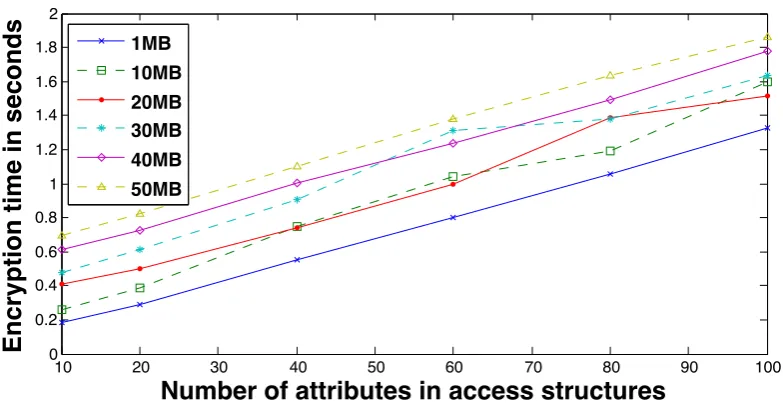
3.3 Encryption time for varying number of attributes in the access struc-ture . . . 38
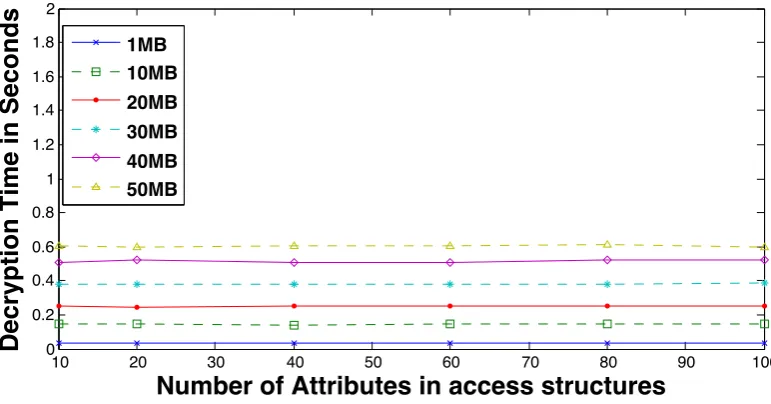
3.4 Decryption time for varying number of attributes in the access struc-ture . . . 39
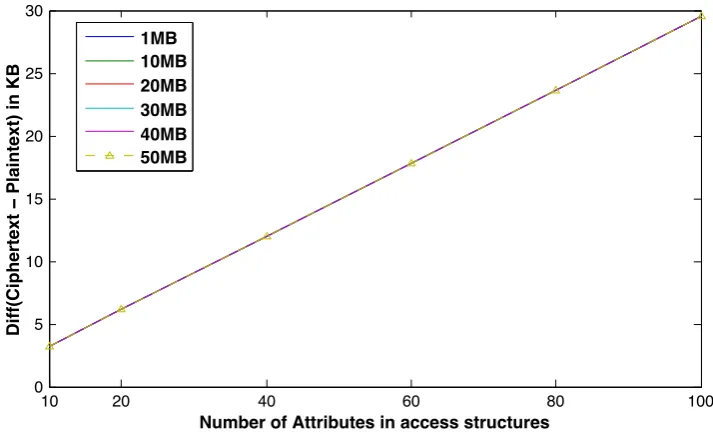
3.5 Difference between ciphertext and plaintext in size . . . 40
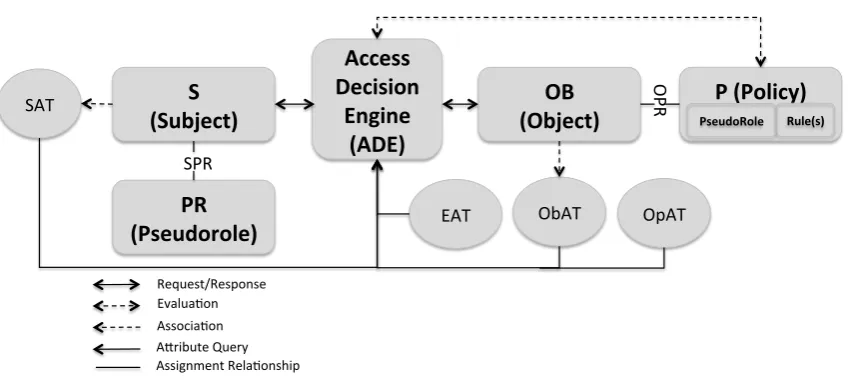
4.1 The components of the BLAC model . . . 47
4.2 The complete set of generated pseudoroles . . . 49
4.3 The structure of a BLAC policy . . . 50
4.4 The two-step evaluation procedure for BLAC policies . . . 51
4.5 Healthcare Scenario . . . 53
4.6 Policy 1 . . . 56
4.8 Policy 3 . . . 58
4.9 Policy 4 . . . 59
6.1 The classification of access in healthcare applications . . . 90
6.2 An architecture of an application implementing an access control model . . . 92
6.3 The interactions among the components of access models . . . 94
6.4 The data flow diagram . . . 96
1.1 Decision evaluation in access control models . . . 5
4.1 Attributes of subjects demonstrating the pseudorole generating
ap-proach . . . 48
4.2 Attributes of the PCP and dermatologist . . . 54
4.3 The table that holds the assignment of subjects to pseudoroles . . . . 55
4.4 Attributes of the patient Bob . . . 55
4.5 The implementation of changing the dermatologist’s permissions . . 60
4.6 The implementation of revoking the PCP . . . 61
5.1 The core access control functions . . . 66
5.2 Summary of the time complexity of the main access control
func-tions for RBAC vs. BLAC and ABAC vs. BLAC . . . 78
5.3 Summary of the time complexity of the core access control functions
in RBAC and BLAC . . . 79
5.4 Summary of the time complexity of the core access control functions
List of Symbols
aR . . . active roles
EAT . . . environment attributes
ob . . . object
OB . . . object dataset
ObAT . . . object attributes
OBR . . . object-to-policy assignment
op . . . operation
OP . . . operation dataset
OpAT . . . operation attributes
p . . . policy
P . . . policy dataset
PA . . . permission-to-object assignment
perm . . . permission
PR . . . pseudorole dataset
PRF . . . PseudoRole function
RF . . . rule function
r . . . role
R . . . role dataset
Ru . . . access rule
s . . . subject
S . . . subject dataset
SA . . . subject-to-role assignment
SAT . . . subject attributes
List of Abbreviations
AA . . . Attribute Authority
ABAC . . . Attribute-Based Access Control
ADE . . . Access Decision Engine
AES . . . Advanced Encryption Standard
BLAC . . . BiLayer Access Control
CBAC . . . Context-Based Access Control
CP-ABE . . . . Ciphertext-Policy Attribute-Based Encryption
DAC . . . Discretionary Access Control
ECC . . . Elliptic Curve Cryptography
EHR . . . Electronic Health Record
EMR . . . Electronic Medical Record
FIBE . . . Fuzzy Identity-Based Encryption
GLBA . . . Gramm-Leach-Bliley Act
. . . Location-Based Access Control
MAC . . . Mandatory Access Control
NIST . . . National Institute of Standards and Technology
PCP . . . Primary Care Physician
PFP . . . Permission Filtering Policy
PHR . . . Personal Health Record
PKC . . . public-key Cryptography
PKE . . . Public-Key Encryption
PKI . . . Public-Key Infrastructure
P-RBAC . . . . Privacy-Aware Role-Based Access Control
RBAC . . . Role-Based Access Control
RSA . . . Rivest, Shamir and Adleman
SKE . . . Symmetric-Key Encryption
T-RBAC . . . . Task-Role-Based Access Control
Chapter
1
Introduction
Information sharing is a basic requirement of modern computing environments
in many application domains ranging from healthcare to financial services.
Al-though sharing of information provides several advantages, it raises privacy
con-cerns, particularly when personally identifiable information is involved. That is,
such information could potentially identify real-life individuals [55].
Many privacy acts and regulations, including the Health Insurance Portability
and Accountability Act (HIPAA), and the Gramm-Leach-Bliley Act (GLBA),
im-pose stringent requirements on handling the protection of such identifiable
infor-mation. Authentication, access control, and auditing are among the key
require-ments in such acts and regulations [91]. Although all of these features are
funda-mental and vital to information and system security, this dissertation focuses on
effective access control models.
Anaccess control model is typically designed to protect data from (1) unautho-rized or improper use and disclosure (confidentiality), and (2) unauthorized or im-proper modification and destruction (integrity). Such protection can be achieved by ensuring that decisions for access requests by subjects (users) for protected
policies.
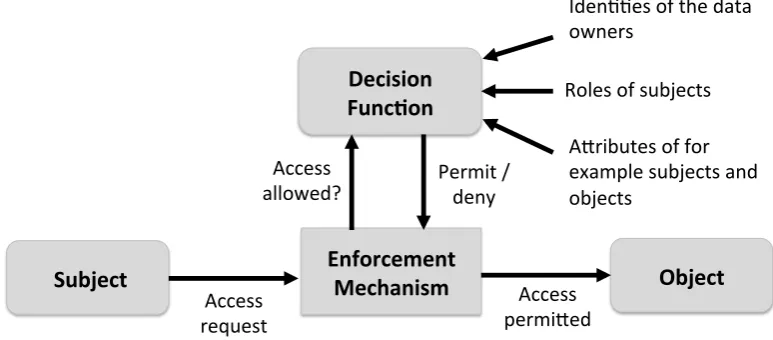
Anaccess controlmodel is conceptually composed of two main components: (1) an enforcement mechanism (or an implementation of a reference monitor), and (2)
a decision function. The enforcement mechanism intercepts and examines each
access request. It consults with the decision function whether the access request
complies with the security policies or not to permit or deny it. The process of
making access-control decisions may involve the identityof the data owners, role
played by subjects in an organization or a set of identifiable attributes associated with each subject. A generic access control model is depicted in Figure 1.1.
Enforcement* Mechanism*
Decision* Func3on*
*Subject* Object*
Access% request%
Access%
allowed?% Permit%/%deny%
Access% permi7ed%
Iden99es%of%the%data% owners%
Roles%of%subjects%
[image:20.595.113.500.343.513.2]A7ributes%of%for% example%subjects%and% objects%%
Figure 1.1: A generic access control model, showing the two main components: an enforce-ment mechanism and a decision function.
1.1
Problem Description
Approaches to access control including Discretionary Access Control model (DAC)
[75], Mandatory Access Control model (MAC) [62], Role-Based Access Control
model (RBAC) [73] and Attribute-Based Access Control model (ABAC) [84] are
1.1. PROBLEM DESCRIPTION
are set according to the discretion of owners based on the identity of subjects and
objects. On the other hand, in MAC, a system controls access to objects and owners
cannot override the controls based on security labels attached to subjects and
ob-jects. A label on an object is called a security classification, while a label on a user is
called a security clearance. DAC and MAC have several limitations including the
lack of scalability and dynamic adaptability to the changes of security policies [12].
In RBAC, access to objects is based on subjects’ roles or their job functions. In
the education setting, for example, a subject may hold the role ”Instructional
Fac-ulty.” RBAC is widely deployed for its simplicity of administering permissions for
large number of users. On the other hand, it is known for its difficulty of defining
and structuring roles and inflexibility in dynamically changing environments as it
supports coarse-grained and predetermined access control due to the use of roles
and the assignments of roles to subjects. RBAC is defined and described in further
detail in Chapter 2.
The use of attributes—characteristics of entities to describe and identify them
from all others such as name, date of birth, and job title—helps to support finer
granularity in access control. Thus, instead of defining access privileges in terms
of externally-defined roles, attributes of subjects can be used to specify targeted
access rules. The concept of attributes in access control models has been extended
to describe objects and environment conditions in addition to subjects’ properties.
Here is an example from the education domain of three access rules with three
different levels of granularity to demonstrate the power of the fine-granularity
pro-vided by the use of attributes in defining access-control rules:
1. Coarse: Faculty members are allowed to open the department office door.
2. Fine: Faculty members in the Computer Science department are allowed to
3. Finer: Faculty members in the Computer Science department are allowed to
open the department office door during office hours if they are assigned to
that office.
Thus, as more attributes are included in access-control rules, the more
speci-fied and targeted the access rules are going to be. In short, attributes allow for
extremely fine-grained access control.
ABAC, which is based on attributes, is a relatively recent yet promising
ac-cess control model [27, 84], which employs attributes and acac-cess policies to
de-fine privileges of subjects. In ABAC, access requests compared against attributes
within these policies to determine whether to allow or deny access requests. ABAC
overcomes the RBAC problem of defining and structuring roles as it (ABAC) uses
attributes for making access-control decisions. Because ABAC uses attributes, it
supports fine-grained access control policies that can be evaluated dynamically in
real-time, and are flexible enough to support environments with frequently
chang-ing user permissions.
Here is another example from the education domain to demonstrate the
flexibil-ity provided by the use of attributes in access control. A faculty member works in a
college and he is defined with a set of attributes. One of these attributes is<Job Ti-tle, Instructional Faculty>. His access privileges in ABAC stem from such attributes, not from the notion of a single role (as in RBAC). So assuming this faculty
mem-ber gets promoted to department chair, the faculty memmem-ber’s access privileges will
need to be updated accordingly.
In ABAC, this change requires only a simple modification to the value of the
attribute job title from <Job Title, Instructional Faculty> to <Job Title, Department Chair>. The faculty is immediately able to access all the information needed to perform the new chair duties. No adjustments to existing access policies or rules
1.1. PROBLEM DESCRIPTION
needed.
ABAC, however, is more cumbersome in terms of the number of rules that need
to be evaluated for access-control decisions. For nattributes, ABAC may require up to 2n possible rules. Also, management of privileges and permission review
for a particular user are difficult to perform as a large set of rules must be
exe-cuted [37].
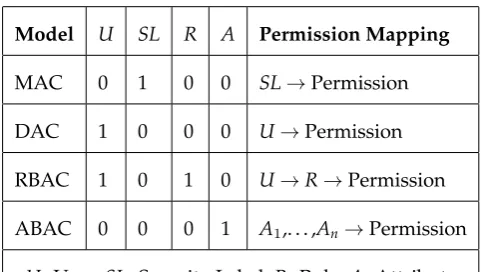
Table 1.1 describes how access-control decisions are evaluated in the access
con-trol models discussed previously. In MAC and DAC, for example, access-concon-trol
decisions are respectively based on security labels of subjects and objects, and
identities of subjects. In RBAC, access-control decisions are made based on the
mapping between subjects and roles, and roles and permissions. In ABAC,
[image:23.595.189.430.464.600.2]access-control decisions are evaluated using attributes.
Table 1.1: Decision Evaluation in access control models. Access-control decisions in MAC, DAC, RBAC and ABAC are made respectively according to security labels of subjects and objects, identities of subjects, assignments of subjects to roles and roles to permissions, and attributes.
Model U SL R A Permission Mapping
MAC 0 1 0 0 SL→Permission
DAC 1 0 0 0 U→Permission
RBAC 1 0 1 0 U→R→Permission
ABAC 0 0 0 1 A1,. . . ,An→Permission
U=User;SL=Security Label;R=Role;A=Attribute
Due to the limitations of both RBAC and ABAC, research therefore is needed
to understand how attributes could be used effectively in designing newer access
control models to improve the process of making access-control decisions. This
Attribute-Based Encryption (CP-ABE) [13]. In CP-ABE, subjects’ private keys are
labeled with sets of attributes and objects are encrypted and associated with
ac-cess structures or rules consisting of AND and OR gates. A subject’s private key
can decrypt a particular encrypted object or ciphertext only if the attribute set of
the subject’s key satisfies the access rule associated with the ciphertext. Details
about this approach and its viability for effective access control are presented in
Chapter 3.
The National Institute of Standards and Technology (NIST) [37] recently called
for the development of a policy-enhanced RBAC model that includes the use of
attributes while maintaining the advantages of RBAC. Three possible mechanisms
were identified: (1) dynamic roles, in which attributes are used to dynamically as-sign roles to subjects, (2) attribute centric, in which roles are defined as another attribute of subjects, and (3) role centric, in which attributes are used to constrain the permissions assigned to roles.
These suggested approaches also suffer drawbacks. The first approach inherits
all limitations of RBAC including the lack of granularity and dynamic
adaptabil-ity. The second approach discards all the advantages of RBAC and inherits all the
disadvantages of ABAC. The third approach lacks the flexibility of ABAC because
the maximum permission sets are constrained by the use of roles.
Given the likely impact of a solution to this call by NIST, the dissertation
ex-amines how attributes could be used effectively in designing newer access control
models while preserving RBACs advantages. Toward achieving this goal, the
dis-sertation proposes a new variant to RBAC and ABAC, the BiLayer Access Control
(BLAC) model [7]. The design of the BLAC model is inspired by several aspects of
CP-ABE, including the association of private keys and attributes and ciphertexts
and access structures. The complete definition and description of the BLAC model
1.2. CONTRIBUTIONS
1.2
Contributions
The major objective of this dissertation has been the exploration of attributes and
policies for the design of effective access control models. As a consequence, the
contributions of this dissertation span several distinct yet related issues around
access control space as listed below.
• This dissertation shows how attributes and policies in CP-ABE [13] can
ad-dress observed inadequacies of current approaches to access control and
stan-dard encryption techniques, through the design and development of a
cloud-based system for electronic health records (EHRs) as described in Alshehri [6].
Specifically, the dissertation shows that CP-ABE provides promising
perfor-mance to enforce access control in information sharing environments.
• The dissertation addresses the problem of improving access control via the
use of attributes for making access-control decisions while retaining the
ad-vantages of RBAC. As a result, the dissertation proposes the design and
vali-dation of the BLAC model, which is described in Alshehri [7]. Unlike current
access control approaches, the BLAC model uses the concept of pseudoroles
and performs access control in a two-step evaluation procedure. Apseudorole
is informally defined as a set of values of static attributes of subjects. That is, a
pseudorole is not a real role as traditionally defined in RBAC. The first layer
in the two-step evaluation process checks access requests to verify whether
requesting subjects have therightpseudoroles specified in the BLAC policies of the requested objects. If requesting subjects hold the right pseudoroles, the
second layer checks rule(s) within the associated BLAC policies for additional
constraints on access.
• This dissertation designs and defines an evaluation framework that
control models. The framework is composed of five core functions of access
control models: authorization decision-making, policy modification,
permis-sion modification, revocation and permispermis-sion review. The functions
underly-ing access control models are theoretically analyzed for their time complexity,
and these results are then used to compare several access control models.
• The dissertation examines how shared information can be protected from
unauthorized or improper use, disclosure, alteration, and destruction by
in-siders, as described in Alshehri [5]. The dissertation uses a generic access
con-trol system to construct a threat model to assess the effectiveness of current
access control mechanisms, including RBAC, ABAC and BLAC, in
mitigat-ing insider threats. This assessment allows the contrast of the BLAC model
against the two major access control models, RBAC and ABAC.
1.3
Dissertation Organization
The rest of the dissertation is organized as follows. Chapter 2 presents the
back-ground in access control models and related work in this space. Chapter 3 presents
one approach for using attributes for secure access control via CP-ABE. Chapter 4
presents the BLAC model, which is a major contribution of this dissertation.
Chap-ters 5 and 6 present the evaluation framework and the generic access control threat
model respectively, and apply them to assess the effectiveness of the BLAC model.
Chapter
2
Background
This chapter reviews the foundational and related work in the area of access
con-trol, and motivates the need for developing an access control model that uses
at-tributes in access decisions while preserving the benefits of RBAC.
2.1
Role-Based Access Control (RBAC)
The term RBAC was first introduced and formally modeled in the early 1990s by
Ferraiolo and Kuhn [22]. Subsequently, Sandhu et al. proposed frameworks for
four RBAC models to meet various levels of complexity requirements [73]. These
models are core RBAC, hierarchical RBAC, static separation of duty relations, and
dynamic separation of duty relations. The core RBAC model introduces the basic
and minimum components of RBAC in which subjects are assigned to roles and
permissions are assigned to roles. The hierarchical RBAC extends the core model
by introducing the support for role hierarchies to define an inheritance relation
among roles. Separation of duty relations are used to enforce conflict of interest
policies to restrict subjects from exceeding a reasonable level of authority to
separation of duty relations. The former enforces strong constraints on the
assign-ment of subjects to roles; for example, if one role requests an order and another
approves it, the subject should not be assigned both roles. The latter enforces the
constraints on the assignment of subjects to roles in addition to the context such
as the time. All these models have the same limitations of the core RBAC that
Chapter 1 discusses.
RBAC has been widely investigated to meet various applications’ requirements.
The rest of this section presents the basic RBAC model and discusses the main
extensions of RBAC.
2.1.1 The Basic RBAC Model
The NIST model for RBAC [23] was adopted in this dissertation focusing, for the
sake of simplicity, on the core RBAC that introduces the required components for
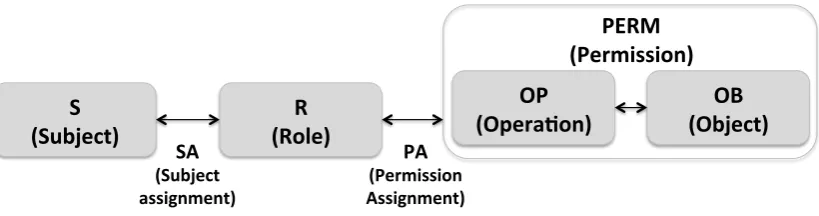
any RBAC model [74]. The basic elements of RBAC are illustrated in Figure 2.1.
[image:28.595.110.520.472.580.2]S* (Subject)*
OP*
(Opera3on)* (Object)*OB*
R* (Role)*
PERM** (Permission)*
SA*
(Subject*
assignment)%
PA*
(Permission*
Assignment)%
Figure 2.1: The basic components of the core RBAC, containing five data sets: subject, role, object, operation and permission, and two relations: subject assignment and permission assignment.
2.1. ROLE-BASED ACCESS CONTROL (RBAC)
Subjects are assigned to roles, and roles are associated with permissions that
define which operations can be performed over which objects. Subjects are defined
as individuals, and roles represent job functions within the organization. In the
context of healthcare, roles could be “doctor,” “nurse,” and “staff.” Permissions
could be “read a record” and “write a record.”
The following definition of RBAC is adopted from Ferraiolo et al. [23].
Definition 2.1.1. [RBAC]
• S, R, OP, and OB are subjects, roles, operations, and objects, respectively.
• SA⊆S×R, a many-to-many mapping subject-to-role assignment relation.
• assigned-subjects(r) = {s ∈ S | (s,r) ∈ SA }, the mapping of role r onto a set of subjects.
• PERM(the set of permissions)⊆ {(op,ob)|op∈OPV
ob∈OB}.
• PA⊆PERM×R, a many-to-many mapping permission-to-role assignment relation.
• assigned-permissions(r)={perm∈PERM|(perm,r)∈PA}, the mapping of role r onto a set of permissions.
2.1.2 RBAC Extensions
RBAC is a good starting model for researchers to advance access control models
due to its widespread adoption and formal definition. These extensions are needed
to meet requirements in specific domain areas. One of the significant extensions
of RBAC is Context-Based Access Control (CBAC) in which access decisions are
based on the context of the request in addition to requesters’ roles concerning the
temporal constraints, as in Temporal Role-Based Access Control (TRBAC) [11, 33]
major extensions include Task-Role-Based Access Control (T-RBAC) [61, 72], and
Privacy-Aware Role-Based Access Control (P-RBAC) [47, 59].
In TRBAC, the use of permissions assigned to roles can be enabled only
dur-ing specific temporal periods which can be fixed or periodic. Bertino et al. [11]
proposed a TRBAC model that supports temporal constraints on role activation
and deactivation. Thus, roles can be in two states: active, in which the associated
roles can be used, and non-active, in which associated roles cannot be used. The
model also defines temporal dependencies among role activation and deactivation
which can be expressed through triggers. For example, when a role is activated,
a trigger can be set up to activate another role. Joshi et al. [33] extended TRBAC
to a generalized TRBAC (GTRBAC) that introduced temporal constraints user-role
assignments, and role-permission assignments in addition to roles.
In LBAC, access decisions are based on roles and constraints on users’ locations
to meet the increasing security requirements by mobile applications and users.
Thus, access requests are granted, for example, when users are in a specific
loca-tion within an organizaloca-tion’s premises or a localoca-tion that satisfies certain security
properties. Damiani et al. [19] extended RBAC by supporting the notation of
spa-tial roles for geographically bounded organizational functions. The boundary of a
role is defined as a feature such as road, city or hospital. This boundary specifies
the spatial extent in which the user has to be located in to use the role. Ray and
Toahchoodee [68] extended LBAC to support spatial and temporal constraints on
users and objects.
In T-RBAC, access decisions are based on roles and tasks that represent
funda-mental units of business activity in enterprise environments. A role can be “Sales
Manager,” and a task can “review sales results.” Oh and Park [61] extended RBAC
by incorporating the notation of tasks in addition to roles to evaluate access
2.2. ATTRIBUTE-BASED ACCESS CONTROL (ABAC)
roles. Sainan [72] extended the model by Oh and Park by introducing constraints
rules between users and roles, and roles and tasks.
In P-RBAC, privacy policies are incorporated in access control systems, thus
access to private and sensitive data is considered when making access decisions.
Ni et al. [59] extended RBAC to support privacy policies through introducing
pur-poses, conditions and obligations. Purposes are the reasons for data access.
Obli-gations are actions that must be performed after an access has been executed.
Con-ditions are prerequisites needed to be met before any action can be executed. In the
proposed model, users are assigned to roles, and permissions are assigned to roles.
However, the main difference here is the structure of the privacy permissions.
Masoumzadeh and Joshi [47] extended the model presented by Ni et al. by
treating a purpose as an intermediary entity between a role and permission
enti-ties. The model also defines constraints and obligations as conditions on
assign-ment of permissions to purposes. In Masoumzadeh and Joshi’s model, users are
assigned to roles, purposes are assigned to roles, permissions are then assigned to
purposes, and conditions are assigned to permission.
2.2
Attribute-Based Access Control (ABAC)
Access decisions in ABAC are based on the use of attributes that are compared
against rules created by security administrators. These attributes are associated
with entities such as subjects, objects and the context of access requests. To the
best of the author’s knowledge, the first work that explicitly introduced a model
for ABAC was by Yuan and Tong [101]. However, the use of attributes and policies
2.2.1 The Basic ABAC Model
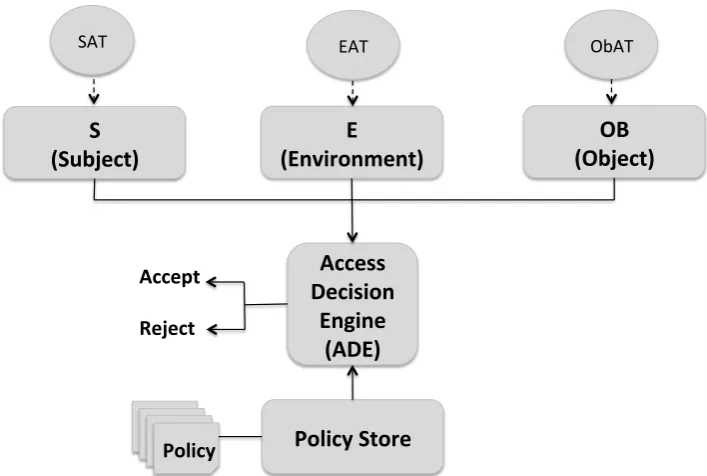
The concept of ABAC is based on the use of attributes (subjects, environments, and
objects) and access rules [27,101]. In addition, attributes are sets of key-value pairs
to describe subjects, objects, and environments. The basic components of ABAC
are shown in Figure 2.2.
S"
(Subject)" (Environment)"E" (Object)"OB"
Access" Decision"
Engine" (ADE)"
Policy"Store"
Policy! Accept! Reject!
[image:32.595.130.484.266.504.2]SAT! EAT! ObAT!
Figure 2.2: The basic components of ABAC, employing attributes of subjects, objects, envi-ronment conditions and access policies. SAT, EAT and ObAT represent subject attributes, environment attributes and object attributes respectively.
2.2. ATTRIBUTE-BASED ACCESS CONTROL (ABAC)
Attributes can be static or dynamic, depending on how frequently their
val-ues change. Access rules, i.e. policies, are defined using attributes. Reqval-uesters
must possess attributes that satisfy relevant rules to be granted access to requested
objects.
The following definition of ABAC is adopted from Yuan and Tong [101].
Definition 2.2.1. [ABAC]
• S, OB, and E are subjects, objects, and environments, respectively.
• SATk(1≤k≤K), ObATm(1≤m≤M), and EATn(1≤n≤N)are the pre-defined
attributes for subjects, objects, and environments, respectively.
• ATTR(s), ATTR(o), and ATTR(e) are attribute assignment relations for subject s, object o, and environment e, respectively:
ATTR(s)⊆SA1×SA2×. . .×SAK
ATTR(o)⊆OA1×OA2 ×. . .×OAM
ATTR(e)⊆EA1×EA2×. . .×EAN.
• A policy rule that decides whether subject s can access object o in a particular envi-ronment e, is a boolean function of s, o, and e’s attributes:
Rule: can-access(s, o, e)←f(ATTR(s),ATTR(o),ATTR(e))
i.e. given all the attribute assignments of s, o, and e, if the function’s evaluation is true, then the access to the object is granted; otherwise the access is denied.
2.2.2 ABAC Extensions
Yuan and Tong [101] discussed the challenges of access control for web services.
They proposed an ABAC model based on subject, object, and environment
at-tributes. They also described the model in terms of authorization architecture and
policy formulation. The ABAC model here consists of two sub-models: the policy
model that defines the policies, and the architecture model that applies the
poli-cies to web services. In the policy model, a policy rule is a Boolean function that
decides on whether a subjectscan access a resourcerin a particular environment
e. For example,
Rule: can-access(s,r,e)←f(ATTR(s),ATTR(r),ATTR(e)).
Given the attributes ofs,r, ande, if the function’s evaluation returns true, then the access to the resource is granted; otherwise the access is denied. The ABAC model
described by Yuan and Tong, however, does not consider operations on resources
and does not provide any implementation details of the policy evaluation.
Subsequently, many researchers presented other models for ABAC for different
applications and domains [4, 38, 40, 79, 102]. Hai-bo and Fan described a model for
ABAC for web services [79] that evaluate access requests to web services based on
the attributes that requesters hold. Hai-bo and Fan did not provide any algorithms
or implementation specifications.
Alipour et al. [4] extended Yuan and Tong’s ABAC model for SOA
environ-ments. Zhu and Smari [102] presented an ABAC model for collaboration
envi-ronments. Their model incorporated trust and privacy preserving concerns by
monitoring subjects’ previous behavior and ensuring that the purpose of access
corresponds to the intended use of the requested objects.
Lang et al. [38] described an Attribute-Based Multipolicy Access Control Model
for Grid Computing that addressed the problem of supporting multiple types of
2.3. REVISING THE NIST-RBAC MODEL
Li et al. presented an ABAC model for ubiquitous e-business environments [40].
HP Praesidium Authorization Server was a commercial implementation of a
rule-based access control model [34]. It centralizes authorization rules and
priv-ileges in a single database shared by multiple applications. Rules and privpriv-ileges
are specified by an organization to define access rules in the former and to specify
access limits for subjects in the latter. Thus, when a subject requests to perform
a transaction, transaction attributes input from the application and privilege
at-tributes input from the privilege are evaluated against an access rule for each
priv-ileges of the requesting subject. If true, access is granted, if false, continue; if all
privileges specified for the requesting subject have been evaluated to false, access
is denied.
Although all the previously mentioned research work was important to
ad-vance ABAC models, it did not consider the complexity of ABAC in terms of
priv-ilege management, user permissions, and permission review for a user.
2.3
Revising the NIST-RBAC Model
Due to the limitations of RBAC and ABAC, Kuhn et al. [37] recently announced a
NIST initiative that focuses on addressing the need of including attributes in access
decisions while preserving the benefits of RBAC. Kuhn et al. suggested combining
RBAC and ABAC to leverage the advantages of each. They discussed three
possi-ble combination strategies for integrating attributes into RBAC: (1) dynamic roles,
(2) attribute centric, and (3) role centric. The rest of this section discusses these
2.3.1 Dynamic roles
In this approach, attributes are used to dynamically assign subjects to roles. This
dynamic role approach has been studied by Al-Kahtani et al. [2] and Huang et
al. [29]. Although these models solved the problem of assigning subjects into roles,
they inherit the major limitations of RBAC described earlier in chapter 1,
includ-ing the lack of granularity and flexibility and dynamic adaptability. Al-Kahtani et
al. [2] introduced a rule-based RBAC model that uses rules defined by an
organiza-tion. These rules are used to automatically assign users to roles taking into account
users’ attributes and constraints on using roles.
Huang et al. [29] presented an integrated model of RBAC and ABAC. The
idea behind the model is the composition of two layers: aboveground and under-ground. The former constructs a traditional RBAC model extended with envi-ronment constraints. The latter uses attribute-based user-role assignment
poli-cies and role-permission assignment polipoli-cies to automate user-role assignment and
role-permission assignment functions for the aboveground level or the traditional
RBAC model. Again, neither of the models address the problem of granularity and
dynamic adaptability, which is the focus of this work.
2.3.2 Attribute-centric Approach
In the attribute centric approach, roles are defined as attributes of subjects. Thus,
roles are not assigned to a set of permissions as in RBAC. This approach discards
all the advantages of RBAC and inherits all the disadvantages of ABAC discussed
earlier in Section 1. Basic ABAC models presented earlier can be used to
2.4. CHAPTER SUMMARY
2.3.3 Role-centric Approach
In the role-centric approach, attributes are used to constrain the permissions
as-signed to roles. Although this approach retains the ability of RBAC to determine
the maximum set of permissions for a single user, it lacks ABAC’s flexibility
be-cause the maximum permission sets are constrained by the use of roles. Jin et
al. [31] present a model for a role-centric approach that incorporates RBAC basic
elements in addition to user attributes, object attributes, and permission filtering
policy (PFP).
The PFP constrains the available set of permissions based on user and object
attributes. Theavail-session-permfunction in basic RBAC returns the permission set associated with the roles activated in a given session. However, in this model, the
function returns the maximum permission set for a given session. The permission
set is then reduced by the PFP. For each of the permissions in the permission set,
there is a function that maps objects to subsets of Boolean filter functions, which are
based on the use of object attributes. These filter functions are compared against
the associated permission within the permission set returned byavail-session-perm. If any of these functions returns false, the permission is blocked and removed from
the available permission set for the given session.
2.4
Chapter Summary
This chapter presented the background and reviewed the related word in the area
of access control to set the stage for this dissertation. It defined and reviewed the
basic access control models, RBAC and ABAC and their extensions. The chapter
also discussed the call by NIST to advance access control models to use attributes
The chapter presented the approaches proposed by NIST and discussed their
Chapter
3
Access Control using Attribute-Based
Encryption
Cloud computing has been viewed as an appropriate platform to deploy
appli-cations in various domains for its cost-effective services (including data
manage-ment and storage, and computational resources) and features (portability,
reliabil-ity, scalabilreliabil-ity, and elasticity) delivered by cloud service providers [18]. Despite
these attractions to cloud-based systems, cloud service providers are not trusted to
store private information unencrypted, for example EHRs, even when traditional
access control models are in place [18]. This is because unencrypted information
stored in the cloud is vulnerable to unauthorized disclosure or alteration. Thus,
end-to-end information encryption (including storage and transmission) must be
required in cloud-based systems.
Standard encryption techniques, however, are not well suited for EHR and
sim-ilar systems, especially in cloud-based settings, as multiple subjects have have
overlapping but distinct roles and attributes in accessing EHR and similar
pro-tected data. The following paragraphs review standard encryption techniques and
• Symmetric-Key Encryption (SKE).These techniques, for example, AES
(Ad-vanced Encryption Standard), typically provide secrecy between two parties.
SKE uses a shared keykfor encryption and decryption;
M=Dk(Ek(M)).
In the above function,Eis the encryption function and it uses the shared key
kto encrypt the messageM. D, on the other hand, is the decryption function and it uses the shared keykto decrypt the encrypted message. For two par-ties, say Alice and Bob to use SKE, they first need to agree on a shared key
k. Alice then encrypts Musing the the encryption algorithm Eand key k to obtain the ciphertextC=Ek(M). Alice then sendsCto Bob. Bob uses the de-cryption algorithmDand the same keykto recover the messageM=Dk(C). SKE techniques are usually efficient but introduce complexity in systems as
additional mechanisms are required to apply access control. Also, parties
who want to use SKE need first to agree on the shared key via key exchange
methods, for example public-key cryptography, such as Diffie-Hellman key
exchange. As SKE uses a shared key among parties, if the shared key is
com-promised, all encrypted information is compromised.
• Public-Key Encryption (PKE). Techniques such as RSA (Rivest, Shamir and
Adleman) provide methods for shared key distribution, authentication and
non-repudiation. In PKE, each subject has a pair of keys: a public keypkthat is known to everyone, and a secret key sk that is only known to the subject. PKE uses the public keypkfor encryption and the secret keyskfor decryption:
M=Dsk(Epk(M)).
Bob has the pair of keys: pkand sk, and that Alice wants to encrypt a mes-sageMfor Bob. Alice encryptsMusing the encryption algorithmEand Bob’s public key pkto obtain the ciphertextC= Epk(M). Alice sendsCto Bob who uses the decryption function and his secret key skto computeM = Dsk(C)to recover the message M. PKE are are not practical for secure storage due to the requirement for an expensive public-key infrastructure (PKI) to be
main-tained for distributing and managing public keys and digital certificates for
subjects.
The above inadequacies with standard access control and encryption techniques
in supporting cloud-based systems motivate the investigation of other approaches.
This work builds on CP-ABE [13] that utilizes attributes for accessing and handling
secure data.
This chapter shows how attributes and policies in CP-ABE can be used
effec-tively in designing access control systems, which improve the process of making
access-control decisions through the design and development of a secure
attribute-based system, as described in Alshehri [6]. Particularly, the dissertation shows that
CP-ABE provides promising performance to enforce access control in
information-sharing environments.
This chapter first presents the relevant background in cryptography. It then
describes the proposed design for the cloud-based system using CP-ABE in the
context of healthcare domain. Although the focus is on EHR systems, the
pro-posed design is general and may be applied to other domains where users have
multiple overlapping roles and attributes in data access and handling, for
exam-ple, financial services and critical infrastructure protection systems. This chapter
then provides an assessment of performance of secure cloud-based EHR systems
to validate the proposed approach. Finally, the chapter discusses the related work
3.1
Cryptography Preliminaries
This section reviews the needed background in cryptography to pave the way to
the discussion of the secure attribute-based access system in the next section.
3.1.1 Bilinear Maps
Bilinear Maps, or pairings, construct a relationship between two cryptographic
groups leading to new schemes. Boneh and Franklin’s pairing-based encryption
scheme [16] was the first to construct a fully functional Identity-Based Encryption
(IBE) that is based on bilinear mapping on groups of elliptic curves over finite
fields. IDE, however, was originally proposed by Adi Shamir in 1984 [77], by
us-ing a public key as an arbitrary strus-ing to identify a user. Seventeen years later,
Boneh and Franklin built an elegant scheme using bilinear maps (Weil pairing)
over elliptic curves and finite fields [16]. The abstract definition of bilinear pairing
is presented in Definition 3.1.1.
Definition 3.1.1. [Bilinear Maps]
LetG1andG2be cyclic groups of prime order p; g a generator ofG1. e is a bilinear map, e:
G1 ×G1 →G2, where|G1|=|G2|= p. The bilinear map e has three properties:
• Bilinearity: ∀P,Q∈G1,∀a,b∈Z∗p, e(aP,bQ) =e(P,Q)ab,
• Non-Degeneracy: P6=0⇒e(P,P)6= 1,
• Computability: e is efficiently computable.
3.1. CRYPTOGRAPHY PRELIMINARIES
3.1.2 Elliptic Curve Cryptography
Elliptic Curve Cryptography (ECC) is a type of public-key Cryptography (PKC)
that is based on the algebraic structure of elliptic curves over finite fields. The
re-lationship between elliptic curves and cryptography was first introduced by
Hen-drik Lenstra [39] in 1987 when he presented the elliptic curve factorization method
for integer factorization which employs elliptic curves. This discovery inspired
re-searchers to investigate other approaches to incorporate elliptic curves into
cryp-tography. In 1985, Koblitz [35] and Miller [54] independently suggested the use of
elliptic curve over a finite field for cryptographic schemes. The security of these
cryptographic schemes rely on the hardness of the elliptic curve discrete logarithm
problem. The elliptic curves over finite field and the elliptic curve discrete
loga-rithm problem are defined defined in Definition 3.1.2 and Definition 3.1.3
respec-tively.
Definition 3.1.2. [Elliptic Curves over Finite Field]
Let Fp be a finite field where p > 3 is a prime, and a, b ∈ Fp such that 4a3 + 27b2 6=
0 (mod p). An elliptic curve E[Fp] is the set of solutions, called points P = (x,y) to the
equation y2 =x3+ax+b(mod p),together with the point at infinity 0. Addition of points on ECC is defined to form the so-called elliptic curve group. For P ∈ E[F], nP denotes P+P+. . .+P, n times.
Definition 3.1.3. [Elliptic Curve Discrete Logarithm Problem]
If E is an elliptic curve over a field F, then the elliptic curve discrete logarithm to base Q∈
E[F]is the problem of finding an n∈Z such that P =nQ for a given P∈E[F].
a much smaller group. For example, a 163-bit key in ECC is considered to be as
se-cure as 1024-bit key in RSA. This results in smaller key sizes and faster
implemen-tations. These features allow ECC to be suitable to be used on compact platforms
such as smart phones and smart cards [36].
The PBC (Pairing-Based Cryptography) library [43] is designed to perform
im-plementations for pairing-based cryptosystems including elliptic curve
genera-tion, elliptic curve arithmetic and pairing computation. The PBC library supports
seven types of elliptic curves for pairing-based cryptography over finite fields;
however, these curves can be grouped into supersingular curves and ordinary
curves. These types of curves are as follows [42, 43].
1. Type A Curves: LetEbe an elliptic curve of the form
y2 =x3+axfor anya
over a finite field Fp for some prime p = 3 (mod 4). 1, -1 and -3 are good choices forato achieve the best performance. E[Fp]is supersingular, and thus #E[Fp] = q + 1 and #E[Fp2] = (q+ 1)2. Type A curves have an embedding degree of 2.
2. Type B Curves: LetEbe an elliptic curve of the form
y2 =x3+bfor anyb
over a finite fieldFp for some primep= 2 (mod3). Typically, b = 1 or -1. Sim-ilar to the type A curves, E[Fp]is supersingular, and thus #E[Fp] = q+ 1and #E[Fp2] = (q+ 1)2. Again, these curves have an embedding degree of 2. Type B curves are unimplemented in the PBC library as they provide no significant
advantage over type A curves [46].
3. Type C Curves: LetEbe an elliptic curve of the form
y2 =x3+ 2x+ 1overF 3l
3.1. CRYPTOGRAPHY PRELIMINARIES
y2 =x3+ 2x−1also overF 3l.
Type C curves are unimplemented as well as few useful cryptographic curves
are found and pairings on these type of curves are vulnerable to certain
dis-crete log attacks [42].
4. Type D Curves: These are ordinary curves with embedding degree of 3, 4
or 6, however, 6 is the most useful. Type D curves are constructed using the
complex multiplication equation
DV2 = 4p−t2
SupposingD, V, p, tare integers andp is prime and D > 0, no square of an odd prime divides Dand D = 0,3 mod 4. Type D curves are constructed by substitutingp=x2+ 1,t=±x+ 1andU= 3x±1into the complex
multipli-cation equation, and solving the resulting equation. The resulting curves are
of orderp∓x.
5. Type E Curves: These are also ordinary curves with embedding degree of 1.
Type E curves can be constructed by settingt = 2,D = 7. Letrbe a positive integer and suppose p = 28r2h2 + 1 is prime for some h. Then the complex
multiplication equation becomes
7V2 = 4(28(rh)2+ 1)−4
After these substitutions, the equation is solved to V = 4rh. As H7(x) = x+ 3375, ifk= 3375/(17283375)inFpthen the produced curve is of the form
y2 =x3+ 3kx+ 2k
of orderp−1orp+ 3. If this curve has the orderp+ 3, then use instead the curve of the form
y2 =x3+ 3kc2x+ 2kc3,
wherecis any quadratic nonresidue∈Fp.
Type F curves can be constructed by settingp = 36x4+ 36x3+ 24x2+ 6x+ 1, t= 6x2+1, andD= 3. Then the complex multiplication equation has solution
V = 6x2+ 4x+ 1,
andp+1−t|p12−1. To construct a type F curve, any value ofxcan be chosen,
then pshould be checked if it is a prime forx, and thatn = p(x)t(x) + 1has a large prime factor r. If these statements are true, then different values ofk
can be tried until a random point ofy2 = x3 +khas ordernis found.
7. Type G Curves: These are also ordinary curves with embedding degree of 10.
Type G curves can be constructed by settingp= 25x4+ 25x3+ 25x2+ 10x+ 3, t = 10x2 + 5x+ 3, and Dis squarefree and D = 43,67 mod 120. A solution (u; v)of the equation u2 −15Dv2 = −20needs to be find. uwill always be
equal to5 mod 15. Thus, x = (−5±u)/15. As in type F curves, p should be checked if it is a prime forx, and thatn=p(x)t(x) + 1has a large prime factor
r. If yes, the complex multiplication equation is used to construct the curve.
3.1.3 Attribute-Based Encryption
Sahai and Waters subsequently introduced a new type of IBE called Fuzzy
Identity-Based Encryption (FIBE) [71]. FIBE is closely related to the concept of IBE that was
introduced by Shamir [77] and proposed by Boneh and Franklin [16] In FIBE, a
private key is associated with a set of attributes,ω, and able to decrypt ciphertexts
encrypted with a set of attributes, ω0, if and only if at least k attributes overlap betweenω0andω. FIBE’s motivation was to design an error-tolerant IBE that uses
biometric identities as public keys. IBE and FIBE have limited applications, as they
do not allow for a scalable and fine-grained access control to ciphertexts.
Bethencourt, Sahai, and Waters [13] constructed the first CP-ABE in which
pri-vate keys are labeled with sets of attributes and ciphertexts are associated with
3.1. CRYPTOGRAPHY PRELIMINARIES
was the lack of expressing negative attributes due to the use of monotonic access
structures. The definition of access structure is presented in Definition 3.1.4.
Definition 3.1.4. [Access Structure]
Let following be as set of parties:{P1,P2, ...,Pn}. A collectionA⊆2{P1,P2,...,Pn}is monotone
if ∀B,C : if B ∈ Aand B ⊆C then C∈ A. An access structure (respectively, monotone access structure) is a collection (respectively, monotone collection)Aof non-empty subsets
of{P1,P2, ...,Pn}, i.e.,A⊆2{P1,P2,...,Pn}\ {∅}. The sets inAare called the authorized sets,
and the sets not inAare called the unauthorized sets.
Current implementations of CP-ABE are typically based on the construction of
a bilinear pairing between two elliptic curve groups [13].
A CP-ABE scheme consists of four fundamental algorithms: Setup, Encrypt,
KeyGen, and Decrypt, and one optional algorithm, Delegate.
Bethencourt’s CP-ABE Construction
Let G0 be a bilinear group of prime orderp, and let gbe a generator ofG0. In
addition, let e: G0 × G0 → G1 denote the bilinear map. A security parameter, k,
will determine the size of the groups.
The Lagrange coefficient∆i,Sfori∈Zpand a set,S, of elements inZp: ∆i,S(x) =
Πj∈S,j6=ix
−j
i−j is defined. Additionally, a hash functionH: {0,1}
∗ →
G0 is employed to
map any attribute described as a binary string to a random group element.
• Setup:
The setup algorithm begins with choosing a bilinear groupG0 of prime order pwith generatorg. Next, the algorithm randomly selects two numbers:αand β ∈Zp. Accordingly, the public key and master key are as follows.
MK=(β,gα),
whereG0is the bilinear group of prime orderp,gis the generator ofG0,e(g,g)
is the bilinear pairing,e: G0×G0→G1.
• KeyGen(MK,S):
The key generation algorithm takes two parameters, the master key MK of the CPABE scheme, and a set of attributesSthat describe a subject, and out-puts a private key for that subjectSK. The algorithm first randomly selects a valuer∈Zp, and then randomly chooses valuesrj ∈Zp for each attributej∈
S. The secret key is solved as follows.
SK= (D=g(α+r)/β,∀j∈S: D
j =gr·H(j)rj,D0j =grj),
whereH(j)is the hash function that relates any attribute described as binary string to an element ofG0.
• Encrypt(PK,M,T):
The encryption algorithm takes three parameters, the public key PK, a mes-sage M, and a tree access structure T over a set of attributes. It will en-crypt M and produce a ciphertext CT such that only a user who possesses the set of attributes satisfying the tree access structure will be able to
de-crypt CT. The encryption process starts with producing a polynomial qx for each node x in T starting from the root node R. The degree dx of these
qx are dx = kx −1, where kx is the threshold value of the node x. Starting with qR ,the polynomial of root node R, the algorithm sets qR(0) = s, where
s ∈ Zp is randomly chosen, and then chooses other random points to define the other coefficients of the polynomial qR. For the rest of qx of the other nodes x, the algorithm sets qx(0) =qparent(x) (index(x))and chooses other
ran-domly points to define the other coefficients of the polynomials qx. After the polynomials are generated, the ciphertext is then constructed as follows.
3.1. CRYPTOGRAPHY PRELIMINARIES
∀y∈Y: Cy =gqy(0),Cy0 =H(att(y))qy(0)),whereYis the set of all leaf nodes in T.
• Decrypt(PK,CT,SK):
The decryption algorithm takes three inputs, the public keyPK, the ciphertext
CT, which was obtained for a tree access structureT, and the private keySK
for a set Sof attributes. If the setSof attributes satisfies the access structure
T, then the algorithm decrypts the ciphertextCTand returns the messageM. The decryption algorithm performs the decryption in a two-step process. The
first step determines if tree access structureT of the ciphertextCTsatisfies the set of attributesSofSK. The second step decryptsCT to obtainM. The first step calls a recursive algorithm DecryptNode(CT,SK,x), where x is a node fromT starting from the root nodeR. Ifxis a leaf node, theni=att(x). Ifi∈
S, then
DecryptNode(CT,SK,x)= e(Di,Cx)
e(D0
i,C0x)
= e(g
r·H(i)ri,gqx(0)) e(gri,H(i)qx(0))
=e(g,g)rqx(0).
Ifi6∈S, thenDecryptNode(CT,SK,x)=⊥.
If xis not a leaf node, thenDecryptNode(CT,SK,z)calls for allzwhere zare children of x, and stores the results inFz. It then randomly chooses Sx a kx -sized subset of child nodes of z where Fz 6= ⊥. If Sx does not exist, then DecryptNode(CT,SK,x) = ⊥; otherwise, a polynomial interpolation is per-formed on the nodes to computee(g,g)rqz(0). If the return value in both cases, x is a leaf node and a non leaf node, is not⊥ or an error value, the decryp-tion process begins by calling the decrypdecryp-tion algorithm starting from the root
A =DecryptNode(CT,SK,R)=e(g,g)rqR(0) =e(g,g)rs.
The decryption algorithm decryptsCTto obtainMby computing
e
C/(e(C,D)/A)=Ce/(e(hs,g(α+r)/β)/e(g,g)rs)=M.
• Delegate(SK,eS):
The delegation algorithm takes as inputs a secret key SK for some set of at-tributesS and a seteS⊆S. It outputs a secret key SKf for the set of attributes e
S. As in the key generation algorithm, the delegation algorithm randomly selects a valueerand rek ∀ k ∈eS. The delegate secret keySKf is constructed as follows.
f
SK= (De =Dfer,∀k∈
e
S: Dfk=DkgerH(k)erk,
f
D0
k=D
0
kgerk).
Tools for implementing the CP-ABE scheme are the cpabe toolkit developed by
Bethencourt et al. [32], the CHARM library developed by Akinyele et al. [1] and
PIRATTE Jahid and Borisov [82]. The cpabe toolkit lacks the support of the
delega-tion funcdelega-tion and the ability to perform asymmetric bilinear pairings— such that
e: G1 ×G2 →GT. The CHARM library allows the construction of both symmetric and asymmetric bilinear pairings. On the other hand, the PIRATTE scheme
re-quires the use of asymmetric pairings. This is to prevent subjects from maliciously
combining the same group in case of using the symmetric pairings to skip the key
revocation [46].
Martin [46] experimented with various types of curves for the different
3.2. A CLOUD-BASED EHR SYSTEM
function, type F curves performed the worst. Type A curves was the fastest,
fol-lowed by type D and E curves. So in overall, the performance of type A, D, and F
curves were acceptable for the usage of CPABE. However, type F curves may not
be recommended for the poor performance in theDecrypt(PK,CT,SK)function.
3.2
A Cloud-Based EHR System
This section explores the proposed design, based on CP-ABE, for a cloud-based
EHR system that provides secure EHR storage, with flexible, fine-grained access
control.
3.2.1 The CP-ABE Scheme
Following Bethencourt, Sahai, and Waters [13], healthcare providers share one
public key for encryption in the proposed CP-ABE design, thus avoiding PKI;
however, each healthcare provider has a distinct secret key for decryption.
CP-ABE supports complex policies to specify which secret keys can decrypt which
ci-phertexts: each healthcare provider’s secret key is labeled with a set of attributes,
and ciphertexts are associated with access policies. The secret key of a healthcare
provider can decrypt a particular ciphertext only if the attribute set of the
health-care provider’s key satisfies the access policy associated with that ciphertext, as
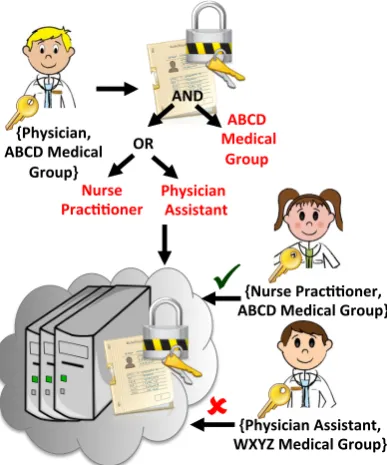
il-lustrated in Figure 3.1. Here, the nurse practitioner with the ABCD Medical Group
can access EHRs that are only allowed to physician assistants ornurse practition-ers, andwho work in the ABCD Medical Group; and the physician assistant with the WXYZ Medical Group is not allowed access.
CP-ABE thus supports flexible and fine-grained access control with healthcare
providers being able to access only relevant EHRs encrypted with access policies
AND(
ABCD(( (Medical(
Group(
OR(
Nurse(
PracDDoner( Physician((Assistant(
{Physician(Assistant,( WXYZ(Medical(Group}((
{Nurse(PracDDoner,( ABCD(Medical(Group}((
(
{Physician,( [image:52.595.210.404.131.364.2]ABCD(Medical( Group}((
Figure 3.1: An example of using CP-ABE in a cloud-based EHR system. A record is en-crypted with an access structure stating that any physician assistant or nurse practitioner who works in the ABCD Medical Group can decrypt the record. Here, the nurse practi-tioner is allowed to access (and decrypt) the record, but not the physician assistant as he doesn’t work in the ABCD Medical Group.
that can be decrypted with that key will be compromised; other EHRs are still
protected.
3.2.2 System Architecture
In the proposed scheme, EHRs are stored in the cloud, and can be accessed through
a web portal by multiple users who are typically healthcare professionals. The
users who create EHRs are also responsible for generating access policies based
on the attributes of authorized healthcare providers, encrypting EHRs based on
the generated policies and uploading encrypted EHRs into the cloud. EHRs are
3.2. A CLOUD-BASED EHR SYSTEM
to share different parts of the EHR, thus making the scheme more flexible.
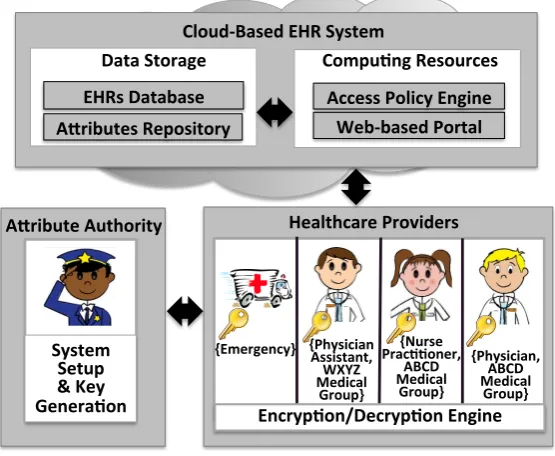
Figure 3.2 shows the architecture for the proposed cloud-based EHR system,
which consists of three main components: the cloud-based EHR system,
health-care providers (users), and the Attribute Authority (AA). The system uses two
fundamental cloud services: data storage and computing resources. The first
ser-vice is for storing encrypted EHRs that are accessible only to healthcare providers
through authentication mechanisms, and access policies based on complete
at-tributes of healthcare providers. The second service is for hosting the web portal,
generating access policies, and performing other needed computing tasks.
[image:53.595.172.450.341.569.2]Web$based(Portal( Access(Policy(Engine( {Physician,( ABCD( Medical( Group}(( {Physician( Assistant,( WXYZ( Medical( Group}(( {Nurse( PracDDoner,( ABCD( Medical( Group}(( EncrypDon/DecrypDon(Engine( {Emergency}(( CompuDng(Resources( Cloud$Based(EHR(System( AJributes(Repository( EHRs(Database( Data(Storage( System( Setup(( &(Key( GeneraDon( AJribute(Authority( Healthcare(Providers(
Figure 3.2: The cloud-based EHR system architecture consisting of three main compo-nents: the cloud-based EHR system, healthcare providers (users), and the attribute au-thority (AA).
Once healthcare providers obtain their private keys from the AA, they log in
to the system using their username and password; on first login, they will need
locally. When a healthcare provider requests access to an encrypted record, she will
first locate and download it, and then use her key and the lightweight software to
decrypt it. To upload a new record, she will first request the desired attributes and
generate the access policy using the Access Policy Engine; encrypt the record using
the lightweight software; and finally upload the encrypted record.
3.2.3 Key Management
Key management must be cost-effective and its components are carefully
imple-mented. In the proposed system, key management is handled appropriately for
cloud-based EHR systems.
• Generation and Distribution: The AA generates the public and master
pri-vate keys using the Setup algorithm. When a new healthcare provider joins
the system, the AA derives a distinct secret key associated with her attributes
by running the Key Generation algorithm off-line. Healthcare providers must
store their secret keys securely, and regenerate keys after a predefined
expi-ration date. Secret key regeneexpi-ration is performed without the need to
re-fresh the system parameters, public key, and master private key. Healthcare
providers can only seek their secret keys through their healthcare
organiza-tions.
• Revocation: The cloud-based EHR requires forward secrecy such that when
a healthcare provider’s access is revoked, she should not be allowed to access
EHRs that she was able to access before being revoked. Owners of encrypted
EHRs h