promoting access to White Rose research papers
White Rose Research Online
[email protected]
Universities of Leeds, Sheffield and York
http://eprints.whiterose.ac.uk/
This is an author produced version of a paper published in
Physical Review
Letters
.
White Rose Research Online URL for this paper:
Published paper
Ramsay, A.J., Godden, T.M., Boyle, S.J., Gauger, E.M., Nazir, A., Lovett, B.W.,
Fox, A.M., Skolnick, M.S. (2010)
Phonon-induced rabi-frequency renormalization
of optically driven single InGaAs/GaAs quantum dots
, Physical Review Letters,
105 (17), Art no.177402
InGaAs/GaAs quantum dots
A. J. Ramsay,1,∗ T. M. Godden,1 S. J. Boyle,1 E. M. Gauger,2
A. Nazir,3 B. W. Lovett,2 A. M. Fox,1 and M. S. Skolnick1
1Department of Physics and Astronomy, University of Sheffield, Sheffield, S3 7RH, United Kingdom
2Department of Materials, University of Oxford, Oxford OX1 3PH, United Kingdom
3Department of Physics and Astronomy, University College London, London, WC1E 6BT, United Kingdom
(Dated: July 21, 2010)
We study optically driven Rabi rotations of a quantum dot exciton transition between 5 and 50 K, and for pulse-areas of up to 14π. In a high driving field regime, the decay of the Rabi rotations is nonmonotonic, and the period decreases with pulse-area and increases with temperature. By comparing the experiments to a weak-coupling model of the exciton-phonon interaction, we demonstrate that the observed renormalization of the Rabi frequency is induced by fluctuations in the bath of longitudinal acoustic phonons, an effect that is a phonon analogy of the Lamb-shift.
PACS numbers: 78.67.Hc, 42.50.Hz, 71.38.-k
The decoherence of a two-level system or qubit in the solid-state is often understood in terms of its interaction with a reservoir of bosons [1] or half-integer spins [2]. An important issue with respect to both decoherence physics and the performance of quantum logic operations is how these interactions are modified by a driving field. In the case of bosons, this issue has received considerable theo-retical attention [1], but as far as we are aware, the only experimental studies to support this work are restricted to the field of superconducting qubits [3, 4]. Here we use Rabi rotation measurements of quantum dot exci-tons [5–7] to study the dephasing of a solid-state driven two-level system coupled to a boson bath, where recently we identified longitudinal acoustic phonons as the prin-cipal cause of the intensity damping of optically driven Rabi rotations in InAs/GaAs quantum dots [8].
In this letter, we report experimental evidence for a phonon-induced shift in the Rabi frequency of an optically-driven excitonic transition in a semiconductor quantum dot. A single laser pulse drives a Rabi rota-tion between the ground and neutral exciton states of a single InGaAs/GaAs quantum dot, where the pulse-area, the time-integral of the Rabi frequency, is controlled via the incident power. Compared to a two-level atom pic-ture, the resulting Rabi rotations are modified by the exciton-phonon interaction. We observe key signatures of the dynamics of a driven two-level system coupled to a boson bath. Firstly, the period of the Rabi rotations decreases with the pulse-area, and increases with temper-ature implying a renormalization of the Rabi frequency as theoretically anticipated in refs. [9–13]. This shift in the Rabi energy is a result of fluctuations in the phonon bath, and is an effect analogous to the Lamb-shift observed in the spectra of atomic hydrogen. Secondly, the damp-ing of the Rabi rotations is nonmonotonic and exhibits a roll-off behavior as the Rabi energy starts to exceed the bandwidth~ωc of the exciton-phonon coupling.
Since our previous work [8], we have greatly improved
our experimental setup by swapping a cold-finger cryo-stat for a helium bath cryocryo-stat with the sample mounted on low temperature piezoelectric stages. This provides access to lower temperatures (4.2 K vs 15 K), higher me-chanical stability, and enables the use of a shorter focal length objective. Overall this increases the range of the pulse-area from 6π to 14π, providing the bandwidth in the Rabi energy needed to resolve the new physics re-ported here. The experiments are performed on a single quantum dot embedded in an n-i-Schottky diode struc-ture. Uncapped test specimens exhibit an ensemble of InGaAs/GaAs dots with heights of 3-4 nm, and base di-ameters of 25-30 nm. The measurements presented here are from a single dot emitting at 951 nm in the high en-ergy tail of the dot distribution, and energetically distant from the wetting layer that emits at 861 nm. The biex-citon binding energy is 1.9 meV. The dot is excited with a single laser pulse, and the final occupation of the ex-citon state is measured using photocurrent detection [6]. A background photocurrent proportional to the incident power is subtracted from all data, attributed to absorp-tion of scattered light by other dots in the sample [15]. Further details of the sample, and the optical system can be found in ref. [16].
Figure 1 presents a Rabi rotation measurement at a temperature of 12.5 K, where the qualitative features of the data are clearly expressed. A single laser pulse with a Gaussian envelope resonantly excites the neutral exciton transition. Circular polarization and a narrow 0.2-meV FWHM spectral width are used to suppress ex-citation of the two-photon biexciton transition [17], and of multi-excitons [18]. The bare Rabi frequency Ω(t) of the laser pulse is described by Ω(t) = Θ
2τ√πexp (−( t
propor-2
0 2 4 6 8 10 12
0 2 4 6 8 P h o t o cu r r e n t ( p A )
pul se-area: ( ) T =12.5 K
FIG. 1: (◦)A Rabi rotation measurement at 12.5 K. The full lines are calculated using Eqs. (1,2). (red) (K(Ω) is real, and P = 1) In a low driving field regime (Θ < 6π), the data are described by an Ω2 damping, but at higher fields
this model overdamps the oscillation. (green) (K(Ω) is real,
P(Ω) =e−Ω2/ω2
c) The roll-off in the damping is reproduced
by including the frequency dependence of the exciton-phonon form-factorP(Ω). With a constant rotation frequency, this model provides a ‘clock-signal’ against which the nonlinearity of the rotation angle with Θ is clearly observed. (blue)(K(Ω) is complex) By including the imaginary part ofK(Ω) the vari-ation of rotvari-ation angle with Θ is reproduced.
tional to the pulse-area Θ. The photocurrent exhibits a damped oscillation with pulse-area. To help illustrate the main qualitative features of the data, calculations of various models of the driven dephasing are presented in fig. 1 as color-coded lines. The traces are scaled to fit the data at low pulse-area and will be discussed shortly. To analyze the data, we use a model described by a pair of Bloch-equations:
˙
sy ={Ω +=[K(Ω, T)]}sz− {Γ∗2+<[K(Ω, T)]}sy (1) ˙
sz=−Ωsy (2)
where s = (sx, sy, sz) is the Bloch-vector of the two-level system in the rotating-frame of the laser, composed of the crystal ground, and the exciton states. sz rep-resents the population inversion, and sy the imaginary component of the excitonic dipole. The photocurrent is a measure of the final occupation of the exciton state: P C ∝(1 +sz)/2. In the case of on-resonance excitation, where the initial state iss= (0,0,−1), as discussed here, the sx equation is decoupled from Eqs. (1,2) and does not influence the dynamics of the measuredsz-basis. Γ∗2
is a phenomenological dephasing rate used to account for electron-tunneling, and other possible sources of driving-field independent dephasing. The complex response func-tion K(Ω, T) describes the Rabi-frequency dependence of the exciton-phonon interaction. The real part<gives rise to a rate of dephasing, and the imaginary part = shifts the rotation frequency of the Bloch-vector;< and =satisfy a Kramers-Kronig relationship.
Eqs. (1,2) are derived using a weak-coupling Born-Markov approximation [13] that treats the exciton-phonon interaction Hamiltonian HI =|XihX|
P
q~(gqb†q+g∗qbq) as a perturbation to sec-ond order, whereb†
q,bqare the creation and annihilation operators for a longitudinal acoustic phonon of wave-vector q. The material dependent coupling strengths gq are given in ref. [19]. K(Ω, T) =R0∞dt eiΩtK(t, T˜ ), where ˜K(t, T) is the time-domain response of the exciton-phonon system:
˜
K(t, T) = Z ∞
0
dωJ(ω)coth( ~ω
2kBT) cosωt, (3)
whereJ(ω) =Pq|gq|2δ(ω−ωq) is the spectral density
of the exciton-phonon interaction, and can be approxi-mated by J(ω) ≈ ~A
πkBω
3P2(ω). A is defined such that
limΩ→0<[K] =ATΩ2 [8]. The form-factor, which is the
Fourier transform of the probability distribution of the carriers, is approximated asP(ω)≈e−ω2/2ω2
c [13].
A physical interpretation of the model is as follows. The laser couples the crystal-ground and exciton states to form optically dressed states separated by a Rabi split-ting. Emission and absorption of LA-phonons with an energy equal to the Rabi-splitting results in a relaxation between the dressed states that leads to a rate of dephas-ing that is a function of the instantaneous Rabi frequency. To satisfy a Kramers-Kronig relationship, the dephasing is accompanied by a shift to the Rabi splitting induced by fluctuations of the LA-phonon bath.
Now we return to fig. 1, to consider the qualitative fea-tures of the Rabi rotations using the results of Eqs. (1,2) to help identify these features. Values ofA= 11.2 fs K−1,
and~ωc = 1.44 meV have been used, found from fits to fig. 2(a), discussed below. (i) The red-trace is calculated by neglecting the imaginary part ofK, and approximat-ing the form-factor as P ≈ 1. The pulse-area used in the calculations is scaled to provide best-fits to the data. For low pulse-areas of Θ < 6π, the data are well de-scribed by the red-trace, which is consistent with our previous work [8]. In the low-driving field, high tempera-ture regime (Ω< ωc, 2kBT À~Ω) the rate of dephasing is<[K]≈ATΩ2, which is the expected behavior of a
[image:3.595.95.270.64.189.2]the Rabi frequency, and thus provides a periodic-signal against which the nonlinear dependence of the Rabi ro-tation angle with pulse-area is clearly observed. (iii) The blue-trace is calculated using the full model. Now both the envelope and the variation of Rabi rotation angle with pulse-area Θ are reproduced, demonstrating that the nonlinear rotation angle results from the imaginary part of thesame exciton-phonon responsethat describes the damping.
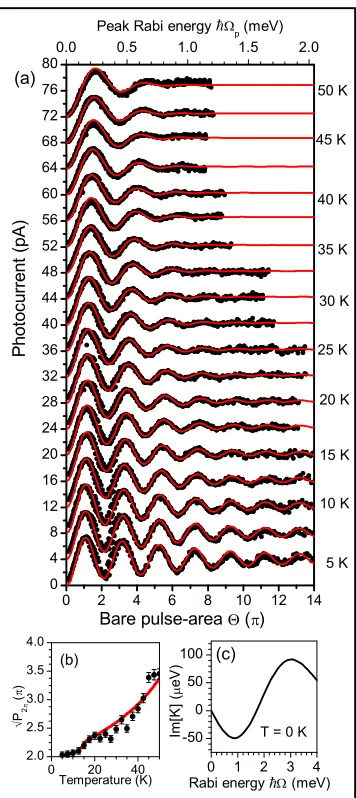
To further confirm that the nonmonotonic decay and the nonlinear rotation angle are a result of the exciton-phonon interaction, a set of Rabi rotation measurements as a function of temperature [21] was performed. The data are presented in fig. 2(a). The Rabi rotations are offset for clarity, and plotted as a function of the pulse-area deduced from the fits. For each temperature, the laser is tuned to resonance with the exciton transition. At low temperatures, oscillations can be observed over the full range of measured pulse-area. As the temperature increases, the damping and the rotation period increase. At 35 K the period of rotation is approximately 23% larger than at 5 K.
To compare the model to the experimental data pre-sented in fig. 2(a), we make fits of the entire data-set to Eqs. (1,2). This is achieved as follows. First we calculate all of the Rabi rotations using trial values forAand~ωc. To accommodate small variations in the dot-laser cou-plings between measurements at different temperatures, the calculation is scaled to the data by finding the values ofa= Θ/√P, andηthat minimize the root-mean square error for each temperature. ais a measure of the dot-laser coupling, andηis the photocurrent corresponding to one exciton. A genetic search algorithm [22] is then used to find the values ofAand ~ωc that provide the best fit of the entire data set. Note that only two parameters are used to fit the shape of the Rabi rotation, which is char-acterized by three qualitative features. A is determined by the strength of the damping, and~ωc by the cut-off in the damping. The nonlinearity of the rotation angle, which depends on bothAand~ωc, provides a test of the consistency of the model. By treatingAand~ωcas global fitting parameters, the temperature dependence of these features is tested against the model, and the values ofA and~ωc are determined with greater accuracy compared to using a series of local fits. Good fits to the entire data-set between 5-50 K are achieved. This confirms that the weak-coupling model used here provides a good descrip-tion of the experimental data. Note that Γ∗
2= 0.025 ps−1
is not used as an adjustable fitting parameter.
Based on fits to the data in fig. 2(a), we extract values of A= 10.8−11.9 fs.K−1, and~ω
c = 1.37−1.46 meV. The value ofAis consistent with a calculation using bulk GaAs material parameters [8]. The cut-off energy ~ωc corresponds to a spherical [23] wavefunction of ψ(x) ∝ e−x2/2d2
, withd=√2cs/ωc = 3.25−3.46 nm, wherecs is the speed of sound. This corresponds to a probability
0 20 40
2.0 2.5 3.0 3.5 4.0 P 2 ( )
Tem perature (K)
(b)
0 2 4 6 8 10 12 14 0 4 8 12 16 20 24 28 32 36 40 44 48 52 56 60 64 68 72 76 80
0.0 0.5 1.0 1.5 2.0
Bare pulse-area ( )
P h o t o cu r r e n t ( p A ) 10 K 15 K 20 K 25 K 30 K 35 K 40 K 45 K 50 K 5 K (a)
Peak Rabi energy
p
(m eV)
0 1 2 3 4 -50 0 50 100 I m [ K ] ( e V )
Rabi energy (m eV) T = 0 K (c)
FIG. 2: (a) Temperature dependence of the Rabi rotations. Red-lines are calculated using A = 11.2 fs.K−1, ~ω
c =
1.44 meV, and Γ∗
2 = 0.025 ps−1, whereA and ~ωc are
ex-tracted from a fit to all data. The bottom axis is scaled to the bare pulse-area Θ, while the top axis indicates the peak Rabi energy of the laser pulse. (b) Square-root of the incident power√P2π corresponding to the first minimum plotted vs
temperature. √P2πis scaled to the pulse-area Θ for the case
[image:4.595.352.530.97.496.2]4
distribution of∼5.5 nm FWHM, which is reasonable for an InAs/GaAs quantum dot.
Figure 2(b), presents the square-root of the incident power used to reach the first minimum in the Rabi rota-tion√P2π, scaled to the pulse-area at 5 K, and plotted against the temperature. The line is calculated assuming that the scaling parameter ais constant. There is good agreement between the model and the data, with a less than 9% departure of any data point from the calculation. This implies that the increase in the period with temper-ature shown in fig. 2(b) is due to the interaction with phonons, and that variations in the dot-laser couplinga due to the thermo-mechanical stability of the alignment are small. On close inspection of the fits in fig. 2(a) (not shown) forT ≥40 K, the weak-coupling model over esti-mates the damping reducing the quality of the fits. Since non-Markovian effects should be more influential at low temperature [25], we cautiously suggest that at higher temperatures, a model which uses the renormalized Rabi frequency for calculating the rate of damping (e.g. as ac-complished by the strong-coupling approach of Ref. [26]) may provide a better description.
For a number of reasons only LA-phonons can explain the data. In a low-driving field regime (Θ < 6π), the Rabi rotations can be described by a rate of dephasing Γ2=K2Ω2, whereK2is proportional to temperature [8].
This is characteristic of LA-phonons, since other mech-anisms such as LO-phonons or the wetting layer would be characterized by an activation energy. The temper-ature gradient A is consistent with a calculation based on LA-phonons using literature values for bulk GaAs [8]. The wetting layer model, as presented in ref. [24], can-not describe the cut-off behavior in the damping, or the nonlinearity of the Rabi rotation angle. Furthermore, the spectral density of the dot-environment interaction,J(Ω) can be deduced from the Rabi rotation data, and is only consistent with an LA-phonon mechanism.
To conclude, we have studied the interplay between an optically driven quantum dot exciton and a reservoir of LA-phonons using Rabi rotation measurements. The thermal and vacuum fluctuations of the phonon bath give rise to a temperature and driving-field dependent rate of dephasing and a renormalization of the Rabi en-ergy, which are connected by a Kramers-Kronig relation-ship. The vacuum contribution, analogous to the photon-induced Lamb-shift observed in the spectra of atomic hy-drogen, can be inferred from the fits to the data by calcu-lating=[K] at 0 K. This is presented in the fig. 2(c). The Lamb-shift term depends on the Rabi frequency, and has a value of−49±3µeV at the first minimum. At low Rabi frequencies this can account for up to a 4.5±0.3% de-crease in the effective Rabi rotation frequency. At 20 K, where kBT ∼ ~ωc, the thermal and vacuum contribu-tions to the shift =[K] are of a similar size, indicating that for T ¿ 20 K the shift to the Rabi rotation fre-quency is dominated by the vacuum contribution. In
comparison to the photon-induced Lamb-shift, here the Rabi splitting of the optically dressed states can be tuned with a laser from zero to a few meV, probing the spec-tral density of the exciton-phonon coupling. By contrast, optical transitions have energies in the eV range, which is large compared with the tuning range of the transi-tion. The phonon fluctuation-induced shift to the Rabi frequency observed here contrasts with the case of quan-tum wells [27], where a Rabi frequency renormalization results from an increase in the excitonic dipole due to many-body Coulomb effects.
The authors thank the EPSRC (UK) EP/G001642, and the QIPIRC UK for financial support. AN is sup-ported by the EPSRC, and BWL by the Royal Society. We thank H. Y. Liu and M. Hopkinson for sample growth; R. Golestanian, G. A. Gehring and D. P. S. McCutcheon for useful discussions.
∗ Electronic address: [email protected]
[1] A. J. Leggett,et alRev. Mod. Phys.591 (1987).
[2] R. Hanson,et al, Science320352 (2008).
[3] C. M. Wilson,et alPhys. Rev. Lett.98257003 (2007).
[4] C. M. Wilson,et alPhys. Rev. B81024520 (2010).
[5] T. H. Stievater,et alPhys. Rev. Lett.87133603 (2001).
[6] A. Zrenner,et al, Nature418612 (2002).
[7] Q. Q. Wang,et alPhys. Rev. B72035306 (2005).
[8] A. J. Ramsay,et alPhys. Rev. Lett.104017402 (2010).
[9] J. F¨orstner,et alPhys. Rev. Lett.91127401 (2003).
[10] P. Machnikowski, and L. Jacak, Phys. Rev. B69193302 (2004).
[11] A. Kr¨ugelet alAppl. Phys. B81897 (2005).
[12] A. Vagov,et alPhys. Rev. Lett.98227403 (2007).
[13] A. Nazir, Phys. Rev. B 78 153309 (2008).
[14] W. E. Lamb, Jr. and R. E. Retherford, Phys. Rev. 72
241 (1947).
[15] S. Stufler,et al, Phys. Rev. B72121301(R) (2005).
[16] S. J. Boyle,et al, Phys. Rev. B78075301 (2008).
[17] S. Stufler,et al, Phys. Rev. B73125304 (2006).
[18] B. Patton, U. Woggon, and W. Langbein, Phys. Rev. Lett.95266401 (2005).
[19] B. Krummheuer,et al, Phys. Rev. B65195313 (2002).
[20] Uses Eq. (2) of ref. [13] in the resonant case (ν = 0), where a Markov approximation is applied by taking the integrals to infinity, and assuming Ω is quasi-constant on the timescale of the integrand. This gives Eqs. (1,2) of the main-text withD(∞) =<[K(Ω, T)], and<[ζ2(∞)] =
=[K(Ω, T)].
[21] Heating by the laser is<2 K at Θ = 14π.
[22] K. Price and R. Storn, ‘Differential evolution: a simple evolution strategy for fast optimization’ http://www.ddj.com/architect/184410166
[23] We have calculated the form-factorP(ω) for asymmetric dots with different sizes of electron and hole wavefunc-tions. In the cases of interestP(ω) can be approximated bye−ω2/2ω2
c described by a single parameter.
[24] J. M. Villas-Bˆoaset alPhys. Rev. Lett.94057404 (2005).
[25] A. Kr¨ugelet alPhys. Rev. B73035302 (2006).