EUROPEAN COAL AND STEEL COMMUNITY EUROPEAN ECONOMIC COMMUNITY EUROPEAN ATOMIC ENERGY COMMUNITY
COMMISSION
REPORT
on the
Development of the Social Situation
in the Community
in 1972
(Addendum to the "Sixth General Report on the Activities of the Communities" in accordance
with Article 122 of the Treaty of Rome)
This Report is published in six languages (Danish, German,, English, French, Italian and Dutch)
. ~ . ' ,, , I ,-•
CONTENTS
' ...
Introduction 7
' ,. A - Outline of activities by the Commission of the European
Com-munities in the social field in 1972 15
' .. , .
. ' I •., ''I ' ., ~·, .
B - Development of the Social Situation in 1972 47
Part
I - Trends of development of the social situation in the Coinmiiriity . ·/ 49Employment
Community Assistance to Transfers
,;
Free Movement of Workers Vocational Training Industrial Relations
Labour Conditions and L~nv Wages and Asset-Ownership Housing
. . Family Matters Social Services Social Security
' ·.~ .
...
I,,Industrial Safety, Medicine and Hygiene
Health Protection and Protection of the Environment
t,
49
' .. ~
..
54 ., '
55 ....
· ; 57
.
; 59 67',.·,
70 76
78 ': .. . . ' ~.
81
84 91 94
Part II - Development of the Social Situation in the Countries of the
European Communities 103
Employment 103
Vocational Training 106
Labour Conditions and Law 115
Contractual Wages, Actual Earnings and Purchasing Power 121
Housing 124
Family Matters 137
Social Services 143
Social Security 149
Industrial Safety, Medicine and Hygiene 155
Protection of the Environment 162
Part III - General survey of the evolution of the social situation in the
United Kingdom, Ireland and Denmark 169
Population and Employment 169
Vocational Guidance and Training 174
Industrial Relations 178
Labour Law and Working Conditions 182
Incomes and Wealth 186
Housing-Family Questions-Social Services 191
Social Security 195
Vocational Safety, Oecupational Medicine and Health 202
Environment 205
INTRODUCTION
In many respects the development of the social situation in 1972 has been merely the repetition or continuation of trends which were pinpointed in the previous Social Report. Thus, this year it would be possible to define this development by noting that it: "has been dominated by employment problems. Short-term economic and monetary factors have disturbed the rate of expan-sion and the level of employment. In nearly all the peripheral regions of the Community, structural unemployment has hardly diminished-a fact which raises the question of Community solidarity expressed in the Treaties" .1
It is true that the level of the full-time unemployed during the year has remained above that reached in 1971, and that structural inadaptations, mainly at regional level, have become further pronounced in certain Member States. At the same time', the unemployment among young people, even those in possession of skills, is a subject for increasing concern.
Nevertheless, the year 1972-precisely because it saw the repetition of certain events, and in particular monetary disturbances, and the persistence, and even the accentuation, of certain imbalances, particularly as regards em-ployment and incomes-cannot be considered as a pure and simple repetition
of 1971. ·
The fact that these phenomena are no longer considered as accidental or transitory, makes them now less tolerable.
Their persistence or repetition confers on them quite another dimension. Certainly, they oblige us to question the outline interpretations of socio-economic phenomena on which socio-economic and social policies are based. Hence we have, for example, the debate on "stagflation", or the more general ques-tions on the final aims and limits of growth. But, more especially, they have at the same time the effect of modifying the behaviour of social and economic agents, not only as producers (affected by their working systems and environ-ment), but also-which is something new at this level-as consumers.
Up to now social policy has been very largely the uncoordinated sum total of the various reactions of the social body to the results and consequences
1 Report on the Social Situation in the Community in 1971-Commission, February 1972,
of other policies. This is now no longer the case. It is now accepted that social policy should be accepted in its own right. Admittedly, the correlations between social policy and other policies have long since been obvious, and in the at-tempts at planning or programming on the national or Community plane efforts have been made to give a place in the objectives to strictly social aims, but with varying degrees of succes. The first Summit Meeting in The Hague, in December 1969, had already advocated close concertation of social policies in the light of an economic and monetary union in process of formation. The third Medium-term Economic Policy Programme, and the Preliminary Guide-lines for a Community Social Policy Programme, adopted by the Commission on March 17, 1971, have also helped to bring about this awareness oftbe inter-dependence of the various factors.
But what is new, and what confers on the Paris Summit Meeting of October 1972 its most marked and decisive feature for the future of Europe, is the fact that "the Heads of State or Government emphasized that they attach-ed as much importance to vigorous action in the social field as to achievement of economic and monetary union. The Heads of State or Government thought it essential to ensure the increasing involvement of labour and management in the economic and social decisions of the Community (Declaration, Chapter 6).
The solemn recognition of the importance of the development of a coher-ent social policy for the Community is accompanied by an indication of the means to be used-the participation of management and htbour-which will help to integrate the social aspects into the general body of Conimunity policies.
The Declaration of the Summit Conference is in no way a statement of limited scope which would concern only the social sector in the strict sense. It will be noted that it also concerns participation in economic decisions, and that the preamble to the Declaration, which faithfully reflects this radical trans-formation of public opinion referred to above, announces that: "Economic expansion is not an end in itself. Its first aim should be to enable disparities in living conditions to be reduced. It must take place with the participation of all the social partners. It should result in an improvement in the quality of life as well as in standards. of living" (Declaration, Preamble (iii)).
This does not exclude but,. on the contrary, implies (for otherwise the Community could fall apart) the maintenance and safeguarding of overall coherence. As the Commission stressed in the Preliminary Guidelines for a social Policy Programme in the Community: "In order to bring economiC mea-sures more closely into line with social targets and ensure that they will be as effective as possible,, it is vital that economic policies should not only take full aceount of social objectives but also that they should be interlinked in a co-ordinated Community programme. This programme must cover all factors contributing to.a harmonious, balanced development and must allow" for all the wide structural differences which still exist. Clearly, the options must form the subject 9f wideranging democratic discussions. This is not merely an ethical or political consideration; the collective processes must be followed and this is inconceivable without effective participation by the people in their formulation
and supervisi~n ". · ·
' · · A.
Employmen't problems
' ' 'The supply of information is gradually improving thanks to the various studies, inquiries .and reports on. the situation and .trend of the employment market,· the functioning of free movement, and vocational training problems. Yet we must note the obstacles encountered by the development of harmonized statistics at Community level. Migration affords a' particularly good illustration here. Not only are. the Member States reluctant.to undertake a coordination of immigation policies-without which. the applicatiql). of the principle of the free movement of workers is considerably weakened-but there is lack of progress ensuring the acquisition of information on migratory .flows. · '
I , ' • • , . f '
This lack .of knowledge is paradoxical in view of the importance .which the planning· or programming services rightly attach to the balance of the manpower market. The unsatisfactory level of information regarding employ~ ment inevit;:tbly has a detrimental. affect· on forecasting. Much more consid-erable efforts should be made to improve such forecasting, particularly in view of the possible repercussions on the ec(;momy and on hum~n beings of an ill-conceived and· ill-directed training policy~
but to arrive at the most immediate and detailed knowledge possible at Com-munity level of developments and trends on the employment market. A recent memorandum from the French Government suggesting that the Social Fund should help in this field links up with the ideas which are exercising the mind of the Commission.
In fact, it may be feared that the "modernization" in desperate fashion of each national employment market using different and perhaps incompatible systems may well end by making the Community labour market practically opaque, and thus in fact ruling out any active employment policy. If things are taken to extremes, the juxtaposition of increasingly rigid and watertight labour markets would become a major obstacle to the achievement of economic and monetary union.
Only great efforts at the Community level will give any hope of achieving the objective of full and better employment which the Commission, with the support of the European Parliament and all those concerned in social life, places and has always placed in the first rank of priorities and which will retain this rank in the social action programme which the Community is to adopt by January l, 1974.
This is why the permanent cooperation of the institutes, offices and bodies dealing with employment problems begun under the aegis of the Commission, will be actively followed up. In the coming years an endeavour will be made to render it more systematic and operational.
In addition, the Commission had adopted the "SEDOC" System (Euro-pean system for the diffusion of job offers and applications in international clearing) which, by means of a conversion table, defines for some 900 significant occupations at the level of the Community employment market a nomenclature of practical equivalences. In addition to ensuring the better functioning of the free movement of labour and of the activities of the coordination office instructed to watch over the implementation of Regulation 1612/68, this system should facilitate the preparatory work for the establishment of a harmonized data bank for the whole employment market.
Similarly, the action programme for a common policy on vocational training submitted to the Council in November 1972 will assume its full meaning only in the perspective of a genuine common employment market.
The new Social Fund began to operate on May l, 1972 and provided the opportunity for an interesting revision of social policy in this field. With financial resources which, although still modest when compared with the needs, are already considerable, the catalystic effect of the new Social Fund makes a genuinely active employment policy possible.
and Steel Community, and which is continuing, constitutes a promising experiment.
It is not only a matter of supplying Community aid towards solving of particular difficulties existing in various regions or certain sectors. The aid given for the training of people under the new Social Fund and within the framework of the ECSC provisions is an excellent instrument to promote balanced econom-ic development in the light of poleconom-icies jointly laid down by the Community authorities. It depends on the imagination and will whether those concerned, both at private and public level, profit by the opportunity offered to dovetail programmes of training and vocational readaption into development projects submitted for assessment by the Community authorities. In this way, the Social Fund can be seen as an instrument available to all the policies tending to give the Community a human visage as desired by the Summit.
***
The Community institutions have continued to examine important aspects of employment. Those include the employment of women and handicapped persons.
As regards work by women, studies, confrontation and enquiries carried on over the last two years have led to the conclusion that the problem is as much sociological as legal. Equal treatment will not be really possible until the fact of being a woman with special social responsibilities is no longer used as a pretext for inadequate training, interruption of professional careers, under-qualification and lesser chances of advancement. The development of appropriate legis-lation taking into account the place of women in society and the growth of collective facilities, are closely linked with the chances of the advancement of women at work. The economic interest of such achievement is often less clearly perceived than the social aspects in the strict sense.
Member States. In addition, difference between migration policies is calculated to influence wage structures in a manner prejudicial to social progress.
The situation of handicapped persons is no less a subject of concern. Their number is also continuously increasing in the Community as a whole. The Commission is convinced that the objective to be attained is the reintegration of these people into normal active life to the greatest extent possible. The lessons learned indicate that the cost of such reintegration is infinitely less than the considerable economic loss resulting from a passive solution founded on recourse to social security. But a readaption "without any break" between the beginning of the handicap and reintegration into social life, implying close co-operation between the medical bodies and the agencies for professional training and recycling, is the precondition for success. The intervention of the Social Fund for the occupational adaptation and readaptation of handicapped persons is an established achievement. However, it should be better dovetailed into an overall policy which still needs to be defined with the agreement of all the interested parties.
B.
Living and working conditions
In this field, in which, in accordance with Article 117 of the Treaty establishing the EEC, there is "need to promote improved working conditions and an improved standard of living for workers, so as to make possible their harmonization while the improvement is being maintained", it is particularly necessary that the existing situatjon at Community level be clarified as well as trends in the various Member States. Whether it is a matter of income and assets, of social security, including the social transfers which this covers, or rules and regulations governing work, the first need is to know what the real position is.
It is to this end that the Commission's departments, while continuing their efforts to improve statistics, are endeavouring to work out "social indica-tors. The result of an initial effort in this direction is to be found in the present Report.
It is the same concern for clarification which inspired the elaboration of the European Social Budget adopted in principle by the Council of Ministers on November 9, 1972. At the present stage, the main point is not to define objectives but to give a sufficiently clear view of realities, This is a prior condi-tion for the "harmonizacondi-tion while the improvement is being maintained" which it will be possible to envisage later.
(in places where· people live)~ The. Commission, in addition to presenting a general memorandum, has· already started to take concrete measures in this field.
Basing itself in particular on the lessons learned in the framework of the Treaty establishing the European Atomic Energy Community, and also on the research and confrontations that have taken place, in close liaison with manage-ment and labour, in the coal and steel industries, the Commission has begun, within the limits of the means placed at its disposal, to move beyond the context of radio-activity on the tin·e hand and the pollution resulting from industrial activity in iron and steel arid mining on the other. The efforts made in 1972 were essentially directed to working out methods for tackling the problems posed by· the major pollutants (lead, mercury, sulphurdioxide, carbon monoxide, etc ... ). The point is to define harmonized reference indicators concerning pollution and nuisances, with a view to .evaluating the danger these represent by means of. standardized measurements. This is the prerequisite for the deter-mi.nation of genuine basic norms fixed by common accord at Community level. The need to avoid dumping on quality, that is say to a levelling downwards imposed by the needs of competitiveness, calls for. the definition ofcommon rules of conduct in the most extensive areas possible, but in any case at the level of the Community. It is true that in some of its aspects this policy goes beyond the context of social policy, but it is too closely Iinke!f with the latter
to' be left out of a social report. '
As regards the free movements of workers, 1972 ,witnessed the implemen-tation of the revised regulations on the social security of .migrant workers, which resulted in con~iderable improvements. It should be pointed out that very important work was carried out as part of the preparations[ or the enlarge-ment of the Communities to enable these regulations to be rapidly extended to the new member countries. Furthermore, the se.venth scheme of financial aid to ECSC housing is in full operation. A noteworthy development of these activ-ities is planned,' particularly in favour of migrant workers.
C. Democratization of economic and
socia~life
Apart from their interest per se, the measures relating to the democrati-zation of economic and social life are, in the last analysis, as was recognized by the Paris Summit, one of the essential conditions for the effective achieve-ment of economic and monetary union.
Apart from the proposal for a statute for the European joint-stock company (societe anonyme), the Commission submitted in November 1972 a ·further proposal for a directive which provides for worker's representation in
There is, in addition, the need to organise and develop the dialogue between the Community institutions and the two sides of industry. Apart from the Advisory Committees attached to the Commission, which bring together the representatives of all the parties conCerned and play a very important role in the definition of objectives and the control of day-to-day administration, the importance of the Standing Committee on Employment should be stressed. Mter two years of operation, this Committee, which is a centre for concerted action between the Council, the Governments, the Commisssion and the em-ployers' and workers' organization, has proved a valuable instrument for the definition of employment policy. Without changing the institutional balance laid down by the Treaties, it lends a valuable political dimension to the prep-aration of concrete measures. It helps in a flexible and informal manner, to develop a Community will.
The sectoral mixed or joint committees, which develop first in the steel and coal sector and then in agriculture, fishing and transport, have received a new boost from the Summit Conference. The Commission desires concerted action at sectoral level, covering both economic and social problems, in which all aspects of the future of the branch concerned could be debated freely and frankly and would make rapid progress. It will do everything in its power to promote this aim.
I
The conclusion of European collective bergaining agreements would contribute, while fully respecting the autonomy of both sides of industry, to the achievement of equalization in an upward direction. It would make it possible for Community rules and regulations to be applied but only on a complementary basis, in order to avoid social dumping and ensure that the measures adopted by common accord are respected.
A- Outline of activities
by
the Commission of the European Communities
in the social field in 1972
GENERAL
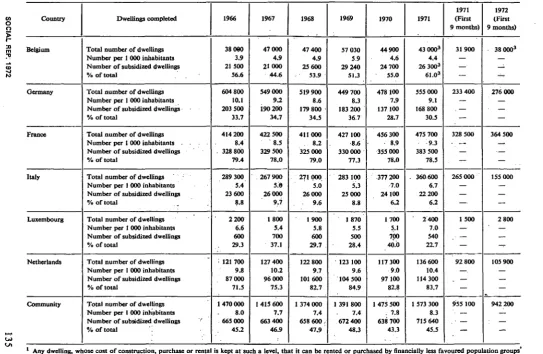
1. An increasing tendency to consider social policy in an overall context,
"( as opposed to the too generally compartmentalized view, could be said to
have marked the Commission's activities in 1972 and the impulse given to them through the prospects afforded by the enlargement of the Community. Many questions were thus examined in the light of the participation of the acceding countries. This was particularly the case with the Regulation im-plementing social security provisions for migrant workers, effective from 1 October 1972.1 For this a large amount of adaptation work had to be under-taken to enable the social security legislation of the acceding countries to be brought into line with Community rules from April 1973 and to enable the reformed Social Fund to start operating in these countries as soon as possible.
The most important decisions are undoubtedly those concerning the im-plementing procedures, which have become effective, for the reform of the European Social Fund.2 The Commission had the opportunity to present its
first proposals for specific decisions connected with common policies or situa-tions in the Community-for agriculture, and the textiles and clothing industries. In both these cases it was a matter of tackling the sectoral problems by inter-vening systematically and in good time but with due regard for the background of general economic policy. On 9 November the Council adopted decisions on measures for agriculture and textiles.
This concern governed all the work connected with employment, which, once again, had top priority. For emphasis was placed on an active policy to facilitate continuity of employment without hindering the mobility necessary for economic and social progress. Nevertheless, particular problems like juvenile employment and different aspects of female employment have not failed to receive attention. In order to reduce geographical imbalances in the labour market, the idea was also mooted of having closer links between move-ments of labour in the Community and the development even of those regions where there is a surplus of demand for employment, through integrated schemes uniting both economic and social aspects and based, in particular, on vocational training and the assisted placement of workers. This is the setting for the preparation of a new action programme for vocational training entitled "First measures to implement a common policy of vocational training" and for the achievement of a European system of distributing codified
tion on employment supply and demand (SEDOC). Furthermore, the reformed Social Fund has already proved to be a first-rate instrument for assuring the success of an overall policy.
Obviously this desire for a more integrated and consequently more dynamic concept of social needs will be favoured by the establishment of a "European social budget". A proposed programme concerning this has been put before the Council by the Commission.
2. In addition, safeguarding the environment has become a major matter of concern. The Commission's action programme provides for, among others, measures concerning the protection of health and the environment at the level of undertakings and regions. During the year the Commission paid special attention to the problem of handicapped workers, apart from con-tinuing work on industrial health and medicine.
Finally, mention should be made of a point of internal organization which has a bearing on the desire to associate the two sides of industry more closely with Community policy. This is the creation, within the Directorate-General for Social Affairs, of a department designed more especially to develop and coordinate the activities of the Joint Committees which were established to deal with the social problems of the different sectors.
SOCIAL ASPECTS OF THE COMMON AND COMMUNITY POLICIES
of consumer protection. The opening of this broad prospect certainly constitutes an event in the Community's history as regards social affairs. The first practical step was taken by the Council on 9 November, namely to call a tripartite Conference-Governments, Commission and both sides of industry of the nine countries-in the spring of 1973 to prepare the new social programme.
4. In 1972 activities connected with the various common and Community policies were more closely correlated with the social policy. In the short and medium-term economic policies, employment questions rank among the most important. Even though increased economic activity may enable the level of employment to rise, it still remains necessary to try to achieve a better balance on the labour market through structural measures. In this connection the Commission believes it would be preferable to step up the activities designed to remedy regional imbalances and to adjust vocational training and readapta-tion to the requirements of those sectors in which demand will grow.
On the other hand, the very marked increase in prices has made the damping-down of inflationary trends a major necessity. To remedy inflation, a whole series of measures is called for. One of these is the achievement of regulated growth of prices and incomes, which requires a collective effort to attain greater coherence in the economic and social fields. A special effort should be made to improve the position of the worst-off. Activity undertaken as part of the short and medium-term economic policies has increased, as appears from the Annual Report on the economic situation of the Community in 1972 and from prosecution of the Third Medium-term Economic Policy Programme.
Concern for improving the quality of life led the Commission to submit a memorandum to the Council on Community policy in environmental matters. This memorandum covers three plans: one for the introduction of a programme to reduce pollution and nuisance; one for the exchange of information with a view to harmonizing the urgent steps to be taken in environmental questions; and one dealing with the pollution of the Rhine.
With a view to achieving greater democratization of economic and social life the Commission, in its draft proposal for a fifth Directive on the harmoniza-tion of company law, provided for the introducharmoniza-tion into all limited companies of an organizational system which would comprise a managing body and a supervisory body, with the participation of workers in the constitution of the supervisory body. This draft does not insist on uniformity but leaves the Member States free to choose between two models, both of which, despite the differences between them, give workers the same guarantees.
given at the conference on "Industry and Society in the European Community" which took place in Venice from 20 to 22 April 1972. The subjects discussed at this Conference included industrial development and the reduction of social and regional disparities and the multinational activities of enterprises.
Work undertaken with regard to agriculture, sea fishing, transport, and the coal and steel industries is dealt with later under industrial relations.
ACTIVITIES IN CO~NECTION WITH EMPLOYMENT
5. The Commission put the first conclusions from the Italian memorandum on employment policy of 24 June 1971 before the Standing Committee on Employment on 27 April 1972 and before the Council on 12 June 1972. It
emphasized the need to view employment problems in the setting of general economic policy and structural, regional and social policies. The conclusions of the Council meeting of 12 June 1972 complied at many points both with the suggestions of the Italian Government and those of the Commission. The latter is preparing proposals which will touch in particular on the following fields: support through Community action for the efforts made by the Italian authori-ties to improve the efficiency of their employment services. the revival of Com-munity assistance in filling vacancies, aid from the European Social Fund for vocational training for migrant workers, and establishment of the machinery provided for in Regulation (EEC) No. 1612/68 for matching employment applications and vacancies. Finally a group of independent experts set up by the Commission has just brought out a draft programme for the practical achievement of a Community employment policy. After the draft has been examined by the Commission, it will be put before the Council.
6. At its meetings in 1972 the Standing Committee on Employment discussed the drafts and reports from the Commission concerning: implementation of the reformed Social Fund; the programme of work to improve the quality of em-ployment statistics; the situation and trends of emem-ployment in the Community, and mass layoffs.
7. A report on the employment situation was distributed by the Commission. Drawn up in May, it is a summary of the major changes since November 1971 and the measures taken, and it outlines the trends in the coming months.
As regards employment forecasting, the Commission drew its conclusions from the in-training period organized at Erlangen.1 These conclusions form
the basis of a draft action programme which will be proposed to the Council, after due consultation with experts. The exchanges of information and expe-riences between the employment services in the Member States continued, with special reference to the use of computers in the employment field. The aspects dealt with mainly concerned harmonization of the criteria for job applications and vacancies and for establishment of the labour market.
The third report on the activities of the employment services in the Member States was sent to the Council and the Standing Committee on Employment. In the report the Commission outlined the measures taken by the Member States and put forward suggestions for developing the in-training periods and seminars which it organizes for the staff of these services.
Following the Council debates on the reports dealing with juvenile employment and unemployment, the Commission's conclusions will be examined by the Standing Committee on Employment. These conclusions suggest that priority must be given to: better information about employment prospects; access to jobs; various forms of aid; particularly from the European Social Fund; and the changeover from school to working life. The Commission will submit to the Council a final memorandum containing suggestions for possible action.
As regards employment and working conditions for women, the Com-mission helped in carrying out a survey on working conditions for women in paid employment in the private sector of the six Community countries. The Commission's contribution was possible due to the studies it had carried out and the many contacts it had made, particularly in 1972 at meetings with representatives of womens' organizations, the two sides of industry and government experts. The results of the survey will be widely distributed. Furthermore, the Commission elaborated its ideas and suggestions on the situation and prepared guidelines for an action programme. These will be submitted to the Standing Committee on Employment for an opinion before the Commission makes its final proposals to the Council.
ACTIVITIES IN CONNECTION WITH VOCATIONAL GUIDANCE AND TRAINING
8. In accordance with the General Guidelines for a Community Programme on Vocational Training the Commission finalized its new action programme1
entitled "First measures to implement a common policy of vocational training". The draft, which was adopted by the Commission on 25 October, was forwarded to the Council on 6 November 1972 to be adopted by mutual agreement. This initiative-limited still-will have to be integrated in more general action for vocational betterment in conformity with the general guidelines already referred to and with the provisions to be taken under the overall action pro-gramme for social matters which the Community institutions must adopt by 1 January 1974 as required by the decisions taken at the Conference of Heads of State or Government on 19 and 20 October 1972. This programme takes particular note of the efforts made in Community countries to enable people to develop their own personality and make a career for themselves in an economy undergoing constant evolution. The programme likewise underlines the development of a Community employment policy in which vocational training will be called upon to play an increasingly important role in connection with the hopes raised by the prospective utilization of the reformed European Social Fund. Furthermore, it points out the new conditions created by the enlargement of the Community and by the implementation of the Medium-term Economic Policy Programme and the common policies for agriculture, sea fishing, transport, industry, etc.
The programme includes activities concerning three groups of problems where Community action can assist in informing, studying certain key aspects, and encouraging collaboration between Governments and the areas concerned. These groups are: trends in vocational training policies, structures and organiza-tion; adaptation of training methods; priority for the training of certain categories of people, certain sectors and certain regions.
9. In conjunction with the Advisory Committee on Vocational Training, the Commission undertook or continued studies on training methods, the approxi-mation of training levels, the training of workers leaving agriculture, and the provision of a legal framework for vocational training. Three seminars for training cadres were organized. They concerned the training of staff engaged in commerce (10 to 14 April), handicapped workers (5 to 10 June), and migrant workers (2 to 6 October). In addition a sixth seminar was organized on in-service training for Mrican cadres on 15 and 16 June.
The working party of experts set up last year1 met in 20 June to discuss
the promotion and coordination of research into vocational training. Having established a list of the priority problems, it is now using this basis to define a number of pilot projects for Community cooperation.
On 9 June a European Centre for Progress and Training in Agricultural and Rural Areas (CEPFAR) was established through joint efforts by the Commission and the employers and trade unions.
On the ECSC side the Vocational Training Committee agreed at its meeting on 2 June to concentrate more especially on the problems po.sed by the refresher and retraining of adult workers. Furthermore, the Commission published the third volume (steel works) of its manual on new processes in iron and steel production. Finally, the Commission adopted and published its fourth report on vocational guidance activities in the Member States, covering the years 1968 to 1970.
THE SOCIAL FUND,
READAPTATION, REDEVELOPMENT AND REEMPLOYMENT
European Social Fund
10. The European Social Fund, as reformed by Council Decision of I February 1971,1 became operational from 1 May 1972.2 In September 1972 the Com-mission published a memorandum relating to .the subCom-mission of applications for assistance froni the Fund, 3 this being a practical measure to supplement
its administrative and financial rules. The Commission should be in a position to determine in January 1973 the maximum amount of assistance from the Fund for four of the types of aid set out in Council Regulation (EEC) No. 2397/ 71 (Article 2) of 8 November 1971.4
In July 1972 the Commission proposed that the Council should start applying Article 4 of the Decision of 1 February 1971. Under the common agricultural policy the Fund could help to finance schemes designed to aid retraining and reemployment of people· leaving the land to work in other sectors. Under the Community's commercial policy, the Fund could be in-strumental in helping to solve the employment problems created by the re-organization of the textile and clothing industry. As the Council took 'no decisions on this until 9 November 1972, no applications for assistance under Article 4 could be made in the 1972 financial year. It must be stressed that the Council reserved the right to decide later on the part of the Com~~ssion's
1 OJ No. L 28, 4 February 1971, p. 15, and Fifth General Report, sec. 229.
~ OJ No. L 101, 28 April 1972, p. 3, and EC Bulletin, No. 1-72, sec. 33.
initial proposals not adopted on 9 November 1972, subject to being able to have at its disposal supplementary documentation enabling an examination to be undertaken in good time. The main points are possible action by the Fund in the clothing industry and the provision of aid to maintain agriculture workers' income for six months following the training period.
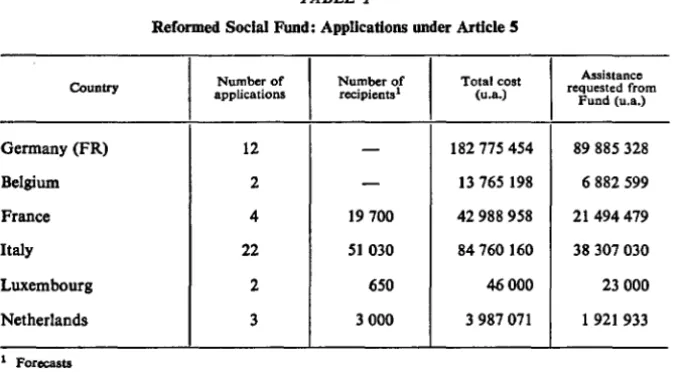
However, some applications were filed under Article 5 of the Decision of 1 February 1971. They are listed in Table 1.
'
~In this initial phase, applications for assistance mainly relate to vocational . training sch~mes, usually from a body governed by public law. However, some of the applications have come from bodies governed by private law, which ,, is sufficient justification for correspondingly broadening the scope of the European Social Fund. The measures concerned are designed to assist regions in difficulty, industries faced with demands made by technical progress, groups of undertakings experiencing basic changes in the conditions of production or ; marketing of their products, and handicapped workers.
TABLE 1
Reformed Social Fund: Applications under Ardcle 5
Number of Number of Total cost Assistance
Country applications
recipients1 (u.a.) requested from
Fund (u.a.)
Germany (FR) 12
-
182 775 454 89 885 328Belgium 2
-
13 765 198 6 882 599France 4 19 700 42 988 958 21494 479
Italy 22 51 030 84 760 160 38 307 030
Luxembourg 2 650 46000 23 000
Netherlands 3 3 000 3 987 071 1 921 933
1 Forecasts
[image:21.451.64.405.270.457.2]of technical progress, and 6.5 million u.a. for schemes concerning handicapped persons.
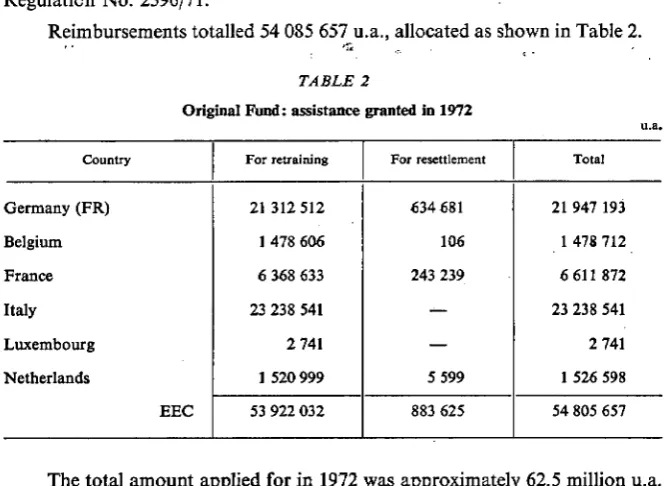
11. Side by side with this, the original Fund remained active under Article 125 of the EEC Treaty, in accordance with Article 12 of the general implementing Regulation No. 2396/71.1
Reimbursements totalled 54 085 657 u.a., allocated as shown in Table 2.
..
·~TABLE 2
Original Fund: assistance granted in 1972
u.a.
Country
I
For retraining For resettlement TotalGermany (FR) 21 312 512 634681 21 947 193
Belgium 1 478 606 106 1 478 712
France 6 368 633 243 239 6 611 872
Italy 23 238 541
-
23 238 541Luxembourg 2 741
-
2 741Netherlands 1 520 999 5 599 1 526 598
EEC 53 922 032 883 625 54 805 657
The total amount applied for in 1972 was approximately 62.5 million u.a. Of this,
Germany asked for . 32.8 million u.a.,
Belgium for 1.6 million u.a.,
France for 6.5 million u.a.,
Italy for 19.8 million u.a.,
Luxembourg for 0.003 million u.a.,
Netherlands for 1.8 million u.a.
In the above total amount only 0.8 million u.a. was for resettlement projects.
For the 1973 financial year the European Social Fund has been allocated a budget of 240 million u.a. Of this, 60 million u.a. is for the activities of the original Fund, 70 million u.a~. is for assistance to be granted under Article 4 and 110 million u.a. is for assistance under Article 5. With respect to the last
[image:22.446.51.384.117.360.2]two types of assistance, it will also be possible to make appropriations in 1973 for the 1974 and 1975 financial years to the amount of94 million u.a. (Article 4) and 90 million u.a. (Article 5).
The sum of 750 000 u.a. has been allocated for carrying out studies and pilot schemes.
As regards Community aid for redundant workers from the Italian sulphur mines,1 a total of 345 714 u.a. was paid to the Italian Government during
the 1972 financial year for miners discharged before 31 December 1970.
Readaptation and reemployment of workers
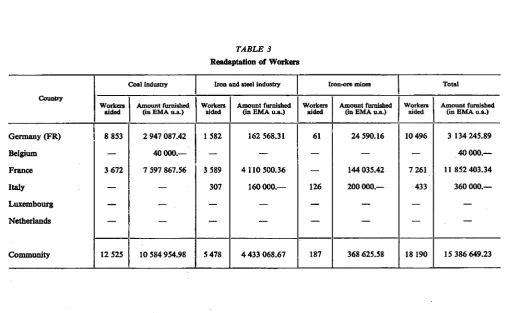
12. In 1972 there was no overall increase in the credits available for readapta-tion: 15 million u.a. as compared with 16 million u.a. in 1971. There was a pick-up of readaptation schemes in the iron and steel industry, particularly in Lorraine (Table 3).
With respect to the methods of readaptation, a new sort of aid was instituted in the Federal Republic for those coal miners affected by cutbacks in employment during the five years preceding their retirement. Likewise, in France aid for vocational training was stepped up to facilitate reemployment outside the coal industry, with extension of the payment period where necessary.
Redevelopment and reemployment
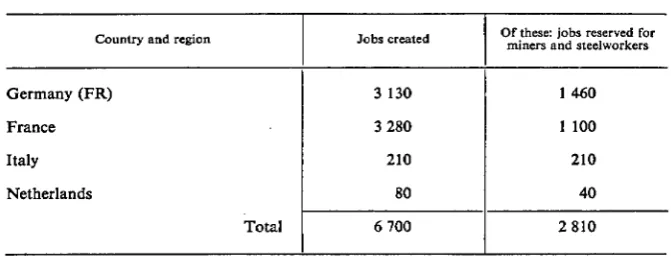
13. In 1972 only a few applications for redevelopment loans under Article 56(2a) of the ECSC Treaty were received. They concerned investment projects to create 590 jobs in the coal or iron and steel areas of France, the Netherlands or Italy. The decisions taken to grant loans or interest subsidies essentially referred to applications made earlier. The Commission therefore helped to create 6 700 new jobs; for 2 810 of these, priority will be given to former miners and steelworkers (Table 4).
Judging from inspections carried out periodically at enterprises in receipt of redevelopment loans, it can be said that, in general, they have fulfilled their obligations to reemploy ex-ECSC workers. However, it must be noted that they encountered difficulties in areas where the collieries are still in need of skilled manpower, especially in the Ruhr and Dutch Limburg. On the other hand there were no problems in meeting those obligations in areas where small collieries have been closed down for good. This was especially the case in
,_-...,---.,._-~-~· ~--~
-~---(/) 0
n
:.;
,...
:II m
::v
-~ N
Country
Germany (FR)
I
Belgium
France
Italy
Luxembourg
Netherlands
Community
Coal industry
I
TABLE 3
Readaptation of Workers
Iron and steel industry
I
Iron-ore minesI
TotalWorkers
I
Amount furnishedI
WorkersI
Amount furnishedI
WorkersI
Amount furnishedI
WorkersI
Amount furnishedaided (in EMA u.a.) aided (in EMA u.a.) aided (In EMA u.a.) aided (in EMA u.a.)
8 853 2 947 087.42 1 582 162 568.31 61 24 590.16 10496 3 134245.89
- 40000.-
-
-
- --
40000.-3672 7 597 867.56 3 589 4 110 500.36
-
144035.42 7 261 11 852 403.34-
-
307 160000.- 126 200000.- 433360000.--
-
-
-
-
-
-
-- -
-
-
--
-
[image:24.640.83.598.60.373.2]France, where the new undertakings have thus been able to get established with the help of readaptation programmes.
TABLE 4
Alternative jobs created with Commission financial assistance in 1972
Country and region Jobs created Of these: jobs reserved for miners and steelworkers
Germany (FR) 3 130 1 460
France 3 280 1 100
Italy 210 210
Netherlands 80 40
Total 6 700 2 810
FREE MOVEMENT OF WORKERS
14. As regards Community provisions on the free movement of workers the Commission considered what measures had to be taken in order to supple-ment the rules in force (Regulation (EEC) No. 1612/68 and Directive No. 68/ 360 EEC), and to create a better balance between employment supply and demand in the Community.
To this end the Commission has prepared various proposals including two for Council Regulations, one on conflicts between laws on labour relations and one on the drawing up of uniform statistics for foreign labour in the Community; further, the Commission prepared, after receiving on 12 October 1972 the opinion of the Advisory Committee on the free movement ofworkers,1 a proposal for a Council Directive to guarantee the free movement and social protection of workers employed by temporary staff agencies when they work in a client enterprise situated in another Member State.
In the context of measures to promote priority of employment for Com-munity workers the Commission put forward a plan designed to encourage assisted migration. This plan was examined in collaboration with the Advisory Committee on Freedom of Movement for Workers. It seems essential that freedom of movement should be backed up by measures to help in the place-ment of workers. To develop migration along these lines, it might be useful
[image:25.446.60.396.115.246.2]to organize vocational training and language courses in the country of origin to start with and afterwards in the host country. Measures have been taken so that at the beginning of 1973 a first group of 800 workers should receive a crash vocational and language course for the purpose of employment in Germany.
Information systems have been substantially improved in order to enable workers to have a clearer idea of the state of affairs when making their decisions. With a view to facilitating Community manpower clearance, on 8 December 1972 the Commission adopted a uniform system for exchange of the informa-tion on employment supply and demand used by the Member States' employ-ment services in their relations between each other. This is the "Systeme europeen de diffusion des offres et demandes d'emploi et de compensation internationale" (SEDOC)-a European codification of occupations and the main criteria for describing them. This system, worked out in collaboration with the Technical Committee on Freedom of Movement for Workers, will be put into practice in the six Member States at the beginning of 1973; pending its extension to the acceding countries, the transitional provisions of Article 38 of Regulation (EEC) No. 1612/68 will apply to them.
The Commission, again in agreement with the Technical Committee, adopted on 14 December a codified Community scheme for stepping up exchanges of information on living and working conditions in each State between the specialized departments in the Member States.
The Commission initiated discussion in the Advisory Committee con-. cerning the Member States' immigration policies for workers from third coun-tries. A working party from the Advisory Committee was set up to examine this crucial problem with the Commission .
. HARMONIZATION OF SOCIAL SECURITY ARRANGEMENTS
General social security matters and European social budget.
European social budget. Starting in February the Commission submitted to the Council, and subsequently to the European Parliament and the Economic and Social Committee, a survey of trends on financing social security arrange-ments from 1965 to 1975, and it also began to bring the forecasts included in the study for the 1970 to 1972 period into line with later developments. This forecasting represents an important step towards the preparation of the European social budget. At the Council session of9 November on social affairs, decisions were taken enabling the Commission, together with the national experts, to begin working out the first European social budget, which will deal with the present content of the social accounts, and will cover 1970/72 in its retrospective part and 1973/75 as regards forecasts.
Various studies on social security questions have been completed: the effect of colliery personnel cutbacks on social security in mining; special social security schemes; relations between the medical profession and social security; consumption of pharmaceuticals under social security; the cost of hospital treatment under social security; an information memorandum regard-ing the occupational diseases on the European list, and a report on the imple-mentation in the Member States of the recommendations concerning occupa-tional diseases.
Furthermore, the German Government, in order to give effect to the decisions taken by the Heads of State at the The Hague Summit Conference relating to the concertation of social policies, suggested that the Commission should prepare a report on the categories of people eligible for social security, so as to enable the Council to discover what Community action could be undertaken in order to achieve harmonization. The Council adopted this proposal unanimously on 26 November 1970, stating "that it is important that alignment between Member States in the field of social policy should be based on concrete action". The report in question was drawn up by the Com-mission and sent to the Council on 20 June 1972. It will be examined by the Council so that conclusions can be drawn regarding the appropriate action to take on it. In order to prepare the conclusions the report was examined by the Directors-General of Social Security from the ministries of the Six founder states meeting with the Council Group for Social Matters on 24 October. A meeting was held on 17 November 1972 to enable the Commission to discuss the main activities in social security and the European social budget with the two sides of industry.
Social security for migrant workers
Regulation (EEC) No. 574/721 on the procedures to implement Regulation (EEC) No. 1408/71 (revised Regulation No. 3), adopted on 14 June 1971.2
The two new Regulations came into force for all six Member States on 1 Octo-ber 1972. Their introduction, which brought about very considerable improve-ments, entailed a considerable amount of work for the preparation of the new Community forms needed (documents adopted by the Administrative Committee on Social Security for Migrant Workers).3 At the same time the Commission,
with the aid of the Administrative Committee and experts from the candidate countries examined technical adaptations which needed to be made to Regula-tion (EEC) No. 574/72 in order to take account of social security legislaRegula-tion in the acceding countries and in order to apply the technical adaptations made to the basic Regulation (EEC) No. 1408/71 in the Accession Treaty.4 As
provided for in Annex II to the Accession Treaty, supplementary adjust-ments have had to be made to Regulation (EEC) No. 1408/71 to take account of the considerable changes in Danish social security legislation made between 1 June 1971 and 30 June 1972 pursuant to the new regulations.
The bringing into force on I April 1973 throughout the enlarged Com-munity of the regulations thus adapted involves the revision of the forms adopted by the Administrative Committee for the purpose of applying the new regulations in the six original Member States from 1 October 1972 to 31 March 1973. Further, it will necessary to reexamine some 60 decisions adopted by the Administrative Committee since 1959 implementing and inter-preting Regulations No. 3 and 4, for those decisions lapsed on the entry into force of Regulations (EEC) Nos. 1408/71 and 574/72. While a number of the decisions are no longer applicable, others are still wholly or in part of importance and must therefore be replaced by new decisions.
In 1972 the Court of Justice delivered 5 judgments on the interpretation of Community provisions concerning social security for migrant workers. 5
Industrial relations
17. In searching for solutions to the problems arising in the course of economic and social development, the Commission has been led to take decisions, with a view to intensifying and rendering more effective discussions and cooperation
1 Fifth General Report, ~ecs. 239 and 240, and OJ No. L 74, 27 March 1972. 2. Ibid., sec. 232 and OJ No. L 149, 5 July 1971.
3 OJ No. L261, 20 November 1972.
between representatives of management and labour in the various industries at Community level, as well as between them and the Commission.
In the agricultural sphere the Council adopted three directives on 17 April 1972. These concerned the modernization of farms, measures to encourage the cessation of farming, provision of socio-economic guidance and the acquisi-tion of occupaacquisi-tional skills by persons engaged in agriculture.1 The Com-mission also collaborated with government departments and trade organizations in increased efforts to improve safety and health in agriculture. In a report, the two sides of industry affirmed their willingness actively to stimulate the harmonization of working and living conditions for paid agricultural workers. The procedure they have chosen to achieve this entails the conclusion of new Community agreements and their adjustment to trends in the social field on the basis of permanent concerted action, the two sides having decided together that these agreements will serve as directives during their national and regional negotiations.
For sea fishing, the Commission submitted to the Council a proposed regulation on the granting of aid for conversion of the cod-fishing fleet and readaptation of those employed in it. The Commission also continued its efforts to improve safety and health in this sector in collaboration with govern-ment departgovern-ments and the two sides of industry. Possibilities of improving training facilities and the social position of fishermen are also under review. Furthermore, it should be noted that on 7 June 1972 a joint declaration was signed at La Rochelle by the trade organizations for sea fishing concerning the levelling-up of working and living conditions for fishermen.
In the field of transport, the Commission sent the Council a proposed second Regulation on the harmonization of social provisions in road transport, supplementing Council Regulation No. 543/69. The Joint Advisory Committee on Social Problems in Road Haulage prepared an opinion on the equipment of cabs and bunks in lorries, buses and coaches. The Commission is also preparing a regulation on harmonization of the social aspects of inland water transport. As regards the railways, the tripartite Joint Advisory Committee, set up last year, was turned into a bipartite Committee (workers/employers), so that it now has the same structure as the comparable Committees for the other two modes of transport. Consultations have started with this Committee for the purpose of formulating a proposed regulation on the harmonization of social provisions. The Commission also began studies on the social problems peculiar to sea transport, ports, and air transport, three fields not yet covered by the common transport policy. For these the Commission intends to set up joint committees on the lines of those already in existence for the other fields.
· Joint Committees on Harmonization of Terms of Employment established by the .High Authority of the ECSC for the coal and steel sectors continued their work. Special attention . was paid to analysing possible forms of dis-crimination practised against migrant workers in the coal industry. In the Joint Committee on Harmonization of Terms of Employment (Steel) it was suggested that the possibilities of concluding an outline agreement might be examined (for these sectors, see also sections on vocational training, readap-tation of workers and redevelopment, housing, and industrial health and medicine).
Negotiations are under way for the creation of othet: committees in sectors where specific problems will arise in respect of which the Treaty makes no provision for a common policy. It was in this context that the first joint meeting for the construction industry took place on 25 October ·1972. On 13 November 1972 there was a meeting with the representatives of the trade union and employers' organizations. This was devoted'to examining the results of the Conference of the Heads cif State or Government of the enlarged Com-munity and their implications for a ComCom-munity social policy. ·
·wages and terms of employment
18. On 9 November 1972 the Council agreed on the Commission proposal for the institution of a European index of collective bargaining agreements. The Commission consequently started work on the systematic collation and evalua-tion of collective bargaining agreements in the Member States. In a first phase the collective bargaining agreements in' 12. industrial sectors will be taken into consideration one by one when the time comes to renew or alter them. The Commission considers that this instrument will enable it to help make the development of the social ·situatio~ in the Community easier to grasp.1
The Comniission pursued its studies on the social problems posed by cross-frontier mergers and combinations and meetings were therefore held with government experts from the Member States and with trade union and employers • organizations. 2
19. As regards wages the Commission drew up its sixth progress report on equal pay for equal work between men and women (Article 119 of the EEC Jreaty). To put things in perspective before the three new States join the Community, the report points not only to the progress made since 1958 in
the six member countries, but also to the main gaps and insufficiencies which still persist and which the Commission proposes to abolish by a whole range of concrete measures. One particular study, now approaching completion, could lead to some of these measures being implemented. It concerns the way in which functions are classified and whether this could result in indirect discrimination against women.
Taking the report on wage drift submitted to the Council as a basis, the Commission, with the help of national statistical experts, has embarked on the examination of the indices for trends in contractual and actual wage rates. In addition, the study on incomes and assets in the Community countries was published.
Having completed the purely descriptive list of national incentives to asset formation by workers, the Commission drew its own conclusions, for submission to the Council. Their object is, firstly, to coordinate the various national measures, and secondly to present a number of guidelines and basic choices which could lead to the development at Community level of a coherent and more effective concept of policy on the formation of assets.
In the field of labour law the Commission sent the Council a report on the provisions for the benefit of workers in t~e event of dismissal, along with its own conclusions on the possibilities of harmonizing these provisions.1
Following Council discussions of the matter, the Commission drew up a more detailed memorandum on the measures which could be taken at Community level to ensure better protection for workers against the effects of collective dismissal. The Council took note of this memorandum and laid down its own guidelines in the matter. Tt then put the problem before the Standing Committee on Employment, which examined it at its meeting of 26 October 1972, and then the Commission submitted a proposal for a directive to the Council. The proposal was given an initil!) examination by the Council at its session of 9 November, but is was decided to consult the Economic and Social Com-mittee and the European Parliament before adoption of the proposal.
HOUSING
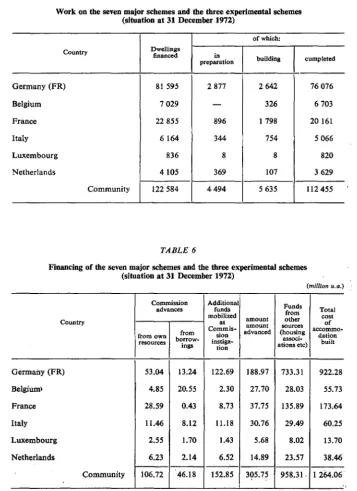
20. A recapitulation of the assistance given over the years down to 31 Decem-ber 1972 to the building of houses for workers in the ECSC industries shows~
that in all 122 584 dwellings had been part-financed by that date under the three experimental schemes and the seven major loan-aided schemes, 60%
en Situation at:
0
0
>
31-1-1956....
:Jl
m
:v 31-1-19$1
-"'
... 31-1-1958
N
31-1-1959
31-1-1960
31-1-1961
31-1-1962
31-1-1963
31-1-1964
31-l-196S
31-1-1966
31-1-1967
31-12-1967
31-12-1968
31-12-1969
31-12-1970
31-12-1971
w 31-12-1972
u.
.
-Graph
ECSC subsidized housing financed and completed
iJ
Dwellings financed~ Dwellings completed
B
= 2 ooo unitsTABLE 5
Work on the seven major schemes and the three experimental schemes (situation at 31 December 1972)
of which:
Country Dwellings financed in
preparation building cumpletcd
Germany (FR) 81 595 2 877 2 642 76076
Belgium 7029
-
326 6 703France 22 855 896 1 798 20 161
Italy 6 164 344 754 5 066
Luxembourg 836 8 8 820
Netherlands 4105 369 107 3 629
Community 122 584 4494 5 635 112 455
TABLE 6
Financing of the seven major schemes and the three experimental schemes (situation at 31 December 1972)
(million u.a.)
Commission Additional Funds
advances funds Total
mobilized from cost
Country at amount amount sources other of
from Commis- advanced (housing accommo ..
from own sion dation
borrow- instiga- associ- built
resources ings ations etc)
tion
Germaily (FR) 53.04 13.24 122.69 188.97 733.31 922.28
Belgium1 4.85 20.55 2.30 27.70 28.03 55.73
France 28.59 0.43 8.73 37.75 135.89 173.64
Italy 11.46 8.12 11.18 30.76 29.49 60.25
Luxembourg 2.55 1.70 1.43 5.68 8.02 13.70
Netherlands 6.23 2.14 6.52 14.89 23.57 38.46
[image:33.450.52.409.66.556.2] [image:33.450.47.400.70.275.2]of them for renting and 40% for owner-oecupation. Dwellings completed totalled 112 455.1
Scheme VII is on the way to being completed, with a first tranche initially totalling 10' million u.a. from the special reserve of the 1971-1972 budget.2
On top of the 2 million u.a.3 which could be earmarked in the 1971 budget, 1 million u.a. was added to the 1972 ESCC operational budget, bringing the total appropriation for the budgeting years 1971 and 1972 to 13 million u.a. The additional sums were used on a priority basis for the housing of migrant workers and of steelworkers at coastal plants. In all this first instalment will have made it possible to contribute to the financing of about 9 000 dwellings and 3 800 beds in hostels for workers living on their own.
On 22 December 1972 the Commission, desirous of advancing its policy to promote housing in accordance with the Paris Treaty, decided to allocate, for the enlarged Community, a total of 20 million u.a. for the second instal-ment (1973-1974) from the ECSC operational budgets for the same years. This sum is intended to help build housing for steelworkers at coastal plants, in connection with the ECSC restructuration scheme, for migrant workers, and for the purpose of modernizing existing dwellings.
21. As regards accommodation for migrant workers, the. Commission has gathered information from the Governments on the progress the Member States have made in implementing the Commission's recommendation on housing for workers and their families moving within the Community.4 This
information made it possible to draw up and distribute a third report, covering the period from
i
January 1969 to 31 December 1970.WELFARE AND FAMILY METIERS
22.
The Commission's · efforts concerning the welfare activities of the six countries have borne mainly on the reception service provided for migrant workers and their families, and on the promotion of their well-being. Among the numerous problems in this field, that of schooling for the children of migrant workers turned out to be of prime importance. A meeting on this subject was organized at Naples on. 27 and 30 November, It was attended by about forty social workers and teachers from the six countries and )::ly regional1 See Table
5 and 6 and the graph. ·
2 Third General Report, sec. 347; Fourth General Report, sec. 148; Fifth General Report
sec. 247. ' ·
delegates responsible for social questions in those regions of Italy which are most affected by emigration. The action taken by the Member States to follow up the Commission's recommendation on welfare activities for the benefit of migrant workers1 is described in a fourth report2 dealing with the
years 1969 and 1970.
The social problems of old people also received the necessary attention from the Commission, which prepared a general study on the subject establish-ing the lines along which action should be taken. Furthermore, in connection with the surveys and studies made by the Commission on working conditions for women, discussions took place with trade unions and women's and family organizations concerning the sort of social facilities required (creches, kinder-gartens, etc.) to cater for children whose mothers are gainfully employed out-side the home.
COMMON HEALTH AND SAFETY POLICY
Handicapped persons
23. A semilar on vocational training for the handicapped was held at Heidel-berg from 5 to I 0 June I 972.3 Furthermore, the working party set up to prepare
a long-term Community programme,4 submitted an interim report in which it analyses the experiences acquired in finding points of departure for rehabilita-tion and the acrehabilita-tion leading to them. This report, which has been sent to the Council by the Commission, contains the basic elements for immediate imple-mentation of plans for occupational rehabilitation and for the best use of the handicapped in a free market economy. A documentary account of the results of research encouraged by the ECSC has been prepared,4 and these results will be discussed in April 1973 at the study sessions on "the traumatology of work: basis for the retraining of accident· victims".
Industrial medicine
24. The research programme on chronic respiratory disease5 is going forward
as planned. All the working parties are active (epidemiology, respiratory
1 Recommendation of 23 July 1962 (OJ No. 75, 16 August 1962).
:l Doc. V/338/71.
3 This is one of the three meetings referred to in sec. 9. 4 Fifth General Report, sec. 249.