This is a repository copy of Pruning and prioritising: a case study of a pragmatic method
for managing a rapid systematic review with limited resources.
White Rose Research Online URL for this paper:
http://eprints.whiterose.ac.uk/97286/
Version: Accepted Version
Article:
Harnan, S.E., Cooper, K., Jones, S.L. et al. (1 more author) (2015) Pruning and prioritising:
a case study of a pragmatic method for managing a rapid systematic review with limited
resources. Evidence and Policy, 11 (4). pp. 589-601. ISSN 1744-2648
https://doi.org/10.1332/174426414X14199471271588
This is a post-peer-review, pre-copy edited version of an article published in Evidence and
Policy. The definitive publisher-authenticated version Harnan, Sue Elizabeth, et al.
"Pruning and prioritising: a case study of a pragmatic method for managing a rapid
systematic review with limited resources." Evidence & Policy: A Journal of Research,
Debate and Practice 11.4 (2015): 589-601. is available online at:
https://dx.doi.org/10.1332/174426414X14199471271588
[email protected] https://eprints.whiterose.ac.uk/ Reuse
Unless indicated otherwise, fulltext items are protected by copyright with all rights reserved. The copyright exception in section 29 of the Copyright, Designs and Patents Act 1988 allows the making of a single copy solely for the purpose of non-commercial research or private study within the limits of fair dealing. The publisher or other rights-holder may allow further reproduction and re-use of this version - refer to the White Rose Research Online record for this item. Where records identify the publisher as the copyright holder, users can verify any specific terms of use on the publisher’s website.
Takedown
If you consider content in White Rose Research Online to be in breach of UK law, please notify us by
Pruning and prioritising: a case study of a pragmatic method for managing a rapid systematic review with limited resources
Sue Harnana, Katy Coopera, Sarah Lynne Jonesb, Elaine Jonesb
a
University of Sheffield, UK; bBritish Wheel of Yoga
Abstract
Full systematic reviews are time and resource heavy. We describe a method successfully used to
produce a rapid review of yoga for health and wellbeing, with limited resources, using mapping
methods. Inclusion and exclusion criteria were developed a priori and refined post hoc, with the
review team blind to the study results to minimise the introduction of bias. This method allowed the
review to be tailored to make use of the best available evidence and the health topics of most
relevance to the commissioners, and to enable the evidence base to be disseminated to practitioners in
a timely fashion.
Introduction
Well-conducted systematic reviews are a cornerstone of evidence based medicine and are used to
inform policy and practice. The scientific rigour of the process can, at times, be at odds with the needs
of the commissioners in terms of time, resources and political input (Rotstein and Laupacis 2004).
This tension between rigour and relevance has led to the development of different approaches which
reduce both the budget and the time needed to complete a review. Some such reviews are termed “rapid reviews” and employ systematic review methods, but diverge from standard methodologies in one or more stages of the review process. This may include using only one reviewer, reducing the
number of databases searched, not performing quality assessment of studies, or using less
comprehensive approaches to data extraction and synthesis (Ganann et al. 2010; Harker and Kleijnen
2012).
Any divergence from full systematic review methodologies comes at a price in terms of quality and
robustness. For example, using only a single author can introduce errors in data extraction and study
selection, whilst not performing quality assessment can lead to important issues of bias and quality in
the evidence base being missed. As such, methods should be tailored to minimise the impact on the
reliability of the results in light of the research question being answered. For example, if the rapid
synthesis of the results may not be as important as data extraction of study variables that enable a
detailed gap analysis.
Alongside rapid reviews, other review types that employ systematic methods include mapping
reviews and scoping reviews. The definitions of these three vary across the literature (Grant and
Booth 2009) and the terms are often used interchangeably. Indeed a recent scoping review of scoping
review methodologies included both mapping and scoping reviews (Pham et al. 2014). Both tend to
address broad topic areas, aim to identify gaps in the evidence, facilitate the definition of topics and
subtopics where a full systematic review is both viable and useful, and gauge the time and resources
needed to complete these reviews (Grant & Booth 2009). Pham et al. quantified certain characteristics
amongst the reviews they included: electronic literature searches were usual, though additional search
methods were not; study selection criteria could be very broad, including most study and publication
types, but selection was rarely checked by another reviewer; quality assessment was not usual;
presentation was usually tabular, with less than a third presenting graphical results; and narrative
summaries were presented, but meta-analyses were never done (Pham 2014). One key concept that
separates the two review types is that scoping reviews may also include a summary of research
findings and a consultation exercise (Arksey and O'Malley 2005), which rarely if ever appears in
descriptions of mapping reviews.
In the normal scheme of a systematic review, mapping and scoping methodologies are used as well as
clinical and political inputs to define the research question and scope. One key feature of systematic
reviews is the a priori statement of the research question and methods in the study protocol, so these
processes usually occur before the protocol is written. This minimises the potential for bias to be
introduced either intentionally or unwittingly. Post hoc amendments to reviews (amendments made
after the study has commenced) are generally thought acceptable where a legitimate reason is given
for the change (Centre for Reviews and Dissemination 2009). And it could be argued that the point at
which the change is made also impacts the potential for any such amendments to introduce bias. For
example, a change in the analysis plan to include an additional analysis, made in response to
impressions about the availability of evidence formed by reviewers during initial study selection (e.g.
which outcome measure has been used most by researchers) may seem less problematic than a change
made after the primary analysis has been performed. At the study selection stage where abstracts are
consulted, the reviewer is unlikely to be forming a reliable impression of the direction of the evidence,
especially where more than one outcome is being reviewed. However if an analysis is only planned
and performed after the a priori analysis results are known, it could be that this was done in response
to unfavourable or undesirable results in the original analysis in an attempt to mitigate any negative
As reported in Harker and Kleijnen (2012), 47% of the rapid reviews they considered did not have a
clear research or clinical question, which may indicate that little or no scoping had been performed by
the commissioners of the review. When funding and time for scoping are limited, and where a
question or topic is broad, it can be difficult to see clearly where available research best lends itself to
evidence review and synthesis, and where the information needs of the commissioners might best be
met. Whilst adaptations to systematic review methodologies to date have mainly focussed on
economies in individual components of the methods used, there are some examples where economies
are made across the whole review process, from scoping to completion, by selecting a different
methodology for the review. Examples include the “two-stage review” process described in the EPPI
Centre’s methods guidelines (Anon 2010), a very similar method described in Gough et al.’s book
(Gough et al. 2012) and the methods for “rapid evidence assessments” described by the UK
government’s Social Research Service (Civil Service 2013). In the EPPI Centre method, studies are mapped according to well defined codes and the scope of the review narrowed with regard to the
results of the map. Scoping and reviewing are performed from a single iteration of searching and
sifting to select appropriate literature. In the latter example (Civil Service 2013), narrowing of the
review focus may take place once synthesis of study results has commenced. In this case study, we
describe and discuss the strengths and weaknesses of a novel approach to shortening the timescales of
a review from scoping to completion by conducting scoping/ mapping and reviewing in a three-phase
process necessitating only a single iteration of searching and sifting.
The project
Our research team was commissioned by British Wheel of Yoga (BWY) in 2010 to produce an
evidence summary that aimed to draw together research evidence relating to yoga in adults aged 18 to
65 years , in a broad range of common health conditions in a single resource. No limits were specified
as to which health conditions to include, or which study types to focus on, though only the previous
10 years were to be searched. The output was to be suitable for a health professional and
non-health-professional audience.
The commissioners required the report to be limited to approximately 40 studies in order that the
report be concise for readability and to fit within their own budgetary constraints; a total of 33 days
spread over several months (if necessary) were funded by the commissioners. The problem for the
review team was how to deliver these requirements within the budget and time limits but without
knowing the scope of the literature, without introducing bias, and whilst maintaining a broad scope to
Methodological innovation within the review
The research report was to be based on the methods described by Wilkinson et al (2008) in that a set
of initial inclusion and exclusion criteria would be applied to retrieved titles and abstracts, and the
review team would then work with experts (who were also the commissioners) to refine the set of
studies for inclusion. This constitutes a post hoc amendment to the selection criteria as set out in the
study protocol. Bias could be introduced in that criteria could be altered so that their application
resulted in the exclusion of studies reporting negative results, and thus bias the overall evidence base
towards positive results. This could occur intentionally, or unintentionally.
We sought to reduce the potential for the introduction of such bias and sought to formalise the process
of article selection to increase transparency and reproducibility, so that readers could judge for
themselves whether the process and resulting criteria were likely to introduce bias. We formalised the
process by mapping the available literature in two stages during the review. We were then able to
tailor the focus of the review to the topics where there was available evidence and which were of most
interest to the commissioners, whilst keeping within the limited resources and timescales. We sought
to minimise the introduction of bias when refining the selection criteria by defining key selection
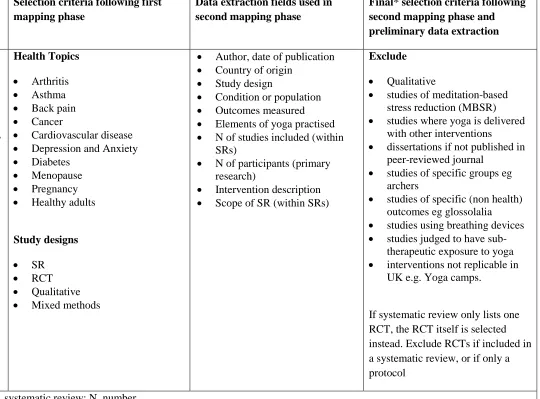
criteria a priori (Table 1) in the protocol, as described in Wilkinson et al. (2008), and purposefully not
extracting the results of studies during the mapping stage, in an attempt to blind those involved in
refining criteria to the direction of effect. The process we undertook can be broken down in to a
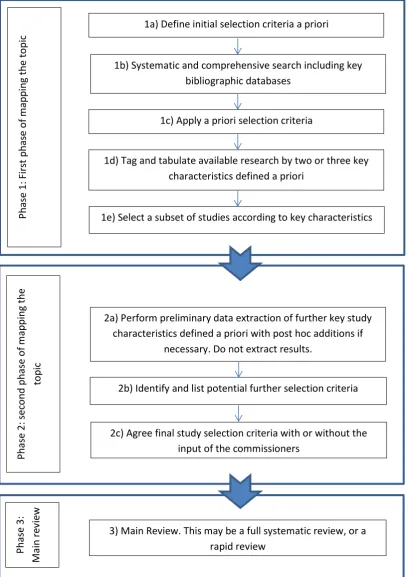
three-phase process as follows (see Figure 1):
Phase 1: First phase of mapping the topic
1a) Initial selection criteria were defined with input from the commissioners (Table 1)
1b) A broad, systematic and comprehensive search of the topic was performed
1c) Studies were selected according to the initial selection criteria (Table 1).
1d) Studies selected were tagged in the reference management software according to key
characteristics (kept to a minimum to avoid unnecessary work) ascertained from the title or
abstract. In this case study, this included only the health topic (e.g. asthma, cancer, arthritis
etc.) and the study design (e.g. systematic review, randomised controlled trial [RCT] etc.). A
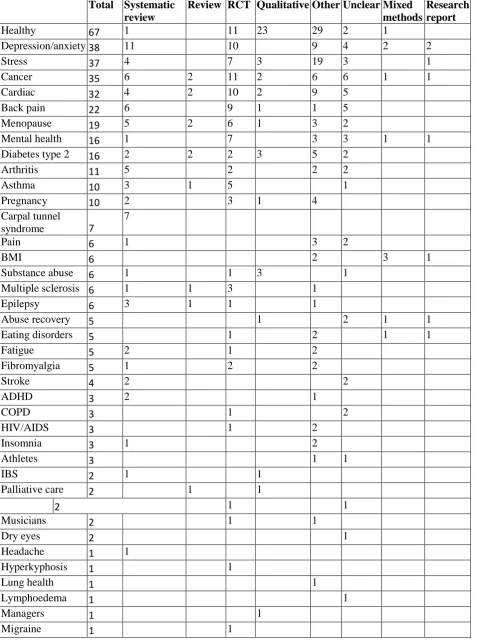
matrix of the studies by the key characteristics was constructed to provide an overview of the
literature (Table 2).
1e) The review team and commissioners chose key characteristics as selection criteria to select
health topics of greatest relevance to the commissioners and where there was evidence, and
the study designs of highest quality according to the hierarchy of evidence (National Institute
for Health and Clinical Excellence 2012). The characteristics that were selected are listed in
Table 1.
Phase 2: Second phase of mapping the topic
2a) A preliminary data extraction was carried out in which key study characteristics were
extracted from included abstracts (or full text where necessary). Crucially, study results were
not extracted so that users were blind to the direction of effect (within the confines of the data
extraction database). The fields that were extracted in this case study are listed in Table 1.
2b) A list of potential further selection criteria were developed by the review team with reference
to the preliminary data extraction and presented for discussion to the commissioners. The list
of potential selection criteria for this case study are listed in Table 1.
2c The commissioners and the review team discussed and selected the inclusion criteria that both
improved relevance to the commissioners, and resulted in the review remaining within
resource constraints. The list of final selection criteria for this case study are listed in Table 1.
Phase 3: Main review (rapid or systematic)
3a) In this case study, we performed a rapid review. The rapid review was “rapid” in that study
selection and data extraction were conducted by one reviewer, and formal data synthesis was
not performed. The preliminary data extraction was expanded into full data extraction to
minimise duplication of effort. However, it should also be possible to conduct a full
systematic review with any form of synthesis (e.g. narrative, meta-analysis).
3b) The main output was a report to the commissioners which comprised structured abstracts for
each study, with a commentary on study quality and conclusions. A further important output
of this particular review was a set of research recommendations, and identification of gaps in
the literature.
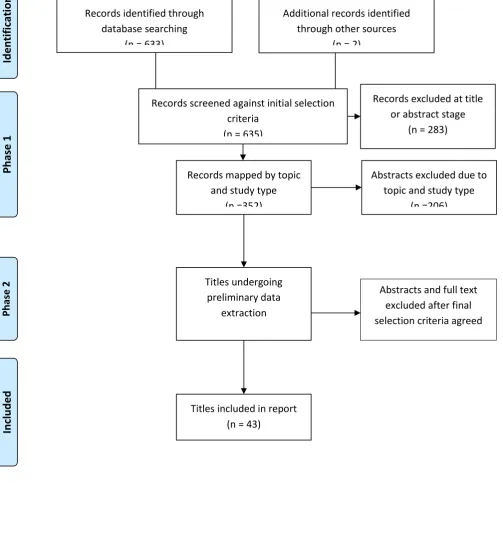
The flow of studies through the review is represented in a modified PRISMA diagram in Figure 2.
Discussion
In this case study, we have described a pragmatic method for managing a review within limited
resources, by incorporating the mapping/scoping stage of a review within the review process, and
introduction of bias. Mapping the review comprised two phases – one to map two key characteristics
of the literature (in this case, health condition and study type) and narrow the potential includable
studies according to the interests of the commissioners and availability of high quality evidence, and a
further phase to data extract details about additional key characteristics of the studies and further
refine the selection criteria.
As discussed in the introduction, any deviation from standard systematic review methods has the
potential to impact on the quality of the results and the impartiality of the analysis and interpretation
of the review. In comparison to other review methodologies that could have been employed for this
review, the method we have outlined here has both strengths and weaknesses. We have compared the
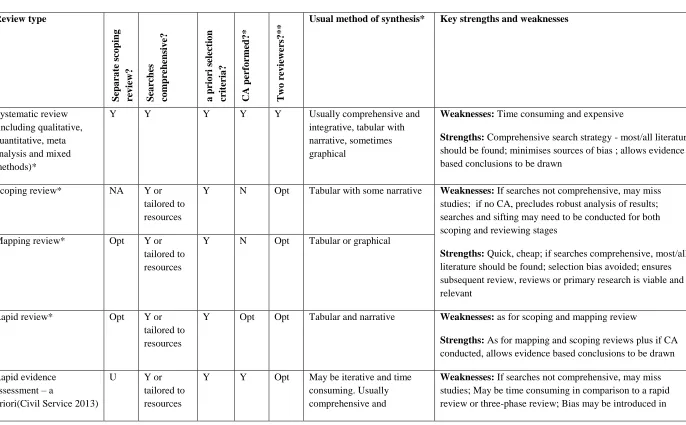
method against seven other review methodologies in Table 3. The key factors considered in this Table
include: whether a separate scoping review was first performed; whether comprehensive literature
searches were conducted; whether the selection criteria were designated a priori; whether critical
appraisal was conducted; whether two reviewers were involved in the review process; what type of
synthesis was performed. The final column in Table 3 lists some of the key strengths and weaknesses
of each method for easy comparison. As can be seen from this Table, each method entails its own
unique trade-off between rigour and relevance. At one end of the spectrum, we have systematic
reviews which can reach the highest standards of rigour, but are resource-heavy and as such can lack
relevance to the commissioners e.g. where they have inadequate funds. All other methods sit
somewhere below these high standards in no empirically determined order, or serve a somewhat
different objective, e.g. scoping reviews do not intend to be comprehensive.
In comparison to a full systematic review, our method sacrifices some of the rigour; the refinement of
some inclusion criteria was performed post hoc and could introduce bias. This sacrifices buys the
method greater relevance/utility to the commissioners, in that the review can be produced in a timely
fashion with minimal resource use and tailored to their interests. An alternative to this method would
have been to conduct a rapid review without the mapping phases. Rapid reviews tend to trade off
different aspects of rigour, for example, completeness of searching, or data extraction validation, to
achieve the same reduction in demand on resources. However, this would have necessitated a separate
scoping or mapping stage to narrow the review a priori. In this case study, a rapid review
methodology was employed to gain yet further economies, but more robust full systematic review
methods could have been employed in these later stages. The methods for writing the UK
government’s Social Research Service rapid evidence assessments (Civil Service 2013) are divided
into “a priori” reviews and “iterative” reviews on the basis of the detail in the protocol. Our method employs aspects of both the a priori and iterative approaches, but has the advantage over the iterative
approach of being predictable in terms of demands on resources, and the advantage over the “apriori”
approach of not involving narrowing of the review focus at the synthesis stage, where it could be
A similar process to our three-phase approach is described in the EPPI Centre’s methods guide (2010) and is termed a “two-stage” review, where studies are first coded according to key characteristics, and the scope narrowed on the basis of this map. Another very similar method is described in Gough et al.’s book (2012), where an initial map is used as the basis for discussion with commissioners in narrowing the review question. The method we describe here was developed independently, and
differs in some aspects. Rather than coding all key characteristics in all potentially includable studies,
we selected two key characteristics (health condition and study type) and used these to short-list
studies for further consideration, according to the interests of the commissioners and availability of
evidence. This equates roughly to the first stage described by the EPPI Centre. To then capture the
level of detail about studies as is achieved by the EPPI Centre method through their use of a “standard
and well defined set of keywords”, our method performs a preliminary data extraction on the remaining studies. This is likely to take longer than simply tagging studies. However, our approach
recoups some of this time in that a) we used only two tags per study, and completed the initial sift
very quickly, b) we did not have to invest time in the identification, definition and redefinition of a
standard set of keywords, but rather we generate these keywords inductively through the process of
data extraction and c) fewer studies are involved in this greater level of coding. In addition, the
flexibility of and detail captured during data extraction may reduce the chances of missing important
details that can be lost in abstraction when using pre-defined key word tags. And finally d) the time
spent on data extraction is in part recouped as this data extraction will be expanded into a full data
extraction for those studies that are eventually included in the review.
Both our approach and the EPPI Centre and Gough et al. approaches have differential demands on
resources, and reviewers should consider which methods to use with reference to the specifics of their
own review. For example, our approach may have advantages where the review team and
commissioners are new to the topic and do not have the required breadth of familiarity to identify and
code the heterogeneity of key study characteristics such as population, setting, outcomes and
intervention from the outset. Conversely, where commissioners or reviewers are highly familiar with
the field, coding data from the outset may represent an economy as studies will only have to be visited
once, and data extraction performed only on included studies. Our method may also be more useful
where there are initially a very large number of includable studies; in cases where the EPPI Centre
method would require coding of all these studies, and the number of codes is large, our approach
would allow an initial triaging of studies so that only those of most interest are considered in detail.
The method we have outlined here carries certain limitations, and will certainly not be a suitable
approach in all situations. However, when it is used carefully and appropriately it can offer a number
of advantages. We believe this method will be most useful where budgets are tight and contracts
impose restraints in terms of resources or timescales. It could be especially useful if a commissioner’s
strengths of the available research, balancing this against the utility of the finished review to the end
user, and the requirements of the commissioners. We expect that these types of conditions are most
likely to occur where reviews are commissioned by bodies with limited resources, such as charities, or
where the commissioners are interested in a broad topic, but are unsure where best to focus their
efforts, such as in policy units.
There are important limitations to this method and instances where its application would be
inappropriate. The unbiased choice of post hoc selection criteria relies on blinding to study results
being achieved by not extracting this data. However, this blinding could be subverted in cases where
those involved in choosing the selection criteria are already familiar with the literature, or refer to the
original journal articles when refining the selection criteria. This could lead to the conscious or
subconscious introduction of bias in the choice of selection criteria. This may be a particular problem
where commissioners have a vested interest in the results of the review, for example, pharmaceutical
manufacturers. Even in our case study this could have been problematic, though fortunately the
commissioners were not themselves familiar with the literature. Several practical considerations may
also determine whether this method will be appropriate. Where the scope of a review is clear and
focussed, such as for reviews of intervention A versus intervention B, this method would confer no
advantages and would be unnecessary. Where searches lead to very large numbers of citations being
retrieved and carried forward to the second phase of mapping the topic, there is a risk that many
studies will needlessly undergo preliminary data extraction, only to be later rejected. In this case, the
approach may still be useful, but instead of performing a preliminary data extraction on all studies, the
reviewers could use characteristics presented in existing reviews to help inform the choice of
inclusion and exclusion criteria, though this may unduly limit which characteristics are considered.
The resource implications of a review can be ascertained at protocol stage by running a search in one
key bibliographic database e.g. Medline, and methods selected appropriately. Finally, where
commissioners are not able or willing to contribute to the process, this method may still be viable if
the commissioners are happy for the review team to finalise the inclusion and exclusion criteria. In
this case, it may also be possible to substitute the commissioners with other independent reviewers.
Conclusion
All adaptations of the systematic review process involve a trade-off between quality and resource use,
both of which are aspects of rigour and relevance. Our research report for the BWY successfully used
post hoc refinement of inclusion and exclusion criteria to select studies for inclusion that we believe
avoided major bias and maintained a degree of scientific rigour comparable to other rapid review
methods. We were able to satisfy the requirements of the commissioners by producing a review with
high relevance to them and with a broad scope, whilst keeping within the budget and resource
three-phase approach has wider applications as a pragmatic method of mapping and reviewing the
literature within a limited timescale where the scope is broad or unknown.
Acknolwedgements
The authors would like to thank Dr Andrew Booth for guidance at the inception of the project, and
comments on the first draft of this manuscript.
Sponsorship
References
Eppi-Centre methods for conducting systematic reviews. 2010. Social Science Research Unit, Institute of Education, University of London. 25-2-2013.
Ref Type: Online Source
Arksey, H. & O'Malley, L. 2005. Scoping studies: towards a methodological framework. International
journal of social research methodology, 8, (1) 19-32
Centre for Reviews and Dissemination 2009, Systematic reviews. CRD's guidance for undertaking
reviews in healthcare, CRD, York.
Civil Service. Governement Social Research Service: How to do a REA. 2013. 25-2-2013. Ref Type: Online Source
Ganann, R., Ciliska, D., & Thomas, H. 2010. Expediting systematic reviews: methods and implications of rapid reviews. Implement.Sci, 5, 56 available from: PM:20642853
Gough, D., Oliver, S., & Thomas, J. 2012. An introduction to systematic reviews London, Sage.
Grant, M.J. & Booth, A. 2009. A typology of reviews: an analysis of 14 review types and associated methodologies. Health Info.Libr.J, 26, (2) 91-108 available from: PM:19490148
Harker, J. & Kleijnen, J. 2012. What is a rapid review? A methodological exploration of rapid reviews in Health Technology Assessments. Int J Evid.Based.Healthc., 10, (4) 397-410 available from:
PM:23173665
National Institute for Health and Clinical Excellence. Clinical guideline development methods. 2012. Nice,London.
Ref Type: Online Source
Pham, M.T., Raji-ç, A., Greig, J.D., Sargeant, J.M., Papadopoulos, A., & McEwen, S.A. 2014. A scoping review of scoping reviews: advancing the approach and enhancing the consistency. Research Synthesis Methods
Rotstein, D. & Laupacis, A. 2004. Differences between systematic reviews and health technology assessments: A trade-off between the ideals of scientific rigor and the realities of policy making.
International Journal of Technology Assessment in Health Care, 20, (2) 177-183
Wilkinson A, Papaioannou D, Keen C, Booth A. 2008. The role of the information specialist in supporting knowledge transfer: a public health information case study. Health Information &
Figure 1. Flow chart of the review methods
1a) Define initial selection criteria a priori
1b) Systematic and comprehensive search including key
bibliographic databases
1c) Apply a priori selection criteria
1d) Tag and tabulate available research by two or three key
characteristics defined a priori
1e) Select a subset of studies according to key characteristics
2a) Perform preliminary data extraction of further key study characteristics defined a priori with post hoc additions if
necessary. Do not extract results.
2b) Identify and list potential further selection criteria
2c) Agree final study selection criteria with or without the input of the commissioners
P h as e 1 : F ir st p h as e o f m ap p in g t h e to p ic P h as e 2 : se co n d p h as e o f m ap p in g t h e to p ic
Figure 2. Modified PRISMA flow diagram representing flow of studies through the review
Records identified through database searching
(n = 633)
P
h
a
se
1
In
cl
u
d
e
d
P
h
a
se
2
Id
e
n
ti
fi
ca
ti
o
n
Additional records identified through other sources
(n = 2)
Records screened against initial selection criteria
(n = 635)
Records excluded at title
or abstract stage (n = 283)
Records mapped by topic and study type
(n =352)
Abstracts excluded due to topic and study type
(n =206)
Titles included in report
(n = 43) Titles undergoing
preliminary data extraction
(n=146)
Table 1 Development of selection criteria.
Initial selection criteria Selection criteria following first mapping phase
Data extraction fields used in second mapping phase
Final* selection criteria following second mapping phase and preliminary data extraction
Population: Adults aged 18 to 65 years old.
Intervention: Any yoga intervention including yoga meditation, relaxation, postures and breathing techniques.
Comparator: Any.
Outcomes: Any health outcome.
Study design: Any. Excluded laboratory-based studies.
Health Topics
Arthritis
Asthma
Back pain
Cancer
Cardiovascular disease
Depression and Anxiety
Diabetes
Menopause
Pregnancy
Healthy adults
Study designs
SR
RCT
Qualitative
Mixed methods
Author, date of publication
Country of origin
Study design
Condition or population
Outcomes measured
Elements of yoga practised
N of studies included (within
SRs)
N of participants (primary
research)
Intervention description
Scope of SR (within SRs)
Exclude
Qualitative
studies of meditation-based
stress reduction (MBSR)
studies where yoga is delivered
with other interventions
dissertations if not published in
peer-reviewed journal
studies of specific groups eg
archers
studies of specific (non health)
outcomes eg glossolalia
studies using breathing devices
studies judged to have
sub-therapeutic exposure to yoga
interventions not replicable in
UK e.g. Yoga camps.
If systematic review only lists one RCT, the RCT itself is selected instead. Exclude RCTs if included in a systematic review, or if only a protocol
Table 2. First phase of mapping the topic. Matrix number of studies of each study design, by health topic. Note: some studies appear in more than one category.
Total Systematic review
Review RCT Qualitative Other Unclear Mixed methods
Research report
Healthy 67 1 11 23 29 2 1
Depression/anxiety 38 11 10 9 4 2 2
Stress 37 4 7 3 19 3 1
Cancer 35 6 2 11 2 6 6 1 1
Cardiac 32 4 2 10 2 9 5
Back pain 22 6 9 1 1 5
Menopause 19 5 2 6 1 3 2
Mental health 16 1 7 3 3 1 1
Diabetes type 2 16 2 2 2 3 5 2
Arthritis 11 5 2 2 2
Asthma 10 3 1 5 1
Pregnancy 10 2 3 1 4
Carpal tunnel
syndrome 7
7
Pain 6 1 3 2
BMI 6 2 3 1
Substance abuse 6 1 1 3 1
Multiple sclerosis 6 1 1 3 1
Epilepsy 6 3 1 1 1
Abuse recovery 5 1 2 1 1
Eating disorders 5 1 2 1 1
Fatigue 5 2 1 2
Fibromyalgia 5 1 2 2
Stroke 4 2 2
ADHD 3 2 1
COPD 3 1 2
HIV/AIDS 3 1 2
Insomnia 3 1 2
Athletes 3 1 1
IBS 2 1 1
Palliative care 2 1 1
2 1 1
Musicians 2 1 1
Dry eyes 2 1
Headache 1 1
Hyperkyphosis 1 1
Lung health 1 1
Lymphoedema 1 1
Managers 1 1
Musculoskeletal 1 3
Osteoporosis 1 1
Pancreatitis 1 1
Piriformitis 1 1
Post partum 1 1
Preterm labour 1 1
Prisoners 1 1
PTSD 1 1
Sexual function 1 1
Smoking cessation 1 1 (ongoing)
Trauma 1 1
Table 3. Comparison of review methodologies. Scores indicate a generalisation, and there may be exceptions in all cases. Review type Sepa ra te sco pin g re v iew? Sea rc hes co mp re hen siv e? a prio ri selec tio n cr it er ia ? CA perf o rmed? * T wo re v iewe rs? * *
Usual method of synthesis* Key strengths and weaknesses
Systematic review (including qualitative, quantitative, meta analysis and mixed methods)*
Y Y Y Y Y Usually comprehensive and
integrative, tabular with narrative, sometimes graphical
Weaknesses: Time consuming and expensive
Strengths: Comprehensive search strategy - most/all literature
should be found; minimises sources of bias ; allows evidence based conclusions to be drawn
Scoping review* NA Y or tailored to resources
Y N Opt Tabular with some narrative Weaknesses: If searches not comprehensive, may miss
studies; if no CA, precludes robust analysis of results; searches and sifting may need to be conducted for both scoping and reviewing stages
Strengths: Quick, cheap; if searches comprehensive, most/all
literature should be found; selection bias avoided; ensures subsequent review, reviews or primary research is viable and relevant
Mapping review* Opt Y or tailored to resources
Y N Opt Tabular or graphical
Rapid review* Opt Y or tailored to resources
Y Opt Opt Tabular and narrative Weaknesses: as for scoping and mapping review
Strengths: As for mapping and scoping reviews plus if CA
conducted, allows evidence based conclusions to be drawn
Rapid evidence assessment – a
priori(Civil Service 2013)
U Y or tailored to resources
Y Y Opt May be iterative and time consuming. Usually comprehensive and
Weaknesses: If searches not comprehensive, may miss
Review type Sepa ra te sco pin g re v iew? Sea rc hes co mp re hen siv e? a prio ri selec tio n cr it er ia ? CA perf o rmed? * T wo re v iewe rs? * *
Usual method of synthesis* Key strengths and weaknesses
Rapid evidence assessment –
iterative(Civil Service 2013)
U Y or tailored to resources
Opt Y Opt integrative. May be tabular and/or narrative
iterative processes at any stage in review, including synthesis.
Strengths: If searches comprehensive, most/all literature
should be found; Iterative synthesis allows focus to be tailored according to availability of evidence and areas of most interest
EPPI Centre two-stage review( 2010)
N Y Partial Y Y Usually comprehensive and integrative, tabular with narrative
Weaknesses: May be time consuming in comparison to a
rapid review or three-phase review
Strengths: Comprehensive search strategy - most/all literature
should be found; Removes need for separate scoping stage to save time and resources; Ensures review focus is viable and relevant
Three-phase review N Y or tailored to resources
Partial Opt Opt Any of the above Weaknesses: As for mapping, scoping and rapid reviews, plus
bias may be introduced in focussing selection criteria
Strengths: As for rapid reviews, plus: Removes need for
separate scoping stage to save time and resources; Ensures review focus is viable and relevant; Only one search and sift required across scoping and reviewing stages; Subsequent review phase can be rapid or comprehensive, according to the resources available
* some definitions adapted from Grant and Booth (2009)
** to check or independently perform sifting, data extraction and/or CA